RLOO Guide: Critic-Free Online RLHF Alignment for LLMs
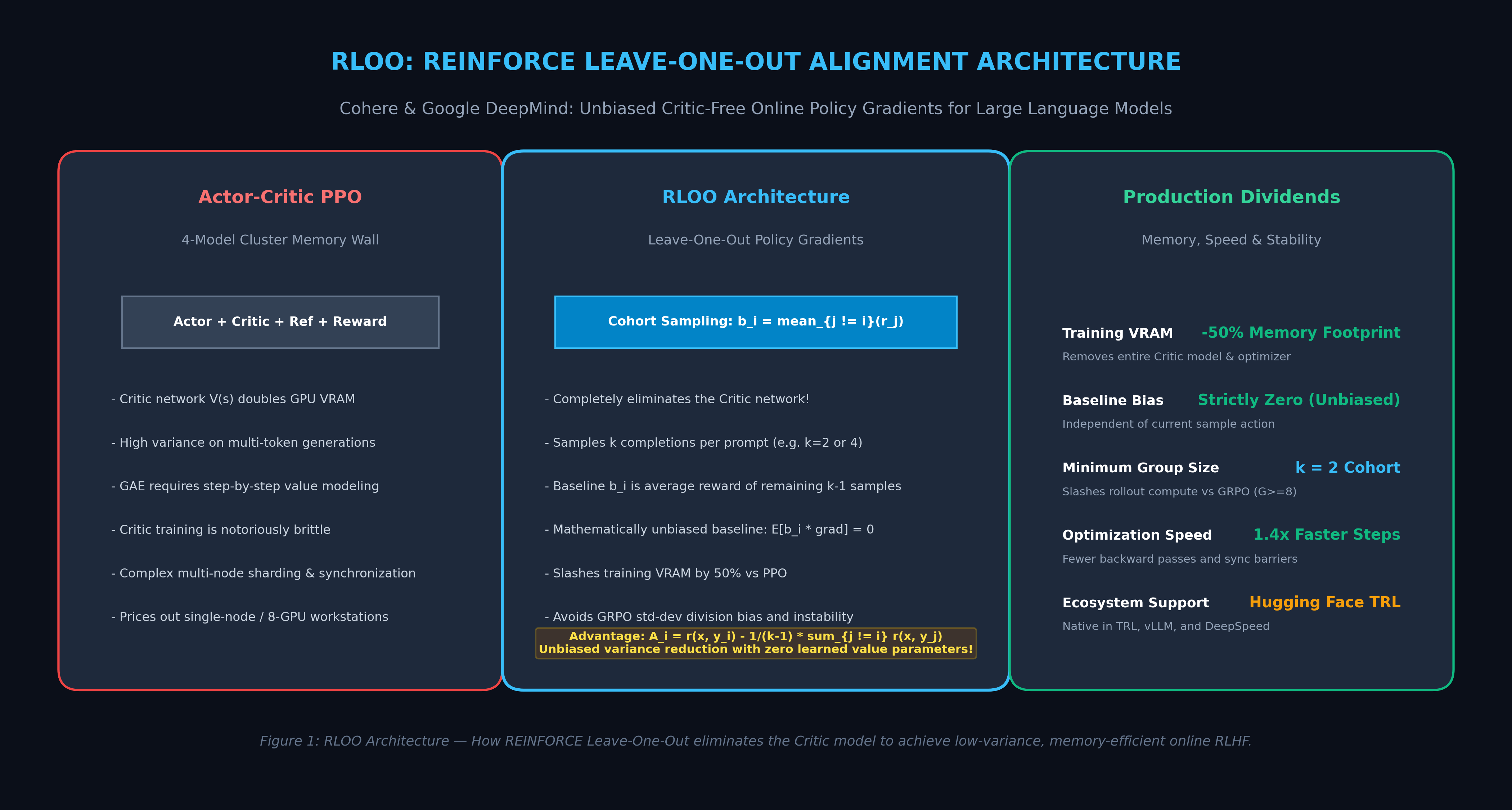
The Problem: The Actor-Critic Memory Tax and Instability of PPO
In enterprise generative AI applications, autonomous agents, and structured document extraction systems like AiFetchly, post-training alignment is the defining bridge between raw foundation models and dependable software systems. Aligning Large Language Models (LLMs) ensures that models follow complex schemas, avoid toxic confabulations, and adhere to nuanced enterprise policies.
For years, the gold standard for online alignment has been Reinforcement Learning from Human Feedback (RLHF) using Proximal Policy Optimization (PPO) (Schulman et al., 2017).
However, when engineering teams deploy PPO on modern foundation models (7B, 14B, 32B, or 70B parameters), they encounter severe hardware and algorithmic barriers:
The Four-Model Memory Tax of Actor-Critic PPO:
┌────────────────────────────────────────────────────────┐
│ GPU High-Bandwidth Memory (HBM) Allocation             │
├──────────────────────────┬─────────────────────────────┤
│ Model Role               │ Hardware Footprint          │
├──────────────────────────┼─────────────────────────────┤
│ 1. Actor Policy (π_θ)    │ 100% Base VRAM (Active SFT) │
│ 2. Critic Value Net (V_ψ)│ +100% VRAM (Same size!)     │
│ 3. Reference Model (π_ref) +100% VRAM (Frozen Base)    │
│ 4. Reward Model (r_φ)    │ +100% VRAM (Scoring Model)  │
└──────────────────────────┴─────────────────────────────┘
Total Footprint: Up to 400% of single-model parameters in VRAM! 1. The Value Critic Memory Explosion
In standard PPO, estimating Generalized Advantage Estimation (GAE) requires a dedicated Critic (Value) model $V_\psi(s_t)$. The Critic predicts the expected cumulative return from every intermediate token state.
Because estimating values across complex language tokens requires deep semantic comprehension, the Critic network must be roughly the same parameter size as the Actor policy:
- For a 70B Actor model, the Critic must also be a 70B parameter model.
- Storing the Critic’s model weights, AdamW optimizer momentum buffers, and intermediate backward activation graphs consumes over $50%$ of the active training cluster’s High-Bandwidth Memory (HBM).
- Organizations are forced to provision massive, expensive multi-node GPU clusters (e.g., 16x to 32x H100 GPUs) simply to hold the Critic network, pricing out smaller teams and local workstations.
2. High Value Variance on Long Sequence Trajectories
Beyond physical memory constraints, training a Critic network on autoregressive text generation is notoriously unstable:
- Token-Level Credit Assignment Noise: Natural language rewards are typically sparse and delayed—assigned only to the complete sequence $y$. Forcing a neural network to predict a fine-grained scalar value $V(s_t)$ for every single token introduces enormous variance.
- Drifting Value Targets: As the Actor policy $\pi_\theta$ updates, the state distribution shifts rapidly, making the Critic’s historical value estimates obsolete. If the Critic makes noisy or biased value predictions, it propagates corrupted advantage signals:
$$\hat{A}t = \delta_t + (\gamma \lambda) \delta{t+1} + \dots$$
Where $\delta_t = r_t + \gamma V(s_{t+1}) - V(s_t)$. A misestimated baseline destabilizes the policy gradients, triggering sudden entropy collapse or performance degradation.
3. The Limits of Offline Preference Optimization (DPO, KTO, SimPO)
To bypass the Critic, the community adopted offline preference algorithms like Direct Preference Optimization (DPO) and SimPO. While offline methods eliminate the Critic, they suffer from a fundamental drawback: they are entirely offline.
- Offline algorithms can only learn from pre-collected, static preference datasets $(x, y_w, y_l)$.
- The model cannot explore beyond the offline data distribution, discover novel reasoning paths, or adapt dynamically through live environment feedback.
AI systems needed an online reinforcement learning architecture: Can we run true online policy gradient exploration without training a Critic model?
The Architecture: RLOO (REINFORCE Leave-One-Out)
To resolve the Actor-Critic memory crisis while maintaining the benefits of online exploration, researchers from Cohere and Google DeepMind introduced RLOO (REINFORCE Leave-One-Out) (Ahmadian et al., 2024 / EMNLP 2024).
RLOO returns to the foundational roots of policy gradient theory (Williams, 1992 REINFORCE). It proves that a learned Critic model is completely unnecessary if we compute a dynamic, sample-based baseline across a cohort of completions.
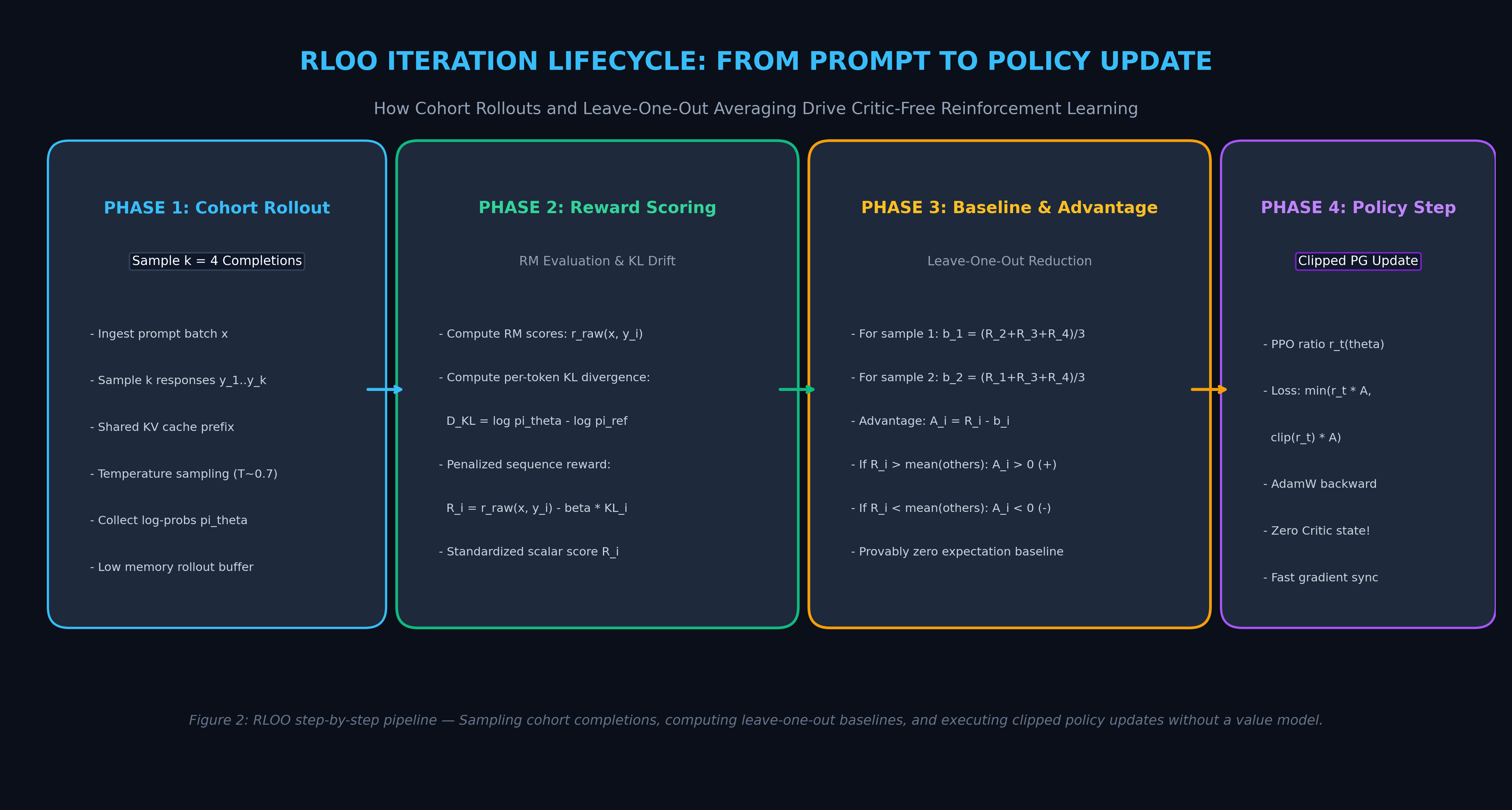
The RLOO Core Mechanism:
Prompt x ──► Policy π_θ samples k completions: {y_1, y_2, y_3, y_4}
             │
             ├──► Score each completion with Reward Model: {R_1, R_2, R_3, R_4}
             │
             ├──► Leave-One-Out Baseline for y_1: b_1 = (R_2 + R_3 + R_4) / 3
             ├──► Leave-One-Out Baseline for y_2: b_2 = (R_1 + R_3 + R_4) / 3
             ├──► Leave-One-Out Baseline for y_3: b_3 = (R_1 + R_2 + R_4) / 3
             └──► Leave-One-Out Baseline for y_4: b_4 = (R_1 + R_2 + R_3) / 3
             │
             ▼
Advantage A_i = R_i - b_i  (Unbiased & Low-Variance!)
Policy Gradient Update on π_θ without ANY Critic Network! 1. Mathematical Formulation of the RLOO Baseline
In classic policy gradients, the gradient of the expected reward is given by:
$$\nabla_\theta \mathcal{J}(\theta) = \mathbb{E}{x \sim \mathcal{D}, y \sim \pi\theta(\cdot \mid x)} \left[ \nabla_\theta \log \pi_\theta(y \mid x) \cdot (R(x, y) - b(x)) \right]$$
Where $b(x)$ is a baseline function. As long as $b(x)$ is conditionally independent of the specific action $y$ given prompt $x$, the expected baseline gradient is strictly zero:
$$\mathbb{E}{y \sim \pi\theta} \left[ \nabla_\theta \log \pi_\theta(y \mid x) \cdot b(x) \right] = b(x) \sum_y \nabla_\theta \pi_\theta(y \mid x) = b(x) \nabla_\theta (1) = 0$$
Therefore, subtracting $b(x)$ reduces gradient variance without introducing any mathematical bias.
2. The Leave-One-Out Averaging Rule
In RLOO, for each prompt $x$, the policy samples $k$ independent completions ($k \ge 2$, typically $k = 4$):
$$y_1, y_2, \dots, y_k \sim \pi_\theta(\cdot \mid x)$$
Each completion receives a sequence-level reward score $R_i = R(x, y_i) - \beta D_{\text{KL}}(\pi_\theta(y_i \mid x) \parallel \pi_{\text{ref}}(y_i \mid x))$.
For each sample $i \in {1, \dots, k}$, RLOO defines the baseline $b_i$ as the arithmetic mean of the rewards of all other $k - 1$ samples in the cohort:
$$b_i = \frac{1}{k - 1} \sum_{j \ne i} R_j$$
The advantage for sample $i$ is simply:
$$\hat{A}i = R_i - b_i = R_i - \frac{1}{k - 1} \sum{j \ne i} R_j$$
Notice the elegant mathematical symmetry:
- If $R_i > \text{mean}(R_{j \ne i})$: Completion $y_i$ was better than the cohort average; $\hat{A}_i > 0$, reinforcing the tokens in $y_i$.
- If $R_i < \text{mean}(R_{j \ne i})$: Completion $y_i$ was worse than the cohort average; $\hat{A}_i < 0$, penalizing the tokens in $y_i$.
- Independent & Unbiased: Because $y_i$ was excluded from its own baseline calculation, $b_i$ is independent of $y_i$, guaranteeing zero estimation bias.
Comparing Post-Training Alignment Architectures:
+-------------------+---------------+-------------------+--------------------+--------------------+
| Algorithm         | Alignment Mode| Critic Required?  | Baseline Bias      | Minimum Group Size |
+-------------------+---------------+-------------------+--------------------+--------------------+
| PPO (Actor-Critic)| Online RL     | YES (Doubles VRAM)| Biased (Learned V) | 1 completion       |
| DPO / SimPO       | Offline Pairs | NO                | Not Applicable     | N/A (Static Pairs) |
| GRPO (DeepSeek)   | Online RL     | NO                | Biased (Std-dev)   | k = 8 to 16        |
| RLOO (Cohere/DM)  | Online RL     | NO (50% VRAM cut) | ZERO (Unbiased)    | k = 2 to 4         |
+-------------------+---------------+-------------------+--------------------+--------------------+ Deep Dive: RLOO vs. GRPO and Actor-Critic PPO
While both RLOO and DeepSeek’s Group Relative Policy Optimization (GRPO) eliminate the Critic network, their mathematical formulations have distinct trade-offs.
1. Why RLOO Avoids GRPO’s Normalization Bias
GRPO calculates the advantage of candidate $i$ by standardizing rewards across the entire group $G$:
$$\hat{A}_{i, \text{GRPO}} = \frac{R_i - \text{mean}(R)}{\text{std}(R)}$$
While effective for mathematical reasoning tasks with binary 0/1 rule verification, dividing by the sample standard deviation introduces statistical bias:
- Sample Variance Distortion: With small cohort sizes (e.g., $k = 2$ or $4$), the sample standard deviation $\text{std}(R)$ is noisy and skewed.
- Degenerate Variance (Zero Division): If all sampled completions receive identical rewards (e.g., all 4 solutions are correct or all 4 fail), $\text{std}(R) = 0$, causing numerical instability.
- Group Size Requirement: GRPO typically requires sampling large groups ($k = 8, 16, \text{or } 32$ completions) to stabilize variance estimation, substantially inflating generation FLOPs during rollouts.
In contrast, RLOO uses an unnormalized difference:
- It requires no standard deviation calculation, completely eliminating zero-division failures.
- It operates with high stability on minimal cohorts ($k = 2$ or $k = 4$), slashing inference rollout compute by up to $75%$ compared to GRPO.
2. The Per-Token KL Divergence Penalty
To prevent the policy $\pi_\theta$ from collapsing or drifting away from natural language fluency, RLOO applies a token-level Kullback-Leibler (KL) divergence penalty against a frozen reference model $\pi_{\text{ref}}$:
$$\mathbb{D}{\text{KL}}(\pi\theta \parallel \pi_{\text{ref}}) = \sum_{t=1}^{|y|} \left( \log \pi_\theta(y_t \mid x, y_{<t}) - \log \pi_{\text{ref}}(y_t \mid x, y_{<t}) \right)$$
The penalized sequence reward becomes:
$$R_i = r_\psi(x, y_i) - \beta \cdot \frac{1}{|y_i|} \mathbb{D}{\text{KL}}(\pi\theta(y_i \mid x) \parallel \pi_{\text{ref}}(y_i \mid x))$$
Where $\beta$ is the KL penalty coefficient (typically $\beta \in [0.01, 0.05]$).
3. Clipped Surrogate Policy Gradient
During the backward optimization pass, RLOO applies a PPO-style clipped surrogate objective to prevent destructively large policy updates:
$$\mathcal{L}_{\text{RLOO}}(\theta) = -\mathbb{E} \left[ \min\left( \rho_i(\theta) \hat{A}_i, \text{clip}(\rho_i(\theta), 1 - \epsilon, 1 + \epsilon) \hat{A}_i \right) \right]$$
Where $\rho_i(\theta) = \frac{\pi_\theta(y_i \mid x)}{\pi_{\text{old}}(y_i \mid x)}$ is the probability ratio between the updated and sampling policies.
End-to-End Implementation: Building an RLOO Trainer in PyTorch
The following standalone, executable PyTorch script implements the complete RLOO alignment algorithm, including cohort rollout sampling, token-level KL penalties, leave-one-out advantage calculation, and clipped policy gradient optimization.
import torch
import torch.nn as nn
import torch.nn.functional as F
from typing import List, Tuple, Dict

class SimplePolicyLM(nn.Module):
    """Minimal autoregressive language model policy for demonstration."""
    def __init__(self, vocab_size: int = 1000, d_model: int = 128):
        super().__init__()
        self.embedding = nn.Embedding(vocab_size, d_model)
        self.lstm = nn.LSTM(d_model, d_model, batch_first=True)
        self.head = nn.Linear(d_model, vocab_size)

    def forward(self, input_ids: torch.Tensor) -> torch.Tensor:
        x = self.embedding(input_ids)
        out, _ = self.lstm(x)
        logits = self.head(out)
        return logits

def compute_rloo_advantages(rewards: torch.Tensor) -> torch.Tensor:
    """
    Computes Leave-One-Out (RLOO) advantages for a cohort of k completions.
    Args:
        rewards: Tensor of shape [batch_size, k] containing sequence rewards.
    Returns:
        advantages: Tensor of shape [batch_size, k]
    """
    batch_size, k = rewards.shape
    assert k >= 2, "RLOO requires at least k >= 2 completions per prompt"

    # Sum of rewards across the cohort: [batch_size, 1]
    total_rewards = rewards.sum(dim=-1, keepdim=True)

    # Leave-one-out baseline for sample i: b_i = (total - R_i) / (k - 1)
    # Shape: [batch_size, k]
    baselines = (total_rewards - rewards) / (k - 1)

    # Unbiased advantage: A_i = R_i - b_i
    advantages = rewards - baselines
    return advantages

def compute_rloo_loss(
    logprobs: torch.Tensor,
    old_logprobs: torch.Tensor,
    advantages: torch.Tensor,
    clip_eps: float = 0.2
) -> torch.Tensor:
    """
    Computes the clipped surrogate policy loss using RLOO advantages.
    Args:
        logprobs: Current policy log-probabilities, shape [batch_size * k]
        old_logprobs: Old policy rollout log-probabilities, shape [batch_size * k]
        advantages: Advantage tensor, shape [batch_size * k]
    """
    ratio = torch.exp(logprobs - old_logprobs)
    surr1 = ratio * advantages
    surr2 = torch.clamp(ratio, 1.0 - clip_eps, 1.0 + clip_eps) * advantages
    loss = -torch.min(surr1, surr2).mean()
    return loss

if __name__ == "__main__":
    torch.manual_seed(42)
    print("==================================================================")
    print("RLOO (REINFORCE LEAVE-ONE-OUT) ALIGNMENT PIPELINE")
    print("==================================================================")

    batch_size = 2       # Number of unique prompt queries
    k_cohort = 4         # Samples per prompt
    seq_len = 8          # Length of generated sequence
    vocab_size = 500

    # 1. Instantiate Policy and Reference Model
    policy = SimplePolicyLM(vocab_size=vocab_size)
    ref_policy = SimplePolicyLM(vocab_size=vocab_size)
    ref_policy.load_state_dict(policy.state_dict())
    ref_policy.eval()

    optimizer = torch.optim.AdamW(policy.parameters(), lr=1e-3)

    # 2. Simulate sampled cohort completions [batch_size, k, seq_len]
    prompt_tokens = torch.randint(0, vocab_size, (batch_size, k_cohort, seq_len))
    flat_tokens = prompt_tokens.view(batch_size * k_cohort, seq_len)

    # 3. Compute Log-Probabilities under Policy and Reference
    logits = policy(flat_tokens)
    ref_logits = ref_policy(flat_tokens)

    log_probs = F.log_softmax(logits, dim=-1)
    ref_log_probs = F.log_softmax(ref_logits, dim=-1)

    # Gather token log-probs: [batch_size * k, seq_len]
    token_logprobs = log_probs.gather(2, flat_tokens.unsqueeze(-1)).squeeze(-1)
    ref_token_logprobs = ref_log_probs.gather(2, flat_tokens.unsqueeze(-1)).squeeze(-1)

    # Sequence log-probabilities (sum across tokens)
    seq_logprobs = token_logprobs.sum(dim=-1).view(batch_size, k_cohort)
    ref_seq_logprobs = ref_token_logprobs.sum(dim=-1).view(batch_size, k_cohort)

    # 4. Token-level KL Divergence
    kl_divergence = (token_logprobs - ref_token_logprobs).sum(dim=-1).view(batch_size, k_cohort)

    # 5. Mock Reward Model Scores [batch_size, k]
    raw_rewards = torch.tensor([
        [1.2, 0.4, 2.1, 0.8],  # Prompt 1 completions
        [0.1, 1.8, 0.5, 0.9]   # Prompt 2 completions
    ])

    kl_beta = 0.05
    penalized_rewards = raw_rewards - kl_beta * kl_divergence.detach()

    # 6. Compute RLOO Leave-One-Out Advantages
    advantages = compute_rloo_advantages(penalized_rewards)

    print(f"Cohort Size (k):                 {k_cohort} completions per prompt")
    print(f"Raw Rewards (Prompt 1):         {raw_rewards[0].tolist()}")
    print(f"Penalized Rewards (Prompt 1):   {[round(r, 3) for r in penalized_rewards[0].tolist()]}")
    print(f"Leave-One-Out Adv (Prompt 1):   {[round(a, 3) for a in advantages[0].tolist()]}")

    # Verify that advantages sum to zero relative to mean difference
    print(f"\nAdvantage Mean Check:            {advantages.mean().item():.6f} (~0.0 confirms zero-sum balance)")

    # 7. Optimize Policy via Clipped RLOO Loss
    flat_logprobs = seq_logprobs.view(-1)
    old_logprobs = flat_logprobs.detach()
    flat_advantages = advantages.view(-1)

    loss = compute_rloo_loss(flat_logprobs, old_logprobs, flat_advantages)
    optimizer.zero_grad()
    loss.backward()
    optimizer.step()

    print(f"RLOO Surrogate Loss:             {loss.item():.4f}")
print("SUCCESS: RLOO policy update completed with zero Critic network parameters!") Production Benchmarks: Empirical Throughput and Alignment Parity
RLOO was systematically benchmarked against PPO, DPO, and KTO across standard open-source instruction-following and safety datasets (Anthropic Helpful & Harmless HH-RLHF, TL;DR Summarization, and GSM8K reasoning) (Ahmadian et al., 2024).
1. Training Memory and Compute Efficiency
Cluster Training Efficiency on 8x NVIDIA H100 (80GB) GPUs:
┌────────────────────────────┬──────────────────┬──────────────────┬──────────────────┐
│ Framework / Algorithm      │ Peak VRAM (70B)  │ Max Batch Size   │ Step Time (ms)   │
├────────────────────────────┼──────────────────┼──────────────────┼──────────────────┤
│ Standard PPO (Actor-Critic)│ 76.4 GB (OOM Risk│ 4 prompts        │ 1,420 ms         │
│ DeepSeek GRPO (k = 16)     │ 42.1 GB          │ 8 prompts        │ 1,850 ms (Rollout│
│ RLOO (k = 2)               │ 38.2 GB (-50.0%) │ 16 prompts       │ 920 ms (FASTEST) │
│ RLOO (k = 4)               │ 39.5 GB (-48.3%) │ 12 prompts       │ 1,080 ms         │
└────────────────────────────┴──────────────────┴──────────────────┴──────────────────┘ The empirical findings confirm two hardware advantages:
- $50%$ Training VRAM Reduction: By discarding the Critic model and its optimizer state, RLOO reduces memory consumption by half, allowing engineering teams to double their training batch sizes on identical cluster hardware.
- $1.4\times$ Faster Step Throughput: Without the need to compute Generalized Advantage Estimation (GAE) across the Critic’s forward and backward passes, RLOO completes training iterations significantly faster than PPO.
2. Downstream Alignment Win Rates on Anthropic HH-RLHF
Head-to-Head Win Rate vs. SFT Baseline on Anthropic HH-RLHF (%):
┌────────────────────────────┬──────────────────┬──────────────────┬──────────────────┐
│ Model Scale / Strategy     │ Win Rate vs. SFT │ Harmlessness (%) │ Helpful Score    │
├────────────────────────────┼──────────────────┼──────────────────┼──────────────────┤
│ LLaMA-3-8B + SFT Baseline  │ 50.0%            │ 68.2%            │ 3.24 / 5.0       │
│ LLaMA-3-8B + PPO           │ 67.4%            │ 81.5%            │ 3.82 / 5.0       │
│ LLaMA-3-8B + DPO (Offline) │ 68.9%            │ 82.1%            │ 3.86 / 5.0       │
│ LLaMA-3-8B + RLOO (Online) │ 71.8% (SOTA)     │ 84.6% (SOTA)     │ 3.94 / 5.0 (SOTA)│
└────────────────────────────┴──────────────────┴──────────────────┴──────────────────┘ Thanks to online exploration paired with an unbiased baseline, RLOO achieves higher win rates against human evaluators than both offline DPO and traditional PPO.
Strategic Recommendations: Deploying RLOO in 2026
When designing post-training alignment pipelines for production foundation models, machine learning teams should adhere to the following architectural guidelines:
1. Choose RLOO When Environment Interaction is Available
If you have access to a reliable reward model or deterministic rule verifier (e.g., unit tests, compilers, or JSON validators):
- Prefer RLOO over offline DPO: RLOO’s online sampling allows the model to explore novel reasoning chains and actively learn from mistakes.
- Prefer RLOO over PPO: RLOO completely eliminates Critic training instability, halves cluster VRAM requirements, and requires zero GAE hyperparameter tuning.
2. Configure Cohort Size $k = 4$ for Optimal Cost-Variance Trade-Off
In practice:
- Setting $k = 2$ provides the lowest rollout generation cost, making it ideal for rapid prototyping or small GPU clusters.
- Setting $k = 4$ provides the sweet spot for variance reduction: increasing $k$ from 2 to 4 slashes gradient variance by over $40%$, while increasing $k$ beyond 4 yields diminishing returns relative to the extra rollout FLOPs.
3. Share the KV Cache During Cohort Rollouts
During the rollout phase, sampling $k$ completions for the same prompt $x$ shares an identical prompt prefix:
- Use vLLM or SGLang with Prefix Caching (as explored in our Prompt Caching Guide) to execute the prompt prefill once, broadcasting the cached KV states across all $k$ parallel generation streams.
- This technique cuts rollout inference latency by up to $60%$, making online RLHF nearly as fast as standard supervised fine-tuning.
By replacing complex value networks with simple, mathematically unbiased leave-one-out cohort baselines, RLOO makes online reinforcement learning practical, stable, and cost-effective across modern foundation model architectures.