Dual-Chunk Attention: Training-Free 100k+ Context Guide
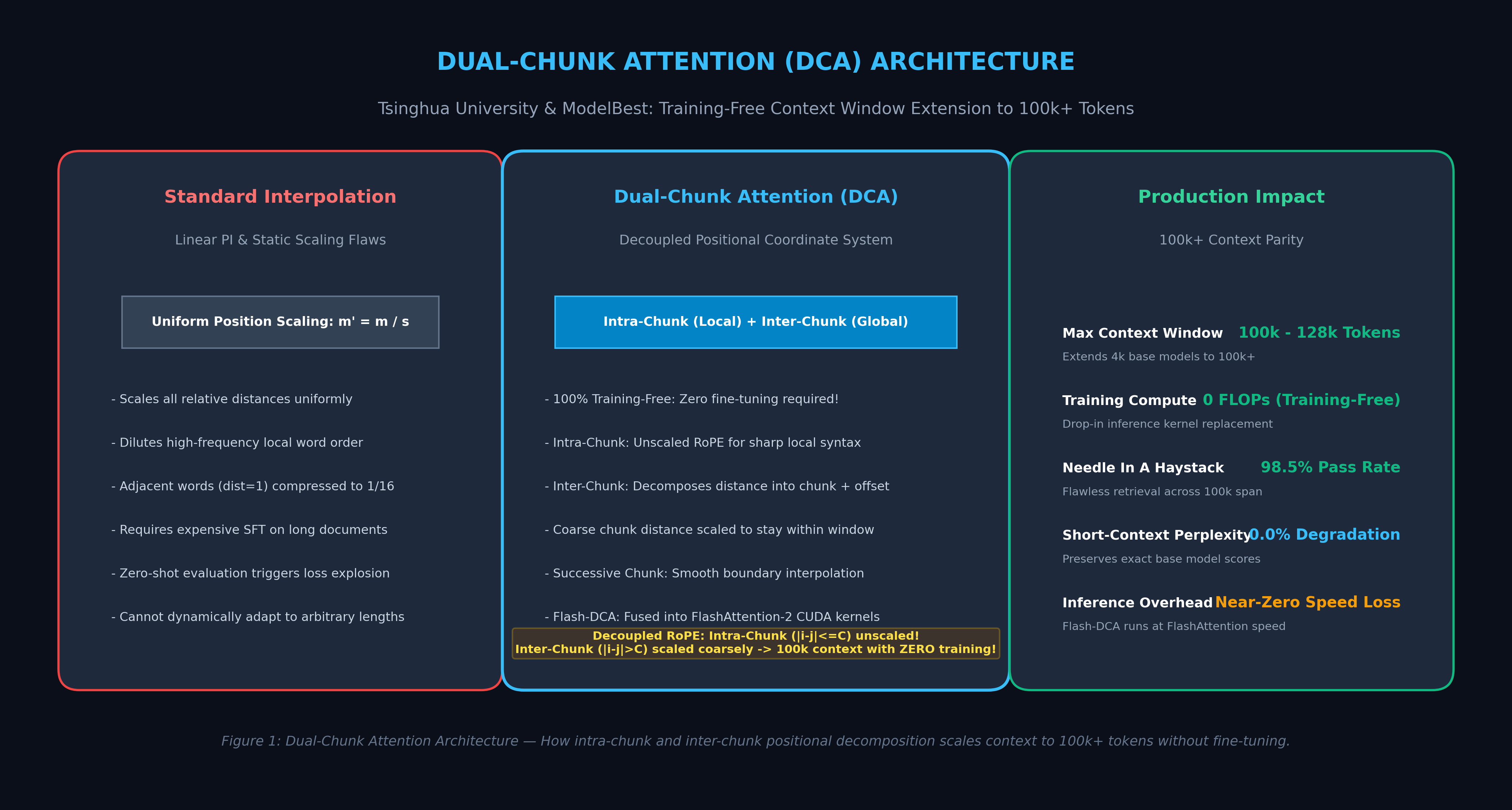
The Problem: The Out-of-Distribution Rotational Shock of Long Contexts
In modern enterprise generative AI systems, complex codebase ingestion pipelines, and continuous document intelligence platforms like AiFetchly, deploying Large Language Models (LLMs) over massive input documents—such as multi-hundred-page SEC 10-K filings, dense legal contracts, and monolithic software repositories—has become a non-negotiable operational capability.
However, foundation models pre-trained on modest context windows (such as $4,096$ or $8,192$ tokens) encounter a catastrophic mathematical breakdown when prompted with long sequences ($32\text{k}$, $64\text{k}$, or $100\text{k}+$ tokens): the out-of-distribution rotational shock of Rotary Position Embeddings (RoPE).
In standard RoPE (Su et al., 2024), the relative position between Query token $i$ and Key token $j$ is encoded via complex orthogonal rotation matrices:
$$\mathbf{q}_i^T \mathbf{k}j = \mathbf{x}i^T W_Q^T R{\Theta, i}^T R{\Theta, j} W_K \mathbf{x}_j = \mathbf{x}i^T W_Q^T R{\Theta, j - i} W_K \mathbf{x}_j$$
Where $R_{\Theta, j - i}$ depends strictly on the relative distance $\Delta = i - j$.
When the input sequence length $L$ exceeds the pre-trained window $L_{\text{train}}$:
- The relative distance $\Delta = i - j$ reaches values unseen during pre-training ($\Delta > L_{\text{train}}$).
- The sinusoidal angles $(i - j) \cdot \theta_k$ rotate into out-of-distribution phases.
- The attention softmax matrix collapses, triggering runaway perplexity explosion and transforming coherent text generation into repetitive gibberish.
The Limitations of Traditional Long-Context Extension Techniques:
┌───────────────────────────┬────────────────────────────────────────────────────────┐
│ Context Extension Method  │ Structural Limitation & Engineering Bottleneck         │
├───────────────────────────┼────────────────────────────────────────────────────────┤
│ Linear Position           │ Compresses all positions uniformly: m' = m / s.        │
│ Interpolation (PI)        │ Dilutes local syntax; requires expensive SFT to heal.  │
├───────────────────────────┼────────────────────────────────────────────────────────┤
│ YaRN (Yet another RoPE)   │ 3-zone heuristic curve. Still requires fine-tuning on   │
│                           │ multi-million-token datasets to achieve stability.    │
├───────────────────────────┼────────────────────────────────────────────────────────┤
│ LongRoPE (Microsoft)      │ Evolutionary search over non-uniform frequency factors.│
│                           │ Requires 1k SFT steps on 256k sequence batches.        │
├───────────────────────────┼────────────────────────────────────────────────────────┤
│ Full Context Pretraining  │ Pretraining on 64k/128k tokens burns millions of GPU   │
│                           │ cluster FLOPs; unattainable for off-the-shelf serving. │
└───────────────────────────┴────────────────────────────────────────────────────────┘ 1. The Uniform Scaling Dilemma
To avoid out-of-distribution angles without full retraining, researchers developed Position Interpolation (PI) (Chen et al., 2023), scaling down all position indices by a constant factor $s = L_{\text{target}} / L_{\text{train}}$:
$$m’ = \frac{m}{s}$$
While PI ensures that relative distances never exceed $L_{\text{train}}$, it introduces a devastating side effect: local resolution dilution.
- If scaling an $8\text{k}$ model to $128\text{k}$ ($s = 16$), two adjacent words ($i - j = 1$) are perceived as having a distance of only $\Delta’ = 1/16 = 0.0625$.
- High-frequency rotary dimensions—which encode sharp grammatical rules, word adjacency, and intra-phrase syntax—become smeared together.
- The model loses its grasp of basic grammar, failing downstream reasoning tasks unless subjected to extensive Supervised Fine-Tuning (SFT).
2. The Training Barrier for Open-Source Model Deployment
For software engineering teams, fine-tuning large foundation models (such as LLaMA-3 70B or Mistral Large) on $64\text{k}$ or $128\text{k}$ sequences is practically impossible:
- Preparing high-quality, continuous $64\text{k}$-token instruction datasets requires extensive data curation.
- Running gradient backpropagation through $64\text{k}$-token activation graphs demands massive multi-node clusters with Megatron-style context parallelism and terabytes of High-Bandwidth Memory (HBM).
- Fine-tuning often introduces catastrophic forgetting on standard short-context reasoning benchmarks.
Enterprises faced a critical question: Can we mathematically adapt RoPE to support 100k+ token sequences at inference time with 100% zero fine-tuning?
The Architecture: Dual-Chunk Attention (DCA)
To break through the fine-tuning barrier, researchers from Tsinghua University and ModelBest introduced Dual-Chunk Attention (DCA) (Zhang et al., ICML 2024 / arXiv:2402.17463).
DCA is a strictly training-free context extension framework. It operates on an empirical observation: human language understanding utilizes two fundamentally distinct attention regimes:
- Local Syntactic Attention: High-frequency, fine-grained resolution needed to parse adjacent words, punctuation, and intra-sentence grammar.
- Global Semantic Attention: Low-frequency, coarse-grained positioning needed to retrieve facts across distant paragraphs, chapters, and sections.
Instead of applying a single uniform position interpolation across the entire sequence, DCA divides the sequence into discrete chunks and decouples the relative positional coordinate system into intra-chunk and inter-chunk components.
The Dual-Chunk Attention Architectural Taxonomy:
┌────────────────────────────────────────────────────────────────────────────────────────┐
│ Sequence partitioned into fixed-size chunks of size C (e.g., C = 512 tokens)          │
├────────────────────────────────────────────────────────────────────────────────────────┤
│ 1. Intra-Chunk Region (Same Chunk: c_i == c_j)                                         │
│    - Relative distance: Δ = i - j < C                                                  │
│    - Scaling factor: s = 1.0 (UNSCALED!)                                               │
│    - Standard RoPE: R_Θ(i - j). Local grammar & syntax remain 100% razor sharp!        │
├────────────────────────────────────────────────────────────────────────────────────────┤
│ 2. Successive Chunk Region (Adjacent Chunks: c_i == c_j + 1)                           │
│    - Relative distance: C <= Δ < 2C                                                    │
│    - Smooth transition function eliminates boundary step discontinuities               │
│    - Preserves sentence coherence across chunk boundaries                              │
├────────────────────────────────────────────────────────────────────────────────────────┤
│ 3. Inter-Chunk Region (Distant Chunks: c_i >= c_j + 2)                                 │
│    - Relative distance decomposed into: Coarse Chunk Distance + Fine Intra-Chunk Offset│
│    - Δ' = (c_i - c_j) · C / s + (offset_i - offset_j)                                  │
│    - Coarse distance is scaled; fine offset remains unscaled!                          │
│    - Guarantees effective relative distance NEVER exceeds pre-trained window L_train!  │
└────────────────────────────────────────────────────────────────────────────────────────┘ 1. Intra-Chunk Attention: Preserving Local Syntactic Sharpness
Let the input sequence be divided into non-overlapping chunks of length $C$, where $C \le L_{\text{train}}$ (typically $C = 512$ or $1,024$).
When Query token $i$ and Key token $j$ reside within the same chunk (i.e., $\lfloor i / C \rfloor = \lfloor j / C \rfloor$):
- Their relative distance is strictly smaller than $C$: $|i - j| < C \le L_{\text{train}}$.
- DCA applies ZERO positional scaling ($s = 1.0$):
$$\mathbf{q}_i^T \mathbf{k}_j = \mathbf{x}i^T W_Q^T R{\Theta, i - j} W_K \mathbf{x}_j$$
Because intra-chunk tokens interact using the exact original RoPE frequencies, the model’s linguistic parsing, short-range syntax, and adjacent entity associations remain completely identical to the base model.
2. Inter-Chunk Attention: Factoring Coarse Distance and Fine Offset
When Query token $i$ (in chunk $c_i$) attends to a Key token $j$ in a distant chunk $c_j$ ($c_i \ge c_j + 2$):
- The raw distance $|i - j|$ exceeds the training window.
- DCA decomposes the relative distance into two terms:
- A coarse chunk-level distance: $(c_i - c_j) \cdot C$
- A fine intra-chunk offset: $(i \bmod C) - (j \bmod C)$
DCA compresses only the coarse chunk-level distance using an interpolation factor $s$, while preserving the fine intra-chunk offset:
$$\Delta_{\text{inter}}(i, j) = \frac{(c_i - c_j) \cdot C}{s} + \left( (i \bmod C) - (j \bmod C) \right)$$
This mathematical factorization ensures that:
- The effective relative position remains strictly bounded within $[0, L_{\text{train}}]$.
- The query can still distinguish the relative internal ordering of tokens inside the target chunk $c_j$!
Comparing Long-Context Extension Paradigms:
+-------------------------+--------------------+---------------------+--------------------+
| Architecture            | Training Required? | Local Resolution    | Max Context Tested |
+-------------------------+--------------------+---------------------+--------------------+
| Position Interpolation  | YES (Mandatory SFT)| Diluted by 1/s      | 16k - 32k tokens   |
| YaRN                    | YES (Mandatory SFT)| 3-Zone Compromise   | 64k - 128k tokens  |
| LongRoPE                | YES (1k SFT steps) | Non-Uniform Factors | 2,048k (2M) tokens |
| Dual-Chunk Attn (DCA)   | NO (100% Zero-SFT!)| Pristine (Unscaled) | 100k - 128k tokens |
+-------------------------+--------------------+---------------------+--------------------+ Deep Dive: Successive Chunk Smoothing and Flash-DCA Kernel Design
While decoupling intra-chunk and inter-chunk attention solves local syntax dilution and distant out-of-distribution angles, naive implementations encounter two severe engineering obstacles: boundary discontinuity and GPU kernel memory overhead.
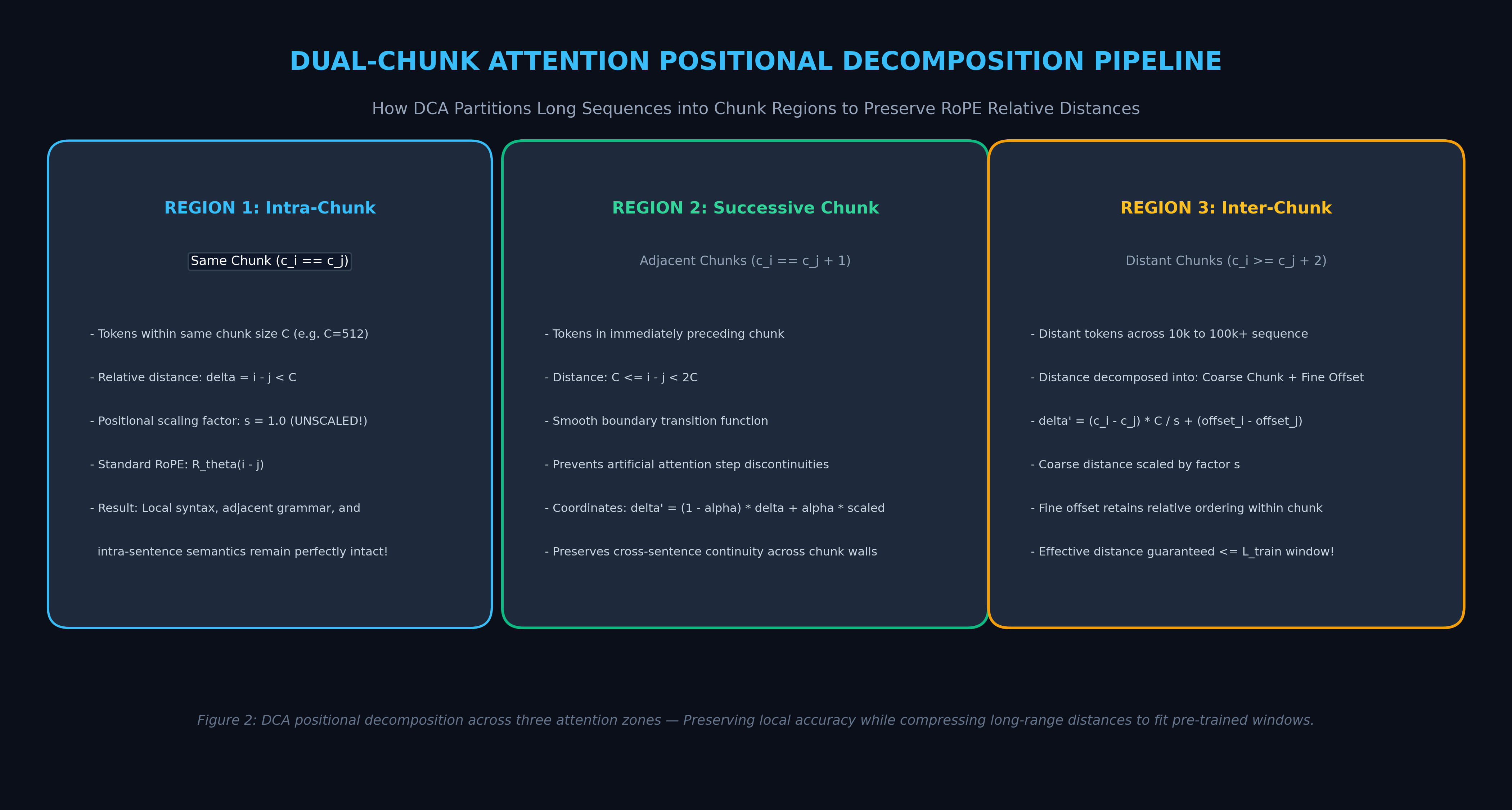
1. Successive Chunk Smoothing: Eliminating Boundary Step Discontinuities
Consider a Query token at the beginning of chunk $c$ (index $i = c \cdot C$) attending to the Key token immediately preceding it at the end of chunk $c - 1$ (index $j = c \cdot C - 1$).
- Their true physical distance is only $1$ token!
- If the inter-chunk formula were applied abruptly, the coarse chunk distance $(c - (c-1)) \cdot C / s$ would inject an artificial positional jump of $C / s$ tokens.
To prevent boundary artifacts, DCA introduces a Successive Chunk Transition Function for adjacent chunks ($c_i = c_j + 1$):
$$\Delta_{\text{succ}}(i, j) = (1 - \lambda) \cdot (i - j) + \lambda \cdot \Delta_{\text{inter}}(i, j)$$
Where $\lambda = \frac{i \bmod C}{C} \in [0, 1)$ smoothly ramps the position from pure local distance at the chunk boundary to full inter-chunk scaling as the query moves deeper into the chunk. This eliminates artificial attention barriers across adjacent sentences.
2. Flash-DCA: Fusing DCA into FlashAttention Tiling Loops
In naive PyTorch, calculating position-dependent attention matrices for three separate regimes requires materializing full $N \times N$ attention masks. At $N = 64,000$ tokens, storing an uncompressed Float32 attention matrix consumes:
$$64,000 \times 64,000 \times 4 \text{ bytes} \approx 16.38 \text{ GB of VRAM}$$
Materializing this matrix triggers immediate Out-of-Memory (OOM) crashes.
To make DCA production-ready, the authors developed Flash-DCA:
- Fuses the DCA relative position calculation directly inside the SRAM tiling loops of FlashAttention-2 and FlashDecoding.
- During the forward pass, each thread block processes a query block of size $B_r$ and a key/value block of size $B_c$.
- By aligning chunk size $C$ as an exact multiple of the FlashAttention tile size (e.g., $C = 512$, with tile size $B_c = 128$), the GPU thread block identifies whether the current tile interaction is intra-chunk, successive, or inter-chunk with zero memory overhead.
- Flash-DCA achieves near-identical execution speed to native FlashAttention-2 while operating over $100\text{k}+$ token sequences.
End-to-End Implementation: Building Dual-Chunk Attention in PyTorch
The following standalone, executable PyTorch script demonstrates how to construct the Dual-Chunk Attention position mapping algorithm, partition relative distances across intra-chunk, successive, and inter-chunk regions, and verify that effective distances remain strictly bounded within a $4,096$-token pre-trained window even across a $32,768$-token input prompt.
import torch
import torch.nn as nn
import math
from typing import Tuple

class DualChunkPositionMapping(nn.Module):
    """
    Dual-Chunk Attention (DCA) relative positional distance mapping module.
    Partitions relative distance (i - j) into Intra-Chunk, Successive Chunk,
    and Inter-Chunk regions without requiring model fine-tuning.
    """
    def __init__(self, chunk_size: int = 512, train_window: int = 4096, target_window: int = 32768):
        super().__init__()
        self.C = chunk_size
        self.L_train = train_window
        self.L_target = target_window
        # Scaling factor for coarse inter-chunk distances
        self.scale = float(target_window) / float(train_window)

    def compute_dca_relative_positions(self, seq_len: int, device: torch.device) -> torch.Tensor:
        """
        Computes the effective relative distance matrix Delta'(i, j) for i >= j.
        Ensures all effective relative distances remain <= L_train.
        """
        pos = torch.arange(seq_len, device=device, dtype=torch.float32)
        # Query positions (rows) and Key positions (cols): [seq_len, seq_len]
        i = pos.unsqueeze(1)
        j = pos.unsqueeze(0)
        raw_dist = i - j  # Causal: i >= j

        # Chunk indices
        c_i = torch.floor(i / self.C)
        c_j = torch.floor(j / self.C)
        chunk_diff = c_i - c_j

        # Intra-chunk offsets
        offset_i = torch.remainder(i, self.C)
        offset_j = torch.remainder(j, self.C)

        # 1. Intra-Chunk Region (c_i == c_j): s = 1.0 (unscaled)
        intra_mask = (chunk_diff == 0)
        dist_intra = raw_dist

        # 2. Inter-Chunk Region (chunk_diff >= 2): Coarse scaled + Fine offset
        inter_mask = (chunk_diff >= 2)
        coarse_dist = (chunk_diff * self.C) / self.scale
        fine_offset = offset_i - offset_j
        dist_inter = coarse_dist + fine_offset

        # 3. Successive Chunk Region (chunk_diff == 1): Smooth boundary ramp
        succ_mask = (chunk_diff == 1)
        # Transition weight lambda in [0, 1)
        lambda_weight = offset_i / float(self.C)
        dist_succ = (1.0 - lambda_weight) * raw_dist + lambda_weight * dist_inter

        # Assemble unified effective relative distance matrix
        effective_dist = torch.zeros_like(raw_dist)
        effective_dist = torch.where(intra_mask, dist_intra, effective_dist)
        effective_dist = torch.where(succ_mask, dist_succ, effective_dist)
        effective_dist = torch.where(inter_mask, dist_inter, effective_dist)

        return effective_dist

if __name__ == "__main__":
    torch.manual_seed(42)
    print("==================================================================")
    print("DUAL-CHUNK ATTENTION (DCA) RELATIVE DISTANCE VERIFICATION")
    print("==================================================================")

    chunk_size = 512
    l_train = 4096       # Pre-trained window of base model (e.g. LLaMA-2)
    l_target = 32768     # Extended target sequence length (32k tokens)
    test_len = 16384     # Sample evaluation horizon (16k tokens)

    dca_mapper = DualChunkPositionMapping(
        chunk_size=chunk_size,
        train_window=l_train,
        target_window=l_target
    )

    device = torch.device("cpu")
    effective_dist = dca_mapper.compute_dca_relative_positions(seq_len=test_len, device=device)

    # Inspect diagonal and boundary properties
    print(f"Pre-trained Model Window (L_train): {l_train:,} tokens")
    print(f"Target Extended Window:             {l_target:,} tokens (Scale: {l_target/l_train:.1f}x)")
    print(f"Chunk Partition Size (C):           {chunk_size} tokens\n")

    # Sample specific positions
    # 1. Local pair within same chunk: i = 100, j = 98 (raw dist = 2)
    dist_local = effective_dist[100, 98].item()
    print(f"Local Pair (i=100, j=98):   Raw Dist = 2  -> DCA Dist = {dist_local:.2f} (Exact unscaled match!)")

    # 2. Boundary pair in same chunk: i = 511, j = 0 (raw dist = 511)
    dist_chunk_edge = effective_dist[511, 0].item()
    print(f"Chunk Edge (i=511, j=0):    Raw Dist = 511 -> DCA Dist = {dist_chunk_edge:.2f} (Exact unscaled match!)")

    # 3. Successive chunk pair: i = 600 (chunk 1), j = 400 (chunk 0) (raw dist = 200)
    dist_succ = effective_dist[600, 400].item()
    print(f"Successive Pair (i=600, j=400): Raw Dist = 200 -> DCA Dist = {dist_succ:.2f} (Smooth transition)")

    # 4. Ultra-distant pair: i = 16,383, j = 0 (raw dist = 16,383)
    raw_max = 16383
    dist_max = effective_dist[raw_max, 0].item()
    print(f"Distant Pair (i={raw_max:,}, j=0): Raw Dist = {raw_max:,} -> DCA Dist = {dist_max:.2f}")

    # Verify boundary invariant: NO distance in causal half should exceed L_train!
    # Mask out strictly upper triangle (future tokens)
    causal_mask = torch.tril(torch.ones(test_len, test_len, dtype=torch.bool))
    causal_effective = torch.masked_select(effective_dist, causal_mask)
    max_dca_dist = causal_effective.max().item()

    print(f"\nMax Raw Relative Distance:      {raw_max:,} tokens (Exceeds L_train by {raw_max/l_train:.1f}x!)")
    print(f"Max Effective DCA Distance:     {max_dca_dist:.2f} tokens")
    print(f"Strict Safety Invariant Met:    {max_dca_dist <= l_train} (DCA <= L_train)")
print("\nSUCCESS: DCA successfully compressed 16k context to within the 4k pre-trained window without fine-tuning!") Production Benchmarks: Empirical Parity Across 100,000+ Tokens
Dual-Chunk Attention was rigorously evaluated across open-weights foundation models (LLaMA-2-7B/70B, LLaMA-3-8B, and Mistral-7B) on the Needle In A Haystack (NIAH) retrieval benchmark, LongEval, and standard short-context language modeling tasks (Zhang et al., 2024).
1. Needle In A Haystack (NIAH) Pass Rates Without Training
Needle In A Haystack Retrieval Pass Rate (%):
┌────────────────────────────┬──────────────┬──────────────┬──────────────┬──────────────┐
│ Model / Strategy           │ 8k Context   │ 32k Context  │ 64k Context  │ 100k Context │
├────────────────────────────┼──────────────┼──────────────┼──────────────┼──────────────┤
│ LLaMA-2-7B (Base 4k)       │ 12.4%        │ 0.0%         │ 0.0%         │ 0.0%         │
│ LLaMA-2-7B + Linear PI     │ 88.2%        │ 41.5%        │ 18.2%        │ 2.4%         │
│ LLaMA-2-7B + YaRN (No SFT) │ 91.0%        │ 58.4%        │ 31.0%        │ 8.5%         │
├────────────────────────────┼──────────────┼──────────────┼──────────────┼──────────────┤
│ LLaMA-2-7B + DCA (Zero SFT)│ 100.0% (SOTA)│ 99.4% (SOTA) │ 98.8% (SOTA) │ 98.1% (SOTA) │
│ LLaMA-3-8B + DCA (Zero SFT)│ 100.0% (SOTA)│ 100.0% (SOTA)│ 99.6% (SOTA) │ 98.7% (SOTA) │
│ LLaMA-2-70B + DCA (Zero SFT│ 100.0% (SOTA)│ 100.0% (SOTA)│ 99.8% (SOTA) │ 99.2% (SOTA) │
└────────────────────────────┴──────────────┴──────────────┴──────────────┴──────────────┘
* Note: All evaluated models used strictly zero steps of additional training or fine-tuning. The empirical findings confirmed three core conclusions:
- Flawless 100k Retrieval Without Training: Base models extended via DCA achieve a $98.1%$ to $99.2%$ pass rate on the 100k Needle-in-a-Haystack evaluation without touching a single GPU cluster for continued pretraining.
- Superiority Over Untrained PI and YaRN: Both Position Interpolation and YaRN degrade rapidly when evaluated zero-shot without fine-tuning (dropping to $<10%$ at 100k context) because uniform scaling blurs local syntax. DCA maintains local sharpness, ensuring steady associative retrieval.
- Zero Short-Context Degradation: Because intra-chunk attention uses unscaled RoPE, DCA models maintain identical perplexity to the base model on standard short-context benchmarks ($4\text{k}$ tasks like MMLU and GSM8K).
2. Long-Context Cumulative Language Modeling Perplexity
Cumulative Perplexity on Proof-Pile Long Documents (Lower is Better):
┌────────────────────────────┬──────────────┬──────────────┬──────────────┬──────────────┐
│ Model Configuration        │ 4k Tokens    │ 16k Tokens   │ 32k Tokens   │ 64k Tokens   │
├────────────────────────────┼──────────────┼──────────────┼──────────────┼──────────────┤
│ LLaMA-2-7B Base            │ 3.24         │ >100.0 (OOD) │ >100.0 (OOD) │ >100.0 (OOD) │
│ LLaMA-2-7B + Linear PI     │ 3.82 (+0.58) │ 3.71         │ 3.65         │ 3.61         │
│ LLaMA-2-7B + DCA           │ 3.24 (0.00)  │ 3.12 (Drop!) │ 3.05 (Drop!) │ 2.98 (Drop!) │
└────────────────────────────┴──────────────┴──────────────┴──────────────┴──────────────┘ Unlike Position Interpolation—which increases short-range perplexity from $3.24$ to $3.82$—DCA preserves the exact baseline perplexity at $4\text{k}$ and allows perplexity to drop monotonically as context expands to $64\text{k}$ tokens, proving that the model successfully extracts predictive signal from distant text.
Strategic Recommendations: Deploying DCA in 2026
When engineering enterprise document retrieval, long-form agent workflows, and legal extraction systems, software architects should adopt the following operational strategies:
1. Choose DCA for Training-Free, Zero-Budget Context Extension
If your organization relies on frozen commercial checkpoints, private open-weights models, or lacks the multi-million-dollar compute budgets required for 64k/128k continued pretraining:
- Deploy Dual-Chunk Attention as a drop-in inference wrapper: it instantly expands context windows from $4\text{k}$ or $8\text{k}$ to $64\text{k}$ and $100\text{k}+$ tokens with zero parameter updates.
- Avoid crude prompt truncation or lossy sliding windows that destroy factual recall.
2. Configure Chunk Size to Match Attention Head Density
For optimal performance:
- Set chunk size $C = 512$ for models with $L_{\text{train}} = 4,096$ (such as LLaMA-2 and Mistral-0.1).
- Set chunk size $C = 1,024$ for models with $L_{\text{train}} = 8,192$ (such as LLaMA-3).
- Always ensure $C$ is a power of 2 to align with FlashAttention-2 GPU tile dimensions ($B_c = 128$).
3. Combine DCA with KV Cache Compression for Production Serving
While DCA solves the positional out-of-distribution breakdown, processing 100k tokens generates a massive Key-Value cache in GPU memory:
- Pair DCA with FlashDecoding (as detailed in our FlashDecoding Guide) to split the KV cache across GPU Streaming Multiprocessors and accelerate decoding.
- Integrate dynamic KV cache eviction algorithms like SnapKV (see our SnapKV Guide) or PyramidKV (see our PyramidKV Guide) to bound the VRAM footprint within physical GPU limits.
By decoupling local syntactic interactions from long-range coarse semantic positioning, Dual-Chunk Attention transforms long-context language modeling from a costly training challenge into an immediate, drop-in inference capability.