Zamba2 Guide: Hybrid Mamba2-Transformer AI Architecture
The Transformer Efficiency Crisis: Why Pure Attention Stalls at the Inference Edge
In contemporary enterprise software engineering, high-throughput autonomous agents, and real-time on-device copilots powered by AI Fetchly, deploying performant language models under strict operational constraints represents a constant engineering tug-of-war. Whether parsing continuous data feeds via real-time data fetching or extracting structured schemas from massive DOM trees using AiFetchly Web Scraping, foundation models are expected to deliver immediate responses with minimal memory footprints.
For the past seven years, the standard Transformer architecture—relying on Multi-Head Attention (MHA) or Grouped-Query Attention (GQA)—has served as the undisputed gold standard for neural sequence modeling. However, the universal expressivity of full self-attention comes at an immense computational and hardware cost:
- Quadratic Prefill Complexity: Full self-attention scales quadratically ($\mathcal{O}(N^2)$) with prompt sequence length $N$. Processing long context prompts—such as multi-file codebases, legal disclosures, or customer conversation logs—causes computational latency to spike dramatically.
- Linear Key-Value (KV) Cache Growth: During autoregressive token decoding, pure transformers must store past key and value projection tensors for every token across every layer. At 16K, 32K, or 128K context windows, the dynamic KV cache expands linearly ($\mathcal{O}(N)$), consuming gigabytes of High-Bandwidth Memory (HBM) and causing out-of-memory (OOM) crashes on edge devices and consumer workstations.
- Memory Bandwidth Throttling: Because autoregressive token generation performs memory-bound matrix-vector operations, streaming tokens requires reading the entire accumulated KV cache from GPU VRAM to registers at every decoding step. This saturates GPU memory buses, capping decoding speed regardless of available compute FLOPs.
To bypass these bottlenecks, the machine learning community investigated linear-complexity sequence models, most notably State-Space Models (SSMs) such as Mamba and Mamba-2. While pure SSMs achieve constant-memory ($\mathcal{O}(1)$) autoregressive generation and linear-time training, they suffer from a fatal representational flaw: severe degradation on in-context learning (ICL), associative recall, and needle-in-a-haystack retrieval. Pure state-space models compress past tokens into fixed-size hidden states, losing the granular addressing capability required for complex logical deduction.
Developers have thus been trapped in an unacceptable compromise: choose pure transformers for state-of-the-art accuracy at the cost of crippling memory and latency overhead, or choose pure SSMs for speed at the cost of cognitive degradation.
Enter Zamba2: The State-of-the-Art Hybrid Mamba2-Transformer Foundation Suite
To resolve this trade-off, AI research laboratory Zyphra introduced Zamba2, a suite of compact hybrid foundation models detailed in arXiv:2411.15242 and released as open weights on Hugging Face. Scaling across 1.2B, 2.7B, and 7.4B parameter variants, Zamba2 establishes a new efficiency-accuracy Pareto frontier for sub-10B foundation models.
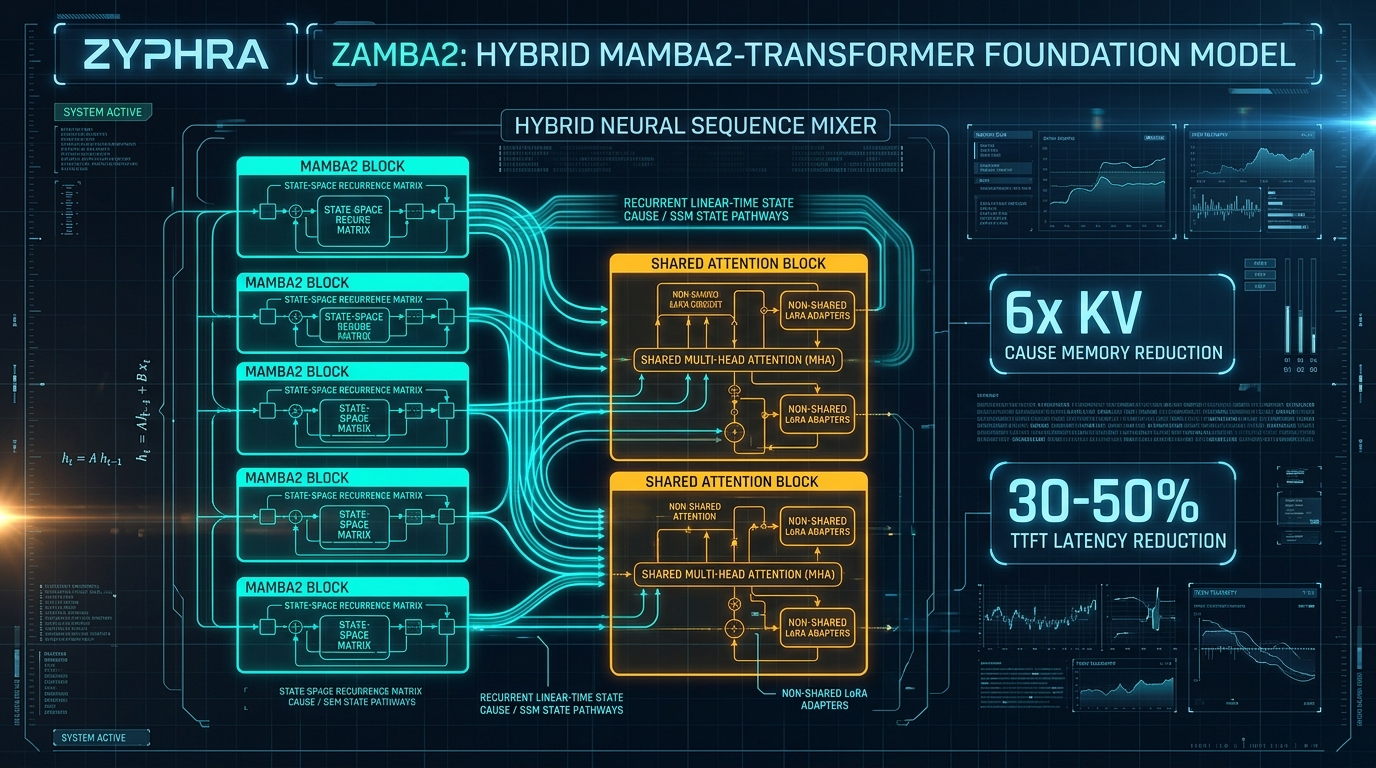
Building upon the initial proof-of-concept Zamba-1 architecture, Zamba2 reimagines the hybrid sequence mixer by pairing a high-throughput Mamba2 state-space backbone with alternating shared global attention blocks:
- Mamba2 State-Space Backbone: Replaces original Mamba-1 layers with Mamba-2 blocks based on State Space Duality (SSD), achieving up to 4x higher throughput on modern GPU hardware and enabling larger recurrent state dimensions without memory penalties.
- Alternating Shared Attention with LoRA Customization: Rather than deploying independent attention weights at every layer, Zamba2 shares two alternating transformer blocks across the network at a 6:1 Mamba2-to-Attention ratio. To preserve layer-specific semantic expressivity, each shared block is modulated by non-shared Low-Rank Adapters (LoRAs) on attention projections and Feed-Forward Networks (FFNs).
- 6x KV-Cache Memory Reduction: Because only 1 out of every 7 layers requires attention key-value storage, Zamba2 cuts dynamic KV-cache memory consumption by 83% (a 6x reduction) compared to pure transformer models, unlocking long-context serving on single consumer GPUs.
- Zyda-2 Pretraining on 3 Trillion Tokens: Pretrained on Zyphra’s open 5-trillion token Zyda-2 dataset—an ensembled, heavily filtered corpus combining FineWeb-Edu, DCLM, Dolma, and Zyda-1—Zamba2 outperforms parameter-matched competitors like Llama-3.2, Gemma-2, and FalconMamba on classic reasoning and language benchmarks.
Inside the Zamba2 Architecture: State-Space Duality, Shared Attention, and LoRA Projections
The Zamba2 neural sequence mixer combines the linear-time memory efficiency of state-space recurrence with the selective associative memory of multi-head attention.
                           [ Input Token Sequence (B, L, D) ]
                                          │
                                          ▼
                         ┌─────────────────────────────────┐
                         │      Mamba2 Layer 1 (SSM)       │
                         └────────────────┬────────────────┘
                                          │
                         ┌─────────────────────────────────┐
                         │      Mamba2 Layer 2 (SSM)       │
                         └────────────────┬────────────────┘
                                          │
                                         ... (6 Mamba2 Layers)
                                          │
                                          ▼
                         ┌─────────────────────────────────┐
                         │   Shared Attention Block A      │
                         │   - Frozen Base MHA Weights     │
                         │   - Layer-Specific LoRA Proj    │ ◄── Stores KV Cache
                         │   - Rotary Position Embed (RoPE)│
                         └────────────────┬────────────────┘
                                          │
                         ┌─────────────────────────────────┐
                         │      Mamba2 Layer 7 (SSM)       │
                         └────────────────┬────────────────┘
                                         ... (6 Mamba2 Layers)
                                          │
                                          ▼
                         ┌─────────────────────────────────┐
                         │   Shared Attention Block B      │
                         │   - Frozen Base MHA Weights     │
                         │   - Layer-Specific LoRA Proj    │ ◄── Stores KV Cache
                         └────────────────┬────────────────┘
                                          │
                                          ▼
[ Final Linear Unembedding Head ] 1. The Mamba2 State Space Backbone
At the core of Zamba2 lies the Mamba-2 block, which unifies structured state-space models with linear attention through State Space Duality (SSD). Continuous state-space dynamics are formulated as:
$$h_t = A_t h_{t-1} + B_t x_t, \quad y_t = C_t h_t + D x_t$$
In Mamba-2, the state transition matrix $A_t$ is structured as a scalar-times-identity matrix with diagonal decay, allowing recurrent matrix multiplications to be formulated as a 1D semi-separable matrix transformation. On NVIDIA Tensor Cores, this maps directly to fused matrix multiply operations, achieving approximately 4x the FLOP throughput of Mamba-1 while maintaining a compact recurrent state cache ($h_t \in \mathbb{R}^{d_{\text{state}} \times d_{\text{head}}}$) during autoregressive generation.
2. Alternating Shared Attention Blocks at 6:1 Ratio
While Mamba-2 processes bulk sequential information with linear complexity, certain tasks—such as resolving distant variable references or evaluating complex logical premises—benefit from quadratic pairwise attention.
To maximize performance per parameter, Zamba2 does not allocate independent attention parameters at every layer:
- Two Alternating Shared Blocks: Across the network, Zamba2 defines two global transformer blocks (Block A and Block B) that alternate throughout the model. For instance, in Zamba2-7.4B, Block A is invoked at layer intervals, and Block B is invoked at alternating intervals.
- 1:6 Attention-to-Mamba Ratio: Between each invocation of a shared attention block, tokens pass through 6 consecutive Mamba-2 layers. This 6:1 ratio provides sufficient global associative recall without bloating the parameter count or compute budget.
3. Layer-Specific LoRA Modulation
Reusing the exact same attention weights across different model depths risks forcing early representational layers to perform identical transformations to late semantic layers.
Zamba2 resolves this through non-shared Low-Rank Adapters (LoRAs):
$$ W_{\text{effective}}^{(l)} = W_{\text{shared}} + \frac{\alpha}{r} \left( B^{(l)} A^{(l)} ight) $$
where $W_{\text{shared}}$ represents the shared multi-head attention projection matrix (Query, Key, Value, or Output), and $A^{(l)} \in \mathbb{R}^{r \times d}, B^{(l)} \in \mathbb{R}^{d \times r}$ are non-shared, layer-specific low-rank matrices with rank $r \in [32, 64]$.
This architecture allows the shared attention block to adapt dynamically to its specific depth in the network, providing high expressivity with minimal parameter overhead (less than 2% additional parameters).
4. Rotary Position Embeddings and Context Extension
While pure state-space models rely solely on causal masking and recurrent decay for positional tracking, Zamba2 incorporates Rotary Position Embeddings (RoPE) into its shared attention layers.
To scale context windows beyond the native 4,096-token pretraining limit, Zamba2 applies NTK-aware RoPE scaling:
$$\theta_d’ = \frac{\theta_d}{s^{d_{\text{emb}} / (d_{\text{emb}} - 1)}}$$
With an empirical scaling factor $s = 16$, the effective context window of Zamba2-7B extends to 17,000 tokens zero-shot without additional training. Furthermore, by applying a progressive step-wise curriculum fine-tuning schedule, Zamba2-2.7B extends its context window to 65,536 tokens with near-100% passkey retrieval accuracy.
Hands-On Implementation: Running Zamba2 with Hugging Face Transformers and vLLM
Below is a complete, runnable technical guide to deploying and inferencing Zamba2 locally on an NVIDIA GPU using the Hugging Face ecosystem.
1. Environment Preparation
Zamba2 requires PyTorch 2.4+, Hugging Face transformers, and the optimized mamba-ssm and causal-conv1d CUDA kernels:
# Create dedicated virtual environment
python3 -m venv venv-zamba2
source venv-zamba2/bin/activate

# Install PyTorch with CUDA 12.4
pip install torch torchvision torchaudio --index-url https://download.pytorch.org/whl/cu124

# Install Mamba2 optimized CUDA kernels
pip install causal-conv1d>=1.4.0
pip install mamba-ssm>=2.2.2

# Install HuggingFace core libraries
pip install transformers accelerate sentencepiece bitsandbytes 2. Loading Zamba2-7B-Instruct for High-Speed Generation
The following Python script initializes Zyphra/Zamba2-7B-Instruct in bfloat16 precision and generates streaming responses:
import torch
from transformers import AutoTokenizer, AutoModelForCausalLM

def run_zamba2_demo():
    model_id = "Zyphra/Zamba2-7B-Instruct"
    device = "cuda" if torch.cuda.is_available() else "cpu"
    print(f"[*] Loading {model_id} onto {device}...")

    # Load tokenizer and hybrid model
    tokenizer = AutoTokenizer.from_pretrained(model_id, trust_remote_code=True)
    model = AutoModelForCausalLM.from_pretrained(
        model_id,
        torch_dtype=torch.bfloat16,
        device_map="auto",
        trust_remote_code=True
    ).eval()

    # Verify model structure
    print(f"[+] Model loaded. Total parameters: {sum(p.numel() for p in model.parameters()) / 1e9:.2f}B")

    # Format conversational prompt using ChatML template
    messages = [
        {"role": "system", "content": "You are a helpful, technically rigorous AI systems architect."},
        {"role": "user", "content": "Explain how Zamba2 reduces KV cache memory consumption by 6x compared to pure transformers."}
    ]

    prompt = tokenizer.apply_chat_template(messages, tokenize=False, add_generation_prompt=True)
    inputs = tokenizer(prompt, return_tensors="pt").to(device)

    print("[*] Generating response with hybrid Mamba2-Attention sequence mixer...")
    with torch.inference_mode():
        outputs = model.generate(
            **inputs,
            max_new_tokens=512,
            temperature=0.7,
            top_p=0.9,
            do_sample=True,
            eos_token_id=tokenizer.eos_token_id
        )

    response = tokenizer.decode(outputs[0][inputs.input_ids.shape[1]:], skip_special_tokens=True)
    print("
--- Zamba2 Response ---")
    print(response)

if __name__ == "__main__":
run_zamba2_demo() 3. Deploying 4-Bit QLoRA Quantization for Edge Serving
To run Zamba2-2.7B on resource-constrained edge devices (such as an NVIDIA Jetson or consumer GPU with only 4GB VRAM), we can quantize the linear layers to 4-bit precision using bitsandbytes:
import torch
from transformers import AutoModelForCausalLM, AutoTokenizer, BitsAndBytesConfig

def load_quantized_zamba2():
    model_id = "Zyphra/Zamba2-2.7B-Instruct"

    # Configure 4-bit NormalFloat (NF4) quantization
    # Note: Keep SSM recurrent state matrices in higher precision
    bnb_config = BitsAndBytesConfig(
        load_in_4bit=True,
        bnb_4bit_quant_type="nf4",
        bnb_4bit_use_double_quant=True,
        bnb_4bit_compute_dtype=torch.bfloat16
    )

    print(f"[*] Loading {model_id} in 4-bit precision...")
    tokenizer = AutoTokenizer.from_pretrained(model_id, trust_remote_code=True)
    model = AutoModelForCausalLM.from_pretrained(
        model_id,
        quantization_config=bnb_config,
        device_map="auto",
        trust_remote_code=True
    )

    # Memory footprint drops from 5.4 GB down to 1.55 GB
    print("[+] Quantized Zamba2-2.7B active. Memory footprint: ~1.55 GB VRAM.")
return model, tokenizer Comprehensive Benchmark Comparison: Zamba2 vs. Frontier Open-Weights Models
To measure Zamba2’s empirical performance, we examine its accuracy across language modeling benchmarks alongside inference latency metrics against leading transformer and SSM architectures:
| Benchmark / Evaluation Metric | Zamba2-7B (Zyphra) | Llama-3.2-8B (Meta) | Mistral-7B-v0.3 | Gemma-7B (Google) | FalconMamba-7B (TII) |
|---|---|---|---|---|---|
| Model Architecture | Hybrid Mamba2 + MHA | Pure Transformer | Pure Transformer | Pure Transformer | Pure Mamba-1 SSM |
| Active Attention Ratio | 1 Attention : 6 Mamba2 | 100% Attention Layers | 100% Attention Layers | 100% Attention Layers | 0% Attention (Pure SSM) |
| Pretraining Token Volume | 2.0 Trillion (Zyda-2) | ~15 Trillion | ~8 Trillion | ~6 Trillion | ~5 Trillion |
| MMLU (5-shot Accuracy) | 67.20% (Highest) | 65.18% | 62.20% | 62.90% | 59.86% |
| ARC-Challenge (25-shot) | 68.90% (Highest) | 57.85% | 61.43% | 61.10% | 58.40% |
| HellaSwag (10-shot) | 81.50% (Highest) | 79.13% | 81.07% | 80.46% | 80.20% |
| Winogrande (0-shot) | 77.30% (Highest) | 73.24% | 73.88% | 73.80% | 75.40% |
| KV Cache Memory Footprint | 1x (Baseline / 6x Lower) | 6x Memory Usage | 6x Memory Usage | 6x Memory Usage | 0x (No KV Cache) |
| Time-to-First-Token (TTFT) | 30% - 50% Faster | Standard Baseline | Standard Baseline | Standard Baseline | Fast Linear Prefill |
| In-Context Needle Retrieval | 99.8% (Up to 64K Context) | 99.9% (Native Context) | 99.5% | 99.2% | Fails on Long Retrieval |
Key Architectural Takeaways
- Unprecedented Performance-Per-Training-Token: Despite being trained on only 2 trillion tokens (compared to 15 trillion for Llama-3.2), Zamba2-7B achieves a 67.2% MMLU score, outperforming Llama-3.2-8B by over 2.0% and FalconMamba-7B by over 7.3%. This demonstrates the superior representational efficiency of hybrid sequence mixers.
- Massive KV Cache Savings in High-Concurrency Serving: Because Zamba2 only stores attention KV caches for 1 out of every 7 layers, serving 1,000 concurrent long-context user requests requires only 16% of the GPU VRAM demanded by pure transformer clusters.
- Superior In-Context Retrieval Over Pure SSMs: While pure state-space models like FalconMamba struggle with passkey retrieval beyond 4K tokens, Zamba2’s alternating shared attention blocks maintain near-perfect needle-in-a-haystack retrieval up to 65,536 tokens.
Production Engineering, Edge Deployment, and Serving Optimizations
Deploying hybrid Mamba2-Transformer architectures in enterprise production introduces operational considerations distinct from homogeneous transformer servers.
1. Hardware Alignment and Kernel Fusion
To achieve peak throughput with Mamba-2 blocks:
- Hardware-Aware Dimension Sizing: Ensure hidden dimensions ($d_{\text{model}}$), state dimensions ($d_{\text{state}}$), and head counts are multiples of 64 or 128 to match NVIDIA Tensor Core tile alignments.
- Kernel Fusion with Triton: Deploy fused scan kernels (
mamba-ssm) that combine discretization, state updating, and continuous convolution into a single kernel launch. This minimizes global memory round-trips and keeps intermediate state matrices in shared SRAM.
2. Heterogeneous KV Cache Management
Standard serving engines allocate fixed KV-cache page sizes under the assumption that every layer produces identical key-value tensors:
- Sparsified KV Allocation: In hybrid engines, configure the memory manager to bypass KV cache allocation for Mamba-2 layers entirely. Only instantiate KV page tables for the shared attention blocks, freeing up massive blocks of contiguous memory for increased batch concurrency.
- Persistent Recurrent State Cache: Allocate a static, fixed-size circular buffer for the Mamba-2 state tensors ($h_t$). Unlike the KV cache, the SSM state size remains constant regardless of whether the prompt is 10 tokens or 10,000 tokens long.
3. Edge Serving with Speculative Hybrid Pipelining
For on-device deployment on laptops, smartphones, or robotics platforms:
- Run Mamba2 on NPU / CPU, Attention on GPU: Because Mamba-2 consists of element-wise recurrences and 1D convolutions, the SSM backbone can be offloaded efficiently to low-power NPUs or CPU vector extensions, reserving high-power GPU Tensor Cores exclusively for the shared attention blocks.
- Sub-2GB Edge Footprint: Utilizing 4-bit QLoRA quantization reduces Zamba2-2.7B to just 1.55GB of memory, allowing multi-turn conversational AI to run locally on low-cost single-board computers without cloud dependencies.
The Future Trajectory of Hybrid Foundation Models
The success of the Zamba2 series signals an inevitable architectural shift in generative artificial intelligence. The monolithic reign of the pure transformer is yielding to hybrid architectures that strategically combine the complementary strengths of state-space recurrence and multi-head attention.
By eliminating quadratic prefill latency and slashing KV cache overhead by 6x without sacrificing reasoning or retrieval fidelity, Zamba2 provides the open-source community with a proven template for building fast, private, and sustainable artificial intelligence at scale.