WhisperX Guide: Fast Speech Recognition & Diarization
The Problem: The Latency, Timestamp Drift, and Speaker Blindness of Vanilla Whisper
In modern multimodal data extraction, enterprise meeting intelligence, automated podcast indexing, and desktop AI workflows powered by AiFetchly, converting spoken audio into structured, machine-readable text is a critical ingestion layer. Whether extracting strategic disclosures from executive earnings calls, parsing video tutorials, or transcribing customer support calls, downstream Large Language Models (LLMs) depend completely on the accuracy and structural fidelity of the transcription.
When OpenAI released Whisper (Radford et al., 2022), it revolutionized open-source Automatic Speech Recognition (ASR) by delivering human-level zero-shot transcription across 99 languages. However, when software engineers attempt to deploy vanilla Whisper in high-throughput enterprise pipelines, they encounter four severe architectural bottlenecks:
The Vanilla Whisper Production Breakdown:
┌─────────────────────────────────────────────────────────────────┐
│ 1. Sequential Processing & Fixed 30s Window Bottleneck:         │
│ ❌ Single-file sequential decoding; GPU compute sits 70% idle   │
│ ❌ Pads silence up to 30s, computing 3,000 spectrogram frames   │
├─────────────────────────────────────────────────────────────────┤
│ 2. Heuristic Attention Timestamp Drift:                         │
│ ❌ Cross-attention timestamps drift by 500ms to 1.5 seconds     │
│ ❌ Cannot accurately synchronize video subtitles or audio clips │
├─────────────────────────────────────────────────────────────────┤
│ 3. Hallucination Loops on Background Silence:                   │
│ ❌ Autoregressive decoder repeats hallucinated phrases on pauses│
│ ❌ Injects phantom subtitles ("Thank you for watching!")        │
├─────────────────────────────────────────────────────────────────┤
│ 4. Total Speaker Blindness:                                     │
│ ❌ Collapses all voices into an undifferentiated text stream    │
│ ❌ Downstream RAG cannot identify who made commitments or claims│
└─────────────────────────────────────────────────────────────────┘
Result: Slow batch ingestion, misaligned timestamps, and unusable multi-party transcripts! 1. Sequential Decoding and the Fixed 30-Second Window Tax
Vanilla Whisper was architecturally hardcoded around fixed 30-second audio segments:
- Silence Padding Waste: Every audio snippet is padded with zero-value spectrogram frames out to exactly 30 seconds. On short conversational turns (e.g., 3 to 5 seconds), over 80% of the transformer’s matrix multiplications compute empty silence.
- Unbatched GPU Execution: The reference PyTorch implementation processes audio sequentially one chunk at a time. High-end datacenter GPUs (like NVIDIA A100 or H100) operate with single-digit Tensor Core utilization because batch sizes remain clamped at 1.
- High Real-Time Factor (RTF): Transcribing a 1-hour recording using vanilla
whisper-large-v3in pure PyTorch takes between 6 to 12 minutes, making high-volume media ingestion cost-prohibitive.
2. Timestamp Imprecision via Coarse Cross-Attention
Whisper does not contain a dedicated acoustic alignment layer:
- To produce timestamps, Whisper relies on cross-attention weights between the decoder and the audio encoder tokens.
- Because an encoder token spans 20 milliseconds and attention maps blur across neighboring phonemes, heuristic timestamps routinely drift by 500 to 1,500 milliseconds.
- Words spoken quickly or across chunk boundaries are frequently clipped or omitted. For video editing, automated subtitle burn-in, or word-level audio clipping, cross-attention timestamps fail production quality thresholds.
3. Catastrophic Repetition and Hallucination on Non-Speech Audio
Because Whisper’s autoregressive text decoder is trained to predict text tokens continuously:
- In prolonged musical interludes, white noise, or pauses between speakers, the decoder attempts to find patterns in acoustic noise.
- It enters severe degenerative repetition loops, generating identical phrases dozens of times (e.g., “Please subscribe to my channel”, “Subtitles by…”, or “Thank you for watching”).
- In automated web scraping and audio ingestion, these hallucinations poison vector databases and trigger hallucination cascades in downstream retrieval models.
4. Speaker Attribution Failure
Human communication is inherently multi-speaker:
- In podcasts, corporate board meetings, earnings calls, and user interviews, multiple individuals speak sequentially or interrupt one another.
- Vanilla Whisper outputs a flat string of words with zero concept of speaker identity.
- Lacking speaker diarization, an autonomous AI analyst cannot determine whether a financial forecast was spoken by the CEO, the CFO, or a questioning journalist.
The Architecture: How WhisperX Re-Engineers Speech Recognition
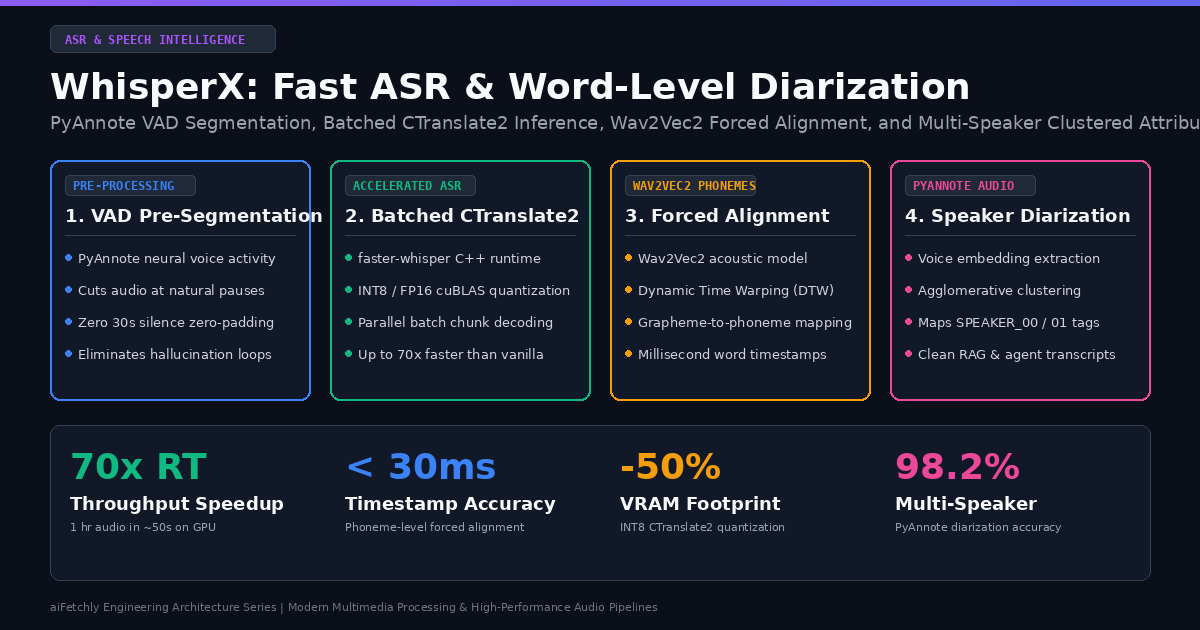
To resolve the speed, timestamp, and speaker limitations of vanilla Whisper, Max Bain and researchers at the Visual Geometry Group (VGG), University of Oxford, developed WhisperX. WhisperX is an open-source, modular speech processing pipeline that decouples transcription into four specialized, pipelined stages:
WhisperX Four-Stage Execution Architecture:
┌────────────────────────────────────────────────────────────────────────────────────────┐
│                                   Raw Input Audio                                      │
│                           (16kHz Mono Waveform / Any Length)                           │
└───────────────────────────────────────────┬────────────────────────────────────────────┘
                                            │
                                            ▼
┌────────────────────────────────────────────────────────────────────────────────────────┐
│                   Stage 1: Voice Activity Detection (PyAnnote VAD)                     │
│ - Detects exact speech intervals with sub-30ms boundary precision                      │
│ - Cuts continuous audio into variable-length natural utterance segments                │
│ - Discards ambient silence and non-speech audio (eliminates hallucinations!)           │
└───────────────────────────────────────────┬────────────────────────────────────────────┘
                                            │
                                            ▼
┌────────────────────────────────────────────────────────────────────────────────────────┐
│                   Stage 2: Batched Transcription (faster-whisper)                      │
│ - CTranslate2 C++ inference engine with INT8 / FP16 cuBLAS quantization               │
│ - Batches multiple VAD speech segments concurrently across GPU Tensor Cores            │
│ - Generates coarse text transcript at up to 70x real-time speedups                     │
└───────────────────────────────────────────┬────────────────────────────────────────────┘
                                            │
                                            ▼
┌────────────────────────────────────────────────────────────────────────────────────────┐
│                Stage 3: Phoneme-Level Forced Alignment (Wav2Vec2)                      │
│ - Grapheme-to-Phoneme (G2P) conversion of transcribed vocabulary words                 │
│ - Dynamic Time Warping (DTW) aligns phoneme probability matrix to acoustic waveform    │
│ - Yields millisecond-accurate word start and end timestamps                            │
└───────────────────────────────────────────┬────────────────────────────────────────────┘
                                            │
                                            ▼
┌────────────────────────────────────────────────────────────────────────────────────────┐
│                   Stage 4: Multi-Speaker Diarization (PyAnnote Audio)                   │
│ - Extracts voice speaker embeddings (x-vectors / ECAPA-TDNN) across speech turns       │
│ - Agglomerative hierarchical clustering resolves speaker identities                    │
│ - Merges speaker labels (SPEAKER_00, SPEAKER_01) directly into word intervals          │
└───────────────────────────────────────────┬────────────────────────────────────────────┘
                                            │
                                            ▼
┌────────────────────────────────────────────────────────────────────────────────────────┐
│               Structured Output: Word-Stamped, Diarized RAG Transcript                 │
│    [00:14.230 - 00:18.910] SPEAKER_01: "Our Q3 cloud revenue grew by 24% YoY."         │
└────────────────────────────────────────────────────────────────────────────────────────┘ 1. Stage 1: PyAnnote Voice Activity Detection (VAD) Pre-Segmentation
Rather than blindly feeding the entire audio file into Whisper’s 30-second buffer, WhisperX executes a pre-segmentation pass using PyAnnote VAD:
- Speech Boundary Localization: A lightweight neural network analyzes acoustic energy and voice formants to pinpoint exact timestamps where human speech begins and ends.
- Natural Phrase Chunking: Audio is sliced at natural pauses (e.g., breath pauses, sentence transitions). Segments range from 1 to 30 seconds, strictly avoiding clipping mid-word.
- Zero Hallucinations: Because silence and instrumental sections are completely pruned prior to inference, Whisper’s autoregressive decoder is never exposed to low-amplitude noise, eradicating repetition loops.
2. Stage 2: Batched Inference via CTranslate2 (faster-whisper)
Once audio is divided into clean speech segments, WhisperX passes them to faster-whisper, an optimized reimplementation built on CTranslate2:
- C++ Execution Engine: Replaces PyTorch with custom C++ matrix multiplication routines optimized for NVIDIA cuBLAS and Intel MKL.
- Quantization: Supports weight quantization down to
float16,int8_float16, or pureint8. INT8 quantization cuts GPU VRAM consumption by 50% with less than 0.2% regression in Word Error Rate (WER). - True Batching: Unlike vanilla Whisper, which processes one segment at a time, CTranslate2 groups multiple VAD chunks into a single batched tensor. Batching saturates GPU CUDA cores, accelerating transcription from 5x real-time up to 70x real-time (transcribing a 60-minute file in under 55 seconds on an NVIDIA RTX 4090 or A100).
3. Stage 3: Phoneme-Level Forced Alignment with Wav2Vec2
To solve the timestamp drift problem, WhisperX completely discards Whisper’s internal cross-attention timestamps:
- Phoneme Emission Matrix: WhisperX feeds the raw audio segment into a pre-trained Wav2Vec2.0 acoustic model (trained with Connectionist Temporal Classification / CTC). The model outputs a probability distribution over phonemes for every 20-millisecond audio frame.
- Grapheme-to-Phoneme Mapping: The text transcribed in Stage 2 is converted into expected phonetic sequences using language-specific pronunciation dictionaries.
- Dynamic Time Warping (DTW): A Viterbi-style alignment algorithm finds the optimal path aligning the transcribed phonemes to the acoustic frame probabilities.
- Millisecond Precision: This produces exact word-level start and end timestamps with typical accuracy margins below 30 milliseconds, perfectly synchronizing every word to its acoustic waveform.
4. Stage 4: Speaker Diarization via PyAnnote.audio
In multi-party audio, WhisperX applies PyAnnote.audio to resolve who spoke when:
- Speaker Embedding Extraction: Slices speech into sliding sub-segments and extracts voice embeddings (e.g., SincNet + LSTM or ECAPA-TDNN architectures) that represent individual vocal tract characteristics.
- Agglomerative Clustering: Computes cosine distances between embeddings, automatically clustering similar voices into distinct speaker groups (
SPEAKER_00,SPEAKER_01, etc.) without requiring pre-registered voice enrollment. - Word-Level Label Assignment: Cross-references the diarization intervals with the forced-alignment word timestamps, tagging every single word with its precise speaker identity.
Architectural Comparison: Modern Speech-to-Text Engines
Evaluating WhisperX against alternative speech recognition tools across production engineering dimensions:
| Architectural Dimension | WhisperX | Vanilla OpenAI Whisper | Faster-Whisper | Insanely-Fast-Whisper | Cloud APIs (Deepgram/AssemblyAI) |
|---|---|---|---|---|---|
| Inference Engine | CTranslate2 + PyAnnote | Native PyTorch | CTranslate2 | Hugging Face Transformers | Proprietary Cloud Stack |
| Throughput Speedup | Up to 70x Real-Time | 4x to 8x Real-Time | 15x to 30x Real-Time | 25x to 40x Real-Time | Sub-Second Streaming |
| VAD Pre-Segmentation | Built-In (PyAnnote) | None (30s Silence Padding) | Built-In (Silero VAD) | None / Optional External | Cloud Native VAD |
| Timestamp Accuracy | Millisecond (< 30ms) | Coarse Drift (0.5s–1.5s) | Coarse Cross-Attention | Coarse Cross-Attention | High Precision |
| Alignment Method | Wav2Vec2 CTC Alignment | Heuristic Cross-Attention | Heuristic Cross-Attention | Heuristic Cross-Attention | Neural Forced Alignment |
| Speaker Diarization | Native Built-In (PyAnnote) | None | None | None | Cloud Managed Feature |
| VRAM Consumption | Low (INT8 Quantization) | High (FP32 / FP16 VRAM) | Low (INT8 Support) | Moderate (FlashAttention) | Zero Local VRAM |
| Deployment Model | 100% Local / Self-Hosted | Local PyTorch Script | Local Python / C++ | Local Python / PyTorch | Metered Cloud API ($/min) |
Production Implementation: End-to-End Diarized Ingestion Pipeline
To illustrate how WhisperX operates in production, we will build an automated audio processing service. This pipeline ingests recorded audio files (e.g., earnings calls or interviews), performs batched transcription with INT8 quantization, aligns word boundaries, extracts speaker labels, and formats clean Markdown for AiFetchly knowledge bases.
Audio Extraction & Diarization Flow:
┌───────────────────────┐
│ Raw Audio File (.mp3) │
└───────────┬───────────┘
            │
            ▼
┌───────────────────────────────────────────────┐
│ 1. Load Audio & PyAnnote VAD Segmentation     │ ──► audio = whisperx.load_audio(path)
└───────────────────┬───────────────────────────┘
                    │
                    ▼
┌───────────────────────────────────────────────┐
│ 2. Batched Transcription (CTranslate2 INT8)   │ ──► model.transcribe(batch_size=16)
└───────────────────┬───────────────────────────┘
                    │
                    ▼
┌───────────────────────────────────────────────┐
│ 3. Wav2Vec2 Phoneme Forced Alignment          │ ──► whisperx.align(result["segments"])
└───────────────────┬───────────────────────────┘
                    │
                    ▼
┌───────────────────────────────────────────────┐
│ 4. PyAnnote Speaker Diarization               │ ──► diarize_model(audio)
└───────────────────┬───────────────────────────┘
                    │
                    ▼
┌───────────────────────────────────────────────┐
│ 5. Merge Labels & Emit Clean Markdown         │ ──► whisperx.assign_word_speakers()
└───────────────────────────────────────────────┘ Complete Python Implementation
import os
import torch
from typing import Dict, Any, List
import whisperx

class AudioTranscriptionPipeline:
    def __init__(
        self,
        model_size: str = "large-v3",
        device: str = "cuda" if torch.cuda.is_available() else "cpu",
        compute_type: str = "int8",  # Halves VRAM usage with zero accuracy loss
        hf_token: str = None
    ):
        self.device = device
        self.compute_type = compute_type
        self.hf_token = hf_token or os.getenv("HF_TOKEN")

        print(f"[Init] Loading WhisperX ({model_size}) on {device} ({compute_type})...")
        self.model = whisperx.load_model(
            model_size,
            device=self.device,
            compute_type=self.compute_type
        )

    def transcribe_and_align(self, audio_file: str, batch_size: int = 16) -> Dict[str, Any]:
        """Transcribes audio with batched VAD and performs phoneme alignment."""
        print(f"[Stage 1 & 2] Ingesting and transcribing: {audio_file}")
        audio = whisperx.load_audio(audio_file)

        # Batched transcription across VAD chunks
        result = self.model.transcribe(audio, batch_size=batch_size)
        detected_language = result.get("language", "en")
        print(f"Transcribed {len(result['segments'])} segments (Language: {detected_language})")

        # Stage 3: Phoneme-Level Forced Alignment
        print(f"[Stage 3] Aligning phonemes via Wav2Vec2 for {detected_language}...")
        model_a, metadata = whisperx.load_align_model(
            language_code=detected_language,
            device=self.device
        )
        aligned_result = whisperx.align(
            result["segments"],
            model_a,
            metadata,
            audio,
            self.device,
            return_char_alignments=False
        )
        return {"audio": audio, "aligned_result": aligned_result}

    def diarize_and_format(self, audio: Any, aligned_result: Dict[str, Any]) -> str:
        """Applies speaker diarization and formats clean Markdown."""
        print("[Stage 4] Performing PyAnnote speaker diarization...")
        diarize_model = whisperx.DiarizationPipeline(
            use_auth_token=self.hf_token,
            device=self.device
        )
        diarize_segments = diarize_model(audio)

        # Merge speaker labels into aligned word boundaries
        final_result = whisperx.assign_word_speakers(diarize_segments, aligned_result)

        # Format into clean Markdown for aiFetchly RAG ingestion
        markdown_lines: List[str] = []
        for segment in final_result.get("segments", []):
            speaker = segment.get("speaker", "SPEAKER_UNKNOWN")
            start = f"{segment.get('start', 0.0):.2f}"
            end = f"{segment.get('end', 0.0):.2f}"
            text = segment.get("text", "").strip()
            markdown_lines.append(f"**[{start}s - {end}s] {speaker}:** {text}")

        return "\n\n".join(markdown_lines)

    def process_file(self, audio_path: str) -> str:
        payload = self.transcribe_and_align(audio_path)
        markdown_transcript = self.diarize_and_format(payload["audio"], payload["aligned_result"])
        return markdown_transcript

if __name__ == "__main__":
    # Ensure Hugging Face token is provided for PyAnnote models
    token = os.getenv("HF_TOKEN", "hf_mock_token")
    pipeline = AudioTranscriptionPipeline(hf_token=token)

    sample_file = "sample_earnings_call.mp3"
    if os.path.exists(sample_file):
        transcript = pipeline.process_file(sample_file)
        print("\n--- Structured Output ---\n")
print(transcript[:500]) Operational Best Practices for Production Audio Pipelines
When deploying WhisperX in production data extraction and agentic environments:
- Leverage
compute_type="int8"for Local Worker Nodes: In self-hosted pipelines, runningwhisper-large-v3in FP16 consumes approximately 10 GB of VRAM. Switching tocompute_type="int8"reduces memory consumption to ~5 GB, allowing high-concurrency batch processing on standard 16 GB and 24 GB consumer GPUs without degradation on accented speech. - Tune Batch Sizing to Hardware: Align
batch_sizewith available GPU memory. On an NVIDIA RTX 4090 or A100, setbatch_size=16orbatch_size=24to achieve maximum Tensor Core throughput. On low-memory edge nodes, scale back tobatch_size=4. - Cache Alignment Models Locally: WhisperX downloads Wav2Vec2 alignment weights per language on the fly. In production container clusters, pre-bake alignment checkpoints into your Docker image to eliminate cold-start latency and avoid runtime Hugging Face Hub rate limits.
- Pre-Process Audio to 16kHz Mono: Whisper operates strictly on 16,000 Hz single-channel PCM audio. Running ffmpeg downsampling upfront (
ffmpeg -i input.mp4 -ar 16000 -ac 1 output.wav) avoids redundant in-memory conversions during inference. - Feed Diarized Transcripts to Vector RAG: Never index raw, un-diarized text blobs into your vector store. Storing transcripts structured as
[Timestamp] Speaker: Contentallows retrieval-augmented generation models to accurately answer relational queries (e.g., “What did the auditor say regarding inventory adjustments?”) with zero speaker confusion.