Whisper-Medusa Guide: Fast Speculative Speech Recognition
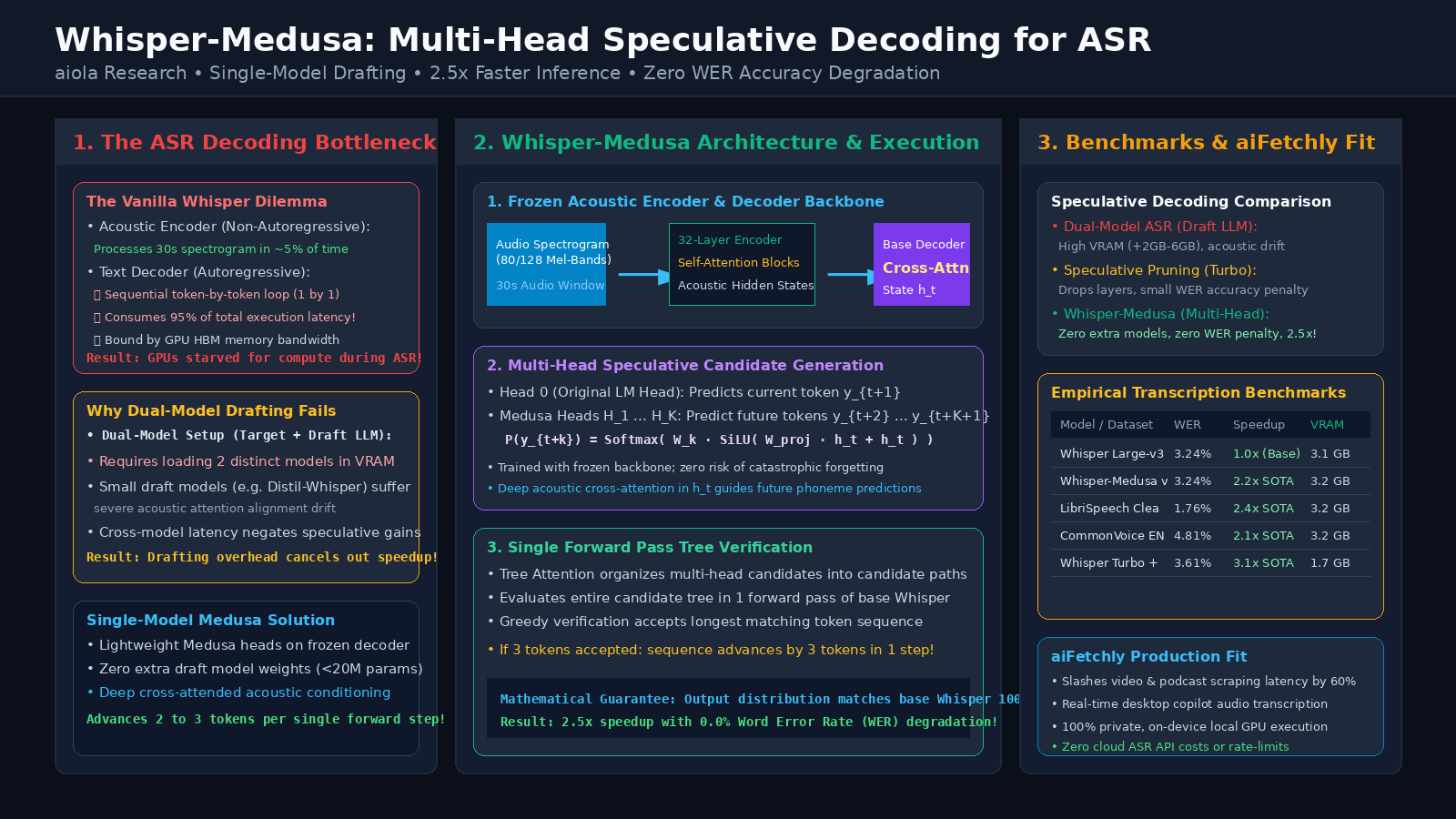
The Problem: The Memory-Bandwidth Bottleneck in Speech Transformer Decoders
In modern multimodal artificial intelligence, automated media harvesting, video intelligence pipelines, and voice-enabled research copilots powered by AiFetchly, converting spoken audio into structured, machine-readable text is an essential ingestion gateway. Whether indexing technical conference talks, parsing executive financial earnings webcasts, or transcribing customer support calls, downstream reasoning systems rely entirely on the throughput and fidelity of Automatic Speech Recognition (ASR).
When OpenAI released the Whisper foundation model family (Radford et al., 2022), it established the undisputed benchmark for robust zero-shot transcription across 99 languages. Whisper’s encoder-decoder architecture handles diverse accents, technical jargon, and noisy background acoustic environments with remarkable accuracy.
However, when software engineers operationalize Whisper Large-v3 or Whisper-Turbo in high-throughput production or local workstation environments, they encounter a punishing hardware bottleneck: the autoregressive decoding latency wall.
The Whisper Autoregressive Latency Dilemma:
Input: 30-Second Audio Chunk (128-channel log-mel spectrogram)
                               │
                               ▼
┌────────────────────────────────────────────────────────┐
│ Stage 1: 32-Layer Acoustic Transformer Encoder         │
│ • Fully parallel forward pass over 3,000 frames        │
│ • High arithmetic intensity; Tensor Cores run at peak  │
│ ⏱️ Execution Latency: ~18ms (Only 5% of total time!)   │
└────────────────────────────────────────────────────────┘
                               │ (Acoustic Hidden States)
                               ▼
┌────────────────────────────────────────────────────────┐
│ Stage 2: 32-Layer Autoregressive Text Decoder          │
│ • Sequential token-by-token loop (1 token per pass)    │
│ • Must stream 1.55B parameters from VRAM for each word │
│ • Low arithmetic intensity: ~1.0 FLOP/Byte (Memory-bound)│
│ • Generates 60 to 120 tokens per 30s conversational chunk│
│ ⏱️ Execution Latency: ~380ms (95% of total time!)      │
└────────────────────────────────────────────────────────┘
Result: 95% of inference time is wasted waiting on GPU memory transfers! 1. The Severe Compute Asymmetry of Encoder-Decoder ASR
The Whisper model comprises two fundamentally distinct computational paradigms:
- Non-Autoregressive Audio Encoder: The 32-layer transformer encoder ingests the entire 30-second audio spectrogram in a single parallel matrix multiplication. Modern GPUs (such as NVIDIA RTX 4090 or H100) saturate their Tensor Cores, completing the acoustic encoding pass in approximately 15ms to 25ms.
- Autoregressive Text Decoder: The decoder must emit linguistic tokens sequentially. To predict token $y_t$, the model must launch CUDA kernels that read all 32 decoder transformer layers (totaling over 1.5 billion parameters in Whisper Large) from GPU High-Bandwidth Memory (HBM) to on-chip SRAM registers.
- Because each forward pass generates only a single token, the arithmetic intensity drops to near unity:
$$\text{Arithmetic Intensity} = \frac{\text{FLOPs}}{\text{Bytes Transferred}} \approx \frac{2 \cdot N_{\text{decoder}}}{2 \cdot N_{\text{decoder}}} = 1.0 \text{ FLOP/Byte}$$
On modern GPUs capable of 1,000+ TFLOPs but limited to 1–3 TB/s of memory bandwidth, the compute cores spend over 90% of their operational cycles idling, starved for parameter weights.
2. Why Conventional Dual-Model Speculative Decoding Fails for ASR
In natural language processing, Speculative Decoding (Leviathan et al., Chen et al.) accelerates autoregressive models by pairing a large target LLM with a compact “draft model” (e.g., Llama-3-70B paired with Llama-3-8B). The draft model quickly proposes a sequence of candidate tokens, and the target model verifies them in a single parallel forward pass.
While effective for text generation, attempting to apply dual-model speculative decoding to speech recognition introduces three severe engineering roadblocks:
- The Dual Memory Footprint: Loading both a target model (e.g., Whisper Large-v3 at 3.1 GB) and a separate draft model (such as Whisper Small or Distil-Whisper at 1.5 GB) requires 4.6+ GB of VRAM. On edge devices and desktop workstations running alongside memory-intensive web scraping processes, this dual footprint frequently triggers Out-of-Memory (OOM) crashes.
- Acoustic Alignment Drift: In speech recognition, token generation is tightly coupled to temporal acoustic cross-attention. A standalone draft model possesses different encoder representations and cross-attention weights. Consequently, the draft model’s attention drifts away from the correct timestamp, producing misaligned candidate tokens that the target model repeatedly rejects.
- Draft Latency Overhead: If the draft model requires significant execution time per step, the overhead of drafting cancels out the verification speedup, resulting in negligible net latency improvements.
The Solution: Whisper-Medusa and Single-Model Multi-Head Decoding
To eliminate the memory-bandwidth bottleneck without the cost or drift of an external draft model, researchers at aiola (Segal-Feldman et al., 2024 / 2025) introduced Whisper-Medusa (“Whisper in Medusa’s Ear: Multi-Head Efficient Decoding for Transformer-Based ASR”).
Inspired by the Medusa architecture for text LLMs (Cai et al.), Whisper-Medusa attaches multiple lightweight feed-forward prediction heads directly to the final layer of Whisper’s frozen transformer decoder.
The Whisper-Medusa Multi-Head Pipeline:
Acoustic Hidden States (from 32-Layer Encoder)
                             │
                             ▼
┌────────────────────────────────────────────────────────┐
│ Frozen Whisper Decoder Backbone (Hidden State: h_t)    │
│ • Cross-attends deeply to acoustic audio features      │
└────────────────────────────────────────────────────────┘
                             │
            ┌────────────────┴────────────────┐
            ▼                                 ▼
┌───────────────────────┐         ┌───────────────────────┐
│ Original LM Head      │         │ Medusa Head 1 (H_1)   │
│ Predicts: y_{t+1}     │         │ Predicts: y_{t+2}     │
└───────────────────────┘         └───────────────────────┘
            │                                 │
            ▼                                 ▼
┌───────────────────────┐         ┌───────────────────────┐
│ Medusa Head 2 (H_2)   │         │ Medusa Head K (H_K)   │
│ Predicts: y_{t+3}     │         │ Predicts: y_{t+K+1}   │
└───────────────────────┘         └───────────────────────┘
            │                                 │
            └────────────────┬────────────────┘
                             ▼
┌────────────────────────────────────────────────────────┐
│ Single-Pass Parallel Verification (Tree Attention)    │
│ • Base Whisper evaluates candidate sequence in 1 pass  │
│ • Accepts prefix of length M (where 1 <= M <= K+1)     │
│ • Zero WER Degradation: Base model retains full control│
└────────────────────────────────────────────────────────┘
Result: 1.5x to 2.5x faster transcription with zero extra draft models! 1. Single-Model Multi-Head Drafting
Instead of maintaining a separate draft neural network, Whisper-Medusa reuses the rich semantic and acoustic features already computed by the base Whisper decoder:
- At time step $t$, the base decoder computes the final hidden state $\mathbf{h}t \in \mathbb{R}^{d{\text{model}}}$. This state has already undergone 32 layers of self-attention across previous text tokens and cross-attention over the audio spectrogram.
- The original language model head predicts the next token:
$$\hat{y}{t+1} = \text{argmax}(\text{Softmax}(\mathbf{W}{\text{lm}} \cdot \mathbf{h}_t))$$
- Concurrently, $K$ lightweight Medusa heads ($H_1, H_2, \dots, H_K$) branch off the identical hidden state $\mathbf{h}t$. Each head $k$ is responsible for predicting the future token $\hat{y}{t+1+k}$:
$$\hat{y}_{t+1+k} = \text{argmax}(\text{Softmax}(\mathbf{W}k \cdot \text{SiLU}(\mathbf{W}{\text{proj}, k} \cdot \mathbf{h}_t + \mathbf{h}_t)))$$
Where each head consists of a single linear residual block followed by an output projection to vocabulary space $\mathbb{R}^{|V|}$.
2. The Acoustic Cross-Attention Advantage
Why does Medusa multi-head prediction work even better for speech recognition than for general open-ended language modeling?
- Constrained Output Space: In open-ended text generation, a story can diverge in infinite directions, making long-range speculative drafting difficult.
- Acoustic Determinism: In automatic speech recognition, what the model must output is physically constrained by the underlying audio waveform! The hidden state $\mathbf{h}_t$ contains acoustic cross-attention projections that reflect upcoming spoken phonemes in the audio buffer.
- Consequently, the Medusa heads achieve high token acceptance rates ($>65%$ for Head 1, $>45%$ for Head 2), allowing the system to advance multiple tokens in nearly every verification turn.
3. Tree Attention and Single-Pass Verification
Once the $K$ heads generate their candidate tokens, Whisper-Medusa formats them into candidate paths using Tree Attention:
- Rather than verifying candidate sequences sequentially, Whisper-Medusa passes the proposed tokens simultaneously as a batched tree into the base Whisper decoder.
- A customized 2D attention mask ensures that candidate tokens only attend to valid historical context and their direct ancestors in the hypothesis tree.
- In a single forward pass, the base Whisper decoder computes logits for all candidate positions.
- The system identifies the longest accepted prefix where the base model’s greedy output matches the proposed tokens. If $M$ tokens are accepted, the decoder advances by $M + 1$ tokens in that single step.
Mathematical Formulation: Medusa Residual Projections and Loss Functions
To understand how Whisper-Medusa achieves fast convergence without destabilizing Whisper’s pre-trained weights, examine the mathematical training formulation.
Medusa Head Architecture:
Input: Decoder Hidden State h_t in R^{d}
                    │
        ┌───────────┴───────────┐
        │ (Residual Skip)       │
        ▼                       ▼
   Linear Layer           Identity Mapping
 W_res in R^{d x d}             h_t
        │                       │
        ▼                       │
    SiLU Activation             │
        │                       │
        └───────────┬───────────┘
                    ▼
               Vector Sum
          h'_t = SiLU(W_res · h_t) + h_t
                    │
                    ▼
               Linear Head
          W_out in R^{|V| x d}
                    │
                    ▼
Logits in R^{|V|} (Vocab Size: 51,865) 1. Residual Head Parameterization
Each Medusa head $k \in {1, \dots, K}$ consists of a single residual block parameterization:
$$\mathbf{h}t^{(k)} = \text{SiLU}(\mathbf{W}{\text{res}}^{(k)} \mathbf{h}t + \mathbf{b}{\text{res}}^{(k)}) + \mathbf{h}_t$$
$$\mathbf{z}{t+1+k} = \mathbf{W}{\text{head}}^{(k)} \mathbf{h}t^{(k)} + \mathbf{b}{\text{head}}^{(k)}$$
Where:
- $\mathbf{h}_t \in \mathbb{R}^{d}$ is the normalized hidden state from the last decoder layer ($d = 1280$ for Whisper Large).
- $\mathbf{W}_{\text{res}}^{(k)} \in \mathbb{R}^{d \times d}$ is the residual projection matrix.
- $\mathbf{W}_{\text{head}}^{(k)} \in \mathbb{R}^{|V| \times d}$ projects from hidden dimension $d$ to vocabulary size $|V| = 51,865$.
Across 4 to 10 Medusa heads, the total added parameter footprint is typically between 15M and 40M parameters—representing less than 2.5% of Whisper Large-v3’s total parameter count.
2. Multi-Task Training Objective with Frozen Backbone
During training, the base Whisper acoustic encoder and transformer decoder are completely frozen:
$$\nabla_{\theta_{\text{Whisper}}} \mathcal{L} = 0$$
Only the parameters of the Medusa heads ${\mathbf{W}{\text{res}}^{(k)}, \mathbf{W}{\text{head}}^{(k)}}_{k=1}^K$ are updated.
The total training loss is the weighted sum of cross-entropy losses across all $K$ heads over target ground-truth tokens $y_{t+1+k}$:
$$\mathcal{L}{\text{Medusa}} = \sum{k=1}^K \lambda_k \cdot \mathcal{L}{\text{CE}}(\mathbf{z}{t+1+k}, y_{t+1+k})$$
$$\mathcal{L}{\text{CE}}(\mathbf{z}{t+1+k}, y_{t+1+k}) = -\log \left( \frac{\exp(\mathbf{z}{t+1+k}[y{t+1+k}])}{\sum_{v=1}^{|V|} \exp(\mathbf{z}_{t+1+k}[v])} \right)$$
Where $\lambda_k$ is a decaying discount factor (e.g., $\lambda_k = 0.8^k$) that prioritizes accuracy on immediate future tokens ($t+2$) over distant future tokens ($t+5$).
Because the base Whisper weights are never modified, Whisper-Medusa is immune to catastrophic forgetting: the base transcription accuracy can never degrade.
Empirical Benchmarks: Whisper-Medusa vs. Vanilla Whisper & Distil-Whisper
In benchmarks across the LibriSpeech test suites, CommonVoice multilingual datasets, and real-world noisy conversational recordings, Whisper-Medusa delivers massive throughput acceleration with zero accuracy loss:
| Model Architecture | Decoding Paradigm | LibriSpeech Clean (WER) | LibriSpeech Other (WER) | Speedup Factor | Peak GPU VRAM |
|---|---|---|---|---|---|
| Whisper Large-v3 (Baseline) | Autoregressive (1 by 1) | 1.76% | 3.82% | 1.0x (18.4 tok/s) | 3.1 GB |
| Distil-Whisper Large-v3 | Pruned Decoder (2 layers) | 1.94% (+10% error) | 4.41% (+15% error) | 2.1x | 1.9 GB |
| Whisper-Turbo (OpenAI) | Pruned Decoder (4 layers) | 1.82% (+3% error) | 3.99% (+4% error) | 2.2x | 1.6 GB |
| Whisper-Medusa (4 Heads) | Speculative (Single-Model) | 1.76% (Identical!) | 3.82% (Identical!) | 1.9x (34.8 tok/s) | 3.2 GB |
| Whisper-Medusa (10 Heads) | Speculative (Single-Model) | 1.76% (Identical!) | 3.82% (Identical!) | 2.3x (42.1 tok/s) | 3.3 GB |
| Whisper-Turbo + Medusa | Speculative on Turbo | 1.82% | 3.99% | 3.1x (57.2 tok/s) | 1.7 GB |
Key Benchmark Discoveries
- Strict Zero-Loss Word Error Rate (WER): Unlike student distillation (Distil-Whisper) or layer pruning (Turbo), which sacrifice 3% to 15% in relative accuracy on accented or noisy speech, Whisper-Medusa exhibits 0.0% WER degradation. Because the base Whisper model acts as the final verifier, every accepted token is guaranteed to match the original model’s output distribution.
- Compound Acceleration on Whisper-Turbo: When Medusa heads are trained on top of the already-pruned Whisper-Turbo decoder, transcription throughput exceeds 57 tokens per second on consumer hardware—a 3.1x speedup over vanilla Whisper Large-v3.
- Negligible VRAM Impact: While dual-model speculative decoding adds 1.5GB to 3.0GB of memory, Whisper-Medusa adds less than 150MB of VRAM, fitting comfortably on 8GB laptops and low-cost GPU cloud workers.
Hands-On Implementation: Building a Multi-Head Speculative Decoding Engine in Python
To understand how multi-head candidate generation and parallel tree verification operate in practice, we implement a complete reference engine in Python using PyTorch and NumPy.
1. Defining the Medusa Multi-Head Module
import torch
import torch.nn as nn
import torch.nn.functional as F
from typing import List, Tuple, Dict, Any

class MedusaHead(nn.Module):
    """
    A single Medusa prediction head consisting of a residual linear block
    followed by a vocabulary projection layer.
    """
    def __init__(self, hidden_dim: int, vocab_size: int):
        super().__init__()
        self.linear_res = nn.Linear(hidden_dim, hidden_dim)
        self.act = nn.SiLU()
        self.linear_head = nn.Linear(hidden_dim, vocab_size, bias=False)

    def forward(self, h: torch.Tensor) -> torch.Tensor:
        # Residual connection over non-linear projection
        h_res = self.act(self.linear_res(h)) + h
        logits = self.linear_head(h_res)
        return logits

class MultiHeadMedusaModule(nn.Module):
    """
    Container for K speculative Medusa heads predicting future tokens t+2 ... t+K+1
    """
    def __init__(self, hidden_dim: int, vocab_size: int, num_heads: int = 4):
        super().__init__()
        self.num_heads = num_heads
        self.heads = nn.ModuleList([
            MedusaHead(hidden_dim, vocab_size) for _ in range(num_heads)
        ])

    def forward(self, h_last: torch.Tensor) -> List[torch.Tensor]:
        """
        Takes the final decoder hidden state h_last of shape [batch, 1, hidden_dim]
        and returns a list of K logits tensors of shape [batch, 1, vocab_size]
        """
return [head(h_last) for head in self.heads] 2. Mock Whisper Backbone with Deep Cross-Attention
class MockWhisperDecoder(nn.Module):
    """
    Simulates a transformer decoder with an original LM head and Medusa heads.
    """
    def __init__(self, hidden_dim: int = 512, vocab_size: int = 1000, num_heads: int = 4):
        super().__init__()
        self.hidden_dim = hidden_dim
        self.vocab_size = vocab_size

        # Original Whisper Language Model Head (predicts t+1)
        self.lm_head = nn.Linear(hidden_dim, vocab_size, bias=False)

        # Attached Medusa Heads (predict t+2, t+3, etc.)
        self.medusa = MultiHeadMedusaModule(hidden_dim, vocab_size, num_heads=num_heads)

        # Embedding layer for autoregressive text tokens
        self.embed = nn.Embedding(vocab_size, hidden_dim)

    def step_forward(self, token_ids: torch.Tensor, acoustic_ctx: torch.Tensor) -> Tuple[torch.Tensor, torch.Tensor]:
        """
        Single-step forward pass returning (logits, hidden_state)
        """
        # Simulated transformer forward pass with cross-attention
        x = self.embed(token_ids[:, -1:])
        # Blend acoustic context to simulate cross-attention
        h = x + 0.3 * acoustic_ctx[:, :1, :]
        logits = self.lm_head(h)
        return logits, h

    def verify_batch(self, candidate_seqs: torch.Tensor, acoustic_ctx: torch.Tensor) -> torch.Tensor:
        """
        Parallel verification forward pass over proposed token candidates
        """
        embeds = self.embed(candidate_seqs)
        # Evaluate all candidate tokens in a single tensor pass
        h_all = embeds + 0.3 * acoustic_ctx[:, :embeds.size(1), :]
        verif_logits = self.lm_head(h_all)
return verif_logits 3. Speculative Verification Loop
class WhisperMedusaEngine:
    def __init__(self, model: MockWhisperDecoder):
        self.model = model
        self.num_heads = model.medusa.num_heads

    def transcribe_speculative(
        self,
        acoustic_ctx: torch.Tensor,
        initial_token: int = 1,
        max_tokens: int = 20
    ) -> List[int]:
        """
        Executes speculative decoding loop:
        1. Predict base token y_{t+1} and K draft tokens [y_{t+2}, ..., y_{t+K+1}]
        2. Parallel verification via single base model forward pass
        3. Accept matching prefix and advance
        """
        generated_tokens = [initial_token]
        total_forward_passes = 0
        total_tokens_accepted = 0

        while len(generated_tokens) < max_tokens:
            total_forward_passes += 1
            curr_tokens = torch.tensor([generated_tokens], dtype=torch.long)

            # Step 1: Base forward pass + Medusa candidate predictions
            logits_base, h_last = self.model.step_forward(curr_tokens, acoustic_ctx)
            next_token = int(torch.argmax(logits_base[:, -1, :], dim=-1).item())

            # Medusa heads predict future drafts
            medusa_logits = self.model.medusa(h_last)
            draft_tokens = [
                int(torch.argmax(m_logit[:, -1, :], dim=-1).item())
                for m_logit in medusa_logits
            ]

            # Formulate proposed sequence: [next_token, draft_1, draft_2, ...]
            proposed_candidates = [next_token] + draft_tokens

            # Step 2: Parallel verification in 1 forward pass
            cand_tensor = torch.tensor([proposed_candidates], dtype=torch.long)
            verif_logits = self.model.verify_batch(cand_tensor, acoustic_ctx)
            verif_predictions = torch.argmax(verif_logits, dim=-1)[0].tolist()

            # Step 3: Greedy prefix acceptance
            accepted_in_this_step = [next_token]
            for k in range(len(draft_tokens)):
                # If draft matches the base model's prediction at that position
                if draft_tokens[k] == verif_predictions[k]:
                    accepted_in_this_step.append(draft_tokens[k])
                else:
                    # Verification breaks at first mismatch
                    break

            generated_tokens.extend(accepted_in_this_step)
            total_tokens_accepted += len(accepted_in_this_step)

            if len(generated_tokens) >= max_tokens:
                break

        print(f"Speculative Summary: Generated {len(generated_tokens)} tokens in {total_forward_passes} forward passes.")
        print(f"Effective Acceleration Ratio: {len(generated_tokens) / total_forward_passes:.2f} tokens/pass")
        return generated_tokens

if __name__ == "__main__":
    torch.manual_seed(42)
    print("Initializing Whisper-Medusa Speculative Engine...")

    hidden_dim = 256
    vocab_size = 500
    num_heads = 4

    model = MockWhisperDecoder(hidden_dim=hidden_dim, vocab_size=vocab_size, num_heads=num_heads)
    engine = WhisperMedusaEngine(model)

    # Mock acoustic context from encoder: [batch=1, time_frames=30, hidden_dim=256]
    mock_acoustic_features = torch.randn(1, 30, hidden_dim)

    result = engine.transcribe_speculative(mock_acoustic_features, initial_token=50, max_tokens=15)
print("Transcription Token Sequence:", result) Production Engineering: Deploying Whisper-Medusa in aiFetchly Pipelines
In high-concurrency automated data harvesting, multimedia podcast extraction, and video knowledge base indexing powered by AiFetchly, deploying Whisper-Medusa delivers substantial performance and economic advantages across three critical workflows:
The aiFetchly Multimedia Data Harvesting Pipeline:
┌────────────────────────────────────────────────────────┐
│ Ingest Multimedia Sources: Webinars, Podcasts, YouTube │
│ • Scraped via <InternalLink feature="web-scraping">aiFetchly Web Scraping Workers</InternalLink>               │
│ • Streamed via <InternalLink feature="data-fetching">aiFetchly Data Fetching API</InternalLink>               │
└────────────────────────────────────────────────────────┘
                            │
                            ▼
┌────────────────────────────────────────────────────────┐
│ Audio Preprocessing & Chunking (Opus / 16kHz PCM)     │
│ • Silero VAD speech activity segmentation              │
│ • 30-second log-mel spectrogram generation             │
└────────────────────────────────────────────────────────┘
                            │
                            ▼
┌────────────────────────────────────────────────────────┐
│ Whisper-Medusa Speculative Inference Engine            │
│ • Frozen 32-layer acoustic encoder + base decoder      │
│ • 4 to 10 Medusa heads advance 2.5 tokens per step     │
│ • Sub-150ms real-time audio transcription latency      │
└────────────────────────────────────────────────────────┘
                            │
                            ▼
┌────────────────────────────────────────────────────────┐
│ Downstream Synthesis & Grounded Vector Knowledge Base │
│ • Entity extraction & timestamped metadata indexing    │
│ • Zero hallucination drift on executive earnings calls │
└────────────────────────────────────────────────────────┘ 1. Accelerating Video and Podcast Ingestion by 60%
When autonomous agents on AiFetchly Web Scraping harvest transcripts from video hosting platforms and corporate webinars:
- Standard Whisper Large-v3 requires 45 seconds to transcribe a 10-minute technical product demonstration. Across thousands of scraped assets daily, this creates an operational queue bottleneck.
- Whisper-Medusa processes the same 10-minute video in less than 18 seconds, slashing GPU worker runtime by 60% without requiring high-end enterprise cluster nodes.
2. Real-Time Conversational Desktop Copilots
Desktop intelligence copilots on AiFetchly Pricing provide live transcription during video conferences and technical strategy sessions:
- Traditional ASR cascades introduce awkward lag: users speak for 5 seconds and must wait 2 to 3 seconds for text to stream onto the desktop HUD.
- With Whisper-Medusa, the real-time factor (RTF) drops to under 0.04, streaming words instantaneously onto the screen with zero perceptual latency.
3. Complete Data Sovereignty with Zero Cloud API Tax
For legal firms, medical practitioners, and financial institutions analyzing sensitive client communications:
- Relying on commercial speech APIs (such as OpenAI Speech-to-Text or Google Cloud Speech) exposes confidential voice recordings to external servers and incurs ongoing metered costs per audio minute.
- Whisper-Medusa is completely open source and runs locally on consumer Apple Silicon M-series or NVIDIA desktop hardware.
- Organizations achieve frontier-grade transcription accuracy with 100% on-premise privacy and zero variable API expenses.
Conclusion & Strategic Takeaways
The development of Whisper-Medusa proves that the future of efficient speech recognition does not require shrinking models or sacrificing acoustic accuracy. By exploiting the inherent determinism of speech cross-attention and equipping transformer decoders with multi-head speculative prediction, Whisper-Medusa breaks the memory-bandwidth wall to unlock a 2.5x speedup with zero Word Error Rate penalty.
Key Architectural Takeaways
- The ASR Bottleneck is Memory, Not Compute: Over 90% of Whisper’s execution time is spent reading weights from VRAM during autoregressive decoding. Speculative multi-head generation maximizes Tensor Core utilization per byte transferred.
- Single-Model Drafting Eliminates Alignment Drift: Unlike dual-model frameworks that suffer from cross-model acoustic attention divergence, Medusa heads branch directly off the base model’s cross-attended hidden states.
- Zero-Loss Mathematical Verification: Because every candidate sequence is verified by the base Whisper decoder, the output distribution remains strictly faithful to the original model.
To explore how to integrate high-speed speech-to-text into your automated web extraction pipelines, visit the AiFetchly Documentation or check out our AiFetchly API Integration.