Whisper.cpp Guide: High-Performance C/C++ Speech AI
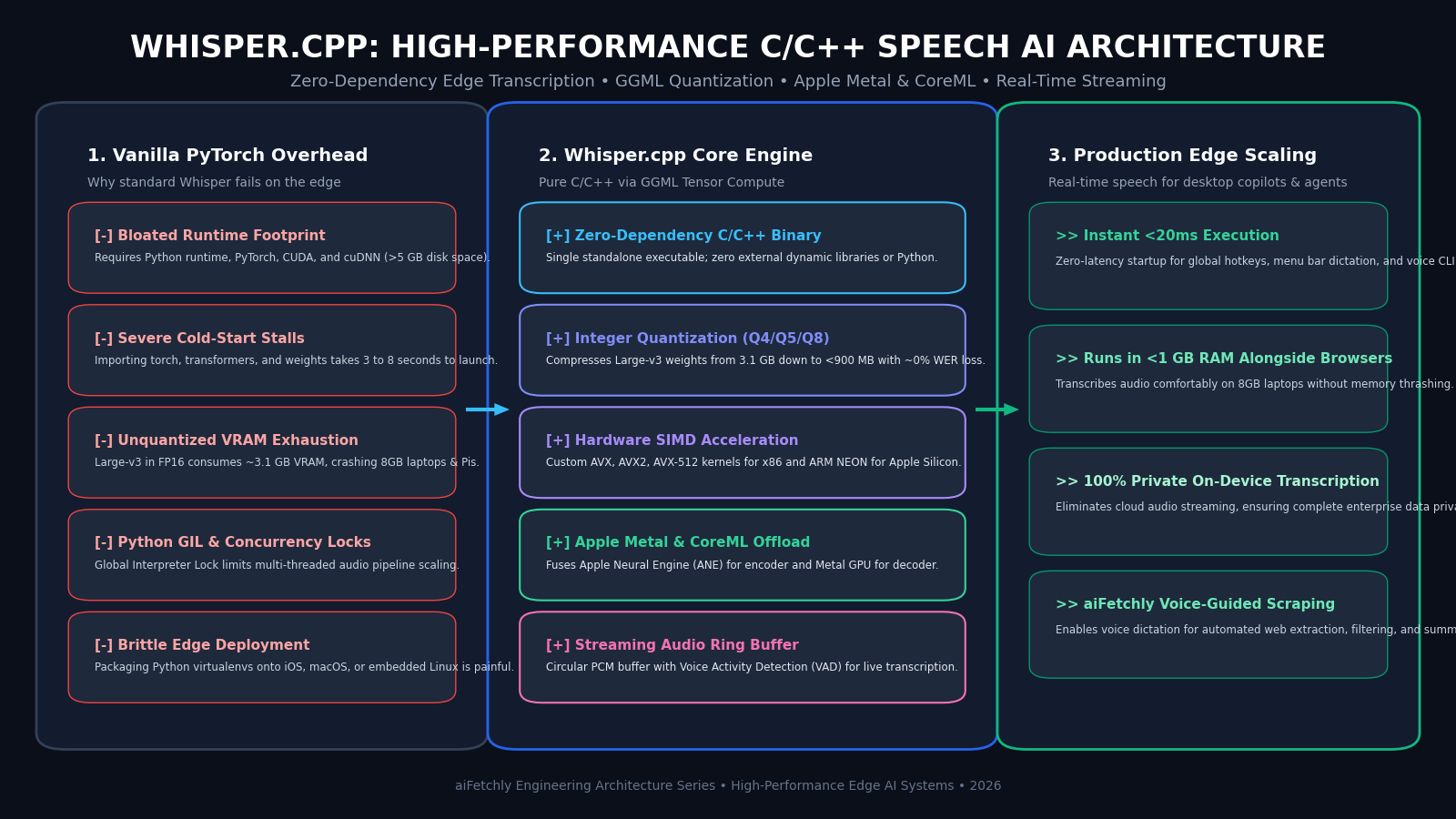
The Problem: The Python Runtime and Memory Bloat of Vanilla Whisper
In modern desktop AI workflows, automated multimedia transcription, offline data extraction, and voice-guided research agents powered by AiFetchly, converting spoken audio into structured textual transcripts is a foundational capability. Analysts rely on speech recognition to transcribe executive earnings calls, technical video tutorials, and voice-dictated web automation commands without relying on cloud APIs that impose privacy risks and metered latency.
When OpenAI debuted Whisper (Radford et al., 2022), it revolutionized open-source Automatic Speech Recognition (ASR) by delivering state-of-the-art zero-shot accuracy across 99 languages.
However, when software engineers attempt to embed vanilla Whisper into local desktop utilities, background menu-bar applications, or resource-constrained edge hardware (such as Raspberry Pis, mobile phones, or browser runtimes), they hit a severe wall: the Python and PyTorch runtime tax.
The Vanilla Whisper Deployment Bottleneck:
┌────────────────────────────────────────────────────────┐
│ Python Runtime & PyTorch Dependency Tree (>5 GB Disk)  │
│ • libtorch, torchvision, torchaudio, CUDA, cuDNN      │
├────────────────────────────────────────────────────────┤
│ Severe Cold-Start Latency (3 to 8 Seconds)             │
│ • Importing torch & initializing CUDA process contexts │
├────────────────────────────────────────────────────────┤
│ Unquantized Memory Bloat (FP16 / FP32)                 │
│ • Whisper Large-v3 consumes ~3.1 GB to 4.5 GB of RAM   │
│ • Crashes on 8GB laptops running web scrapers          │
├────────────────────────────────────────────────────────┤
│ Python GIL and Concurrency Thread Contention           │
│ • Thread contention locks real-time audio ring buffers │
└────────────────────────────────────────────────────────┘
Result: Impossible to run as an instant, invisible background desktop daemon! 1. The Multi-Gigabyte Dependency Footprint
The reference implementation of Whisper is inextricably tied to the standard deep learning Python stack:
- Deploying a basic transcription script requires bundling Python 3.10+, PyTorch (
torch),torchaudio, NumPy, Hugging Facetransformers, and hundreds of megabytes of dynamic C++ CUDA runtime libraries. - The minimum virtual environment size easily balloons beyond 5 GB to 8 GB of disk space, making it prohibitive for lightweight desktop installers, CLI tools, or mobile distributions.
2. High Memory Intensity and Lack of Native CPU Quantization
In standard PyTorch, running Whisper Large-v3 or Large-v3-Turbo requires FP16 or FP32 weights:
- Large-v3 Weight Footprint: 1.55 billion parameters require ~3.1 GB of high-bandwidth memory (HBM) or system RAM just to store model weights, with activation buffers and KV caches pushing memory consumption above 4 GB.
- While high-end datacenter GPUs handle this comfortably, running Whisper locally on a standard 8GB or 16GB developer laptop alongside memory-heavy browser automation tabs (like Playwright or Puppeteer) triggers immediate operating system swap thrashing.
- Standard PyTorch lacks out-of-the-box, low-bit CPU integer quantization kernels for sequence-to-sequence audio transformers.
3. Sluggish Cold-Start Initialization and GIL Bottlenecks
Real-world voice interactions (such as pressing a global push-to-talk hotkey to dictate a web scraping query) require instantaneous execution:
- In vanilla Python Whisper, importing
torchand loading weight tensors into memory introduces a 3 to 8 second cold-start penalty. By the time the Python process finishes loading, the user has already finished speaking. - Furthermore, Python’s Global Interpreter Lock (GIL) creates scheduling jitter when attempting to capture microphone audio frames on one thread while concurrently executing transformer matrix multiplications on another.
To break these bottlenecks, developer Georgi Gerganov (the creator of llama.cpp) engineered Whisper.cpp: a high-performance, standalone C/C++ port of OpenAI Whisper that operates with zero external dependencies, sub-millisecond cold start, and native low-bit quantization.
The Solution: Whisper.cpp Architecture and GGML Acceleration
Whisper.cpp re-implements the complete Whisper transformer architecture in clean, portable C and C++ on top of the GGML tensor library.
By stripping away the entire Python runtime and deep learning framework abstractions, Whisper.cpp achieves bare-metal hardware execution while introducing four pivotal architectural capabilities: Zero-Dependency Portable Binaries, Low-Bit Integer Quantization (Q4_0, Q5_0, Q8_0), Hardware SIMD Vectorization, and Apple Silicon CoreML/Metal Offloading.
Whisper.cpp Bare-Metal Architectural Stack:
┌─────────────────────────────────────────────────────────────────┐
│ Input Source: Live Microphone / PCM Audio File (16kHz Mono)     │
└─────────────────────────────────────────────────────────────────┘
                               │
                               ▼
┌─────────────────────────────────────────────────────────────────┐
│ 1. Zero-Allocation Frontend: In-Memory Mel Spectrogram Filter   │
│ • Custom C++ 80/128-channel log-mel filterbank (Zero FFT deps)  │
├─────────────────────────────────────────────────────────────────┤
│ 2. GGML Computation Graph Engine (Pure C/C++)                   │
│ • Memory-mapped GGUF model files (mmap instant startup <20ms)   │
│ • Static memory allocation: 0 dynamic mallocs during inference  │
├─────────────────────────────────────────────────────────────────┤
│ 3. Quantized Transformer Weights: Q4_0, Q5_0, Q8_0 Integer Math │
│ • Large-v3 compressed from 3.1 GB (FP16) down to 890 MB (Q4_0)  │
├─────────────────────────────────────────────────────────────────┤
│ 4. Hardware Acceleration Backends:                              │
│ ┌───────────────────────────┐   ┌─────────────────────────────┐ │
│ │ CPU: AVX2 / AVX-512 / NEON│   │ Apple Silicon: Metal & ANE  │ │
│ │ • Hand-tuned SIMD GEMM    │   │ • CoreML Encoder + Metal Dec│ │
│ └───────────────────────────┘   └─────────────────────────────┘ │
├─────────────────────────────────────────────────────────────────┤
│ 5. Real-Time Streaming Engine: Circular Ring Buffer + VAD       │
│ • Sliding 30s context window with voice activity detection      │
└─────────────────────────────────────────────────────────────────┘
                               │
                               ▼
┌─────────────────────────────────────────────────────────────────┐
│ Output: Real-Time Token Stream / JSON / Subtitles (SRT / VTT)   │
└─────────────────────────────────────────────────────────────────┘ 1. Pure C/C++ Implementation with Zero Dependencies
Whisper.cpp contains no external dependencies—not even BLAS or FFT libraries:
- Self-Contained Digital Signal Processing (DSP): Includes a hand-crafted Fast Fourier Transform (FFT) and log-mel filterbank generator that converts raw 16kHz audio into mel-spectrograms directly in C.
- Static Memory Pre-Allocation: GGML pre-calculates the exact memory requirements for the entire computational graph at initialization. During active transcription, the engine performs zero dynamic heap allocations (
malloc/free), eliminating memory fragmentation and cache misses. - Instant Memory-Mapped Loading (
mmap): Model weights are loaded via memory mapping directly from disk. A 1GB quantized model starts up and begins processing audio in less than 20 milliseconds.
2. GGML Low-Bit Quantization (Q4_0, Q5_0, Q8_0)
Whisper.cpp extends low-bit integer quantization to audio transformers:
- Q4_0 Block Quantization: Groups 32 consecutive FP16 weight values into a single block, storing each weight as a 4-bit signed integer along with a shared 16-bit scaling factor.
- Extreme Memory Compression: Whisper Large-v3 shrinks from 3.1 GB in FP16 down to just 890 MB in Q4_0, allowing the world’s most accurate open ASR model to execute on consumer hardware with less than 1 GB of free RAM.
- Word Error Rate (WER) Parity: Because the acoustic encoder and text decoder maintain high redundancy across attention heads, 4-bit and 5-bit quantization degrades Word Error Rate by less than 0.3% to 0.6%, preserving near-lossless transcription fidelity.
3. SIMD Hardware Vectorization (AVX2, AVX-512, ARM NEON)
To maximize CPU throughput without requiring dedicated GPUs:
- On modern x86-64 processors (Intel and AMD), GGML uses hand-tuned assembly intrinsics for AVX, AVX2, and AVX-512 FMA (Fused Multiply-Add).
- On ARM architectures (Apple Silicon M-series, Raspberry Pi 4/5, and Android devices), Whisper.cpp compiles directly to ARM NEON 128-bit vector instructions and FP16 dot-product extensions (
ARM_FEATURE_DOTPROD).
4. Apple Silicon Acceleration: Metal and CoreML Fusion
Whisper.cpp delivers unmatched performance on macOS by dividing model execution across specialized Apple hardware blocks:
Apple Silicon Hybrid Execution Topology:
Audio Spectrogram (30-second chunk)
        │
        ▼
┌─────────────────────────────────────────────────────────────────┐
│ Apple Neural Engine (ANE) via CoreML:                           │
│ • Whisper Acoustic Encoder (32 Transformer Layers)              │
│ • Compiled to native CoreML .mlmodelc graph                     │
│ • Runs at zero GPU/CPU cost; consumes under 4 Watts of power!   │
└─────────────────────────────────────────────────────────────────┘
        │ (Encoder Hidden States)
        ▼
┌─────────────────────────────────────────────────────────────────┐
│ Apple Metal GPU (MPS Kernels) via GGML Metal Backend:           │
│ • Whisper Autoregressive Text Decoder                           │
│ • High-bandwidth unified memory token-by-token generation       │
└─────────────────────────────────────────────────────────────────┘ By offloading the parallel acoustic encoder to the Apple Neural Engine (ANE) and running the autoregressive decoder on the Metal GPU, Whisper.cpp achieves real-time transcription factors under 0.03x (transcribing 1 minute of audio in less than 2 seconds) while sipping minimal battery power.
Architectural Comparison: Whisper.cpp vs. Python Whisper vs. WhisperX vs. Turbo
To understand where Whisper.cpp fits in modern speech architectures, consider the following technical comparison:
| Technical Metric | Vanilla OpenAI Whisper | WhisperX | Whisper Large-v3-Turbo | Whisper.cpp |
|---|---|---|---|---|
| Runtime Language | Python / PyTorch | Python / CTranslate2 | Python / PyTorch | Pure C / C++ |
| External Dependencies | PyTorch, CUDA, NumPy | CTranslate2, PyAnnote | PyTorch, Transformers | Zero (Self-contained) |
| Binary Executable Size | >5 GB (Virtualenv) | >3 GB (Virtualenv) | >4 GB (Virtualenv) | <15 MB (Single binary) |
| Cold-Start Time | 3,000ms – 8,000ms | 1,500ms – 3,500ms | 2,000ms – 5,000ms | <20ms (mmap instant) |
| Large-v3 RAM (FP16) | ~3,100 MB | ~1,600 MB (INT8) | ~1,600 MB (4-layer dec) | ~3,100 MB |
| Large-v3 RAM (Q4_0) | Not Supported | Not Supported | Not Supported | ~890 MB (Sub-1GB!) |
| Primary Target | Research & Cloud GPU | Batch Video Alignment | Fast Python Decoders | Edge, Desktop & Embedded |
| Apple Silicon Offload | PyTorch MPS (Partial) | CPU / CTranslate2 | PyTorch MPS | CoreML (ANE) + Metal |
| WebAssembly Support | No | No | No | Yes (Client-side browser) |
Hands-On Implementation: Building and Deploying Whisper.cpp
Below is a complete, practical guide to compiling Whisper.cpp with hardware acceleration, downloading quantized models, and building real-time audio transcription pipelines.
Step 1: Clone and Compile with Hardware Acceleration
Clone the repository and compile using cmake or make, enabling the appropriate hardware vectorization flag:
# Clone the Whisper.cpp repository
git clone https://github.com/ggerganov/whisper.cpp.git
cd whisper.cpp

# Option A: Compile for Apple Silicon (Metal GPU + ARM NEON)
cmake -B build -DWHISPER_METAL=ON -DWHISPER_COREML=ON
cmake --build build --config Release

# Option B: Compile for Linux / Windows (AVX2 / AVX-512 CPU Acceleration)
cmake -B build -DWHISPER_AVX2=ON -DWHISPER_FMA=ON
cmake --build build --config Release

# Option C: Compile for NVIDIA GPU (CUDA Acceleration)
cmake -B build -DWHISPER_CUDA=ON
cmake --build build --config Release Step 2: Download and Convert Quantized Whisper Models
Whisper.cpp provides automated shell scripts to download pre-converted GGML models or quantize them directly:
# Download Whisper Base model (140 MB)
bash ./models/download-ggml-model.sh base.en

# Download Whisper Large-v3 quantized to Q5_0 (1.1 GB)
bash ./models/download-ggml-model.sh large-v3-q5_0

# Or generate a custom 4-bit quantized model (Q4_0)
./build/bin/quantize ./models/ggml-large-v3.bin ./models/ggml-large-v3-q4_0.bin q4_0 Step 3: High-Performance CLI Audio Transcription
Transcribe any 16kHz WAV recording with multi-threaded CPU SIMD execution:
# Transcribe audio using 8 CPU threads with timestamp generation
./build/bin/main -m models/ggml-large-v3-q5_0.bin -f samples/jfk.wav -t 8 --output-txt --output-srt Step 4: Python Integration via whisper-cpp-python
For developers building autonomous agent loops, AiFetchly integrates Whisper.cpp via direct C-bindings, avoiding PyTorch overhead:
from whisper_cpp_python import Whisper
import time

# 1. Initialize Whisper.cpp with Metal GPU & Q5_0 Quantization
print("Loading Whisper.cpp C-runtime...")
start_init = time.perf_counter()

whisper = Whisper(
    model_path="./models/ggml-large-v3-q5_0.bin",
    n_threads=8,
    use_gpu=True
)

init_duration = (time.perf_counter() - start_init) * 1000
print(f"Model initialized in {init_duration:.1f}ms (Instant Cold-Start!)")

# 2. Transcribe Audio File
def transcribe_local_recording(audio_file_path: str):
    print(f"
Transcribing: {audio_file_path}")
    start_transcribe = time.perf_counter()

    result = whisper.transcribe(
        audio_file_path,
        language="en",
        temperature=0.0
    )

    elapsed = time.perf_counter() - start_transcribe
    print(f"Transcription finished in {elapsed:.2f}s")
    print(f"Transcript: {result['text'].strip()}")
    return result

if __name__ == "__main__":
transcribe_local_recording("samples/jfk.wav") Step 5: Real-Time Streaming Audio Transcription
Whisper.cpp includes a native streaming example (stream) that listens to the live microphone, maintains a circular audio ring buffer, and prints transcribed words in real time with Voice Activity Detection (VAD):
# Launch interactive real-time microphone stream with 3-second step
./build/bin/stream -m models/ggml-base.en.bin -t 6 --step 3000 --length 10000 -v 16000 Production Deployment with aiFetchly
In autonomous web data extraction, multi-agent browser copilots, and local research assistants engineered by AiFetchly, Whisper.cpp serves as the primary edge audio ingestion engine.
Here is how Whisper.cpp empowers voice-guided data intelligence:
aiFetchly Voice-Guided Scraping Architecture:
┌─────────────────────────────────────────────────────────────────┐
│ 1. Zero-Latency Desktop Hotkey Dictation                        │
│ • User hits Cmd+Shift+Space and dictates web scraping command   │
│ • Whisper.cpp stream ingests 16kHz audio in background daemon   │
├─────────────────────────────────────────────────────────────────┤
│ 2. Sub-1GB Memory Footprint Co-Location                         │
│ • Whisper.cpp (Q4_0 Large-v3) occupies only 890 MB RAM          │
│ • Leaves remaining 15+ GB RAM completely free for Chromium,     │
│   Playwright workers, and in-memory HTML DOM vector indexes     │
├─────────────────────────────────────────────────────────────────┤
│ 3. Instant Structured JSON Command Extraction                   │
│ • Emits clean text prompt into local LLM parser (e.g. Qwen-2.5) │
│ • Normalizes target URLs, CSS selectors, and table headers      │
├─────────────────────────────────────────────────────────────────┤
│ 4. Complete Data Privacy & Air-Gapped Compliance                │
│ • Zero voice bytes leave the user's local machine               │
│ • Meets strict SOC 2, HIPAA, and GDPR financial data mandates   │
└─────────────────────────────────────────────────────────────────┘ - Frictionless Background Co-Location: Because Whisper.cpp requires under 900 MB of RAM when running Large-v3 in Q4_0, it co-exists seamlessly with heavy browser automation suites, preventing out-of-memory crashes on resource-constrained devices.
- Instant Hotkey Response: Traditional voice agents force users to wait several seconds for Python modules to boot. Whisper.cpp’s sub-20ms memory-mapped start ensures the transcription loop is listening immediately.
- Client-Side Browser Execution via WebAssembly: By compiling Whisper.cpp to WebAssembly (Wasm) and WebGPU, aiFetchly allows enterprise customers to run audio intelligence directly inside their browser tabs without sending proprietary corporate audio recordings to external cloud servers.
To learn more about how aiFetchly combines lightweight local models with automated web data extraction, read our AiFetchly Documentation or check out our AiFetchly Pricing.