Weaviate Guide: Hybrid Vector Search & Multi-Tenancy
The Problem: The Scalability and Multi-Tenancy Crisis in Enterprise Vector Search
In modern enterprise software, SaaS applications, and automated data extraction engines like AiFetchly, generative artificial intelligence is rarely deployed for a single isolated user. Enterprise platforms serve thousands of commercial tenants: distinct corporate clients, internal business units, and decentralized edge agents. Each tenant requires isolated document indices, strict data access controls, and zero tolerance for cross-tenant data leakage.
However, scaling vector search across multi-tenant production environments reveals three punishing engineering bottlenecks: the multi-tenant isolation failure, the RAM cost wall of uncompressed embeddings, and the lexical blind spots of pure dense vectors.
The Enterprise Multi-Tenant Vector Dilemma:
┌─────────────────────────────────────────────────────────────────┐
│ Approach 1: Filter-Based Multi-Tenancy (Single Global Index)    │
│ • Documents tagged with metadata: `tenant_id: "acme_corp"`      │
│ ❌ Noisy Neighbor: Tenant A's 10M vectors stall Tenant B's queries│
│ ❌ Filter Degradation: ANN graph traversals fail on small subsets│
│ ❌ Security Nightmare: Buggy filter leaks competitor data!       │
├─────────────────────────────────────────────────────────────────┤
│ Approach 2: Monolithic Per-Tenant Clusters or Collections       │
│ • Creating 5,000 separate collections / cloud database nodes    │
│ ❌ Memory Exhaustion: Idle HNSW graphs consume 100s of GBs RAM! │
│ ❌ Connection Limits: OS file descriptors and sockets collapse  │
│ ❌ Astronomical Cloud Costs: Paying $50,000/mo for idle data    │
├─────────────────────────────────────────────────────────────────┤
│ Approach 3: Pure Dense Vector Semantic Retrieval                │
│ ❌ Exact Keyword Blindness: Misses part numbers (e.g., "A-104") │
│ ❌ Acronym Failures: Confuses domain abbreviations with slang   │
└─────────────────────────────────────────────────────────────────┘
Result: Engineering teams are forced into untenable infrastructure tradeoffs! 1. The Failure of Metadata Pre-Filtering for Multi-Tenancy
In legacy vector architectures, multi-tenancy is often handled through metadata filtering:
- Every document is stored in a single, massive global HNSW (Hierarchical Navigable Small World) index and tagged with a metadata field:
tenant_id = "tenant_123". - Search Degradation: HNSW graphs rely on dense geometric clustering. When a query filters by a specific tenant that only owns 0.1% of the total vectors, the graph traversal algorithm is forced to explore hundreds of irrelevant nodes before finding valid candidates, causing query latencies to spike from 5ms to over 500ms.
- Data Bleed Vulnerabilities: A single omitted filter predicate in application code accidentally exposes one customer’s private contracts to another customer’s prompt context.
2. The Crushing RAM Cost Wall of 1536-Dimensional Vectors
Standard embedding models (such as text-embedding-3-large, bge-large, or Cohere v3) emit dense vectors spanning 1,024 to 3,072 dimensions:
- Storing vectors in standard 32-bit floating point (
float32) requires $4 \text{ bytes per dimension}$. - For an enterprise indexing 50 million document chunks at 1,536 dimensions, the raw vectors alone demand 307 Gigabytes of memory.
- When factoring in HNSW graph bidirectional links and inverted index structures, RAM requirements exceed 600 Gigabytes, requiring multi-node enterprise cloud clusters costing tens of thousands of dollars per month.
3. The Lexical Blind Spots of Dense Embeddings
While dense bi-encoders capture abstract semantic meaning well (e.g., matching “feline medical care” with “cat veterinary health”), they are notoriously bad at exact lexical matching:
- They fail on specific serial numbers, part codes (e.g.,
"XG-9021"), programming variable identifiers, legal statute codes, and uncommon proper nouns. - Without unified lexical search, mission-critical document retrieval frequently surfaces conceptually similar but factually incorrect passages.
The Solution: Weaviate’s Cloud-Native Modular Architecture
To overcome the scaling limits of first-generation vector databases, developers built Weaviate.
Weaviate is an open-source, cloud-native vector search engine written in Go. Engineered from the ground up for high-scale enterprise multi-tenancy and production RAG, Weaviate natively integrates two-way hybrid search (BM25 + HNSW), multi-stage vector compression (Binary Quantization, Product Quantization, Scalar Quantization), and a dynamic cold-storage tenant offloading architecture.
Weaviate Cloud-Native Multi-Tenant Architecture:
┌─────────────────────────────────────────────────────────────────┐
│ Client Applications (aiFetchly SaaS, Web Scrapers, Python v4)   │
└─────────────────────────────────────────────────────────────────┘
 │
 ▼ (High-Throughput gRPC v4 Protobuf Streams / GraphQL)
┌─────────────────────────────────────────────────────────────────┐
│ Weaviate Cluster Router & Tenant Coordinator                    │
│ • Directs queries to isolated tenant shards                     │
│ • Manages tenant lifecycle states dynamically                   │
└─────────────────────────────────────────────────────────────────┘
 │
 ├── Tenant "Acme Corp" [ACTIVE State]
 │    ├── HNSW Vector Index (Compressed via Binary Quantization)  │
 │    └── Inverted BM25 Index (Exact Lexical Keyword Search)      │
 │
 ├── Tenant "Globex Inc" [INACTIVE State]
 │    └── Local NVMe SSD Cache (Unloaded from active RAM)         │
 │
 └── Tenant "Initech LLC" [OFFLOADED State]
      └── Cold Object Storage (Amazon S3 / Google Cloud Storage)  │
 │
 ▼
┌─────────────────────────────────────────────────────────────────┐
│ Relative Score Fusion (RSF) Engine (alpha = 0.5)                │
│ • Normalizes BM25 score curve with HNSW cosine distance         │
│ • Sub-10ms ranked top-k passages delivered to LLM context       │
└─────────────────────────────────────────────────────────────────┘ The Architectural Pillars of Weaviate
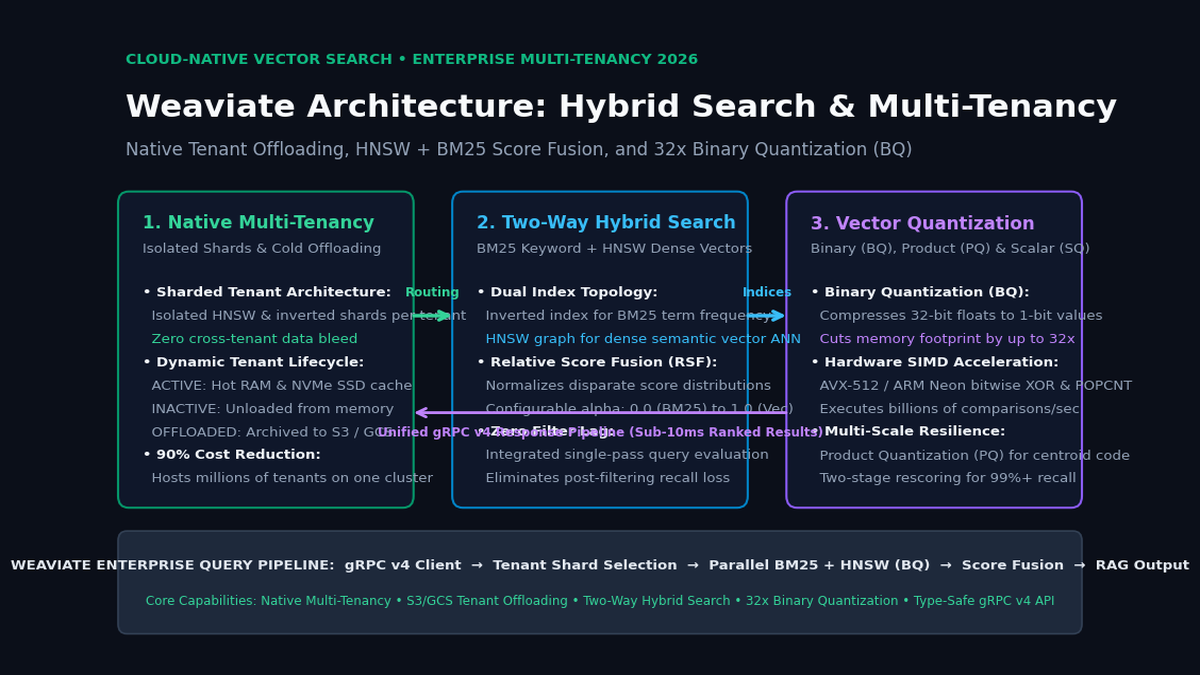
- Native Multi-Tenancy with Tenant Offloading: Weaviate treats multi-tenancy as a first-class citizen. Each tenant receives a completely isolated physical shard (independent HNSW graph and BM25 inverted index). Tenants can be dynamically transitioned between
ACTIVE,INACTIVE, andOFFLOADEDstates, archiving inactive tenant data to Amazon S3 or Google Cloud Storage to cut RAM hosting costs by up to 90%. - Native Two-Way Hybrid Search: Fuses dense vector similarity with sparse BM25 term frequency in a single query execution pass using Relative Score Fusion (RSF) or Reciprocal Rank Fusion (RRF), controlled via an intuitive
alphaparameter. - Extreme Memory Compression (Binary Quantization - BQ): Compresses 32-bit floating point vectors down to 1-bit representations, delivering a 32x reduction in RAM and accelerating vector comparisons using hardware-accelerated SIMD Hamming distance instructions (AVX-512, ARM Neon).
- Modern Type-Safe Python v4 Client (gRPC): Completely replaces slow REST and GraphQL roundtrips with high-throughput binary gRPC protobuf streams, delivering up to 10x higher ingestion and query throughput.
- Modular Ecosystem (Vectorizers & RAG): Built-in modules for text, multimodal images, and audio embeddings, paired with generative search modules that summarize retrieved passages directly inside the database tier.
Comparing Enterprise Vector Search Engines
The table below contrasts Weaviate against other leading production vector databases:
Enterprise Vector Search Comparison:
┌───────────────────────────┬───────────────────────────────┬───────────────────────────────┬───────────────────────────────┐
│ Dimension                 │ Pinecone                      │ Qdrant                        │ Weaviate                      │
├───────────────────────────┼───────────────────────────────┼───────────────────────────────┼───────────────────────────────┤
│ Core Implementation       │ Closed-source proprietary     │ Open-source Rust              │ Open-source Go & C++ (HNSW)   │
│ Multi-Tenancy Support     │ Namespaces (Shared index)     │ Payload-based partition keys  │ Native Isolated Shards        │
│ Cold Storage Offloading   │ Serverless tier only          │ Manual snapshot management    │ Native S3/GCS Tenant Offload  │
│ Hybrid Search Fusion      │ Sparse-dense vectors          │ Sparse vectors (BM42) + Dense │ Relative Score Fusion (BM25)  │
│ Quantization Modes        │ Proprietary compression       │ Scalar (SQ) & Product (PQ)    │ Binary (BQ), PQ, and SQ       │
│ Memory Reduction (Max)    │ ~4x–8x                        │ ~8x–16x                       │ Up to 32x (1-bit BQ)          │
│ Query Transport           │ HTTPS / gRPC                  │ gRPC / REST                   │ Native gRPC v4 Protobuf       │
│ Self-Hosting Capability   │ No (Managed cloud only)       │ Yes (Docker / Kubernetes)     │ Yes (Docker / Helm / Hybrid)  │
└───────────────────────────┴───────────────────────────────┴───────────────────────────────┴───────────────────────────────┘ Deep Dive into Weaviate Core Primitives & Engines
Weaviate delivers high-concurrency enterprise retrieval through four foundational systems: Native Multi-Tenancy, Two-Way Hybrid Search, Multi-Stage Quantization, and the Python v4 gRPC Engine.
Weaviate Core Subsystems:
Weaviate Engine
 ├──► 1. Multi-Tenancy: Physical shard isolation with ACTIVE, INACTIVE, and OFFLOADED states
 ├──► 2. Hybrid Search: BM25 inverted index + HNSW graph fused via Relative Score Fusion
 ├──► 3. Vector Quantization: Binary Quantization (32x cut), Product (PQ), and Scalar (SQ)
 ├──► 4. gRPC v4 API: Binary protobuf streams delivering microsecond network dispatch
└──► 5. Generative Search: Integrated in-database LLM summarization and RAG generation 1. Native Multi-Tenancy & Tenant Lifecycle States
Unlike monolithic vector indices, Weaviate’s multi-tenancy partitions collections into isolated physical shards:
- Zero Cross-Talk: Tenant $A$ and Tenant $B$ have completely separate inverted indices and HNSW graphs. An influx of millions of documents by one tenant has zero impact on another tenant’s query latency or recall.
- Dynamic Lifecycle States:
ACTIVE: The tenant’s HNSW graph and inverted index are loaded into system RAM and local NVMe storage for sub-10ms queries.INACTIVE: Vectors are unloaded from active RAM and preserved purely on local NVMe disk. On the next incoming query, Weaviate transparently reloads the index in milliseconds.OFFLOADED: The entire tenant shard is compressed and archived directly to cold cloud object storage (Amazon S3, Google Cloud Storage, or Azure Blob). It consumes 0 MB of local disk and 0 MB of RAM, allowing a single cluster to host millions of tenants economically.
2. Two-Way Hybrid Search with Relative Score Fusion (RSF)
Weaviate blends keyword search and vector similarity through an integrated query planner:
- The Challenge: BM25 produces unbounded positive scores based on term frequency ($[0, \infty)$), whereas cosine vector distance is bounded ($[-1, 1]$ or normalized $[0, 1]$).
- Relative Score Fusion (RSF): Weaviate normalizes both score distributions onto a common $[0, 1]$ scale: $$\text{Score}{\text{norm}} = \frac{S - S{\min}}{S_{\max} - S_{\min}}$$
- The $\alpha$ Weight Parameter:
$$\text{Final_Score} = \alpha \cdot \text{Vector_Score} + (1 - \alpha) \cdot \text{BM25_Score}$$
- $\alpha = 1.0$: Pure dense vector semantic search.
- $\alpha = 0.0$: Pure lexical BM25 keyword matching.
- $\alpha = 0.5$: Balanced hybrid retrieval capturing both semantic context and exact part numbers.
3. Multi-Stage Vector Quantization: Achieving 32x Compression
To crush the memory-bandwidth wall, Weaviate supports three complementary quantization modes:
- Binary Quantization (BQ):
- Compresses 32-bit floats into single bits based on sign: $$b_i = \begin{cases} 1 & \text{if } v_i \ge 0 \ 0 & \text{if } v_i < 0 \end{cases}$$
- Compresses 1,536 floats (6,144 bytes) into just 192 bytes—a 32x reduction in memory footprint.
- Vector distance is computed via bitwise
XORfollowed by a population count (POPCNT), executing in CPU registers thousands of times faster than floating-point dot products.
- Product Quantization (PQ):
- Decomposes high-dimensional vectors into $M$ sub-vectors and clusters each sub-vector against a learned centroid codebook, achieving 8x to 16x compression.
- Scalar Quantization (SQ):
- Quantizes 32-bit floating points to 8-bit integers (
int8), cutting memory by 75% with virtually zero loss in recall.
- Quantizes 32-bit floating points to 8-bit integers (
4. High-Throughput gRPC v4 Architecture
In Weaviate v4, the communication protocol shifted from REST and GraphQL to native gRPC with Protocol Buffers:
- Bypasses JSON serialization overhead and text parsing bottlenecks.
- Enables streaming batch ingestion at over 100,000 vectors per second per node while reducing client-side CPU consumption.
Hands-On Implementation: Building a Multi-Tenant Hybrid Knowledge Base
Let’s build an enterprise multi-tenant vector retrieval system using Weaviate and the Python v4 client. We will configure Docker, define a schema with Binary Quantization, manage tenant states, and execute hybrid searches.
1. Environment Setup via Docker Compose
Create a docker-compose.yml to launch Weaviate with local persistence and the text2vec-transformers module:
version: '3.4'
services:
  weaviate:
    image: cr.weaviate.io/semitechnologies/weaviate:1.26.4
    ports:
      - '8080:8080' # REST & GraphQL
      - '50051:50051' # High-Speed gRPC v4
    environment:
      QUERY_DEFAULTS_LIMIT: 25
      AUTHENTICATION_ANONYMOUS_ACCESS_ENABLED: 'true'
      PERSISTENCE_DATA_PATH: '/var/lib/weaviate'
      ENABLE_MODULES: 'text2vec-transformers'
      DEFAULT_VECTORIZER_MODULE: 'text2vec-transformers'
      CLUSTER_HOSTNAME: 'node1'
    volumes:
- ./weaviate_data:/var/lib/weaviate Launch the cluster:
docker compose up -d 2. Connecting with the Python v4 Client
Install the modern Weaviate client:
pip install -U weaviate-client Connect using native gRPC:
import weaviate
from weaviate.classes.config import (
    Configure,
    Property,
    DataType,
    VectorDistances
)
from weaviate.classes.tenants import Tenant, TenantActivityStatus

# 1. Connect to local Weaviate instance with gRPC transport
client = weaviate.connect_to_local(
    port=8080,
    grpc_port=50051
)

assert client.is_ready(), "Weaviate cluster is not ready!"
print("Connected to Weaviate via gRPC successfully.") 3. Creating a Multi-Tenant Collection with Binary Quantization
Define a collection schema configured for multi-tenancy and 32x memory compression:
# Create multi-tenant collection with Binary Quantization (BQ)
collection = client.collections.create(
    name="EnterpriseContracts",
    multi_tenancy_config=Configure.multi_tenancy(
        enabled=True,
        auto_tenant_creation=False
    ),
    vector_index_config=Configure.VectorIndex.hnsw(
        distance_metric=VectorDistances.COSINE,
        quantizer=Configure.VectorIndex.Quantizer.bq(
            rescore_limit=100  # Rescore top-100 candidates with uncompressed vectors
        )
    ),
    properties=[
        Property(name="title", data_type=DataType.TEXT),
        Property(name="content", data_type=DataType.TEXT),
        Property(name="category", data_type=DataType.TEXT),
        Property(name="clause_id", data_type=DataType.TEXT)
    ]
)

print(f"Collection '{collection.name}' created with Native Multi-Tenancy and BQ.") 4. Managing Tenant Lifecycles & Ingesting Documents
Add tenant shards and ingest isolated documents:
# 1. Register tenants with ACTIVE status
collection.tenants.create([
    Tenant(name="AcmeCorp", activity_status=TenantActivityStatus.ACTIVE),
    Tenant(name="Cyberdyne", activity_status=TenantActivityStatus.ACTIVE)
])

# 2. Scope collection specifically to AcmeCorp tenant
acme_tenant = collection.with_tenant("AcmeCorp")

# 3. Batch insert documents into AcmeCorp shard
contracts = [
    {
        "title": "Master Services Agreement",
        "content": "Liability is capped at $5,000,000 under section 14.2 for infrastructure defects.",
        "category": "legal",
        "clause_id": "SEC-14-2"
    },
    {
        "title": "Data Protection Addendum",
        "content": "All personal customer data must be encrypted using AES-256 at rest and TLS 1.3 in transit.",
        "category": "compliance",
        "clause_id": "DPA-08"
    }
]

with acme_tenant.batch.dynamic() as batch:
    for doc in contracts:
        batch.add_object(properties=doc)

print("Ingested documents into AcmeCorp tenant shard.") 5. Executing Two-Way Hybrid Search with Relative Score Fusion
Perform hybrid queries balancing exact lexical keywords with semantic vector similarity:
# Query: Looking for specific liability clause with exact section ID
query_text = "liability limitation under SEC-14-2"

# Execute hybrid search with alpha = 0.5 (balanced 50% vector, 50% BM25)
response = acme_tenant.query.hybrid(
    query=query_text,
    alpha=0.5,
    limit=2,
    return_metadata=["score"]
)

print("\n--- AcmeCorp Hybrid Retrieval Results ---")
for obj in response.objects:
    print(f"Title: {obj.properties['title']}")
    print(f"Clause ID: {obj.properties['clause_id']}")
    print(f"Hybrid Score: {obj.metadata.score:.4f}")
    print(f"Snippet: {obj.properties['content']}\n")

# Offload tenant to cold storage when inactive
collection.tenants.update([
    Tenant(name="AcmeCorp", activity_status=TenantActivityStatus.INACTIVE)
])
print("AcmeCorp tenant successfully set to INACTIVE (RAM unloaded).")

client.close() Production Architecture & Integration for aiFetchly
Integrating Weaviate into automated web extraction pipelines, enterprise SaaS platforms, and desktop copilots like AiFetchly establishes a horizontally scalable, multi-tenant vector tier.
aiFetchly Enterprise SaaS & Weaviate Topology:
┌─────────────────────────────────────────────────────────────────┐
│ aiFetchly Web Scrapers & Distributed Document Harvesters        │
└─────────────────────────────────────────────────────────────────┘
 │
 ▼ (Parallel Stream Ingestion via gRPC v4)
┌─────────────────────────────────────────────────────────────────┐
│ Weaviate Multi-Tenant Cluster                                   │
│ • Tenant 1 (Acme Corp): Active Hot Shard in RAM (BQ 32x)        │
│ • Tenant 2 (Initech): Inactive Shard cached on NVMe SSD         │
│ • Tenant 3 (Globex): Offloaded to S3 Object Storage ($0 RAM)   │
└─────────────────────────────────────────────────────────────────┘
 │
 ├──► Two-Way Hybrid Retrieval (BM25 Keyword + BQ HNSW Vectors)
 │
 ▼
┌─────────────────────────────────────────────────────────────────┐
│ Grounded Inference Engine (Local or Cloud LLM)                  │
│ • High-Throughput Clusters: TensorRT-LLM (FP8 Hopper)           │
│ • Local Workstations: Ollama / LM Studio (LLaMA-3.3 70B)        │
└─────────────────────────────────────────────────────────────────┘
 │
 ▼
┌─────────────────────────────────────────────────────────────────┐
│ Continuous Observability & Evaluation (Arize Phoenix / DeepEval)│
│ • Traces every gRPC span and evaluates Groundedness & Hallucination│
└─────────────────────────────────────────────────────────────────┘ 1. Zero-Leakage Data Isolation for SaaS Users
When AiFetchly powers multi-tenant corporate deployments:
- Each enterprise organization is assigned a dedicated Weaviate tenant shard.
- Scraping workers ingest company-specific knowledge graphs and competitive market intelligence strictly into their isolated shard.
- Search queries execute exclusively against the calling organization’s shard, providing mathematical certainty against cross-tenant data leaks.
2. Slashing Hosting Costs with Automated Tenant Lifecycle Management
In SaaS platforms where 80% of accounts are inactive at any given moment:
- Configure a background worker to monitor tenant access patterns.
- If a tenant has not issued a query in 2 hours, transition its state to
INACTIVE. - If inactive for 7 days, transition its state to
OFFLOADED, moving the shard to Amazon S3. - When the user logs back into AiFetchly, the tenant transitions back to
ACTIVEin under 300 milliseconds, slashing cloud memory bills by up to 90%.
3. Full-Stack Observability and Evaluation
Connect Weaviate directly to modern observability platforms:
- Instrument the gRPC query client with Arize Phoenix using OpenTelemetry semantic conventions to track query latency and token counts.
- Run continuous evaluation suites with DeepEval or RAGAS to benchmark how varying the hybrid
alphaparameter optimizes retrieval accuracy across complex technical documents.
Summary: Industrializing Vector Retrieval for Enterprise Generative AI
Moving from single-user experimental prototypes to production multi-tenant enterprise software requires an infrastructure foundation built for scale, cost efficiency, and rigorous isolation.
By uniting native physical shard multi-tenancy, dynamic cold-storage tenant offloading, two-way hybrid search with Relative Score Fusion, and 32x Binary Quantization, Weaviate solves the memory, latency, and data-bleed challenges of enterprise vector search. For automated web harvesting, intelligent document extraction, and secure SaaS applications built with AiFetchly, Weaviate provides the enterprise-grade vector storage engine necessary to deliver high-precision, cost-effective semantic intelligence at scale.