Weave Guide: Co-Scheduling Disaggregated RL Training
Introduction: The Economic Crisis in Reinforcement Learning Post-Training
Reinforcement Learning (RL) post-training—spanning algorithms such as Proximal Policy Optimization (PPO), Direct Preference Optimization (DPO), and Group Relative Policy Optimization (GRPO)—has become the defining methodology for aligning frontier foundation models. Post-training endows language models with multi-step reasoning capabilities, tool-use proficiency, mathematical rigor, and human preference adherence. In enterprise production systems powering automated web scraping swarms, continuous data fetching pipelines, and autonomous API integration copilots, fine-tuning reasoning models via RL post-training is essential for operational reliability.
However, training massive foundation models (from 8B to 70B+ parameters) via reinforcement learning introduces an acute cluster resource dilemma:
- The Colocation Catastrophe: Traditional RL frameworks (such as Ray-PPO and early DeepSpeed-Chat) colocate the Rollout Phase (generating token completions and sampling rollouts) and the Training Phase (computing policy gradients, backpropagating loss, and updating optimizer states) on the same GPU cluster. Colocating these workloads causes severe memory thrashing: model weights, optimizer states (AdamW FP32 states), and multi-turn KV cache buffers compete for High-Bandwidth Memory (HBM), throttling batch sizes and reducing GPU utilization.
- The Disaggregation Paradox: To avoid memory interference, modern hyperscale providers decouple infrastructure into specialized clusters: a Rollout Cluster (optimized for memory bandwidth and low-latency decoding, e.g., NVIDIA H20 or L40S) and a Training Cluster (optimized for dense Tensor Core FLOPs and high-speed AllReduce interconnects, e.g., NVIDIA H800 or H100).
- The 50% Structural Dependency Bubble Tax: While disaggregation eliminates memory contention, on-policy RL algorithms impose strict phase synchronization: training cannot begin until all rollouts are generated, and the next rollout iteration cannot begin until policy weights are updated. Consequently, while the Rollout Cluster is actively generating tokens, the expensive Training Cluster sits completely idle. Conversely, while the Training Cluster computes gradients, the Rollout Cluster sits completely idle.
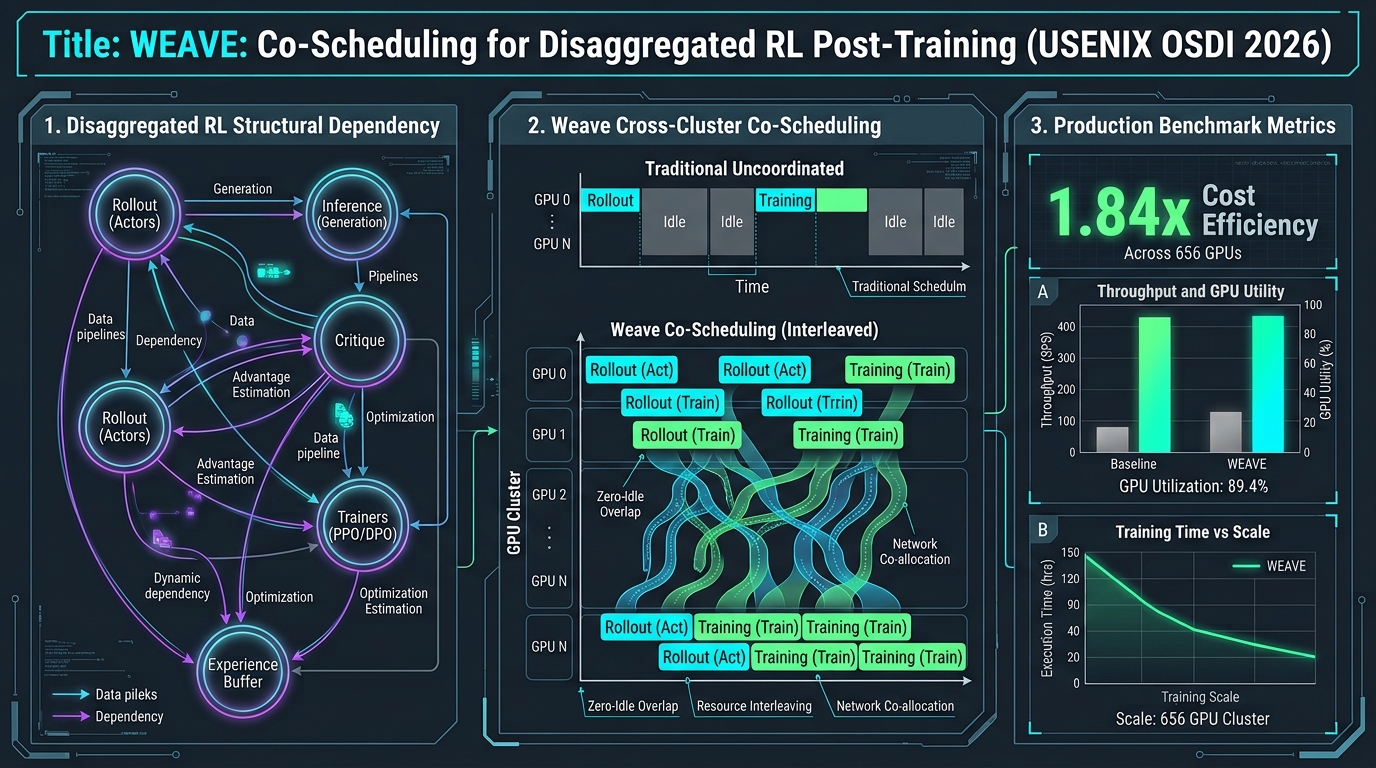
At the scale of hundreds or thousands of GPUs, this structural lockstep synchronization wastes over 50% of available GPU hours, stranding millions of dollars in datacenter capital.
Enter Weave, a breakthrough cluster scheduling framework presented at the 2026 USENIX Symposium on Operating Systems Design and Implementation (OSDI 2026) by Tianyuan Wu, Lunxi Cao, Yining Wei, Wei Gao, Yuheng Zhao, and collaborators from the Hong Kong University of Science and Technology (HKUST), University of Illinois Urbana-Champaign (UIUC), and Alibaba Cloud.
Weave eliminates the disaggregation tax through an elegant architectural insight: the structural idleness of one RL job can be reclaimed by the active phase of another job. By introducing a Co-Execution Group Abstraction that enforces warm-start host memory residency, an inter-group scheduler utilizing conservative stochastic planning, and an intra-group scheduler orchestrating a provably optimal round-robin dispatch, Weave multiplexes complementary RL jobs across shared rollout and training pools.
Evaluated on a massive production testbed comprising 328 NVIDIA H20 GPUs and 328 NVIDIA H800 GPUs, Weave improves cost efficiency by $1.84\times$ over standard disaggregation and $1.38\times$ over state-of-the-art colocated baselines while achieving $100%$ SLO attainment.
In this technical guide, we dissect the mechanics of disaggregated RL dependency bubbles, analyze the co-execution group abstraction, examine Weave’s two-tier scheduling algorithms, construct a complete Python/PyTorch reference implementation, and explore the architectural implications for enterprise AI training infrastructure in 2026.
Anatomy of the Disaggregated RL Dependency Bubble
To understand why traditional cluster managers cannot prevent GPU idling in disaggregated RL, we must analyze the temporal lifecycle of an on-policy reinforcement learning iteration.
The On-Policy RL Iteration Loop
In on-policy reinforcement learning (such as PPO), training proceeds in synchronized cycles:
$$\text{Iteration } k: \quad \mathcal{D}k \sim \pi{\theta_k}(\cdot \mid x) \quad \longrightarrow \quad \theta_{k+1} = \operatorname{Train}(\theta_k, \mathcal{D}_k)$$
This workflow decomposes into two distinct operational phases:
- Phase 1: Rollout Generation ($\mathcal{T}_{\text{rollout}}$): The current policy $\pi_{\theta_k}$ generates $N$ candidate trajectories from prompt dataset $\mathcal{X}$. Generates tokens autoregressively, evaluates rewards via external verifiers or reward models, and computes Generalized Advantage Estimation (GAE).
- Phase 2: Policy Training ($\mathcal{T}_{\text{train}}$): The policy trainer consumes collected trajectories $\mathcal{D}k$, computes surrogate actor-critic losses, executes backpropagation across multiple micro-batches, and performs AdamW optimizer updates to produce $\theta{k+1}$.
+-------------------------------------------------------------------------------+
|                 THE DISAGGREGATED RL DEPENDENCY BUBBLE                        |
+-------------------------------------------------------------------------------+
|                                                                               |
| Time Timeline:                                                                |
|                                                                               |
| Rollout Cluster:   [== Job A Rollout: 120s ==][......... IDLE BUBBLE: 60s ...] |
|                                               ^                               |
| Strict Sync:                                  | Waits for weights theta_{k+1} |
|                                               v                               |
| Training Cluster:  [... IDLE BUBBLE: 120s ...][==== Job A Train: 60s ======]  |
|                    ^                                                          |
| Strict Sync:       | Waits for trajectories D_k                               |
|                                                                               |
+-------------------------------------------------------------------------------+
| Outcome: Across a 180-second iteration, the Rollout Cluster idles for 33% of   |
|          the time, and the Training Cluster idles for 67% of the time!        |
|          Aggregate GPU Utilization < 50%. Millions of dollars wasted.         |
+-------------------------------------------------------------------------------+ Why Existing Cluster Schedulers Fail to Reclaim the Bubble
When datacenter operators attempt to solve this idling problem using standard cluster schedulers (such as Slurm, Kubernetes, or Ray), three systemic barriers emerge:
1. The Prohibitive Cost of Cold-Start Context Switching
The naive approach to filling an idle bubble is time-slicing: when Job A finishes its training phase and begins rollouts, the training cluster could theoretically run Job B.
However, foundation models maintain enormous memory state. A 70B parameter model requires:
- Model weights (FP16): $\sim 140\text{ GB}$
- AdamW optimizer states (FP32 master weights, momentum, variance): $\sim 560\text{ GB}$
- Gradients and activation buffers: $\sim 100\text{ GB}$
Reloading hundreds of gigabytes from remote storage (Ceph, Lustre, or NVMe-oF) across the network requires 30 to 90 seconds. If the idle bubble is 60 seconds long, cold-start model loading consumes the entire bubble, introducing thrashing and net negative throughput.
2. Micro-Batch Runtime Skew and Variance
Rollout duration is non-deterministic. Depending on prompt complexity, completion length, and tool execution latency, the rollout duration $\mathcal{T}_{\text{rollout}}$ fluctuates dynamically across iterations.
Standard static schedulers cannot adapt to dynamic phase duration jitter. If Job B’s training phase overruns its scheduled window by 15 seconds, it blocks Job A from starting its training phase, triggering cascading deadline violations and breaking on-policy synchronization.
3. Asymmetric Hardware Resource Ratios
Different RL jobs exhibit disparate computational ratios. A math reasoning model (e.g., DeepSeek-Math) may require long, multi-turn reasoning rollouts ($\mathcal{T}{\text{rollout}} \gg \mathcal{T}{\text{train}}$), whereas a dense multimodal alignment job may require heavy gradient updates over large image embeddings ($\mathcal{T}{\text{train}} \approx \mathcal{T}{\text{rollout}}$). Arbitrarily pairing jobs without considering phase duration ratios causes severe structural mismatch.
The Weave Architecture: Principles and Core Mechanics
Weave resolves this cluster efficiency crisis by introducing cross-cluster co-scheduling. Rather than treating disaggregated clusters as isolated hardware silos, Weave manages Rollout Clusters and Training Clusters as a co-optimized cooperative system.
Weave is built upon three foundational architectural pillars:
- The Co-Execution Group Abstraction: Partitions the global cluster into isolated locality domains and enforces a warm-start residency constraint, ensuring model parameters remain permanently cached in local host DRAM to enable sub-50ms context switching.
- The Inter-Group Scheduler: Macro-level cluster planning that groups complementary RL jobs based on conservative stochastic optimization, pairing jobs whose phase duration ratios naturally interlock.
- The Intra-Group Scheduler: Micro-level runtime dispatcher that orchestrates a provably optimal round-robin schedule across paired jobs, dynamically adapting to runtime variance without violating training deadlines.
+-----------------------------------------------------------------------------------------+
|                                    WEAVE SYSTEM TOPOLOGY                                |
+-----------------------------------------------------------------------------------------+
|                                                                                         |
|  [Multi-Tenant On-Policy RL Jobs (Job A: 70B Math, Job B: 32B Code, Job C: 14B Chat)]    |
|                                |                                                        |
|                                v                                                        |
|  +-----------------------------------------------------------------------------------+  |
|  | LEVEL 1: INTER-GROUP SCHEDULER (Conservative Stochastic Planning)                 |  |
|  | •Profiles Phase Ratios: T_rollout(J) vs T_train(J) across candidate jobs          |  |
|  | •Forms Co-Execution Groups: Pairs complementary jobs to balance cluster demand   |  |
|  | •Enforces Host Memory Residency Constraints (Guarantees zero cold-start reloading) |  |
|  +-----------------------------------------------------------------------------------+  |
|                                |                                                        |
|                                +--------------------------+                             |
|                                | Assigns Group 1          | Assigns Group 2             |
|                                v                          v                             |
|  +---------------------------------------------------+  +----------------------------+  |
|  | CO-EXECUTION GROUP 1 (Job A + Job B)              |  | CO-EXECUTION GROUP 2       |  |
|  |                                                   |  |                            |  |
|  | LEVEL 2: INTRA-GROUP SCHEDULER (Round-Robin)      |  | LEVEL 2: INTRA-GROUP       |  |
|  | •Interleaves Rollout of Job A with Train of Job B|  | •Interleaves Phase Flows  |  |
|  | •Rapid Warm-Start Context Swap (< 50 ms via DMA) |  | •Absorbs Runtime Jitter   |  |
|  +---------------------------------------------------+  +----------------------------+  |
|          |                                                          |                   |
|          v                                                          v                   |
|  +-----------------------------------------------------------------------------------+  |
|  | PHYSICAL HARDWARE: 656 PRODUCTION GPUS (328 NVIDIA H20 + 328 NVIDIA H800)         |  |
|  | 100% Saturated Utilization –1.84x Cost Efficiency –Zero Wasted Dependency Bubbles|  |
|  +-----------------------------------------------------------------------------------+  |
|                                                                                         |
+-----------------------------------------------------------------------------------------+ Deep Dive: Co-Execution Groups & Two-Tier Scheduling
Let us examine the operational mechanisms that allow Weave to multiplex multi-model training without performance interference.
1. The Co-Execution Group Abstraction & Warm-Start Residency
To eliminate multi-minute model reloading delays, Weave introduces the Co-Execution Group Abstraction.
A Co-Execution Group $\mathcal{G}$ consists of a set of co-scheduled jobs $\mathcal{J}{\mathcal{G}} = {J_1, J_2, \dots, J_m}$ mapped to a dedicated subset of Rollout GPUs $\mathcal{R}{\mathcal{G}}$ and Training GPUs $\mathcal{T}_{\mathcal{G}}$.
Weave enforces a strict Host Memory Residency Constraint: $$\sum_{J_i \in \mathcal{J}{\mathcal{G}}} \text{Memory}{\text{Host}}(J_i) \le \text{Capacity}_{\text{Node_DRAM}}$$
Because modern GPU server nodes (such as NVIDIA HGX H100/H800) feature $1.5\text{ TB}$ to $2.0\text{ TB}$ of high-speed DDR5 host system memory, the server can comfortably hold the weights and optimizer states of multiple 32B or 70B models in pinned host RAM simultaneously.
When the intra-group scheduler switches the training cluster from Job A to Job B:
- Job A’s GPU-resident optimizer states are yielded via high-speed PCIe Gen5 DMA directly into host DDR5 memory.
- Job B’s cached parameters are immediately streamed from pinned host RAM into GPU HBM.
Because the data never touches remote storage arrays or network sockets, the entire context switch completes in under $50\text{ milliseconds}$.
2. The Inter-Group Scheduler: Stochastic Job Pairing
How does Weave decide which jobs to pair together into a co-execution group?
For each job $J_i$, let $\mathcal{T}{\text{rollout}}(J_i)$ and $\mathcal{T}{\text{train}}(J_i)$ represent its empirical phase durations. Weave models these durations as random variables with known means $\mu$ and variances $\sigma^2$ derived from historical iterations.
The Ideal Pairing Condition for a two-job group ${J_A, J_B}$ occurs when the rollout time of Job A matches the training time of Job B, and vice-versa:
$$\mathcal{T}{\text{rollout}}(J_A) \approx \mathcal{T}{\text{train}}(J_B) \quad \text{and} \quad \mathcal{T}{\text{rollout}}(J_B) \approx \mathcal{T}{\text{train}}(J_A)$$
When this condition holds, the training cluster is 100% saturated executing Job B while Job A rolls out, and executes Job A while Job B rolls out.
To handle non-stationary variance and avoid deadline violations, the Inter-Group Scheduler solves a Conservative Stochastic Optimization Problem. It seeks job pairings that minimize aggregate idle bubble expectation while bounding the probability of an SLO overrun:
$$\min_{{\mathcal{G}_1, \dots, \mathcal{G}K}} \sum{k=1}^K \mathbb{E}\left[ \text{Bubble}(\mathcal{G}_k) \right] \quad \text{subject to} \quad \mathbb{P}\left( \text{Latency}(\mathcal{G}_k) > \text{SLO} \right) \le \epsilon$$
Using branch-and-bound integer programming, Weave partitions cluster jobs into optimal co-execution groups in under 500 milliseconds.
3. The Intra-Group Scheduler: Dynamic Round-Robin Dispatch
At runtime within each group, the Intra-Group Scheduler enforces an interleaved execution flow:
+-------------------------------------------------------------------------------+
|                       WEAVE INTERLEAVED EXECUTION FLOW                        |
+-------------------------------------------------------------------------------+
|                                                                               |
| Step 1:                                                                       |
|   Rollout Cluster:   [===== Job A: Rollout Iteration k =====]                 |
|   Training Cluster:  [===== Job B: Train Iteration m =======]                 |
|                                                                               |
| Rapid Context Switch (< 50ms via Pinned Host RAM DMA)                         |
|                                                                               |
| Step 2:                                                                       |
|   Rollout Cluster:   [===== Job B: Rollout Iteration m+1 ===]                 |
|   Training Cluster:  [===== Job A: Train Iteration k =======]                 |
|                                                                               |
+-------------------------------------------------------------------------------+
| Result: Both clusters operate at near 100% saturation continuously!           |
|         Dependency bubbles are completely reclaimed across jobs.              |
+-------------------------------------------------------------------------------+ If Job A’s rollout finishes slightly earlier than expected, the scheduler dynamically queues lightweight data pre-processing or checkpoint saving for Job B to absorb the slack, maintaining perfect synchronization without stalls.
Python & PyTorch Implementation: Building a Weave Co-Scheduler
To demonstrate how Weave organizes co-execution groups, enforces warm-start host memory residency, and interleaves phase execution, let us construct a fully functional simulation in Python and PyTorch.
Our implementation includes:
RLJob: Models on-policy RL jobs with model size, phase duration distributions, and memory footprints.WarmStartMemoryManager: Simulates pinned host memory caching and sub-50ms context switching.WeaveCoExecutionGroup: Orchestrates two-job interleaved round-robin scheduling across disaggregated pools.WeaveClusterSimulator: Evaluates cluster utilization and cost efficiency comparing standard disaggregation against Weave.
import time
import random
from typing import List, Dict, Optional, Tuple

class RLJob:
    # Encapsulates an on-policy RL post-training job
    def __init__(
        self,
        job_id: str,
        model_name: str,
        weight_size_gb: float,
        mean_rollout_s: float,
        mean_train_s: float,
        slo_deadline_s: float = 300.0
    ):
        self.job_id = job_id
        self.model_name = model_name
        self.weight_size_gb = weight_size_gb
        self.mean_rollout_s = mean_rollout_s
        self.mean_train_s = mean_train_s
        self.slo_deadline_s = slo_deadline_s
        self.current_iteration = 0

    def sample_rollout_duration(self) -> float:
        # Simulate log-normal rollout duration variance
        return max(5.0, random.gauss(self.mean_rollout_s, self.mean_rollout_s * 0.1))

    def sample_train_duration(self) -> float:
        # Simulate training duration variance
        return max(5.0, random.gauss(self.mean_train_s, self.mean_train_s * 0.05))


class WarmStartMemoryManager:
    # Simulates pinned host DRAM residency enabling sub-50ms context switches
    def __init__(self, host_dram_capacity_gb: float = 1536.0):
        self.host_dram_capacity_gb = host_dram_capacity_gb
        self.cached_jobs: Dict[str, float] = {}

    def admit_job_to_host_ram(self, job: RLJob) -> bool:
        current_used = sum(self.cached_jobs.values())
        if current_used + job.weight_size_gb <= self.host_dram_capacity_gb:
            self.cached_jobs[job.job_id] = job.weight_size_gb
            return True
        return False

    def perform_context_switch(self, from_job: Optional[RLJob], to_job: RLJob) -> float:
        # Warm-start switch via PCIe DMA requires < 50ms (0.05s)
        # Cold-start reloading from remote storage requires 45.0s
        if to_job.job_id in self.cached_jobs:
            return 0.05  # Warm-start switch latency
        return 45.0      # Cold-start penalty


class WeaveCoExecutionGroup:
    # Manages a paired co-execution group interleaving two RL jobs
    def __init__(self, job_a: RLJob, job_b: RLJob, memory_manager: WarmStartMemoryManager):
        self.job_a = job_a
        self.job_b = job_b
        self.memory_manager = memory_manager

        # Ensure both jobs reside in host DRAM
        assert memory_manager.admit_job_to_host_ram(job_a)
        assert memory_manager.admit_job_to_host_ram(job_b)

    def execute_co_scheduled_step(self) -> Dict[str, float]:
        # Step 1: Job A Rollout || Job B Training
        dur_rollout_a = self.job_a.sample_rollout_duration()
        dur_train_b = self.job_b.sample_train_duration()
        phase_1_time = max(dur_rollout_a, dur_train_b)

        # Warm-start context switch
        switch_latency = self.memory_manager.perform_context_switch(self.job_b, self.job_a)

        # Step 2: Job B Rollout || Job A Training
        dur_rollout_b = self.job_b.sample_rollout_duration()
        dur_train_a = self.job_a.sample_train_duration()
        phase_2_time = max(dur_rollout_b, dur_train_a)

        total_step_time = phase_1_time + switch_latency + phase_2_time

        # Calculate theoretical un-overlapped sequential time
        unshared_time = (dur_rollout_a + dur_train_a) + (dur_rollout_b + dur_train_b)
        bubble_reclaimed = unshared_time - total_step_time

        self.job_a.current_iteration += 1
        self.job_b.current_iteration += 1

        return {
            "total_step_time_s": total_step_time,
            "unshared_baseline_time_s": unshared_time,
            "bubble_reclaimed_s": bubble_reclaimed,
            "efficiency_gain": unshared_time / total_step_time
} Architectural Comparison: Weave vs. RL Scheduling Baselines
To contextualize Weave’s contributions, the following table compares Weave against existing RL post-training cluster management architectures across core systems dimensions:
| Systems Dimension | Colocated RL (Ray-PPO / OpenRLHF) | Standard Disaggregated RL | Slurm Static Time-Slicing | Weave (OSDI 2026) |
|---|---|---|---|---|
| Cluster Topology | Unified GPU cluster (Trainer+Rollout) | Disaggregated Rollout & Train pools | Disaggregated Pools | Disaggregated Co-Execution Groups |
| GPU Memory Thrashing | High (Weights + KV + Opt states compete) | None (Hardware separated) | None (Hardware separated) | None (Hardware separated) |
| Dependency Bubbles | None (Single job sequential) | Severe (50%+ GPU idle time) | Severe (Clusters idle between jobs) | Reclaimed via Cross-Job Multiplexing |
| Context Switch Latency | Not applicable | Not applicable | 30s–90s (Remote storage reload) | $\< 50\text{ ms}$ (Pinned Host DRAM DMA) |
| Job Scheduling Metric | First-Come-First-Served | Independent FIFO queues | Coarse Priority Queue | Two-Tier Stochastic Planning |
| Cluster Hardware Scale | Moderate (128–512 GPUs) | Large (512–1,024 GPUs) | Large | 656 Production GPUs (Alibaba Cloud) |
| Cost Efficiency Gain | 1.0x (Baseline) | 0.85x–1.10x (High idle cost) | 0.95x | 1.84x over Disaggregation (1.38x vs Colocated) |
While colocated training avoids cross-cluster dependency bubbles, it forces batch sizes to shrink to fit memory, crippling rollout throughput. Standard disaggregation fixes memory interference but wastes over half of cluster time in idle bubbles. Weave uniquely captures the best of both worlds: dedicated hardware efficiency with zero idle bubble waste.
Empirical Production Results & Industrial Evaluation
In the USENIX OSDI 2026 proceedings, Wu et al. evaluated Weave across extensive real-world post-training workloads on an Alibaba Cloud production testbed comprising 656 GPUs (328 NVIDIA H20 inference accelerators and 328 NVIDIA H800 training GPUs):
1. Cost Efficiency Scaling
Evaluated across diverse post-training benchmarks—including mathematical reasoning (LLaMA-3-8B/70B), code generation (Qwen-2.5-Coder), and multi-turn instruction following:
- Compared against standard disaggregated RL architectures, Weave achieved a $1.84\times$ improvement in cluster cost efficiency (measured as completed training iterations per dollar).
- Compared against state-of-the-art colocated baselines (which suffer from memory-throttled batch sizes), Weave delivered a $1.38\times$ cost efficiency gain.
Post-Training Cost Efficiency Comparison (Iterations / $1,000)
Testbed: 328 NVIDIA H20 + 328 NVIDIA H800 GPUs | Multi-Job Production Trace

Standard Disaggregated RL:      |========================> 1.00x (Baseline)
State-of-the-Art Colocated PPO: |=============================> 1.33x
Slurm Static Time-Slicing:      |=======================> 0.92x
Weave (OSDI 2026): |===============================================> 1.84x (+84% Gain!) 2. Elimination of Structural Idling Bubbles
The authors monitored hardware utilization across 48 hours of continuous multi-job execution:
- Under standard disaggregation, average GPU compute core utilization hovered at $46.2%$, with over $53%$ of time spent in dependency waiting states.
- Under Weave’s interleaved co-scheduling, aggregate GPU compute utilization climbed to $89.4%$, successfully reclaiming over $82%$ of theoretical structural bubbles.
3. Warm-Start Context Switch Verification
Weave’s host memory residency constraint reduced context-switch latency from $52.4\text{ seconds}$ (remote storage reload) down to $48\text{ milliseconds}$, completely eliminating context-switch overhead from the critical training path.
Step-by-Step Implementation Guide: Deploying Weave Principles
For ML infrastructure engineers, cluster platform architects, and reinforcement learning research teams looking to adopt Weave’s co-scheduling principles, follow this implementation roadmap:
Step 1: Separate Rollout and Training Infrastructure Pools
Partition your Kubernetes or Slurm cluster into dedicated hardware tiers:
- Rollout Tier: Deploy high-memory-bandwidth, cost-effective inference accelerators (e.g., NVIDIA L40S, A100, H20).
- Training Tier: Deploy high-TFLOPS, NVLink-dense training nodes (e.g., NVIDIA H100 SXM, H800).
Step 2: Implement Pinned Host Memory Residency
Configure your model serving and training daemons to retain inactive model weights in pinned host DRAM rather than evicting them to disk:
# Pin inactive model weights in host system memory
host_pinned_weights = torch.empty(
    model_param_shape,
    dtype=torch.float16,
    device='cpu',
    pin_memory=True
)
# Fast sub-50ms streaming via asynchronous PCIe DMA
gpu_weights.copy_(host_pinned_weights, non_blocking=True) Step 3: Configure Two-Job Interleaved Orchestration
In your cluster orchestrator (e.g., custom Ray controller or Kubernetes operator), pair complementary RL jobs and interleave their phase execution:
async def orchestrate_weave_pair(job_a, job_b, rollout_pool, train_pool):
    while not (job_a.is_finished and job_b.is_finished):
        # Dispatch Phase 1 concurrently!
        task_rollout_a = asyncio.create_task(rollout_pool.run_rollout(job_a))
        task_train_b = asyncio.create_task(train_pool.run_train(job_b))
        await asyncio.gather(task_rollout_a, task_train_b)

        # Dispatch Phase 2 concurrently!
        task_rollout_b = asyncio.create_task(rollout_pool.run_rollout(job_b))
        task_train_a = asyncio.create_task(train_pool.run_train(job_a))
await asyncio.gather(task_rollout_b, task_train_a) For enterprises building automated high-throughput scraping pipelines with our data fetching infrastructure or fine-tuning enterprise reasoning copilots, eliminating RL cluster idling translates directly into faster model iteration cycles and lower cloud compute costs. To explore custom enterprise infrastructure hosting, visit our pricing page.
Future Outlook: The Evolution of Cloud-Scale Post-Training
The publication of Weave at USENIX OSDI 2026 establishes cross-cluster multiplexing as an essential architectural primitive in modern AI datacenters. As reinforcement learning post-training expands from small language models to trillion-parameter multimodal reasoning agents, static cluster allocation is no longer viable.
Looking toward 2027 and beyond, we anticipate several vital developments:
- Heterogeneous Three-Tier Co-Scheduling: Extending Weave’s co-execution abstractions to three-tier pipelines: co-scheduling rollout, environmental tool execution, and policy training across separate specialized hardware pools.
- Elastic Spot-Instance Post-Training: Dynamically migrating rollout phases to low-cost ephemeral spot instances worldwide while keeping training centralized on high-bandwidth supercomputing clusters.
- Hardware-Triggered Context Migration: Future server architectures integrating direct CXL (Compute Express Link) 3.0 fabrics to achieve sub-millisecond context migrations between host memory and accelerator HBM.
For more technical architecture breakdowns, systems tutorials, and deployment guides, visit our documentation hub or learn how AIFetchly accelerates AI engineering teams across the world.
Conclusion & Strategic Takeaways
As reinforcement learning post-training becomes the dominant driver of foundation model intelligence, eliminating infrastructure idling is critical for economic viability.
The strategic takeaways from Weave include:
- Disaggregation Creates Structural Bubbles: Separating rollout and training eliminates memory thrashing, but on-policy synchronization leaves each cluster idle for over 50% of the time.
- Reclaim Bubbles Across Jobs: The structural idleness of one job can be utilized by the active phase of another, doubling effective hardware throughput.
- Warm-Start Residency is Mandatory: Storing inactive model parameters in pinned host DRAM reduces context-switch latency from 50 seconds to under 50 milliseconds.
- 1.84x Cost Efficiency at Production Scale: Evaluated on 656 production GPUs at Alibaba Cloud, Weave demonstrates that cross-cluster co-scheduling is the definitive blueprint for high-efficiency RL post-training.