Wanda: Pruning LLMs with Zero Retraining & 2:4 Sparsity
The Problem: The Memory Footprint and the Failure of Naive Pruning
In production generative AI pipelines—including high-volume web scrapers, schema analyzers, and automated data extractors in AiFetchly—serving large foundation models is bound by hardware limits.
A 70-billion-parameter model stored in 16-bit precision requires 140 gigabytes of VRAM merely to load its weights. During inference, streaming these parameters from GPU High Bandwidth Memory (HBM) to compute cores limits throughput and inflates cloud hosting expenditures.
To compress model weights, deep learning practitioners historically turned to weight pruning. However, when applied to modern Large Language Models (LLMs), classical pruning approaches encounter severe obstacles:
1. The Catastrophic Failure of Magnitude Pruning
In smaller neural networks (such as ResNets or classic BERT), magnitude pruning (dropping the smallest weights $|W_{ij}|$) was the standard baseline.
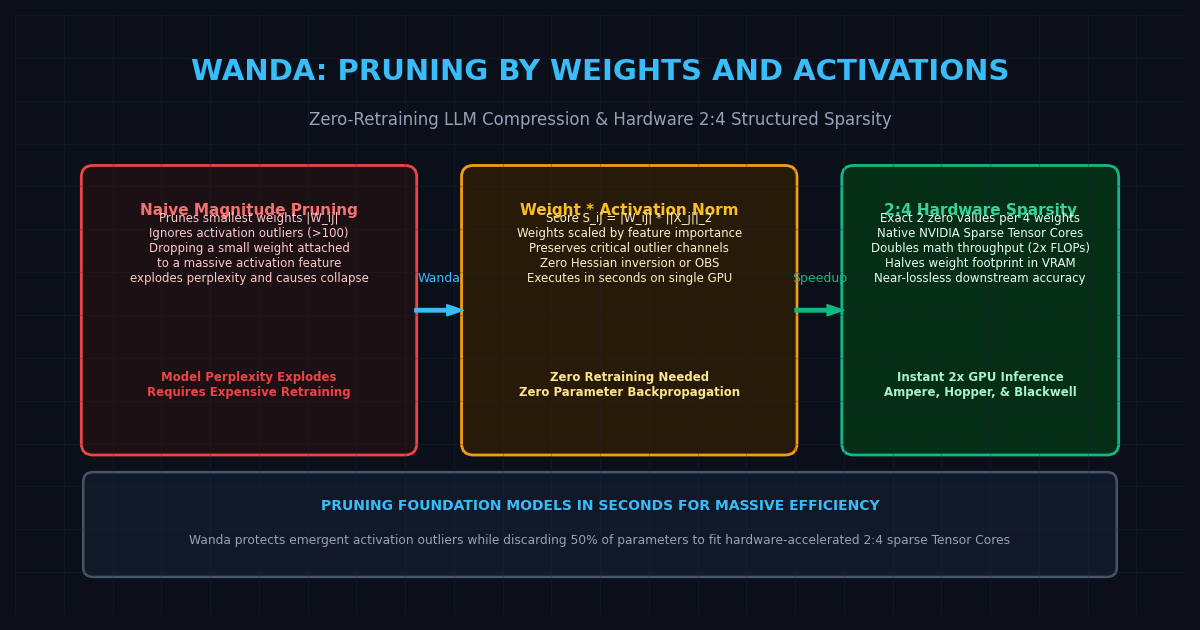
In modern LLMs, however, magnitude pruning completely collapses model perplexity. Research by Dettmers et al. revealed the Emergent Activation Outlier phenomenon: as language models scale beyond 6.7B parameters, certain hidden state dimensions exhibit activation values up to 100x larger than normal channels.
A weight $W_{ij}$ with a relatively small numerical value (e.g., $0.02$) that is multiplied by an outlier activation feature (e.g., $150.0$) produces a massive product that heavily steers downstream attention. Dropping that small weight via magnitude pruning severs the critical outlier pathway, causing the model to output incoherent gibberish.
2. The Computational Complexity of Second-Order Methods (SparseGPT)
To account for activation dynamics, second-order pruning frameworks like SparseGPT apply the Optimal Brain Surgeon (OBS) algorithm. SparseGPT uses Taylor series expansion to invert the Hessian matrix $H = 2 X X^T$ and re-adjust the remaining unpruned weights.
While effective, inverting Hessians across billions of parameters is computationally expensive, requires high GPU memory during calibration, and can become numerically unstable on complex architectures.
The Architecture: Pruning by Weights and Activations (Wanda)
Introduced by researchers from Carnegie Mellon University and Meta AI (Mingjie Sun et al., ICLR 2024 / 2025), Wanda (Pruning by Weights and Activations) solves the pruning bottleneck through a remarkably straightforward, closed-form metric.
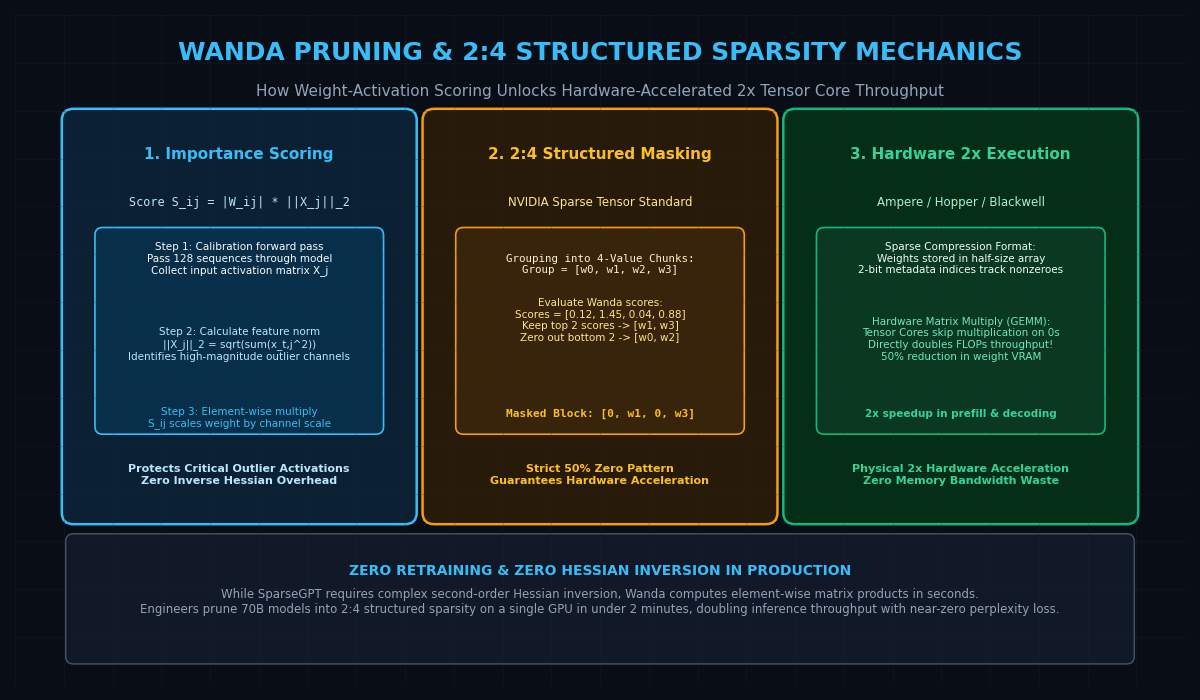
Instead of inverting complex Hessian matrices or retraining the network, Wanda computes the saliency of each individual weight as the product of its magnitude and the input activation feature norm:
$$S_{ij} = |W_{ij}| \cdot |\mathbf{X}_j|_2$$
Where:
- $W_{ij}$ is the weight parameter connecting input feature $j$ to output feature $i$.
- $|\mathbf{X}j|2 = \sqrt{\sum{t=1}^T x{t, j}^2}$ is the L2-norm of the activation column corresponding to feature $j$, evaluated across a tiny calibration dataset (e.g., 128 tokenized sequences from C4 or WikiText).
Why Wanda Protects Model Expressivity
By scaling weight magnitude $|W_{ij}|$ by the activation norm $|\mathbf{X}_j|_2$, Wanda naturally accounts for outlier channels:
- If input channel $j$ contains massive activation outliers, $|\mathbf{X}_j|2$ is very large. All weights in column $j$ receive high importance scores $S{ij}$, protecting them from eviction.
- If input channel $j$ carries low activation variance, its weights must possess large absolute values to survive pruning.
Crucially, Wanda modifies zero remaining weights. It requires zero backpropagation, zero gradient descent, and zero weight updates, executing the pruning pass across a 70B parameter model in under two minutes on a single GPU.
Key Mechanics: 2:4 Structured Sparsity on NVIDIA Tensor Cores
Pruning produces two fundamentally different patterns: unstructured sparsity and structured sparsity.
1. The Myth of Unstructured Speedup
Unstructured pruning removes weights randomly across the tensor. While this reduces the storage size on disk, standard GPU Tensor Cores cannot execute sparse matrix multiplications efficiently without specialized sparse libraries. In practice, unstructured 50% sparsity runs at the exact same speed—or even slower due to indexing overhead—as dense matrix operations.
2. Hardware-Enforced 2:4 Structured Sparsity
To deliver physical wall-clock acceleration, modern GPU architectures (NVIDIA Ampere A100, Hopper H100, and Blackwell B200) feature Sparse Tensor Cores governed by a strict 2:4 structured sparsity constraint:
- In every contiguous group of 4 values along the input channel dimension, exactly 2 values must be zero and 2 values must be non-zero.
Dense Matrix (4 weights):      [ 0.12,  1.45,  0.04,  0.88 ]
Wanda Saliency Scores:         [ 0.35,  4.20,  0.11,  2.60 ]
2:4 Sparse Mask:               [    0,     1,     0,     1 ]
Compressed Matrix: [ 1.45, 0.88 ] + 2-bit index metadata When encoded in NVIDIA’s sparse format, the matrix occupies exactly 50% of the original VRAM. During execution, Sparse Tensor Cores automatically bypass multiplying by the zero elements, directly doubling computational throughput (2x FLOPs).
Wanda generates optimal 2:4 masks by evaluating importance scores $S_{ij}$ within each 4-element block, retaining the two highest-scoring weights and zeroing out the remaining two.
LLM Pruning and Compression Comparison
| Feature Dimension | Magnitude Pruning (L1) | SparseGPT (Second-Order) | Post-Training Quantization (AWQ/GPTQ) | Wanda (2:4 Structured) | | :-------------------------- | :--------------------- | :-------------------------- | :------------------------------------ | :------------------------------------- | ----------------- | ----- | ----------------- | ----------------------------------------- | | Pruning Metric | Absolute weight $ | W_{ij} | $ | Inverse Hessian $H^{-1} W$ | Bit-grid rounding | **$ | W_{ij} | \cdot |\mathbf{X}_j|_2$** | | Calibration Cost | None | High (Hessian inversion) | Moderate | Ultra-Low (<2 min forward pass) | | Weight Modification | None | Re-adjusts unpruned weights | Scales & zero-points | Zero weight updates | | Hardware Speedup | 1.0x (Zero speedup) | 2.0x (if 2:4 formatted) | 1.5x - 2.5x (Memory bound) | Exact 2.0x Tensor Core Speedup | | VRAM Footprint | 100% (unless packed) | 50% (with 2:4 format) | 25% - 50% (4-bit / 8-bit) | 50% Weight Compression | | Perplexity Preservation | Fails catastrophically | High | High | Near-lossless (<0.5 drift) |
Reference Implementation: Wanda Pruning and 2:4 Masking in PyTorch
Below is a self-contained PyTorch implementation demonstrating calibration-driven Wanda scoring and 2:4 structured sparsity generation:
import torch
import torch.nn as nn

def apply_wanda_2_4_pruning(
    layer: nn.Linear,
    calibration_inputs: torch.Tensor
) -> nn.Linear:
    """
    Applies Wanda 2:4 structured sparsity to an nn.Linear layer.
    calibration_inputs: Tensor of shape [num_tokens, in_features]
    """
    with torch.no_grad():
        W = layer.weight.data # Shape: [out_features, in_features]
        out_features, in_features = W.shape

        assert in_features % 4 == 0, "in_features must be divisible by 4 for 2:4 sparsity"

        # 1. Compute input activation L2-norm for each feature channel
        # Shape: [in_features]
        activation_norm = torch.norm(calibration_inputs, p=2, dim=0)

        # 2. Compute Wanda Saliency Matrix: S_ij = |W_ij| * ||X_j||_2
        # Broadcasting activation_norm across rows
        saliency = torch.abs(W) * activation_norm.unsqueeze(0)

        # 3. Reshape saliency into 4-element chunks: [out_features, in_features // 4, 4]
        saliency_reshaped = saliency.view(out_features, in_features // 4, 4)

        # 4. Find the threshold for top-2 in each group of 4
        # topk returns values in descending order; index 1 is the 2nd largest value
        top2_thresholds = torch.topk(saliency_reshaped, k=2, dim=-1).values[:, :, 1:2]

        # 5. Create binary mask: Keep elements >= 2nd largest value
        mask_reshaped = (saliency_reshaped >= top2_thresholds).float()
        mask = mask_reshaped.view(out_features, in_features)

        # 6. Apply mask directly to weights
        layer.weight.data.mul_(mask)

        sparsity_ratio = (layer.weight.data == 0).float().mean().item()
        print(f"Pruned layer: Sparsity = {sparsity_ratio * 100:.1f}% (Expected exactly 50.0%)")

    return layer

if __name__ == "__main__":
    torch.manual_seed(42)
    # Simulate a transformer projection layer (e.g. intermediate FFN)
    in_dim, out_dim = 256, 512
    linear_layer = nn.Linear(in_dim, out_dim, bias=False)

    # Simulate calibration activations with an outlier feature at index 42
    calib_tokens = torch.randn(128, in_dim)
    calib_tokens[:, 42] *= 50.0  # Emergent outlier channel

    print("--- Executing Wanda 2:4 Structured Pruning ---")
    pruned_layer = apply_wanda_2_4_pruning(linear_layer, calib_tokens)

    # Verify that the outlier channel was preserved
    outlier_weights_pruned = (pruned_layer.weight.data[:, 42] == 0).float().mean().item()
    print(f"Outlier channel zero-ratio: {outlier_weights_pruned * 100:.1f}% (Protected by activation norm!)")
print("Successfully produced hardware-compliant 2:4 sparse layer with zero retraining.") Production Scaling: 2x Accelerated Extraction in aiFetchly
In automated document extraction engines and web crawlers like AiFetchly, deploying 2:4 sparse models unlocked by Wanda yields immediate operational dividends:
1. Doubling Query Throughput on Identical Hardware
During large-scale data extraction, servers process thousands of incoming documents per minute. By pruning foundation models into NVIDIA 2:4 structured sparsity, Sparse Tensor Cores execute feed-forward network projections in half the clock cycles. This doubles document processing throughput without purchasing additional GPU instances.
2. Rapid Multi-Model Turnaround
Because Wanda runs without backpropagation or parameter retraining, engineering teams can compress freshly fine-tuned specialist checkpoints in seconds during CI/CD build pipelines. A newly fine-tuned extraction model is pruned, packaged into 2:4 sparse format, and deployed to production endpoints in under five minutes.
By harmonizing activation outlier dynamics with hardware-accelerated Tensor Core architectures, Wanda establishes a practical standard for post-training LLM compression in 2026.