vLLM V1 Architecture: Zero-Overhead LLM Serving Guide
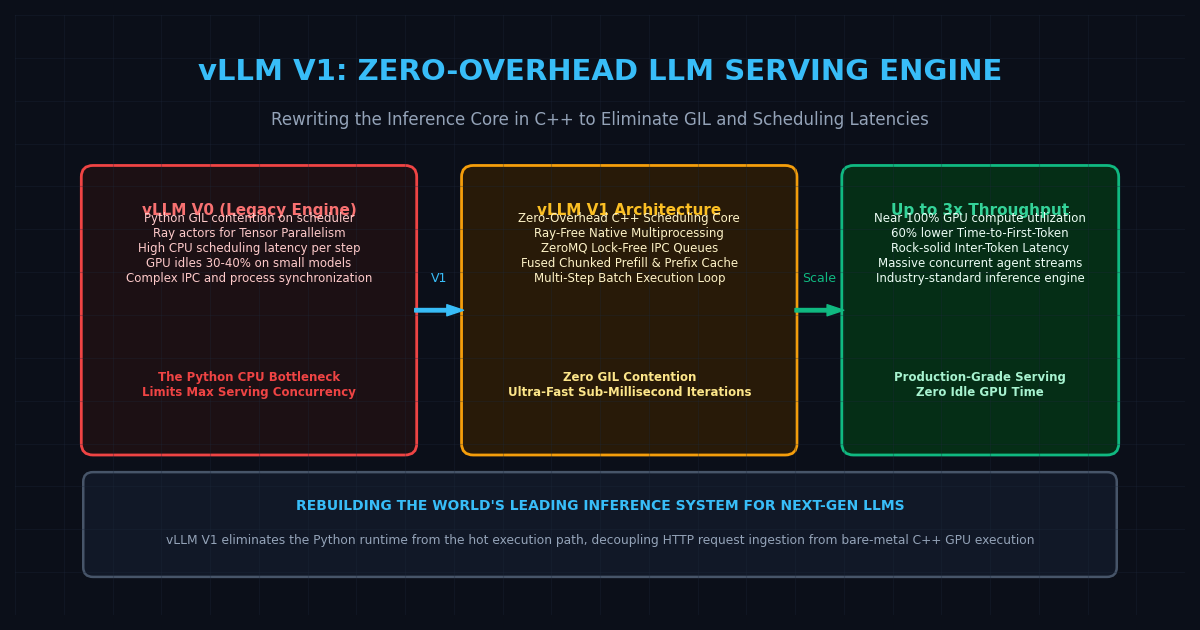
The Problem: The Python GIL and CPU Scheduling Wall in vLLM V0
In high-throughput enterprise infrastructure—from autonomous web crawlers to real-time schema extraction engines in AiFetchly—inference engines must maximize GPU saturation to keep operational costs low.
When vLLM debuted in 2023, its pioneering PagedAttention algorithm eliminated memory fragmentation and transformed large language model serving. However, as foundation models became faster and smaller (such as 3B to 8B parameter small language models) and speculative decoding arrived, the legacy vLLM V0 architecture encountered a fundamental systems barrier: the CPU scheduling bottleneck.
1. The Python Global Interpreter Lock (GIL) Contention
In vLLM V0, the entire control plane—including the async HTTP API server, request tokenization, continuous batching scheduler, KV cache block manager, and model execution runner—operated within Python.
Because Python relies on a Global Interpreter Lock (GIL), threads continuously contend for CPU cycles. In high-concurrency environments with hundreds of active streaming connections, the CPU spends up to 30% to 50% of its time stalled in Python lock synchronization, unable to schedule batches fast enough to keep GPU Tensor Cores fed.
2. GPU Starvation on Sub-Millisecond Iterations
On modern GPUs (like NVIDIA H100 or H200), executing a forward decoding pass for an 8B model takes less than 3 milliseconds.
In vLLM V0, the Python scheduling loop frequently required 2 to 4 milliseconds per iteration to calculate block tables, determine preemptions, and assemble batch tensors. Consequently, the GPU spent 40% of its operating cycles completely idle, waiting for the host CPU to dispatch the next forward pass.
3. Ray Actor Overhead and Fragility
To distribute models across multiple GPUs via Tensor Parallelism (TP), vLLM V0 relied on Ray.
While convenient, Ray introduced significant inter-process communication (IPC) serialization overhead, background heartbeat daemons, and complex failure modes. Synchronizing Ray worker actors added latency to every step and introduced cold-start delays.
The Architecture: The vLLM V1 Redesign and Decoupled Topology
To eradicate CPU scheduling latency and achieve bare-metal GPU throughput, the vLLM core engineering team executed a ground-up architectural rewrite: vLLM V1.
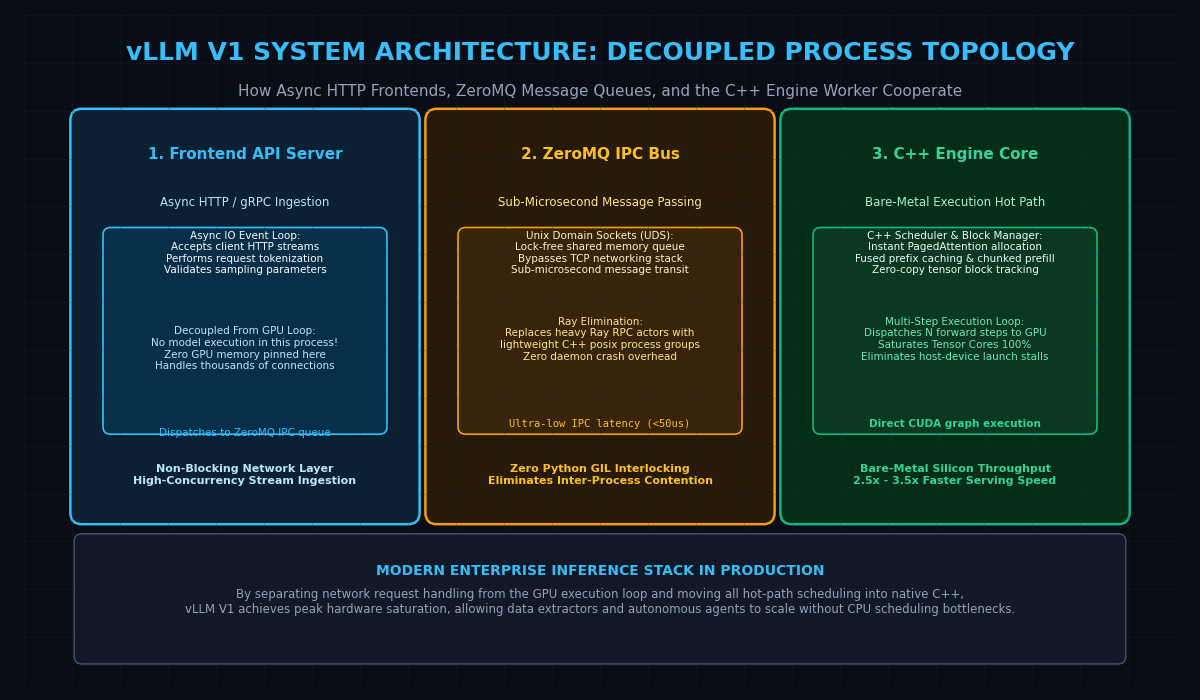
vLLM V1 transitions the engine from a monolithic Python loop to a decoupled, multi-process topology powered by a zero-overhead C++ execution core.
The Three Architectural Pillars of vLLM V1
vLLM V1 restructures the serving pipeline into three isolated layers:
1. Decoupled Frontend (Async Python API Server)
The entry point remains an asynchronous Python process responsible for accepting client HTTP/gRPC streams, validating sampling parameters, and executing tokenizer encodings.
Crucially, no model execution or GPU memory management occurs in this process. It handles pure network I/O, allowing it to scale across thousands of concurrent client connections without blocking GPU execution.
2. Sub-Microsecond ZeroMQ IPC Bus
To communicate between the API frontend and the engine backend, vLLM V1 discards Python queues and Ray RPC in favor of ZeroMQ over Unix Domain Sockets (UDS).
Incoming tokenized requests are serialized into compact binary structs and pushed into a lock-free IPC queue in under 50 microseconds. This completely severs the frontend Python event loop from the GPU execution engine, preventing GIL contention.
3. Zero-Overhead C++ Engine Core (The Hot Path)
The critical scheduling loop is implemented natively in C++. The C++ core manages:
- The High-Speed Block Allocator: Manages PagedAttention virtual memory frames directly in bare-metal C++, allocating and freeing KV cache pages in nanoseconds.
- Fused Prefix Caching and Chunked Prefill: Tracks shared token prefix trees and calculates chunked prefill slices in a single pass without Python runtime overhead.
- Ray-Free Multi-GPU Orchestration: Replaces Ray with lightweight, native POSIX processes coordinated via shared memory and custom C++ process groups.
Key Mechanics: Multi-Step Execution and CUDA Graph Pipelining
Beyond rewriting the scheduler in C++, vLLM V1 introduces core algorithmic optimizations that maximize hardware saturation:
1. Multi-Step Batch Scheduling
In vLLM V0, the scheduler engaged in a synchronous ping-pong interaction with the GPU: schedule 1 token step $\to$ launch CUDA kernel $\to$ wait for output $\to$ repeat.
vLLM V1 introduces Multi-Step Execution. The C++ scheduler plans $M$ consecutive decoding steps in advance (typically $M = 4$ to $8$ steps):
- The engine dispatches a single execution command instructing the GPU to run $M$ sequential forward passes.
- The GPU executes the entire $M$-step trajectory directly on-chip, completely bypassing host-CPU communication.
- Intermediate tokens are sampled and fed into subsequent steps directly in GPU registers, driving compute utilization to near 100%.
2. Zero-Overhead Speculative Decoding Integration
In legacy engines, speculative decoding was an external wrapper that doubled scheduling complexity: proposing tokens in one step, verifying in another, and updating KV caches across Python boundaries.
In vLLM V1, speculative drafting (e.g., via draft models, Medusa heads, or Lookahead decoding) is compiled directly into the C++ engine loop. Draft proposal and verification execute as an atomic GPU batch, unlocking the full theoretical speedup of speculative decoding without CPU stalls.
Inference Engine Evolution: vLLM V0 vs. TGI vs. SGLang vs. vLLM V1
| Architectural Dimension | vLLM V0 (Legacy) | Hugging Face TGI | SGLang (v0.3) | vLLM V1 (Modern) |
|---|---|---|---|---|
| Scheduler Language | Python (GIL Bound) | Rust | Python / C++ | Pure C++ Core |
| Multi-GPU Orchestration | Ray Actors / RPC | Native Rust Process | Python Multiprocessing | Ray-Free Native C++ |
| IPC Transport | Python Queues / Ray | gRPC (Rust/Python) | ZeroMQ IPC | Lock-Free ZeroMQ UDS |
| Scheduling Overhead | 2.0ms – 4.0ms / step | < 0.5ms / step | ~1.0ms / step | < 0.1ms / step |
| Multi-Step Execution | Experimental / Brittle | Limited | Yes | Native First-Class Citizen |
| GPU Utilization (Small LLMs) | 50% – 65% | 75% – 85% | 80% – 90% | 95% – 99% (Peak Saturation) |
Production Configuration: Deploying vLLM V1 in Enterprise Stacks
vLLM V1 is enabled natively in modern releases of vLLM. Below is a production configuration command deploying an 8B foundation model with multi-step scheduling, fused prefix caching, and C++ engine acceleration:
# Launch vLLM V1 Production Server
vllm serve meta-llama/Meta-Llama-3-8B-Instruct \
    --v1 \
    --tensor-parallel-size 1 \
    --gpu-memory-utilization 0.92 \
    --max-num-seqs 256 \
    --max-model-len 16384 \
    --enable-prefix-caching \
    --enable-chunked-prefill \
    --num-scheduler-steps 8 \
    --dtype bfloat16 \
    --host 0.0.0.0 \
--port 8000 Key Deployment Flags Explained:
--v1: Activates the C++ core execution engine and decoupled ZeroMQ IPC topology.--num-scheduler-steps 8: Dispatches 8 consecutive decoding steps per engine invocation, eliminating CPU host-device synchronization latency.--enable-prefix-caching: Automatically activates tree-based KV cache prefix reuse in C++.--enable-chunked-prefill: Slices long prompt prefills into 512-token chunks and interleaves them with active decoding batches.
Production Scaling: High-Throughput Web Extraction in aiFetchly
In automated data extraction architectures like AiFetchly, foundation models process thousands of concurrent web documents, extract tabular entities, and generate structured JSON records:
1. Eliminating CPU Bottlenecks Under High Batch Concurrency
When serving high-throughput scraper pipelines, requests arrive in erratic bursts. Under vLLM V0, a sudden burst of 200 incoming web pages caused the Python scheduler to spike CPU usage to 100%, causing request timeouts and latency jitter.
With vLLM V1, the C++ scheduler processes incoming requests in microseconds. The server sustains full batch concurrency without dropping connections, ensuring stable latency across peak scraping windows.
2. Maximizing GPU Hardware ROI
Cloud GPU infrastructure is a major line item in generative AI budgets. Operating GPUs at 50% utilization due to Python scheduling delays doubles hosting bills.
By adopting vLLM V1’s bare-metal C++ loop, enterprise teams double or triple token throughput on identical GPU hardware clusters—slashing cost-per-token and powering real-time autonomous agent workflows in 2026.