vLLM-Omni Guide: Disaggregated Multimodal Model Serving
The Problem: The Heterogeneous Contention Crisis in Monolithic Omni-Modal Serving
In modern conversational artificial intelligence, autonomous customer support agents, hands-free desktop copilots, and real-time intelligence monitoring powered by AiFetchly, foundation models have evolved beyond text-in, text-out generation into omni-modality architectures. State-of-the-art models—such as GPT-4o, Gemini Live, Qwen-Omni, Mini-Omni, and Chameleon—ingest streaming speech and video in real time while concurrently synthesizing text, visual frames, and natural spoken audio.
However, software engineering teams attempting to serve these omni-modality models using standard inference engines (such as traditional vLLM, TGI, or vanilla PyTorch) encounter a crippling systems barrier: the heterogeneous resource contention crisis.
The Monolithic Omni-Modal Serving Bottleneck:
┌────────────────────────────────────────────────────────┐
│ The Contention Dilemma on a Single GPU Runtime:        │
│ 1. Input Stage: Continuous streaming audio/vision ViT  │
│ 2. Core Stage: Heavy autoregressive LLM reasoning      │
│ 3. Output Stage: Iterative Flow Matching / Vocoding    │
├────────────────────────────────────────────────────────┤
│ Failure Mode 1: Head-of-Line Compute Blocking          │
│ • Long vision prefill or vocoder pass freezes GPU      │
│ ❌ LLM autoregressive token decoding stalls completely!│
│ ❌ Inter-Token Latency (ITL) spikes from 20ms to 400ms!│
├────────────────────────────────────────────────────────┤
│ Failure Mode 2: Memory Fragmentation & Cache Thrashing │
│ • Diffusion latents & audio buffers allocate randomly  │
│ ❌ Fragments PagedAttention KV cache memory pool!      │
│ ❌ Triggers fatal OutOfMemory crashes during peak load!│
├────────────────────────────────────────────────────────┤
│ Failure Mode 3: The Full-Sentence Latency Waterfall    │
│ • Vocoder waits for complete text sentence generation  │
│ ❌ Time-to-First-Audio (TTFA) balloons past 1.8s!      │
└────────────────────────────────────────────────────────┘
Result: Serving omni models monolithically produced stuttering audio and unusable conversational lag! 1. Incompatible Computational Workloads on Shared Silicon
A true omni-modality model is not a homogeneous transformer; it is an assembly of fundamentally divergent mathematical workloads:
- Input Encoders (Vision & Audio): Models like Whisper or SigLIP execute compute-intensive convolutional and dense self-attention forward passes across multi-megabyte image and audio tensors.
- Core Reasoning LLM: An autoregressive transformer (such as Qwen 2.5 or Llama 3.3) that is intensely memory-bandwidth bound, sequentially fetching weights from HBM to generate individual tokens.
- Output Decoders (Acoustic Flow Matching & Vocoders): Models like CosyVoice 2 or Firefly-GAN execute iterative diffusion ODE steps or multi-scale convolutional deconvolution to generate continuous 24kHz/44.1kHz audio.
- When all three stages are forced into a single monolithic Python process or single GPU, heavy vocoder passes steal execution priority from the core LLM. The autoregressive decode loop starves, resulting in sudden 200ms to 500ms audio dropouts and severe conversational stutter.
2. Memory Pool Fragmentation and KV Cache Thrashing
High-throughput LLM serving relies on contiguous or virtualized memory pools (such as PagedAttention) to manage Key-Value (KV) activations:
- In monolithic deployments, output modality generators (such as diffusion transformers or GAN vocoders) dynamically allocate temporary multi-megabyte tensor buffers on the PyTorch heap.
- These non-uniform allocations interleave with KV cache blocks, causing catastrophic virtual memory fragmentation.
- The inference engine is forced to throttle concurrent user batch sizes, slashing overall serving throughput by over 60%.
3. The Full-Sentence Generation Waterfall Delay
In naive cascaded serving setups:
- The serving system waits until the reasoning LLM generates an entire punctuation-delimited sentence before forwarding the text tokens to the audio synthesis worker.
- At an average generation speed of 40 tokens per second, a 20-word sentence requires 500ms of generation time alone, before acoustic decoding even begins.
- Total Time-to-First-Audio (TTFA) frequently exceeds 1,500ms to 2,500ms, destroying the human conversational threshold of 300ms.
The Solution: vLLM-Omni’s Disaggregated Any-to-Any Architecture
To dismantle these monolithic serving bottlenecks and unlock fluid, real-time voice-to-voice interaction, the vLLM project community officially introduced vLLM-Omni.
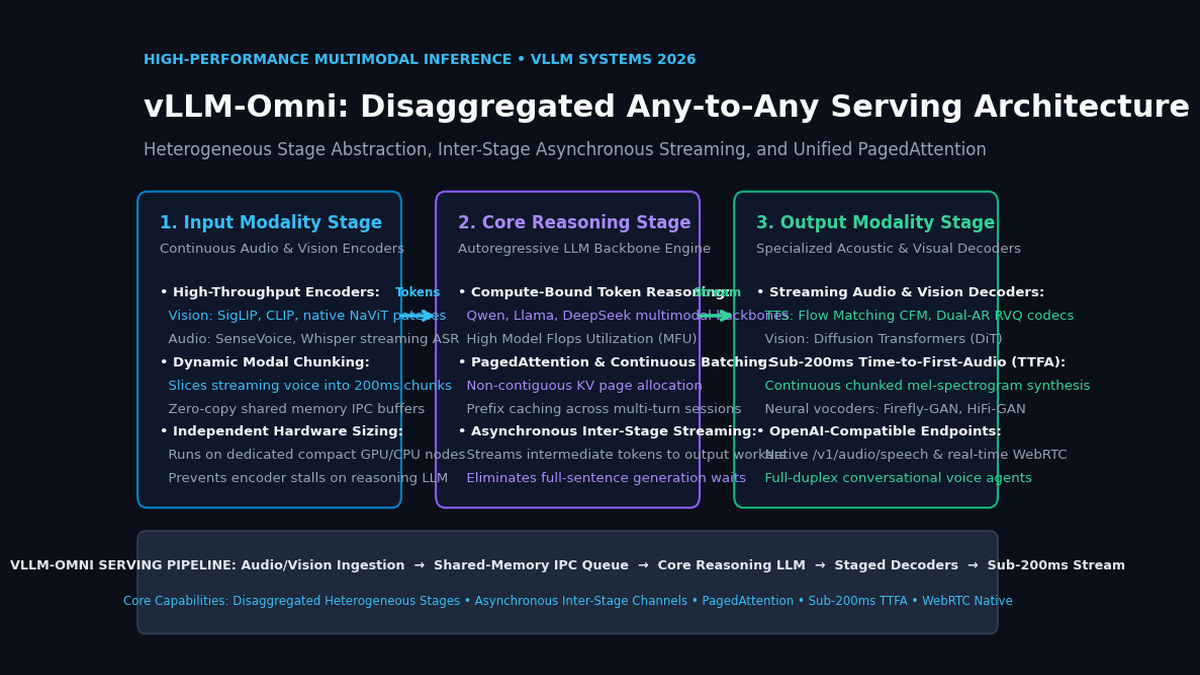
vLLM-Omni pioneers a fully disaggregated, multi-stage serving architecture that decomposes composite omni models into a Directed Acyclic Graph (DAG) of independent execution stages: Input Modality Encoders, the Core Reasoning LLM, and Output Modality Decoders. Connected via lock-free asynchronous shared-memory channels, vLLM-Omni achieves sub-200ms streaming audio latency while maximizing hardware utilization across heterogeneous GPUs.
vLLM-Omni Disaggregated Serving Topology:
┌─────────────────────────────────────────────────────────────────────────┐
│ Client Request: Real-Time WebRTC Audio / Video Stream                   │
└────────────────────────────────────┬────────────────────────────────────┘
                                     │
                                     ▼
┌─────────────────────────────────────────────────────────────────────────┐
│ Stage 1: Input Modality Workers (Dedicated GPU / Edge Accelerator)      │
│ • Continuous streaming Whisper / SenseVoice audio transcription         │
│ • SigLIP / NaViT native-resolution visual patch extraction              │
│ • Slices streaming input into 200ms discrete semantic chunks            │
└────────────────────────────────────┬────────────────────────────────────┘
                                     │ (Zero-Copy Shared-Memory IPC Ring Buffer)
                                     ▼
┌─────────────────────────────────────────────────────────────────────────┐
│ Stage 2: Core Reasoning LLM Engine (Tensor Parallel Cluster: 2x-8x GPUs)│
│ • High-Throughput PagedAttention KV Cache & Continuous Batching         │
│ • Autoregressively generates text tokens + semantic speech tokens       │
│ • Emits intermediate tokens asynchronously without waiting for <eos>!   │
└────────────────────────────────────┬────────────────────────────────────┘
                                     │ (Asynchronous Token-by-Token Streaming)
                                     ▼
┌─────────────────────────────────────────────────────────────────────────┐
│ Stage 3: Output Modality Generation Workers (Dedicated L4 / 4090 GPUs)  │
│ • Staged Acoustic Flow Matching (CFM) & RVQ Multi-Codebook Decoders     │
│ • CUDA-Graphed Firefly-GAN / HiFi-GAN Neural Vocoders                   │
│ • Emits 24kHz/44.1kHz continuous audio chunks with sub-200ms TTFA       │
└────────────────────────────────────┬────────────────────────────────────┘
                                     │
                                     ▼
┌─────────────────────────────────────────────────────────────────────────┐
│ Native OpenAI-Compatible Endpoints (/v1/audio/speech, WebRTC Full-Duplex)│
└─────────────────────────────────────────────────────────────────────────┘ The Architectural Pillars of vLLM-Omni
- Disaggregated Stage Abstraction: Instead of running the entire multimodal pipeline inside one monolithic execution engine, vLLM-Omni decouples the model into distinct stages. Each stage runs as an independent process with its own execution loop, memory manager, and CUDA stream, eliminating cross-workload blocking.
- Asynchronous Inter-Stage Streaming Channels: Stages communicate via high-speed, zero-copy POSIX shared memory ring buffers (
posix_ipc) within a single node, or InfiniBand RDMA across multi-node clusters. The core reasoning LLM streams semantic audio tokens to the vocoder token-by-token as they are generated, cutting Time-to-First-Audio latency to under 200 milliseconds. - Heterogeneous Hardware Sizing & Independent Autoscaling: Large foundation models require vast amounts of compute and memory for text reasoning, while audio vocoders require high memory bandwidth but fewer parameters. vLLM-Omni allows deploying the 70B reasoning LLM across four NVIDIA H100 GPUs (Tensor Parallelism = 4), while routing output audio generation to cost-effective NVIDIA L4 or RTX 4090 GPUs.
- Omni-Aware PagedAttention: Memory management extends beyond text to accommodate multimodal tokens. PagedAttention virtualizes memory for visual prompt embeddings and acoustic tokens, preventing memory fragmentation and sustaining high concurrent user batch sizes.
- Native Full-Duplex WebRTC & OpenAI Compatibility: Exposes production endpoints for
/v1/audio/speech,/v1/chat/completionswith streaming PCM/Opus audio, and WebRTC protocols. Native barge-in handling allows an incoming user interruption signal to instantly purge in-flight shared-memory buffers across all three stages simultaneously.
Comparing Monolithic vs. Disaggregated Serving
The table below contrasts vLLM-Omni against monolithic PyTorch serving and standard text-only vLLM:
Omni Serving Architecture Comparison:
┌───────────────────────────┬───────────────────────────────┬───────────────────────────────┬───────────────────────────────┐
│ Dimension                 │ Monolithic PyTorch / HF       │ Standard vLLM (Text-Only)     │ vLLM-Omni Engine              │
├───────────────────────────┼───────────────────────────────┼───────────────────────────────┼───────────────────────────────┤
│ Execution Topology        │ Single monolithic process     │ Single engine (Text focused)  │ Disaggregated Multi-Stage DAG │
│ Inter-Stage Communication │ Sequential Python blocking    │ Internal C++ memory queues    │ Asynchronous Shared Memory IPC│
│ Time-to-First-Audio (TTFA)│ 1,500ms–3,000ms               │ Not supported (Text only)     │ <200 milliseconds             │
│ Head-of-Line Blocking     │ Extreme (Vocoder freezes LLM) │ Low (Homogeneous tokens)      │ Zero (Isolated stages)        │
│ Hardware Heterogeneity    │ ❌ Fixed to single GPU pool   │ ❌ Homogeneous GPU cluster    │ ✅ Heterogeneous Hardware Sizing│
│ Memory Management         │ Fragmented PyTorch Heap       │ PagedAttention (Text only)    │ Omni-Aware PagedAttention     │
│ Supported Output Types    │ Text only (or manual glue)    │ Text tokens only              │ Text, Audio, Video, Speech    │
│ Interruption / Barge-In   │ Brittle socket resets         │ Abort request signal          │ Synchronized Multi-Stage Purge│
└───────────────────────────┴───────────────────────────────┴───────────────────────────────┴───────────────────────────────┘ Deep Dive into vLLM-Omni Core Subsystems & Execution Lifecycle
To understand how vLLM-Omni achieves ultra-low latency across heterogeneous stages, let’s explore its core architectural subsystems: the Disaggregated Stage Abstraction, Zero-Copy IPC Channels, and Staged PagedAttention Scheduling.
vLLM-Omni Architectural Engine:
vLLM-Omni
 ├──► 1. Stage Abstraction: Modular DAG of independent Input, Reasoning, and Output nodes
 ├──► 2. Asynchronous Channels: Lock-free POSIX shared memory ring buffers for token streaming
 ├──► 3. Staged PagedAttention: Virtualized non-contiguous block tables for multi-modal tokens
 ├──► 4. Output Modality Workers: CUDA-graphed Flow Matching & Firefly-GAN streaming vocoders
└──► 5. WebRTC Gateway: Full-duplex audio transport with synchronized barge-in purge 1. The Disaggregated Stage Abstraction & Scheduler
In vLLM-Omni, an omni-modality model is formally registered as a directed graph of execution stages:
$$\mathcal{G} = (\mathcal{V}{\text{stages}}, \mathcal{E}{\text{channels}})$$
InputStage: Receives raw audio chunks or video frames, executes the feature encoder (e.g., Whisper encoder, SigLIP ViT), and writes normalized latent tokens to the input channel.ReasoningStage: A fully featured vLLM engine instance managing the central transformer backbone (e.g., Qwen-Omni, Llama-3-Omni). It pulls input tokens from the input channel, executes continuous batching and PagedAttention, and autoregressively generates output tokens.OutputStage: A specialized worker managing speech synthesis or image diffusion. As soon as theReasoningStageemits an acoustic token or text token, theOutputStagereads it from the shared memory channel and executes streaming synthesis.- Each stage runs its own independent event loop and operating system process, preventing GPU kernel synchronization stalls from propagating across stage boundaries.
2. Zero-Copy Shared-Memory Channels (IPC & RDMA)
Traditional microservice pipelines transmit intermediate tensors over HTTP or gRPC, incurring serialization overhead and TCP network delays:
- vLLM-Omni implements Zero-Copy Inter-Stage Channels:
- Within a single server node, stages communicate through shared memory segments (
/dev/shm) managed by lock-free circular ring buffers. - When the
ReasoningStagesamples next token $s_t$, it writes the token ID and its hidden state activation $\mathbf{h}_t \in \mathbb{R}^D$ directly into a pre-allocated circular ring buffer in shared RAM. - The
OutputStageworker monitors the buffer pointer and immediately dispatches the acoustic decoding kernel without copying data across user-space memory. - In multi-node clusters, the channels seamlessly swap shared memory for InfiniBand Remote Direct Memory Access (RDMA), achieving inter-node transfer latencies under 15 microseconds.
- Within a single server node, stages communicate through shared memory segments (
3. Staged PagedAttention & Continuous Batching
Managing memory for composite models requires handling multiple sequence dimensions simultaneously:
- Text prompts generate static 1D sequence lengths.
- Vision prompts generate 2D spatial patch grids (e.g., $24 \times 24$ tokens).
- Spoken audio generation produces continuous streams of acoustic codebook indices.
- Unified Block Allocation: vLLM-Omni’s block manager virtualizes physical GPU memory into uniform 16-token memory pages. The core reasoning transformer maps all incoming modality tokens into these non-contiguous pages, while separate pinned memory pools are allocated exclusively for the output vocoder’s continuous convolution buffers. This structural decoupling guarantees that acoustic synthesis never starves the LLM’s KV cache.
4. Full-Duplex Interruption & Synchronized State Purging
In conversational voice applications, handling user interruptions (barge-in) with minimal latency is vital:
- When the client’s Voice Activity Detector (VAD) detects that the human user has started speaking while the agent is generating audio:
- The WebRTC gateway issues an atomic
CANCEL_REQUESTsignal to the vLLM-Omni coordinator. - The coordinator writes an abort flag into the shared-memory channels connecting Stage 1, Stage 2, and Stage 3.
- The
OutputStageinstantly mutes the vocoder audio buffer, discarding partially synthesized chunks. - The
ReasoningStagestops autoregressive sampling and frees the request’s KV cache blocks immediately. - The entire interruption cycle completes in under 30 milliseconds, delivering seamless, conversational turn-taking.
- The WebRTC gateway issues an atomic
Hands-On Implementation: Serving an Omni-Modality Model with vLLM-Omni
Let’s walk through installing vLLM-Omni, launching a multi-stage disaggregated serving pipeline, and querying the streaming voice endpoint in Python.
1. Environment Setup and Installation
Install vllm-omni with support for CUDA 12.4+ and audio/vision decoders:
conda create -n vllm-omni python=3.10 -y
conda activate vllm-omni

# Install vLLM-Omni from official community distribution
pip install torch torchvision torchaudio --index-url https://download.pytorch.org/whl/cu124
pip install vllm-omni soundfile librosa 2. Deploying a Disaggregated Omni Model via CLI
Launch a production omni model (e.g., Qwen/Qwen2.5-Omni-7B) with disaggregated stages:
# Launch vLLM-Omni server with staged execution enabled
vllm serve Qwen/Qwen2.5-Omni-7B \
  --omni \
  --tensor-parallel-size 2 \            # 2 GPUs dedicated to Core Reasoning LLM
  --omni-output-backend flow-matching \ # Stage 3: Flow Matching acoustic decoder
  --host 0.0.0.0 \
  --port 8000 \
  --max-model-len 8192 \
--gpu-memory-utilization 0.90 3. Multi-Stage Pipeline Configuration via YAML
For production multi-node deployments, configure stage topology explicitly in omni_config.yaml:
model: 'Qwen/Qwen2.5-Omni-7B'
pipeline:
  input_stage:
    device: 'cuda:0'
    encoder_type: 'sensevoice'
    chunk_size_ms: 200
  reasoning_stage:
    devices: ['cuda:1', 'cuda:2']
    tensor_parallel_size: 2
    dtype: 'bfloat16'
    kv_cache_dtype: 'auto'
    max_num_seqs: 64
  output_stage:
    device: 'cuda:3'
    decoder_type: 'firefly-gan'
    vocoder_sample_rate: 24000
channel:
  transport: 'shared_memory'
buffer_size_mb: 256 Launch using the declarative configuration:
vllm-omni-launch --config omni_config.yaml 4. Querying the Streaming Audio API via Python
Stream synthesized audio chunks directly from the vLLM-Omni OpenAI-compatible endpoint:
import time
import httpx
import soundfile as sf
import numpy as np

# Connect to vLLM-Omni OpenAI-compatible speech endpoint
url = "http://localhost:8000/v1/audio/speech"

payload = {
    "model": "Qwen/Qwen2.5-Omni-7B",
    "input": (
        "Welcome to aiFetchly! We have detected a 14% price drop on enterprise GPUs "
        "across major retail vendors. Preparing your detailed market summary now."
    ),
    "voice": "alloy",
    "response_format": "pcm",  # Raw 24kHz 16-bit PCM stream
    "stream": True
}

print("Initiating streaming request to vLLM-Omni...")
start_time = time.time()
first_chunk_received = False
audio_buffer = []

with httpx.stream("POST", url, json=payload, timeout=30.0) as response:
    for chunk in response.iter_bytes(chunk_size=4096):
        if not first_chunk_received:
            ttfa_ms = (time.time() - start_time) * 1000
            print(f"Time-to-First-Audio (TTFA): {ttfa_ms:.2f} ms")
            first_chunk_received = True

        audio_buffer.append(chunk)

print("Audio streaming completed successfully.")
raw_pcm_data = b"".join(audio_buffer)

# Convert PCM bytes to float32 numpy array and export to WAV
audio_array = np.frombuffer(raw_pcm_data, dtype=np.int16).astype(np.float32) / 32768.0
sf.write("aifetchly_voice_brief.wav", audio_array, samplerate=24000)
print("Saved 24kHz audio file: aifetchly_voice_brief.wav") Production Architecture & Integration for aiFetchly
In automated data extraction, competitor pricing intelligence, and desktop automation copilots powered by AiFetchly, deploying vLLM-Omni provides the foundational serving layer for real-time multimodal interaction.
aiFetchly Real-Time Multimodal Architecture:
┌─────────────────────────────────────────────────────────────────┐
│ aiFetchly Web Intelligence Engine & Desktop Copilot Workspace  │
└────────────────────────────────────┬────────────────────────────┘
                                     │ (Dispatches Streaming Audio/Video Tasks)
                                     ▼
┌─────────────────────────────────────────────────────────────────┐
│ vLLM-Omni Disaggregated Serving Cluster                         │
│ • Input Encoders: Slices streaming voice/screen inputs          │
│ • Core Reasoning: 70B LLM cluster with PagedAttention           │
│ • Output Workers: Sub-200ms Flow Matching & Vocoder Decoders    │
└───────────────────┬─────────────────────────────────┬───────────┘
                    │                                 │
     (Isolated Sandbox Execution via E2B)   (Telemetry & Latency Tracing)
                    ▼                                 ▼
┌───────────────────────────────────────┐ ┌───────────────────────────────┐
│ E2B MicroVM Sandboxing                │ │ Langfuse / Phoenix Monitoring │
│ • Sandboxed audio post-processing     │ │ • Track TTFA & inter-token gap│
│ • Zero local host contamination       │ │ • Trace multi-stage pipeline  │
└───────────────────────────────────────┘ └───────────────────────────────┘ 1. Hands-Free Conversational Web Intelligence
When AiFetchly monitors live web pages:
- Rather than requiring operators to monitor visual dashboards, aiFetchly streams spoken market intelligence updates with sub-200ms TTFA.
- The user can interrupt the agent mid-sentence to request drill-downs into specific tables, with vLLM-Omni executing synchronized multi-stage aborts in under 30 milliseconds.
2. Multi-Agent Ecosystem Interoperability
Orchestrating omni-modal agents across modern frameworks:
- Model Context Protocol via FastMCP: Expose vLLM-Omni’s speech generation and vision perception as standardized MCP tools using FastMCP, allowing desktop assistants and IDEs to trigger voice output natively.
- Workflow State Machines with LangGraph: Use state machines in LangGraph to manage dialogue state and retrieve structured records from ChromaDB or LanceDB.
- Sandboxed Execution with E2B: Execute dynamic audio transcoding, ffmpeg processing, and scraping scripts safely inside isolated E2B Firecracker microVMs.
3. Latency Telemetry and Quality Auditing
Managing high-concurrency omni workloads in production:
- Track Time-to-First-Audio (TTFA), Inter-Token Latency (ITL), and shared-memory ring buffer occupancy using Langfuse and Arize Phoenix.
- Quantify speech intelligibility and Word Error Rate (WER) using DeepEval test suites to ensure reliable voice delivery across global edge networks.
Summary: Disaggregation as the Standard for Omni-Modal AI Infrastructure
The transition from text-only language models to true any-to-any omni-modality systems requires a fundamental shift in serving architecture.
By replacing monolithic GPU execution with a disaggregated multi-stage pipeline connected via asynchronous shared-memory channels, vLLM-Omni eliminates the computational contention, memory fragmentation, and latency compounding that crippled early multimodal deployments. Delivering sub-200ms streaming audio, native PagedAttention memory virtualization, and full-duplex WebRTC turn-taking, vLLM-Omni establishes the industrial blueprint for serving next-generation foundation models. For automated data extraction, hands-free conversational assistants, and desktop intelligence engineered with AiFetchly, vLLM-Omni provides the high-throughput infrastructure required for real-time multimodal intelligence.