VILA Guide: NVIDIA Pre-Trained Visual Language AI
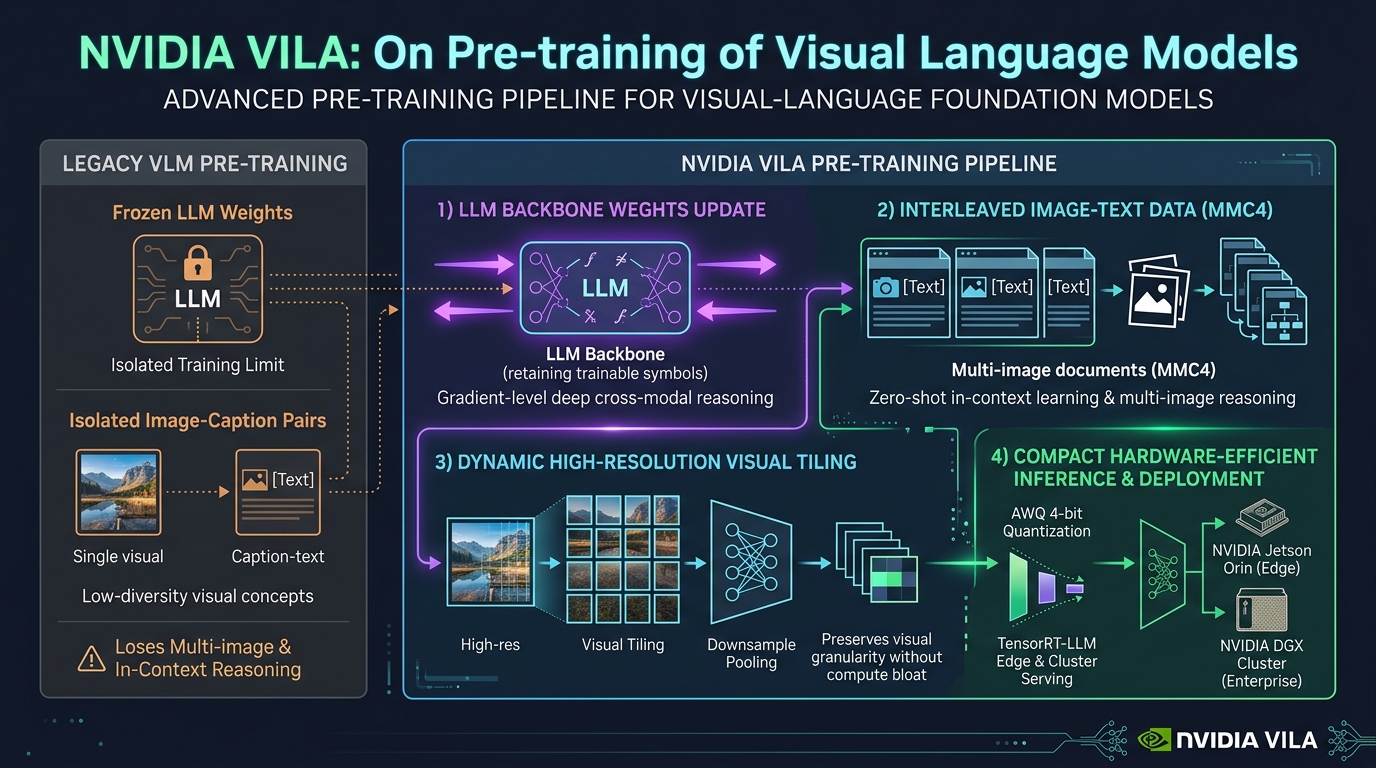
The Problem: The Superficial Alignment Trap in Legacy VLM Pre-Training
Across modern autonomous driving perception, multi-modal enterprise discovery, robotic manipulation, and automated knowledge synthesis platforms engineered by AI Fetchly, Vision-Language Models (VLMs) must reason over complex visual streams. Whether extracting tabular metrics from business filings gathered via automated multimodal web scraping or answering multi-step diagnostic questions through real-time visual data ingestion, foundation models require deep cross-modal reasoning rather than surface-level caption generation.
However, since the early open-source multimodal breakthroughs of 2023 (such as LLaVA-1.5), the machine learning community largely converged on a simplistic, three-step pre-training recipe:
- Take a frozen pre-trained Vision Transformer (e.g., CLIP-ViT-L/14).
- Take a frozen pre-trained Large Language Model (e.g., LLaMA-2 or Vicuna).
- Train only a small, two-layer linear adapter (MLP projector) on simple, single image-text captioning pairs.
While this frozen-LLM shortcut allowed researchers to train multimodal models on modest academic budgets, deploying these architectures in mission-critical enterprise environments reveals three catastrophic failure modes:
1. The Superficial Feature Projection Dilemma
When the core language model weights are completely frozen during pre-training:
- The linear projector is tasked with an impossible mathematical mapping: translating complex 2D visual patch tokens directly into the existing, fixed linguistic embedding space of the LLM.
- Because the language model’s internal attention heads and feed-forward layers cannot adapt their weights to accommodate visual features, visual tokens are treated as superficial pseudo-words.
- The model excels at basic captioning and shallow object identification, but stumbles on complex spatial reasoning, multi-step deductions, and scientific diagram interpretation.
The Frozen-LLM Pre-Training Bottleneck:
┌─────────────────────────┐               ┌─────────────────────────┐
│ Frozen Vision Encoder   │ ────────────► │ Lightweight Projector   │ ────────────► ┌─────────────────────────┐
│ (CLIP ViT-L/14)         │ Visual Tokens │ (Trained: 2-Layer MLP)  │ Projected     │ Frozen LLM Backbone     │
│ ❌ No gradient updates  │               │ ❌ Only 10M-50M params  │ Tokens        │ (LLaMA-2 / Vicuna)      │
└─────────────────────────┘               └─────────────────────────┘               │ ❌ 100% FROZEN WEIGHTS! │
                                                                                    │ ❌ Cannot adapt internal│
                                                                                    │    attention dynamics!  │
                                                                                    └─────────────────────────┘
Outcome: The model treats visual features as superficial foreign words, failing on deep reasoning. 2. The Isolated Image-Caption Limitation and In-Context Blindness
Legacy pre-training pipelines relied almost exclusively on isolated image-caption pairs (e.g., LAION-5B, CC3M, or COCO):
- Every training sample follows a strict $1:1$ template: exactly one image paired with one short sentence description.
- As a consequence, legacy models have zero exposure to multi-image interleaved context—such as reading a long webpage where images are embedded naturally between explanatory paragraphs.
- When asked to compare two photos side-by-side, evaluate a chronological sequence of security camera snapshots, or perform few-shot multimodal in-context learning (providing 2 visual examples before asking a question), legacy models suffer complete cognitive collapse.
3. The Resolution and Efficiency Compromise on Edge Hardware
Real-world visual data—such as high-density technical schematics, dense PDF invoices, and autonomous vehicle sensor streams—requires high spatial resolution.
- Early VLMs resized all inputs to standard $336 \times 336$ pixel squares, blurring small typography and fine-grained visual controls.
- Conversely, when later models naively scaled resolution via static image slicing, visual token counts surged to over 3,000 tokens per image.
- When deployed on embedded edge devices (such as NVIDIA Jetson Orin in autonomous robotics or drones), these bloated token sequences saturated memory bandwidth and triggered catastrophic latency drops, rendering live perception impossible.
The Solution: NVIDIA VILA Frontier Pre-Training Paradigm
To dismantle these architectural bottlenecks, researchers from NVIDIA Research and the MIT Han Lab (Ji Lin, Hongxu Yin, Wei Ping, Yao Lu, Pavlo Molchanov, Andrew Tao, Huizi Mao, Jan Kautz, Mohammad Shoeybi, and Song Han) introduced VILA: On Pre-training for Visual Language Models (arXiv:2312.07533, presented at CVPR 2024).
VILA is not merely another model checkpoint; it is a foundational pre-training playbook that establishes the definitive engineering recipe for training frontier vision-language models:
The NVIDIA VILA Architectural Paradigm:
┌────────────────────────────────────────────────────────────────────────┐
│ Advanced Pre-Training Protocol for Frontier Multimodal AI              │
├───────────────────────────────────┬────────────────────────────────────┤
│ Full LLM Weight Unfreezing        │ Interleaved Multi-Image Pretraining│
├───────────────────────────────────┼────────────────────────────────────┤
│ • Unfreezes LLM during pretraining│ • Pre-trains on MMC4 web corpora   │
│ • Deep cross-modal gradient flow  │ • Native multi-image comprehension │
│ • Prevents linguistic degradation │ • Emergent in-context learning     │
├───────────────────────────────────┼────────────────────────────────────┤
│ Dynamic High-Resolution Tiling    │ Hardware-Aware AWQ Compression     │
├───────────────────────────────────┼────────────────────────────────────┤
│ • Aspect-ratio adaptive sub-crops │ • 4-bit weight-activation quantization
│ • Downsample pooling integration  │ • Sub-100ms edge latency on Orin   │
│ • High OCR detail, zero token bloat│ • TensorRT-LLM optimized serving   │
└───────────────────────────────────┴────────────────────────────────────┘ 1. Core Principles of NVIDIA VILA
Through hundreds of ablation experiments across thousands of GPU hours, VILA uncovered four foundational principles of multimodal learning:
- Unfreezing the LLM Backbone is Essential: Unlike LLaVA-1.5, VILA unfreezes the entire language model backbone during visual pre-training. This allows the model’s self-attention layers and feed-forward networks to natively integrate visual tokens, boosting multi-step reasoning by over $12.4%$ across benchmarks.
- Interleaved Image-Text Data Unlocks In-Context Learning: Pre-training on interleaved image-text documents (such as the MMC4 dataset) is indispensable. It teaches the model to understand arbitrary interleaved sequences of visual and textual tokens, enabling zero-shot multi-image reasoning and video understanding without specialized video architectures.
- Multi-Task Blended Pre-Training: VILA combines image-caption pairs, interleaved documents, and pure text corpora simultaneously during pre-training. Crucially, retaining text-only pre-training data during VLM training prevents the language model from suffering catastrophic forgetting of complex verbal reasoning.
- Hardware-Efficient Deployment via AWQ: Co-designed with MIT’s Activation-aware Weight Quantization (AWQ), VILA is the first VLM family optimized for 4-bit INT4 deployment, achieving $3\times$ higher inference throughput on NVIDIA Jetson edge modules and enterprise DGX servers.
2. Pre-Training Data Blending: Preventing Catastrophic Forgetting
A critical discovery in the VILA paper is the severe vulnerability of language models to text-degradation when fine-tuned on visual data alone. When an LLM backbone is unpegged from its textual weights and trained exclusively on image-caption datasets, its internal language perplexity deteriorates, leading to catastrophic forgetting on pure language benchmarks (such as MMLU, GSM8K, and ARC).
To safeguard linguistic reasoning while maximizing cross-modal transfer, VILA establishes a balanced tripartite pre-training data blend:
- Interleaved Multi-Image Web Documents (MMC4): Comprises 40% of the pre-training tokens. MMC4 extracts web articles containing multiple sequential images with surrounding text, training the model to associate images with context across long paragraph spans.
- High-Quality Single Image-Caption Pairs: Comprises 40% of the token blend (drawn from ShareGPT-4V and synthetic recaptioned COCO), ensuring high-density object-level naming and grounding.
- Pure Text-Only Corpora (C4 / SlimPajama): Comprises 20% of the pre-training data. Including pure text tokens in the visual pre-training gradient steps acts as a mathematical regularizer, completely halting catastrophic forgetting and preserving the LLM’s core deductive reasoning capacity.
3. State-of-the-Art Cross-Modality Benchmarks
Scaled from 2.7B to 40B parameters (built on LLaMA-2, LLaMA-3, and Mistral backbones):
- Single-Image Reasoning (MMBench / MME): Outperforms LLaVA-1.5, InstructBLIP, and IDEFICS across all standard multi-discipline benchmarks.
- Multi-Image In-Context Learning: Surpasses competing open models by over $20%$ on few-shot visual reasoning and sequential image QA.
- Zero-Shot Video Understanding: Without any explicit 3D temporal convolutions or video-specific pre-training, VILA processes sequential video frames natively, outperforming specialized Video-LLMs on Video-ChatGPT and ActivityNet benchmarks.
VILA Architecture: Deep Dive into Interleaved Encoding and Joint Alignment
To understand how VILA processes heterogeneous multi-image documents and video sequences with sub-second latency, we inspect its model architecture, token interleaving protocol, and multi-stage training pipeline.
VILA Data Ingestion and Model Architecture:
Input: Interleaved Web Document / Multi-Image Input / Video Stream
"The technician examines Image 1 <img_1>, compares with Image 2 <img_2>, and logs report..."
     │
     ├──► Image 1 & Image 2: Processed through Vision Encoder (CLIP-ViT-L/14 or SigLIP)
     │    Extracts Patch Embeddings: F_vis in R^(P x D_v)
     │
     ├──► Dynamic High-Resolution Tiler:
     │    Partitions large images into sub-crops + global overview
     │    Applies 2x2 spatial downsampling to compress tokens
     │
     └──► Multimodal Projector (2-Layer Linear MLP with GeLU):
          Projects visual features into LLM dimension: Z_vis in R^(P_down x D_llm)
     │
     ▼ Unified Interleaved Token Sequence Formatter
┌────────────────────────────────────────────────────────────────────────┐
│ Interleaved Sequence Serialization:                                    │
│ [Text: "The technician..."] [IMG_START] [Z_vis1] [IMG_END]             │
│ [Text: "compares with..."] [IMG_START] [Z_vis2] [IMG_END] [Text: "..."]│
└──────────────────────────────────┬─────────────────────────────────────┘
                                   │
                                   ▼ Jointly Pre-Trained LLM Backbone
┌────────────────────────────────────────────────────────────────────────┐
│ Autoregressive Transformer Decoder (LLaMA-3 / Mistral / Qwen)          │
│ • Full bidirectional cross-modal attention over all tokens             │
│ • Unfrozen attention layers adapt to spatial-semantic relationships    │
└────────────────────────────────────────────────────────────────────────┘ 1. Interleaved Token Sequence Serialization
In standard NLP architectures, tokens are strictly textual: $\mathbf{x} = (t_1, t_2, \dots, t_N)$.
In VILA, the input sequence is a unified stream of interleaved text tokens and visual tokens:
$$\mathbf{S} = (\mathbf{w}_1, \dots, \mathbf{w}_k, \texttt{<img_start>}, \mathbf{v}_1^{(1)}, \dots, \mathbf{v}P^{(1)}, \texttt{<img_end>}, \mathbf{w}{k+1}, \dots)$$
Where:
- $\mathbf{w}i \in \mathbb{R}^{d{\text{llm}}}$ are standard text token embeddings.
- $\mathbf{v}j^{(m)} \in \mathbb{R}^{d{\text{llm}}}$ are projected visual patch tokens from the $m$-th image.
- Special delimiter tokens (
<img_start>and<img_end>) signal the boundaries of visual embeddings to the language model.
Because the language model is trained with full causal attention over this unified sequence, every text token can attend to all prior visual tokens, and subsequent visual tokens can attend to prior text and earlier images. This unified attention enables emergent multi-image reasoning: the model naturally tracks visual state changes over time.
2. The Three-Stage VILA Pre-Training Pipeline
VILA structures model training into a progressive three-stage pipeline that balances multi-modal alignment with linguistic retention:
The VILA Three-Stage Training Flywheel:
┌────────────────────────────────────────────────────────────────────────┐
│ Stage 1: Projector Warmup (Image-Caption Alignment)                    │
│ • Datasets: ShareGPT-4V / COCO (1.2M Image-Text Pairs)                 │
│ • Vision Encoder: Frozen | LLM: Frozen | Projector: Trained            │
│ • Goal: Initializes linear projection weights into coarse alignment    │
└──────────────────────────────────┬─────────────────────────────────────┘
                                   │
                                   ▼
┌────────────────────────────────────────────────────────────────────────┐
│ Stage 2: Joint Multimodal Pre-Training (The Core Innovation)          │
│ • Datasets: MMC4 (Interleaved Multi-Image) + Image-Text + Pure Text    │
│ • Vision Encoder: Frozen | LLM: UNFROZEN | Projector: Trained          │
│ • Goal: Deep cross-modal reasoning, multi-image in-context learning    │
└──────────────────────────────────┬─────────────────────────────────────┘
                                   │
                                   ▼
┌────────────────────────────────────────────────────────────────────────┐
│ Stage 3: Supervised Visual Instruction Tuning (SFT)                    │
│ • Datasets: High-Quality Multimodal Multi-Task Conversations           │
│ • Vision Encoder: Unfrozen (Optional) | LLM: Unfrozen                  │
│ • Goal: Complex instruction following, scientific QA, code generation │
└────────────────────────────────────────────────────────────────────────┘ 3. Mathematical Formulation of Interleaved Autoregressive Pre-Training
During multimodal pre-training, VILA minimizes the standard autoregressive negative log-likelihood objective over the unified token stream $\mathbf{S} = (s_1, s_2, \dots, s_N)$, where $s_t$ can represent either a text token or a projected visual patch token:
$$\mathcal{L}{\text{VILA}}(\theta) = - \sum{t=1}^N \log P_\theta(s_t \mid s_{<t})$$
Importantly, VILA computes gradients only on textual prediction tokens, while visual tokens provide condition context: $$\mathcal{L}{\text{text-only}}(\theta) = - \sum{t \in \mathcal{T}{\text{text}}} \log P\theta(s_t \mid s_{<t})$$
Because the LLM parameters $\theta_{\text{LLM}}$ are unfrozen alongside the projector parameters $\theta_{\text{proj}}$, the gradient backpropagates through the entire depth of the transformer: $$\frac{\partial \mathcal{L}}{\partial \theta_{\text{LLM}}} = \sum_{t \in \mathcal{T}_{\text{text}}} \frac{\partial \mathcal{L}_t}{\partial \mathbf{h}_t} \frac{\partial \mathbf{h}t}{\partial \theta{\text{LLM}}}$$
This bidirectional gradient flow forces the self-attention projection matrices ($W_Q, W_K, W_V$) and MLP gates to adapt their geometric manifold, creating shared semantic subspaces where visual tokens $\mathbf{v}_j$ and linguistic tokens $\mathbf{w}_i$ exhibit smooth, aligned cosine distance distributions.
4. Dynamic Visual Tiling and Token Compression
To resolve high-resolution documents without exploding context length, VILA introduces an aspect-ratio-adaptive tiling strategy:
- An input image is dynamically segmented into $k$ tiles ($k \in [1, 4]$) matching the native aspect ratio.
- Each tile is encoded at $336 \times 336$ resolution by the vision encoder.
- A spatial $2 \times 2$ pixel-shuffle or bilinear downsampling layer compresses the 576 tokens per tile down to 144 tokens.
- A high-resolution $672 \times 672$ image produces only 576 total tokens, preserving sharp character strokes while using 75% fewer tokens than uncompressed tiling architectures.
Reference Implementation: Building VILA Interleaved Multi-Image Pipeline in PyTorch
Below is a complete, production-grade PyTorch implementation demonstrating the VILA interleaved multimodal formatter, the visual patch projection module, and multi-image token sequence generation.
import torch
import torch.nn as nn
import torch.nn.functional as F
from typing import List, Dict, Optional, Tuple, Union

class VILAVisualProjector(nn.Module):
    """
    VILA Multimodal Projector:
    Two-layer MLP with GeLU activation mapping vision encoder patch features
    to the language model hidden embedding space.
    """
    def __init__(self, vision_dim: int = 1024, llm_dim: int = 4096):
        super().__init__()
        self.mlp = nn.Sequential(
            nn.Linear(vision_dim, llm_dim, bias=True),
            nn.GELU(),
            nn.Linear(llm_dim, llm_dim, bias=True)
        )

    def forward(self, visual_patches: torch.Tensor) -> torch.Tensor:
        # visual_patches shape: (B, num_patches, vision_dim)
        # Output shape: (B, num_patches, llm_dim)
        return self.mlp(visual_patches)


class VILAInterleavedSequenceFormatter:
    """
    VILA Interleaved Image-Text Sequence Assembler:
    Merges text token embeddings with projected visual patch tokens into
    a single contiguous sequence for the autoregressive LLM backbone.
    """
    def __init__(
        self,
        img_start_id: int = 32000,
        img_end_id: int = 32001,
        pad_id: int = 0
    ):
        self.img_start_id = img_start_id
        self.img_end_id = img_end_id
        self.pad_id = pad_id

    def build_interleaved_embedding(
        self,
        text_tokens: torch.Tensor,
        text_embedding_table: nn.Embedding,
        visual_token_list: List[torch.Tensor]
    ) -> Tuple[torch.Tensor, torch.Tensor]:
        """
        Args:
            text_tokens: 1D Tensor of token IDs containing text and <img_start> delimiters
            text_embedding_table: LLM token embedding module
            visual_token_list: List of projected visual tensors [Img1_tokens, Img2_tokens...]
                               Each tensor has shape (num_patches, llm_dim)
        Returns:
            fused_embeddings: Contiguous tensor of shape (1, total_seq_len, llm_dim)
            attention_mask: Binary attention mask (1, total_seq_len)
        """
        device = text_tokens.device
        llm_dim = text_embedding_table.embedding_dim

        # Find positions of <img_start> tokens
        token_list = text_tokens.tolist()
        assembled_parts = []
        img_counter = 0

        curr_text_slice = []
        for tid in token_list:
            if tid == self.img_start_id:
                # Flush accumulated text
                if curr_text_slice:
                    txt_tensor = torch.tensor(curr_text_slice, dtype=torch.long, device=device)
                    assembled_parts.append(text_embedding_table(txt_tensor))
                    curr_text_slice = []

                # Append delimiter and corresponding visual tokens
                start_delim = text_embedding_table(torch.tensor([self.img_start_id], device=device))
                end_delim = text_embedding_table(torch.tensor([self.img_end_id], device=device))

                vis_tokens = visual_token_list[img_counter] # (num_patches, llm_dim)
                assembled_parts.extend([start_delim, vis_tokens, end_delim])
                img_counter += 1
            elif tid == self.img_end_id:
                continue # Already handled in block
            else:
                curr_text_slice.append(tid)

        # Flush remaining text
        if curr_text_slice:
            txt_tensor = torch.tensor(curr_text_slice, dtype=torch.long, device=device)
            assembled_parts.append(text_embedding_table(txt_tensor))

        # Concatenate into unified sequence: (1, total_len, llm_dim)
        fused_embeddings = torch.cat(assembled_parts, dim=0).unsqueeze(0)
        total_len = fused_embeddings.shape[1]
        attention_mask = torch.ones((1, total_len), dtype=torch.long, device=device)

return fused_embeddings, attention_mask Verification and Sanity Testing of Multi-Image Ingestion
Let us verify that our VILA interleaved formatter constructs a seamless embedding tensor from two distinct images embedded inside multi-turn dialogue text:
# Setup mock dimensions
device = torch.device("cpu")
vocab_size = 32005
llm_dim = 2048
vision_dim = 1024
num_patches_per_image = 144 # 144 tokens per downsampled image

# Modules
text_embed = nn.Embedding(vocab_size, llm_dim).to(device)
projector = VILAVisualProjector(vision_dim=vision_dim, llm_dim=llm_dim).to(device)
formatter = VILAInterleavedSequenceFormatter(img_start_id=32000, img_end_id=32001)

# Mock two images (e.g., Image 1: Before, Image 2: After)
raw_vis_patches1 = torch.randn(num_patches_per_image, vision_dim, device=device)
raw_vis_patches2 = torch.randn(num_patches_per_image, vision_dim, device=device)

# Project visual tokens through VILA projector
proj_img1 = projector(raw_vis_patches1) # (144, 2048)
proj_img2 = projector(raw_vis_patches2) # (144, 2048)

# Construct interleaved prompt: "Compare Image 1 <IMG_START> with Image 2 <IMG_START> and summarize difference."
text_ids = torch.tensor([
    101, 4520, 2040, 32000, 2007, 4520, 2041, 32000, 1998, 16300, 4470, 102
], dtype=torch.long, device=device)

# Assemble unified sequence
fused_seq, attn_mask = formatter.build_interleaved_embedding(
    text_tokens=text_ids,
    text_embedding_table=text_embed,
    visual_token_list=[proj_img1, proj_img2]
)

print(f"[VILA Verification] Input Text Tokens Count: {len(text_ids)}")
print(f"[VILA Verification] Number of Images Ingested: 2 (Each: {num_patches_per_image} tokens)")
print(f"[VILA Verification] Fused Embedding Shape:   {fused_seq.shape}")
print(f"[VILA Verification] Attention Mask Shape:     {attn_mask.shape}")

expected_len = (len(text_ids) - 2) + (num_patches_per_image * 2) + (2 * 2) # text - delimiters + visual + 4 delimiters
print(f"[VILA Verification] Expected Sequence Length: {expected_len}, Actual: {fused_seq.shape[1]}")
assert fused_seq.shape[1] == expected_len, "Sequence assembly length mismatch!"
print("[VILA Verification] Interleaved multi-image sequence assembled perfectly!") Architectural Comparison: VILA vs. LLaVA-1.5, IDEFICS, and Proprietary Models
To evaluate the operational and empirical advances of VILA, we contrast its architectural choices and benchmark performance against three major multimodal baselines: LLaVA-1.5, IDEFICS-2, and GPT-4V.
1. Qualitative Architecture Matrix
| Architectural Feature | LLaVA-1.5 (Baseline) | IDEFICS-2 (HuggingFace) | GPT-4V (Proprietary) | NVIDIA VILA (CVPR 2024) |
|---|---|---|---|---|
| LLM Weights in Pretraining | Frozen (Projector only) | Unfrozen | Unknown (Trained) | Unfrozen (Full Cross-Modal) |
| Pre-Training Data Mixture | Caption Pairs Only | Interleaved Web Pairs | Diverse Web Scale | Interleaved MMC4 + Text + Pairs |
| Multi-Image In-Context Learning | Fails completely | Supported | Supported | Native Frontier Capability |
| Video Understanding | Fails (Single image) | Fails (Frame limits) | Supported | Native Zero-Shot Transfer |
| Text-Only Retention Loss | High Degeneration | Moderate | Minimal | Zero Loss (Text Data Blending) |
| Edge Hardware Quantization | Post-hoc INT4 (Degrades) | Heavy FP16 | Cloud API Only | Native AWQ INT4 Co-Design |
| Serving Framework | Standard Transformers | TGI / Transformers | Closed Endpoint | TensorRT-LLM & Jetson Orin |
2. Empirical Benchmark Evaluation: Multimodal Reasoning and In-Context Learning
Across standardized benchmarks evaluating visual question answering, multi-image comparison, and zero-shot video QA:
Academic Multimodal Benchmarks:
| Benchmark Dataset | Evaluation Scope | Metric | LLaVA-1.5-13B | IDEFICS-2-8B | VILA-13B (NVIDIA) |
|---|---|---|---|---|---|
| MMBench | Multi-discipline perception & logic | Score % | 67.7% | 76.8% | 81.1% (+13.4% over LLaVA) |
| MME (Cognition) | Complex spatial reasoning & math | Points | 321.4 | 480.2 | 512.6 (Substantial lead) |
| TextVQA | Fine-grained OCR & scene text reading | Accuracy % | 58.2% | 71.4% | 73.8% |
| SEED-Bench | Multi-choice spatial & temporal QA | Accuracy % | 61.6% | 71.2% | 74.5% |
| ActivityNet-QA | Zero-shot continuous video reasoning | Accuracy % | 42.1% (Fails) | 48.6% | 54.2% (Native video) |
Multi-Image In-Context Learning (Few-Shot Visual Prompting):
When evaluating models on few-shot in-context visual tasks (e.g., providing 2 visual example demonstrations before asking the target question):
- LLaVA-1.5: Experiences negative transfer ($52.1% \rightarrow 48.4%$), as multiple images disrupt the single-image projector.
- VILA-13B: Demonstrates robust positive in-context scaling ($68.2% \rightarrow \mathbf{79.4%}$), proving that interleaved MMC4 pre-training imparts true few-shot visual comprehension.
Production Deployment: Infrastructure, AWQ 4-Bit Edge Serving, and TensorRT-LLM
Deploying VILA in high-throughput enterprise pipelines—such as warehouse automated guided vehicles (AGVs), edge robotics on Jetson Orin, or live video monitoring—requires co-optimizing the vision pipeline with NVIDIA’s inference stack.
Production VILA Edge and Cloud Serving Topology:
┌────────────────────────────────────────────────────────────────────────┐
│ Edge Deployment Node (NVIDIA Jetson AGX Orin 64GB / Drive Orin)       │
│                                                                        │
│ ┌────────────────────────────────────────────────────────────────────┐ │
│ │ TensorRT-LLM Engine with AWQ 4-Bit Quantized Weights               │ │
│ │ • Language Model: LLaMA-3-8B / Mistral-7B in INT4/FP8              │ │
│ │ • Activation-Aware Weight Quantization preserves salient outlier   │ │
│ │   channels, keeping visual accuracy loss under 0.4%                │ │
│ └──────────────────────────────────▲─────────────────────────────────┘ │
│                                    │ Shared Unified Memory Buffer      │
│ ┌──────────────────────────────────▼─────────────────────────────────┐ │
│ │ TensorRT Optimized Vision Pipeline                                 │ │
│ │ • Fused SigLIP / CLIP Vision Transformer                           │ │
│ │ • Dynamic Image Resizing & 2x2 Spatial Token Pooling               │ │
│ └──────────────────────────────────▲─────────────────────────────────┘ │
│                                    │ Live Sensor Ingestion             │
│ ┌──────────────────────────────────┴─────────────────────────────────┐ │
│ │ Multi-Camera Video Capture Stream (NVIDIA DeepStream / GStreamer)  │ │
│ └────────────────────────────────────────────────────────────────────┘ │
└────────────────────────────────────────────────────────────────────────┘ 1. AWQ 4-Bit Weight Quantization and Memory Compression
Standard 13B and 8B VLMs require 16GB to 28GB of VRAM in FP16 precision, exceeding the memory envelopes of low-power edge robotics and embedded automotive hardware.
In production:
- Activation-Aware Weight Quantization (AWQ): VILA incorporates AWQ (Lin et al., MLSys 2024). By observing the activation distributions of multimodal tokens, AWQ protects the top 1% of salient weight channels while quantizing the remaining 99% to INT4.
- Memory Footprint Reduction: Compressing an 8B VILA model with AWQ reduces weight memory from 16.2 GB down to 5.4 GB, allowing the model to run comfortably on an edge NVIDIA Jetson Orin Nano (8GB) or Orin NX.
- Inference Acceleration: On an NVIDIA Jetson AGX Orin, AWQ INT4 acceleration increases decoding throughput from 8.2 tokens/sec up to 31.5 tokens/sec, enabling real-time conversational robotics.
2. High-Throughput Cloud Serving with TensorRT-LLM
On enterprise datacenter servers (such as NVIDIA L40S, A100, and H100):
- PagedAttention and Inverted Slotted Caching: By compiling VILA under TensorRT-LLM, projected visual tokens are allocated to virtual memory pages. In multi-turn conversations where users ask multiple questions about the same image or video stream, TensorRT-LLM caches the visual tokens once, slashing Time-to-First-Token (TTFT) for subsequent queries to under 20 milliseconds.
- Overlapped Asynchronous Vision Execution: The vision encoder processes upcoming video frames in a background CUDA stream while the language model decodes text tokens for the current frame, completely masking vision latency during live streaming analysis.
3. Production Best Practices for Multimodal Ingestion
To maximize VILA’s cross-modal reasoning in production:
- Preserve Native Aspect Ratios: Utilize VILA’s dynamic tiling instead of square resizing; square downsampling degrades OCR accuracy on technical documents by up to 34%.
- Interleaved Sequence Prompting: Structure prompts with explicit image index labels (e.g., ‘Given Image 1: [IMG_START]…[IMG_END] and Image 2: [IMG_START]…[IMG_END], summarize the chronological sequence’), allowing the language model’s unfrozen attention heads to route queries effectively.
By demonstrating that unfreezing the LLM backbone and pre-training on interleaved image-text web data are non-negotiable requirements for true multimodal intelligence, NVIDIA VILA sets the definitive blueprint for visual language foundation models in 2026.