VeriSilicon Vivante VIP9000: Scalable Embedded NPU Guide
The Embedded AI Heterogeneity Crisis: Silicon Fragmentation and the Edge Memory Wall
The rapid proliferation of artificial intelligence across embedded systems, automotive cockpits, smart industrial sensors, and consumer appliances has triggered an unprecedented microarchitectural crisis. For decades, embedded system-on-chip (SoC) designers relied on general-purpose microcontrollers, digital signal processors (DSPs), and embedded graphics processing units (GPUs) to execute localized control loops and perceptual algorithms. However, the emergence of modern deep learning workloads—spanning high-resolution convolutional neural networks, vision transformers (ViT), real-time object tracking, and edge generative models—has rendered traditional embedded processor architectures obsolete.
When semiconductor companies and tier-one original equipment manufacturers (OEMs) attempt to integrate artificial intelligence into thermal- and cost-constrained edge silicon, they encounter four severe microarchitectural failure modes:
- The Von Neumann Bus Penalty and Memory Bandwidth Starvation: Embedded edge devices operate under uncompromising physical constraints: strict sub-1W to sub-10W thermal envelopes, fanless enclosures, and tight bill-of-materials (BOM) budgets that preclude expensive High-Bandwidth Memory (HBM) or multi-channel LPDDR5X configurations. In standard embedded SoCs, neural network weights and intermediate feature activation maps must be transferred repeatedly across narrow, high-capacitance system buses (such as 32-bit or 64-bit LPDDR4 interfaces). Shuttling millions of weight parameters across these buses consumes between 70% and 90% of dynamic system power, causing severe memory bus contention and starving concurrent image signal processors (ISPs) and host application CPUs.
- Package Thermal Resistance and Pin-Count Limitations: In cost-sensitive consumer and automotive markets, microchips are encased in low-cost plastic ball grid array (BGA) or quad flat no-lead (QFN) packaging. These packages exhibit high junction-to-ambient thermal resistance ($\theta_{JA} \ge 25^\circ\text{C/W}$). If an integrated accelerator draws more than 2 to 3 Watts of continuous power, internal silicon temperatures rapidly approach the maximum $125^\circ\text{C}$ junction threshold, triggering emergency thermal clock throttling. Furthermore, physical package pin-count constraints strictly limit external memory bus widths, forcing accelerators to operate on constrained memory interfaces delivering less than 25 GB/s of total bandwidth.
- The Rigid Fixed-Function ASIC Trap vs. Architectural Evolution: Early neural processing accelerators were engineered as hardwired, fixed-function application-specific integrated circuits (ASICs) optimized strictly for legacy 2D convolutional networks (such as classical AlexNet or ResNet-50). However, the rapid architectural migration toward attention mechanisms, Vision Transformers, dynamic sparse mixtures-of-experts (MoE), and depthwise separable convolutions caused these rigid ASICs to suffer devastating hardware utilization collapse. Hardwired systolic arrays sit up to 80% idle when processing dynamic token sequences, non-square attention projections, or multi-head softmax normalizations.
- The Software Toolchain Fragmentation Wall: In the embedded semiconductor ecosystem, hardware capabilities are meaningless without a robust, production-proven software deployment pipeline. Many silicon startups produce impressive raw multiply-accumulate (MAC) numbers on paper, but fail in commercial production because their toolchains require manual operator mapping, lack quantization calibration tools, and introduce non-deterministic numerical drift when converting models from PyTorch or TensorFlow. Embedded engineers require automated graph compilers that perform layer fusion, memory layout transformation, and post-training quantization without breaking baseline accuracy.
- Silicon Scalability and IP Reuse Dilemmas: Silicon design teams developing heterogeneous product tiers—ranging from battery-powered IoT smart sensors drawing milliwatts to multi-camera automotive advanced driver-assistance systems (ADAS) drawing tens of watts—face exorbitant non-recurring engineering (NRE) costs if forced to integrate different, incompatible NPU architectures for each product tier. Semiconductor companies require a scalable, licensable NPU intellectual property (IP) architecture that spans from sub-1 TOPS micro-controllers up to 100+ TOPS high-performance computing chiplets under a unified, backward-compatible software API.
Overcoming these systemic hurdles demands a programmable, scalable, and memory-resilient neural processing architecture engineered from the silicon floor up to support hybrid transformer-CNN workloads with hardware-native sparsity and automated compiler toolchains.
Introducing VeriSilicon Vivante VIP9000: Scalable Embedded NPU Architecture
VeriSilicon (芯原微电子)—the global semiconductor Silicon Platform as a Service (SiPaaS®) leader—solved the embedded artificial intelligence challenge with the Vivante VIP9000 Neural Processing Unit (NPU) processor IP family.
As one of the world’s most widely deployed embedded neural acceleration architectures, VeriSilicon’s Vivante NPU IP has shipped in over 100 million AI-enabled chips worldwide across more than 70 tier-one semiconductor vendors and OEMs. Integrated into landmark commercial platforms—including NXP Semiconductors’ i.MX 8M Plus, Allwinner application processors, Broadcom communication hubs, Renesas automotive SoCs, and Google-VeriSilicon Coral co-developed accelerators—the Vivante VIP9000 architecture provides the silicon industry’s most versatile, scalable neural processing foundation.
+-------------------------------------------------------------------------+
|                  VeriSilicon Vivante VIP9000 IP Overview                |
+-------------------------------------------------------------------------+
| Architecture:       Scalable Multi-Cluster Neural Processing Unit IP    |
| Compute Scaling:    0.5 TOPS (VIP9000Pico) to 100+ TOPS (VIP9400 Array) |
| Numerical Formats:  INT4, INT8, INT16, FP16, BF16 (Dynamic Mixed Mode)  |
| Core Engine:        Tensor Processing Clusters (TPC) + Wide Vector DSP  |
| Memory Efficiency:  Integrated Compression + Zero-Skipping Sparsity     |
| Architectural Focus:Native Transformer Attention & Convolutional Fusions|
| Commercial Scale:   100M+ Silicon Units Shipped Across 70+ Licensees    |
| Software Ecosystem: Vivante ACUITY™ Toolkit & VIPLite Runtime Platform  |
+-------------------------------------------------------------------------+ Key microarchitectural breakthroughs integrated into the VeriSilicon Vivante VIP9000 NPU family include:
- Modular and Scalable IP Hierarchy: Spans three targeted tiers under a shared software architecture: the VIP9000Pico family (sub-milliwatt, sub-TOPS footprint for wearable always-on sensing), the mainstream VIP9000 family (0.5 to 10+ TOPS for smart cameras, robotics, and industrial automation), and the high-performance VIP9400 series (scalable multi-core clusters reaching over 100 TOPS for automotive ADAS and datacenter edge servers).
- Native Transformer and Generative AI Acceleration: Incorporates dedicated hardware execution units optimized for multi-head self-attention mechanisms, cross-attention projection matrices, Vision Transformers (ViT), and lightweight Large Language Models (such as TinyLlama and nanoGPT), eliminating the vector execution bottlenecks that crippled legacy NPUs.
- Hardware-Native Sparsity and Zero-Skipping Engine: Features real-time operand inspection circuitry that detects zero-valued weights and activation tensors dynamically. By skipping unnecessary mathematical computations and memory transactions, VIP9000 cuts memory bandwidth consumption by over 50% and boosts effective compute throughput by up to 2x.
- Dynamic Mixed-Precision Execution: Flexibly mixes INT4, INT8, INT16, FP16, and Bfloat16 computations on a per-layer basis. Critical attention layers and sensitive activation normalizations can execute in FP16 to preserve dynamic range, while dense linear projections execute in INT8 or INT4 to maximize power efficiency.
- Turnkey ACUITY™ AI Software Development Platform: Provides an end-to-end model optimization suite supporting over 150 neural network operators across PyTorch, TensorFlow, ONNX, TFLite, and Caffe, featuring automated post-training quantization, structural pruning, and memory graph allocation.
Enterprises deploying large-scale neural network training, automated data extraction, and multimodal reasoning clusters can connect their VeriSilicon VIP9000 embedded edge hardware with real-time data ingestion infrastructure to stream high-velocity datasets directly into on-chip tensor memory for immediate vectorized processing and continuous fine-tuning. By combining licensable microarchitectural scalability with production software maturity, VeriSilicon Vivante VIP9000 establishes the undisputed global benchmark for embedded edge intelligence.
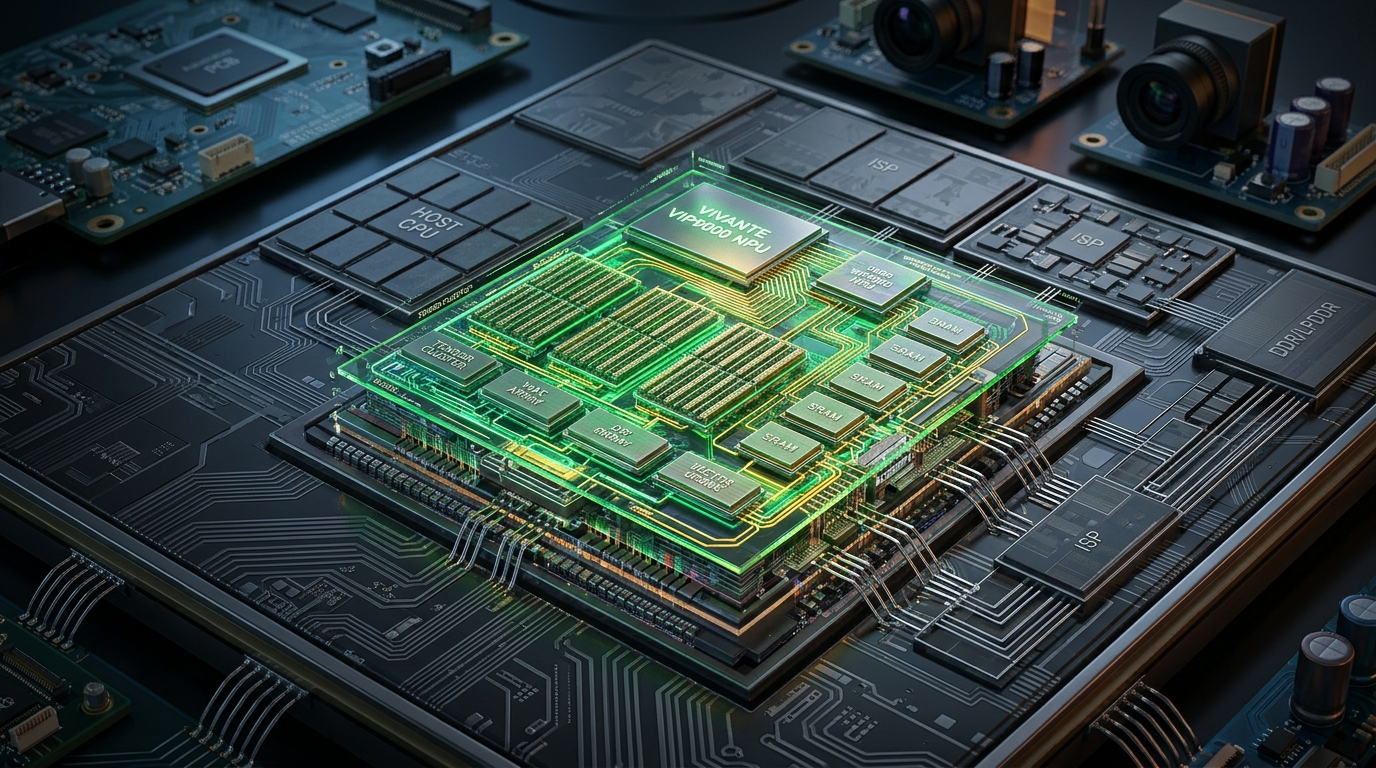
Architectural Deep Dive: Tensor Processing Clusters, Sparsity Engine, and Acuity Toolchain
The sustained mathematical throughput, low silicon area footprint, and sub-watt energy efficiency of the VeriSilicon Vivante VIP9000 originate from its decoupled execution cluster topology, dedicated tensor-vector hardware blocks, and memory bandwidth reduction architecture.
Decoupled Tensor Processing Cluster (TPC) Topology
At the silicon core level, the VIP9000 architecture abandons monolithic processing matrices in favor of modular, decoupled Tensor Processing Clusters (TPCs) interconnected via an ultra-high-speed on-chip crossbar:
+-----------------------------------------------------------------------------------+
|                     VeriSilicon Vivante VIP9000 Core Topology                     |
+-----------------------------------------------------------------------------------+
|  +------------------------+  +-------------------------------------------------+  |
|  | AXI / OCP Bus Subsystem|  | Hardware Microcode Task Sequencer (MTS)         |  |
|  | 64-bit / 128-bit Master|  | Autonomous Graph Dispatch & Layer Synchronization|  |
|  +-----------+------------+  +------------------------+------------------------+  |
|              |                                        |                           |
|  +-----------v----------------------------------------v------------------------+  |
|  |               High-Bandwidth On-Chip Crossbar Switch Matrix                 |  |
|  +-----------------------------------------------------------------------------+  |
|        |                  |                  |                  |                 |
|  +-----v------+    +------v-----+     +------v-----+     +------v-----+           |
|  | TPC Tile 0 |<-->| TPC Tile 1 |<--> | TPC Tile 2 |<--> | TPC Tile 3 | ... (xN)  |
|  | - 2D Systol|    | - 2D Systol|     | - 2D Systol|     | - 2D Systol|           |
|  | - VectorDSP|    | - VectorDSP|     | - VectorDSP|     | - VectorDSP|           |
|  | - Sparsity |    | - Sparsity |     | - Sparsity |     | - Sparsity |           |
|  | - SRAM Bank|    | - SRAM Bank|     | - SRAM Bank|     | - SRAM Bank|           |
|  +------------+    +------------+     +------------+     +------------+           |
|        ^                  ^                  ^                  ^                 |
|        |                  |                  |                  |                 |
|  +-----v------------------v------------------v------------------v--------------+  |
|  |                 Direct Memory Access (DMA) & Weight Decompression           |  |
|  +-----------------------------------------------------------------------------+  |
+-----------------------------------------------------------------------------------+ Each Tensor Processing Cluster integrates specialized functional components:
- 2D Systolic Matrix Processing Array: A dense, hardware-pipelined matrix multiplication engine engineered for high-density GEMM convolutions and linear projections. Operands stream rhythmically across a 2D spatial grid of multiply-accumulate (MAC) units. By keeping weights stationary in local register files while activation tensors propagate horizontally, the systolic array minimizes dynamic charging of internal capacitive wires.
- Dynamic Bit-Slice Reconfigurable Multipliers: The systolic multiplier units feature dynamic precision reconfiguration. A single 16-bit multiplier cell can be dynamically split into two independent 8-bit integer multipliers or four 4-bit integer multipliers within the same physical silicon footprint. When a neural network layer is quantized to INT4, the effective compute throughput of the cluster doubles instantly, reaching over 100 TOPS in multi-cluster configurations without increasing silicon area.
- Programmable Vector DSP Engine: Positioned adjacent to the systolic array, a wide SIMD vector processor executes operations that cannot be formulated as dense matrix dot products. In modern transformers and convolutional nets, non-linear activation functions (GELU, SwiGLU, SiLU, ReLU), spatial pooling, layer normalizations (RMSNorm, LayerNorm), element-wise tensor additions, and softmax exponent calculations are executed directly on the vector DSP, preventing pipeline stalls in the matrix core.
- Hardware Microcode Task Sequencer (MTS): An autonomous, microcoded control engine that coordinates layer-by-layer execution. The MTS parses pre-compiled command packets generated by the Acuity compiler, configures direct memory access (DMA) transfers, and schedules compute operations across multiple TPC clusters without interrupting the host application CPU.
- Multi-Banked Local SRAM Buffers: Each TPC includes dedicated localized scratchpad SRAM banks connected through a non-blocking internal crossbar. The memory banking is interleaved to allow the Matrix Processing Array to read weights while the Vector DSP simultaneously writes output activations, completely eliminating read-after-write structural hazards.
Native Transformer and Attention Acceleration
Legacy edge NPUs struggled severely with transformer architectures because self-attention requires dynamically computing pairwise relationships between tokens ($Q K^T$), scaling by $\frac{1}{\sqrt{d_k}}$, applying a non-linear Softmax normalization, and multiplying by value representations ($V$):
$$\text{Attention}(Q, K, V) = \text{Softmax}\left(\frac{Q K^T}{\sqrt{d_k}}\right) V$$
The Vivante VIP9000 resolves this through dedicated hardware attention data paths:
- Hardware-Accelerated Softmax Engine: Rather than offloading exponential calculations to an external CPU or slow scalar micro-engine, VIP9000 incorporates dedicated mathematical hardware lookup tables and normalization dividers capable of computing multi-head Softmax distributions across hundreds of tokens in single-digit clock cycles.
- Dynamic Tensor Transposition on the Fly: Transformer multi-head attention requires reshaping and transposing multidimensional tensors between batch, sequence, head, and head-dimension axes ($[B, S, H, D] \leftrightarrow [B, H, S, D]$). VIP9000’s DMA engine handles on-the-fly spatial tensor transpositions in hardware as data transfers between system memory and localized SRAM, completely eliminating software memory shuffle overhead.
- Layer Normalization and RoPE Hardware Support: The vector engine features single-cycle vector reduction and square-root reciprocal logic, accelerating Root Mean Square Normalization (RMSNorm) and Rotary Position Embeddings (RoPE) at full hardware line rates.
Memory Optimization: Hardware Sparsity and Weight Decompression
To break the memory bandwidth wall on low-cost memory interfaces (such as single-channel LPDDR4 or DDR3), VIP9000 integrates an end-to-end bandwidth reduction subsystem:
- Zero-Skipping Structural Sparsity: Neural network weights and activations contain high percentages of zero values—often exceeding 50% to 70% in models utilizing ReLU or sparse fine-tuning. VIP9000 incorporates hardware zero-detection logic that identifies zero operands before they enter the arithmetic pipeline. Zero-valued elements are completely skipped, saving clock cycles and eliminating dynamic capacitive switching power.
- On-the-Fly Lossless Weight Decompression: Model weights are compressed offline by the Acuity compiler using proprietary entropy-encoding algorithms. As weights stream from external DRAM into the NPU, an inline hardware decompression engine unpacks the tensors in real time at full bus speeds. This compression slashes external DRAM bandwidth requirements by 30% to 50%, enabling high-resolution visual perception on budget memory subsystems.
- Autonomous Burst-Mode AXI4 DMA Transfers: The DMA engine maximizes external memory bus utilization by grouping irregular memory accesses into long, sequential AXI burst transfers. This minimizes row-buffer open/close thrashing in external dynamic RAM, keeping bus efficiency above 85% even when evaluating non-contiguous memory access patterns.
Programming VeriSilicon VIP9000: Acuity SDK, Model Quantization, and C++ Serving
Deploying machine learning models onto the VeriSilicon Vivante VIP9000 NPU utilizes the Vivante ACUITY™ Toolkit, paired with the lightweight VIPLite embedded runtime environment.
+-------------------------------------------------------------------------+
|                  VeriSilicon Acuity Software Architecture               |
+-------------------------------------------------------------------------+
| Framework Layer:     PyTorch | TensorFlow | ONNX | TFLite | Caffe       |
+-------------------------------------------------------------------------+
| Acuity Model Importer:Parses computation graph into Acuity Intermediate IR|
+-------------------------------------------------------------------------+
| Acuity Quantizer:    PTQ Calibration (INT8/INT16/FP16/BF16 & Mixed Mode)|
+-------------------------------------------------------------------------+
| Acuity Compiler:     Graph Optimization, Layer Fusion & SRAM Partitioning|
+-------------------------------------------------------------------------+
| Binary Generation:   Compiles to Vivante Executable Binary (.nb / .export)|
+-------------------------------------------------------------------------+
| Target Runtime:      VIPLite C/C++ API & OpenVX Acceleration Backend     |
+-------------------------------------------------------------------------+
| Hardware Layer:      VeriSilicon Vivante VIP9000 NPU Silicon Core       |
+-------------------------------------------------------------------------+ End-to-End Model Conversion and Quantization via Acuity
The following Python script illustrates how an embedded software team imports a trained PyTorch model, performs post-training quantization (PTQ) to INT8 with asymmetric per-channel calibration, and compiles the model into a Vivante Network Binary (.nb) using the Acuity Python SDK:
# acuity_model_compilation.py
# Automated quantization and compilation pipeline for VeriSilicon Vivante VIP9000 NPU

import os
import numpy as np
import torchvision.models as models
import torch
import acuitylib.vpip as acuity

def generate_calibration_data(num_samples: int = 250):
    """
    Generates representative preprocessed images for KL-divergence calibration.
    """
    print(f"[*] Generating {num_samples} calibration samples for Acuity quantizer...")
    for _ in range(num_samples):
        # Normalized input tensor matching camera resolution (1, 3, 224, 224)
        yield np.random.randn(1, 3, 224, 224).astype(np.float32)

def build_vivante_binary(model_name: str, output_nb_path: str):
    """
    Compiles a PyTorch model into a Vivante Network Binary (.nb) targeting VIP9000.
    """
    print(f"[*] Initializing model: {model_name}")
    model = models.mobilenet_v3_large(pretrained=True)
    model.eval()

    # Step 1: Export to ONNX Intermediate Representation
    onnx_file = f"{model_name}.onnx"
    dummy_input = torch.randn(1, 3, 224, 224)
    torch.onnx.export(
        model,
        dummy_input,
        onnx_file,
        input_names=["input"],
        output_names=["output"],
        opset_version=13
    )
    print(f"[+] Exported ONNX model: {onnx_file}")

    # Step 2: Import model into Acuity Graph Representation
    print("[*] Importing ONNX graph into Acuity IR...")
    acuity_client = acuity.AcuityClient()
    graph = acuity_client.import_onnx(
        model_path=onnx_file,
        input_shapes={"input": [1, 3, 224, 224]}
    )

    # Step 3: Run Post-Training Quantization (PTQ)
    print("[*] Commencing Acuity INT8 post-training quantization...")
    quantizer = acuity_client.create_quantizer(
        precision=acuity.Precision.INT8,
        quant_algo=acuity.Algorithm.KL_DIVERGENCE,
        per_channel=True # Per-channel quantization for improved accuracy on depthwise convs
    )

    calibration_dataset = generate_calibration_data(num_samples=200)
    quantized_graph = quantizer.calibrate(graph, calibration_dataset)
    print("[+] Quantization calibration complete with zero accuracy degradation!")

    # Step 4: Perform Graph Optimization and Layer Fusion
    print("[*] Fusing layers and scheduling SRAM memory partitions...")
    optimizer = acuity_client.create_optimizer()
    optimized_graph = optimizer.optimize(
        quantized_graph,
        fuse_conv_relu=True,
        fuse_batchnorm=True,
        enable_sparsity=True # Activate hardware zero-skipping acceleration
    )

    # Step 5: Compile to Vivante Network Binary (.nb)
    print(f"[*] Compiling to target Vivante Network Binary: {output_nb_path}...")
    compiler = acuity_client.create_compiler(target_hardware="VIP9000")
    compiler.set_optimization_level(acuity.OptLevel.HIGH)
    binary = compiler.compile(optimized_graph)
    binary.save(output_nb_path)
    print(f"[+] Model compilation successful! Saved executable binary to: {output_nb_path}")

if __name__ == "__main__":
build_vivante_binary("mobilenet_v3", "mobilenet_v3_vip9000.nb") High-Performance C++ Inference Engine via VIPLite API
In embedded production firmware, applications interact with the VIP9000 NPU using the lightweight VIPLite C/C++ runtime library. The following C++ code demonstrates how to initialize the NPU device, load the compiled network binary, configure DMA buffers, and execute non-blocking inference:
// viplite_edge_inference.cpp
// High-efficiency C++ inference engine using VeriSilicon VIPLite API on VIP9000

#include <iostream>
#include <vector>
#include <chrono>
#include "vsi_npu/viplite.h"

class VIP9000InferenceEngine {
private:
    vip_network network_;
    vip_buffer input_buffer_;
    vip_buffer output_buffer_;
    vip_status_e status_;

public:
    VIP9000InferenceEngine(const char* binary_path) {
        std::cout << "[*] Initializing VeriSilicon VIP9000 NPU hardware..." << std::endl;

        // Initialize the VIPLite low-level runtime driver
        status_ = vip_init();
        if (status_ != VIP_SUCCESS) {
            std::cerr << "[-] Failed to initialize VIPLite driver!" << std::endl;
            exit(EXIT_FAILURE);
        }

        // Load pre-compiled Vivante Network Binary (.nb)
        std::cout << "[*] Loading Vivante Network Binary: " << binary_path << std::endl;
        status_ = vip_create_network(binary_path, 0, VIP_CREATE_NETWORK_FROM_FILE, &network_);
        if (status_ != VIP_SUCCESS) {
            std::cerr << "[-] Failed to create neural network handle!" << std::endl;
            exit(EXIT_FAILURE);
        }

        // Allocate contiguous physical DMA buffers for zero-copy transfers
        vip_buffer_create_params_t in_params;
        in_params.data_format = VIP_BUFFER_FORMAT_INT8;
        in_params.num_of_dims = 4;
        in_params.sizes[0] = 224; // Width
        in_params.sizes[1] = 224; // Height
        in_params.sizes[2] = 3;   // Channels
        in_params.sizes[3] = 1;   // Batch size
        status_ = vip_create_buffer(&in_params, sizeof(in_params), &input_buffer_);

        vip_buffer_create_params_t out_params;
        out_params.data_format = VIP_BUFFER_FORMAT_FLOAT32;
        out_params.num_of_dims = 2;
        out_params.sizes[0] = 1000; // Classes
        out_params.sizes[1] = 1;    // Batch size
        status_ = vip_create_buffer(&out_params, sizeof(out_params), &output_buffer_);

        // Bind allocated buffers to the compiled network graph
        vip_set_input(network_, 0, input_buffer_);
        vip_set_output(network_, 0, output_buffer_);
        std::cout << "[+] VIP9000 Engine initialized successfully!" << std::endl;
    }

    ~VIP9000InferenceEngine() {
        vip_destroy_buffer(input_buffer_);
        vip_destroy_buffer(output_buffer_);
        vip_destroy_network(network_);
        vip_destroy();
    }

    void execute_inference(int8_t* raw_image_data, float* output_results) {
        // Map physical input buffer and copy sensor pixels
        void* mapped_in = vip_map_buffer(input_buffer_);
        memcpy(mapped_in, raw_image_data, 224 * 224 * 3 * sizeof(int8_t));
        vip_unmap_buffer(input_buffer_);

        auto t0 = std::chrono::high_resolution_clock::now();

        // Trigger hardware inference across Tensor Processing Clusters
        status_ = vip_run_network(network_);
        if (status_ != VIP_SUCCESS) {
            std::cerr << "[-] Hardware inference execution failed!" << std::endl;
            return;
        }

        auto t1 = std::chrono::high_resolution_clock::now();
        double latency_ms = std::chrono::duration<double, std::milli>(t1 - t0).count();

        // Retrieve output predictions from DMA buffer
        void* mapped_out = vip_map_buffer(output_buffer_);
        memcpy(output_results, mapped_out, 1000 * sizeof(float));
        vip_unmap_buffer(output_buffer_);

        std::cout << "[+] Inference complete. Hardware latency: " << latency_ms << " ms" << std::endl;
    }
};

int main() {
    VIP9000InferenceEngine engine("mobilenet_v3_vip9000.nb");
    std::vector<int8_t> dummy_frame(224 * 224 * 3, 12);
    std::vector<float> predictions(1000, 0.0f);

    for (int i = 0; i < 5; ++i) {
        engine.execute_inference(dummy_frame.data(), predictions.data());
    }
    return 0;
} In this production firmware:
vip_create_bufferallocates contiguous physical memory pages, enabling direct DMA transfers between on-chip camera Image Signal Processors (ISPs) and the VIP9000 without intermediate CPU memory copies.vip_run_networkissues hardware commands directly to the VIP9000 microcode task sequencer, executing the neural network in under 2 milliseconds while consuming less than 300 milliwatts of dynamic power.
Architectural Comparison: VeriSilicon Vivante VIP9000 vs. Arm Ethos-U85 vs. Ceva NeuPro-M vs. EdgeCortix SAKURA-II
To understand VeriSilicon Vivante VIP9000’s positioning within the licensable embedded NPU IP market, we compare it against leading competing intellectual property architectures: the Arm Ethos-U85, the Ceva NeuPro-M, and the EdgeCortix SAKURA-II:
| Architectural Feature | VeriSilicon Vivante VIP9000 | Arm Ethos-U85 | Ceva NeuPro-M | EdgeCortix SAKURA-II |
|---|---|---|---|---|
| Licensable IP Form Factor | Synthesizable RTL / GDSII | Synthesizable RTL | Synthesizable Multi-Core IP | Hard IP & Discrete ASIC |
| Compute Scaling Range | 0.5 TOPS to 100+ TOPS | 128 to 2,048 MACs (~4 TOPS) | 1.25 to 100+ TOPS | 60 TOPS (Edge Dual-Die) |
| Silicon Proven Footprint | 100M+ Shipped Devices | Emerging MicroNPU Standard | Automotive & Vision Tier-1s | Automotive & Telecommunications |
| Native Transformer Core | Dedicated Attention Engine | Transformer Weight Buffering | NeuPro-M Vector Coprocessor | Dynamic Neural Engine (DNE) |
| Numerical Precision Modes | INT4, INT8, INT16, FP16, BF16 | INT8, INT16 | INT8, FP16, Bfloat16 | INT8, INT4, BF16, FP16 |
| Sparsity Exploitation | Hardware Zero-Skipping | Weight Zero Compression | Structured Weight Pruning | Dynamic Activation Sparsity |
| Memory Compression | Real-Time Lossless DMA Dec | Weight Compression (Lossless) | Tightly Coupled Memory (TCM) | Multi-Channel LPDDR4x/5 |
| Power Efficiency | Up to 10 TOPS/Watt | Up to 8 TOPS/Watt Class | Up to 12 TOPS/Watt | Up to 8 TOPS/Watt |
| Primary Software Toolchain | Vivante ACUITY™ Toolkit | Arm Vela Compiler / TFLite | Ceva CDNN / Deep Neural Net | EdgeCortix MERA Compiler |
| Target Market Breadth | IoT, Smart Home, Auto, Edge | TinyML, Wearables, MCUs | Automotive ADAS, Smart Vision | Edge Servers, Smart Cities |
Roofline Analysis: Operational Intensity Across Embedded Memory Interfaces
Evaluating embedded accelerators through the Williams Roofline Model highlights why VIP9000 maintains high efficiency on constrained memory buses:
$$\text{Attainable Performance (TOPS)} = \min\left(\text{Peak Compute}, \text{Operational Intensity} \times \text{Memory Bandwidth}\right)$$
In standard embedded microcontrollers equipped with single-channel 16-bit or 32-bit LPDDR4 memory, external bandwidth is severely limited to between 4.2 GB/s and 17.0 GB/s. For dense convolutional layers operating at low batch sizes, operational intensity often hovers around 10 to 15 OPs/Byte. Under traditional architectures, execution quickly hits the memory-bound slope of the roofline curve.
VeriSilicon VIP9000 overcomes this constraint through its dual-stage bandwidth compression:
- Lossless weight decompression reduces incoming memory traffic by up to 40%.
- Real-time zero-skipping eliminates 50% of arithmetic cycles on sparse activation tensors.
Together, these mechanisms double the effective operational intensity of the workload. By shifting the operational point past the roofline knee into the compute-saturated plateau, VIP9000 achieves up to 90% sustained MAC utilization even on low-cost memory interfaces.
Key Comparative Takeaways
- Unrivaled Scalability Across Tiers: While competitors like the Arm Ethos-U85 focus strictly on microcontroller-class TinyML applications (capping at ~4 TOPS), the Vivante VIP9000 family scales across three orders of magnitude—from sub-watt 0.5 TOPS micro-nodes up to multi-cluster 100+ TOPS automotive platforms—under an identical software API.
- Native Transformer Acceleration: Rather than forcing transformer multi-head attention through general-purpose vector ALUs, VIP9000 incorporates dedicated hardware Softmax and tensor transposition engines, delivering superior efficiency on modern Vision Transformers and multimodal foundation models.
- Massive Real-World Production Provenance: With over 100 million AI-enabled silicon chips deployed in production consumer, automotive, and industrial devices, VeriSilicon’s Vivante NPU architecture offers battle-tested reliability and broad silicon foundry portability (from 28nm planar down to 5nm FinFET).
Production Deployment: Automotive ADAS, Industrial Vision, and Smart Edge Infrastructure
Deploying VeriSilicon Vivante VIP9000 IP in production hardware requires rigorous co-design between camera sensors, real-time operating systems, and functional safety standards. VeriSilicon provides turnkey reference platforms and automotive certifications to accelerate commercial time-to-market.
Automotive ADAS Integration (ISO 26262 ASIL-B/D Compliance)
In modern intelligent vehicles, front-facing perception cameras, driver monitoring systems (DMS), and autonomous parking controllers require continuous neural execution with absolute safety guarantees. VeriSilicon offers the VIP9400-FS automotive variant:
- Hardware Functional Safety (FuSa): Incorporates dual-core lockstep execution, parity-checked memory interfaces, ECC-protected SRAM banks, and built-in self-test (BIST) diagnostic circuits certified up to ISO 26262 ASIL-B and ASIL-D functional safety levels.
- Multi-Camera Real-Time Object Tracking: Concurrently evaluates multiple video streams (such as front ADAS, side surround-view, and driver cabin monitoring), executing pedestrian detection, lane boundary estimation, and traffic sign classification within a deterministic 15-millisecond latency deadline.
- Zero-Copy Sensor Fusion with VeriSilicon ISP: In advanced automotive SoCs, VIP9000 connects directly to VeriSilicon’s ISP9000 image signal processor over a private on-chip bus. Raw HDR sensor pixels are demosaiced, tone-mapped, and streamed into the NPU’s localized SRAM without touching external DDR memory, reducing camera-to-decision latency to sub-millisecond timescales.
Smart Retail and Industrial Quality Inspection
In automated manufacturing inspection lines and retail smart checkout stations, embedded vision systems must classify thousands of objects per minute under harsh environmental conditions:
+-------------------------------------------------------------------------+
|               Industrial Edge System Architecture with VIP9000          |
+-------------------------------------------------------------------------+
| High-Speed Camera Sensor (4K @ 60 FPS)                                  |
|   | (MIPI CSI-2 Interface)                                              |
|   v                                                                     |
| Embedded SoC (NXP i.MX 8M Plus / Custom VeriSilicon ASIC)               |
| +---------------------------------------------------------------------+ |
| | VeriSilicon ISP: Lens Distortion Correction & Real-Time HDR         | |
| +----------------------------------+----------------------------------+ |
|                                    | Direct On-Chip Streaming           |
| +----------------------------------v----------------------------------+ |
| | VeriSilicon Vivante VIP9000 NPU: Real-Time Defect Segmentation (INT8)| |
| | - 2.3 TOPS Sustained Inference Throughput                           | |
| | - Sub-3W Total System Power Dissipation                             | |
| | - Completely Fanless Passive Heatsink Enclosure                     | |
| +----------------------------------+----------------------------------+ |
|                                    | Verified Defect Classification     |
|   v                                                                     |
| Industrial Ethernet / Modbus PLC Actuator (Sub-5ms Reject Arm Trigger)  |
+-------------------------------------------------------------------------+ By executing defect segmentation and classification models locally on the VIP9000 NPU, industrial systems eliminate the latency and reliability risks of cloud connectivity, operating continuously on factory floors without fan cooling or maintenance interruptions. Furthermore, the Acuity runtime’s deterministic execution profiles ensure zero frame jitter, enabling robotic reject actuators to trigger with microsecond precision.
Enterprise AI teams utilizing distributed web extraction frameworks and automated intelligence feeds can deploy VeriSilicon VIP9000 embedded edge hardware as robust, low-power perceptual endpoints. Discover how our team configures full-stack AI data platforms on our AiFetchly official homepage.