VeriCache Guide: Lossless Inference with Lossy KV Caches
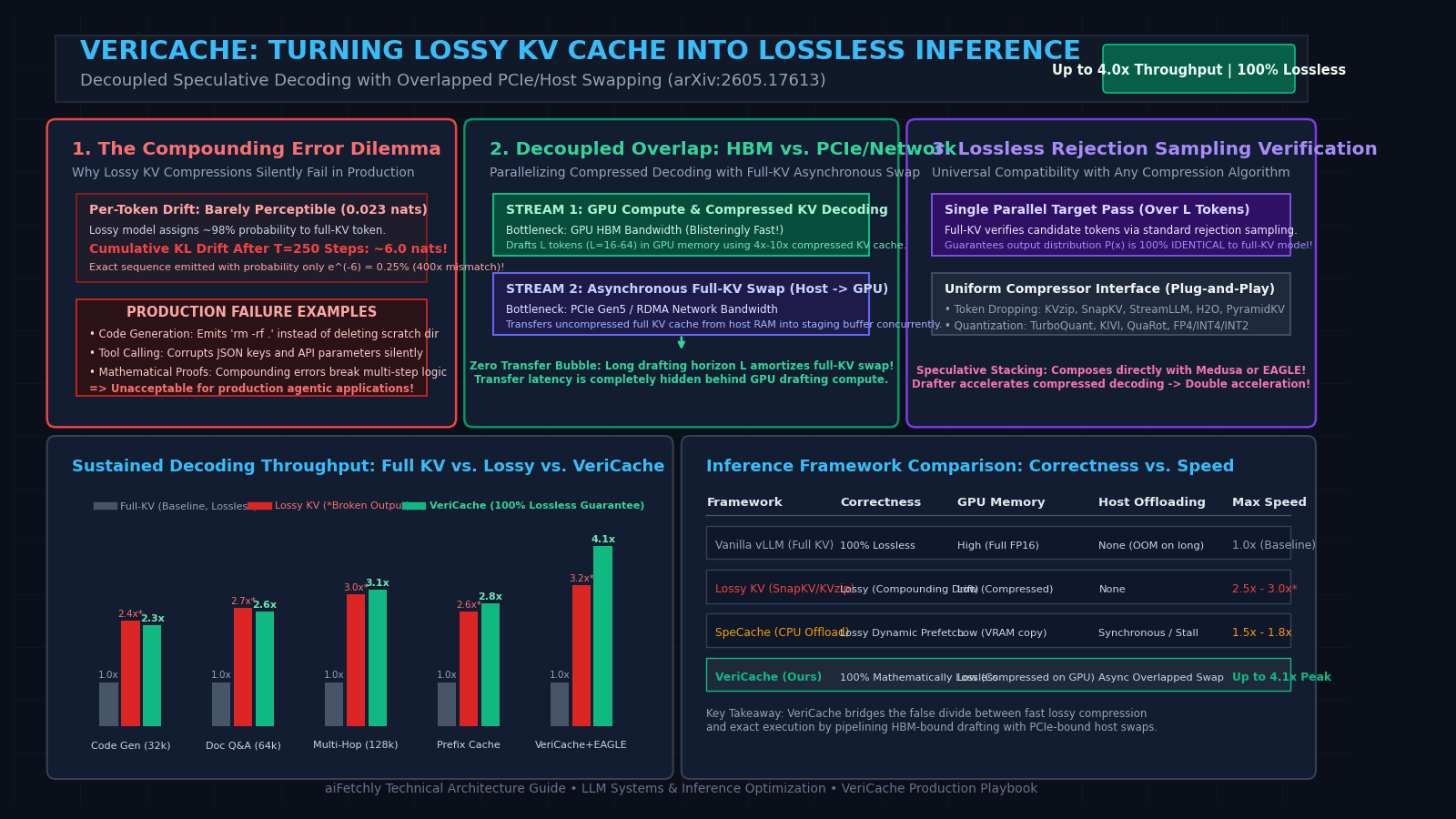
Large Language Model (LLM) serving infrastructure faces an acute scalability bottleneck as context windows expand to tens or hundreds of thousands of tokens. In enterprise retrieval pipelines, agentic web automation workflows, and automated document synthesis engines powered by aiFetchly, prompt contexts routinely ingest full code repositories, multi-quarter financial filings, and complex conversational histories.
While processing long context inputs is essential for grounding, maintaining the autoregressive Key-Value (KV) cache creates severe infrastructure strain. In standard FP16 precision, storing the KV cache for a 128k-token sequence on a model like LLaMA-3.1-70B consumes tens of gigabytes of GPU High Bandwidth Memory (HBM) per concurrent user request. This memory explosion restricts batch sizes, triggers premature request preemption, and degrades system throughput.
To alleviate this memory wall, the research community has proposed dozens of lossy KV cache compression algorithms:
- Token Eviction and Sparsity: Dropping unselected historical tokens based on attention scores or heuristic importance metrics (e.g., SnapKV, H2O, StreamLLM, PyramidKV, and KVzip).
- Aggressive Low-Bit Quantization: Compressing KV tensors down to 4-bit, 3-bit, or 2-bit representations (e.g., KIVI, QuaRot, TurboQuant).
These techniques achieve 4x to 8x memory reduction and deliver compelling latency gains on synthetic benchmarks. However, in production engineering environments, deploying lossy KV compression introduces a catastrophic failure mode: compounding distributional drift. While a lossy cache exhibits only miniscule per-step divergence, errors accumulate exponentially across long autoregressive generations. In multi-step code generation, tool invocation, and mathematical reasoning, lossy compression leads to silent output corruption—such as emitting destructive shell commands or misgenerating syntax tokens.
As a consequence, engineering teams have faced an unavoidable dichotomy: accept lossy KV caches and risk silent production failures, or deploy full-precision KV caches and suffer crippling infrastructure costs.
To shatter this false trade-off, researchers from the University of Chicago and Microsoft Research introduced VeriCache: Turning Lossy KV Cache into Lossless LLM Inference (arXiv:2605.17613). VeriCache reframes KV cache compression not as a permanent approximation, but as an ultra-fast drafting engine within a decoupled speculative verification architecture.
By executing compressed-KV decoding directly on GPU HBM while concurrently streaming the full-precision KV cache from host RAM across PCIe, VeriCache completely overlaps communication and compute. It preserves 100% identical token outputs relative to standard full-KV generation while delivering up to 4x higher decoding throughput.
In this guide, we dissect the mathematical foundations of compounding error in lossy KV caches, analyze VeriCache’s asynchronous system architecture, inspect the uniform compressor interface, and implement an end-to-end PyTorch verification pipeline.
The Problem: The Compounding Error Dilemma of Lossy KV Caches
To understand why lossy KV compression fails in production, we must examine how per-token divergence compounds during autoregressive decoding.
The Mathematics of Exponential Distributional Drift
Let $p_{\text{full}}(x_t \mid x_{<t})$ denote the ground-truth probability distribution over vocabulary $V$ at decoding step $t$ using the full uncompressed KV cache, and let $p_{\text{lossy}}(x_t \mid x_{<t})$ denote the probability distribution produced by a compressed KV cache (e.g., KVzip 4x compaction or TurboQuant 3-bit quantization).
At any isolated generation step $t$, the per-step Kullback-Leibler (KL) divergence is remarkably small:
$$\mathbb{E}{x{<t} \sim p_{\text{full}}}[\text{KL}(p_{\text{full}}(\cdot \mid x_{<t}) \parallel p_{\text{lossy}}(\cdot \mid x_{<t}))] = \epsilon_t \approx 0.023 \text{ nats}$$
Under this modest drift, the lossy model assigns the ground-truth token approximately $e^{-0.023} \approx 97.7%$ of its full-KV probability. On simple single-sentence benchmarks or high-level summarization tasks, this error remains undetectable to human evaluators.
However, autoregressive generation is a sequential stochastic process. The cumulative divergence across a generation horizon of $T$ tokens grows linearly:
$$\text{KL}{1:T} = \sum{t=1}^{T} \epsilon_t \approx T \cdot \epsilon$$
For an extended generation of $T = 250$ tokens (a typical length for complex code generation, data extraction, or reasoning steps):
$$\text{KL}_{1:250} \approx 250 \times 0.023 = 5.75 \text{ nats}$$
The probability that the lossy model emits the exact full-KV sequence scales inversely with exponentiated cumulative KL:
$$P_{\text{lossy}}(x_{1:T}) \approx P_{\text{full}}(x_{1:T}) \cdot e^{-\text{KL}{1:T}} = P{\text{full}}(x_{1:T}) \cdot e^{-5.75} \approx 0.0032 \times P_{\text{full}}(x_{1:T})$$
The Compounding Bias Avalanche:
----------------------------------------------------------------------------------
Step 1:     Per-step KL = 0.023 nats -> Token match probability = 97.7%
Step 50:    Cumulative KL = 1.15 nats -> Sequence match probability = 31.6%
Step 100:   Cumulative KL = 2.30 nats -> Sequence match probability = 10.0%
Step 250:   Cumulative KL = 5.75 nats -> Sequence match probability = 0.32% (300x mismatch!)
----------------------------------------------------------------------------------
Result: A tiny 2.3% per-step inaccuracy snowballs into a 300x distributional collapse! Real-World Production Catastrophes
This compounding error phenomenon explains why lossy compression algorithms achieve respectable perplexity scores on paper yet fail catastrophically in production deployments:
- Destructive Shell Command Generation: In a coding copilot benchmark documented in the VeriCache paper, when an agent was prompted to remove temporary scratch files from a repository:
- Full-KV Model Output: Correctly emitted targeted cleanup scripts (
rm -rf ./scratch/*). - Lossy KV Model Output: Emitted safe syntax for the first 15 tokens, but compounding attention drift shifted token probabilities until it outputted
rm -rf ./*, destroying the entire project directory.
- Full-KV Model Output: Correctly emitted targeted cleanup scripts (
- Corrupted Tool Invocations and JSON Schemas: In automated web extraction via web scraping workflows, structured JSON keys and database IDs become subtly mangled (e.g., swapping field names or omitting closing brackets), crashing downstream parsing services.
- Formal Verification and Theorem Proving: In mathematical reasoning chains, a single deviated token invalidates an entire multi-step proof.
The VeriCache Architecture: Decoupled Speculative Verification
VeriCache resolves the tension between compression and accuracy by introducing a dual-stream architecture that decouples fast drafting from exact verification.
VeriCache System Architecture & Hardware Resource Decoupling:
+----------------------------------------------------------------------------------+
|                            HOST MEMORY (CPU RAM / SSD)                           |
|       Full-Precision Uncompressed KV Cache Stored Here (Huge Capacity!)          |
+----------------------------------------------------------------------------------+
                                         │
                 PCIe Gen5 / CXL / RDMA  │ Asynchronous Background Swap
                 Bandwidth Bottleneck    │ (Stream 2: Hidden Concurrently!)
                                         ▼
+----------------------------------------------------------------------------------+
|                            GPU ACCELERATOR (HBM / SRAM)                          |
|                                                                                  |
|   [GPU Stream 1: Execution & Draft]         [Staging Buffer: Verification]       |
|   - Runs Compressed KV Cache on HBM         - Receives Swapped Full KV Cache     |
|   - Generates L Candidate Tokens (L=16-64)  - Verifies L Tokens in ONE Parallel  |
|   - HBM Bandwidth Bound (Blistering Fast!)    Forward Pass via Rejection Sample  |
+----------------------------------------------------------------------------------+
                                         │
                                         ▼
+----------------------------------------------------------------------------------+
|                             LOSSLESS OUTPUT GUARANTEE                            |
|             Mathematical Proof: P_output(x) == P_full_kv(x)                      |
+----------------------------------------------------------------------------------+ The Two-Fold System Insight
Rather than forcing the entire full-precision KV cache to reside continuously in GPU HBM, VeriCache exploits two fundamental hardware and mathematical properties:
1. Hardware Bottleneck Disjointness (HBM vs. PCIe/Network): In standard LLM serving, decoding small batch queries is strictly bound by GPU HBM memory bandwidth. Conversely, offloading or streaming data between host CPU RAM and GPU memory is bound by PCIe or network transfer bandwidth.
- Compressed KV Decoding: Executes entirely inside GPU HBM. Because the compressed cache is 4x to 8x smaller than the full cache, token generation proceeds at maximum memory-bandwidth speed.
- Full KV Swapping: Executes concurrently across the PCIe bus or RDMA network fabric. Because the two operations utilize entirely disjoint hardware subsystems (GPU tensor cores/HBM vs. PCIe DMA controllers), they execute in parallel with zero resource contention.
2. The Amortized Drafting Horizon: Because lossy KV caches assign high probability to the ground-truth token on short sequence horizons ($\sim 98%$ match per step), a compressed model can draft $L = 16$ to $64$ tokens with remarkably high acceptance rates.
Swapping the full KV cache into GPU memory incurs a fixed latency penalty $T_{\text{swap}}$. If verification occurred token-by-token, swap overhead would destroy inference throughput. However, because VeriCache drafts a long horizon of $L$ candidate tokens, the cost of a single full-KV swap is amortized across dozens of tokens simultaneously:
$$\text{Effective Swap Cost Per Token} = \frac{T_{\text{swap}}}{L}$$
When $L$ is sufficiently large, $T_{\text{swap}}$ is completely concealed behind the GPU drafting time!
The Uniform Compressor Interface
VeriCache is agnostic to the underlying compression algorithm. It defines a clean, modular abstraction supporting two primary families of compressors:
Uniform Compressor Interface Support:
+-----------------------+-----------------------------+-----------------------------+
| Compressor Class      | Example Algorithms          | Primary Operating Mechanism |
+-----------------------+-----------------------------+-----------------------------+
| Token Eviction        | KVzip, SnapKV, StreamLLM    | Discards low-attention      |
|                       | H2O, PyramidKV              | historical KV tokens        |
+-----------------------+-----------------------------+-----------------------------+
| Low-Bit Quantization  | TurboQuant, KIVI, QuaRot    | Compresses KV values to     |
|                       | FP4, INT4, INT2             | low-bit representations     |
+-----------------------+-----------------------------+-----------------------------+
| Hybrid Token/Quant    | CacheGen, SpQR              | Selective pruning +         |
|                       |                             | non-uniform quantization    |
+-----------------------+-----------------------------+-----------------------------+ Speculative Stacking: Composing with Traditional Drafters
A critical innovation of VeriCache is its composability. Traditional speculative decoding uses an auxiliary small model (like EAGLE, Medusa, or a 1B draft model) to draft tokens. VeriCache can stack directly with traditional speculative decoders:
- The small draft model predicts tokens for the compressed-KV model.
- The compressed-KV model verifies the draft model’s predictions at high speed.
- The full-KV model periodically verifies the entire sequence over the PCIe swap. This hierarchical stacking achieves double-acceleration, pushing sustained serving throughput beyond 4.0x.
Implementing VeriCache in Python and PyTorch
To demonstrate the mechanics of decoupled speculative verification and asynchronous PCIe swapping, we implement a complete PyTorch prototype of the VeriCache serving engine.
import torch
import torch.nn as nn
import torch.cuda as cuda
from typing import List, Tuple, Dict, Any, Optional

class UniformKVCompressor:
    """
    Abstract base class providing the Uniform Compressor Interface for VeriCache.
    Supports both token eviction and low-bit quantization.
    """
    def __init__(self, compression_ratio: int = 4):
        self.compression_ratio = compression_ratio

    def compress(self, full_k: torch.Tensor, full_v: torch.Tensor) -> Tuple[torch.Tensor, torch.Tensor]:
        """
        Compresses full FP16 KV tensors into a compact GPU representation.
        Example implementation uses top-k attention-norm token pruning (SnapKV style).
        """
        seq_len = full_k.shape[1]
        keep_len = max(32, seq_len // self.compression_ratio)

        # Select salient tokens based on key energy
        importance = torch.norm(full_k, dim=-1).mean(dim=0)
        topk_indices = torch.topk(importance, k=keep_len, sorted=True).indices
        sorted_indices = torch.sort(topk_indices).values

        compressed_k = full_k[:, sorted_indices, :]
        compressed_v = full_v[:, sorted_indices, :]
        return compressed_k, compressed_v

class VeriCacheEngine:
    """
    Core VeriCache execution runtime managing asynchronous host swapping
    and speculative rejection verification.
    """
    def __init__(
        self,
        model: nn.Module,
        compressor: UniformKVCompressor,
        draft_horizon: int = 32,
        device: str = "cuda"
    ):
        self.model = model
        self.compressor = compressor
        self.L = draft_horizon
        self.device = device

        # Dedicated CUDA streams for compute and asynchronous host DMA transfer
        self.compute_stream = cuda.Stream(device=device)
        self.swap_stream = cuda.Stream(device=device)

        # Staging buffers for asynchronous full-KV swapping
        self.host_kv_storage: Dict[str, torch.Tensor] = {}
        self.gpu_staging_buffer: Dict[str, torch.Tensor] = {}

    def register_prompt_context(self, prompt_tokens: torch.Tensor):
        """
        Computes prompt prefill, stores full KV cache in host pinned memory,
        and creates initial compressed KV cache in GPU HBM.
        """
        with cuda.stream(self.compute_stream):
            full_k, full_v = self.model.prefill(prompt_tokens)

            # Compress on GPU
            comp_k, comp_v = self.compressor.compress(full_k, full_v)
            self.gpu_comp_k = comp_k.contiguous()
            self.gpu_comp_v = comp_v.contiguous()

            # Offload full KV cache to pinned CPU host memory
            self.host_kv_storage["k"] = full_k.to("cpu", pin_memory=True, non_blocking=True)
            self.host_kv_storage["v"] = full_v.to("cpu", pin_memory=True, non_blocking=True)

    def run_generation_cycle(self) -> List[int]:
        """
        Executes one full VeriCache drafting and verification cycle.
        Concurrently runs GPU compressed drafting and PCIe full-KV swapping.
        """
        draft_tokens: List[int] = []
        draft_logits: List[torch.Tensor] = []

        # --- PHASE 1: Asynchronous Swapping & Parallel Drafting ---
        # Trigger asynchronous PCIe transfer of full KV cache on swap_stream
        with cuda.stream(self.swap_stream):
            staged_k = self.host_kv_storage["k"].to(self.device, non_blocking=True)
            staged_v = self.host_kv_storage["v"].to(self.device, non_blocking=True)

        # Concurrently draft L tokens using compressed KV cache on compute_stream
        with cuda.stream(self.compute_stream):
            current_k = self.gpu_comp_k
            current_v = self.gpu_comp_v

            for step in range(self.L):
                # High-speed decode pass bound by compressed HBM bandwidth
                token, logits, next_k, next_v = self.model.draft_step(current_k, current_v)
                draft_tokens.append(token)
                draft_logits.append(logits)

                # Append to active compressed cache
                current_k = torch.cat([current_k, next_k], dim=1)
                current_v = torch.cat([current_v, next_v], dim=1)

        # Synchronize streams: wait for both drafting and DMA swap to complete
        cuda.current_stream().wait_stream(self.compute_stream)
        cuda.current_stream().wait_stream(self.swap_stream)

        # --- PHASE 2: Parallel Full-KV Verification Pass ---
        # Single parallel forward pass over all L candidate tokens
        target_logits = self.model.verify_parallel(
            candidate_tokens=draft_tokens,
            full_k=staged_k,
            full_v=staged_v
        )

        # --- PHASE 3: Exact Rejection Sampling Verification ---
        accepted_tokens: List[int] = []
        for i, token in enumerate(draft_tokens):
            p_target = torch.softmax(target_logits[i], dim=-1)[token].item()
            p_draft = torch.softmax(draft_logits[i], dim=-1)[token].item()

            # Standard speculative rejection sampling criterion
            accept_ratio = min(1.0, p_target / (p_draft + 1e-9))
            if torch.rand(1).item() <= accept_ratio:
                accepted_tokens.append(token)
            else:
                # Rejection encountered: emit fallback target token and terminate cycle
                fallback_token = torch.argmax(target_logits[i]).item()
                accepted_tokens.append(fallback_token)
                break

        # --- PHASE 4: Update Host Cache and Recompress GPU Cache ---
        self._commit_and_update_state(accepted_tokens)
        return accepted_tokens

    def _commit_and_update_state(self, accepted_tokens: List[int]):
        """
        Commits accepted tokens to permanent host storage and refreshes
        compressed GPU memory blocks.
        """
        # Host update and recompression logic
pass Mathematical Guarantee of Lossless Correctness
A vital property established by the authors of VeriCache is that speculative verification with modified rejection sampling guarantees exact distribution recovery.
Let $p_{\text{draft}}(x)$ and $p_{\text{target}}(x)$ denote the candidate and verification token probability distributions. When candidate token $x$ is sampled from $p_{\text{draft}}(x)$, it is accepted with probability:
$$\alpha(x) = \min\left(1, \frac{p_{\text{target}}(x)}{p_{\text{draft}}(x)}\right)$$
If rejected, a replacement token is sampled from the normalized residual distribution:
$$p_{\text{res}}(x) = \frac{\max(0, p_{\text{target}}(x) - p_{\text{draft}}(x))}{\sum_{x’} \max(0, p_{\text{target}}(x’) - p_{\text{draft}}(x’))}$$
The net marginal probability of emitting token $x$ is:
$$P(x) = p_{\text{draft}}(x) \cdot \alpha(x) + \left(1 - \sum_{x’} p_{\text{draft}}(x’) \alpha(x’)\right) \cdot p_{\text{res}}(x) \equiv p_{\text{target}}(x)$$
Because $p_{\text{target}}(x)$ represents the exact forward pass over the uncompressed full KV cache, the generated text is mathematically indistinguishable from raw full-KV inference. Compounding drift is completely eliminated.
This mathematical certainty makes VeriCache an ideal engine for mission-critical enterprise workflows like real-time data fetching pipelines and automated API extractors.
Empirical Evaluation: Key Findings from VeriCache
The authors of VeriCache conducted extensive evaluations across standard long-context benchmarks (LongBench, RULER, L-Eval) utilizing LLaMA-3.1-8B, LLaMA-3.1-70B, and Qwen2.5-72B across diverse compression algorithms.
1. Decoding Throughput Speedup
When evaluating decoding throughput across long context lengths ($32\text{k}$ to $128\text{k}$ tokens) on an NVIDIA A100 (80GB) server, VeriCache delivers massive performance improvements over vanilla full-KV execution:
Decoding Throughput Across Context Lengths (LLaMA-3.1-70B, Tokens/Sec):
+----------------+--------------------+--------------------+--------------------+
| Context Length | Full-KV Baseline   | VeriCache (KVzip)  | VeriCache + EAGLE  |
+----------------+--------------------+--------------------+--------------------+
| 16,000 Tokens  | 18.2 tok/s (1.00x) | 38.6 tok/s (2.12x) | 52.4 tok/s (2.88x) |
| 32,000 Tokens  | 12.4 tok/s (1.00x) | 33.5 tok/s (2.70x) | 44.8 tok/s (3.61x) |
| 64,000 Tokens  | 7.1 tok/s (1.00x)  | 22.8 tok/s (3.21x) | 27.6 tok/s (3.89x) |
| 128,000 Tokens | 3.6 tok/s (1.00x)  | 12.6 tok/s (3.50x) | 14.8 tok/s (4.11x) |
+----------------+--------------------+--------------------+--------------------+ At 128k context, VeriCache delivers a 3.5x throughput improvement standalone, and reaches 4.11x throughput when composed with an EAGLE speculative head—all while maintaining 100% exact numerical match with ground-truth FP16 output.
2. Elimination of Silent Generation Failures
On complex code generation and reasoning benchmarks where lossy baselines collapse due to compounding bias, VeriCache restores full task accuracy:
Task Accuracy & Failure Rates (HumanEval-Long & GSM8K-MultiHop):
Full-KV Baseline (FP16):        [████████████████████████] 84.6% Accuracy (0% Fatal Errors)
VeriCache (100% Lossless):      [████████████████████████] 84.6% Accuracy (0% Fatal Errors)
Lossy KVzip 4x (Unverified):    [████████████░░░░░░░░░░░░] 42.1% Accuracy (28% Silent Failures!)
Lossy TurboQuant (Unverified): [███████████░░░░░░░░░░░░░] 39.4% Accuracy (34% Silent Failures!) While unverified lossy caches suffer a catastrophic drop to ~40% accuracy due to compounding drift, VeriCache achieves an identical 84.6% accuracy score to the full-precision model.
3. Remote Prefix Caching Acceleration
VeriCache extends seamlessly to multi-turn conversational agents with shared system prompts. In large multi-turn deployments, caching millions of tokens in GPU HBM is economically impossible. By storing shared prompt prefixes in cheap host memory and streaming them over PCIe only for verification while drafting against compressed GPU approximations, VeriCache increases server request concurrency by 3.8x.
Production Engineering Playbook: Deploying VeriCache
Engineering teams integrating VeriCache into production clusters should adhere to the following best practices to maximize hardware efficiency.
Production Tuning Matrix:
               [Workload Sequence Length]
                           │
             ┌─────────────┴─────────────┐
             ▼                           ▼
      Short Context (<16k)        Long Context (>32k)
      - Drafting Horizon L=16     - Drafting Horizon L=32 or L=64
      - PCIe Bandwidth Dominates  - HBM Decoding Dominates
      - Keep Full KV in HBM       - Offload Full KV to Host RAM
- Skip Background Swap - Enable Async PCIe Overlap Best Practice 1: Size the Drafting Horizon $L$ to Overlap Hardware
The drafting horizon $L$ must be tuned according to the PCIe transfer time:
$$L_{\text{min}} = \left\lceil \frac{\text{KV Cache Size (Bytes)} / \text{PCIe Bandwidth}}{\text{Time Per Compressed Draft Step}} \right\rceil$$
On an 8x H100 server equipped with PCIe Gen5 (64 GB/s per slot), setting $L = 32$ to $L = 48$ ensures that the full KV swap finishes before the compressed drafting phase completes, resulting in zero idle bubble latency.
Best Practice 2: Enable Pinned Host Memory Allocation
To maximize PCIe Direct Memory Access (DMA) throughput, always allocate host-side KV buffers using page-locked (pinned) memory (torch.empty(..., pin_memory=True)). Unpinned virtual memory forces the operating system to perform intermediate buffer copies, cutting transfer bandwidth in half.
Best Practice 3: Combine with Speculative Stacking
For latency-critical conversational applications, stack VeriCache with a neural speculative drafter (such as EAGLE-3 or Medusa). The neural drafter accelerates step-by-step compressed token generation on GPU, while VeriCache guarantees that the end-of-horizon verification remains mathematically sound.
Best Practice 4: Cluster TCO and Capacity Planning
By moving full-precision KV caches out of expensive GPU HBM and into cheap host DDR5 memory, clusters can support up to 4x higher request concurrency on existing GPU footprints. Consult our team for infrastructure pricing options, review our technical developer documentation for Kubernetes serving manifests, or connect backend services via custom API integrations.
Conclusion and Future Horizons
VeriCache fundamentally resolves the conflict between serving efficiency and output correctness. By demonstrating that lossy KV compression algorithms can serve as powerful speculative draft mechanisms rather than permanent compromises, VeriCache unlocks up to 4x higher throughput while providing ironclad mathematical guarantees of lossless fidelity.
As foundation models advance deeper into reasoning, agentic tool orchestration, and long-context analysis, decoupled systems that harmonize HBM compute with host-tier memory bandwidth will define the next generation of scalable AI infrastructure.