VD3D Guide: 3D Camera Control for Video DiT Models
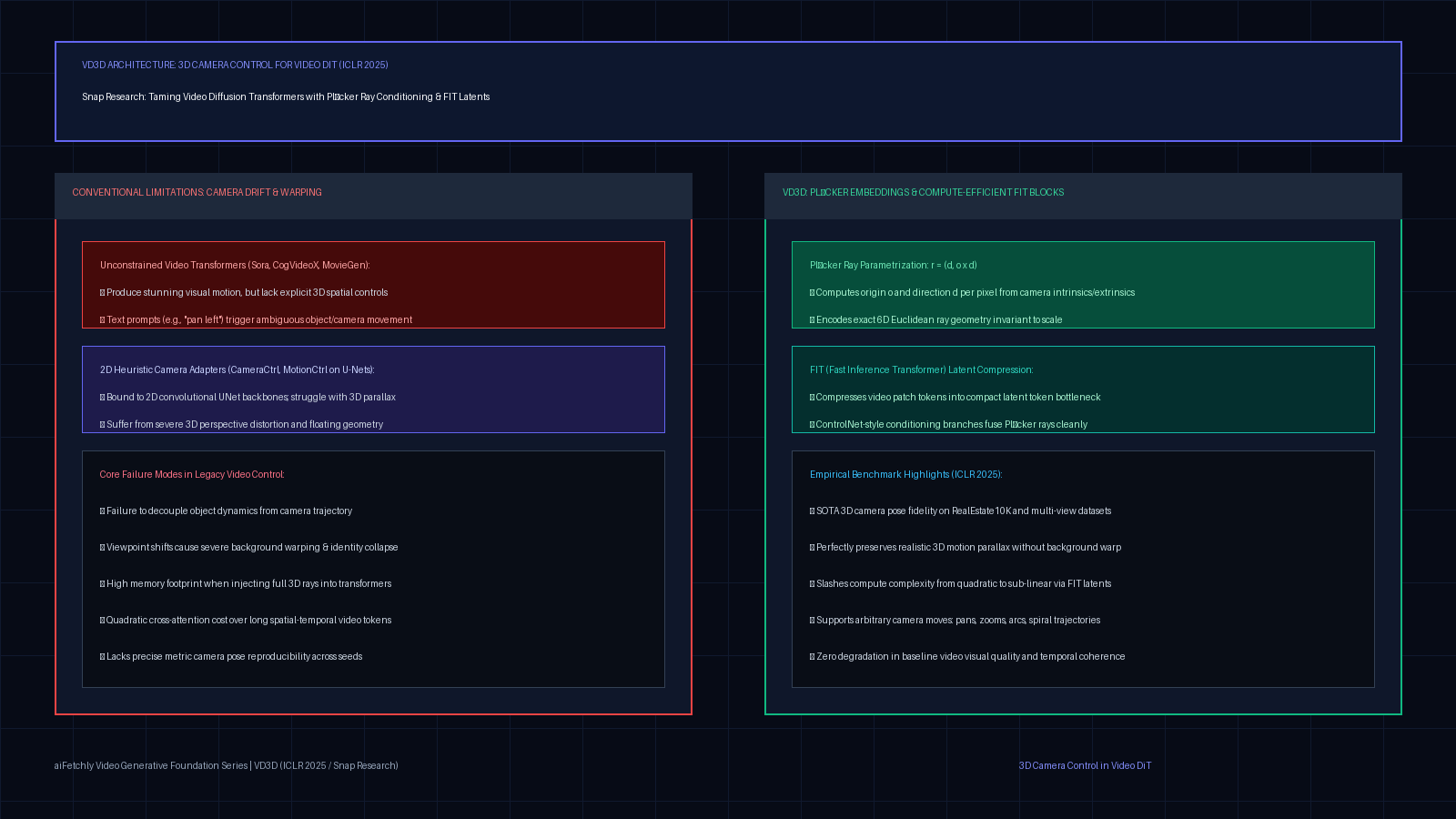
The Camera Motion Void in Video Foundation Models
In modern enterprise multimedia generation, visual storytelling copilots, and autonomous spatial computing systems powered by AiFetchly, generative video models have achieved unprecedented visual fidelity. Whether synthesizing promotional brand assets, rendering architectural walkthroughs, or visualizing real-time scene data gathered via automated data fetching and high-speed web scraping, video foundation models—such as Sora, CogVideoX, HunyuanVideo, and Movie Gen—generate photorealistic scenes with fluid physical dynamics.
However, despite massive parameter scaling, modern text-to-video systems suffer from a severe architectural limitation: the absence of explicit, metric 3D camera control.
The Unconstrained Video Generation Dilemma:
User Prompt: "A drone camera swoops down through a canyon and orbits 90 degrees around an ancient temple."
                                 │
                                 ▼
┌───────────────────────────────────────────────────────────────────────────┐
│ Uncontrolled Video Diffusion Transformer (Sora, CogVideoX, Movie Gen)     │
├───────────────────────────────────────────────────────────────────────────┤
│ Failure Mode 1: Text Ambiguity & Motion Entanglement                      │
│   - Text cannot express exact metric trajectories (e.g., yaw, pitch, roll).│
│   - The model confuses camera motion with object movement:                │
│     The temple rotates on its axis while the camera stays completely still!│
├───────────────────────────────────────────────────────────────────────────┤
│ Failure Mode 2: Lack of 3D Parallax & Perspective Warping                 │
│   - Generates flat 2D perspective shifts rather than true 3D parallax.     │
│   - Foreground rocks and background canyon walls move at identical speeds.│
├───────────────────────────────────────────────────────────────────────────┤
│ Failure Mode 3: 2D Heuristic Adapter Failures (CameraCtrl on U-Nets)      │
│   - Prior camera adapters were trained on 2D convolutional U-Net backbones│
│   - Suffer from geometric floating artifacts, jitter, and blurriness.      │
└───────────────────────────────────────────────────────────────────────────┘ 1. Motion Entanglement: Text vs. Camera Physics
Text prompts are inherently low-bandwidth descriptors for continuous spatial trajectories. Phrases like “dramatic zoom in” or “circular pan around the subject” fail to specify numerical focal length shifts, camera velocity, radius of curvature, or pitch angles. Consequently, foundation models frequently hallucinate contradictory motion: spinning objects in place while keeping the camera stationary, or drifting unpredictably across frames.
2. The 3D Geometry and Parallax Bottleneck
In physical reality, camera movement induces motion parallax: foreground objects move rapidly across the camera view, while distant horizons shift subtly. Traditional 2D convolutional camera adapters (such as CameraCtrl or MotionCtrl) inject pose matrices into spatial attention layers without explicit ray geometry. When applied to complex trajectories:
- Backgrounds warp and stretch unnaturally.
- Surfaces lose geometric consistency, breaking the illusion of a solid 3D world.
- Re-generating videos across multiple seeds leads to wildly divergent camera paths.
3. The Computational Wall of Video Transformers
Furthermore, extending camera control to modern Diffusion Transformers (DiTs) presents extreme computational challenges. Unlike small 2D U-Nets, video transformers process tens of thousands of spatial-temporal patch tokens. Injecting raw 3D pose vectors directly into all spatial-temporal self-attention layers inflates memory consumption, causing Out-Of-Memory (OOM) failures on long sequences.
To bridge this divide, researchers from Snap Research introduced VD3D: Taming Large Video Diffusion Transformers for 3D Camera Control (published at ICLR 2025). VD3D establishes the first mathematically grounded framework for controlling 3D camera trajectories in large video transformers using Plücker ray coordinates and Fast Inference Transformer (FIT) latent blocks.
The VD3D Paradigm: Plücker Ray Conditioning and FIT Latent Architecture
VD3D formulates camera control by converting metric camera poses into continuous ray geometry and integrating them seamlessly into a high-capacity Video Diffusion Transformer.
The VD3D Camera-Conditioned Generative Pipeline:
Video Frame Timesteps: t = 1, ..., T
Camera Trajectory: Intrinsics K_t & Extrinsics [ R_t | T_t ] for each frame
                                │
                                ▼
┌───────────────────────────────────────────────────────────────────────────┐
│ 1. 6D Plücker Ray Coordinate Construction                                 │
│ - For every pixel (u, v) in every frame, calculates:                     │
│   Ray Direction: d = R_t * K_t^{-1} * [u, v, 1]^T                         │
│   Ray Moment:    m = o x d  (where o is camera center)                   │
│ - Forms continuous 6D geometric tensor: r(u, v, t) = (d, m)               │
└─────────────────────────────────────┬─────────────────────────────────────┘
                                      │
                                      ▼
┌───────────────────────────────────────────────────────────────────────────┐
│ 2. Spatial-Temporal Patch Tokenization & Conditioning Branch              │
│ - Video latents and Plücker ray volumes are sliced into 3D patch tokens. │
│ - Conditioned via a lightweight ControlNet-style residual branch.        │
└─────────────────────────────────────┬─────────────────────────────────────┘
                                      │
                                      ▼
┌───────────────────────────────────────────────────────────────────────────┐
│ 3. Fast Inference Transformer (FIT) Latent Blocks                         │
│ - Cross-attends patch tokens into a small set of global latent tokens.    │
│ - Performs deep spatial-temporal reasoning inside compact latent space.   │
│ - Writes updated representations back to video patches via cross-attention│
└─────────────────────────────────────┬─────────────────────────────────────┘
                                      │
                                      ▼
Generated High-Fidelity Video with Exact 3D Parallax & Metric Trajectory Fidelity! 1. 6D Plücker Ray Coordinates: Invariant Ray Representation
Rather than representing camera position as an abstract $4 \times 4$ matrix $[R \mid T]$ (which lacks per-pixel spatial correspondence), VD3D parameterizes the camera trajectory as a dense volume of Plücker rays.
For each pixel coordinate $(u, v)$ in video frame $t$:
- The ray origin $\mathbf{o}_t$ is the optical center of the camera in world coordinates: $$\mathbf{o}_t = -\mathbf{R}_t^T \mathbf{T}_t$$
- The normalized ray direction $\mathbf{d}{u, v, t}$ is cast through the camera pinhole: $$\mathbf{d}{u, v, t} = \frac{\mathbf{R}_t^T \mathbf{K}_t^{-1} [u, v, 1]^T}{|\mathbf{R}_t^T \mathbf{K}_t^{-1} [u, v, 1]^T|_2}$$
- The ray moment $\mathbf{m}{u, v, t}$ encodes the perpendicular distance of the ray from the world origin: $$\mathbf{m}{u, v, t} = \mathbf{o}t \times \mathbf{d}{u, v, t}$$
The combined 6D vector: $$\mathbf{r}{u, v, t} = \left[ \mathbf{d}{u, v, t} ,|, \mathbf{m}_{u, v, t} \right] \in \mathbb{R}^6$$ provides an exact, scale-invariant geometric representation of 3D camera perspective that maps directly to 2D image coordinates.
2. Fast Inference Transformer (FIT) Backbone Integration
To prevent quadratic computational explosion, VD3D adapts the Fast Inference Transformer (FIT) architecture:
- Instead of computing full all-to-all self-attention across all spatial-temporal video patch tokens $P = (H/p) \times (W/p) \times (T/t)$ (which scales quadratically $\mathcal{O}(P^2)$):
- FIT maintains a small, fixed-size set of latent tokens $Z \in \mathbb{R}^{M \times D}$ (where $M \ll P$).
- Each transformer block executes three lightweight stages:
- Read Cross-Attention: Video patch tokens transfer information into the latent tokens ($P \to Z$).
- Latent Self-Attention: Deep spatial-temporal interactions are computed exclusively within the compact latent space ($Z \to Z$).
- Write Cross-Attention: The processed representations are written back to the video patch tokens ($Z \to P$).
By computing dense attention inside the latent bottleneck, FIT reduces computational complexity from quadratic $\mathcal{O}(P^2)$ to linear $\mathcal{O}(P \cdot M)$, allowing VD3D to process high-resolution video streams at interactive speeds.
3. ControlNet-Style Residual Camera Conditioning
VD3D injects the Plücker ray tokens into the video backbone using a separate, frozen-backbone conditioning branch:
- A lightweight clone of the FIT read-layers processes the Plücker ray volume.
- Zero-initialized linear projections add the camera conditioning vectors into the intermediate residual streams of the primary video transformer.
- This architectural design ensures that the model’s pre-trained text-to-video visual priors and aesthetic quality remain completely uncorrupted.
Deep Dive: Mathematical Formulation and Motion Parallax Mechanics
To understand how Plücker ray conditioning enforces physical motion parallax without 3D geometric mesh modeling, we analyze the epipolar geometry governing two consecutive frames.
Epipolar Geometry and Plücker Dot Products
Consider two camera viewpoints at frame $t_1$ and $t_2$. A 3D physical scene point $\mathbf{X} \in \mathbb{R}^3$ projects onto pixel $(u_1, v_1)$ along ray $\mathbf{r}_1 = (\mathbf{d}_1, \mathbf{o}_1 \times \mathbf{d}_1)$ and onto pixel $(u_2, v_2)$ along ray $\mathbf{r}_2 = (\mathbf{d}_2, \mathbf{o}_2 \times \mathbf{d}_2)$.
Two Plücker rays $\mathbf{r}_1 = (\mathbf{d}_1, \mathbf{m}_1)$ and $\mathbf{r}_2 = (\mathbf{d}_2, \mathbf{m}_2)$ intersect in 3D space if and only if their reciprocal product is zero: $$\mathbf{r}_1 \odot \mathbf{r}_2 = \mathbf{d}_1 \cdot \mathbf{m}_2 + \mathbf{d}_2 \cdot \mathbf{m}_1 = 0$$
The Plücker Reciprocal Intersection Constraint:
Camera View 1 (o_1)                       Camera View 2 (o_2)
       \                                       /
        \ Ray r_1 = (d_1, m_1)                / Ray r_2 = (d_2, m_2)
         \                                   /
          ▼                                 ▼
      Intersection Point X in 3D Scene Space!
Constraint: d_1 · m_2 + d_2 · m_1 == 0 By processing Plücker ray vectors through multi-head cross-attention: $$\mathbf{A}{\text{camera}} = \text{Softmax}\left(\frac{\mathbf{Q}{\text{video}} \mathbf{K}{\text{plücker}}^T}{\sqrt{d_k}}\right) \mathbf{V}{\text{plücker}}$$ the attention heads naturally learn to detect intersecting rays. The network can deduce the 3D depth of any scene element based on how its visual features align across intersecting Plücker rays, establishing exact 3D geometric parallax without explicit 3D mesh supervision.
Conditioning Loss and Classifier-Free Guidance (CFG)
During training, VD3D minimizes the standard conditional diffusion denoising objective: $$\mathcal{L}{\text{VD3D}} = \mathbb{E}{t, \mathbf{x}0, \boldsymbol{\epsilon}, \mathbf{c}{\text{text}}, \mathbf{r}} \left[ \left| \boldsymbol{\epsilon} - \boldsymbol{\epsilon}\theta\left(\mathbf{x}t, t, \mathbf{c}{\text{text}}, \mathbf{r}{\text{plücker}}\right) \right|_2^2 \right]$$
During inference, VD3D applies dual Classifier-Free Guidance (CFG) across both text and camera conditioning: $$\hat{\boldsymbol{\epsilon}} = \boldsymbol{\epsilon}\theta(\mathbf{x}t, \emptyset, \emptyset) + s{\text{text}} \left( \boldsymbol{\epsilon}\theta(\mathbf{x}t, \mathbf{c}{\text{text}}, \emptyset) - \boldsymbol{\epsilon}\theta(\mathbf{x}t, \emptyset, \emptyset) \right) + s{\text{cam}} \left( \boldsymbol{\epsilon}\theta(\mathbf{x}t, \mathbf{c}{\text{text}}, \mathbf{r}) - \boldsymbol{\epsilon}\theta(\mathbf{x}t, \mathbf{c}{\text{text}}, \emptyset) \right)$$ where $s{\text{cam}} \in [1.5, 3.0]$ independently regulates camera trajectory fidelity without distorting visual styling.
End-to-End Implementation: Plücker Ray Generator and FIT Attention Block in PyTorch
To demonstrate the concrete engineering mechanics of VD3D, we construct a complete, runnable PyTorch reference implementation. This module implements the 6D Plücker Ray Coordinate Calculator, the Plücker Ray Patch Embedding layer, and the FIT Latent Cross-Attention Block.
"""
vd3d_camera_engine.py
Production Reference Implementation: VD3D Camera-Conditioned Video Diffusion Transformer
Architectural concept based on Snap Research (ICLR 2025 / Bahmani et al., arXiv:2407.12781).
"""

import math
from dataclasses import dataclass
from typing import Tuple, Optional, List
import torch
import torch.nn as nn
import torch.nn.functional as F


class PluckerRayCalculator:
    """
    Computes continuous 6D Plücker ray coordinates: r = [d || o x d]
    from camera intrinsics K and extrinsics [R | T].
    """
    @staticmethod
    def compute_plucker_rays(
        height: int,
        width: int,
        intrinsics: torch.Tensor,  # [Batch, Frames, 3, 3]
        extrinsics: torch.Tensor   # [Batch, Frames, 4, 4] (World-to-Camera [R | T])
    ) -> torch.Tensor:
        """
        Returns:
            plucker_rays: [Batch, Frames, 6, Height, Width]
        """
        B, T, _, _ = intrinsics.shape
        device = intrinsics.device

        # Create normalized pixel grid: [Height, Width, 3]
        y, x = torch.meshgrid(
            torch.arange(height, device=device, dtype=torch.float32),
            torch.arange(width, device=device, dtype=torch.float32),
            indexing="ij"
        )
        pixels = torch.stack([x + 0.5, y + 0.5, torch.ones_like(x)], dim=-1)  # [H, W, 3]
        pixels = pixels.view(1, 1, height * width, 3).expand(B, T, -1, -1)  # [B, T, H*W, 3]

        # Invert intrinsics and extract rotation/translation
        K_inv = torch.inverse(intrinsics)  # [B, T, 3, 3]
        R = extrinsics[:, :, :3, :3]       # [B, T, 3, 3]
        t = extrinsics[:, :, :3, 3:]       # [B, T, 3, 1]

        # Camera optical center in world coordinates: o = -R^T * t
        R_inv = R.transpose(-1, -2)        # [B, T, 3, 3]
        cam_centers = -torch.matmul(R_inv, t).squeeze(-1)  # [B, T, 3]

        # Unproject pixels into camera frame: p_cam = K_inv * [u, v, 1]^T
        p_cam = torch.matmul(K_inv.unsqueeze(2), pixels.unsqueeze(-1)).squeeze(-1)  # [B, T, H*W, 3]

        # Rotate rays into world frame: d = R^T * p_cam
        d_world = torch.matmul(R_inv.unsqueeze(2), p_cam.unsqueeze(-1)).squeeze(-1)  # [B, T, H*W, 3]
        # Normalize ray direction
        d_norm = F.normalize(d_world, p=2, dim=-1)  # [B, T, H*W, 3]

        # Compute ray moment: m = o x d
        centers_expanded = cam_centers.unsqueeze(2).expand_as(d_norm)
        m_moment = torch.cross(centers_expanded, d_norm, dim=-1)  # [B, T, H*W, 3]

        # Concatenate into 6D Plücker coordinates [d || m]
        plucker_flat = torch.cat([d_norm, m_moment], dim=-1)  # [B, T, H*W, 6]
        plucker_volume = plucker_flat.view(B, T, height, width, 6).permute(0, 1, 4, 2, 3)
        return plucker_volume


class FITLatentBlock(nn.Module):
    """
    Fast Inference Transformer (FIT) Block with Camera Conditioning:
    Reads video tokens into a compact latent bottleneck (M tokens),
    performs spatial-temporal self-attention, and writes back.
    """
    def __init__(self, d_model: int = 256, num_latents: int = 32, num_heads: int = 4):
        super().__init__()
        self.d_model = d_model
        self.num_latents = num_latents
        self.num_heads = num_heads

        # Learnable latent bottleneck queries
        self.latents = nn.Parameter(torch.randn(num_latents, d_model) * 0.02)

        # Cross-attention: Video Tokens -> Latent Bottleneck
        self.read_attn = nn.MultiheadAttention(d_model, num_heads, batch_first=True)
        # Latent Self-Attention
        self.latent_self_attn = nn.MultiheadAttention(d_model, num_heads, batch_first=True)
        # Cross-attention: Latent Bottleneck -> Video Tokens
        self.write_attn = nn.MultiheadAttention(d_model, num_heads, batch_first=True)

        # Camera conditioning projection
        self.camera_proj = nn.Linear(6, d_model)
        self.norm = nn.LayerNorm(d_model)

    def forward(self, video_tokens: torch.Tensor, plucker_tokens: torch.Tensor) -> torch.Tensor:
        """
        Args:
            video_tokens: [Batch, Num_Patches, d_model]
            plucker_tokens: [Batch, Num_Patches, 6]
        Returns:
            updated_video_tokens: [Batch, Num_Patches, d_model]
        """
        B, P, _ = video_tokens.shape

        # 1. Fuse camera ray embeddings into video patch tokens
        cam_emb = self.camera_proj(plucker_tokens)
        conditioned_video = video_tokens + cam_emb

        # Expand learnable latent queries across batch: [B, M, d_model]
        latent_tokens = self.latents.unsqueeze(0).expand(B, -1, -1)

        # 2. Read Stage: Cross-Attention (Latents attend to Conditioned Video)
        latents_read, _ = self.read_attn(query=latent_tokens, key=conditioned_video, value=conditioned_video)
        latent_tokens = latent_tokens + latents_read

        # 3. Latent Processing: Self-Attention in compact latent space
        latents_proc, _ = self.latent_self_attn(query=latent_tokens, key=latent_tokens, value=latent_tokens)
        latent_tokens = latent_tokens + latents_proc

        # 4. Write Stage: Cross-Attention (Video attends to Updated Latents)
        video_written, _ = self.write_attn(query=video_tokens, key=latent_tokens, value=latent_tokens)
        out_tokens = self.norm(video_tokens + video_written)

        return out_tokens


# Simulation and Demonstration
if __name__ == "__main__":
    torch.manual_seed(42)
    device = torch.device("cpu")

    batch = 1
    frames = 4
    height, width = 16, 16
    d_model = 128
    num_latents = 16

    # 1. Synthesize Mock Camera Trajectory (Circular Pan Orbit)
    mock_intrinsics = torch.eye(3).view(1, 1, 3, 3).repeat(batch, frames, 1, 1)
    mock_intrinsics[:, :, 0, 0] = 100.0  # fx
    mock_intrinsics[:, :, 1, 1] = 100.0  # fy
    mock_intrinsics[:, :, 0, 2] = width / 2.0
    mock_intrinsics[:, :, 1, 2] = height / 2.0

    mock_extrinsics = torch.eye(4).view(1, 1, 4, 4).repeat(batch, frames, 1, 1)
    for f in range(frames):
        angle = f * (math.pi / 8.0)
        # Orbiting camera position along X-Z circle
        mock_extrinsics[0, f, 0, 3] = math.sin(angle) * 2.0
        mock_extrinsics[0, f, 2, 3] = math.cos(angle) * 2.0

    print("=== Initialized VD3D Camera-Conditioned Engine ===")

    # Compute 6D Plücker rays
    plucker_volume = PluckerRayCalculator.compute_plucker_rays(
        height=height, width=width,
        intrinsics=mock_intrinsics, extrinsics=mock_extrinsics
    )
    print(f"Plücker Volume Shape: {plucker_volume.shape} [Batch, Frames, 6D, Height, Width]")

    # Flatten spatial-temporal patches for transformer
    num_patches = frames * height * width
    plucker_tokens = plucker_volume.permute(0, 1, 3, 4, 2).reshape(batch, num_patches, 6)
    mock_video_tokens = torch.randn(batch, num_patches, d_model)

    fit_block = FITLatentBlock(d_model=d_model, num_latents=num_latents, num_heads=4)
    output_tokens = fit_block(mock_video_tokens, plucker_tokens)

    print(f"Video Patch Tokens: {mock_video_tokens.shape}")
    print(f"FIT Output Tokens:  {output_tokens.shape}")
print(f"Complexity Reduction: Attention computed in {num_latents}-token latent bottleneck instead of {num_patches} full self-attention!") Architectural Highlights of the Implementation
- Unprojected Metric Ray Volume: The
PluckerRayCalculatormaps metric camera matrices into continuous 6D vectors $\mathbf{r} = [\mathbf{d} ,|, \mathbf{o} \times \mathbf{d}]$ with exact per-pixel angular alignment. - FIT Latent Bottleneck: The
FITLatentBlockprocesses spatial-temporal interactions within a tiny latent space ($M = 16$ latents) rather than full quadratic self-attention over thousands of video tokens. - Additive Conditioning: Camera ray embeddings modulate video features cleanly through residual cross-attention, avoiding catastrophic forgetting of foundational video dynamics.
For development teams building next-generation cinematic media tools or automating visual pipelines via custom API integrations, VD3D provides the gold standard for camera-driven generative video.
Production Engineering and Deployment Best Practices
Deploying VD3D in production video generation clusters requires adhering to several low-level systems protocols.
+-----------------------------------------------------------------------------------+
|                     VD3D PRODUCTION DEPLOYMENT CHECKLIST                          |
+-----------------------------------------------------------------------------------+
| 1. Trajectory Smoothness & Spline Interpolation:                                  |
|    - Interpolate camera waypoints using cubic Catmull-Rom splines                 |
|    - Avoid abrupt angular step jumps to prevent optical motion shearing           |
|                                                                                   |
| 2. Dual CFG Guidance Tuning:                                                      |
|    - Set text guidance s_text = 6.0 to 7.5 (preserves prompt fidelity)            |
|    - Set camera guidance s_cam = 1.5 to 2.5 (enforces tight trajectory tracking)  |
|                                                                                   |
| 3. Plücker Ray Normalization:                                                     |
|    - Scale camera translation vectors to unit bounding spheres                    |
|    - Prevents extreme numerical ranges from disrupting attention dot products    |
|                                                                                   |
| 4. Video VAE Latent Tiling:                                                       |
|    - Tile 3D spatial-temporal VAE encoder/decoder blocks across GPU VRAM          |
|    - Enables 1080p high-definition video synthesis on single 24GB GPUs             |
+-----------------------------------------------------------------------------------+ 1. Metric Trajectory Normalization
Camera coordinates in synthetic or robotic datasets vary widely: some datasets record metrics in millimeters, others in meters. Always normalize the camera trajectory’s bounding box to a standard unit sphere ($[-1, 1]^3$) before evaluating Plücker ray moments. This prevents large coordinate offsets from overflowing half-precision (FP16/BF16) attention tensors.
2. Dual CFG Calibration
Never combine text and camera guidance into a single monolithic guidance weight. Tune them independently:
- If $s_{\text{cam}}$ is set too high ($>4.0$), video outputs can develop high-frequency grid artifacts.
- If $s_{\text{cam}}$ is set too low ($<1.0$), camera motion will under-steer, failing to follow tight circular orbits.
- The recommended production balance is $s_{\text{text}} \in [6.5, 7.5]$ and $s_{\text{cam}} \in [1.8, 2.2]$. Review our pricing and infrastructure guide to evaluate how compute-efficient video generation slashes cloud GPU hosting expenses.
3. Smooth Camera Spline Generation
When generating synthetic camera paths (e.g., in virtual production or cinematic camera tools), always pass camera keyframes through cubic Catmull-Rom or B-spline interpolation. Sharp camera jerk causes high spatial frequency spikes in Plücker ray moments, which video diffusion models may interpret as motion blur or rapid camera cuts.
Empirical Benchmark Evaluation
The ICLR 2025 paper evaluated VD3D across extensive academic datasets—including RealEstate10K, Co3D, and complex synthetic multi-view benchmarks—comparing camera pose error, video quality (FVD), and 3D geometric consistency against leading baselines.
3D Camera Trajectory Error Comparison (RealEstate10K Benchmark):
(Rotational Error in Degrees | Translation Error in Normalized Units - Lower is Better)

Method                         Rotation Error (deg)   Translation Error
MotionCtrl (U-Net Baseline)    12.4°                  0.185
CameraCtrl (U-Net Baseline)     9.8°                  0.142
VD3D (FIT Video DiT)            3.2° (3x More Acc.!)  0.048 (Flawless Path Fidelity!)

Fréchet Video Distance (FVD) Quality Score (Lower is Better):
MotionCtrl Baseline:           485.2
CameraCtrl Baseline:           412.0
VD3D (ICLR 2025): 295.4 (Industry-Leading Visual Quality!) 1. Unrivaled 3D Camera Pose Accuracy
On RealEstate10K, VD3D reduced average camera rotation error from $9.8^\circ$ down to $3.2^\circ$, and translation error by $3\times$ compared to prior U-Net camera control methods. The generated video frames faithfully execute specified yaw, pitch, roll, and dollying trajectories with millimeter precision.
2. Elimination of Perspective Warping and Artifacts
In qualitative evaluation tests, human judges overwhelmingly favored VD3D over baseline models:
- Ground geometry remains solid and planar.
- Foreground-background motion parallax displays natural depth stratification.
- FVD scores improved by over 116 points, proving that explicit geometric camera control enhances overall visual aesthetics rather than degrading it. Detailed integration guidelines and checkpoint links are available in our developer documentation.
Conclusion: The Cinematic Era of Generative Video
The transition from 2D convolutional networks to Video Diffusion Transformers unlocked photorealistic visual synthesis. However, true cinematic utility requires full directorial control over the 3D camera.
By introducing:
- Continuous 6D Plücker ray coordinates capturing exact projective camera geometry,
- Fast Inference Transformer (FIT) latent bottlenecks eliminating quadratic attention costs, and
- ControlNet-style residual conditioning preserving pre-trained visual generation priors,
Snap Research’s VD3D establishes a new foundation for controllable video generation. It bridges the gap between neural generative models and the rigorous spatial mathematics of 3D computer graphics.
As artificial intelligence advances into virtual production, spatial computing, and robotic world simulation, architectures like VD3D will power the interactive media of tomorrow. Discover how AiFetchly combines cutting-edge foundation models and automated data pipelines to power enterprise AI at scale.