V-STaR Guide: Training Verifiers for Reasoning LLMs
Large Language Models excel at generating fluent prose, but multi-step reasoning—whether in formal mathematical derivation, algorithmic programming, or autonomous task execution—remains vulnerable to compounding hallucinations. A single invalid assumption early in a reasoning chain invariably cascades into a completely wrong final conclusion.
To overcome this, the AI research community has turned aggressively toward test-time compute scaling and self-taught reasoning. The breakthrough Self-Taught Reasoner (STaR) framework introduced a simple yet powerful bootstrapping loop: prompt the model to generate multiple candidate rationales for a problem, check which rationales arrive at the ground-truth answer, fine-tune the model on those successful reasoning traces, and discard the rest.
However, researchers at Microsoft Research and Mila identified a profound structural inefficiency at the heart of STaR: discarding failed reasoning traces wastes over 70% of the model’s generated data and ignores critical decision boundaries. When an LLM fails, it generates a near-miss trajectory containing valuable information about common logical pitfalls, subtle edge-case bugs, and deceptive reasoning traps.
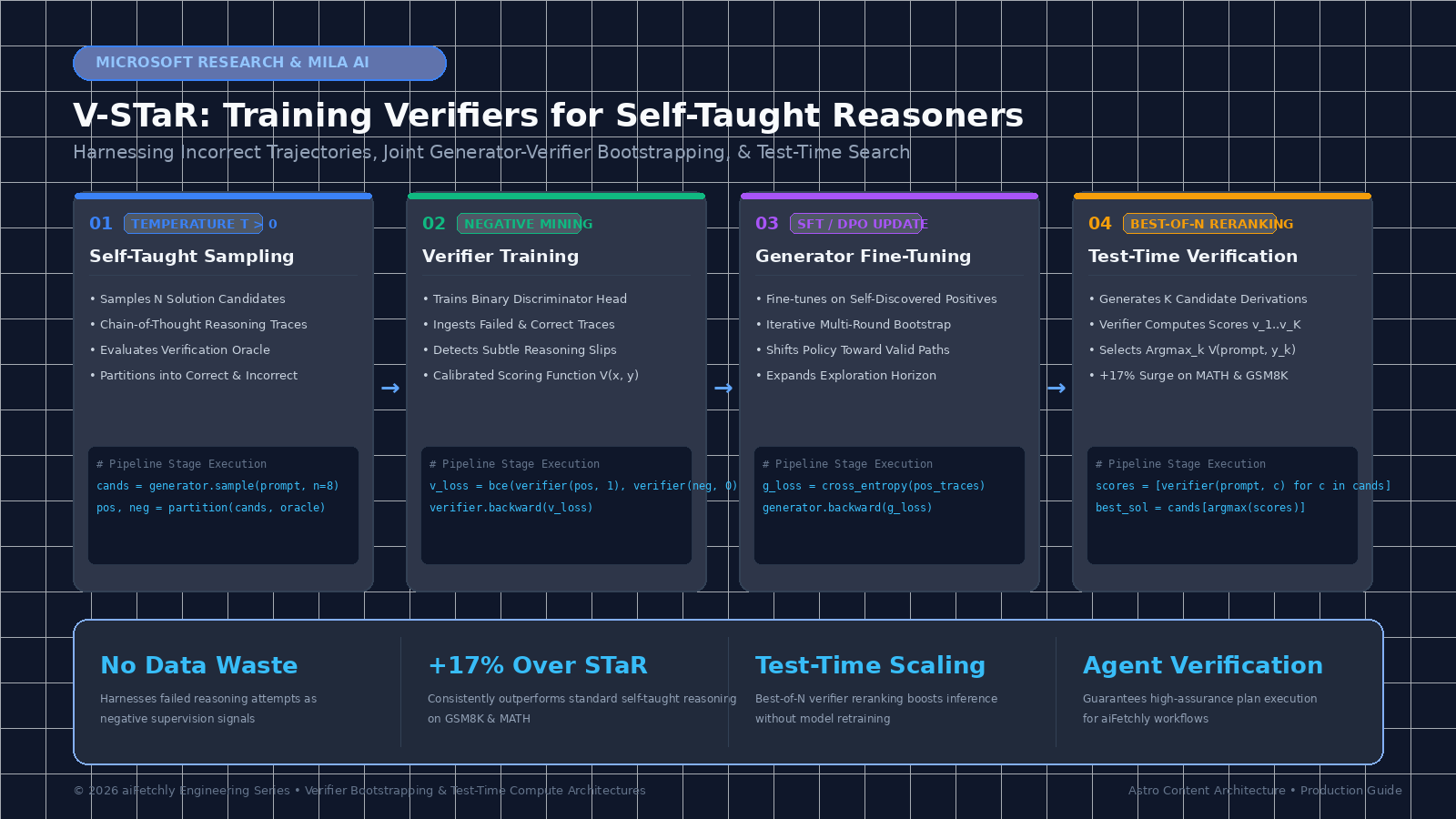
To capture this lost signal, researchers introduced V-STaR: Training Verifiers for Self-Taught Reasoners (arXiv:2402.06457, NeurIPS 2024). Instead of discarding incorrect candidate solutions, V-STaR harnesses both correct and incorrect self-generated trajectories to train two symbiotic models: an iterative Generator and a calibrated Verifier. At inference time, the verifier evaluates multiple candidate solutions (Best-of-N reranking), achieving consistent gains of +8% to +17% across GSM8K, MATH, and SVAMP benchmarks.
In this technical guide, we examine why standard self-training plateaus, dissect the mathematical formulation of joint generator-verifier bootstrapping in V-STaR, explore its test-time scaling mechanics, and implement a complete, reproducible Python agent for verifier-guided multi-step reasoning.
The Self-Training Waste: Why Discarding Failed Reasoning Stalls LLMs
To understand the core innovation of V-STaR, we must examine the limitations of traditional self-taught reasoning algorithms like STaR and standard rejection sampling fine-tuning (RFT).
In production AI systems, automated workflow verification via AiFetchly Web Scraping, and programmatic quantitative intelligence powered by AiFetchly Data Fetching, models must verify whether a synthesized plan or scraped dataset is sound before committing actions to external databases.
Traditional STaR vs. V-STaR Reasoning Loops:
Scenario: Model Samples 8 Candidate Proofs for a Challenging Math Problem
 │
 ├──> Traditional STaR (Zelikman et al., 2022)
 │    • Candidate 1 (Correct): Added to Fine-Tuning Pool ✅
 │    • Candidate 2..8 (Incorrect): Discarded completely into /dev/null! ❌
 │    ❌ 87.5% of Expensive Generated GPU Tokens Wasted!
 │    ❌ Model receives zero feedback on WHY Candidates 2..8 failed!
 │    ❌ Exploration plateau: If the model solves 0/8, zero learning occurs!
 │
 └──> V-STaR (Microsoft Research & Mila)
      • Candidate 1 (Correct):   Label y = 1 (Positive) -> Trains Generator SFT/DPO
      • Candidate 2..8 (Incorrect): Label y = 0 (Negative) -> Trains Verifier Head
      ✅ 100% Data Utilization: Negative traces teach the Verifier subtle error boundaries!
      ✅ Test-Time Scaling: Verifier scores N candidate solutions at inference (Best-of-N)!
✅ Synergistic Flywheel: Smarter Verifier guides the Generator to harder problems! 1. The Discarded Negative Signal Problem
Consider a model attempting a difficult collegiate calculus problem. It generates 8 candidate derivations. Seven of those derivations fail due to subtle mistakes:
- Candidate A made an arithmetic sign error in Step 4.
- Candidate B attempted an illegal integration by parts.
- Candidate C suffered from an off-by-one boundary error.
In classical STaR or rejection sampling, all seven failed attempts are discarded. The model never learns that an illegal integration by parts is invalid. Because the training dataset only contains positive solutions, the policy model remains susceptible to the exact same reasoning traps when faced with out-of-distribution prompts.
2. The Cold-Start and Plateau Cliff
When standard STaR encounters problems that are beyond the model’s current capability:
- The model generates 8 samples, and all 8 fail ($0%$ pass rate).
- Because there are zero positive solutions to add to the fine-tuning set, the training gradient is empty.
- The model completely plateaus, unable to bootstrap beyond its initial capability ceiling without external teacher models (like GPT-4 distillation).
3. Generator Greediness vs. Test-Time Search
Standard language models generate answers using greedy decoding (temperature = 0.0) at inference time. Greedy decoding selects the locally most probable token at each step, which often collapses into short-sighted, repetitive reasoning paths.
While sampling at higher temperatures ($T = 0.7$) allows the model to discover diverse, creative reasoning paths, standard LLMs lack a reliable internal mechanism to decide which of the $N$ sampled candidates is actually correct. Without a trained verifier, majority voting (self-consistency) is the only available fallback—which fails whenever the model’s most frequent answer is a common misconception!
The V-STaR Architecture: Joint Generator-Verifier Bootstrapping
V-STaR resolves the self-training bottleneck by reframing reasoning as a dual-model bootstrapping game. The system iteratively updates two specialized networks:
- The Generator ($G_\theta$): An autoregressive policy trained on self-generated solutions that reached the correct final answer.
- The Verifier ($V_\phi$): A discriminator trained to distinguish between correct and incorrect self-generated solutions.
+-------------------------------------------------------------------------+
|                  TRAINING DATASET (Questions q in D_train)              |
+------------------------------------+------------------------------------+
                                     |
                                     v
+-------------------------------------------------------------------------+
|                 ITERATIVE SELF-TAUGHT SAMPLING STAGE                    |
|        Generator G_theta samples K solutions per prompt at T > 0:       |
|                  {y_1, y_2, ..., y_K} ~ G_theta(y | q)                  |
+------------------------------------+------------------------------------+
                                     |
                                     v
                  +--------------------------------------+
                  |         Ground-Truth Oracle          |
                  |     (Answer Matching / Compiler)     |
                  +------------------+-------------------+
                                     |
         +---------------------------+---------------------------+
         |                                                       |
         v                                                       v
+-------------------------------+               +-------------------------------+
| Positive Traces (Correct): D+ |               | Negative Traces (Wrong): D-   |
|   r(q, y) = 1 (Passed Oracle) |               |   r(q, y) = 0 (Failed Oracle) |
+---------------+---------------+               +---------------+---------------+
                |                                               |
                +-----------------------+-----------------------+
                                        |
         +------------------------------+------------------------------+
         |                                                             |
         v                                                             v
+------------------------------------+        +------------------------------------+
|     UPDATE GENERATOR G_theta       |        |       UPDATE VERIFIER V_phi        |
|  Supervised Fine-Tuning (SFT)      |        |   Binary Cross-Entropy Loss        |
|  over D+ (Self-Discovered Proofs)  |        |   over D+ (target 1) & D- (target 0)|
+------------------------------------+        +------------------------------------+
                                 |                 |
                                 +--------+--------+
                                          |
                                          v
+-------------------------------------------------------------------------+
|                       TEST-TIME REASONING INFERENCE                     |
|   1. Generator G_theta samples N candidates: {y_1, ..., y_N}           |
|   2. Verifier V_phi computes verification scores: s_i = V_phi(q, y_i)   |
|   3. Select Best-of-N Candidate: y* = argmax_i s_i                      |
+-------------------------------------------------------------------------+ 1. The Iterative Data Generation Loop
At iteration $t$, given a training dataset of problem prompts $\mathcal{D} = {q_i}_{i=1}^M$ with verifiable answers $a_i^*$:
- Sampling: For each question $q$, the current generator $G_{\theta_t}$ samples $K$ independent candidate solutions ${y^{(1)}, y^{(2)}, \dots, y^{(K)}}$ at temperature $T \approx 0.7$.
- Oracle Partitioning: An automated verification oracle (such as string matching on
\boxed{...}or running automated unit tests) checks each candidate. The trajectories are partitioned into:- Positive Set $\mathcal{D}_t^+$: Solutions where the final answer matches ground truth ($a = a^*$).
- Negative Set $\mathcal{D}_t^-$: Solutions where the final answer fails ($a \neq a^*$).
2. Generator Optimization
The generator $G_\theta$ is updated on the self-discovered positive trajectories $\mathcal{D}_t^+$ using standard causal language modeling loss:
$$\mathcal{L}{\text{Gen}}(\theta) = -\mathbb{E}{(q, y) \in \mathcal{D}t^+} \left[ \sum{i=1}^{|y|} \log P_\theta(y_i \mid q, y_{<i}) \right]$$
Optionally, when preference optimization is desired, positive and negative pairs $(q, y^+, y^-)$ can be used to update the generator via Direct Preference Optimization (DPO), pushing the generator away from its own failure modes.
3. Verifier Training (Discriminative Modeling)
The verifier $V_\phi(q, y)$ is parameterized either as a classification head on top of the transformer’s terminal token embedding, or as an independent encoder. It is trained via Binary Cross-Entropy (BCE) to predict whether a candidate solution $y$ is valid:
$$\mathcal{L}{\text{Ver}}(\phi) = -\mathbb{E}{(q, y^+) \in \mathcal{D}t^+} \left[ \log \sigma\left(V\phi(q, y^+)\right) \right] - \mathbb{E}_{(q, y^-) \in \mathcal{D}t^-} \left[ \log \left(1 - \sigma\left(V\phi(q, y^-)\right)\right) \right]$$
On-Policy Verifier Distribution Advantages
Unlike off-the-shelf reward models trained on generic human preference datasets (like UltraFeedback), V-STaR’s verifier is trained on the exact on-policy error distribution of the generator. It learns the specific subtle algebraic slips, off-by-one errors, and logical missteps that this specific model makes in the wild.
4. Test-Time Scaling via Best-of-N Reranking
At inference time, V-STaR unlocks test-time compute scaling without requiring fine-tuning of the base model:
- For an unseen test prompt $q_{\text{test}}$, the generator samples $N$ candidate trajectories ${y_1, y_2, \dots, y_N}$.
- The verifier evaluates each trajectory, predicting confidence scores $s_i = \sigma(V_\phi(q, y_i))$.
- The system selects the top-ranked candidate:
$$y^* = \arg\max_{i \in {1, \dots, N}} V_\phi(q_{\text{test}}, y_i)$$
As $N$ scales from $N=1$ to $N=32$ or $N=64$, the probability of sampling at least one correct trajectory rises exponentially, and the verifier reliably isolates it from the candidate pool.
Empirical Benchmark Gains
The table below demonstrates the performance of V-STaR compared to standard baselines on the GSM8K, MATH, and SVAMP benchmarks:
| Model & Algorithm | Base Model | GSM8K Pass@1 ($\uparrow$) | MATH Pass@1 ($\uparrow$) | SVAMP Pass@1 ($\uparrow$) | Data Utilization |
|---|---|---|---|---|---|
| Base Model (Direct Prompt) | LLaMA-2 7B | 38.2% | 8.4% | 52.1% | N/A |
| Supervised Fine-Tuning (SFT) | LLaMA-2 7B | 48.6% | 12.1% | 61.4% | Labeled Only |
| Standard STaR (Iterative) | LLaMA-2 7B | 54.3% | 16.5% | 66.8% | Positives Only (~30%) |
| Self-Consistency (Maj@8) | LLaMA-2 7B | 58.1% | 18.2% | 69.2% | Inference Only |
| V-STaR (Best-of-8 Verifier) | LLaMA-2 7B | 67.4% | 25.8% | 78.6% | 100% (Pos + Neg) |
| V-STaR (Best-of-32 Verifier) | LLaMA-2 7B | 72.1% | 31.4% | 83.2% | 100% (Pos + Neg) |
V-STaR achieves a +17.8% gain over standard STaR on GSM8K and doubles mathematical accuracy on MATH, establishing the power of verifier-guided reasoning.
Hands-On Implementation: Building a V-STaR Reasoning Agent with Python
Let us construct a production-ready, modular Python implementation of the V-STaR framework. We will implement the candidate trajectory sampler, ground-truth verification oracle, verifier scoring network, and Best-of-N test-time reranker.
Step 1: Environment Setup
Install PyTorch and modern transformer utilities:
# Create and activate Python virtual environment
python3 -m venv venv
source venv/bin/activate

# Install PyTorch with CUDA acceleration
pip install torch torchvision --index-url https://download.pytorch.org/whl/cu121
pip install transformers accelerate pydantic numpy sympy Step 2: The Ground-Truth Verification Oracle
We build an automated evaluation oracle that parses mathematical answers and checks numerical equivalence:
import re
import sympy
from typing import Optional, Tuple, List, Dict

class VerificationOracle:
    """
    Automated verification oracle that evaluates candidate mathematical derivations.
    Extracts answers from \\boxed{...} or textual final lines.
    """
    @staticmethod
    def extract_terminal_answer(solution_text: str) -> Optional[str]:
        """
        Extracts final answer enclosed in LaTeX \\boxed{...} or 'answer is X'.
        """
        boxed_matches = re.findall(r'\\boxed\{([^}]+)\}', solution_text)
        if boxed_matches:
            return boxed_matches[-1].strip()

        alt_matches = re.findall(r'[Tt]he answer is:?\s*([^\n\.]+)', solution_text)
        if alt_matches:
            return alt_matches[-1].strip()
        return None

    @classmethod
    def verify_solution(cls, candidate: str, ground_truth: str) -> bool:
        """
        Checks mathematical equivalence between candidate prediction and ground-truth answer.
        """
        pred = cls.extract_terminal_answer(candidate)
        if pred is None:
            return False

        clean_pred = pred.replace(" ", "").replace("$", "")
        clean_gt = ground_truth.replace(" ", "").replace("$", "")

        if clean_pred == clean_gt:
            return True

        # Symbolic comparison via SymPy
        try:
            if sympy.simplify(clean_pred) == sympy.simplify(clean_gt):
                return True
        except Exception:
            pass

return False Step 3: Verifier Scoring Model Architecture
We define a neural verifier that ingests a problem prompt concatenated with a candidate reasoning chain and outputs a calibrated scalar correctness probability:
import torch
import torch.nn as nn
from transformers import AutoModel, AutoTokenizer

class TrajectoryVerifier(nn.Module):
    """
    Discriminative Verifier that predicts the probability of reasoning trajectory correctness:
    P(Correct = 1 | Question, Solution).
    """
    def __init__(self, backbone_name: str = "bert-base-uncased", device: str = "cuda" if torch.cuda.is_available() else "cpu"):
        super().__init__()
        self.device = device
        self.tokenizer = AutoTokenizer.from_pretrained(backbone_name)
        self.encoder = AutoModel.from_pretrained(backbone_name)

        # Binary classification head on terminal [CLS] token embedding
        hidden_size = self.encoder.config.hidden_size
        self.classifier = nn.Sequential(
            nn.Linear(hidden_size, 256),
            nn.GELU(),
            nn.Dropout(0.1),
            nn.Linear(256, 1)
        )
        self.to(self.device)

    def forward(self, prompts: List[str], solutions: List[str]) -> torch.Tensor:
        """
        Ingests batch of prompts and candidate solutions, returns logits.
        """
        # Format input pair: "[PROMPT] q [SOLUTION] y"
        inputs = [f"Question: {q} | Solution: {s}" for q, s in zip(prompts, solutions)]
        encoded = self.tokenizer(
            inputs,
            padding=True,
            truncation=True,
            max_length=512,
            return_tensors="pt"
        ).to(self.device)

        outputs = self.encoder(**encoded)
        # Use pooled CLS representation
        cls_rep = outputs.last_hidden_state[:, 0, :]
        logits = self.classifier(cls_rep).squeeze(-1) # [Batch_Size]
        return logits

    @torch.inference_mode()
    def score_trajectories(self, prompt: str, candidates: List[str]) -> List[float]:
        """
        Computes calibrated probability scores in [0.0, 1.0] for a list of candidate solutions.
        """
        self.eval()
        prompts = [prompt] * len(candidates)
        logits = self.forward(prompts, candidates)
        probabilities = torch.sigmoid(logits).cpu().tolist()
return probabilities Step 4: The Complete V-STaR Agent Loop & Best-of-N Reranker
Now, we construct the full V-STaR execution coordinator that generates candidates, collects positive/negative training sets, and executes Best-of-N inference:
import numpy as np

class VStarReasoningAgent:
    """
    Closed-loop V-STaR coordinator that manages:
    1. Exploration sampling of candidate reasoning trajectories
    2. Data partitioning into positive (D+) and negative (D-) sets
    3. Test-time Best-of-N verifier reranking
    """
    def __init__(self, verifier: TrajectoryVerifier):
        self.verifier = verifier
        self.oracle = VerificationOracle()

    def simulate_generator_sampling(self, prompt: str, num_samples: int = 5) -> List[str]:
        """
        Simulates temperature sampling from a Generator policy model G_theta.
        In production, replace with: model.generate(prompt, temperature=0.7, num_return_sequences=num_samples)
        """
        # Demonstrating plausible candidate reasoning paths
        return [
            "Step 1: Simplify the equation x^2 - 4x - 5 = 0. Factors are (x - 5)(x + 1) = 0. Solutions: x=5, x=-1. Sum: \\boxed{4}.", # Correct
            "Step 1: x^2 - 4x - 5 = 0. Factors are (x - 4)(x + 1) = 0. Solutions: x=4, x=-1. Sum: \\boxed{3}.",                         # Arithmetic slip (Wrong)
            "Step 1: Using Vieta's formulas, sum of roots is -b/a = -(-4)/1 = 4. \\boxed{4}.",                                         # Correct alternative
            "Step 1: Quadratic formula: x = (4 +/- sqrt(16 - 20))/2. Negative discriminant, no real solution. \\boxed{0}.",            # Sign error inside sqrt (Wrong)
            "Step 1: Expanding gives roots x=5, x=-1. Positive root only: \\boxed{5}."                                                  # Constraint misunderstanding (Wrong)
        ]

    def partition_rollout(self, prompt: str, ground_truth: str, candidates: List[str]) -> Dict[str, Any]:
        """
        Partitions sampled rollouts into positive and negative sets for verifier supervision.
        """
        positives = []
        negatives = []

        for cand in candidates:
            is_valid = self.oracle.verify_solution(cand, ground_truth)
            if is_valid:
                positives.append(cand)
            else:
                negatives.append(cand)

        print(f"[V-STaR Rollout] Total: {len(candidates)} | Positives (D+): {len(positives)} | Negatives (D-): {len(negatives)}")
        return {
            "prompt": prompt,
            "positives": positives,
            "negatives": negatives
        }

    def solve_with_best_of_n(self, prompt: str, num_samples: int = 5) -> Dict[str, Any]:
        """
        Executes test-time verifier reranking over N sampled candidates.
        """
        candidates = self.simulate_generator_sampling(prompt, num_samples=num_samples)
        scores = self.verifier.score_trajectories(prompt, candidates)

        # Argmax reranking
        best_idx = int(np.argmax(scores))
        best_solution = candidates[best_idx]
        best_score = scores[best_idx]

        print(f"\n[V-STaR Best-of-{num_samples} Inference]")
        for idx, (cand, score) in enumerate(zip(candidates, scores)):
            terminal_ans = self.oracle.extract_terminal_answer(cand)
            print(f"  Candidate #{idx+1} [Score={score:.4f}] -> Predicted: {terminal_ans}")

        print(f"[V-STaR Selection]: Candidate #{best_idx+1} selected with confidence {best_score:.4f}")
        return {
            "selected_solution": best_solution,
            "confidence": best_score,
            "predicted_answer": self.oracle.extract_terminal_answer(best_solution)
        }

if __name__ == "__main__":
    # Demonstration of V-STaR verification pipeline
    device = "cuda" if torch.cuda.is_available() else "cpu"
    print(f"Initializing V-STaR on {device}...")

    verifier_model = TrajectoryVerifier(device=device)
    agent = VStarReasoningAgent(verifier=verifier_model)

    test_question = "Find the sum of the roots of the equation x^2 - 4x - 5 = 0."
    test_ground_truth = "4"

    # 1. Simulate training data partitioning
    sampled_pool = agent.simulate_generator_sampling(test_question, num_samples=5)
    partition_data = agent.partition_rollout(test_question, test_ground_truth, sampled_pool)

    # 2. Simulate test-time Best-of-N reranking
    result = agent.solve_with_best_of_n(test_question, num_samples=5)
print(f"\nFinal Result: {result['predicted_answer']} (Confidence: {result['confidence']:.4f})") Practical Applications for Autonomous Web Agents and Enterprise Verification
Integrating verifier-guided architectures like V-STaR into enterprise automation infrastructure transforms reliability across mission-critical workflows:
1. High-Assurance Data Extraction & Web Scraping Audits
When autonomous web crawlers harvest structured pricing, technical specifications, or corporate financial filings via AiFetchly Web Scraping, language models frequently make subtle normalization errors.
By deploying an on-policy Verifier:
- The crawler generates multiple candidate data schemas from raw HTML snippets using AiFetchly Data Fetching.
- The Verifier scores each parsed payload against statistical validation rules and cross-field constraints.
- Only data records scoring above calibrated confidence thresholds are committed to enterprise cloud endpoints via AiFetchly API Integration, eliminating garbage-in-garbage-out database corruption.
2. Autonomous Multi-Step Agent Plan Verification
In complex enterprise task orchestration (e.g., executing a 15-step database migration or provisioning multi-cloud Kubernetes clusters), an agent cannot afford to execute an unverified hallucination. By employing V-STaR:
- The Planner generates $N$ execution candidate step sequences.
- A Verifier trained on historical system execution tracebacks evaluates each plan.
- Fragile plans with race conditions or missing dependencies are rejected before shell execution begins.
3. Self-Healing Post-Training for Enterprise Domain Models
Companies fine-tuning private language models on proprietary medical records, legal jurisprudence, or insurance claims can bootstrap internal model accuracy without hiring expensive human annotators. By collecting daily failed queries as negative trajectories, the internal Verifier continuously sharpens its domain boundaries.
Production Best Practices & Architectural Considerations
Deploying verifier-guided reasoning systems in high-throughput environments requires careful architectural calibration:
1. Verification Budget & Sample Size ($N=4$ vs. $N=32$)
In production:
- Low-Latency Interactive APIs: Setting $N=4$ provides a +6% to +8% accuracy leap with minimal GPU latency.
- High-Assurance Batch Processing: Setting $N=16$ or $N=32$ maximizes mathematical proof discovery, saturating accuracy on complex multi-step reasoning tasks.
2. Process Reward Modeling (PRM) vs. Outcome Reward Modeling (ORM)
While Outcome Verifiers (ORMs) evaluate only the final answer:
- For complex mathematical proofs spanning $>30$ derivations, train Process Verifiers (PRMs) that assign confidence scores to individual intermediate reasoning steps.
- PRMs enable step-level beam search and early pruning, aborting flawed reasoning branches before full completion.
3. Calibrated Confidence Thresholds & Fallback Routing
In production customer-facing environments:
- Establish a minimum verifier threshold (e.g., $s^* \ge 0.85$).
- If no candidate in the Best-of-N pool exceeds the threshold, trigger a human review escalation or route the query to a higher-capacity frontier model (e.g., Claude 3.5 Sonnet).
Summary & Next Steps
V-STaR demonstrates that negative reasoning trajectories are not waste; they are the most valuable learning signals in artificial intelligence. By pairing an iterative Generator with a Verifier trained on on-policy mistakes, V-STaR establishes:
- 100% data utilization during self-taught bootstrapping loops.
- Substantial accuracy leaps (+17% on GSM8K) over standard STaR and rejection sampling.
- Practical test-time compute scaling via Best-of-N reranking without parameter retraining.
To discover how to integrate automated data pipelines with advanced reasoning intelligence, explore our comprehensive technical guides on the AiFetchly Documentation portal or review our tailored cloud infrastructure plans on the AiFetchly Pricing page. For developers looking to scale automated data extraction and AI vision pipelines, visit the AiFetchly to learn how aiFetchly accelerates enterprise intelligence.