Understanding AI Agents and Agentic Workflows: Architecture, Patterns, and Production Design
The Problem: The Inherent Boundaries of Zero-Shot LLMs
Large Language Models (LLMs) have transformed software development, but standard prompt-response interactions have fundamental architectural limits. When you ask a baseline model to design a complete backend service, scrape an authenticated web application, or analyze financial data in a single inference pass, it predicts tokens sequentially without the ability to pause, verify, execute tests, or correct errors mid-thought.
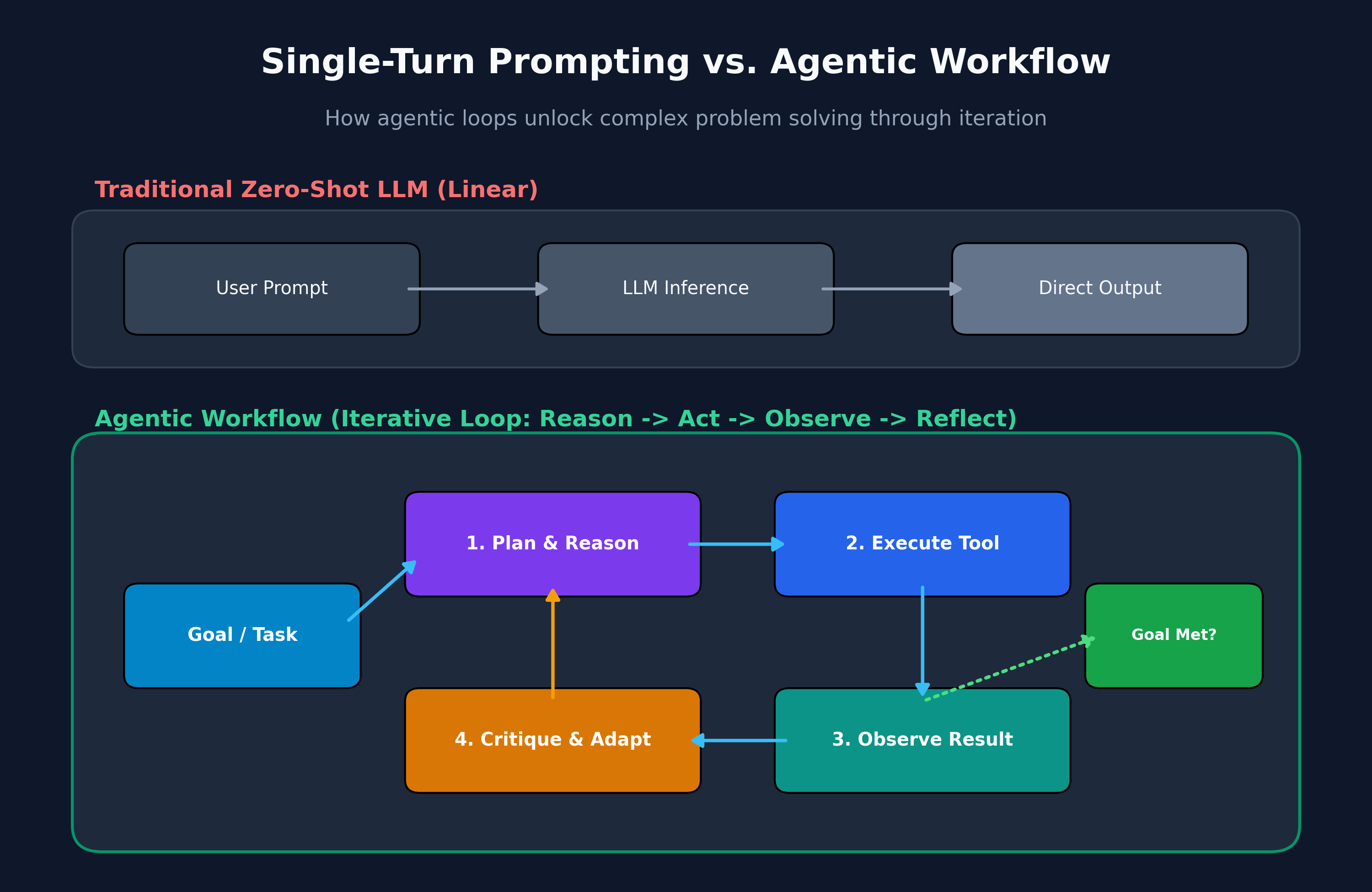
In a conventional linear workflow, a user submits a prompt, the model processes it in one forward pass, and outputs a response. This introduces critical failure modes in production pipelines:
- Cascading Hallucinations: If the model assumes an incorrect parameter type or invents a non-existent API endpoint in step 2 of a 10-step plan, the mistake propagates through the entire remaining generation without opportunity for recovery.
- Static and Closed World Knowledge: A raw model cannot inspect live reality. It cannot query updated databases, check current schema definitions, or verify whether generated code compiles.
- Single-Shot Cognitive Horizon: Complex tasks require exploration, trial-and-error, and dynamic plan adjustment. Expecting an LLM to generate an error-free 1,000-line implementation in one prompt is the software equivalent of expecting a human engineer to write production software without ever running a compiler or test suite.
The Solution: Autonomous Agents and Iterative Agentic Workflows
To overcome these constraints, engineering practices are shifting toward AI Agents and Agentic Workflows. Instead of relying on a single zero-shot generation, agentic architectures embed the model within an iterative execution loop—frequently modeled as Reason → Act → Observe → Reflect.
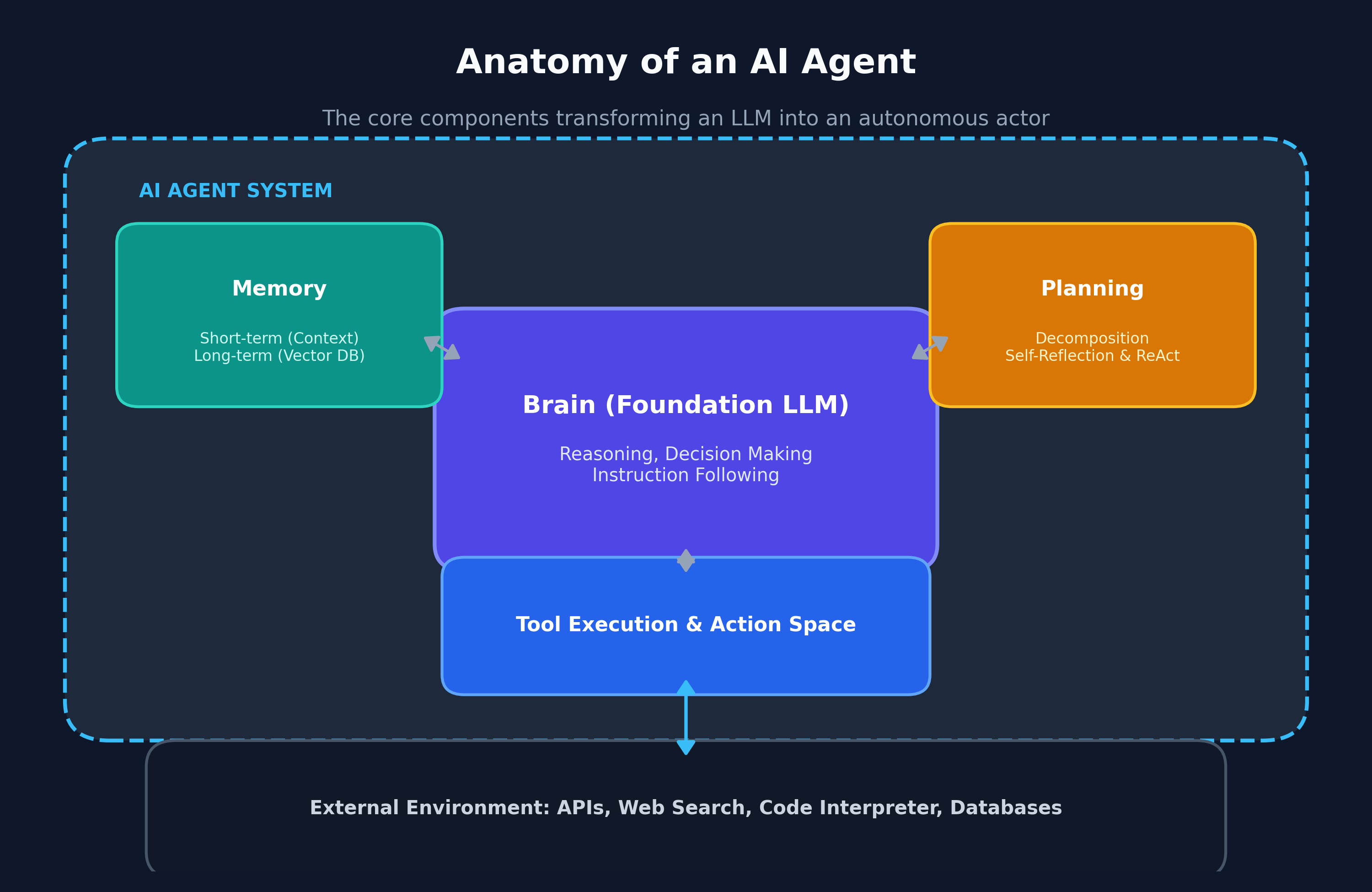
At its core, an AI Agent is an autonomous software system where a foundation model functions as the central cognitive engine, orchestrating planning, memory, and external tools to accomplish an objective.
The Four Pillars of Agent Anatomy
- The Brain (Foundation LLM): The core reasoning engine responsible for language understanding, intent classification, step planning, hypothesis formulation, and synthesis of observations.
- Planning & Task Decomposition: The mechanism by which the agent breaks high-level goals into granular sub-tasks, estimates dependencies, and dynamically adjusts its plan when execution fails.
- Memory Systems:
- Short-Term Memory: In-context state management (conversation history, tool call payloads, terminal outputs, and intermediate scratchpads within the context window).
- Long-Term Memory: External knowledge retrieval (Vector databases, relational stores, or episodic logs) that allows the agent to recall domain-specific context across sessions.
- Tool Execution & Action Space: The operational interface enabling agents to interact with digital infrastructure—executing shell scripts, querying APIs, fetching documentation, and writing files.
The Iterative Reasoning Loop in Practice
Rather than terminating after one token sequence, an agentic workflow runs an active loop:
- Plan & Reason: The agent evaluates its current context and determines the next necessary action.
- Execute Tool: The agent generates structured instructions (such as a database query or web scraper payload).
- Observe Result: The environment executes the command and returns stdout, structured data, or stack traces back to the agent.
- Critique & Adapt: The agent inspects the feedback. If an exception occurred, it diagnoses the root cause, revises its inputs, and retries. Once the validation criteria are satisfied, it delivers the finalized output.
As highlighted by AI researcher Andrew Ng, giving an LLM an agentic workflow to iteratively write, run, test, and revise code often yields performance gains that surpass jumping to a larger model parameter tier.
Implementation: Architectural Patterns and Production Engineering
Building dependable agentic workflows requires moving beyond basic scripts into structured architectural patterns.
Core Agentic Design Patterns
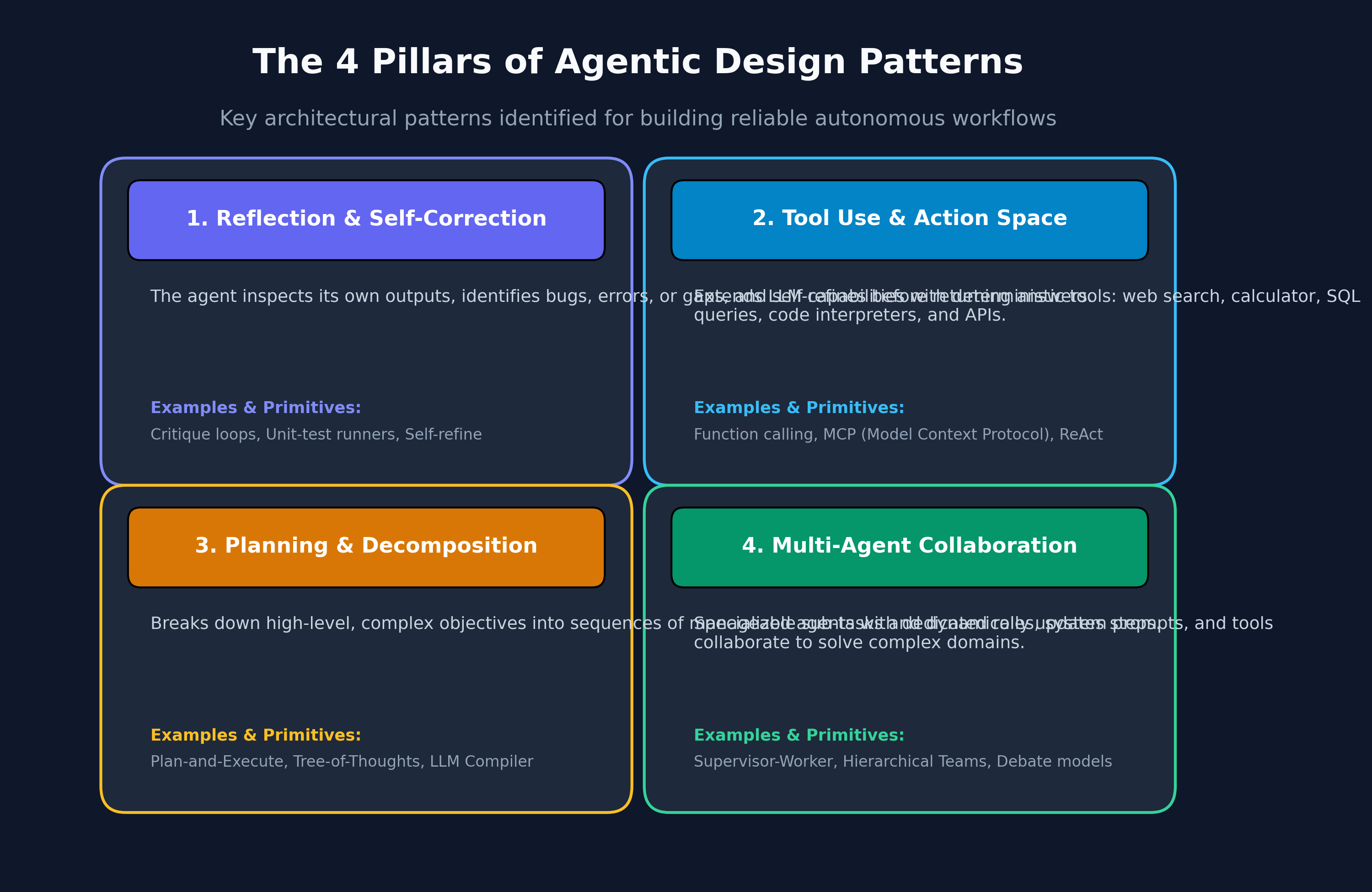
Modern agent design relies on four foundational patterns:
- Reflection & Self-Correction: Rather than accepting the model’s first generation, reflection patterns implement critic loops. In an Evaluator-Optimizer loop, a generator agent produces the artifact, while an evaluator agent scores it against rubrics or unit tests. If validation fails, constructive feedback guides the next iteration.
- Tool Use & Function Calling: Exposes deterministic APIs, databases, and code interpreters to the model via standardized JSON schemas or unified interfaces like the Model Context Protocol (MCP).
- Planning & Decomposition: Approaches like Plan-and-Execute and ReAct (Reasoning + Acting) enable models to construct an initial roadmap, execute each step sequentially, and revise the remaining milestones as real-time feedback arrives.
- Multi-Agent Collaboration: Partitions complex domains into specialized sub-agents (e.g., orchestrator, researcher, programmer, auditor). Each agent operates with isolated system prompts and toolsets, preventing context pollution and lowering token consumption.
Production Engineering Realities
When taking agents from prototype to production, teams must manage four key challenges:
- Preventing Infinite Loops: Always configure hard recursion limits, timeout caps, and human-in-the-loop fallback triggers for recurring API failures.
- Managing Context Window Bloat: Tool outputs and verbose logs quickly consume context space. Implement periodic summarization passes and offload scratchpads to temporary storage.
- Optimizing Latency and Token Costs: Multi-turn loops require multiple inference passes. Cache deterministic tool results, utilize lightweight models for validation checks, and execute independent subtasks in parallel.
- Security Sandboxing: Never run arbitrary shell commands or database mutations on host systems without strict containerization, least-privilege permissions, and explicit guardrails.
Modern Frameworks & Ecosystem
To start building agentic systems, several mature open-source frameworks provide production primitives:
- LangGraph: Optimal for stateful, cyclic multi-agent graphs with fine-grained control over execution flows.
- CrewAI: Ideal for role-playing collaborative multi-agent teams with straightforward coordination abstractions.
- AutoGen: Geared toward multi-agent conversational patterns and event-driven architectures.
- LlamaIndex Workflows: Designed for data-intensive, event-driven agentic applications with complex retrieval requirements.