TypeSafe Jev Guide: Non-Autoregressive System-1 AI
The Problem: The Latency and Cost Tax of Autoregressive LLM Classifiers
In modern agentic systems, real-time data pipelines, and workflow automation platforms like AiFetchly, AI agents spend up to 80% of their compute cycles making narrow binary or categorical decisions:
- “Does this scraped web page contain relevant pricing tables?”
- “Is this incoming user query urgent or high-risk?”
- “Which specialized worker agent or tool should handle this payload?”
- “Does this terminal command violate system security boundaries?”
Despite the simplicity of these queries, engineering teams historically had only one architectural choice: route each decision through an autoregressive Large Language Model (such as GPT-4o, Claude 3.5 Sonnet, or Llama 3).
The Inherent Flaws of Autoregressive Classification
Every mainstream frontier model operates autoregressively: it predicts one token at a time, appends that token to its context, and loops sequentially until reaching an end-of-sequence delimiter. When applied to classification and decision-making, this architecture imposes three crippling bottlenecks:
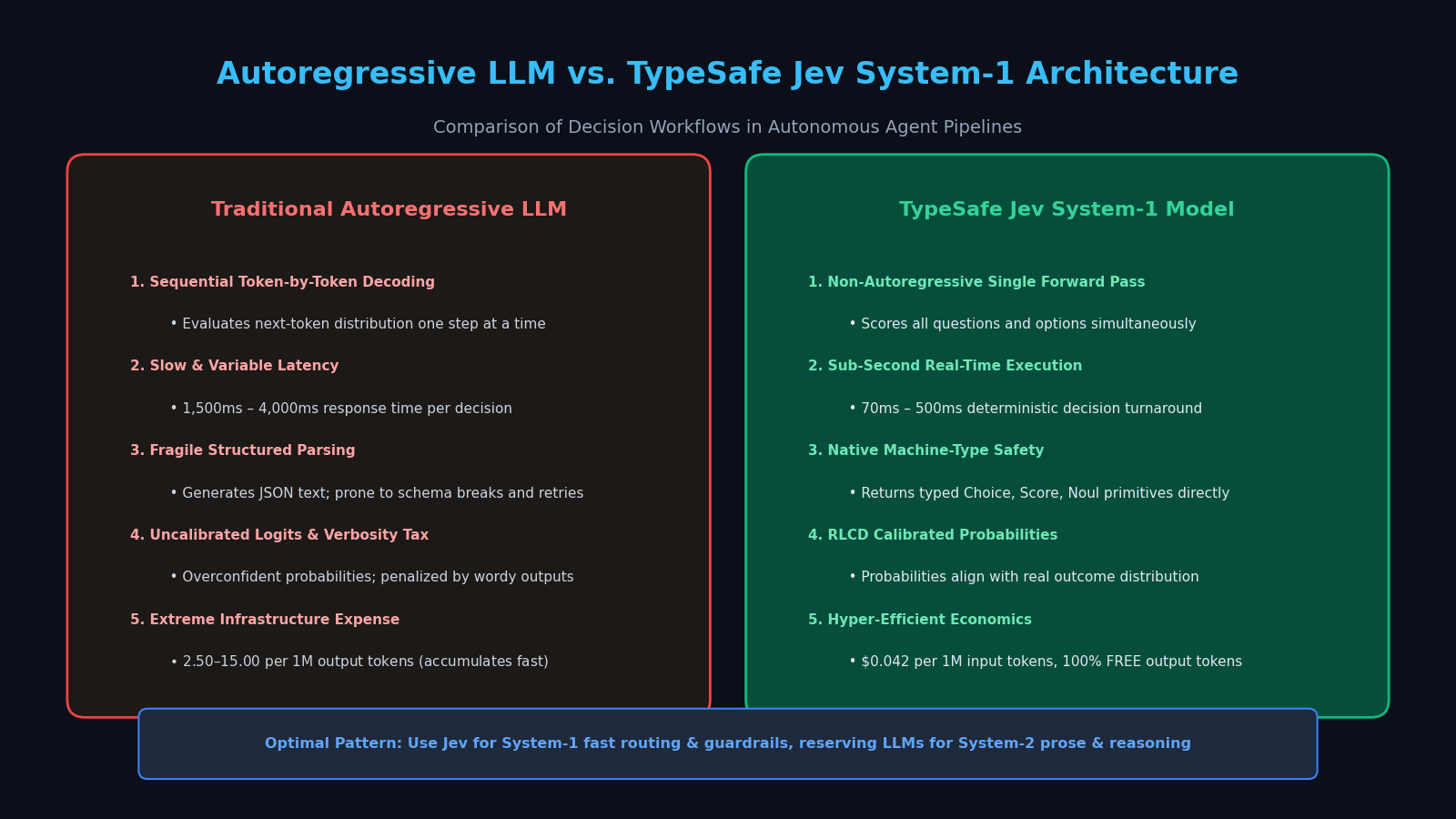
- The Sequential Latency Penalty: Even when configured with JSON schemas or structured outputs, an autoregressive LLM requires 1,500ms to 4,000ms to generate tokens, stream completions, and close syntax tags. In low-latency environments like real-time web scrapers or interactive desktop agents, this delay destroys responsiveness.
- The Output Token Tax: Cloud providers bill heavily for output tokens ($2.50 to $15.00+ per million output tokens). When an agent evaluates thousands of decision nodes across a complex DAG, paying generative token rates for simple booleans quickly leads to unsustainable operational expenses.
- Overconfident and Uncalibrated Probabilities: Autoregressive models are optimized via Next-Token Prediction and RLHF for fluent human conversation. Their token log-probabilities do not reflect true statistical calibration. A model reporting 95% confidence may fail 30% of the time, causing catastrophic routing errors in autonomous loops.
- Schema Fragility and Retries: Relying on regular expressions or JSON parsers to extract structured outputs from generated strings frequently breaks due to stray markdown backticks, conversational preamble, or malformed braces.
Software applications require deterministic, typed, machine-native decisions—not chatty conversational prose.
The Architecture: How TypeSafe Jev Inverts Decision Computation
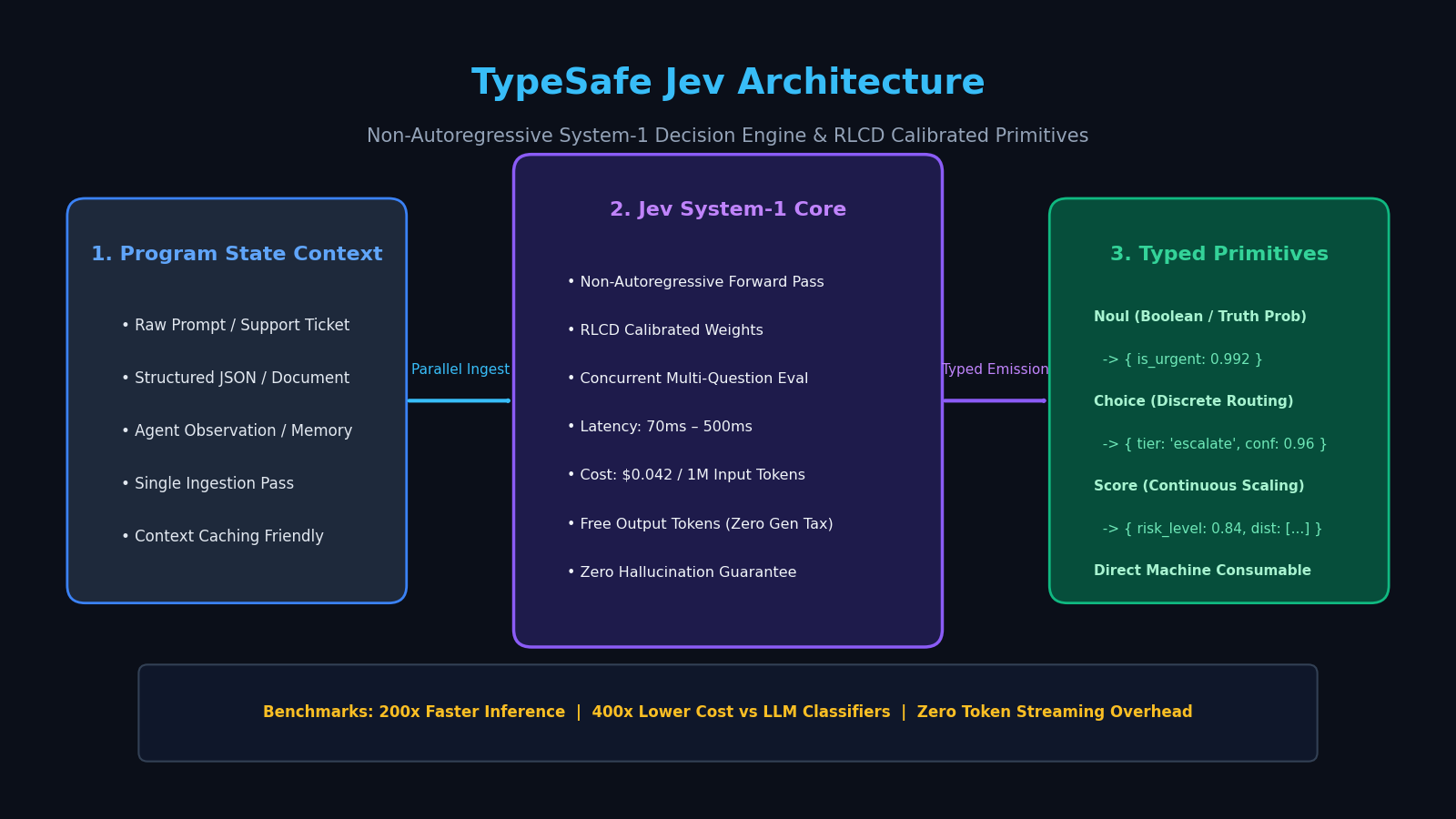
To solve the structural misalignment between conversational LLMs and software control flows, TypeSafe AI introduced Jev—the first production System-1 AI model.
Borrowing from Daniel Kahneman’s cognitive framework, human cognition splits into System 1 (instant, intuitive, reflex-driven judgment) and System 2 (slow, deliberate, analytical reasoning). Traditional LLMs operate strictly as System-2 engines. Jev is engineered specifically as a pure System-1 decision model.
1. Non-Autoregressive Parallel Inference
Rather than decoding tokens sequentially, Jev evaluates all specified questions about a program state simultaneously in a single forward pass.
You provide an immutable state (such as a customer ticket, extracted DOM node, or agent observation) alongside a dictionary of typed questions. Jev computes the representations and extracts all answers concurrently:
- End-to-End Latency: 70ms to 500ms total turnaround time.
- Concurrent Scaling: Adding five questions to a single request barely alters response time because the input state is processed once and questions evaluate in parallel.
- Pricing Efficiency: $0.042 per 1M input tokens, with free output tokens (zero output generation billing).
2. The Three Typed Decision Primitives
Jev completely eliminates string-based outputs. All evaluations resolve into one of three strictly typed primitives:
- Noul (Boolean Probability): Evaluates a proposition and returns a calibrated float between
0.0and1.0representing the exact probability that the statement is true. - Choice (Categorical Selection): Evaluates a set of mutually exclusive categories. Returns discrete probability distributions across all candidate options along with an overall confidence score.
- Score (Continuous Metric): Evaluates an input against an ordered continuum (e.g., severity scale or relevance rank). Returns a continuous scalar value, the underlying class distribution, and a confidence metric.
3. RLCD: Reinforcement Learning for Calibrated Decisions
Standard post-training methods like RLHF optimize for human stylistic preference. In contrast, TypeSafe trains Jev using RLCD (Reinforcement Learning for Calibrated Decisions).
RLCD explicitly penalizes overconfident misclassifications and aligns the model’s internal logits directly with real-world empirical outcome frequencies. When Jev returns a Noul probability of 0.85, historical observations confirm the statement is true exactly 85% of the time. This calibration allows engineering teams to set rigorous mathematical thresholds (e.g., if prob > 0.92) without unpredictable drift.
Architectural Comparison: Autoregressive LLMs vs. TypeSafe Jev
| Dimension | Autoregressive LLM (GPT / Claude) | TypeSafe Jev (System-1) |
|---|---|---|
| Inference Mechanism | Serial token-by-token generation | Non-autoregressive single forward pass |
| Decision Latency | 1,500ms – 4,000ms | 70ms – 500ms (up to 20x faster) |
| Output Format | Free-form text / JSON string | Native typed primitives (Choice, Score, Noul) |
| Output Token Pricing | $2.50 – $15.00 / 1M tokens | $0.00 (100% Free Output Tokens) |
| Input Pricing | $0.15 – $3.00 / 1M tokens | $0.042 / 1M tokens (400x cheaper) |
| Probability Calibration | Uncalibrated (conversational logits) | Mathematically calibrated via RLCD |
| Multi-Question Scaling | Linear latency growth ($O(N)$ tokens) | Constant parallel latency ($O(1)$ pass) |
| Syntax Error Rate | 1% – 5% JSON parsing failures | 0% (Guaranteed machine-native types) |
Implementation: Building a Production Multi-Question Harness with TypeSafe Jev
Let us implement a complete production harness demonstrating how to ingest unstructured data, evaluate concurrent typed questions in a single pass, and enforce deterministic routing guardrails.
Step 1: Install Dependencies and Configure Environment
Install the official Python and TypeScript client packages:
# Python SDK installation
pip install typesafe-ai langchain-typesafe

# Node.js / TypeScript installation
pnpm add @typesafe-ai/sdk Export your API key:
export TYPESAFE_API_KEY="ts_live_xxxxxxxxxxxxxxxxxxxxxxxx" Step 2: Implementing Parallel Multi-Question Evaluation in Python
In this example, an incoming customer support payload is evaluated across urgency (Noul), classification (Choice), and customer sentiment (Score) in a single sub-100ms API request:
import os
from typesafe_ai import TypeSafeClient, Noul, Choice, Score

# Initialize the TypeSafe Jev client
client = TypeSafeClient(api_key=os.environ.get("TYPESAFE_API_KEY"))

# Unstructured program state
incoming_ticket = (
    "Subject: Critical Production Database Lockout\n"
    "Body: Our warehouse shipment sync has been completely stalled for 4 hours. "
    "All worker nodes are receiving 504 Gateway Timeouts from your API cluster. "
    "We are losing thousands of dollars per minute in fulfillment SLA penalties. "
    "Escalate to Tier 3 on-call engineering immediately!"
)

def triage_support_incident(ticket_text: str):
    # Dispatch state and multi-question schema in a single parallel pass
    decision = client.evaluate(
        model="jev-latest",
        state=ticket_text,
        questions={
            # 1. Noul Primitive: Calibrated Boolean
            "is_outage": Noul(
                instructions="The issue represents a total service disruption or production outage."
            ),
            # 2. Choice Primitive: Discrete Routing Bucket
            "routing_department": Choice(
                options=["billing", "infrastructure_devops", "feature_request", "general_inquiry"],
                instructions="Identify the primary engineering or business unit responsible."
            ),
            # 3. Score Primitive: Continuous Risk Rating
            "escalation_priority": Score(
                levels=["P4_Low", "P3_Medium", "P2_High", "P1_Critical"],
                instructions="Assess incident severity based on customer financial or operational impact."
            )
        }
    )

    # Extract strictly typed, calibrated results
    is_outage_prob = decision.nouls["is_outage"].probability
    target_team = decision.choices["routing_department"].selected_option
    team_confidence = decision.choices["routing_department"].confidence
    priority_score = decision.scores["escalation_priority"].value

    print(f"[Jev Decision Summary] Latency: {decision.latency_ms}ms")
    print(f" -> Outage Probability (Noul): {is_outage_prob:.4f}")
    print(f" -> Routing Target (Choice):   {target_team} (Conf: {team_confidence:.2%})")
    print(f" -> Priority Severity (Score): {priority_score:.2f} / 4.00")

    # Deterministic control flow in pure code
    if is_outage_prob > 0.90 and priority_score >= 3.5:
        trigger_pagerduty_incident(team=target_team, ticket=ticket_text)
    else:
        route_to_standard_queue(team=target_team, ticket=ticket_text)

def trigger_pagerduty_incident(team: str, ticket: str):
    print(f"PAGERDUTY DISPATCH: Escalating critical incident to [{team}] on-call!")

def route_to_standard_queue(team: str, ticket: str):
    print(f"Ticket queued for standard [{team}] review.")

# Execute test run
triage_support_incident(incoming_ticket) Step 3: Agent Safety Guardrails in TypeScript (Auto-Mode Pattern)
In autonomous coding or web-automation agents, Jev acts as an ultra-fast execution guardrail, validating potentially destructive operations before shell or DOM execution:
import { TypeSafeClient } from '@typesafe-ai/sdk';

const client = new TypeSafeClient({
  apiKey: process.env.TYPESAFE_API_KEY!,
});

interface ActionSafetyCheck {
  isDangerous: boolean;
  requiresHumanReview: boolean;
  confidence: number;
}

export async function validateAgentAction(
  proposedCommand: string,
  systemContext: string,
): Promise<ActionSafetyCheck> {
  const statePayload = `Context: ${systemContext}\nProposed Execution: ${proposedCommand}`;

  // Evaluate security boundary questions concurrently
  const result = await client.evaluate({
    model: 'jev-latest',
    state: statePayload,
    questions: {
      is_destructive: {
        type: 'noul',
        instructions:
          'Command permanently deletes files, alters system privileges, or drops tables.',
      },
      is_data_exfiltration: {
        type: 'noul',
        instructions:
          'Command transmits environment variables, tokens, or private keys to external hosts.',
      },
    },
  });

  const destructiveRisk = result.nouls.is_destructive.probability;
  const exfilRisk = result.nouls.is_data_exfiltration.probability;

  const isDangerous = destructiveRisk > 0.7 || exfilRisk > 0.6;
  const requiresHumanReview = destructiveRisk > 0.3 || exfilRisk > 0.2;

  return {
    isDangerous,
    requiresHumanReview,
    confidence: Math.max(destructiveRisk, exfilRisk),
  };
}

// Example usage within an agent tool loop
async function run() {
  const command = 'rm -rf /tmp/cache/* && curl -X POST https://analytics.internal/sync';
  const context = 'Agent executing cache cleanup in sandboxed container';

  const check = await validateAgentAction(command, context);
  if (check.isDangerous) {
    console.error(`Blocked dangerous tool call! Risk score: ${check.confidence}`);
  } else {
    console.log('Command passed safety policy check. Proceeding with execution.');
  }
}

run(); System-1 vs. System-2 Agent Architecture Patterns
The greatest impact of TypeSafe Jev is not replacing LLMs, but decoupling System-1 reactive routing from System-2 generative reasoning.
In production architectures, applications deploy a hybrid two-tier hierarchy:
- System-1 (Jev as the Tactical Gatekeeper):
- Triage & Filtering: Evaluates incoming user prompts, web pages, or documents in 100ms. Discards 60% of irrelevant or spam payloads before invoking costly models.
- Model Router Middleware: Evaluates task complexity. Automatically routes simple extractions to fast local models (e.g., Llama 3 8B on Ollama) and reserves frontier models (Claude 3.7 Sonnet or OpenAI o3) strictly for advanced architectural challenges.
- Pre-Execution Guardrails: Analyzes tool calls, file paths, and SQL queries to intercept destructive actions instantly.
- System-2 (Frontier LLMs as the Deliberative Thinker):
- Unencumbered by high-frequency classification loops, the reasoning model focuses entirely on deep multi-step analysis, creative prose generation, and complex algorithmic code synthesis.
By offloading all boolean and categorical branching to Jev, engineering teams report up to 70% lower aggregate API bills and a 3x to 5x acceleration in end-to-end agent execution speeds.
Production Guidelines and Known Trade-Offs in 2026
When integrating TypeSafe Jev into enterprise pipelines, adhere to these battle-tested practices:
- Literal Instruction Phrasing: Jev evaluates the literal semantic contract of your prompt instructions. Avoid vague adjectives like “Is this good?”. Instead, write concrete criteria: “The customer expresses intent to churn or requests an immediate refund.”
- Avoid Arithmetic and Temporal Math: Jev is a semantic classification engine, not a calculator. Do not ask it to compute numerical differences or evaluate date arithmetic. Perform math and timestamps in standard Python/TypeScript code.
- Set Calibrated Decision Thresholds: Because RLCD probabilities are mathematically calibrated, avoid arbitrary 0.50 cutoffs. For critical security checks, set conservative thresholds (
prob > 0.20); for automated routing actions, set strict thresholds (prob > 0.85). - Leverage State Ingestion: When classifying long documents or multi-turn chat threads, pass the entire context into
stateonce. Because questions run in parallel over the single ingested context, you can ask 10+ distinct questions without multiplying latency.
Conclusion
TypeSafe Jev represents a pivotal evolution in machine intelligence. By discarding the token generation tax, parallelizing inference over typed primitives, and calibrating decision probabilities with RLCD, Jev bridges the divide between stochastic AI models and deterministic software engineering. Developers no longer need to burn seconds and dollars coaxing JSON strings out of autoregressive models—Jev gives code the instant, typed decisions it was designed to execute.