Tuning Local RAG: Embedding Models & Vector Dimensions
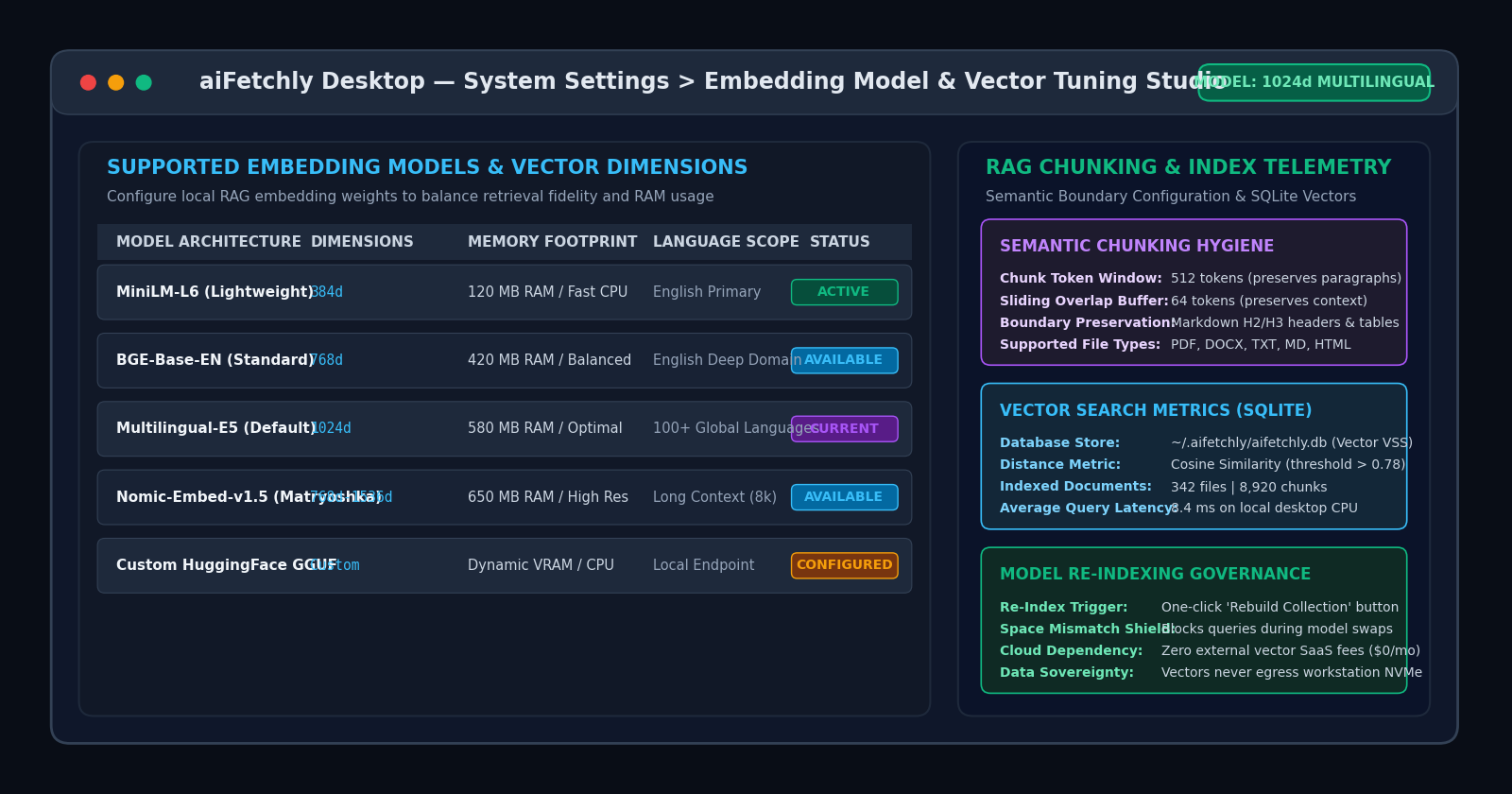
The Dimensional Trade-Off in Local Vector Retrieval
Data analysts building Retrieval-Augmented Generation (RAG) pipelines on desktop workstations face a critical architectural balancing act. Choosing the wrong embedding model compromises the entire intelligence pipeline: lightweight models fail to capture nuanced domain terminology, while oversized dense transformers bottleneck local CPU inference and consume excessive RAM.
Furthermore, cloud-hosted vector databases (such as Pinecone or Qdrant Cloud) introduce recurring API fees, enforce tight ingestion rate limits, and transmit sensitive internal PDFs over external networks.
AI Fetchly resolves these constraints by providing on-device vector embedding and retrieval directly within the desktop environment. In System Settings > Embedding Configuration, analysts can calibrate vector dimensions, chunking boundaries, and language weights to match their specific workstation hardware.
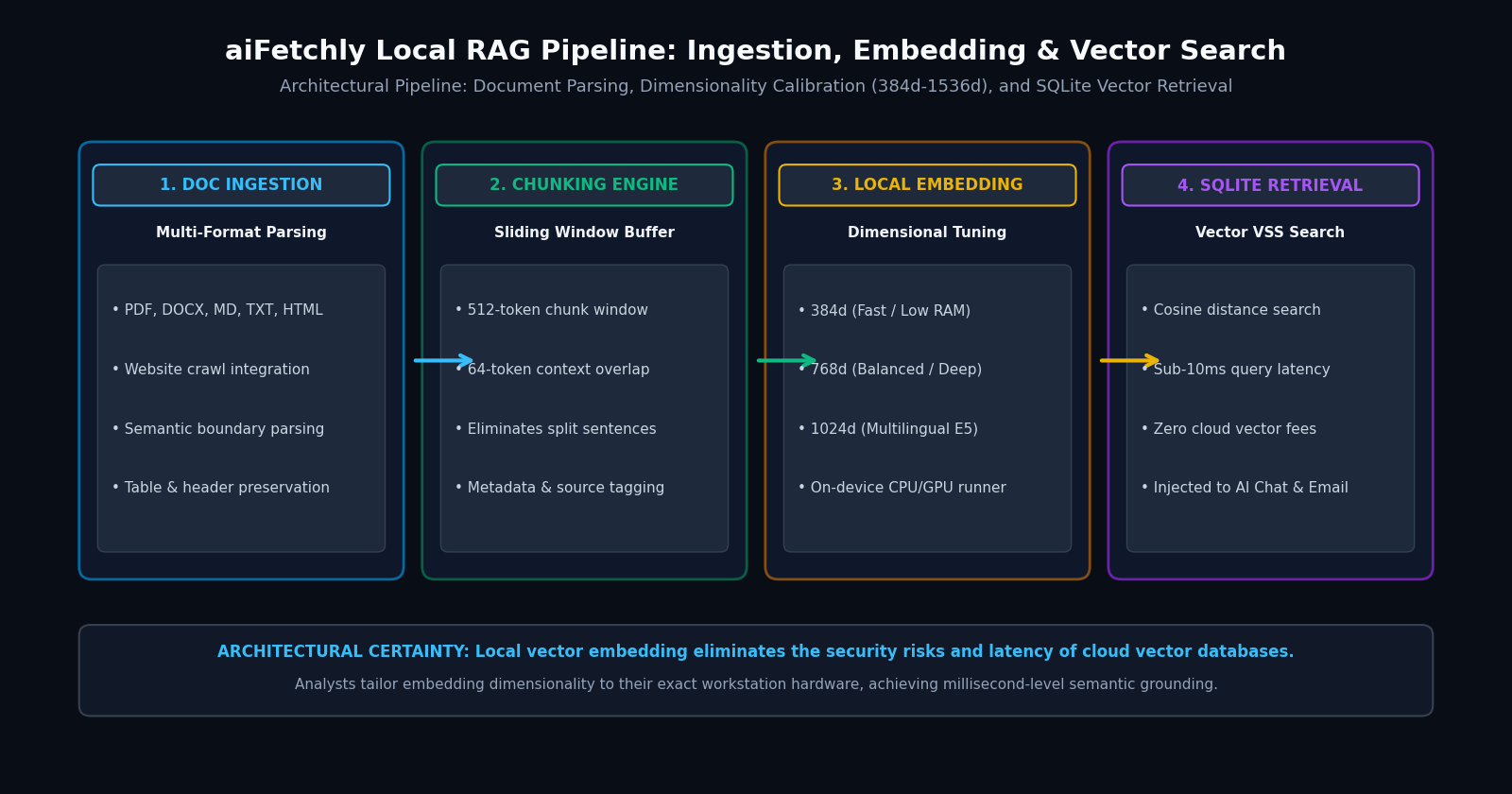
Calibrating Embedding Dimensions: 384d vs. 768d vs. 1024d
aiFetchly supports multiple on-device embedding models spanning distinct dimensional profiles:
| Vector Dimension | Optimal Architecture | Workstation Resource Footprint | Best Applied Domain |
|---|---|---|---|
| 384d (MiniLM-L6) | Compact dense vectors | ~120 MB RAM / Sub-5ms CPU inference | High-speed keyword matching & local search |
| 768d (BGE-Base-EN) | Standard BERT topology | ~420 MB RAM / Balanced CPU-GPU | Deep technical docs & B2B contract analysis |
| 1024d (Multilingual-E5) | Dense multi-head transformer | ~580 MB RAM / High semantic capacity | Global multilingual corpora (100+ languages) |
| 1536d (Nomic-Embed) | Matryoshka representation | ~650 MB RAM / Long context (8k window) | Complex multi-page financial filings & specs |
For general B2B research, 1024d Multilingual-E5 serves as the default standard, ensuring seamless retrieval across English, European, and Asian language datasets.
Semantic Chunking and Boundary Preservation
Vector embeddings are only as effective as the underlying document chunks. In the Knowledge Library, aiFetchly enforces semantic boundary preservation:
- 512-Token Windows with 64-Token Overlap: Maintains contextual coherence across paragraph splits, ensuring critical qualifying statements are not severed across vector boundaries.
- Header-Aware Parsing: Automatically binds Markdown H2/H3 headers and PDF section titles into chunk metadata, guiding vector searches directly to relevant chapters.
- Multi-Format Ingestion: Ingests PDFs, Word DOCX files, Markdown specs, and scraped HTML websites without manual text preprocessing.
Re-Indexing Governance in Local SQLite
All vector representations commit to local SQLite (~/.aifetchly/aifetchly.db) using native vector virtual tables. When analysts switch default embedding models in System Settings:
- Dimensional Mismatch Guard: aiFetchly prevents cross-vector contamination by gating searches until collections are re-indexed.
- One-Click Re-Embedding: The Rebuild Collection button streams documents through the newly selected model weights, re-indexing thousands of chunks in seconds.
By pairing dimensional control with sovereign on-device vector search, aiFetchly delivers enterprise RAG precision at zero marginal cost.
Explore advanced vector parameters in the AI Fetchly Docs.
Visual Generation Prompts
Hero Image Prompt:Modern dark-mode SaaS developer dashboard showing the aiFetchly System Settings Embedding Configuration panel, displaying an active 1024d Multilingual-E5 vector model selection, a comparative benchmark table of vector dimensions (384d, 768d, 1024d, 1536d) with RAM footprints, and real-time SQLite vector search latency gauges, sleek isometric 3D perspective, slate-900 background with cyan and emerald accents.Body Image Prompt:High-resolution technical pipeline flowchart illustrating the aiFetchly Local RAG Architecture: Multi-Format Ingestion (PDF, DOCX, web crawls), Semantic Chunking (512-token window with 64-token overlap), Dimensional Embedding Tuning (384d to 1536d), and Local SQLite Vector Search (cosine similarity calculation), clean dark vector blueprint styling.