Tree-sitter Guide: AST Code Chunking for AI Agents
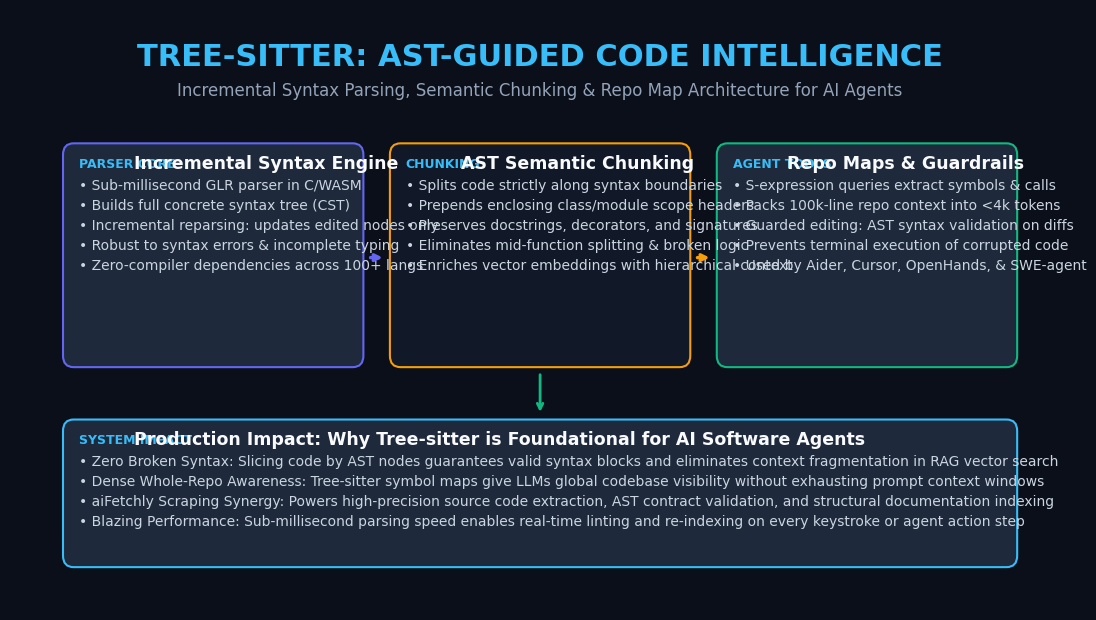
The Problem: The Syntax Destruction and Context Blindness of Naive Code Chunking
In modern autonomous software engineering, intelligent developer copilots, and repository-scale data extraction pipelines like AiFetchly, foundation models are increasingly tasked with ingesting, indexing, and refactoring large multi-file codebases.
However, standard Retrieval-Augmented Generation (RAG) and document chunking systems were originally designed for natural language prose. When naive text splitters (such as character-count slicing, token windowing with fixed overlaps, or line-count splitters) are applied to programming languages, they trigger three catastrophic failure modes:
The Naive Code Chunking Failure Cascade:
Source Code (user_service.py):
class UserService:
    def authenticate(self, username, password):
        # 40 lines of cryptographic hashing & auth logic
        ...
        return token

    def revoke_session(self, token_id):
        ...
  │
  ▼ (Naive Token Splitter: 512 tokens with 50-token overlap)
┌────────────────────────────────────────────────────────┐
│ Chunk A: Slices midway through `authenticate`!         │
│ ❌ Missing closing brackets and return statement       │
│ ❌ Invalid syntax: Fails Python interpreter parsing     │
├────────────────────────────────────────────────────────┤
│ Chunk B: Contains second half of `authenticate`        │
│ ❌ Separated from `class UserService` header           │
│ ❌ Vector embedding has zero idea what class it belongs to!│
└────────────────────────────────────────────────────────┘
Result: Fractured vector embeddings, broken context, and hallucinated code fixes! 1. The Mid-Function Slicing Disaster of Naive Token Chunkers
Standard RAG pipelines slice text at arbitrary token limits (e.g., every 512 tokens). In source code:
- A token cut frequently falls directly inside an
if-elsebranch, a database transaction block, or a complex arithmetic formula. - Neither Chunk A nor Chunk B constitutes valid, compilable code.
- When an AI agent retrieves Chunk B, the model is deprived of variable definitions, parameter type hints, and function docstrings initialized earlier in the function body.
2. Disconnected Scope and Parent Class Blindness
Object-oriented and modular programming structures rely heavily on lexical scope:
- A method like
def execute(self)derives its semantics entirely from its enclosing class (e.g.,class PaymentProcessorvs.class OrderCancellationJob). - Naive chunking isolates the method body, severing it from class-level attributes, decorators (
@retry,@transaction.atomic), and module-level imports. - Vector embedding models embed Chunk B as generic execution logic, resulting in poor retrieval relevance when developers query for payment processing routines.
3. Context Window Saturation vs. Whole-Repository Awareness
Autonomous coding agents (such as Aider, OpenHands, or SWE-agent) must understand relationships across dozens of files to resolve dependencies, API calls, and shared types.
- Stuffing raw full-text files into the context window rapidly saturates token budgets, inflates LLM costs, and induces attention degradation (“Lost in the Middle”).
- Naive keyword search (grep/BM25) misses semantic symbol definitions, call hierarchies, and inheritance chains.
Engineering teams needed a parser that could comprehend code syntax in real time, extract structural hierarchies, and chunk code strictly along semantic syntactic boundaries.
The Solution: Tree-sitter System Architecture & Incremental Parsing
Originally developed for the Atom text editor and now the universal parsing engine behind Neovim, GitHub code navigation, Cursor, and modern AI coding agents, Tree-sitter is an open-source, incremental parsing framework.
Unlike traditional compilers (like gcc, clang, or javac) that require complex build environments and complete project compilation, Tree-sitter operates directly on raw source strings with three core superpowers:
The Tree-sitter Architecture Pipeline:
Source Code (Python, Rust, TS, Go)
  │
  ▼
┌────────────────────────────────────────────────────────┐
│ Tree-sitter GLR Incremental Parser Engine (C / WASM)   │
│ • Sub-millisecond parsing speed (<1ms per file)        │
│ • Resilient Error Recovery: Tolerates incomplete syntax│
│ • Emits Concrete Syntax Tree (CST) & AST               │
└────────────────────────────────────────────────────────┘
  │
  ├─► [ AST-Guided Semantic Chunking ]
  │   └── Chunks along function, class, and method nodes
  │       with parent scope headers prepended
  │
  ├─► [ S-Expression Pattern Queries ]
  │   └── Extracts symbols, function calls, and signatures
  │
  └─► [ Whole-Repo Map Generator ]
└── Packs 100k lines of repo symbols into <4k tokens 1. The Concrete Syntax Tree (CST) and GLR Incremental Parsing Engine
Tree-sitter uses a Generalized LR (GLR) parsing algorithm implemented in pure C:
- Concrete Syntax Trees (CST): Unlike minimal abstract syntax trees that discard whitespace and comments, Tree-sitter preserves every character, keyword, and docstring, enabling exact character-level roundtrips and accurate source slicing.
- Incremental Re-parsing: When an AI agent or developer modifies a 10,000-line file, Tree-sitter does not re-parse the entire file. It re-parses only the modified syntax nodes, updating the tree in microseconds (sub-1ms).
- Error Tolerance: If code has syntax errors (e.g., an unclosed bracket during active generation), Tree-sitter localizes the error to a single
ERRORnode while continuing to parse the rest of the file cleanly.
2. Tree-sitter S-Expression Pattern Queries
Tree-sitter provides a domain-specific query language based on S-expressions:
(function_definition
  name: (identifier) @function.name
  parameters: (parameters) @function.params
body: (block) @function.body) This pattern matcher searches AST nodes directly, allowing AI systems to extract all function definitions, class names, export signatures, and imports across any language with a single declarative query.
3. Polyglot Zero-Dependency Uniformity via C & WASM Runtimes
Tree-sitter decouples language grammars from host applications:
- Over 100 standardized language grammars exist (Python, TypeScript, Rust, Go, Java, C++, Ruby, SQL).
- Runtimes exist for Python (
py-tree-sitter), Node.js, Rust, Go, and WebAssembly (WASM), allowing tools like AiFetchly to parse and index code directly in local desktop applications or serverless workers.
Deep Dive: AST-Guided Semantic Chunking & Repo Map Construction
Understanding how Tree-sitter transforms coding agents requires looking at two critical mechanics: Scope-Aware Semantic Chunking and Repo Map Construction.
AST-Guided Semantic Chunking Transformation:
AST Node: `class PaymentGateway` (Lines 10..120)
  │
  ├── Child Node: `def charge(self, amount, token)` (Lines 15..55)
  │   ▼
  │   [ Semantic Chunk #1 ]
  │   Header Context: "class PaymentGateway:"
  │   Chunk Body: def charge(self, amount, token)... [Lines 15..55]
  │
  └── Child Node: `def refund(self, charge_id)` (Lines 60..110)
      ▼
      [ Semantic Chunk #2 ]
      Header Context: "class PaymentGateway:"
      Chunk Body: def refund(self, charge_id)... [Lines 60..110]

Outcome: Every chunk is 100% syntactically valid with full lexical scope preserved! 1. Scope-Aware Semantic Chunking Algorithm
Rather than splitting on character counts:
- The chunker parses the file into a Tree-sitter CST.
- It traverses top-level declaration nodes:
class_definition,function_definition,interface_declaration. - If a node exceeds the maximum chunk size (e.g., 512 tokens), the chunker recurses into its child method nodes.
- Crucially, the chunker prepends the parent scope signature (e.g.,
class PaymentGateway:) to the child chunk. - In vector databases, this ensures embeddings capture both the specific logic and its structural namespace.
2. Whole-Repository Map Generation via Tag Queries
Pioneered in autonomous coding agents like Aider and OpenHands, the Repo Map provides the LLM with a structural overview of an entire repository:
- Tree-sitter queries extract all defined classes, methods, function signatures, and exported types across all files.
- A graph algorithm (e.g., PageRank on symbol references) ranks the most important architectural symbols.
- The system formats this outline into a concise Markdown code outline (e.g., 3,000 tokens for a 150-file repository).
- The LLM can navigate the codebase, understand where functions live, and plan multi-file refactors without ever reading the full source files into context!
Capability Comparison: Naive vs. Regex vs. Tree-sitter AST
The table below contrasts code processing approaches across key engineering dimensions:
| Capability / Metric | Naive Character/Token Splitter | Heuristic Regex Matcher | Tree-sitter AST Semantic Chunker |
|---|---|---|---|
| Syntactic Integrity | ❌ Slices functions midway | ⚠️ Fragile on multiline syntax | 100% Guaranteed Valid Nodes |
| Parent Scope Preservation | ❌ None (Lost context) | ❌ Complex and prone to false positives | Automatic Hierarchical Prepending |
| Tolerance to Syntax Errors | N/A (Plain text) | N/A | Graceful Recovery via ERROR Nodes |
| Parsing Speed | Fast (~0.1ms) | Moderate (~2ms) | Extremely Fast (<1ms via C/WASM) |
| Language Coverage | Universal (Text-only) | Per-language custom regex | 100+ Pre-built Formal Grammars |
| Query Mechanism | None | Regex capturing groups | Structured S-Expression AST Queries |
| Repo Map Extraction | Impossible | Incomplete and brittle | Deterministic Symbol & Call Graphs |
| Code Diff Validation | None | None | AST Diff Syntax Verification |
Practical Implementation: Building an AST-Aware Code Chunker in Python
Let us build an AST-aware semantic code chunker using the official tree-sitter and tree-sitter-python Python packages.
Step 1: Install Dependencies
pip install tree-sitter tree-sitter-python Step 2: Implement AST Semantic Chunking with Scope Prepending
Save the following implementation as ast_chunker.py:
import tree_sitter_python as tspython
from tree_sitter import Language, Parser, Node

class ASTCodeChunker:
    def __init__(self):
        """
        Initializes the Tree-sitter parser with the Python grammar.
        """
        self.language = Language(tspython.language())
        self.parser = Parser(self.language)

    def chunk_python_source(self, code_bytes: bytes, max_lines: int = 40) -> list[dict]:
        """
        Splits Python source code into semantically valid AST chunks,
        attaching enclosing class scope to standalone methods.
        """
        tree = self.parser.parse(code_bytes)
        root_node = tree.root_node
        chunks = []

        for node in root_node.children:
            if node.type == "class_definition":
                class_name_node = node.child_by_field_name("name")
                class_name = class_name_node.text.decode("utf-8") if class_name_node else "UnknownClass"
                scope_header = f"# Enclosing Scope: class {class_name}\n"

                # Check if entire class fits within line budget
                start_line, end_line = node.start_point.row, node.end_point.row
                if (end_line - start_line) <= max_lines:
                    chunks.append({
                        "type": "class",
                        "name": class_name,
                        "code": code_bytes[node.start_byte:node.end_byte].decode("utf-8"),
                        "lines": (start_line + 1, end_line + 1)
                    })
                else:
                    # Class is large: chunk methods individually with scope header
                    body_node = node.child_by_field_name("body")
                    if body_node:
                        for method_node in body_node.children:
                            if method_node.type == "function_definition":
                                method_name_node = method_node.child_by_field_name("name")
                                method_name = method_name_node.text.decode("utf-8") if method_name_node else "method"
                                method_text = code_bytes[method_node.start_byte:method_node.end_byte].decode("utf-8")

                                chunks.append({
                                    "type": "method",
                                    "name": f"{class_name}.{method_name}",
                                    "code": scope_header + method_text,
                                    "lines": (method_node.start_point.row + 1, method_node.end_point.row + 1)
                                })
            elif node.type == "function_definition":
                func_name_node = node.child_by_field_name("name")
                func_name = func_name_node.text.decode("utf-8") if func_name_node else "function"
                chunks.append({
                    "type": "function",
                    "name": func_name,
                    "code": code_bytes[node.start_byte:node.end_byte].decode("utf-8"),
                    "lines": (node.start_point.row + 1, node.end_point.row + 1)
                })

        return chunks

if __name__ == "__main__":
    sample_code = b"""
import os
import hashlib

class AuthenticationService:
    def __init__(self, secret_key: str):
        self.secret_key = secret_key

    def verify_token(self, token: str) -> bool:
        # Validate JWT cryptographic signature
        if not token:
            return False
        return hashlib.sha256(token.encode()).hexdigest() == self.secret_key

def standalone_helper():
    return "ready"
"""
    chunker = ASTCodeChunker()
    chunks = chunker.chunk_python_source(sample_code, max_lines=6)

    print(f"Total Semantic Chunks Produced: {len(chunks)}\n")
    for i, c in enumerate(chunks):
        print(f"--- [Chunk {i+1}: {c['type'].upper()} '{c['name']}'] (Lines {c['lines'][0]}-{c['lines'][1]}) ---")
        print(c["code"].strip())
print() Step 3: Implement AST-Guarded Code Diff Validation
Autonomous agents often generate unified diffs or replacement blocks that contain syntax errors. By validating the modified code with Tree-sitter before executing terminal commands or committing to git, agents can auto-correct syntax errors:
def validate_syntax(code_bytes: bytes, parser: Parser) -> bool:
    """
    Returns True if the code parses without any Tree-sitter ERROR nodes.
    """
    tree = parser.parse(code_bytes)
    def has_error_node(node: Node) -> bool:
        if node.type == "ERROR" or node.is_missing:
            return True
        for child in node.children:
            if has_error_node(child):
                return True
        return False
return not has_error_node(tree.root_node) Production Best Practices: Integrating Tree-sitter into aiFetchly & Agent Pipelines
When deploying Tree-sitter within autonomous data fetching, code generation, and developer agent workflows in AiFetchly, follow these production best practices:
1. Prepending Enclosing Scope and Type Declarations
Never store isolated methods in vector stores without lexical context. Always prepend the class definition header, docstrings, and decorator annotations to each child method chunk so that semantic embeddings retain full scope information.
2. Incremental Cache Invalidation on Live File Edits
Take advantage of Tree-sitter’s incremental re-parsing. When an agent updates a 20-line method in a 2,000-line file, compute the tree delta to re-embed only the modified chunk, saving GPU embedding compute and database writes.
3. Guarding LLM Code Edits Before Terminal Execution
In autonomous agent loops (like OpenHands or Aider), always run a Tree-sitter syntax check on LLM code proposals before running bash test suites. If an ERROR node is detected, feed the syntax error coordinates directly back to the model for instant self-correction.