Tree of Thoughts: Deliberate LLM Problem Solving Guide
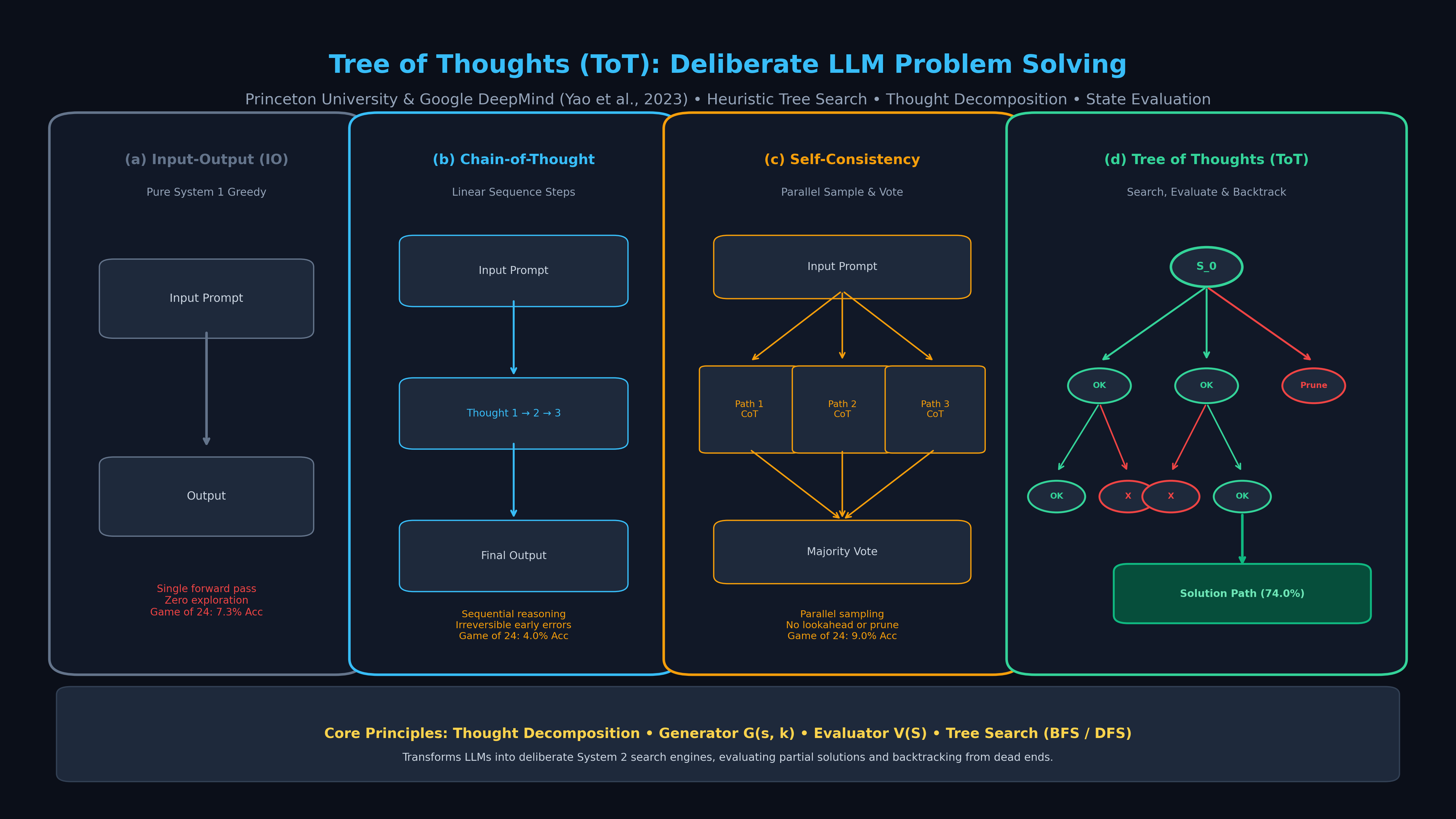
The Problem: The Linear Trap of Autoregressive Generation and Chain-of-Thought
In cognitive psychology, human decision-making is famously characterized by Daniel Kahneman’s dual-process theory:
- System 1: Fast, instinctive, automatic, and associative thinking (e.g., answering “What is 2 + 2?” or completing a common proverb).
- System 2: Slow, deliberate, logical, and computational thinking (e.g., planning chess moves, solving non-trivial mathematical proofs, or refactoring complex software architectures).
In modern generative AI platforms, autonomous data extraction pipelines, and automated research workflows like AiFetchly, deploying Large Language Models (LLMs) on non-trivial problems has historically run into an intractable barrier: standard language models operate strictly as System 1 engines.
The Failure of Autoregressive Greediness and Linear CoT
Whether using standard Input-Output (IO) prompting or Chain-of-Thought (CoT) prompting (Wei et al., 2022), Large Language Models generate text one token at a time in strict left-to-right chronological order:
$$P(y_1, y_2, \dots, y_T \mid x) = \prod_{t=1}^T P(y_t \mid x, y_{<t})$$
While linear Chain-of-Thought prompts the model to generate intermediate rationales (“Let’s think step by step”), it remains trapped within a rigid, sequential trajectory:
The Linear Trapping Dilemma:
Prompt ──► Step 1 (Suboptimal Choice) ──► Step 2 ──► Step 3 ──► Dead End!
                                                                  │
                                                                  ▼
                                                      Cascading Hallucination
(Model forces a fake answer) This linear paradigm imposes three fatal failure modes on complex tasks:
- Irreversible Early Commitments: If the model selects a suboptimal intermediate reasoning path at Step 1, all subsequent steps inherit and compound the error. The model cannot stop, recognize that its calculation is doomed, and revert back.
- Cascading Hallucination: When an autoregressive model hits a logical dead-end, it cannot admit defeat. Instead, it confabulates false arithmetic conversions or invented facts to force an answer that syntactically matches the prompt format.
- Zero Lookahead and Tree Exploration: In combinatorial puzzles, planning problems, or multi-constraint extractions, finding a solution requires evaluating alternative hypotheses, testing multiple branches in parallel, and pruning unviable paths. Linear CoT has no mechanism to compare two alternative intermediate choices.
The Benchmark Collapse: The Game of 24
The severity of this limitation is demonstrated on the classic Game of 24 (given 4 numbers, use basic arithmetic operations $+,-,\times,/$ to make 24):
- GPT-4 with standard Input-Output (IO) prompting: Achieves only 7.3% accuracy.
- GPT-4 with Chain-of-Thought (CoT) prompting: Fails equally, achieving only 4.0% accuracy.
- Even with Self-Consistency (CoT-SC) over 100 sampled independent paths, accuracy barely reaches 9.0%.
Linear models fail because finding a solution requires forward search and backtracking—capabilities fundamentally missing from autoregressive generation.
The Architecture: The Four Core Modalities of Tree of Thoughts
To bridge the gap between fast associative generation and deliberate heuristic search, researchers from Princeton University and Google DeepMind introduced Tree of Thoughts: Deliberate Problem Solving with Large Language Models (Yao et al., 2023 / NeurIPS 2023 / arXiv:2305.10601).
Tree of Thoughts (ToT) formalizes LLM reasoning as an explicit search over a tree of states, where each node represents a partial solution (a “thought”):
The Four Foundational Modalities of Tree of Thoughts:
┌─────────────────────────────────────────────────────────────────────────────┐
│ 1. Thought Decomposition                                                    │
│    • Partitions complex problems into discrete, meaningful semantic units   │
│    • Examples: An equation step, a paragraph outline, a 5-letter word guess │
├─────────────────────────────────────────────────────────────────────────────┤
│ 2. Thought Generator: G(p_θ, s, k)                                          │
│    • Sample Strategy: Samples k i.i.d. candidate thoughts using temperature │
│    • Propose Strategy: Proposes k distinct thoughts in a single prompt      │
├─────────────────────────────────────────────────────────────────────────────┤
│ 3. State Evaluator: V(p_θ, S)                                               │
│    • Value Heuristic: Evaluates state viability (sure / likely / impossible)│
│    • Vote Heuristic: Compares multiple states and votes on the best branch  │
├─────────────────────────────────────────────────────────────────────────────┤
│ 4. Search Algorithm                                                         │
│    • Breadth-First Search (BFS): Level-by-level exploration with top-b beam │
│    • Depth-First Search (DFS): Deep path exploration with backtracking      │
└─────────────────────────────────────────────────────────────────────────────┘ 1. Thought Decomposition
The first step in applying ToT is defining what constitutes a single intermediate “thought”. The granularity must be neither too fine (e.g., individual tokens) nor too coarse (e.g., an entire final essay):
- In Game of 24: A thought is an intermediate arithmetic equation combining two numbers (e.g., $13 - 9 = 4$, leaving $[4, 4, 10]$).
- In Creative Writing: A thought is a high-level 1-sentence outline for one of four paragraphs.
- In Crosswords: A thought is a candidate 5-letter word proposal for a specific grid slot.
2. The Thought Generator: $G(p_\theta, s, k)$
Given a current state $s = [x, z_{1 \dots i}]$, the generator proposes $k$ candidate next thoughts $z_{i+1}$:
- Sample Strategy: Call the LLM $k$ times independently with high temperature ($T = 0.7$). Effective when thoughts are rich, diverse paragraphs.
- Propose Strategy: Prompt the LLM once to generate $k$ distinct, non-overlapping candidate thoughts in a single response. Effective when thoughts are short, constrained choices, preventing redundant exploration of identical branches.
3. The State Evaluator: $V(p_\theta, S)$
Evaluating intermediate states without ground truth is the central engine of ToT:
- Value Heuristic: The model acts as an internal heuristic critic, classifying each state into qualitative tiers:
sure(guaranteed solution path),likely(promising, worth exploring), orimpossible(mathematical or logical dead-end). - Vote Heuristic: When absolute scoring is difficult, the evaluator presents multiple competing states to the LLM simultaneously and asks: “Which of these candidate partial states is most promising to explore next?“
4. The Search Algorithm
To navigate the tree, ToT implements classical computer science search algorithms:
- Breadth-First Search (BFS): Maintains a beam of the top-$b$ most promising states at each depth level. Ideal when tree depth is shallow and known in advance (e.g., Game of 24 with depth 3).
- Depth-First Search (DFS): Explores the highest-scoring branch first. If the state evaluation drops below a pruning threshold ($V(s) \le \text{threshold}$), the algorithm halts exploration along that subtree, prunes the dead end, and backtracks to the parent node to evaluate the next alternative.
Algorithmic Mechanics: BFS Beam Search vs. DFS Backtracking in Practice
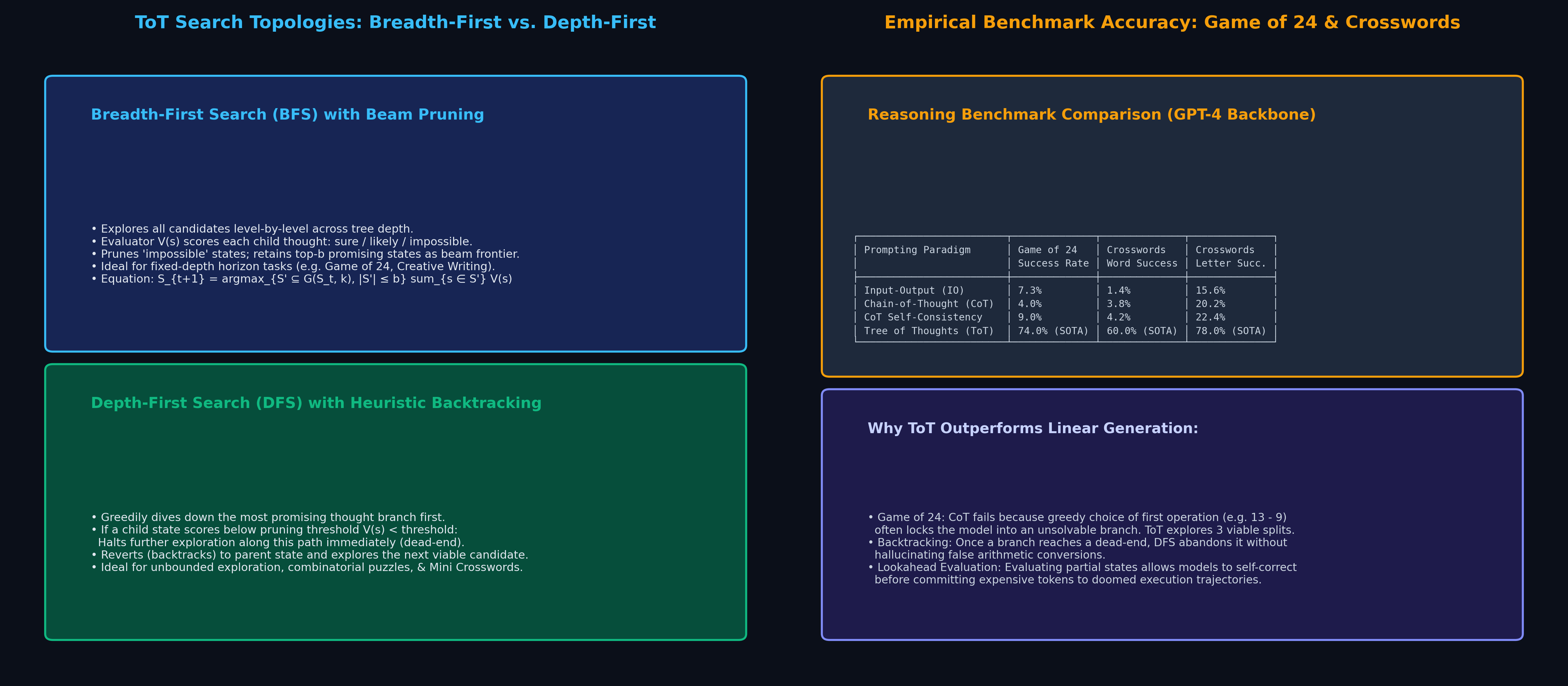
To understand how ToT transforms reasoning in practice, consider a concrete step-by-step trace on the Game of 24 using BFS beam search ($b = 5, k = 5$):
Step-by-Step Walkthrough: Game of 24
Input Numbers: 4 9 10 13 (Target: 24)
Depth 1: Proposing and Evaluating Initial Operations The generator proposes pairs from the 4 input numbers:
- $13 - 9 = 4$ (Remaining:
4, 4, 10) $\to$ Evaluator:likely(Score: 0.8) - $10 - 4 = 6$ (Remaining:
6, 9, 13) $\to$ Evaluator:likely(Score: 0.7) - $13 \times 10 = 130$ (Remaining:
4, 9, 130) $\to$ Evaluator:impossible(Numbers grow too large) - $9 \times 4 = 36$ (Remaining:
10, 13, 36) $\to$ Evaluator:impossible
Search Decision: The BFS beam immediately prunes Candidates 3 and 4, completely avoiding wasted token generation on hopeless mathematical paths. Candidates 1 and 2 are retained in the beam frontier.
Depth 2: Expanding the Best Frontier
From Candidate 1 (4, 4, 10):
- Candidate 1a: $10 - 4 = 6$ (Remaining:
4, 6) $\to$ Evaluator:sure(Score: 1.0) - Candidate 1b: $4 + 4 = 8$ (Remaining:
8, 10) $\to$ Evaluator:likely(Score: 0.5)
Depth 3: Terminal Verification
From Candidate 1a (4, 6):
- Final Candidate: $4 \times 6 = 24$ (Remaining:
24) - Solution Path Discovered: $$(13 - 9) = 4 \implies 10 - 4 = 6 \implies 4 \times 6 = 24$$
Mathematically, the BFS frontier update at each depth step $t$ is expressed as:
$$S_{t+1} \in \operatorname*{argmax}{S’ \subseteq G(S_t, k), , |S’| \le b} \sum{s’ \in S’} V(s’)$$
End-to-End Implementation: Building a Production Tree-of-Thoughts Engine in Python
The following modular Python framework implements a production-grade Tree of Thoughts engine supporting both Breadth-First Search (BFS) and Depth-First Search (DFS) with backtracking:
import math
from typing import List, Dict, Any, Optional

class ToTNode:
    def __init__(self, state: Any, parent: Optional['ToTNode'] = None, thought: str = ""):
        self.state = state          # e.g., current remaining numbers or partial plan
        self.parent = parent        # pointer to parent node for backtracking
        self.thought = thought      # the text action that led to this state
        self.children: List['ToTNode'] = []
        self.value: float = 0.0     # heuristic evaluation score [0.0, 1.0]

    def get_path(self) -> List[str]:
        """Backtracks from current node to root to reconstruct solution chain."""
        path = []
        curr = self
        while curr.parent is not None:
            path.append(curr.thought)
            curr = curr.parent
        return path[::-1]

class TreeOfThoughtsEngine:
    def __init__(self, generator_fn, evaluator_fn, is_terminal_fn):
        self.generator = generator_fn       # G(state) -> List[Tuple[new_state, thought_str]]
        self.evaluator = evaluator_fn       # V(state) -> float score [0.0, 1.0]
        self.is_terminal = is_terminal_fn   # is_terminal(state) -> bool

    def solve_bfs(self, initial_state: Any, beam_width: int = 3, max_depth: int = 4) -> Optional[List[str]]:
        """Breadth-First Search with Beam Pruning."""
        root = ToTNode(state=initial_state)
        beam: List[ToTNode] = [root]

        for depth in range(max_depth):
            candidate_children: List[ToTNode] = []

            for parent_node in beam:
                # 1. Check if parent already satisfies terminal goal
                if self.is_terminal(parent_node.state):
                    return parent_node.get_path()

                # 2. Generate child thoughts
                proposals = self.generator(parent_node.state)
                for new_state, thought in proposals:
                    child = ToTNode(state=new_state, parent=parent_node, thought=thought)
                    # 3. Evaluate heuristic state quality
                    child.value = self.evaluator(child.state)
                    # Prune immediately if deemed impossible
                    if child.value > 0.0:
                        candidate_children.append(child)
                        parent_node.children.append(child)

            if not candidate_children:
                print(f"BFS: All branches pruned at depth {depth}.")
                return None

            # 4. Retain top-b most promising states for next depth beam
            candidate_children.sort(key=lambda node: node.value, reverse=True)
            beam = candidate_children[:beam_width]

        # Final check across remaining leaf beam nodes
        for node in beam:
            if self.is_terminal(node.state):
                return node.get_path()
        return None

    def solve_dfs(self, initial_state: Any, pruning_threshold: float = 0.2, max_depth: int = 5) -> Optional[List[str]]:
        """Depth-First Search with Heuristic Backtracking."""
        root = ToTNode(state=initial_state)
        stack: List[tuple[ToTNode, int]] = [(root, 0)]

        while stack:
            curr_node, depth = stack.pop()

            if self.is_terminal(curr_node.state):
                return curr_node.get_path()

            if depth >= max_depth:
                continue

            # Generate child thoughts
            proposals = self.generator(curr_node.state)
            valid_children = []
            for new_state, thought in proposals:
                child = ToTNode(state=new_state, parent=curr_node, thought=thought)
                child.value = self.evaluator(child.state)
                # Heuristic pruning gate: only explore if above threshold
                if child.value >= pruning_threshold:
                    valid_children.append(child)

            # Sort so highest-value nodes are popped and explored first
            valid_children.sort(key=lambda n: n.value)
            for child in valid_children:
                stack.append((child, depth + 1))

        return None

# Example Run: Solving Game of 24 with Mock Logic Engine
def mock_generator(numbers: List[int]):
    proposals = []
    for i in range(len(numbers)):
        for j in range(len(numbers)):
            if i != j:
                a, b = numbers[i], numbers[j]
                rem = [numbers[k] for k in range(len(numbers)) if k != i and k != j]
                # Addition
                proposals.append((rem + [a + b], f"{a} + {b} = {a+b}"))
                # Multiplication
                proposals.append((rem + [a * b], f"{a} * {b} = {a*b}"))
                # Subtraction
                if a >= b:
                    proposals.append((rem + [a - b], f"{a} - {b} = {a-b}"))
                # Division
                if b != 0 and a % b == 0:
                    proposals.append((rem + [a // b], f"{a} / {b} = {a//b}"))
    return proposals

def mock_evaluator(numbers: List[int]) -> float:
    # Heuristic scoring: return 1.0 if 24 reached, higher if numbers close to 24
    if 24 in numbers and len(numbers) == 1:
        return 1.0
    if any(n > 100 for n in numbers):
        return 0.0 # Prune huge numbers
    return 0.5

def mock_is_terminal(numbers: List[int]) -> bool:
    return len(numbers) == 1 and numbers[0] == 24

engine = TreeOfThoughtsEngine(mock_generator, mock_evaluator, mock_is_terminal)
solution = engine.solve_bfs(initial_state=[4, 9, 10, 13], beam_width=5)
print("Tree of Thoughts Discovered Solution Path:")
for step in solution:
print(f" -> {step}") Empirical Benchmarks: ToT vs. IO, CoT, and Self-Consistency
Across demanding mathematical, linguistic, and combinatorial tasks, Tree of Thoughts demonstrates dramatic performance gains over sequential prompting:
Performance Comparison (GPT-4 Backbone):
┌──────────────────────────────┬──────────────┬──────────────┬──────────────┬──────────────────┐
│ Benchmark Task               │ Input-Output │ Chain-of-    │ CoT Self-    │ Tree of Thoughts │
│                              │ (IO Baseline)│ Thought (CoT)│ Consistency  │ (ToT Framework)  │
├──────────────────────────────┼──────────────┼──────────────┼──────────────┼──────────────────┤
│ Game of 24 (Success Rate)    │ 7.3%         │ 4.0%         │ 9.0% (k=100) │ 74.0% (b=5, SOTA)│
│ Mini Crosswords (Word Succ.) │ 1.4%         │ 3.8%         │ 4.2%         │ 60.0% (SOTA)     │
│ Mini Crosswords (Letter Acc.)│ 15.6%        │ 20.2%        │ 22.4%        │ 78.0% (SOTA)     │
│ Creative Writing (Coherence) │ 6.1 / 10     │ 6.9 / 10     │ 7.0 / 10     │ 7.56 / 10 (SOTA) │
└──────────────────────────────┴──────────────┴──────────────┴──────────────┴──────────────────┘ Key empirical insights:
- Massive Mathematical Leap: On Game of 24, ToT elevates GPT-4 from an abysmal 4% to 74%—an 18.5x improvement.
- Combinatorial Pruning Efficiency: On 5x5 Mini Crosswords, word success jumps from 3.8% to 60.0%. DFS backtracking allows the model to test 5-letter candidates across intersecting down/across clues, discarding conflicts before filling the entire grid.
- Token Economy: While ToT explores multiple branches, its heuristic pruning eliminates dead ends early. Consequently, ToT typically uses fewer total tokens than brute-force Best-of-100 self-consistency sampling while delivering vastly superior accuracy.
Production Best Practices: Integrating ToT in Enterprise Agentic Workflows
Deploying Tree of Thoughts in production architectures requires balancing latency, token expenses, and search depth:
1. Leverage Prefix Caching for Tree Branches
In tree search, multiple candidate nodes share identical parent prompt prefixes:
- When using high-performance serving runtimes (such as vLLM or SGLang with RadixAttention), ensure automatic prefix caching is enabled.
- Reusing the pre-computed Key-Value (KV) cache of parent nodes slashes prefill latency by up to 80%, making multi-branch tree exploration nearly as fast as linear generation.
2. Combine Neural Evaluators with Deterministic Verifiers
Do not rely purely on LLM heuristic evaluation when deterministic checks exist:
- In SQL query synthesis or code refactoring, execute generated thoughts inside an isolated sandbox. If code fails a unit test or throws a syntax error, assign $V(s) = 0.0$ immediately and backtrack.
- In financial extraction pipelines (like aiFetchly), verify whether extracted balance sheet row sums equal total assets before expanding downstream nodes.
3. Tree of Thoughts vs. Test-Time Reasoning Foundation Models (o1 / R1)
In late 2024 and 2025, frontier labs introduced native reasoning models (such as OpenAI o1/o3 and DeepSeek-R1) that generate internal reasoning tokens via reinforcement learning:
- When to use Native Reasoning Models: Ideal for standalone single-turn mathematical and coding questions where the model can execute its internal thinking trace end-to-end.
- When to use Tree of Thoughts Frameworks: Indispensable when reasoning requires external tool calls, sandbox execution feedback, database queries, and human-in-the-loop checkpoints that cannot be contained within an internal closed model context.
By replacing greedy left-to-right decoding with deliberate state decomposition, heuristic lookahead evaluation, and tree search with backtracking, Tree of Thoughts unlocks the true reasoning potential of foundation models across complex enterprise domains.