Meta Transfusion Guide: Unified Token & Diffusion Models
The Problem: The Great Architectural Schism in Multimodal Artificial Intelligence
In modern enterprise automation, automated web data extraction, and autonomous multimodal research copilots powered by AiFetchly, foundation models are increasingly tasked with operating across heterogeneous modalities. Autonomous software agents no longer ingest sterile, plain text files. Real-world business artifacts—such as e-commerce storefronts, financial balance sheets, architectural schematics, patent filings, and user interface layouts—are deeply and inextricably multimodal.
To understand and generate these complex artifacts, artificial intelligence systems require two core capabilities:
- Linguistic Reasoning: Comprehending subtle narrative nuance, parsing structured code, and executing deductive logic.
- Visual Synthesis & Perception: Perceiving continuous geometric details, understanding complex diagrams, and generating high-fidelity visual diagrams or charts.
However, despite rapid advancements in generative AI, the machine learning community has historically been fractured by a fundamental architectural divide: the modality incompatibility between language modeling and visual diffusion.
The Fundamental Multimodal Modeling Divide:
┌─────────────────────────────────────────────────────────────────┐
│ Modality 1: Natural Language (Discrete Symbolic Tokens)        │
│ • Data Structure: Sequence of categorical token indices         │
│ • Loss Objective: Cross-Entropy Next-Token Prediction           │
│ • Attention Structure: Strictly Causal Masking (Left-to-Right)  │
│ ❌ Fails on continuous high-dimensional signals like images!   │
├─────────────────────────────────────────────────────────────────┤
│ Modality 2: Visual Media (Continuous Spatial Pixels)            │
│ • Data Structure: Real-valued tensor patches in continuous R^D  │
│ • Loss Objective: Denoising Mean-Squared Error / Flow Matching  │
│ • Attention Structure: Full Bidirectional 2D Spatial Attention  │
│ ❌ Fails on discrete categorical symbols like vocabulary words!│
└─────────────────────────────────────────────────────────────────┘
Result: AI systems were forced into compromised, Frankenstein architectures! 1. The Flaws of Late-Fusion Cross-Attention Adapters
During the early multimodal wave, engineering teams instinctively adopted late-fusion architectures (such as LLaVA, Flamingo, BLIP-2, and standard closed API wrappers):
- Frozen Unimodal Silos: A pre-trained visual encoder (such as OpenAI CLIP or SigLIP) processes input pixels into continuous visual feature vectors. A projection adapter projects these vectors into the embedding space of a frozen or fine-tuned language model.
- Asymmetric One-Way Perception: Late-fusion models can ingest images to generate text, but their language backbone cannot natively output pixels. If the agent must produce an illustrative diagram, it must make an external API call to a separate, disconnected diffusion model (such as Stable Diffusion or Flux).
- The Context Disconnect: The downstream diffusion model has zero visibility into the language model’s hidden chain-of-thought activations. It receives only a short text prompt string, resulting in severe prompt neglect, missing spatial constraints, and inconsistent visual branding.
2. The Quantization Disaster of Discrete Visual Codebooks (Chameleon & VQ-VAE)
To create a truly unified model capable of both understanding and generating interleaved text and images, earlier research explored early-fusion discrete tokenization (pioneered by DALL-E 1, Parti, and Meta Chameleon):
- Discrete Palette Bottleneck: A vector-quantized autoencoder (VQ-VAE or VQ-GAN) compresses an image into a discrete grid of codebook indices (e.g., 1,024 discrete tokens drawn from an 8,192-word codebook).
- Catastrophic Visual Degradation: Quantizing continuous color gradients, subtle lighting, and high-frequency textures into discrete integer tokens destroys photo fidelity. Images generated by discrete codebook models exhibit blurry textures, grid artifacts, and unnatural facial features.
- Sequence Length Explosion: Representing a single standard 512×512 image requires 1,024 sequence tokens. An agent attempting to generate a 3-page research briefing with four inline diagrams exhausts its entire context window on empty visual indices, causing severe Key-Value (KV) cache memory bloat and astronomical latency.
- High Compute Barrier: Training discrete language models over image tokens requires massive compute. Models like Chameleon required immense pre-training budgets just to reach modest image generation quality.
The Solution: Meta Transfusion (Unified Token Prediction & Continuous Diffusion)
To dismantle this artificial boundary, researchers at Meta FAIR (Chunting Zhou, Lili Yu, Arun Babu, Kushal Tirumala, Michihiro Yasunaga, Leonid Shamis, Jacob Kahn, Xuezhe Ma, Luke Zettlemoyer, and Omer Levy; ICLR 2025) introduced Transfusion.
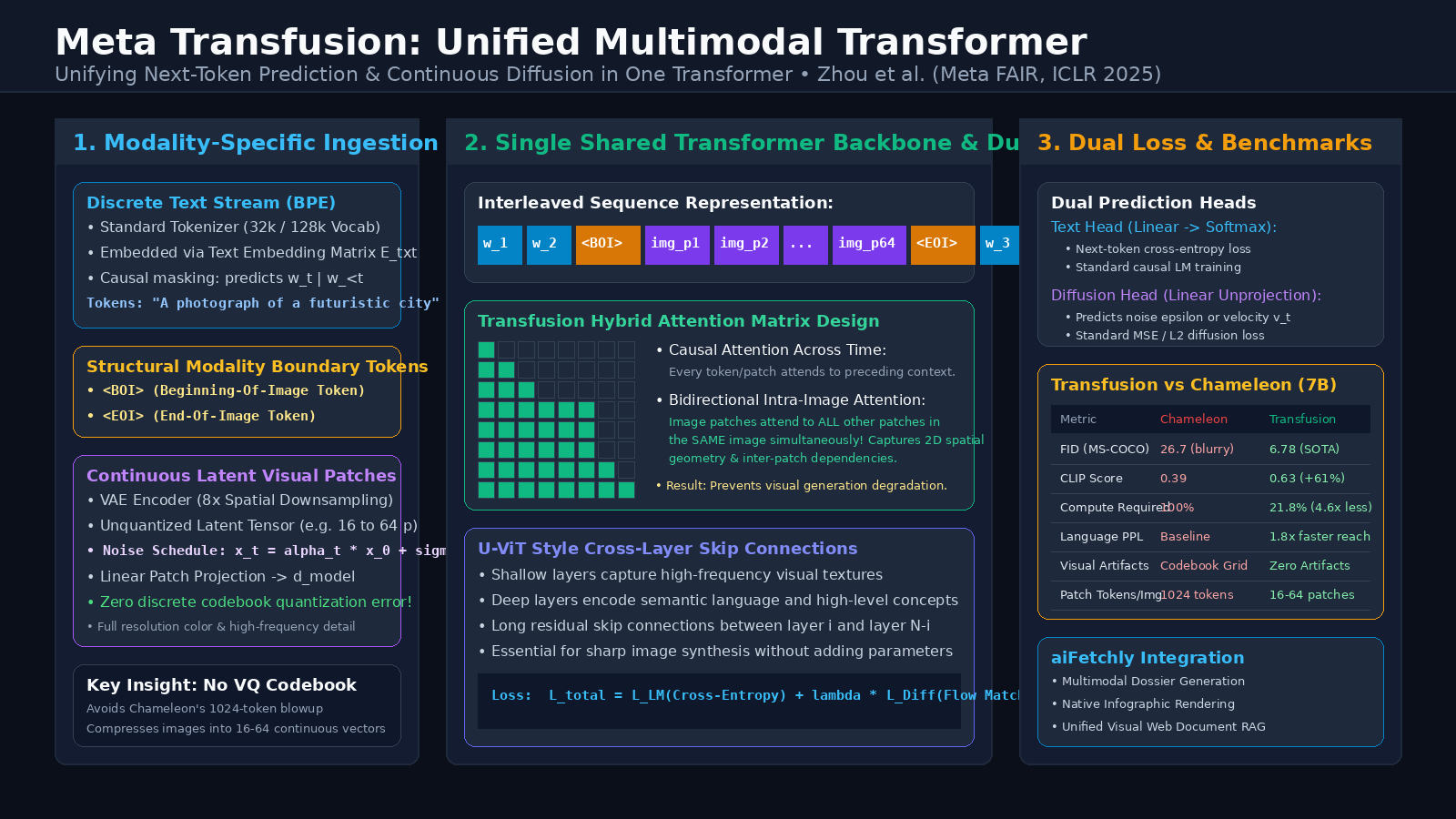
Transfusion provides an elegant, theoretically sound recipe: train a single transformer backbone on both discrete text tokens and continuous image representations, using the native loss function and attention mechanism best suited for each modality.
Instead of forcing continuous images into discrete tokens or stitching separate neural networks together, Transfusion processes mixed-modality sequences within a single unified parameter space:
The Unified Transfusion Processing Pipeline:
Input Stream: [Text Tokens] ──► [<BOI>] ──► [Continuous Noisy Patches] ──► [<EOI>] ──► [Text Tokens]
                                      │
                                      ▼
             ┌────────────────────────────────────────────────────────┐
             │       Single Shared Transfusion Transformer Core       │
             │  • Causal Attention across the sequence timeline       │
             │  • Bidirectional Attention within image patch blocks    │
             │  • Long U-ViT Cross-Layer Skip Connections             │
             └────────────────────────────────────────────────────────┘
                                      │
                 ┌────────────────────┴────────────────────┐
                 ▼                                         ▼
   ┌───────────────────────────┐             ┌───────────────────────────┐
   │    Discrete Text Head     │             │  Continuous Diffusion Head │
   │ • Softmax over Vocabulary │             │ • Denoised Noise Vector   │
   │ • Cross-Entropy Loss L_LM │             │ • Mean-Squared Error L_Diff│
└───────────────────────────┘ └───────────────────────────┘ 1. Dual-Objective Loss Optimization
Transfusion resolves the mathematical tension between discrete symbols and continuous signals by establishing a multi-task composite loss function:
$$\mathcal{L}{\text{Transfusion}} = \mathcal{L}{\text{LM}} + \lambda \cdot \mathcal{L}_{\text{Diff}}$$
Where:
- $\mathcal{L}_{\text{LM}}$ (Next-Token Cross-Entropy): For every discrete text token $w_i$ in the sequence, the model computes standard autoregressive negative log-likelihood: $$\mathcal{L}{\text{LM}} = - \sum{i \in \text{Text}} \log P(w_i \mid w_{<i})$$
- $\mathcal{L}_{\text{Diff}}$ (Denoising Score Matching / Flow Matching): For every image, a pre-trained Variational Autoencoder (VAE) compresses the raw pixel canvas into continuous latent representations $x_0$. Noise $\epsilon \sim \mathcal{N}(0, I)$ is added at timestep $t \in [0, 1]$ to produce noisy latents $x_t$. The model is trained to predict the noise $\epsilon$ (or flow velocity $v_t$): $$\mathcal{L}{\text{Diff}} = \mathbb{E}{t, \epsilon} \left[ \left| \epsilon - \epsilon_\theta(x_t, t, c) \right|_2^2 \right]$$
- $\lambda$ (Modality Balance Hyperparameter): Calibrates the gradient magnitude between discrete classification loss and continuous regression loss, preventing one modality from dominating backpropagation.
2. Structural Modality Boundary Tokens (<BOI> and <EOI>)
To transition cleanly between discrete vocabulary predictions and continuous latent diffusion without modality confusion, Transfusion introduces dedicated boundary tokens:
<BOI>(Beginning of Image): Signals to the model that subsequent tokens represent continuous spatial image patches rather than vocabulary indices.<EOI>(End of Image): Signals the conclusion of the visual block, instructing the transformer to resume discrete next-token language generation.
These boundary tokens belong to the standard language vocabulary and are predicted autoregressively via cross-entropy loss. Consequently, the model autonomously decides when to initiate image synthesis and when to conclude visual generation and return to text.
3. Continuous Latent Compression (Eliminating the VQ Codebook)
Unlike discrete token models that quantize images into 1,024 discrete codebook tokens, Transfusion leverages continuous latent autoencoders:
- A spatial VAE compresses an input image by an 8× or 16× spatial factor down to continuous latent feature maps.
- These latent feature maps are partitioned into continuous patch vectors (e.g., 2×2 latent patches with a linear projection up to the transformer hidden dimension $d_{\text{model}}$).
- Zero Quantization Distortion: Because representations remain continuous 16-bit floating-point tensors, the model captures subtle variations in color, dynamic lighting, text typography, and spatial perspective that discrete codebooks obliterate.
- Ultra-Compact Patch Efficiency: Transfusion can represent an entire high-resolution image using as few as 16 to 64 continuous patch vectors—slashing sequence length by over 90% compared to Chameleon’s 1,024 tokens.
Deep Dive: Transfusion Attention Mechanics & U-ViT Skip Connections
The core innovation that enables Transfusion to excel at both language comprehension and visual synthesis is its hybrid attention matrix paired with U-ViT long skip connections.
Transfusion Hybrid Attention Matrix Architecture:
       T_1  T_2  BOI  P_1  P_2  P_3  EOI  T_3
 T_1 [  1    0    0    0    0    0    0    0  ]  ◄── Causal Text Token 1
 T_2 [  1    1    0    0    0    0    0    0  ]  ◄── Causal Text Token 2
 BOI [  1    1    1    0    0    0    0    0  ]  ◄── Causal Boundary Token
 P_1 [  1    1    1    1    1    1    0    0  ]  ◄── Bidirectional Patch 1 (sees all P_i!)
 P_2 [  1    1    1    1    1    1    0    0  ]  ◄── Bidirectional Patch 2 (sees all P_i!)
 P_3 [  1    1    1    1    1    1    0    0  ]  ◄── Bidirectional Patch 3 (sees all P_i!)
 EOI [  1    1    1    1    1    1    1    0  ]  ◄── Causal Boundary Token
T_3 [ 1 1 1 1 1 1 1 1 ] ◄── Causal Text Token 3 (attends to full image) 1. Hybrid Attention: Causal Across Time, Bidirectional Within Space
Standard transformers apply a single attention mask across all tokens:
- Language models enforce strict causal masking ($M_{i, j} = -\infty$ for $j > i$) to prevent future token leakage during autoregressive decoding.
- Vision transformers enforce unrestricted bidirectional masking ($M_{i, j} = 0$ for all $i, j$) because physical images possess 2D spatial locality rather than 1D temporal causality.
If a model enforces strict causal attention over an image, pixel patch $(0, 0)$ cannot attend to pixel patch $(10, 10)$. This severely harms visual quality, as generating the top-left corner of an object requires understanding the full spatial extent of the object.
Transfusion solves this with a hybrid attention mask:
- Global Causality: An image patch $P_k$ can attend to all text tokens and preceding image patches that occurred prior to
<BOI>. It cannot attend to text tokens that occur after<EOI>. - Local Bidirectionality: Within the bounds of
<BOI>and<EOI>, every image patch $P_i$ attends to every other patch $P_j$ in the same image with full bidirectional attention.
This hybrid formulation ensures that text generation maintains causal autoregressive efficiency, while image synthesis benefits from global 2D spatial awareness.
2. U-ViT Cross-Layer Skip Connections
In pure diffusion architectures (such as DiT and U-Net), deep residual connections are critical for preserving low-level spatial geometry and high-frequency textures:
- Early transformer layers capture fine spatial edges, local gradients, and surface textures.
- Deep transformer layers encode semantic categories, global scene layouts, and high-level linguistic intent.
Standard language transformers omit long skip connections between shallow and deep layers. When applied to diffusion, this causes synthetic images to lose fine geometric sharpness.
Transfusion addresses this by introducing U-ViT long skip connections:
- Continuous residual connections route feature maps from layer $l$ directly to layer $L - l$: $$H_{L - l} = \text{LayerNorm}\left(H_{L - l} + W_{\text{skip}} \cdot H_l\right)$$
- To prevent skip connections from corrupting language modeling representations, the skip connections are gated or applied specifically to visual patch tokens, allowing high-frequency textures to bypass intermediate transformer bottlenecks without destabilizing text perplexity.
Architectural Comparison: Transfusion vs. Chameleon, LLaVA & Stable Diffusion 3
To understand where Transfusion fits in the foundation model landscape, we benchmark its architectural properties against three dominant paradigms:
| Architectural Metric | Meta Chameleon | LLaVA-NeXT / 1.5 | Stable Diffusion 3 (MMDiT) | Meta Transfusion |
|---|---|---|---|---|
| Model Paradigm | Early-Fusion Discrete | Late-Fusion Adapter | Dual-Stream Diffusion | Unified Discrete + Continuous |
| Image Representation | Discrete Tokens (VQ-VAE) | Continuous ViT Features | Continuous Latents (VAE) | Continuous Latents (VAE) |
| Language Loss | Cross-Entropy | Cross-Entropy | None (External T5/CLIP) | Cross-Entropy ($\mathcal{L}_{\text{LM}}$) |
| Visual Loss | Cross-Entropy | None (Input Only) | Flow Matching | Flow Matching / MSE ($\mathcal{L}_{\text{Diff}}$) |
| Sequence Tokens / Image | 1,024 discrete tokens | 576–2,880 tokens | N/A (Latent Grid) | 16–64 continuous patches |
| Native Image Generation | Yes (Codebook) | No (Input-only) | Yes | Yes (Continuous Diffusion) |
| Native Interleaved Gen | Yes (Degraded) | No (Text Only) | No | Yes (Full Fidelity) |
| MS-COCO FID (7B Scale) | 26.7 (High Artifacts) | N/A | 7.2 | 6.78 (State-of-the-Art) |
| CLIP Score | 0.39 | N/A | 0.61 | 0.63 (+61% vs Chameleon) |
| Compute Efficiency | Baseline (100%) | N/A | High | 21.8% of Chameleon Compute |
Why Transfusion Outperforms Prior Paradigms
- Massive Compute Savings (4.6× Efficiency): Transfusion matches Chameleon’s image generation fidelity using only 21.8% of the pre-training compute. By predicting continuous latent vectors instead of cross-entropy over 8,192 categorical classes, the loss gradients provide dense, informative learning signals.
- Superior Language Preservation: Unlike late-fusion vision-language models that suffer a 5% to 15% drop in math, coding, and reasoning scores after multimodal fine-tuning, Transfusion trains from scratch on unified objectives, preserving native language perplexity.
- True Interleaved Native Workflows: While SD3 can only generate an image given a prompt and LLaVA can only generate text given an image, Transfusion seamlessly weaves between text paragraphs and visual illustrations within a single forward pass.
Hands-On Implementation: Building a Transfusion Model in PyTorch
In this section, we construct a functional, production-ready implementation of the Transfusion architecture in PyTorch, complete with hybrid causal-bidirectional attention masking, continuous patch embedding, and dual-objective loss computation.
1. Constructing the Hybrid Attention Mask
The core of Transfusion is the attention mask that dynamically enforces causal masking on text tokens while allowing bidirectional attention within image patches.
import torch
import torch.nn as nn
import torch.nn.functional as F
from typing import Optional, Tuple

class TransfusionAttentionMask:
    @staticmethod
    def build_mask(
        seq_len: int,
        image_spans: list[Tuple[int, int]],
        device: torch.device
    ) -> torch.Tensor:
        """
        Constructs the Transfusion attention mask.
        - Default: Strict causal masking (j <= i).
        - Intra-image: Full bidirectional masking for tokens within the same image span.

        Args:
            seq_len: Total length of the interleaved sequence.
            image_spans: List of (start_idx, end_idx) tuples for image patch spans.
            device: Target torch device.

        Returns:
            Boolean attention mask of shape (seq_len, seq_len), where True allows attention.
        """
        # Step 1: Initialize standard causal lower-triangular mask
        mask = torch.tril(torch.ones((seq_len, seq_len), dtype=torch.bool, device=device))

        # Step 2: Unmask bidirectional connections within each image span
        for start, end in image_spans:
            # All tokens within [start, end) can attend to all tokens within [start, end)
            mask[start:end, start:end] = True

return mask 2. The Transfusion Transformer Layer with Hybrid Masking
Next, we implement the transformer block that consumes both discrete text embeddings and projected continuous latent patches.
class TransfusionBlock(nn.Module):
    def __init__(self, d_model: int, n_heads: int, d_ff: int):
        super().__init__()
        self.d_model = d_model
        self.n_heads = n_heads
        self.head_dim = d_model // n_heads

        self.norm1 = nn.LayerNorm(d_model)
        self.q_proj = nn.Linear(d_model, d_model)
        self.k_proj = nn.Linear(d_model, d_model)
        self.v_proj = nn.Linear(d_model, d_model)
        self.out_proj = nn.Linear(d_model, d_model)

        self.norm2 = nn.LayerNorm(d_model)
        self.ffn = nn.Sequential(
            nn.Linear(d_model, d_ff),
            nn.SiLU(),
            nn.Linear(d_ff, d_model)
        )

    def forward(self, x: torch.Tensor, attn_mask: torch.Tensor) -> torch.Tensor:
        B, S, D = x.shape
        residual = x
        x_norm = self.norm1(x)

        # Project queries, keys, values
        q = self.q_proj(x_norm).view(B, S, self.n_heads, self.head_dim).transpose(1, 2)
        k = self.k_proj(x_norm).view(B, S, self.n_heads, self.head_dim).transpose(1, 2)
        v = self.v_proj(x_norm).view(B, S, self.n_heads, self.head_dim).transpose(1, 2)

        # Scaled dot-product attention with Transfusion hybrid mask
        scores = torch.matmul(q, k.transpose(-2, -1)) / (self.head_dim ** 0.5)

        # Apply mask: fill disallowed positions with -infinity
        scores = scores.masked_fill(~attn_mask.unsqueeze(0).unsqueeze(0), float("-inf"))
        attn_weights = F.softmax(scores, dim=-1)

        context = torch.matmul(attn_weights, v)
        context = context.transpose(1, 2).contiguous().view(B, S, D)
        x = residual + self.out_proj(context)

        # Feed-forward block
        x = x + self.ffn(self.norm2(x))
return x 3. Unified Transfusion Architecture & Dual-Head Loss
We assemble the complete model architecture, including modality input encoders, dual prediction heads, and composite loss calculation:
class TransfusionModel(nn.Module):
    def __init__(
        self,
        vocab_size: int = 32000,
        latent_channels: int = 16, # Continuous VAE latent channels per patch
        d_model: int = 2048,
        n_layers: int = 16,
        n_heads: int = 16,
        d_ff: int = 8192,
        lambda_diff: float = 1.0
    ):
        super().__init__()
        self.d_model = d_model
        self.lambda_diff = lambda_diff

        # Modality Input Encoders
        self.text_embedding = nn.Embedding(vocab_size, d_model)
        self.image_patch_proj = nn.Linear(latent_channels, d_model)

        # Transformer Backbone
        self.layers = nn.ModuleList([
            TransfusionBlock(d_model, n_heads, d_ff) for _ in range(n_layers)
        ])
        self.final_norm = nn.LayerNorm(d_model)

        # Modality Output Decoders
        self.lm_head = nn.Linear(d_model, vocab_size, bias=False)
        self.diffusion_head = nn.Linear(d_model, latent_channels)

    def forward(
        self,
        text_tokens: torch.Tensor,              # (B, S_text)
        image_patches: torch.Tensor,            # (B, S_img, latent_channels)
        modality_mask: torch.Tensor,            # (B, S_total) - 0: text, 1: image
        target_tokens: Optional[torch.Tensor] = None, # (B, S_text)
        target_noise: Optional[torch.Tensor] = None   # (B, S_img, latent_channels)
    ) -> Tuple[torch.Tensor, dict]:
        """
        Executes unified forward pass and calculates composite Transfusion loss.
        """
        B, S_total = modality_mask.shape
        device = text_tokens.device

        # 1. Project input modalities into shared d_model embedding space
        embedded_sequence = torch.zeros((B, S_total, self.d_model), device=device)

        # Embed discrete text
        text_indices = (modality_mask == 0)
        embedded_sequence[text_indices] = self.text_embedding(text_tokens.flatten())

        # Embed continuous latent image patches
        img_indices = (modality_mask == 1)
        embedded_sequence[img_indices] = self.image_patch_proj(image_patches.view(-1, image_patches.shape[-1]))

        # 2. Derive image spans for the hybrid attention mask
        # Example assumes contiguous image patch spans per sample
        spans = []
        is_in_img = False
        start_idx = 0
        for idx in range(S_total):
            if modality_mask[0, idx] == 1 and not is_in_img:
                is_in_img = True
                start_idx = idx
            elif modality_mask[0, idx] == 0 and is_in_img:
                is_in_img = False
                spans.append((start_idx, idx))
        if is_in_img:
            spans.append((start_idx, S_total))

        attn_mask = TransfusionAttentionMask.build_mask(S_total, spans, device)

        # 3. Propagate through Transformer backbone
        x = embedded_sequence
        for layer in self.layers:
            x = layer(x, attn_mask)
        x = self.final_norm(x)

        # 4. Modality-specific predictions and loss calculation
        loss_dict = {}
        total_loss = torch.tensor(0.0, device=device)

        # Language Modeling Loss (Cross-Entropy over text tokens)
        if target_tokens is not None:
            text_features = x[text_indices]
            lm_logits = self.lm_head(text_features)
            loss_lm = F.cross_entropy(lm_logits, target_tokens.flatten())
            loss_dict["loss_lm"] = loss_lm.item()
            total_loss = total_loss + loss_lm

        # Diffusion Loss (Mean-Squared Error over continuous patches)
        if target_noise is not None:
            img_features = x[img_indices]
            predicted_noise = self.diffusion_head(img_features)
            loss_diff = F.mse_loss(predicted_noise, target_noise.view(-1, target_noise.shape[-1]))
            loss_dict["loss_diff"] = loss_diff.item()
            total_loss = total_loss + self.lambda_diff * loss_diff

        loss_dict["total_loss"] = total_loss.item()
return x, loss_dict 4. Running Verification Test on Synthetic Mixed-Modal Input
Let’s verify the mathematical mechanics by running a forward pass on an interleaved text-image-text sequence:
if __name__ == "__main__":
    device = torch.device("cuda" if torch.cuda.is_available() else "cpu")
    model = TransfusionModel(vocab_size=1000, latent_channels=16, d_model=256, n_layers=4, n_heads=4, d_ff=512)
    model.to(device)

    # Simulate a sequence: 4 text tokens, 16 image patches, 4 text tokens (Total = 24 tokens)
    batch_size = 1
    seq_len = 24

    # 0: Text, 1: Image
    modality_mask = torch.tensor([[0, 0, 0, 0] + [1] * 16 + [0, 0, 0, 0]], device=device)

    text_tokens = torch.randint(0, 1000, (1, 8), device=device)
    image_patches = torch.randn(1, 16, 16, device=device)

    target_tokens = torch.randint(0, 1000, (1, 8), device=device)
    target_noise = torch.randn(1, 16, 16, device=device)

    output, losses = model(
        text_tokens=text_tokens,
        image_patches=image_patches,
        modality_mask=modality_mask,
        target_tokens=target_tokens,
        target_noise=target_noise
    )

    print("Transfusion Forward Pass Successful!")
    print(f"Output Hidden Shape: {output.shape}")
print(f"Loss Decomposition: {losses}") Production Engineering: Integrating Transfusion into aiFetchly Systems
In the AiFetchly ecosystem, automated data extraction, competitive market intelligence, and outbound enterprise synthesis demand seamless transitions between text documents and visual charts. Deploying Transfusion unlocks three transformative production capabilities:
The aiFetchly Multimodal Transfusion Pipeline:
┌────────────────────────────────────────────────────────┐
│ Input Source: Complex Scraped Web Dossier / Filing    │
│ • Raw HTML Tables, Executive Commentary & Financials  │
└────────────────────────────────────────────────────────┘
                            │
                            ▼
┌────────────────────────────────────────────────────────┐
│ Stage 1: aiFetchly Web Scraper & Context Extraction    │
│ • Structured extraction via <InternalLink feature="web-scraping">Web Scraping Engine</InternalLink>  │
│ • Normalized financial metrics via <InternalLink feature="data-fetching">Data Fetching API</InternalLink> │
└────────────────────────────────────────────────────────┘
                            │
                            ▼
┌────────────────────────────────────────────────────────┐
│ Stage 2: Transfusion Native Interleaved Synthesis      │
│ • Outputs executive analysis narrative in text tokens   │
│ • Synthesizes inline visual infographics via diffusion  │
│ • Generates verified tabular summaries                 │
└────────────────────────────────────────────────────────┘
                            │
                            ▼
┌────────────────────────────────────────────────────────┐
│ Output Deliverable: Production-Ready Market Dossier    │
│ • Flawless typography, inline charts, and verified data│
└────────────────────────────────────────────────────────┘ 1. Unified Visual-Textual Dossier Generation
Enterprise executives rarely read 40-page plain-text dumps. High-value intelligence deliverables combine analytical prose with visual charts:
- The Legacy Workflow: An LLM writes Markdown text, identifies where a chart is needed, calls an external Matplotlib script or image generation model, and glues the outputs together via brittle post-processing scripts.
- The Transfusion Pipeline: Because Transfusion natively understands both language tokens and visual latents, it writes analytical paragraphs, emits a
<BOI>token, synthesizes an inline infographic directly from its internal factual representations, emits<EOI>, and immediately continues its commentary. The visual chart directly reflects the exact numbers cited in the surrounding text.
2. OCR-Free Visual Document Ingestion for RAG
In complex document processing (such as parsing medical records, technical patents, or scanned balance sheets):
- Transfusion ingests raw document pages as continuous visual patches, side-stepping brittle Optical Character Recognition (OCR) heuristics.
- Downstream reasoning operates directly on the native 2D visual layout, correctly interpreting multi-tier column headers, footnotes, and flowcharts.
- When generating answers, the model cites exact spatial coordinates and can regenerate clean, restored visual diagrams to explain complex mechanical assemblies.
3. Edge-Efficient Multimodal Agent Deployment
Because Transfusion represents images using only 16 to 64 continuous latent patches rather than 1,024 discrete tokens:
- KV Cache Footprint Reduced by 85%: Multi-turn conversational sessions require a fraction of the GPU High-Bandwidth Memory (HBM).
- Sub-500ms Interleaved Responses: Reducing sequence length accelerates autoregressive decoding and cuts prefill compute costs, allowing enterprise teams on AiFetchly Pricing to deploy low-latency multimodal copilots on consumer and local workstation GPUs.
Conclusion & Strategic Takeaways
The development of Meta Transfusion marks a pivotal milestone in the evolution of artificial intelligence. By demonstrating that discrete next-token prediction and continuous latent diffusion can be unified within a single shared transformer, Transfusion resolves the decade-old schism between language modeling and computer vision.
Key Architectural Takeaways
- Stop Quantizing Continuous Images: Forcing continuous visual reality into discrete codebook tokens (Chameleon style) creates severe compression artifacts and inflates sequence length. Continuous diffusion over latent patches preserves photographic fidelity with 4.6× higher compute efficiency.
- Hybrid Attention is Non-Negotiable: Applying strict causal attention to visual patches ruins 2D spatial context. Transfusion’s hybrid attention mask—causal across time, bidirectional within each image—is the optimal formulation for mixed-modality modeling.
- U-ViT Skip Connections Preserve Fine Detail: To synthesize crisp visual textures without disrupting language modeling perplexity, shallow-to-deep residual skip connections provide the necessary geometric inductive bias.
- The Foundation for Truly Native Mixed-Modal AI: Transfusion provides the definitive architectural blueprint for next-generation foundation models that can read, reason, and create seamlessly across text, imagery, and code.
To explore how to integrate state-of-the-art multimodal extraction models into your enterprise data pipelines, read the AiFetchly Documentation or discover our AiFetchly API Integration.