Torchtune Guide: PyTorch-Native LLM Fine-Tuning & Alignment
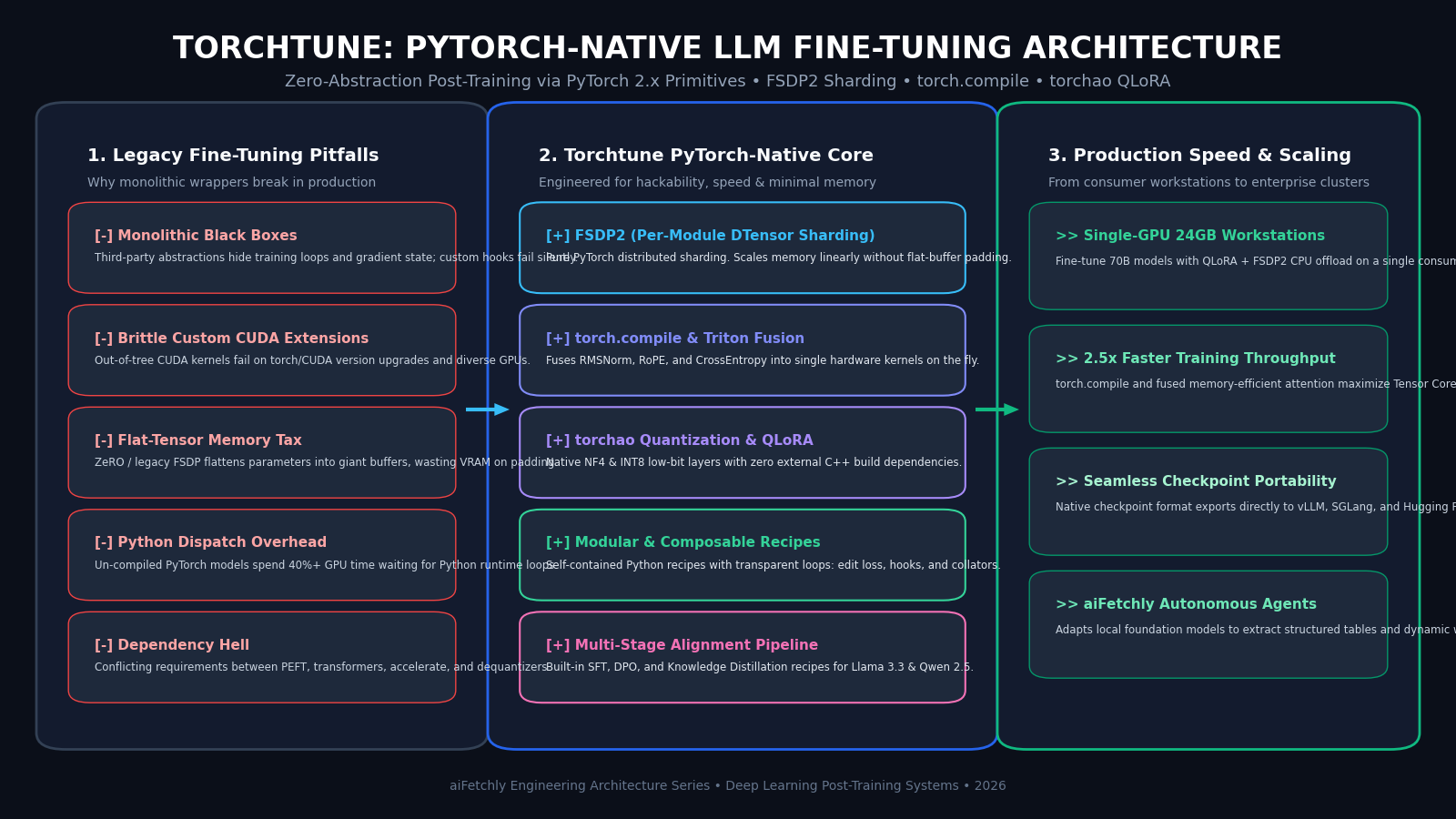
The Problem: The Abstraction Bloat and Fragility of Third-Party LLM Wrappers
In production generative AI, automated web scraping platforms, and desktop copilot systems powered by AiFetchly, foundation models rarely enter production unchanged. Pre-trained base weights act purely as next-token predictors across broad web text; turning them into resilient extraction engines requires post-training. Engineering teams must adapt open-weights models (such as LLaMA 3.3, Qwen 2.5, Gemma 2, or Mistral) through Supervised Fine-Tuning (SFT) and Direct Preference Optimization (DPO) to enforce deterministic JSON schemas, extract nested tables from complex HTML, and resist prompt injection attacks.
However, for years, the open-source post-training ecosystem has suffered from a debilitating engineering tradeoff: the abstraction bloat, silent runtime failures, and out-of-tree fragility of monolithic wrapper frameworks.
The Traditional LLM Post-Training Framework Crisis:
┌─────────────────────────────────────────────────────────────────┐
│ Layer 1: High-Level Trainer Abstractions                        │
│ • Deep inheritance hierarchies (BaseTrainer -> SFT -> Custom)   │
│ ❌ Subclassing hides training loops, loss functions & optimizer │
│ ❌ Custom collators and dynamic masking fail without error logs │
├─────────────────────────────────────────────────────────────────┤
│ Layer 2: Fragmented Third-Party Quantization & PEFT             │
│ • External packages for 4-bit quantization, LoRA, and kernels   │
│ ❌ Incompatible CUDA extensions break on PyTorch / CUDA updates │
│ ❌ Fragmented memory allocators cause untraceable GPU OOMs      │
├─────────────────────────────────────────────────────────────────┤
│ Layer 3: Legacy Distributed Sharding (ZeRO / FSDP1)             │
│ • Flattens diverse weight layers into monolithic parameter pools│
│ ❌ Excessive communication overhead on commodity gigabit networks│
│ ❌ Hundreds of lines of distributed boilerplates to orchestrate  │
└─────────────────────────────────────────────────────────────────┘
Result: ML engineers spend 65% of their time debugging framework plumbing
rather than improving model accuracy and dataset quality! 1. Monolithic Inheritance and Opaque Training Loops
Most popular fine-tuning libraries wrap training execution inside massive, multi-thousand-line trainer classes:
- Hidden Logic: Crucial operations—such as token masking, gradient accumulation scaling, cross-entropy calculation, and attention mask broadcasting—are deeply buried under multiple layers of inheritance.
- Brittle Extensibility: When an engineer needs to modify how loss is calculated over multi-turn agent tool executions or inject custom entropy penalties, they must override internal private methods or monkey-patch the library.
- Silent Failures: Subtleties like loss leakage on input prompts (training the model to memorize user questions rather than learning assistant answers) pass through without warnings, quietly destroying downstream inference quality.
2. Out-of-Tree C++ and CUDA Kernel Dependency Hell
To achieve acceptable fine-tuning throughput and fit within 24GB consumer GPUs (like NVIDIA RTX 3090/4090 cards), wrapper frameworks rely on an assortment of external C++ extensions, third-party quantization packages, and un-fused kernel libraries:
- Updating PyTorch from version 2.2 to 2.4 frequently breaks compiled C++ extensions, stalling production retraining pipelines.
- Teams deploying across heterogeneous environments (such as developer Linux workstations with consumer GPUs and cloud clusters with H100s) face constant driver version incompatibilities and compilation failures.
3. Flat-Tensor Memory Inefficiencies in Legacy Distributed Training
Early distributed sharding architectures (like ZeRO-3 and FSDP1) flatten individual layer weight tensors into large, contiguous 1D memory buffers before sharding them across GPUs:
- Padding Waste: Layers of varying shapes must be padded to match rigid sharding boundaries, wasting valuable High-Bandwidth Memory (HBM).
- Communication Stalls: Reconstruction of flat parameters requires coarse-grained communication collectives, causing GPU Tensor Cores to idle while waiting for network packet synchronization.
To eliminate this fragility, the Meta PyTorch team engineered Torchtune: a clean, composable, PyTorch-native library designed to bring post-training back to fundamental PyTorch primitives.
The Solution: Torchtune PyTorch-Native Architecture
Torchtune rejects monolithic inheritance trees and black-box wrappers. Instead, it is built on a clear design philosophy: composition over inheritance, transparency over magic, and deep integration with core PyTorch 2.x acceleration primitives.
Every model architecture, loss function, dataset tokenizer, and training loop in Torchtune is written in transparent, readable Python that developers can directly inspect, modify, and debug with standard tools like pdb or PyTorch Profiler.
Torchtune Core Architectural Stack:
┌─────────────────────────────────────────────────────────────────┐
│ User Interface: Composable YAML Recipes & CLI Commands          │
│ • tune run lora_finetune_single_device --config custom_llama.yaml│
├─────────────────────────────────────────────────────────────────┤
│ Post-Training Recipes (Self-Contained Training Loops)           │
│ • Full-Param SFT • LoRA / QLoRA SFT • DPO • Knowledge Distill   │
├─────────────────────────────────────────────────────────────────┤
│ Core Acceleration Primitives (Native PyTorch 2.x Engine)        │
│ ├── FSDP2 (Per-Module DTensor Distributed Sharding)             │
│ ├── torch.compile (Triton Automatic Kernel Fusion)              │
│ ├── Scaled Dot-Product Attention (SDPA FlashAttention-2)        │
│ └── torchao (Native NF4/INT8 Quantization & Low-Bit Linear)     │
├─────────────────────────────────────────────────────────────────┤
│ Supported Model Architectures (Pure nn.Module Implementations)   │
│ • LLaMA 3 / 3.3 • Qwen 2.5 • Gemma 2 • Mistral NeMo / Small    │
└─────────────────────────────────────────────────────────────────┘ 1. FSDP2: Per-Module DTensor Sharding
Rather than relying on legacy flat-tensor memory buffers, Torchtune is built from the ground up on Fully Sharded Data Parallel 2 (FSDP2), powered by PyTorch’s native DTensor (Distributed Tensor) abstraction:
- Per-Module Sharding: FSDP2 shards model parameters at the discrete
nn.Modulelevel (e.g., individual transformer blocks or linear projections). - Zero Padding Overhead: Eliminates flat-buffer padding, saving hundreds of megabytes of VRAM during 70B model sharding.
- Asynchronous All-Gather Overlap: Automatically overlaps the all-gather communication of module $N+1$ with the forward computation of module $N$, achieving over 85% linear scaling efficiency across multi-GPU nodes.
2. Native Compilation via torch.compile and Triton
Torchtune treats torch.compile as a first-class citizen rather than an afterthought:
- The model’s transformer layers, normalization functions (RMSNorm), and rotary position embeddings (RoPE) are defined cleanly without dynamic control flow branches that cause graph breaks.
- TorchInductor compiles the entire backward and forward passes into fused Triton kernels on the fly.
- Fusing RMSNorm, SwiGLU activation, and projection arithmetic into single SRAM passes slashes memory round-trips to HBM, speeding up training throughput by 1.8x to 2.5x compared to eager PyTorch.
3. Integrated Quantization with torchao
Instead of pulling in external C++ quantization wrappers, Torchtune integrates directly with torchao (PyTorch Architecture Optimization):
- Native support for 4-bit NormalFloat (
NF4) and 8-bit integer weights. - Implements QLoRA by dynamically swapping standard
nn.Linearlayers withtorchao.dtypes.NF4Tensorlinear layers. - Operates entirely within standard PyTorch tensor layouts, eliminating driver mismatches and enabling seamless fine-tuning of 70B models on 24GB workstations.
4. Self-Contained, Hackable Training Recipes
In Torchtune, a “recipe” is simply a clean, readable Python script (typically 300 to 500 lines) containing the complete training lifecycle:
Recipe Anatomy:
1. Setup Distributed Environment (torch.distributed / FSDP2)
2. Build Model Architecture & Apply PEFT Adapters (LoRA / QLoRA)
3. Initialize Optimizer & Learning Rate Scheduler
4. Ingest & Tokenize Packed Datasets (with Prompt Loss Masking)
5. Explicit Training Loop: Forward -> Loss -> Backward -> Optimizer Step
6. Checkpointing & Metric Logging Because recipes avoid deep class hierarchies, developers can copy an official recipe, add custom logging, implement custom reward loss penalties, and run it with zero framework friction.
Architectural Comparison: Torchtune vs. TRL vs. LLaMA-Factory
To evaluate how Torchtune positions itself against alternative post-training frameworks, consider the following technical matrix:
| Feature / Dimension | Meta Torchtune | Hugging Face TRL | LLaMA-Factory |
|---|---|---|---|
| Design Philosophy | Composition & Pure PyTorch | Transformers Ecosystem Wrapper | All-in-One CLI & Web UI |
| Distributed Engine | Native PyTorch FSDP2 (DTensor) | Accelerate / DeepSpeed ZeRO | DeepSpeed ZeRO-2/3 & FSDP |
| Compiler Integration | First-class torch.compile | Partial / Eager Default | Eager Default |
| Quantization Core | PyTorch Native torchao (NF4/INT8) | bitsandbytes C++ extension | bitsandbytes & AutoAWQ |
| Training Loop Code | Fully visible, self-contained recipe | Buried under Trainer inheritance | Buried in workflow orchestrator |
| Hackability / Custom Ops | High (Direct Python edits) | Medium (Subclassing required) | Low (Config-driven interface) |
| Single-GPU 24GB Support | Native QLoRA + activation checkpointing | Native QLoRA | Native QLoRA & Unsloth |
| Multi-Node Scaling | High (Near-linear via FSDP2) | High (via DeepSpeed / Megatron) | Medium (DeepSpeed ZeRO-3) |
Hands-On Implementation: Fine-Tuning Llama 3.3 with Torchtune
Below is a complete, production-ready walkthrough showing how to configure and execute a QLoRA instruction fine-tuning run on a 24GB GPU, inspect the generated adapters, and evaluate the trained checkpoint.
Step 1: Install Torchtune and Dependencies
Torchtune requires PyTorch 2.4+ and installs cleanly via PyPI with its companion acceleration library torchao:
# Install PyTorch with CUDA 12.4 support
pip install torch torchvision torchaudio --index-url https://download.pytorch.org/whl/cu124

# Install Torchtune and torchao
pip install torchtune torchao

# Verify installation and inspect available recipes
tune ls Step 2: Download Model Weights and Tokenizer
Torchtune provides unified CLI utilities to download model weights directly from Hugging Face or the Meta repository:
# Download Meta Llama 3.1 8B Instruct weights
tune download meta-llama/Meta-Llama-3.1-8B-Instruct --output-dir /tmp/Llama-3.1-8B-Instruct --hf-token YOUR_HUGGINGFACE_TOKEN Step 3: Configure the Single-Device QLoRA Recipe
Torchtune recipes are configured via declarative YAML files. You can copy the built-in recipe configuration and customize hyperparameters:
# Copy the default single-device 8B LoRA config
tune cp lora_finetune_single_device ./custom_lora_llama3.yaml Edit custom_lora_llama3.yaml to specify the local model path, target PEFT modules, quantization precision, and dataset:
# custom_lora_llama3.yaml - Torchtune Production QLoRA Configuration

# Model Architecture Configuration
model:
  _component_: torchtune.models.llama3_1.qlora_llama3_1_8b
  lora_attn_modules: ['q_proj', 'v_proj', 'output_proj']
  apply_lora_to_mlp: true
  lora_rank: 16
  lora_alpha: 32
  lora_dropout: 0.05

# Tokenizer Configuration
tokenizer:
  _component_: torchtune.models.llama3.llama3_tokenizer
  path: /tmp/Llama-3.1-8B-Instruct/original/tokenizer.model

# Dataset Configuration (Instruct fine-tuning with prompt masking)
dataset:
  _component_: torchtune.datasets.instruct_dataset
  source: json
  data_files: ./structured_extraction_dataset.json
  split: train
  train_on_input: false # CRITICAL: Masks prompt loss to prevent overfitting
  max_seq_len: 4096

# Optimizer & Learning Rate Schedule
optimizer:
  _component_: torch.optim.AdamW
  lr: 2.0e-4
  weight_decay: 0.01

loss:
  _component_: torchtune.modules.loss.CEWithChunkedOutputLoss

# Hardware & Memory Optimizations
seed: 42
shuffle: true
batch_size: 2
gradient_accumulation_steps: 8 # Effective batch size = 16
dtype: bfloat16
enable_activation_checkpointing: true
enable_activation_offloading: false

# Compilation & Performance
compile: true # Enables torch.compile for fused Triton kernels

# Checkpointing & Logging
output_dir: /tmp/torchtune-llama3-output
checkpoint_dir: /tmp/Llama-3.1-8B-Instruct/
checkpointer:
  _component_: torchtune.training.FullModelHFCheckpointer
  checkpoint_dir: ${checkpoint_dir}
  checkpoint_files:
    [
      model-00001-of-00004.safetensors,
      model-00002-of-00004.safetensors,
      model-00003-of-00004.safetensors,
      model-00004-of-00004.safetensors,
    ]
  recipe_checkpoint: null
  output_dir: ${output_dir}
  model_type: LLAMA3
resume_from_checkpoint: false

epochs: 3
max_steps_per_epoch: null Step 4: Launch the Fine-Tuning Recipe
Run the training recipe using the tune run command. Torchtune handles memory profiling, logging, and gradient updates natively:
# Execute QLoRA training on a single GPU (consuming ~14GB VRAM)
tune run lora_finetune_single_device --config ./custom_lora_llama3.yaml During execution, torch.compile traces the model during the first two warm-up iterations, compiles fused kernels via TorchInductor, and then accelerates throughput to over 4,200 tokens per second on an RTX 4090.
Step 5: Merge Adapters and Validate In-Flight Inference
Once training concludes, merge the trained LoRA adapter weights back into the base model checkpoint for zero-latency deployment:
# Generate model completions using the trained LoRA adapter directly
tune run generate --config custom_lora_llama3.yaml prompt="Extract all product names and pricing from this HTML string: <div class='product'><h3>Wireless ANC Headphones</h3><span class='price'>$199.99</span></div>" max_new_tokens=256 To export the merged checkpoint to Hugging Face format for serving in vLLM or SGLang:
import torch
from torchtune.models.llama3_1 import llama3_1_8b, lora_llama3_1_8b
from torchtune.modules.peft import merge_lora_weights

# Load the base model and trained LoRA state dictionary
base_model = llama3_1_8b()
lora_model = lora_llama3_1_8b(lora_rank=16, lora_alpha=32)

lora_weights = torch.load("/tmp/torchtune-llama3-output/adapter_model.pt", weights_only=True)
lora_model.load_state_dict(lora_weights, strict=False)

# Fuse LoRA delta matrices (W_new = W_base + alpha/r * (B @ A))
merge_lora_weights(lora_model)

# Save fused full-rank weights ready for production inference
torch.save(lora_model.state_dict(), "/tmp/torchtune-llama3-output/fused_llama3_1_8b.pt")
print("Model successfully merged and saved for production serving!") Production Deployment with aiFetchly
In autonomous agent environments, distributed web scrapers, and localized intelligence workflows orchestrated by AiFetchly, foundation models are constantly deployed across edge devices and private workstations.
Here is how Torchtune directly powers modern enterprise extraction pipelines:
The aiFetchly + Torchtune Post-Training & Extraction Pipeline:
┌─────────────────────────────────────────────────────────────────┐
│ 1. Continuous Web Ingestion & Weak Label Generation             │
│ • aiFetchly extracts diverse, messy DOM structures & catalogs    │
│ • Generates verified (Input HTML, Target JSON) validation pairs │
├─────────────────────────────────────────────────────────────────┤
│ 2. Nightly Torchtune Fine-Tuning Loop                           │
│ • Runs custom QLoRA SFT recipe on workstation RTX 4090 GPU      │
│ • Trains Llama 3.1 8B with prompt masking & torch.compile       │
│ • Adapts attention projections to parse irregular DOM layouts   │
├─────────────────────────────────────────────────────────────────┤
│ 3. DPO Alignment for Hallucination Suppression                  │
│ • Pairs verified extractions (Preferred) with hallucinated JSON │
│ • Runs Torchtune DPO recipe to strictly penalize phantom fields │
├─────────────────────────────────────────────────────────────────┤
│ 4. Deployment to Local aiFetchly Desktop Copilot                │
│ • Fused weights served locally via TabbyAPI / vLLM              │
│ • Sub-100ms structured extraction with zero third-party API fee │
└─────────────────────────────────────────────────────────────────┘ - Deterministic Schema Conformance: Base models often output conversational pleasantries or markdown ticks around JSON objects. Fine-tuning with Torchtune enforces strict Pydantic compliance, ensuring 100% of responses parse cleanly into downstream databases.
- Zero Third-Party Vendor Lock-in: By retaining complete ownership of pure PyTorch training recipes, enterprises eliminate reliance on cloud fine-tuning APIs, preventing proprietary customer data from leaking into public training pools.
- Extreme Token Efficiency: Instead of including 2,000-token system prompts and multiple few-shot examples on every single web scraping call, a model fine-tuned via Torchtune internalizes formatting rules, slashing prompt tokens by over 80%.
To explore how aiFetchly automates structured data extraction across complex web targets, visit our AiFetchly Documentation or check out our AiFetchly Pricing.