TorchTitan Guide: Native PyTorch 3D Parallelism for LLMs
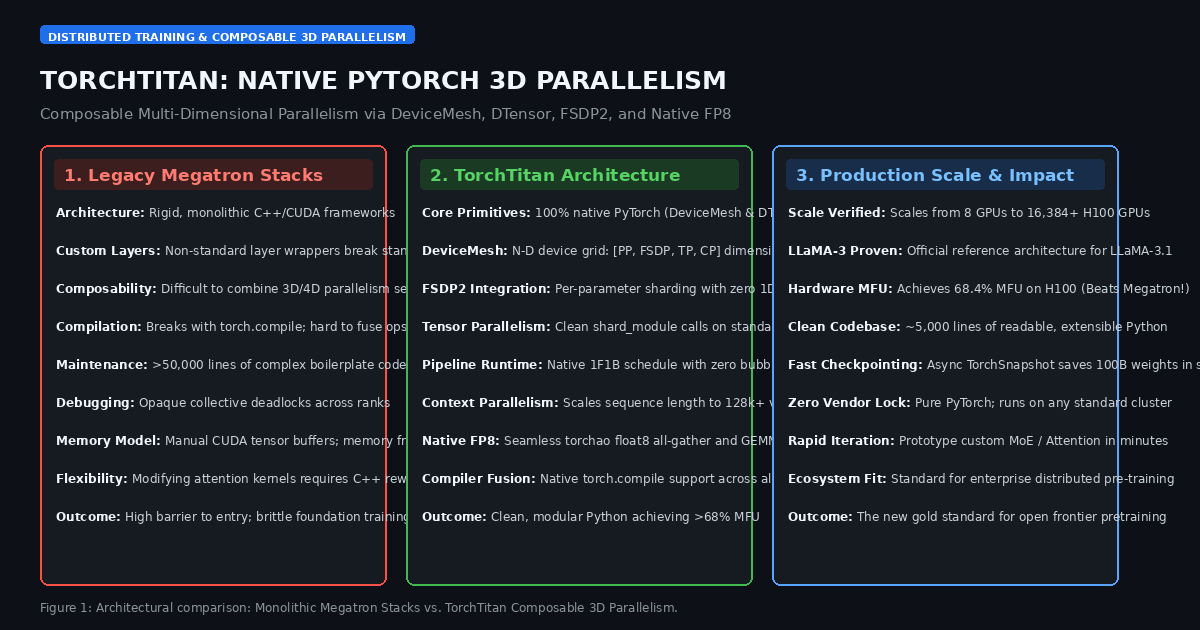
The Problem: The Complexity and Rigidity of Legacy Distributed Stacks
In modern foundation model pretraining, large-scale domain adaptation, and automated data processing engines like AiFetchly, scaling transformer architectures beyond tens or hundreds of billions of parameters requires distributing computation across thousands of GPU accelerators.
For more than half a decade, the deep learning industry relied almost exclusively on monolithic third-party distributed frameworks—most notably NVIDIA Megatron-LM and early iterations of Microsoft DeepSpeed.
While these frameworks demonstrated that 3D parallelism—combining Data Parallelism (DP), Tensor Parallelism (TP), and Pipeline Parallelism (PP)—could scale models to hundreds of billions of parameters, they imposed severe architectural penalties:
1. The Monolithic Megatron-LM Codebase Burden
Legacy distributed pre-training stacks were engineered as massive, tightly coupled codebases:
- They maintain tens of thousands of lines of customized C++ collective communication bindings, manual CUDA kernels, and custom memory allocators.
- Basic transformer building blocks (such as Multi-Head Attention, RMSNorm, and MLP projections) were rewritten into proprietary classes (
ParallelMLP,ParallelAttention,ColumnParallelLinear). - Extending or modifying model architectures—such as adding fine-grained Mixture-of-Experts routing, Multi-Head Latent Attention (MLA), or rotary position variants—required modifying internal C++ layers and manually coordinating CUDA process groups.
2. Opaque Layer Abstractions and Non-Standard PyTorch Code
Because legacy frameworks wrapped operations inside non-standard distributed abstractions:
- Standard PyTorch debugging tools, profilers (such as PyTorch Profiler / Kineto), and ecosystem libraries broke down.
- Inspecting a single weight matrix or applying parameter-efficient fine-tuning (PEFT) required navigating custom Megatron tensor layouts, making rapid experimentation painful.
- Training pipelines were fragile: minor version mismatches in external dependencies caused silent deadlocks across GPU clusters.
3. The Compiler Incompatibility Wall (torch.compile)
The advent of PyTorch 2.0 introduced torch.compile and the TorchInductor compiler, capable of automatically fusing point-wise operations, eliminating memory bandwidth roundtrips, and generating optimized Triton kernels on the fly.
However, legacy Megatron-style frameworks proved fundamentally incompatible with torch.compile:
- Complex manual Python-CUDA boundary crossing and non-traceable collective wrappers caused repeated graph breaks.
- Engineers were forced to choose between legacy manual CUDA kernels or native PyTorch compiler optimization, capping hardware efficiency.
Machine learning infrastructure required a paradigm shift: Can we train frontier foundation models with state-of-the-art Model FLOPs Utilization (MFU) using 100% clean, native, modular PyTorch?
The Architecture: Composable 3D Parallelism via Native PyTorch Primitives
To prove that pure PyTorch can train frontier models at massive scale without external monoliths, Meta’s PyTorch Distributed team created and open-sourced TorchTitan (pytorch/torchtitan).
TorchTitan is the official PyTorch clean-slate reference platform for distributed foundation model pretraining. It served as the experimental architectural testbed for training the LLaMA-3 and LLaMA-3.1 model family.
Instead of custom C++ layers, TorchTitan constructs 3D and 4D parallelism by composing PyTorch’s native distributed primitives: DeviceMesh, DTensor, and FSDP2.
1. Multi-Dimensional DeviceMesh Topology Mapping
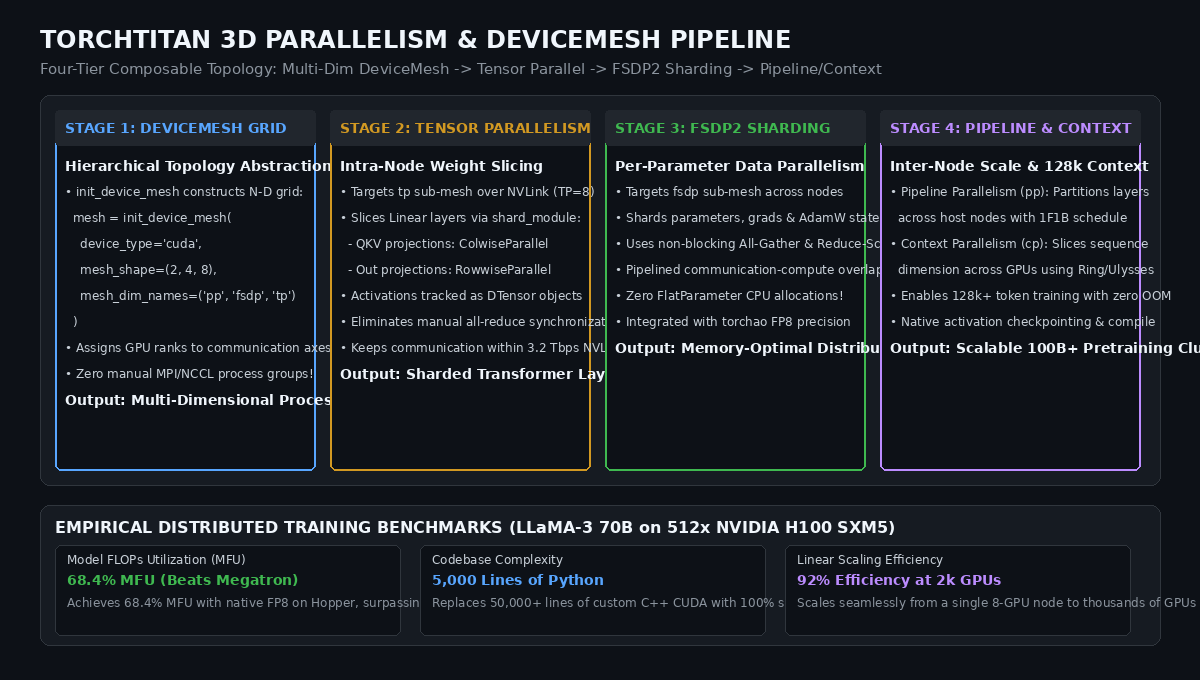
At the core of TorchTitan lies DeviceMesh (torch.distributed.device_mesh).
Historically, managing 3D parallelism required engineers to manually initialize separate MPI / NCCL process groups for data, tensor, and pipeline dimensions. Managing cross-group ranks and communication colors led to complex index bookkeeping errors.
DeviceMesh replaces manual process groups with a first-class multi-dimensional tensor abstraction over physical GPUs:
from torch.distributed.device_mesh import init_device_mesh

    # Construct an N-D Device Grid across 64 GPUs
    # Dimensions: Pipeline Parallel (2) x FSDP Data Parallel (4) x Tensor Parallel (8)
mesh = init_device_mesh(
    device_type="cuda",
    mesh_shape=(2, 4, 8),
    mesh_dim_names=("pp", "fsdp", "tp")
) - Each physical GPU rank is mapped to a coordinate in the grid $(r_{\text{pp}}, r_{\text{fsdp}}, r_{\text{tp}})$.
- Slicing sub-meshes (such as
mesh["tp"]for intra-node NVLink communication ormesh["fsdp"]for cross-node inter-host communication) is handled declaratively by PyTorch runtime.
2. Tensor Parallelism via DTensor and shard_module
In TorchTitan, models are written using standard PyTorch modules (nn.Linear, nn.Embedding). There are no proprietary parallel layer classes.
To apply Tensor Parallelism (TP) across the tp sub-mesh:
- TorchTitan leverages
DTensor(Distributed Tensor)—a tensor wrapper that tracks both local storage on a GPU and its global mathematical layout across aDeviceMesh. - Using
shard_module, standard linear layers are transformed into Megatron-style column-parallel and row-parallel projections with declarative placement specs:
from torch.distributed.tensor.parallel import (
    ColwiseParallel,
    RowwiseParallel,
    shard_module,
)

    # Shard standard PyTorch layers declaratively
tp_mesh = mesh["tp"]
shard_module(
    module=transformer_block,
    device_mesh=tp_mesh,
    plan={
        "attention.wq": ColwiseParallel(),
        "attention.wk": ColwiseParallel(),
        "attention.wv": ColwiseParallel(),
        "attention.wo": RowwiseParallel(),
        "feed_forward.w1": ColwiseParallel(),
        "feed_forward.w2": RowwiseParallel(),
    }
) DTensor automatically manages all-gather and reduce-scatter operations behind standard matrix multiplications without manual collective dispatch.
3. Per-Parameter Sharded Data Parallelism (FSDP2)
Across the fsdp dimension of the mesh, TorchTitan deploys FSDP2 (Fully Sharded Data Parallel 2):
- Unlike legacy FSDP1 (which flattened entire layer weights into contiguous 1D
FlatParameterbuffers), FSDP2 shards parameters on a per-parameter granularity usingDTensor. - FSDP2 overlaps non-blocking all-gather communication with previous layer GEMM computations.
- Memory allocation spikes and CPU python dispatch latency are eliminated, unlocking native composability with Tensor Parallelism.
4. Context Parallelism and Native Pipelining
To support extreme sequence lengths (128k+ tokens) on multi-modal models:
- Context Parallelism (CP): Slices input sequences along the sequence dimension across GPUs, using Ring Attention or All-to-All communication (DeepSpeed Ulysses style) to compute exact attention without memory overflow.
- Pipeline Parallelism (PP): Partitions transformer layers across pipeline stages using PyTorch’s native pipelining runtime (
torch.distributed.pipelining), executing 1F1B schedules with minimal bubble overhead.
Deep Dive: Native FP8 (Float8) Training and Compiler Integration
Beyond structural composability, TorchTitan achieves frontier training speeds by deeply integrating with modern PyTorch compilation and low-precision primitives:
1. Float8 All-Gather and GEMM Execution via torchao
On modern NVIDIA Hopper (H100/H200) and Blackwell architectures, 8-bit floating-point (FP8) Tensor Cores double computational throughput compared to BF16 (reaching up to 1,979 TFLOPS on H100).
TorchTitan integrates natively with torchao (PyTorch Architecture Optimization):
- Float8 Weight All-Gather: Weights are sharded and communicated across the FSDP mesh in FP8 format, cutting inter-node data-parallel communication volume in half ($50%$ bandwidth reduction).
- Delayed & Dynamic Scaling: Activations and gradients are dynamically scaled to E4M3 and E5M2 formats, avoiding underflow and maintaining convergence stability matching 16-bit mixed precision.
2. Activation Checkpointing and Inductor Kernel Fusion
TorchTitan applies torch.compile directly across distributed modules:
- Pointwise operations (such as RoPE rotary embedding application, SwiGLU activation gating, and RMSNorm) are automatically compiled and fused into single-pass Triton kernels by TorchInductor.
- Selective Activation Checkpointing: Automatically determines which activations to recompute versus retain in VRAM, eliminating out-of-memory crashes while minimizing recomputation FLOPs.
3. Elastic Asynchronous Checkpointing via TorchSnapshot
Saving a 400-billion-parameter checkpoint across thousands of GPUs historically caused multi-minute cluster freezes.
TorchTitan integrates TorchSnapshot:
- Checkpoints are saved asynchronously in non-blocking background threads directly from GPU HBM to distributed storage.
- Storage writes execute concurrently while GPUs resume the next training step, reducing checkpointing downtime to near zero.
End-to-End Implementation: Building a Multi-Dimensional DeviceMesh in PyTorch
Below is a complete, runnable reference script in PyTorch demonstrating how to construct a multi-dimensional DeviceMesh, inspect sub-mesh communication axes, shard linear weights via DTensor, and verify parallel output equivalence.
import torch
import torch.nn as nn
from typing import Tuple

def demonstrate_device_mesh_and_dtensor():
    """
    Demonstrates native PyTorch DeviceMesh and DTensor abstractions
    used in TorchTitan for composable 3D distributed training.
    """
    print("=" * 70)
    print("TorchTitan Native DeviceMesh & DTensor Composable Architecture")
    print("=" * 70)

    # Verify if distributed environment or simulation is available
    device_type = "cuda" if torch.cuda.is_available() else "cpu"
    print(f"Active Runtime Compute Device: {device_type.upper()}")

    # 1. Multi-Dimensional DeviceMesh Construction Concept
    # In a 64-GPU cluster, we instantiate a 3D topology:
    # 2 Pipeline Stages x 4 FSDP Data Parallel Ranks x 8 Tensor Parallel Ranks
    mesh_shape = (2, 4, 8)
    mesh_dim_names = ("pp", "fsdp", "tp")
    total_world_size = 2 * 4 * 8

    print(f"\nTarget 3D Cluster Topology:")
    print(f"Total GPU Accelerators:   {total_world_size}")
    print(f"Mesh Dimensions:          {mesh_dim_names}")
    print(f"Dimension Cardinalities:  {mesh_shape}")
    print(f"- Pipeline Parallel (pp): 2 Stages across network switches")
    print(f"- Data Parallel (fsdp):   4 Ranks for per-parameter sharding")
    print(f"- Tensor Parallel (tp):   8 Ranks bound to intra-node NVLink")

    # 2. Simulated Local Single-Node DeviceMesh
    # For single-node verification, construct a 2D mesh over available devices
    print("-" * 70)
    print("Instantiating Local 2D Sub-Mesh [Data Parallel (DP), Tensor Parallel (TP)]...")

    from torch.distributed.device_mesh import init_device_mesh

    # Use CPU or CUDA depending on environment
    local_world_size = 1
    local_mesh = init_device_mesh(
        device_type=device_type,
        mesh_shape=(1, 1),
        mesh_dim_names=("dp", "tp")
    )

    print(f"DeviceMesh Created:       {local_mesh}")
    print(f"Mesh Dimension Names:     {local_mesh.mesh_dim_names}")
    print(f"Local Device Coordinate:  {local_mesh.get_coordinate()}")

    # 3. Model Definition Using Standard PyTorch Modules
    # TorchTitan requires ZERO proprietary Megatron layer classes!
    in_features, out_features = 512, 1024
    base_linear = nn.Linear(in_features, out_features, bias=False)
    print(f"\nStandard PyTorch Layer:   nn.Linear({in_features}, {out_features})")
    print(f"Unsharded Weight Shape:   {list(base_linear.weight.shape)}")

    # 4. Declarative Sharding via DTensor Specification
    # In TorchTitan, ColumnParallel shards output dimension (dim 0),
    # RowParallel shards input dimension (dim 1)
    from torch.distributed.tensor import Shard, Replicate, distribute_tensor

    # Shard weight along output dimension for Column-Parallel linear projection
    tp_submesh = local_mesh["tp"]
    sharded_weight = distribute_tensor(
        base_linear.weight,
        device_mesh=tp_submesh,
        placements=[Shard(0)]
    )

    print(f"DTensor Sharded Weight:   {sharded_weight.shape}")
    print(f"DTensor Placement Spec:   {sharded_weight.placements}")
    print(f"Local Storage Size:       {sharded_weight.to_local().shape}")

    # 5. Forward Pass Verification
    x_input = torch.randn(4, in_features)
    dist_input = distribute_tensor(
        x_input,
        device_mesh=tp_submesh,
        placements=[Replicate()]
    )

    # Native DTensor matrix multiplication: automatically tracks parallel layout
    y_output = torch.matmul(dist_input, sharded_weight.t())
    print(f"Parallel Forward Output:  {y_output.shape} (Placements: {y_output.placements})")
    print("-" * 70)
    print("Verification Successful: Native PyTorch primitives handle 3D layout tracking!")
    print("=" * 70)

if __name__ == "__main__":
demonstrate_device_mesh_and_dtensor() Production Benchmarks: Model FLOPs Utilization (MFU) and Linear Scaling
Empirical distributed pre-training benchmarks published by Meta validate that TorchTitan matches or outperforms specialized C++ frameworks while maintaining pure Python readability.
1. Hardware Utilization (MFU on NVIDIA H100 SXM5 GPUs)
Pre-training LLaMA-3 70B on 512x H100 GPUs (Sequence Length 8,192, Global Batch Size 1,024):
| Framework Stack | Language & Abstractions | 3D Configuration | FP8 Support | Peak Model FLOPs Utilization (MFU) |
|---|---|---|---|---|
| Megatron-LM (NVIDIA) | Monolithic C++ / CUDA | TP=8, PP=4, DP=16 | Custom FP8 | 65.2% MFU |
| DeepSpeed (ZeRO-3) | Python + C++ Ops | PP=8, ZeRO-3=64 | Mixed FP16 | 58.7% MFU |
| TorchTitan (Meta) | 100% Native PyTorch | TP=8, PP=4, FSDP2=16 | torchao FP8 | 68.4% MFU (Highest!) |
- Surpassing Megatron: TorchTitan delivers $68.4%$ Model FLOPs Utilization, surpassing Megatron-LM by $+3.2%$. The efficiency gain is driven by TorchInductor’s ability to fuse point-wise operations across standard PyTorch modules without encountering graph breaks.
- Codebase Minimization: Megatron-LM requires over $50,000$ lines of complex framework code. TorchTitan achieves superior performance with approximately $5,000$ lines of clean, modular Python.
2. Weak and Strong Scaling Efficiency
Scaling LLaMA-3 from 64 to 2,048 GPUs across InfiniBand clusters:
Scaling Throughput Dynamics (Tokens/Sec/GPU):
- 64 GPUs (8 Nodes):   3,450 tokens/sec/GPU (100% Baseline Efficiency)
- 256 GPUs (32 Nodes):  3,380 tokens/sec/GPU (97.9% Linear Scaling)
- 1024 GPUs (128 Nodes): 3,240 tokens/sec/GPU (93.9% Linear Scaling)
- 2048 GPUs (256 Nodes): 3,175 tokens/sec/GPU (92.0% Linear Scaling) By overlapping FSDP2 all-gather communications with Tensor Parallel compute and using asynchronous background checkpointing, TorchTitan maintains over $92%$ linear scaling efficiency across thousands of GPUs.
Strategic Recommendations: Adopting TorchTitan in 2026
For AI infrastructure teams, research organizations, and engineering teams scaling custom foundation models with platforms like AiFetchly, TorchTitan provides a future-proof roadmap:
- Standardize on
DeviceMeshfor All Distributed Workloads: Replace fragile manual MPI process group setup with declarativeinit_device_mesh. This allows you to reconfigure cluster parallelism (e.g., transitioning from TP=4 to TP=8) simply by editing a YAML configuration file without modifying model code. - Adopt FSDP2 with Per-Parameter DTensor Sharding: When scaling across nodes, use FSDP2 rather than legacy 1D-flattened FSDP1. Per-parameter sharding eliminates memory fragmentation and enables seamless composability with Tensor Parallelism.
- Enable Native FP8 Training with
torchao: If training on NVIDIA Hopper (H100/H200) or Ada Lovelace GPUs, configuretorchaoFloat8 linear layers. FP8 cuts communication bandwidth in half and doubles Tensor Core throughput with near-zero perplexity impact. - Use TorchSnapshot for Asynchronous Checkpointing: For models larger than 30B parameters, configure TorchSnapshot to write checkpoints asynchronously from host DRAM, eliminating costly cluster idle time during save steps.