TorchInductor Guide: PyTorch 2 Compiler & Triton
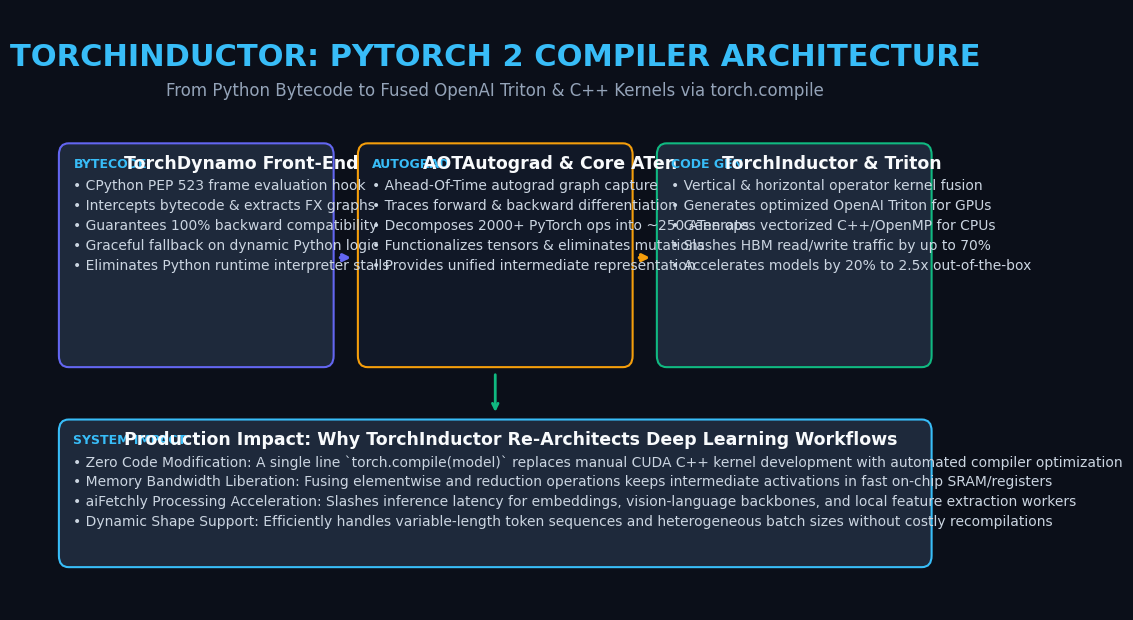
The Problem: The Memory Bandwidth and Launch Overhead of Eager PyTorch
For nearly a decade, PyTorch has been the beloved foundation of deep learning research, computer vision, and autonomous data ingestion engines like AiFetchly. Its defining advantage has always been eager execution: operations execute line-by-line, imperatively in Python, making debugging and interactive development intuitive.
However, as models scaled into multi-billion-parameter transformers and high-throughput production serving systems, eager execution encountered severe physical hardware constraints:
The Eager PyTorch Execution Bottleneck:
Python Code:
Y = torch.relu(torch.matmul(X, W) + bias) * dropout_mask
  │
  ▼ (Eager Execution: 4 Discrete Operations)
┌────────────────────────────────────────────────────────┐
│ 1. MatMul Kernel (GEMM) ──► Writes to VRAM (HBM)       │
├────────────────────────────────────────────────────────┤
│ 2. Bias Add Kernel     ◄── Reads VRAM ──► Writes VRAM  │
├────────────────────────────────────────────────────────┤
│ 3. ReLU Kernel         ◄── Reads VRAM ──► Writes VRAM  │
├────────────────────────────────────────────────────────┤
│ 4. Elementwise Mul     ◄── Reads VRAM ──► Writes VRAM  │
└────────────────────────────────────────────────────────┘
Result: 3 unnecessary HBM roundtrips + 4 separate CUDA kernel launches!
Tensor Cores starve while waiting for High-Bandwidth Memory! 1. The Kernel Launch Overhead and GPU Underutilization
In eager mode, every single PyTorch operation issues a separate CUDA kernel launch from the Python interpreter to the GPU command queue:
- In smaller models, transformer layers, or batch-1 inference workloads, the Python CPU runtime takes longer to dispatch kernels than the GPU takes to execute them (CPU-bound overhead).
- Hundreds of small kernels cause GPU execution pipelines to stall, leaving massive Tensor Core silicon idling between operations.
2. High-Bandwidth Memory (HBM) Roundtrip Bottlenecks in Unfused Ops
Modern GPUs (such as NVIDIA A100, H100, and RTX 4090) possess enormous compute capacity, but memory bandwidth between GPU High-Bandwidth Memory (HBM) and on-chip SRAM/registers is physically limited:
- In an expression like
Y = torch.relu(X + bias), eager PyTorch launches an addition kernel that reads $X$ and $bias$ from VRAM and writes the sum back to VRAM. - Immediately following, a ReLU kernel reads that sum back into SRAM, computes the activation, and writes the output back to VRAM.
- Because elementwise operations have near-zero arithmetic intensity ($< 1 \text{ FLOP/Byte}$), over 70% of execution time is wasted simply shuttling bytes back and forth across the memory bus.
3. The Fragility and Friction of Legacy Static Compilers (TorchScript / ONNX)
Prior to PyTorch 2, engineers attempted to solve these bottlenecks using static graph representations like TorchScript (torch.jit) or ONNX:
- TorchScript required developers to rewrite Python code into an awkward, non-standard Python subset (
TorchScript JIT), frequently failing on dynamic constructs, list comprehensions, or third-party libraries. - If an unsupported Python line was encountered, the entire export failed silently or crashed at runtime.
- Consequently, over 90% of machine learning practitioners abandoned compiler exports, resigning themselves to slow eager execution.
Engineering teams required a compiler that could capture Python graphs dynamically without code rewrites, automatically fuse memory-bound operations, and generate native, peak-performance GPU kernels.
The Solution: The PyTorch 2.x Compiler Stack Architecture
Introduced in PyTorch 2.0 and refined in PyTorch 2.5, torch.compile is powered by a modular, three-tier compiler subsystem: TorchDynamo, AOTAutograd, and TorchInductor.
Activated with a single line of code (model = torch.compile(model)), this architecture decouples Python graph interception from hardware code generation:
The PyTorch 2.x Compiler Pipeline:
User PyTorch Model Code (Standard Python / nn.Module)
  │
  ▼
┌────────────────────────────────────────────────────────┐
│ 1. TorchDynamo (Graph Capture Front-End)               │
│ • Hooks into CPython Frame Evaluation API (PEP 523)    │
│ • Intercepts bytecode, extracts computation graphs     │
│ • Graceful fallback: handles graph breaks safely       │
└────────────────────────────────────────────────────────┘
  │ (Torch FX Graph: PyTorch High-Level Ops)
  ▼
┌────────────────────────────────────────────────────────┐
│ 2. AOTAutograd (Ahead-of-Time Differentiation)         │
│ • Traces forward & backward graphs ahead-of-time       │
│ • Decomposes 2,000+ PyTorch ops into ~250 Core ATen ops│
│ • Functionalizes tensors & removes in-place mutations  │
└────────────────────────────────────────────────────────┘
  │ (AOT Core ATen Graph)
  ▼
┌────────────────────────────────────────────────────────┐
│ 3. TorchInductor (Deep Learning Compiler Backend)      │
│ • Performs vertical & horizontal operator fusion       │
│ • GPU Target: Emits custom OpenAI Triton kernels       │
│ • CPU Target: Emits vectorized C++ / OpenMP kernels    │
└────────────────────────────────────────────────────────┘
  │
  ▼
Optimized Executable Hardware Binary (Up to 2x Speedup!) 1. TorchDynamo: Frame Evaluation & Python Bytecode Interception
TorchDynamo serves as the graph-capture frontend:
- PEP 523 Hook: It integrates directly into the CPython runtime using the Frame Evaluation API, intercepting Python bytecode right before execution.
- Dynamic Tracing: TorchDynamo analyzes bytecode instructions, separates Python runtime logic (such as variable assignments and data structures) from tensor operations, and packages tensor computations into an FX Graph.
- Graph Break Handling: If your code contains unsupported dynamic Python features (such as calling a C-extension, writing to a disk file, or calling
print()), TorchDynamo does not crash. It introduces a graph break: it compiles the preceding subgraph, executes the dynamic Python line in standard eager mode, and resumes compilation for the remaining subgraph.
2. AOTAutograd: Ahead-of-Time Graph Capture & Core ATen Decomposition
PyTorch offers over 2,000 operator variants (add, add_, addmm, conv2d, linear). Building a compiler backend that optimizes 2,000 operators is an engineering nightmare:
- Core ATen Lowering: AOTAutograd intercepts the PyTorch dispatcher and decomposes those 2,000+ high-level operators into a canonical set of approximately 250 primitive
torch._ops.atenoperators. - Ahead-of-Time Gradients: In training workflows, AOTAutograd traces both the forward pass and the exact reverse-mode automatic differentiation graph before execution, handing TorchInductor unified, functionalized computation graphs for both passes.
3. TorchInductor: The Optimizing Triton & C++ Kernel Generator
TorchInductor is the default compiler backend that bridges the gap between mathematical computation graphs and raw hardware execution:
- GPU Backend: Generates highly optimized OpenAI Triton Python code, which is just-in-time compiled by the Triton compiler into native PTX/CUDA assembly.
- CPU Backend: Generates vectorized C++ code using OpenMP and AVX-512/AVX2 SIMD instructions.
- By targeting Triton rather than raw CUDA C++, TorchInductor achieves expert-level GPU kernel performance with a tiny compiler codebase.
Deep Dive: How TorchInductor Fuses Operators and Generates Triton Code
The fundamental mechanism driving TorchInductor’s performance gains is operator fusion.
TorchInductor Operator Fusion Transformation:
Unfused Operations in Graph:
  n1 = aten.add(X, bias)
  n2 = aten.mul(n1, 0.5)
  n3 = aten.tanh(n2)
  n4 = aten.mul(n1, n3)      # GeLU approximation

TorchInductor Loop Scheduling & Fusion:
┌────────────────────────────────────────────────────────┐
│ Single Fused Triton GPU Kernel:                        │
│ • Reads X and bias ONCE from VRAM into registers       │
│ • Computes (x + b), (x + b) * 0.5, tanh, and product   │
│   entirely in fast register memory!                    │
│ • Writes final result Y ONCE to VRAM                   │
└────────────────────────────────────────────────────────┘
Result: 4 memory roundtrips collapsed to 1 single memory roundtrip! 1. Vertical vs. Horizontal Operator Fusion Mechanics
TorchInductor classifies graph operations and performs two types of fusion:
- Vertical Fusion (Producer-Consumer): When Operation B consumes the output of Operation A (e.g.,
Add -> ReLU -> Mul), TorchInductor keeps intermediate values in GPU registers, executing them in a single thread without ever writing intermediate tensors to global HBM. - Horizontal Fusion (Sibling Operations): When multiple independent operations consume the same input tensor (e.g., computing both
meanandvarianceover an input activation), TorchInductor merges their execution into a single kernel loop, reading the input tensor from memory only once.
2. Lowering to Triton: Loop Scheduling and Tile Sizing
When lowering an FX graph to Triton:
- TorchInductor analyzes tensor shapes, strides, and memory layouts (contiguous, channels-last, or transposed).
- It generates an index expression mapping each output element to its constituent input coordinates.
- It dynamically computes the optimal block tile sizes (
BLOCK_SIZE = 128,256, or1024) and assigns thread warps to saturate GPU streaming multiprocessors (SMs).
3. Dynamic Shapes and Autotuning Search Spaces
Real-world production pipelines (such as web document extraction or chat servers) process variable-length inputs:
- With
torch.compile(model, dynamic=True), TorchInductor creates symbolic integer variables for batch sizes and sequence lengths. - It generates parametric Triton kernels that adjust tile bounds dynamically at runtime, avoiding expensive kernel recompilations when batch or token sizes change.
Benchmark & Capability Comparison: Eager vs. TorchScript vs. TorchInductor
The table below contrasts deep learning execution paradigms across production engineering dimensions:
| Dimension / Metric | Eager PyTorch (Baseline) | TorchScript (torch.jit) | PyTorch 2.x + TorchInductor |
|---|---|---|---|
| Code Modification Required | None | High (Requires rewriting into JIT dialect) | Zero (Single torch.compile wrapper) |
| Python Compatibility | 100% | ~40% (Fails on standard Python libraries) | 100% (Guaranteed via Graph Breaks) |
| Kernel Launch Overhead | High (Individual kernel per op) | Low (Single runtime engine) | Extremely Low (Aggressively Fused) |
| Memory Bandwidth Efficiency | Poor (Frequent HBM roundtrips) | Moderate | State-of-the-Art (Fused Triton/C++) |
| GPU Kernel Target | Pre-compiled static ATen | Handcrafted C++ CUDA | Auto-Generated OpenAI Triton PTX |
| Dynamic Shape Support | Native | Poor | Native Symbolic Integer Tracking |
| Speedup vs. Eager | 1.0x (Baseline) | 1.1x–1.2x | 1.2x–2.0x (Average across Hugging Face) |
Practical Implementation: Compiling Neural Networks with TorchInductor
Let us demonstrate how to compile a custom multi-layer transformer block, benchmark execution speedups, and inspect the generated Triton kernel code.
Step 1: Benchmark Baseline Eager Execution vs. torch.compile
Save the following script as benchmark_inductor.py:
import time
import torch
import torch.nn as nn

class TransformerMLPBlock(nn.Module):
    def __init__(self, hidden_dim: int = 4096, intermediate_dim: int = 11008):
        super().__init__()
        self.fc1 = nn.Linear(hidden_dim, intermediate_dim, bias=True)
        self.act = nn.SiLU()
        self.fc2 = nn.Linear(intermediate_dim, hidden_dim, bias=True)

    def forward(self, x: torch.Tensor) -> torch.Tensor:
        # Sequence of operations ideal for operator fusion
        h = self.act(self.fc1(x))
        return self.fc2(h) + x

def run_benchmark():
    device = "cuda" if torch.cuda.is_available() else "cpu"
    print(f"Executing benchmark on: {device.upper()}")

    batch_size, seq_len, hidden_dim = 16, 2048, 4096
    inputs = torch.randn(batch_size, seq_len, hidden_dim, device=device, dtype=torch.bfloat16)

    # Instantiate model
    model = TransformerMLPBlock().to(device=device, dtype=torch.bfloat16).eval()

    # --- 1. Eager Benchmark ---
    # Warmup
    for _ in range(5):
        _ = model(inputs)
    if device == "cuda":
        torch.cuda.synchronize()

    start = time.perf_counter()
    num_runs = 50
    for _ in range(num_runs):
        _ = model(inputs)
    if device == "cuda":
        torch.cuda.synchronize()
    eager_time = (time.perf_counter() - start) / num_runs * 1000

    # --- 2. Compiled Benchmark with TorchInductor ---
    compiled_model = torch.compile(model, backend="inductor", mode="reduce-overhead")

    # Compilation warmup (triggers Dynamo tracing & Inductor Triton generation)
    print("Compiling model via TorchInductor...")
    for _ in range(5):
        _ = compiled_model(inputs)
    if device == "cuda":
        torch.cuda.synchronize()

    start = time.perf_counter()
    for _ in range(num_runs):
        _ = compiled_model(inputs)
    if device == "cuda":
        torch.cuda.synchronize()
    compiled_time = (time.perf_counter() - start) / num_runs * 1000

    speedup = eager_time / compiled_time
    print(f"\nResults across {num_runs} iterations:")
    print(f"Eager Execution Latency:    {eager_time:.2f} ms")
    print(f"TorchInductor Latency:      {compiled_time:.2f} ms")
    print(f"Net Speedup Factor:         {speedup:.2f}x ({((speedup - 1) * 100):.1f}% faster)")

if __name__ == "__main__":
run_benchmark() Step 2: Inspecting the Generated Triton Kernel Code
TorchInductor makes it easy to inspect the exact Triton code it synthesizes. Set the environment variable TORCH_COMPILE_DEBUG=1 before executing:
TORCH_COMPILE_DEBUG=1 python benchmark_inductor.py Under torch_compile_debug/run_.../output_code.py, TorchInductor outputs clean, standalone Triton kernels:
# Sample generated Triton kernel snippet from TorchInductor:
import triton
import triton.language as tl

@triton.jit
def fused_silu_residual_kernel(in_ptr0, in_ptr1, out_ptr, n_elements, BLOCK_SIZE: tl.constexpr):
    pid = tl.program_id(axis=0)
    block_start = pid * BLOCK_SIZE
    offsets = block_start + tl.arange(0, BLOCK_SIZE)
    mask = offsets < n_elements

    # Single load from VRAM into registers
    x = tl.load(in_ptr0 + offsets, mask=mask)
    residual = tl.load(in_ptr1 + offsets, mask=mask)

    # In-register computation of SiLU activation and residual addition
    silu_val = x * tl.sigmoid(x)
    result = silu_val + residual

    # Single store to VRAM
tl.store(out_ptr + offsets, result, mask=mask) Notice how x * sigmoid(x) and the residual addition are fused directly into a single loop, eliminating transient memory allocations.
Step 3: Diagnosing and Eliminating Graph Breaks
To verify whether your model compiles into a single clean graph without interruptions, use torch._dynamo.explain:
import torch

explanation = torch._dynamo.explain(model)(inputs)
print(f"Number of Graphs: {explanation.graph_count}")
print(f"Graph Break Count: {explanation.graph_break_count}")
if explanation.graph_break_count > 0:
    for break_reason in explanation.break_reasons:
print(f"Break Reason: {break_reason.reason}") Production Best Practices: Deploying torch.compile in aiFetchly Pipelines
When integrating TorchInductor into automated document ingestion, local vector embedding generators, and web extraction workers in AiFetchly, follow these production guidelines:
1. Managing Warmup Latency with Compilation Caching
torch.compile spends time during its first forward pass analyzing bytecode and compiling Triton kernels:
- Offline Ahead-of-Time Warmup: Always execute dummy warmup inference passes during worker initialization or container startup to pre-compile graphs before accepting live user requests.
- Enable TorchInductor Cache: Set
TORCHINDUCTOR_CACHE_DIR=/var/cache/inductorin Docker containers to persist compiled Triton kernel binaries across application restarts.
2. Dynamic Shapes for Variable-Length Web Ingestion
When ingesting heterogeneous web articles and scraped PDFs with varying sequence lengths:
- Pass
dynamic=Truetotorch.compile. - This informs TorchInductor to avoid generating specialized kernels for every unique prompt length, preventing memory bloat and compilation storms.
3. Precision and Memory: Combining torch.compile with AMP and FlashAttention
For optimal throughput on modern NVIDIA GPUs:
- Wrap forward passes with
torch.cuda.amp.autocast(dtype=torch.bfloat16). - TorchInductor recognizes FlashAttention / SDPA patterns natively, fusing projection layers and attention blocks into unified asynchronous Hopper/Ada kernels.