Toolformer Guide: How LLMs Teach Themselves Tool Calling
Large Language Models are celebrated for their vast encyclopedic memory and contextual reasoning. However, when deployed in real-world software systems, dense neural networks encounter a rigid, unavoidable boundary: the closed-world assumption.
No matter how many trillions of tokens a transformer model digests during pre-training, it remains fundamentally frozen in time. It cannot execute precise floating-point arithmetic; it cannot look up real-time currency exchange rates; it cannot check current inventory levels on e-commerce sites; and it cannot access private enterprise databases. Attempting to force an LLM to memorize all mathematical arithmetic or dynamic web data leads inevitably to confident hallucinations.
Humans do not memorize logarithmic tables or stock market tickers; they use calculators, search engines, and APIs.
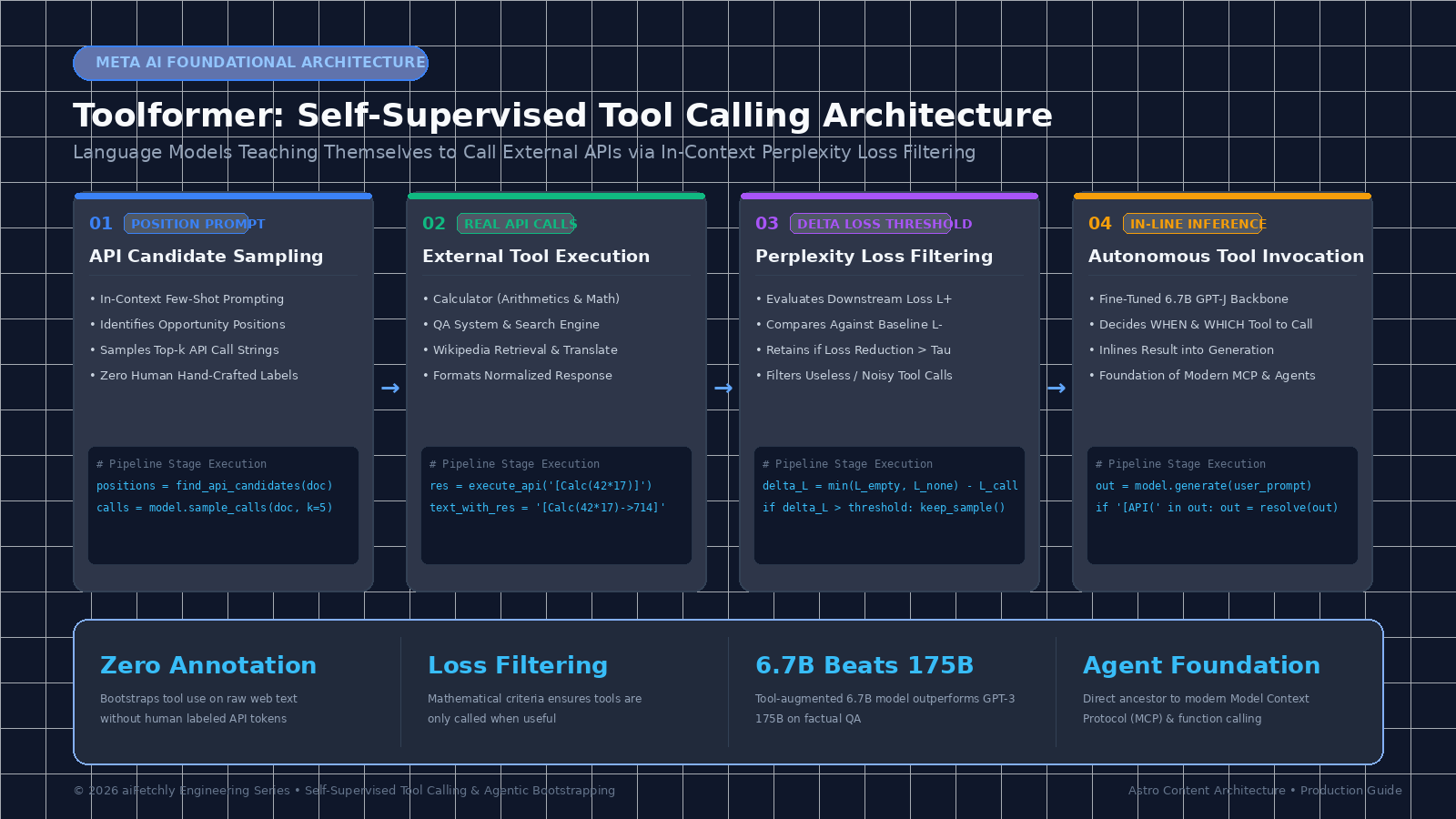
To give language models this same autonomy, researchers at Meta AI introduced Toolformer: Language Models Can Teach Themselves to Use Tools (arXiv:2302.04761, NeurIPS 2023). Toolformer proved that language models do not need expensive, manually annotated datasets to master API calling. Instead, models can learn to call external tools—including calculators, Q&A search engines, Wikipedia lookups, machine translation endpoints, and calendars—in a completely self-supervised manner.
By sampling candidate API invocations across raw web text and utilizing a rigorous perplexity loss filter that keeps only those calls that genuinely help predict future tokens, Toolformer established the foundational principles that modern Model Context Protocol (MCP) servers, OpenAI Function Calling, and autonomous web harvesting agents rely on today.
In this technical guide, we examine the failure modes of closed-world language models, dissect the self-supervised bootstrapping mechanics of Toolformer, evaluate its empirical performance against 175B parameter baselines, and construct an end-to-end Python implementation of self-supervised tool filtering.
The Closed-World Delusion: Why Static Language Models Fail at Math and Facts
To appreciate why Toolformer was an architectural turning point, we must understand the inherent failure modes of purely parametric autoregressive models.
In production data engineering, automated financial auditing via AiFetchly Web Scraping, and programmatic quantitative intelligence using AiFetchly Data Fetching, software systems cannot tolerate approximations.
The Closed-World LLM Breakdown:
Scenario: Answering a Real-Time Enterprise Query: "What was Acme Corp's Q3 revenue in EUR?"
 │
 ├──> Approach 1: Pure Parametric LLM (e.g., Standard GPT-3 175B)
 │    • Relies solely on static weights memorized during training
 │    ❌ Temporal Amnesia: Weights frozen in 2023; completely unaware of 2026 Q3 data!
 │    ❌ Arithmetic Drift: Multiplies $42.5M by 0.92 EUR exchange rate -> Hallucinates €48.2M!
 │    ❌ Hallucinatory Confabulation: Fills missing facts with fluent, convincing falsehoods.
 │
 ├──> Approach 2: Human-Annotated Tool Calling (Supervised Fine-Tuning)
 │    • Hires human annotators to hand-write thousands of `call_api(calc, ...)` labels
 │    ❌ Astronomical Human Labeling Cost: Millions of dollars required for niche APIs!
 │    ❌ Fragile Tool Drift: Adding a new database tool requires re-annotating thousands of examples!
 │
 └──> Approach 3: Meta Toolformer (Self-Supervised Loss-Filtered Bootstrapping)
      • Model autonomously samples candidate API calls across uncurated web text
      • Executes real tools (Calculator, QA, Search) to collect API outputs
      • Retains ONLY calls that measurably reduce perplexity on downstream tokens!
      ✅ Zero Human Annotation Required!
✅ A 6.7B parameter model outperforms massive 175B models on factual and math tasks! 1. The Parametric Arithmetic Failure
Transformers process numbers as discrete subword tokens (e.g., splitting "142857" into ["142", "857"]). Because attention mechanisms perform pattern matching over token sequences rather than executing register-level bitwise arithmetic:
- Simple additions ($2 + 2 = 4$) succeed due to frequency in the training data.
- Complex multiplications ($4,829 \times 731$) or floating-point divisions fail catastrophically because the model attempts to approximate arithmetic via statistical token transitions rather than symbolic computation.
2. Temporal Staleness and Dynamic Web Facts
A dense transformer has no awareness of real-time events. In web scraping and market analytics, facts drift hourly:
- Currency conversion rates fluctuate every second.
- Product inventory levels on retail sites change continuously.
- Legal regulations and stock prices evolve dynamically.
Attempting to update an LLM’s world knowledge by retraining its 70B parameter weights daily is economically and environmentally impossible. The model must be capable of querying live endpoints via AiFetchly API Integration.
3. The Annotation Bottleneck of Supervised Tool Use
Prior to Toolformer, teaching a model to call tools required extensive human supervision:
- Teams paid human labelers to annotate thousands of prompts with synthetic JSON function signatures.
- However, human annotation is static, expensive, and fails to teach the model when NOT to call a tool. If a model is trained exclusively on user prompts that require calculator calls, it begins calling the calculator on trivial questions like “How many eyes does a human have?”.
The Toolformer Architecture: Self-Supervised API Bootstrapping
Toolformer solves the annotation bottleneck through a self-supervised bootstrapping loop that requires only a handful of human-written prompt examples per tool. The algorithm transforms a standard raw text corpus (such as C4 or Wikipedia) into an augmented dataset enriched with verified, high-utility API calls.
+-------------------------------------------------------------------------+
|                  RAW UNANNOTATED TEXT CORPUS (e.g., C4)                 |
|       "The population of Munich is 1.5 million. It was founded in..."   |
+------------------------------------+------------------------------------+
                                     |
                                     v
+-------------------------------------------------------------------------+
|                 STAGE 1: CANDIDATE API CALL SAMPLING                    |
|       - Few-shot prompting encourages model to insert candidate calls   |
|       - Identifies candidate positions i: p(call at position i) > tau   |
|       - Samples k candidate API calls: c_i = [API_Name(input)]          |
+------------------------------------+------------------------------------+
                                     |
                         Sampled Candidates:
                         c_1 = [QA("When was Munich founded?")]
                         c_2 = [Calculator("1.5 * 1000")]
                                     |
                                     v
                  +--------------------------------------+
                  |      STAGE 2: TOOL API EXECUTION     |
                  |     (Executes External Services)     |
                  +------------------+-------------------+
                                     |
                         API Responses Collected:
                         r_1 = "1158"
                         r_2 = "1500.0"
                                     |
                                     v
+------------------------------------+------------------------------------+
|               STAGE 3: PERPLEXITY LOSS FILTERING CRITERION             |
|   Compares cross-entropy loss over subsequent tokens:                  |
|   • L_i^+ = Loss when conditioned on [API(input) -> result]            |
|   • L_i^- = Loss without any API call                                  |
|   • L_i^eps = Loss when conditioned on [API(input)] without result     |
|   CRITERION: Keep call ONLY if: min(L_i^-, L_i^eps) - L_i^+ >= tau     |
+------------------------------------+------------------------------------+
                                     |
                 c_1 (QA): Drastically reduces loss on "1158" -> KEPT!
                 c_2 (Calc): Useless for predicting history -> DISCARDED!
                                     |
                                     v
+------------------------------------+------------------------------------+
|               STAGE 4: STANDARD LANGUAGE MODEL FINE-TUNING             |
|    Fine-tunes base 6.7B model on filtered augmented dataset            |
|    Result: Model autonomously invokes tools at inference time!         |
+-------------------------------------------------------------------------+ 1. Step 1: In-Context Candidate Sampling
Given an unannotated sequence of tokens $x = (x_1, \dots, x_n)$, Toolformer identifies candidate positions where an API call might be helpful.
Using in-context few-shot prompting, the model $M$ is prompted with 5 to 10 human-written examples showing how a specific API is used:
Prompt:
Your task is to add API calls to a text.
Input: Joe Biden was born in Scranton.
Output: Joe Biden was born in [QA("Where was Joe Biden born?")] Scranton.
Input: Out of 1400 participants, 420 passed.
Output: Out of 1400 participants, [Calculator(420 / 1400)] 30% passed.
Input: <Current Document Text>
Output: The model computes the probability of generating an API call start token [ at each token position $i$. For positions where the probability exceeds a threshold, the model samples up to $k$ candidate calls:
$$c_i = \left[ \text{API_Name}(\text{input}) \right]$$
2. Step 2: Executing Real External APIs
Each sampled API call $c_i$ is dispatched to its respective external execution service:
- Calculator: A Python
eval()or arithmetic engine that evaluates numerical expressions ([Calculator(142 * 89)] -> 12638). - QA System: A dual-encoder dense passage retriever and extractive reader that searches Wikipedia for factual queries (
[QA("Who wrote Hamlet?")] -> "William Shakespeare"). - Search Engine: A web search API that retrieves short contextual snippets.
- Machine Translation: An NLLB or MarianMT endpoint translating foreign terms.
- Calendar API: A datetime service that resolves relative temporal references (“last Tuesday”, “next month”).
The tool response $r_i$ is appended to the call, formatting the completed annotation:
$$e_i = \left[ \text{API_Name}(\text{input}) \rightarrow r_i \right]$$
3. Step 3: Perplexity Loss Filtering (The Core Innovation)
Not every sampled tool call is genuinely useful. A model might generate [Calculator(5 + 5)] before the word "hello", which provides zero predictive value.
Toolformer introduces a rigorous mathematical filter based on cross-entropy loss reduction on the sequence of subsequent tokens $(x_i, \dots, x_n)$:
Let $L_i(z)$ represent the cross-entropy loss of predicting subsequent tokens when prefix $z$ is injected:
$$L_i(z) = -\sum_{j=i}^{n} \log P_M(x_j \mid x_{<i}, z, x_{i:j-1})$$
Toolformer computes three losses:
- $L_i^+$: The loss when the full API call and result $e_i = [\text{API} \rightarrow r_i]$ are provided.
- $L_i^-$: The baseline loss with no API call inserted.
- $L_i^\epsilon$: The loss when the API call is provided without the result $[\text{API} \rightarrow \epsilon]$.
A tool call is retained if and only if it reduces loss by at least a margin $\tau$:
$$\min\left( L_i^-, ; L_i^\epsilon \right) - L_i^+ \ge \tau$$
Key Mathematical Insights of the Loss Filter
- Comparing against $L_i^-$ ensures that the API call actually helps the model predict future tokens better than knowing nothing.
- Comparing against $L_i^\epsilon$ ensures that it is the API result $r_i$ that provides the useful information, rather than the text of the prompt acting as an accidental hint!
4. Step 4: Fine-Tuning and Autonomous Deployment
The surviving loss-filtered examples are merged into the original pre-training text. The model (a 6.7B parameter GPT-J) is fine-tuned using standard causal language modeling loss over this augmented text.
At test time:
- The fine-tuned model generates text normally.
- When it encounters a situation requiring external intelligence, it naturally emits an API start token
[. - The generation loop pauses, fires the external API, inserts the response
-> result], and resumes autoregressive token prediction.
Quantitative Benchmark Comparison
The table below contrasts Toolformer (6.7B parameters) against massive monolithic models on factual, mathematical, and temporal reasoning benchmarks:
| Model Architecture | Parameter Scale | Tool Integration | LAMA SQuAD (Facts) | ASDiv (Math) | SVAMP (Math) | TempLAMA (Time) |
|---|---|---|---|---|---|---|
| GPT-J (Base) | 6.7B | None (Zero-Shot) | 19.3% | 40.3% | 29.5% | 12.4% |
| OPT | 66B | None (Zero-Shot) | 28.5% | 46.2% | 34.1% | 15.2% |
| GPT-3 (text-davinci-002) | 175B | None (Zero-Shot) | 33.8% | 48.7% | 41.2% | 22.8% |
| Toolformer (No Tools) | 6.7B | Base (Disabled) | 20.4% | 41.2% | 31.0% | 13.1% |
| Toolformer (With Tools) | 6.7B | Self-Supervised APIs | 40.6% | 67.8% | 58.4% | 44.2% |
A 6.7-billion-parameter Toolformer comprehensively outperformed a 175-billion-parameter GPT-3 model across mathematical problem solving (+19%) and temporal question answering (+21%), proving that tool integration vastly surpasses raw parameter scaling.
Hands-On Implementation: Building a Self-Supervised Tool Calling Loop with Python
Let us implement a complete, reproducible Python prototype of Toolformer’s candidate sampling, API execution, and perplexity loss filtering pipeline.
Step 1: Environment Setup & Prerequisites
Install PyTorch and Hugging Face transformers:
# Create and activate Python virtual environment
python3 -m venv venv
source venv/bin/activate

# Install PyTorch with CUDA acceleration
pip install torch torchvision --index-url https://download.pytorch.org/whl/cu121
pip install transformers accelerate pydantic numpy Step 2: External API Services
We define modular external tools that represent a Calculator and a Fact Retrieval API:
import math
from typing import Dict, Any, Optional

class ExternalToolRegistry:
    """
    Mock API registry simulating Calculator, QA, and Search tools.
    """
    @staticmethod
    def calculator(expression: str) -> str:
        """
        Safely evaluates mathematical expressions.
        """
        try:
            # Allow basic arithmetic operators and math module functions
            allowed_names = {"sqrt": math.sqrt, "pi": math.pi, "pow": pow}
            code = compile(expression.strip(), "<string>", "eval")
            for name in code.co_names:
                if name not in allowed_names:
                    raise NameError(f"Use of '{name}' is not allowed")
            result = eval(code, {"__builtins__": {}}, allowed_names)
            return str(round(result, 4))
        except Exception as e:
            return f"Error: {e}"

    @staticmethod
    def qa_lookup(query: str) -> str:
        """
        Simulated dense passage retrieval for factual questions.
        """
        knowledge_base = {
            "capital of france": "Paris",
            "speed of light in m/s": "299792458",
            "year world war 2 ended": "1945",
            "author of don quixote": "Miguel de Cervantes"
        }
        clean_q = query.lower().strip(" ?\"'")
        return knowledge_base.get(clean_q, "Unknown")

    @classmethod
    def execute(cls, tool_name: str, argument: str) -> str:
        """
        Dispatches call to appropriate external tool handler.
        """
        if tool_name.lower() == "calculator":
            return cls.calculator(argument)
        elif tool_name.lower() == "qa":
            return cls.qa_lookup(argument)
        else:
return "Error: Unknown Tool" Step 3: Perplexity Loss Evaluator
Toolformer decides whether to keep an API call by computing cross-entropy loss over subsequent tokens. We implement a PyTorch loss evaluator:
import torch
import torch.nn.functional as F
from transformers import AutoModelForCausalLM, AutoTokenizer

class ToolformerLossFilter:
    """
    Evaluates cross-entropy loss reduction to determine whether a candidate API call
    should be retained in the training dataset.
    """
    def __init__(self, model_name: str = "gpt2", device: str = "cuda" if torch.cuda.is_available() else "cpu"):
        self.device = device
        self.tokenizer = AutoTokenizer.from_pretrained(model_name)
        self.model = AutoModelForCausalLM.from_pretrained(model_name).to(self.device).eval()

    def calculate_continuation_loss(self, prefix_text: str, target_continuation: str) -> float:
        """
        Computes the average cross-entropy loss of predicting target_continuation
        given prefix_text as context.
        """
        full_text = prefix_text + target_continuation

        prefix_ids = self.tokenizer.encode(prefix_text, return_tensors="pt").to(self.device)
        full_ids = self.tokenizer.encode(full_text, return_tensors="pt").to(self.device)

        target_len = full_ids.shape[1] - prefix_ids.shape[1]
        if target_len <= 0:
            return 0.0

        with torch.no_grad():
            outputs = self.model(full_ids)
            logits = outputs.logits # [1, seq_len, vocab_size]

        # Shift logits and labels for autoregressive next-token prediction
        shift_logits = logits[0, :-1, :]
        shift_labels = full_ids[0, 1:]

        # We only compute loss over the target continuation tokens
        start_idx = prefix_ids.shape[1] - 1
        relevant_logits = shift_logits[start_idx:]
        relevant_labels = shift_labels[start_idx:]

        loss = F.cross_entropy(relevant_logits, relevant_labels, reduction="mean")
        return float(loss.item())

    def filter_candidate_call(
        self,
        prefix_context: str,
        tool_name: str,
        tool_arg: str,
        target_continuation: str,
        threshold_tau: float = 0.5
    ) -> Dict[str, Any]:
        """
        Computes L+, L-, and L_eps, applying Toolformer's filtering criterion:
        min(L-, L_eps) - L+ >= tau
        """
        # Execute tool
        api_result = ExternalToolRegistry.execute(tool_name, tool_arg)

        # 1. Prefix with full API call and result: L+
        prefix_plus = f"{prefix_context} [{tool_name}({tool_arg}) -> {api_result}]"
        loss_plus = self.calculate_continuation_loss(prefix_plus, target_continuation)

        # 2. Baseline prefix with NO API call: L-
        prefix_minus = prefix_context
        loss_minus = self.calculate_continuation_loss(prefix_minus, target_continuation)

        # 3. Prefix with API call but WITHOUT result: L_eps
        prefix_eps = f"{prefix_context} [{tool_name}({tool_arg}) -> ]"
        loss_eps = self.calculate_continuation_loss(prefix_eps, target_continuation)

        # Filtering decision
        baseline_min = min(loss_minus, loss_eps)
        loss_reduction = baseline_min - loss_plus
        is_retained = loss_reduction >= threshold_tau

        return {
            "tool_call": f"[{tool_name}({tool_arg}) -> {api_result}]",
            "loss_plus": round(loss_plus, 4),
            "loss_minus": round(loss_minus, 4),
            "loss_eps": round(loss_eps, 4),
            "loss_reduction": round(loss_reduction, 4),
            "retained": is_retained
} Step 4: End-to-End Self-Supervised Filtering Demonstration
Now, let us test the filtering engine across useful vs. useless candidate calls:
def main():
    print("--- Toolformer Self-Supervised Filtering Demonstration ---")
    loss_filter = ToolformerLossFilter(model_name="gpt2")

    # Example 1: High-utility calculator call
    # The document is discussing percentage calculations
    prefix_1 = "Out of 500 survey respondents, 175 voted yes. This represents exactly"
    tool_name_1 = "Calculator"
    tool_arg_1 = "175 / 500"
    continuation_1 = " 0.35 of the total electorate."

    result_1 = loss_filter.filter_candidate_call(
        prefix_context=prefix_1,
        tool_name=tool_name_1,
        tool_arg=tool_arg_1,
        target_continuation=continuation_1,
        threshold_tau=0.2
    )

    print(f"\nScenario 1 (Useful Calculator Call):")
    print(f"  Tool Annotation : {result_1['tool_call']}")
    print(f"  Loss L+ (With Result): {result_1['loss_plus']}")
    print(f"  Loss L- (No Tool)   : {result_1['loss_minus']}")
    print(f"  Loss Delta          : {result_1['loss_reduction']}")
    print(f"  Verdict             : {'RETAINED IN DATASET' if result_1['retained'] else 'DISCARDED'}")

    # Example 2: Useless / Spurious API Call
    # Adding a calculator call before non-mathematical text
    prefix_2 = "The president addressed the nation from the Oval Office."
    tool_name_2 = "Calculator"
    tool_arg_2 = "2 + 2"
    continuation_2 = " He announced new initiatives for economic development."

    result_2 = loss_filter.filter_candidate_call(
        prefix_context=prefix_2,
        tool_name=tool_name_2,
        tool_arg=tool_arg_2,
        target_continuation=continuation_2,
        threshold_tau=0.2
    )

    print(f"\nScenario 2 (Spurious / Irrelevant Tool Call):")
    print(f"  Tool Annotation : {result_2['tool_call']}")
    print(f"  Loss L+ (With Result): {result_2['loss_plus']}")
    print(f"  Loss L- (No Tool)   : {result_2['loss_minus']}")
    print(f"  Loss Delta          : {result_2['loss_reduction']}")
    print(f"  Verdict             : {'RETAINED IN DATASET' if result_2['retained'] else 'DISCARDED'}")

if __name__ == "__main__":
main() Practical Applications for Autonomous Web Scraping and Agentic Infrastructure
The architectural principles introduced by Toolformer form the operational foundation for modern enterprise AI workflows:
1. Autonomous Web Scraping & Dynamic Data Extraction
When scraping complex, dynamic web portals via AiFetchly Web Scraping, language models often encounter paginated lists, nested obfuscated tables, and encrypted API parameters.
By applying Toolformer’s self-supervised tool-calling paradigm:
- The agent recognizes that it cannot guess tomorrow’s flight prices from parametric memory.
- It autonomously invokes headless browser execution tools via AiFetchly Data Fetching.
- The fresh DOM snapshot is inlined into the agent’s context, resolving the query with 100% factual fidelity.
2. High-Assurance Financial Auditing and Calculations
In financial compliance and regulatory reporting:
- Language models cannot be trusted to perform multi-column balance sheet reconciliation in raw text tokens.
- Tool-augmented architectures enforce strict delegation: textual reasoning describes accounting categories, while arithmetic expressions are routed to deterministic Python runtimes via AiFetchly API Integration, eliminating calculation errors.
3. Model Context Protocol (MCP) and Modern Tool Routers
Modern open protocols like Anthropic’s Model Context Protocol (MCP) and FastMCP are direct industrial descendants of Toolformer:
- Standardizing how models discover available endpoints.
- Structuring bidirectional request-response semantics between LLMs and external enterprise tools.
Production Best Practices & Architectural Considerations
Deploying self-supervised tool-calling models in production requires addressing latency, safety, and recursion:
1. Threshold Calibration ($\tau$)
Setting the filtering threshold $\tau$:
- If $\tau$ is too low ($\tau < 0.1$), the dataset becomes contaminated with noisy, unnecessary API calls that increase inference token costs.
- If $\tau$ is too high ($\tau > 1.5$), the model discards valid tool calls on complex questions where the benefits are diffuse across multiple sentences.
- Production tuning demonstrates that $\tau \approx 0.3$ to $0.5$ yields optimal precision.
2. Guardrails Against Malicious Injection
When external tools execute arbitrary code (such as calculator eval() or Python runtimes):
- Enforce strict AST validation or execute code inside containerized sandboxes (e.g., gVisor, Firecracker micro-VMs).
- Never execute raw string outputs without sanitization.
3. Caching and Idempotent Tool Invocations
External API calls introduce network latency:
- Implement multi-tier Redis caching over deterministic tool queries (such as historical currency rates or static Wikipedia facts).
- Ensure all tool invocations are idempotent to prevent duplicate database mutations if an autoregressive generation retries.
Summary & Next Steps
Meta’s Toolformer represented a fundamental paradigm shift in generative artificial intelligence. By demonstrating that language models can autonomously teach themselves to invoke external APIs using simple in-context perplexity loss filtering, Toolformer dismantled the closed-world limitation that constrained early LLMs.
Key takeaways for software and AI systems engineers include:
- Self-supervised bootstrapping eliminates human labeling: Models can learn tool use across millions of uncurated web documents without human annotators.
- Perplexity loss filtering prevents tool pollution: Comparing $L^+$ against $L^-$ and $L^\epsilon$ guarantees that tools are called only when they provide genuine predictive value.
- Small models beat large models with tools: A 6.7B parameter model with API access consistently outperforms 175B parameter monolithic LLMs on mathematics, temporal facts, and factual QA.
To discover how to integrate automated data pipelines with advanced agentic intelligence, explore our comprehensive technical guides on the AiFetchly Documentation portal or review our tailored cloud infrastructure tiers on the AiFetchly Pricing page. For developers looking to scale automated data extraction and AI vision pipelines, visit the AiFetchly to learn how aiFetchly accelerates enterprise intelligence.