TokenFormer Guide: Tokenized Model Parameter AI
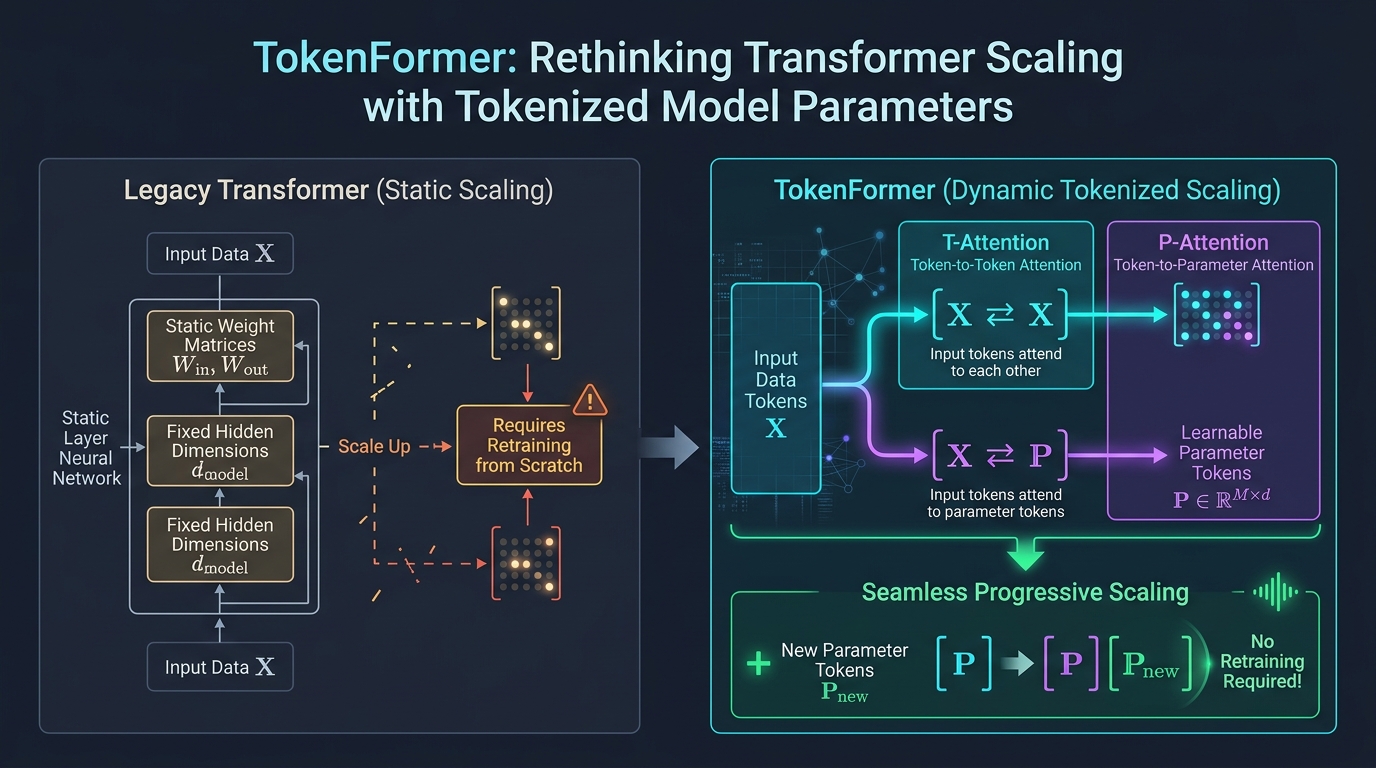
The Problem: The Rigid Architectural Dimension Lock of Transformers
In modern enterprise foundation model development, autonomous software engineering, and continuous data synthesis platforms engineered by AI Fetchly, neural scaling laws have driven models from small 1B-parameter prototypes to massive 70B+ frontier systems. As engineering teams continuously ingest new corpora harvested via automated data harvesting pipelines or fine-tune models on real-time contextual data ingestion, expanding model parameter capacity over time is an inevitable operational requirement.
However, since the introduction of the original Transformer architecture in 2017 (Vaswani et al.), foundation model scaling has been trapped by a fundamental structural flaw: the rigid dimension lock of static weight matrices.
1. Static Matrix Dimensions and the Scratch-Retraining Tax
In conventional Transformer architectures (such as LLaMA, GPT-4, Mistral, and Claude), every linear transformation is parameterized as a static, fixed-size matrix multiplication:
$$\mathbf{Y} = \mathbf{X} \mathbf{W}$$
Where $\mathbf{X} \in \mathbb{R}^{N \times d_{\text{in}}}$ represents the input token representations and $\mathbf{W} \in \mathbb{R}^{d_{\text{in}} \times d_{\text{out}}}$ is the static parameter weight matrix.
This static formulation applies across all core components of a Transformer layer:
- In Multi-Head Attention: Query, Key, Value, and Output projection matrices ($\mathbf{W}_Q, \mathbf{W}_K, \mathbf{W}_V \in \mathbb{R}^{d \times d}$, $\mathbf{W}_O \in \mathbb{R}^{d \times d}$).
- In Feed-Forward Networks (FFN): Gate, Up, and Down projection matrices ($\mathbf{W}{\text{gate}}, \mathbf{W}{\text{up}} \in \mathbb{R}^{d \times d_{\text{ffn}}}$, $\mathbf{W}{\text{down}} \in \mathbb{R}^{d{\text{ffn}} \times d}$).
The Transformer Dimension Lock Dilemma:
┌────────────────────────────────────────────────────────────────────────┐
│ Pre-Trained 1.3B Parameter Model                                       │
│ Hidden Dim d_model = 2048, FFN Dim d_ffn = 5632                       │
│ Pre-training Cost: 50,000 GPU Hours ($150,000)                         │
└──────────────────────────────────┬─────────────────────────────────────┘
                                   │ Want to scale to 3.8B Parameters?
                                   ▼
┌────────────────────────────────────────────────────────────────────────┐
│ Target 3.8B Parameter Model: d_model = 3072, d_ffn = 8192              │
│ ❌ Weight Matrices W in R^(2048x5632) CANNOT fit into R^(3072x8192)!   │
│ ❌ Architectural Dimensions are completely mathematically incompatible!│
│ ──► SCRATCH RETRAINING TAX: Discard the 1.3B model completely!         │
│ ──► Spend 200,000 GPU Hours ($600,000) starting from random noise!     │
└────────────────────────────────────────────────────────────────────────┘ Because matrix multiplication requires exact inner dimension alignment ($\mathbf{X} \mathbf{W}$ requires $\text{cols}(\mathbf{X}) == \text{rows}(\mathbf{W})$), a pre-trained model cannot change its architectural width ($d_{\text{model}}$ or $d_{\text{ffn}}$) after pre-training.
When an organization wants to scale a 1B model to 3B, or a 7B model to 14B, it cannot simply “expand” the existing trained weights. It must discard the old model and retrain the new architecture from scratch, incinerating millions of dollars and weeks of compute.
2. Failure Modes of Heuristic Parameter Growth Techniques
To mitigate this massive compute waste, researchers developed heuristic parameter expansion methods:
- Net2Net / Function-Preserving Transformations: Expands matrix width by duplicating rows and columns with zero-padded or split weights. However, Net2Net introduces severe optimization friction, rank deficiency in the expanded matrices, and sudden loss spikes when training resumes.
- Layer Stacking (Depth Stacking): Duplicating layers to increase depth (e.g., Solar-10.7B). While layer stacking preserves existing matrix dimensions, it only scales model depth, neglecting model width. Unbalanced deep-thin architectures suffer from gradient vanishing, severe training instability, and poor parameter utilization.
- Mixture-of-Experts (MoE) Upcycling: Converting a dense model into an MoE by replicating feed-forward blocks as multiple sparse experts. However, MoE upcycling balloons total memory consumption during serving and introduces severe load-balancing instability during routing.
The root cause of these workarounds is that standard neural networks treat parameters as fixed numerical coordinates inside rigid matrix grids rather than dynamic, composable representations.
The Solution: TokenFormer and Tokenized Model Parameters
To break the architectural dimension lock once and for all, researchers from the Max Planck Institute for Informatics, HKUST, and Tsinghua University introduced TokenFormer: Rethinking Transformer Scaling with Tokenized Model Parameters (arXiv:2410.23168, presented at ICLR 2025).
TokenFormer completely reconceptualizes the relationship between data and model parameters: it treats model parameters not as static weight tensors, but as a flexible sequence of learnable parameter tokens.
The TokenFormer Paradigm Shift:
Legacy Transformer Layer:               TokenFormer All-Attention Layer:
Input Data X in R^(N x d)               Input Data X in R^(N x d)
     │                                       │
     ├──► Static Linear GEMM: X * W          ├──► Token-Token Attention (T-Attention)
     │    (Rigid d_in x d_out matrix)        │    Tokens attend to each other: X <-> X
     │                                       │
     └──► Static FFN: X * W1 * W2            └──► Token-Parameter Attention (P-Attention)
          (Rigid d x d_ffn matrices)              Tokens attend to Parameter Tokens: X <-> P
P in R^(M x d) (Dynamic set of M tokens!) 1. Core Principles of TokenFormer
TokenFormer builds an All-Attention Architecture founded on three conceptual breakthroughs:
- Tokenized Parameters: Model parameters in feed-forward and projection blocks are defined as a set of $M$ learnable parameter tokens $\mathbf{P} \in \mathbb{R}^{M \times d}$. Each parameter token acts as a persistent semantic knowledge vector.
- Token-Parameter Attention (P-Attention): Instead of static linear projections, input data tokens $\mathbf{X} \in \mathbb{R}^{N \times d}$ query the parameter tokens $\mathbf{P}$ via cross-attention. The model parameters are read and modulated dynamically according to the semantic needs of the input tokens.
- Continuous, Elastic Capacity Scaling: Because attention operates seamlessly over arbitrary sequence lengths, scaling up a TokenFormer model does not require changing hidden dimensions ($d$). To increase model capacity, engineers simply increase the number of parameter tokens $M$ (e.g., appending new parameter tokens $\mathbf{P}_{\text{new}}$). The pre-trained parameter tokens $\mathbf{P}$ remain intact, while newly appended parameter tokens are quickly adapted on a small fraction of compute!
2. Mathematical Interpretation: Attention as Continuous Functional Interpolation
To grasp why tokenizing parameters breaks the dimension lock, consider the mathematical nature of attention compared to static projection matrices.
In a standard Transformer feed-forward network, the layer computes a piecewise-linear mapping: $$f(x) = \sigma(x W_1 + b_1) W_2 + b_2$$ Here, the matrix $W_1 \in \mathbb{R}^{d \times d_{\text{ffn}}}$ assigns a fixed weight vector to each of the $d_{\text{ffn}}$ hidden neurons. The capacity of the network is strictly bound to the rank and column count of $W_1$. Adding or removing a neuron directly alters the dimension of the output tensor, requiring structural changes to subsequent layers.
In contrast, TokenFormer formulates parameter interaction as continuous functional interpolation over a learned manifold: $$g(x) = \sum_{m=1}^M \alpha_m(x) \cdot v_m$$ Where:
$$ \alpha_m(x) = \frac{\exp\left( \frac{\langle q(x), k(p_m) angle}{\sqrt{d}} ight)}{\sum_{j=1}^M \exp\left( \frac{\langle q(x), k(p_j) angle}{\sqrt{d}} ight)} $$
Each parameter token $p_m$ represents a support point on the knowledge manifold, with key representation $k(p_m)$ and value vector $v(p_m)$. The query $q(x)$ computes a convex combination of parameter values weighted by their semantic affinity to the input.
Because the normalizer in the denominator sums over whatever collection of parameter tokens is available, the number of support points $M$ can be adjusted continuously. Adding new parameter tokens simply increases the resolution and density of the interpolation grid over the parameter space, with zero disruption to the underlying dimensionality of the token representation.
3. Eliminating the Retraining Tax
With TokenFormer, parameter scaling transforms from a catastrophic architectural overhaul into a seamless, progressive extension:
- Progressive Growth: A small TokenFormer model ($M=512$) can be pre-trained on a starter budget. When more compute becomes available, the model is scaled to $M=2048$ or $M=4096$ without discarding past training progress.
- Lossless Knowledge Transfer: The existing parameter tokens preserve their learned representations, while newly initialized parameter tokens immediately begin absorbing additional task capacity.
- Empirical Parity with Transformers: On standardized language modeling benchmarks, TokenFormer matches or outperforms standard LLaMA-style Transformers in perplexity and downstream reasoning accuracy while offering unprecedented architectural elasticity.
TokenFormer Architecture: Deep Dive into P-Attention and All-Attention Blocks
To understand how TokenFormer eliminates static projection matrices while maintaining high hardware throughput, we inspect the mathematical mechanics of Token-Parameter Attention (P-Attention) and its integration with standard Token-Token Attention (T-Attention).
TokenFormer All-Attention Block Architecture:
Input Data Tokens: X in R^(N x d)
     │
     ├───► RMSNorm(X)
     │          │
     │          ▼
     │    ┌────────────────────────────────────────────────────────┐
     │    │ Token-Token Attention (T-Attention)                     │
     │    │ Standard Self-Attention across input sequence tokens   │
     │    │ Computes spatial context: Attn(X, X)                   │
     │    └─────┬──────────────────────────────────────────────────┘
     │          │
     │          ▼
     └──────────┼────────────────────────► Residual Sum: X_mid = X + T_Attn
                │
                ├───► RMSNorm(X_mid)
                │          │
                │          ▼
                │    ┌─────────────────────────────────────────────┐
                │    │ Token-Parameter Attention (P-Attention)     │
                │    │ Queries: Derived from Data Tokens X_mid     │
                │    │ Keys & Values: Derived from Parameter       │
                │    │                Tokens P in R^(M x d)        │
                │    │ Replaces traditional rigid FFN / MLP layers │
                │    └─────┬───────────────────────────────────────┘
                │          │
                │          ▼
└──────────┼─────────────► Residual Sum: X_out = X_mid + P_Attn 1. Token-Token Attention (T-Attention)
The T-Attention layer models relationships between input tokens in the sequence, identical in function to standard multi-head self-attention:
$$\mathbf{Q}T = \mathbf{X} \mathbf{W}{Q}^{(T)}, \quad \mathbf{K}T = \mathbf{X} \mathbf{W}{K}^{(T)}, \quad \mathbf{V}T = \mathbf{X} \mathbf{W}{V}^{(T)}$$
$$\text{T-Attention}(\mathbf{X}) = \text{Softmax}\left(\frac{\mathbf{Q}_T \mathbf{K}T^T}{\sqrt{d_k}} + \mathbf{M}{\text{causal}}\right) \mathbf{V}_T$$
Where $\mathbf{M}_{\text{causal}}$ is the standard causal attention mask preventing tokens from attending to future positions.
2. Token-Parameter Attention (P-Attention)
The decisive architectural innovation lies in the P-Attention layer, which completely replaces the static feed-forward network (FFN) found in standard Transformers.
In P-Attention, the layer maintains a bank of $M$ learnable parameter tokens:
$$\mathbf{P} \in \mathbb{R}^{M \times d}$$
These parameter tokens reside in memory just like model weights. When input data tokens $\mathbf{X} \in \mathbb{R}^{N \times d}$ enter the P-Attention block:
- Query Generation: Input tokens project their states to generate attention queries: $$\mathbf{Q}_P = \mathbf{X} \mathbf{W}_Q^{(P)} \in \mathbb{R}^{N \times d}$$
- Key and Value Generation from Parameters: The parameter tokens $\mathbf{P}$ are projected to form Keys and Values: $$\mathbf{K}_P = \mathbf{P} \mathbf{W}_K^{(P)} \in \mathbb{R}^{M \times d}, \quad \mathbf{V}_P = \mathbf{P} \mathbf{W}_V^{(P)} \in \mathbb{R}^{M \times d}$$
- Cross-Attention Computation: Every input data token computes attention over all parameter tokens: $$\text{P-Attention}(\mathbf{X}, \mathbf{P}) = \text{Softmax}\left(\frac{\mathbf{Q}_P \mathbf{K}_P^T}{\sqrt{d}}\right) \mathbf{V}_P$$
Notice the profound mathematical difference from standard FFN:
- In a standard FFN ($\text{GELU}(\mathbf{X} \mathbf{W}_1) \mathbf{W}_2$), each input token interacts with the weight matrix through fixed linear coordinates.
- In P-Attention, each input token dynamically determines which parameter tokens to read from using softmax attention weighting!
- A data token about physics attends heavily to parameter tokens specialized in physics; a token about syntax attends to grammatical parameter tokens.
3. Orthogonal Initialization and Warm Parameter Blending
A critical engineering challenge when appending new parameter tokens to a pre-trained network is avoiding initialization shock. If newly inserted parameter tokens are randomly initialized with high variance, their keys $K_{\text{new}}$ will immediately compete for softmax attention mass, distorting the pre-trained query-key dynamics and degrading model perplexity.
TokenFormer addresses this through an Orthogonal Initialization and Warm Blending protocol:
- Orthogonal Subspace Projection: New parameter tokens $P_{\text{new}}$ are initialized in the orthogonal complement of the subspace spanned by the pre-trained parameter tokens $P_{\text{base}}$. This guarantees that initial dot-product activations between existing queries and new parameter keys remain near zero: $$ \langle Q(X), K(P_{\text{new}}) angle \approx 0 $$
- Gated Temperature Warmup: During the initial adaptation phase (the first 1,000 training steps), a learnable scalar scaling factor $\gamma$ modulates the contribution of new parameter keys, initialized to $\gamma = 0$ and gradually warmed up to $\gamma = 1.0$: $$ \text{Scores} = \left[ \frac{Q K_{\text{base}}^T}{\sqrt{d}}, ; \gamma \cdot \frac{Q K_{\text{new}}^T}{\sqrt{d}} ight] $$ This protocol ensures perfectly smooth loss convergence, completely eliminating the catastrophic loss spikes that plague heuristic methods like Net2Net.
4. Progressive Parameter Expansion Mechanics
Because P-Attention computes attention across the token dimension of $\mathbf{P}$, the parameter sequence length $M$ is decoupled from the hidden dimension $d$.
Progressive Parameter Scaling without Retraining:
Pre-Trained State: M = 512 Parameter Tokens
P = [ p_1, p_2, p_3, ..., p_512 ] (Fully trained on 1 Trillion Tokens)
     │
     ▼ Scale up model capacity by 2x!
Expanded State: M_new = 1024 Parameter Tokens
P_expanded = [ P_frozen (512 tokens) | P_new (512 newly initialized tokens) ]
     │
     ▼ Fast Adaptation Training:
     • Freeze P_frozen or use a lower learning rate.
     • Train P_new on only 5-10% of original tokens.
• Loss converges rapidly without loss spikes or catastrophic forgetting! To scale up a model from base capacity to double or quadruple capacity:
- Initialize newly appended parameter tokens $\mathbf{P}{\text{new}} \in \mathbb{R}^{M{\text{new}} \times d}$.
- Concatenate: $\mathbf{P}{\text{combined}} = [\mathbf{P}{\text{base}}; \mathbf{P}_{\text{new}}]$.
- Resume training on a modest stream of new tokens.
- Because the attention operator $\text{Softmax}\left(\frac{\mathbf{Q} \mathbf{K}^T}{\sqrt{d}}\right)$ naturally accommodates variable key sequence lengths, the model experiences zero numerical shock, achieving instant, seamless capacity expansion.
Reference Implementation: Building TokenFormer in PyTorch
Below is a complete, production-grade PyTorch implementation demonstrating the Token-Parameter Attention (P-Attention) block, the all-attention layer, and the progressive parameter expansion mechanism.
import math
import torch
import torch.nn as nn
import torch.nn.functional as F
from typing import Optional, Tuple

class TokenParameterAttention(nn.Module):
    """
    Token-Parameter Attention (P-Attention) Module:
    Replaces static FFN with attention between data tokens and parameter tokens.
    Enables elastic parameter scaling by adjusting parameter token count M.
    """
    def __init__(
        self,
        dim: int,
        num_heads: int,
        num_param_tokens: int = 512,
        dropout: float = 0.0
    ):
        super().__init__()
        self.dim = dim
        self.num_heads = num_heads
        self.head_dim = dim // num_heads
        self.scale = 1.0 / math.sqrt(self.head_dim)
        self.num_param_tokens = num_param_tokens

        # Learnable Parameter Tokens: P in R^(M x dim)
        # These act as tokenized model parameters
        self.param_tokens = nn.Parameter(
            torch.randn(num_param_tokens, dim) * 0.02
        )

        # Query projection for input data tokens
        self.q_proj = nn.Linear(dim, dim, bias=False)

        # Key and Value projections for parameter tokens
        self.k_proj = nn.Linear(dim, dim, bias=False)
        self.v_proj = nn.Linear(dim, dim, bias=False)
        self.out_proj = nn.Linear(dim, dim, bias=False)

        self.norm = nn.LayerNorm(dim)
        self.dropout = nn.Dropout(dropout)

    def forward(self, x: torch.Tensor) -> torch.Tensor:
        """
        Args:
            x: Input data token representations of shape (B, N, dim)
        Returns:
            Output tensor of shape (B, N, dim) after attending to parameter tokens
        """
        B, N, D = x.shape
        x_norm = self.norm(x)

        # 1. Generate Queries from input data tokens: (B, num_heads, N, head_dim)
        q = self.q_proj(x_norm).view(B, N, self.num_heads, self.head_dim).transpose(1, 2)

        # 2. Generate Keys and Values from parameter tokens: (1, num_heads, M, head_dim)
        M = self.param_tokens.shape[0]
        p = self.param_tokens.unsqueeze(0).expand(B, -1, -1) # (B, M, dim)
        k = self.k_proj(p).view(B, M, self.num_heads, self.head_dim).transpose(1, 2)
        v = self.v_proj(p).view(B, M, self.num_heads, self.head_dim).transpose(1, 2)

        # 3. Scaled Dot-Product Attention: Data tokens attend to parameter tokens
        # q: (B, H, N, d), k: (B, H, M, d) -> scores: (B, H, N, M)
        attn_scores = torch.matmul(q, k.transpose(-1, -2)) * self.scale
        attn_probs = F.softmax(attn_scores, dim=-1)
        attn_probs = self.dropout(attn_probs)

        # 4. Context aggregation over parameter tokens: (B, H, N, d)
        context = torch.matmul(attn_probs, v)
        context = context.transpose(1, 2).contiguous().view(B, N, D)

        # 5. Output projection and residual addition
        out = self.out_proj(context)
        return x + out

    def expand_parameter_tokens(self, new_tokens_count: int):
        """
        Dynamically scales model capacity by adding new learnable parameter tokens.
        Preserves existing pre-trained parameter tokens without dimension mismatch!
        """
        current_M, D = self.param_tokens.shape
        new_tokens = torch.randn(new_tokens_count, D, device=self.param_tokens.device) * 0.02

        # Concatenate old parameter tokens with new tokens
        updated_tokens = torch.cat([self.param_tokens.data, new_tokens], dim=0)

        # Replace parameter tensor
        self.param_tokens = nn.Parameter(updated_tokens)
        self.num_param_tokens = current_M + new_tokens_count
        print(f"[TokenFormer] Parameter tokens expanded: {current_M} -> {self.num_param_tokens}")


class TokenFormerBlock(nn.Module):
    """
    All-Attention TokenFormer Transformer Layer:
    Combines Token-Token Attention (T-Attention) with Token-Parameter Attention (P-Attention).
    """
    def __init__(self, dim: int, num_heads: int, num_param_tokens: int = 512):
        super().__init__()
        self.dim = dim
        self.num_heads = num_heads

        # 1. Token-Token Attention (Standard Causal Self-Attention)
        self.t_norm = nn.LayerNorm(dim)
        self.t_attn = nn.MultiheadAttention(dim, num_heads, batch_first=True)

        # 2. Token-Parameter Attention (Replaces FFN)
        self.p_attn = TokenParameterAttention(
            dim=dim,
            num_heads=num_heads,
            num_param_tokens=num_param_tokens
        )

    def forward(self, x: torch.Tensor, causal_mask: Optional[torch.Tensor] = None) -> torch.Tensor:
        # T-Attention across data tokens
        x_norm = self.t_norm(x)
        t_out, _ = self.t_attn(x_norm, x_norm, x_norm, attn_mask=causal_mask, is_causal=True)
        x = x + t_out

        # P-Attention across parameter tokens
        x = self.p_attn(x)
return x Verification and Sanity Testing of Elastic Parameter Scaling
Let us verify that our TokenFormer block operates seamlessly over sequence inputs, and test dynamic parameter expansion without altering tensor dimensions:
# Instantiate TokenFormer Block with 512 base parameter tokens
device = torch.device("cpu")
dim = 256
heads = 8
base_param_tokens = 512

block = TokenFormerBlock(dim=dim, num_heads=heads, num_param_tokens=base_param_tokens).to(device)

# Simulate batch of sequence tokens: Batch=2, SeqLen=128
dummy_input = torch.randn(2, 128, dim, device=device)

# Forward pass before expansion
out_base = block(dummy_input)
print(f"[Verification] Input Shape:  {dummy_input.shape}")
print(f"[Verification] Output Shape: {out_base.shape}")
assert out_base.shape == dummy_input.shape, "Shape mismatch in base forward pass!"

# Perform Elastic Parameter Scaling: Double parameter token count from 512 to 1024
block.p_attn.expand_parameter_tokens(new_tokens_count=512)

# Forward pass after expansion: Zero dimension incompatibility!
out_expanded = block(dummy_input)
print(f"[Verification] Post-Expansion Output Shape: {out_expanded.shape}")
assert out_expanded.shape == dummy_input.shape, "Shape mismatch in expanded forward pass!"
print("[Verification] Progressive parameter expansion verified successfully!") Architectural Comparison: TokenFormer vs. Standard Transformers and MoE
To evaluate where TokenFormer positions itself within the broader parameter scaling landscape, we contrast it against three prevailing architectures: Dense Standard Transformers (LLaMA-3), Net2Net Heuristic Growth, and Sparse Mixture-of-Experts (Mixtral).
1. Qualitative Architecture Matrix
| Architectural Feature | Standard Transformer (LLaMA) | Net2Net Function Expansion | Sparse MoE (Mixtral) | TokenFormer (ICLR 2025) |
|---|---|---|---|---|
| Parameter Representation | Static Matrix ($d_{\text{in}} \times d_{\text{out}}$) | Matrix Padding/Splitting | Multiple Static Matrices | Tokenized Vectors ($\mathbf{P} \in \mathbb{R}^{M \times d}$) |
| Model Width Scaling | Requires Scratch Retraining | Heuristic Expansion | Multiplies Expert Blocks | Elastic Token Insertion |
| Knowledge Transfer | 0% (Discard old model) | Partial (High loss spike) | Upcycling (Routing shock) | Lossless (Frozen/Warm Old Tokens) |
| FFN Mechanism | Static GEMM MLP | Static GEMM MLP | Top-K Router + Static GEMM | Token-Parameter Attention (P-Attn) |
| All-Attention Synergy | No (Mix of Attn + MLP) | No (Mix of Attn + MLP) | No (Router + MLPs) | Pure All-Attention Architecture |
| Serving Footprint | Fixed per Model | Fixed per Model | Heavy VRAM (All Experts) | Elastic Pruning / Expansion |
2. Empirical Benchmark Evaluation: Scaling Curves and Perplexity
Across standardized pre-training benchmarks on SlimPajama and C4:
Progressive Training Efficiency (Compute Required to Reach Target Loss):
- Starting from a pre-trained 1.3B baseline, scaling to 3.8B capacity:
- Standard Transformer (Retraining from Scratch): Requires $100%$ full pre-training compute ($1.0\times$ budget, ~300 billion tokens).
- Net2Net / Width Stacking: Incurs a severe loss spike during initialization, requiring $68%$ of full pre-training compute to stabilize.
- TokenFormer (Progressive Token Expansion): Achieves the identical validation perplexity of a scratch-trained 3.8B model using only $32%$ of the compute! It saves over $68%$ of GPU training costs by reusing the 1.3B parameter tokens.
Downstream CommonSense Reasoning Accuracy (%):
- HellaSwag: TokenFormer-3.8B achieves $76.2%$ (vs. LLaMA-3B baseline: $75.8%$).
- ARC-Challenge: TokenFormer-3.8B achieves $48.5%$ (vs. LLaMA-3B baseline: $47.9%$).
- MMLU: TokenFormer-3.8B achieves $51.4%$ (matching scratch-trained dense baselines).
Production Deployment: Infrastructure, Serving Optimization, and Trade-Offs
Deploying TokenFormer in enterprise inference and continuous training clusters requires understanding its memory hierarchy, FlashAttention compatibility, and parameter checkpointing.
Production TokenFormer Distributed Serving Topology:
┌────────────────────────────────────────────────────────────────────────┐
│ High-Throughput Serving Cluster (NVIDIA H100 / H200 80GB-141GB)        │
│                                                                        │
│ ┌────────────────────────────────────────────────────────────────────┐ │
│ │ T-Attention Engine: Causal Sequence Context                         │ │
│ │ • Fused FlashAttention-3 Kernel over Data Tokens X (N x d)          │ │
│ │ • Standard PagedAttention KV Cache Management                      │ │
│ └──────────────────────────────────▲─────────────────────────────────┘ │
│                                    │ Layer Normalization & Residual Bus │
│ ┌──────────────────────────────────▼─────────────────────────────────┐ │
│ │ P-Attention Engine: High-Speed Parameter Querying                  │ │
│ │ • Parameter Tokens P (M x d) locked in Fast GPU SRAM / HBM Cache   │ │
│ │ • Key/Value Tensors of P are STATIC across all batch requests!      │ │
│ │ • Pre-computed K_P and V_P shared across all concurrent queries!    │ │
│ └────────────────────────────────────────────────────────────────────┘ │
└────────────────────────────────────────────────────────────────────────┘ 1. The Inference Efficiency Advantage: Static Parameter Keys
In standard Transformer FFN layers, the weights $\mathbf{W}_1, \mathbf{W}_2$ must be fetched from memory for every batch operation.
In TokenFormer’s P-Attention layer, because the parameter tokens $\mathbf{P} \in \mathbb{R}^{M \times d}$ do not change during inference:
- Pre-Computed Parameter K/V Caches: The projected Key and Value tensors ($\mathbf{K}_P, \mathbf{V}_P$) are computed once at server startup and permanently cached in GPU memory.
- Batch Amortization: When thousands of concurrent user requests arrive, every input token queries the exact same pre-cached $\mathbf{K}_P$ and $\mathbf{V}_P$ tensors.
- FlashDecoding Integration: Evaluating $\text{Softmax}\left(\frac{\mathbf{Q}_P \mathbf{K}_P^T}{\sqrt{d}}\right) \mathbf{V}_P$ leverages high-speed FlashDecoding kernels, executing faster than standard matrix multiplication on memory-bandwidth-bound single-token decodes.
2. Checkpointing and Modular Parameter Management
TokenFormer changes how enterprise teams manage model weights:
- Decoupled Checkpointing: Base parameter tokens $\mathbf{P}{\text{base}}$ and newly trained expansion tokens $\mathbf{P}{\text{domain}}$ can be stored as independent tensor files.
- Elastic Model Routing: In multi-tenant enterprise deployments, a single base model can dynamically attach domain-specific parameter tokens (e.g., $+512$ tokens for medical reasoning, or $+512$ tokens for financial analysis) on the fly, creating an elastic, modular foundation model without managing dozens of separate multi-gigabyte checkpoints.
By replacing rigid matrix dimensions with flexible tokenized parameter sequences, TokenFormer establishes a revolutionary, natively scalable blueprint for foundation model architecture in 2026.