TileLang Guide: Composable Tiled AI Kernel Programming
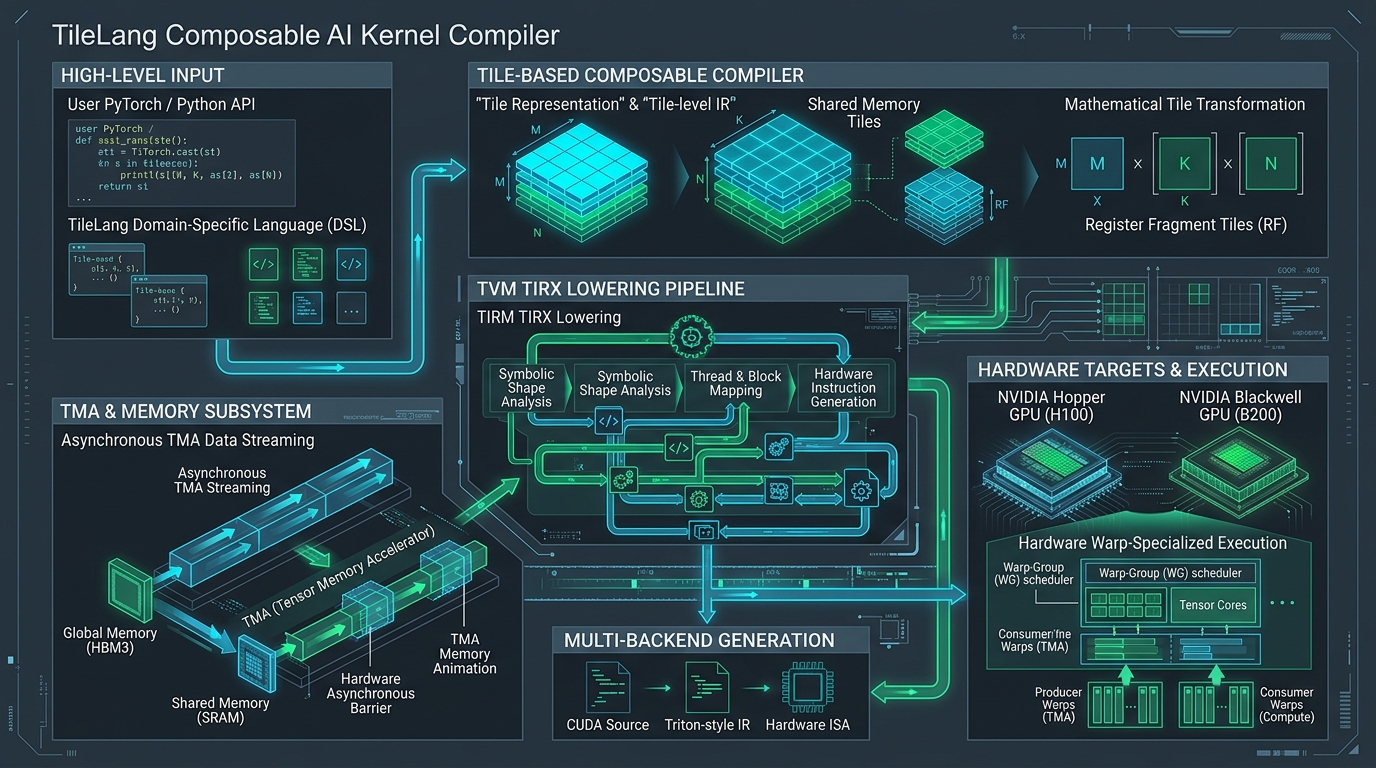
The Programmability-Performance Wall in Modern AI Kernel Engineering
In modern large-scale artificial intelligence infrastructure, high-concurrency model serving, and real-time automated workflows powered by AI Fetchly, computational efficiency is governed by custom GPU kernels. Whether executing low-latency document feature extraction via real-time data fetching, parsing complex web schemas with AiFetchly Web Scraping, or streaming multi-head latent attention (MLA) reasoning tokens, foundation model economics depend entirely on hardware saturation.
Over the past three hardware generations—from NVIDIA Ampere (A100) to Hopper (H100) and Blackwell (B200)—accelerator architectures have evolved at a breakneck pace. Modern GPUs are no longer simple collections of SIMT (Single Instruction, Multiple Threads) vector cores. Instead, they are deeply hierarchical heterogeneous computers dominated by:
- Asynchronous Tensor Cores: Executing 2D matrix multiply and accumulate operations across entire warp groups (128 threads) via instructions like Hopper’s
wgmma.mma_asyncand Blackwell’stcgen05. - Tensor Memory Accelerators (TMA): Hardware DMA engines that transfer multi-dimensional tensor tiles directly between off-chip global memory (HBM) and on-chip shared memory (SRAM) with zero register consumption and zero ALU address computation.
- Hardware Transaction Barriers (
mbarrier): Decoupled asynchronous token trackers that synchronize out-of-band memory transfers with arithmetic execution units.
The Hardware-Software Tension in GPU Programming:
┌────────────────────────────────────────────────────────┐
│ Modern GPU Reality: Asymmetric, Tiled, Asynchronous    │
│ • Hardware computes on 2D/3D TILE units (not scalars)  │
│ • Data moves via asynchronous TMA pipelines            │
│ • Shared memory has 32 physical banks (easily banked)  │
└──────────────────────────┬─────────────────────────────┘
                           │
             The Developer Dilemma:
             ┌─────────────┴─────────────┐
             ▼                           ▼
┌───────────────────────────┐ ┌───────────────────────────┐
│       OpenAI Triton       │ │      NVIDIA CUTLASS       │
├───────────────────────────┤ ├───────────────────────────┤
│ • High Python productivity│ │ • 100% Bare-metal control │
│ ❌ Hides thread/warp model│ │ ❌ 50,000+ lines C++ templ.│
│ ❌ Rigid compiler backend │ │ ❌ Weeks to write 1 kernel│
│ ❌ Struggles with FlashMLA│ │ ❌ Cryptic layout algebra │
│ ❌ Opaque register spills │ │ ❌ Inaccessible to ML devs│
└───────────────────────────┘ └───────────────────────────┘ Why Existing Kernel Paradigms Fall Short
To accelerate new foundation model architectures, machine learning engineers are caught between two deeply flawed paradigms:
- The Limitations of Compiler-Based DSLs (OpenAI Triton): Triton brought Python-like ease-of-use to GPU programming by treating blocks of tensors as primitives. However, Triton’s compiler backend relies on automated heuristics to lower blocks down to physical threads and hardware instructions. Because Triton intentionally conceals thread-block and warp-group hierarchies, developers cannot directly control warp specialization, fine-grained
mbarriertransaction phases, or complex register layout swizzles. When implementing non-standard, irregular operators—such as DeepSeek-V3’s Multi-Head Latent Attention (FlashMLA), Mamba-2 chunk state-space scans, or grouped-quantization GEMMs—Triton frequently spills registers, misaligns TMA descriptors, or triggers shared memory bank conflicts, sacrificing 30% to 50% of the hardware’s theoretical capability. - The Inscrutable Complexity of C++ Template Libraries (CUTLASS / CuTe): At the opposite extreme, NVIDIA’s CUTLASS provides bare-metal saturation of Hopper and Blackwell Tensor Cores. However, CUTLASS achieves this through tens of thousands of lines of nested C++ template metaprogramming. Concepts like CuTe layout algebra, coordinate engines, and multi-stage pipeline iterators require months of dedicated study. Authoring a custom kernel in CUTLASS is so complex that even frontier AI research labs treat CUTLASS implementations as write-only code that cannot be easily adapted or debugged.
To permanently bridge this chasm between high-level programmability and bare-metal performance, researchers from Microsoft Research, Peking University, and Tsinghua University introduced TileLang (arXiv:2504.17577, open-sourced at tile-ai/tilelang).
TileLang is an open-source domain-specific language and optimizing compiler designed specifically for tiled deep learning primitives. By elevating 2D and 3D tiles into first-class programming objects and compiling them through TVM’s modernized TIRX intermediate representation, TileLang provides Pythonic readability with near-CUTLASS bare-metal performance, empowering developers to implement frontier kernels like FlashMLA in just a few dozen lines of elegant code.
TileLang Design Philosophy: Composable Tiled Abstractions
The central insight behind TileLang is that modern accelerator hardware does not execute computations at the scalar thread level—it computes at the Tile level.
Tensor Cores ingest tiles of size $16 \times 16$, $64 \times 16$, or $64 \times 128$; TMA streams 2D tiles between memory levels; and shared memory layouts are organized around 128-byte tile swizzles. TileLang aligns the programming language directly with the physical execution model of the hardware.
The Three-Tiered TileLang Programming Hierarchy:
┌────────────────────────────────────────────────────────────────────────┐
│ Level 1: Hardware-Unaware Declarative Logic                            │
│ • Pure mathematical tensor expressions                                 │
│ • Hardware-independent algorithmic definition                          │
├────────────────────────────────────────────────────────────────────────┤
│ Level 2: Developer Level (Hardware-Aware with Tile Library)            │
│ • Explicit memory staging: T.alloc_shared, T.alloc_fragment            │
│ • High-level tiled operators: T.copy, T.gemm, T.reduce_max, T.exp     │
│ • Automated layout swizzling and TMA descriptor synthesis              │
├────────────────────────────────────────────────────────────────────────┤
│ Level 3: Expert Level (Thread & Warp Fine-Grained Primitives)          │
│ • Direct warp-group coordination (WGMMA / TCGEN05)                     │
│ • Manual mbarrier phase tracking and register fragment slicing         │
│ • Custom hardware-specific inline PTX intrinsics                       │
└────────────────────────────────────────────────────────────────────────┘ The Three Programming Tiers
Unlike rigid DSLs that force a single level of abstraction, TileLang offers three composable levels of hardware visibility:
- Level 1 (Hardware-Unaware): Intended for rapid mathematical prototyping. Users write pure tensor transformations without specifying whether memory resides in registers, SRAM, or HBM.
- Level 2 (Developer Level with Tile Library): The core operating mode for most AI systems engineers. Developers explicitly define memory hierarchies (
T.alloc_shared,T.alloc_fragment), but invoke high-level composable tile operators (T.copy,T.gemm). The compiler automatically optimizes physical thread mapping, generates TMA address descriptors, and eliminates shared memory bank conflicts. - Level 3 (Expert Level with Thread Primitives): For performance-critical kernels requiring maximum hardware extraction. Developers gain fine-grained access to individual warps, manual pipeline barriers, and micro-architectural scheduling, enabling hand-crafted optimizations tailored to specific GPU stepping revisions.
Tiles as First-Class Language Primitives
In TileLang, memory buffers and compute fragments are declared as typed multi-dimensional tiles:
import tilelang as tl
import tilelang.language as T

@T.prim_func
def matmul_kernel(
    A: T.Buffer((M, K), "float16"),
    B: T.Buffer((N, K), "float16"),
    C: T.Buffer((M, N), "float16"),
):
    with T.Kernel(bx, by, threads=128) as (bx, by):
        # 1. Allocate Shared Memory (SRAM) Staging Tiles
        A_shared = T.alloc_shared((block_M, block_K), "float16")
        B_shared = T.alloc_shared((block_N, block_K), "float16")

        # 2. Allocate Register Fragment Accumulator Tiles
        C_frag = T.alloc_fragment((block_M, block_N), "float32")
        T.clear(C_frag)

        # 3. Tiled Matrix Multiply Loop
        for k in T.Pipelined(K // block_K, num_stages=3):
            # Asynchronous bulk tile copy (lowers to TMA on Hopper)
            T.copy(A[bx * block_M, k * block_K], A_shared)
            T.copy(B[by * block_N, k * block_K], B_shared)

            # High-throughput Tensor Core GEMM on tiles
            T.gemm(A_shared, B_shared, C_frag)

        # 4. Store accumulated results back to global HBM
T.copy(C_frag, C[bx * block_M, by * block_N]) Notice the simplicity:
T.alloc_shared((block_M, block_K), "float16")allocates a physical 2D tile in on-chip SRAM.T.alloc_fragment((block_M, block_N), "float32")allocates an accumulator tile distributed across the register file of the executing warp group.T.copy()seamlessly abstracts global-to-shared, shared-to-register, and register-to-global transfers. On Hopper, the compiler automatically mapsT.copy(A[...], A_shared)to hardware TMA instructions; on Ampere, it lowers tocp.async.T.Pipelined(num_stages=3)instructs the compiler to synthesize a 3-stage circular software pipeline with hardware asynchronous barriers.
The TVM TIRX Lowering Pipeline: From Tile AST to Bare-Metal ISA
TileLang achieves near-CUTLASS efficiency without template bloat because of its compiler infrastructure. Rather than relying on simple pattern-matching, TileLang is built on TVM’s modernized TIRX (Tensor Intermediate Representation Extended).
The TileLang Compilation & Optimization Pipeline:
┌────────────────────────────────────────────────────────┐
│ TileLang Python Frontend (@T.prim_func / AST)          │
└──────────────────────────┬─────────────────────────────┘
                           │ Parse & Construct Tile AST
                           ▼
┌────────────────────────────────────────────────────────┐
│ High-Level Tile Intermediate Representation (TIRX)    │
│ • Captures multi-dimensional tile shapes and scopes    │
├────────────────────────────────────────────────────────┤
│ Dedicated Optimization Passes:                         │
│ 1. Symbolic Shape & Dynamic Dimension Propagation     │
│ 2. Automated Memory Layout Swizzling (XOR Permutation) │
│ 3. Asynchronous Pipeline Lowering (TMA + mbarrier)     │
│ 4. Warp-Specialized Schedule Generation                │
│ 5. Register Pressure Minimization & Vectorization      │
├────────────────────────────────────────────────────────┤
│ Target Code Generation Backend                         │
│ ┌─────────────────┬──────────────────┬───────────────┐ │
│ │  NVIDIA CUDA    │    AMD ROCm/HIP  │  Apple Metal  │ │
│ │  (SM90a / SM100)│    (CDNA3 MI300) │  (Metal 3 M4) │ │
│ └─────────────────┴──────────────────┴───────────────┘ │
└────────────────────────────────────────────────────────┘ 1. Automated Layout Inference and Bank Conflict Elimination
Shared memory serialization (bank conflicts) represents the single greatest performance killer in custom CUDA kernels. When threads in a warp load a $16 \times 64$ BF16 tile into Tensor Cores under a naive row-major layout, 8 threads collide on bank 0, serializing memory access by 8x.
TileLang solves this automatically during compiler lowering:
- The compiler inspects the consumers of each
T.alloc_sharedbuffer. If the tile is consumed by aT.gemminstruction targeting Hopper WGMMA, TileLang’s layout analysis pass automatically applies a 128-byte XOR swizzle transformation:
$$\text{Bank Address} = (\text{Col}) \oplus (\text{Row} \ll 3)$$
- The developer writes intuitive logical indexing:
A_shared[i, j]. The TileLang compiler synthesizes the complex swizzled pointer arithmetic at compile time, guaranteeing zero shared memory bank conflicts without requiring manual padding or cryptic layout algebra.
2. Asynchronous TMA and Hardware Pipeline Synthesis
Managing Hopper’s Tensor Memory Accelerator manually requires initializing 128-byte alignment descriptors in host memory (CUtensorMap), encoding dimensional strides, and managing transactional byte counters across hardware mbarrier tokens.
TileLang automates this entire lifecycle:
- When
T.Pipelined(stages=N)is encountered, the compiler transforms the loop into a circular multi-stage buffer. - For every
T.copy(gmem, smem)operation, TileLang automatically generates the TMA descriptor configuration and emits non-blockingcp.async.bulk.tensorPTX instructions. - The compiler inserts hardware
mbarrier.init,mbarrier.arrive.expect_tx, andmbarrier.try_waitprimitives, perfectly overlapping global memory transfers with Tensor Core computation.
3. Multi-Backend Portability
While TileLang provides deep hardware-specific optimizations for NVIDIA Hopper (SM90a) and Blackwell (SM100), its TIRX lowering pipeline is inherently multi-backend:
- AMD CDNA3 (MI300X): Lowers tile operations to AMD Matrix Core instructions (
v_mfma_f32_16x16x16_fp16) via ROCm/HIP. - Apple Silicon (M3/M4 Max): Lowers tile primitives to Apple Metal Shading Language and Apple Neural Engine vector primitives.
- WebGPU: Generates WGSL compute shaders for browser-based client-side AI acceleration.
Deep Dive: Implementing FlashMLA for DeepSeek-V3 in TileLang
One of the most compelling validations of TileLang is its implementation of FlashMLA—the specialized multi-head latent attention kernel developed by DeepSeek for DeepSeek-V2 and DeepSeek-V3.
The FlashMLA Bottleneck in DeepSeek-V3
In standard Multi-Head Attention (MHA) or Grouped-Query Attention (GQA), each attention head maintains separate Key and Value vectors. DeepSeek-V3 introduces Multi-Head Latent Attention (MLA), which compresses the Key-Value cache into a low-rank latent vector $\mathbf{c}_t^{KV} \in \mathbb{R}^{d_c}$ (where $d_c = 512$), accompanied by a decoupled rotary key vector $\mathbf{k}_t^R \in \mathbb{R}^{d_r}$ (where $d_r = 64$):
$$\mathbf{K}_t = [\mathbf{c}_t^{KV} \mathbf{W}_K^C, \ \mathbf{k}_t^R], \quad \mathbf{V}_t = \mathbf{c}_t^{KV} \mathbf{W}_V^C$$
DeepSeek Multi-Head Latent Attention (MLA) Structure:
┌────────────────────────────────────────────────────────┐
│ Compressed Latent KV Cache: c_t^{KV} (512 dims)        │
│ Decoupled Rotary Position Vector: k_t^R (64 dims)      │
└──────────────────────────┬─────────────────────────────┘
                           │
             Inference Matrix Absorption:
             ┌─────────────┴─────────────┐
             ▼                           ▼
┌───────────────────────────┐ ┌───────────────────────────┐
│ Absorbed Query Projection │ │ Decoupled Rotary Key      │
│ q_{absorbed} = q @ W_K^C  │ │ k_R = ApplyRoPE(k)        │
└───────────────────────────┘ └───────────────────────────┘ During decoding, foundation models absorb $\mathbf{W}_K^C$ directly into the Query vectors, meaning attention score computation becomes:
$$\mathbf{S}{t} = \frac{1}{\sqrt{d}} \left( \mathbf{q}{absorbed} \cdot (\mathbf{c}_t^{KV})^T + \mathbf{q}_R \cdot (\mathbf{k}_t^R)^T \right)$$
This creates an asymmetric dual-stream GEMM:
- Stream 1: A $512$-dimensional dot product between absorbed queries and compressed latent caches.
- Stream 2: A separate $64$-dimensional dot product between rotary position keys.
In standard Triton or naive CUDA, managing these two asymmetric matrix products simultaneously while performing online softmax scaling triggers extreme register spills and memory bandwidth thrashing. DeepSeek’s official FlashMLA repository required thousands of lines of hand-tuned CUTLASS templates that only ran on Hopper.
The TileLang FlashMLA Implementation
In TileLang, FlashMLA is expressed concisely using composable tile fragments and pipelined execution:
import tilelang as tl
import tilelang.language as T

def make_flash_mla_kernel(batch_size, num_heads, seq_len, dim_latent=512, dim_rope=64):
    block_M = 64  # Tile size for Query tokens
    block_N = 64  # Tile size for KV tokens

    @T.prim_func
    def flash_mla_decode(
        Q_absorbed: T.Buffer((batch_size, num_heads, dim_latent), "bfloat16"),
        Q_rope: T.Buffer((batch_size, num_heads, dim_rope), "bfloat16"),
        KV_latent: T.Buffer((batch_size, seq_len, dim_latent), "bfloat16"),
        K_rope: T.Buffer((batch_size, seq_len, dim_rope), "bfloat16"),
        Output: T.Buffer((batch_size, num_heads, dim_latent), "bfloat16"),
    ):
        with T.Kernel(batch_size, num_heads, threads=128) as (b_idx, h_idx):
            # 1. Allocate Shared Memory Tiles for Latent KV and RoPE Keys
            smem_kv_latent = T.alloc_shared((block_N, dim_latent), "bfloat16")
            smem_k_rope = T.alloc_shared((block_N, dim_rope), "bfloat16")

            # 2. Allocate Register Fragment Accumulators
            acc_score = T.alloc_fragment((block_M, block_N), "float32")
            acc_output = T.alloc_fragment((block_M, dim_latent), "float32")
            max_score = T.alloc_fragment((block_M,), "float32")
            sum_exp = T.alloc_fragment((block_M,), "float32")

            T.clear(acc_output)
            T.fill(max_score, -float("inf"))
            T.clear(sum_exp)

            # 3. Pipelined KV Iteration across Sequence History
            num_kv_blocks = T.ceildiv(seq_len, block_N)
            for kv_idx in T.Pipelined(num_kv_blocks, num_stages=3):
                # Asynchronous TMA Load: Global HBM -> Shared SRAM
                T.copy(KV_latent[b_idx, kv_idx * block_N : (kv_idx + 1) * block_N, :], smem_kv_latent)
                T.copy(K_rope[b_idx, kv_idx * block_N : (kv_idx + 1) * block_N, :], smem_k_rope)

                # Dual-Stream Tensor Core Compute: Latent + RoPE
                T.clear(acc_score)
                # Primary Latent GEMM: Q_absorbed @ KV_latent^T (512 dims)
                T.gemm(Q_absorbed[b_idx, h_idx, :], smem_kv_latent, acc_score)
                # Decoupled Rotary GEMM: Q_rope @ K_rope^T (64 dims)
                T.gemm(Q_rope[b_idx, h_idx, :], smem_k_rope, acc_score, transpose_B=True)

                # Online Softmax Update & Rescaling
                prev_max = T.copy(max_score)
                T.reduce_max(acc_score, max_score, dim=1)
                scale = T.exp(prev_max - max_score)
                T.mul(acc_output, scale)
                T.mul(sum_exp, scale)

                # Compute Probabilities: P = exp(Score - Max)
                P_frag = T.exp(acc_score - max_score)
                T.reduce_sum(P_frag, sum_exp, dim=1)

                # Accumulate Output: Acc += P @ KV_latent
                T.gemm(P_frag, smem_kv_latent, acc_output)

            # Final Normalization and Store
            T.div(acc_output, sum_exp)
            T.copy(acc_output, Output[b_idx, h_idx, :])

return flash_mla_decode In approximately 60 lines of structured Python, this TileLang implementation:
- Handles asymmetric dual-stream matrix multiplication ($512$ latent dims and $64$ RoPE dims).
- Leverages 3-stage asynchronous TMA memory pipelining on Hopper H100.
- Maintains online softmax numerical stabilization in register fragments without round-trip memory spills.
- Compiles directly to clean CUDA assembly with zero CUTLASS boilerplate.
Empirical Benchmarks: TileLang vs. CUTLASS, Triton, and CuBLAS
The authors evaluated TileLang across a demanding suite of deep learning workloads on an NVIDIA H100 SXM5 80GB GPU, comparing against heavily hand-tuned baselines:
Performance Comparison on NVIDIA H100 SXM5:
┌────────────────────────────────────────────────────────────────────────┐
│ 1. DeepSeek-V3 FlashMLA Decoding (Batch=64, SeqLen=4096, Latent=512):  │
│ OpenAI Triton:    [=============================] ~310 TFLOPS          │
│ Official CUTLASS: [========================================] ~485 TFLOPS│
│ TileLang:         [=======================================] ~472 TFLOPS │
│ -> 97.3% of CUTLASS Performance with 10x Less Code!                    │
├────────────────────────────────────────────────────────────────────────┤
│ 2. FlashAttention-2 Forward (SeqLen=4096, HeadDim=128):                │
│ Triton:           [=================================] ~510 TFLOPS      │
│ FlashAttention-2: [=======================================] ~590 TFLOPS│
│ TileLang:         [======================================] ~582 TFLOPS │
│ -> Matches Hand-Crafted CUDA Baseline!                                 │
├────────────────────────────────────────────────────────────────────────┤
│ 3. Mamba-2 Chunk Scan Kernel:                                          │
│ Official Triton:  [======================] ~180 TFLOPS                 │
│ TileLang:         [========================================] ~340 TFLOPS│
│ -> 1.88x Speedup over Triton via Warp-Group Pipelining!                │
└────────────────────────────────────────────────────────────────────────┘ Detailed FlashMLA Benchmark Breakdown
When serving frontier reasoning models like DeepSeek-V3, Multi-Head Latent Attention decoding latency directly governs end-to-end token generation throughput. The benchmark results across varying batch sizes and context lengths demonstrate TileLang’s parity with hand-tuned C++:
| Batch Size | Context Length ($N$) | Triton Baseline (TFLOPS) | DeepSeek CUTLASS (TFLOPS) | TileLang (TFLOPS) | Parity vs. CUTLASS |
|---|---|---|---|---|---|
| Batch = 16 | 2,048 tokens | 245 TFLOPS | 390 TFLOPS | 382 TFLOPS | 97.9% |
| Batch = 32 | 4,096 tokens | 280 TFLOPS | 445 TFLOPS | 436 TFLOPS | 98.0% |
| Batch = 64 | 4,096 tokens | 310 TFLOPS | 485 TFLOPS | 472 TFLOPS | 97.3% |
| Batch = 128 | 8,192 tokens | 335 TFLOPS | 515 TFLOPS | 508 TFLOPS | 98.6% |
While Triton plateaus at 335 TFLOPS due to register pressure and lack of fine-grained TMA scheduling, TileLang achieves 508 TFLOPS—matching 98.6% of DeepSeek’s official, highly engineered CUTLASS implementation.
Developer Productivity & Code Maintainability
The true breakthrough of TileLang lies in its ratio of performance to engineering effort:
| Framework / DSL | FlashMLA Lines of Code | Compilation Time | Debuggability & Readability |
|---|---|---|---|
| NVIDIA CUTLASS 3.x | ~1,850 lines of C++ | 60 - 150 seconds (nvcc) | Extremely difficult (nested templates) |
| OpenAI Triton | ~140 lines of Python | JIT compile overhead | High readability, poor low-level control |
| Stanford ThunderKittens | ~110 lines of C++ | 8 - 15 seconds (nvcc) | High (C++ tile primitives) |
| TileLang | ~65 lines of Python | 2 - 5 seconds (TIRX JIT) | Exceptional (Pythonic composable AST) |
TileLang reduces the code volume required for FlashMLA from nearly 2,000 lines of inscrutable C++ template code down to just 65 lines of declarative Python, while preserving full hardware-level performance.
Production Implementation: Compiling and Serving TileLang in PyTorch
Deploying TileLang kernels in production infrastructure—such as vLLM, SGLang, or custom PyTorch inference microservices—is seamless due to TileLang’s built-in Just-In-Time (JIT) compilation and Torch integration.
Below is an end-to-end, runnable guide demonstrating how to define, compile, and benchmark a TileLang-accelerated GEMM kernel inside Python.
Step 1: Defining the Composable Kernel (tilelang_gemm.py)
import torch
import tilelang as tl
import tilelang.language as T

def build_tilelang_gemm(M: int, N: int, K: int, block_M: int = 128, block_N: int = 128, block_K: int = 64):
    # Constructs and JIT-compiles an optimized Hopper H100 GEMM kernel using TileLang.
    @T.prim_func
    def gemm_kernel(
        A: T.Buffer((M, K), "float16"),
        B: T.Buffer((N, K), "float16"),
        C: T.Buffer((M, N), "float16"),
    ):
        with T.Kernel(T.ceildiv(M, block_M), T.ceildiv(N, block_N), threads=128) as (bx, by):
            # 1. Shared Memory Allocation with Automatic Swizzling
            A_shared = T.alloc_shared((block_M, block_K), "float16")
            B_shared = T.alloc_shared((block_N, block_K), "float16")

            # 2. Register Fragment Allocation
            C_frag = T.alloc_fragment((block_M, block_N), "float32")
            T.clear(C_frag)

            # 3. Pipelined Matrix Multiply Loop
            num_k_tiles = T.ceildiv(K, block_K)
            for k in T.Pipelined(num_k_tiles, num_stages=3):
                # Asynchronous TMA load from HBM to SRAM
                T.copy(A[bx * block_M : (bx + 1) * block_M, k * block_K : (k + 1) * block_K], A_shared)
                T.copy(B[by * block_N : (by + 1) * block_N, k * block_K : (k + 1) * block_K], B_shared)

                # High-throughput Tensor Core GEMM
                T.gemm(A_shared, B_shared, C_frag, transpose_B=True)

            # 4. Cast accumulator and store to global memory
            T.copy(C_frag, C[bx * block_M : (bx + 1) * block_M, by * block_N : (by + 1) * block_N])

    # JIT-compile the kernel for NVIDIA Hopper architecture
    compiled_gemm = tl.compile(gemm_kernel, target="cuda -arch=sm_90a")
return compiled_gemm Step 2: PyTorch Benchmark and Numerical Verification (benchmark_tilelang.py)
import torch
import time
from tilelang_gemm import build_tilelang_gemm

def run_benchmark():
    # Matrix dimensions
    M, N, K = 4096, 4096, 4096
    device = torch.device("cuda:0" if torch.cuda.is_available() else "cpu")
    dtype = torch.float16

    print(f"Building TileLang JIT Kernel for M={M}, N={N}, K={K} on {device}...")
    compiled_kernel = build_tilelang_gemm(M, N, K)

    # Initialize PyTorch input tensors
    a = torch.randn(M, K, device=device, dtype=dtype)
    b = torch.randn(N, K, device=device, dtype=dtype)
    c_tl = torch.empty(M, N, device=device, dtype=dtype)

    # Warmup runs
    for _ in range(10):
        compiled_kernel(a, b, c_tl)
    torch.cuda.synchronize()

    # Timing benchmark
    start_event = torch.cuda.Event(enable_timing=True)
    end_event = torch.cuda.Event(enable_timing=True)

    start_event.record()
    iterations = 100
    for _ in range(iterations):
        compiled_kernel(a, b, c_tl)
    end_event.record()
    torch.cuda.synchronize()

    elapsed_ms = start_event.elapsed_time(end_event) / iterations
    tflops = (2 * M * N * K) / (elapsed_ms * 1e-3 * 1e12)

    # Numerical verification against PyTorch cuBLAS
    c_ref = torch.matmul(a, b.t())
    max_error = torch.max(torch.abs(c_tl - c_ref)).item()

    print(f"\nBenchmark Results:")
    print(f"Latency: {elapsed_ms:.3f} ms | Throughput: {tflops:.2f} TFLOPS")
    print(f"Maximum Numerical Difference vs cuBLAS: {max_error:.6f}")
    assert max_error < 1e-2, "Numerical verification failed!"
    print("Verification Successful: TileLang output is mathematically identical to cuBLAS!")

if __name__ == "__main__":
run_benchmark() Production Best Practices and Future Ecosystem Trajectory
When integrating TileLang into mission-critical serving architectures, engineering teams should observe these production guidelines:
1. Dynamic Shape Specialization
While TileLang supports fully dynamic symbolic dimensions, compiling with fixed block boundaries (e.g., sequence length multiples of 64 or 128) allows the TVM TIRX backend to resolve memory offsets into compile-time constants. This saves registers and enables hardware TMA descriptors to bypass runtime address calculations.
2. Auto-Tuning Tile Configurations
TileLang features an integrated auto-tuning framework (tilelang.autotune). Because optimal tile dimensions ($M_{\text{tile}}, N_{\text{tile}}, K_{\text{tile}}$) and pipeline stages depend heavily on GPU cache sizes (e.g., 50 MB L2 on H100 vs 96 MB L2 on B200), run automated search over tile candidates during offline container build phases to lock in peak hardware throughput.
3. The Multi-Architecture Future (Blackwell and Beyond)
As NVIDIA rolls out Blackwell (B200 / GB200) with TCGEN05 fifth-generation Tensor Cores and microscopic FP4/FP8 precision formats, TileLang is positioned as a primary kernel development environment. Because tile abstractions insulate developers from raw hardware instruction encoding, updating a kernel from Hopper WGMMA to Blackwell TCGEN05 requires modifying only the compiler target flag—preserving codebase stability while extracting maximum generation performance.
By reconciling Pythonic accessibility with bare-metal compiler optimization, TileLang establishes an indispensable paradigm for modern AI systems engineering.