TextGrad Guide: Textual Gradient Descent for AI Agents
The Problem: The Artisanal Trial-and-Error Trap in Multi-Component AI
In enterprise artificial intelligence, intelligent desktop platforms, and automated data extraction systems like AiFetchly, generative software has evolved from simple one-shot prompts into compound AI systems. Modern pipelines coordinate web scrapers, schema validators, code interpreters, reasoning agents, and vector databases into intricate, multi-stage workflows.
However, as compound AI systems grow in complexity, optimizing their performance collides with a fundamental engineering limitation: the complete lack of an automated backpropagation mechanism for text.
The Compound AI Optimization Dilemma:
┌─────────────────────────────────────────────────────────────────┐
│ Input: Unstructured Web Page / Financial Document Table        │
└─────────────────────────────────────────────────────────────────┘
 │
 ▼
┌─────────────────────────────────────────────────────────────────┐
│ Node 1: Web Scraper / DOM Extractor (Prompt A)                  │
└─────────────────────────────────────────────────────────────────┘
 │
 ▼ (Intermediate Candidate JSON)
┌─────────────────────────────────────────────────────────────────┐
│ Node 2: Reasoning & Entity Resolver (Prompt B)                  │
└─────────────────────────────────────────────────────────────────┘
 │
 ▼ (Structured Entity Payload)
┌─────────────────────────────────────────────────────────────────┐
│ Node 3: Synthesis & Executive Report Generator (Prompt C)       │
└─────────────────────────────────────────────────────────────────┘
 │
 ▼ (Final Deliverable)
┌─────────────────────────────────────────────────────────────────┐
│ Evaluation Output: ❌ 18% Hallucination Rate & Missing Disclaimers │
└─────────────────────────────────────────────────────────────────┘
Question: Which prompt failed? How should Prompt A, B, or C be edited?
Result: Engineers spend days manually guessing changes across prompts! 1. The Failure of Manual Prompt Tweaking in Multi-Stage Graphs
Historically, when an AI pipeline produced sub-optimal outputs, software engineers engaged in artisanal prompt engineering:
- An engineer modifies two sentences in
Prompt Bto fix an entity resolution bug. - While
Prompt Bnow handles the edge case, the subtle phrasing change alters its output format, which inadvertently breaksPrompt Cdownstream. - Without an end-to-end mathematical or algorithmic feedback loop, developers are forced to manually tune high-dimensional textual parameters through blind trial and error.
2. Why Heuristic “Self-Reflection” Loops Spin in Circles
To automate prompt improvement, early agent architectures introduced heuristic self-reflection (such as naive ReAct or critique prompts):
- An LLM inspects its own output, writes a critique, and attempts to re-generate the answer.
- The Local Horizon Trap: Naive reflection operates only at the final output node. It cannot attribute blame to upstream variables—such as a flawed initial query extraction or an ambiguous system persona.
- Context Dilution: Stacking conversational apologies and unstructured critiques directly into the chat history inflates prompt token overhead, triggers attention degradation, and frequently causes agents to repeat the exact same errors.
3. The Need for “Textual Autograd”
In deep learning, training neural networks with billions of weights is made possible by Automatic Differentiation (Autograd):
- Define a forward computational graph ($y = f(W, x)$).
- Compute a loss against an objective function ($L = \mathcal{L}(y, y^*)$).
- Compute exact gradients via the chain rule ($\frac{\partial L}{\partial W}$).
- Update weights via gradient descent ($W \leftarrow W - \eta \nabla_W L$).
Machine learning engineers needed an identical mathematical and programmatic abstraction for generative AI—one where variables store natural language, loss functions evaluate semantic quality, and gradients represent structured semantic critiques that backpropagate through intermediate agent calls.
The Solution: TextGrad’s Automatic Differentiation via Text
To solve the multi-agent optimization bottleneck, researchers from Stanford University introduced TextGrad (Yuksekgonul, Bianchi, Zou et al., published in Nature 2025).
TextGrad is an open-source framework that formalizes Automatic Differentiation via Text. It treats Large Language Models, compound agent graphs, prompts, and code solutions as nodes in a dynamic computational graph. Instead of backpropagating continuous floating-point tensors, TextGrad backpropagates rich natural language feedback (textual gradients) to optimize text variables via Textual Gradient Descent (TGD).
The PyTorch vs. TextGrad Conceptual Mapping:
┌───────────────────────────┬───────────────────────────────┬───────────────────────────────┐
│ Machine Learning Primitive│ PyTorch (Numerical Calculus)  │ TextGrad (Textual Calculus)   │
├───────────────────────────┼───────────────────────────────┼───────────────────────────────┤
│ Fundamental Variable      │ torch.Tensor(requires_grad)   │ textgrad.Variable(text, grad) │
│ Parameter Types           │ Continuous floating-point W   │ Natural language text / code  │
│ Forward Operation         │ Matrix multiply, Conv2D, ReLU │ BlackboxLLM, Tool, Code Exec  │
│ Objective Function        │ MSELoss, CrossEntropyLoss     │ TextLoss(semantic rubric)     │
│ Backward Signal           │ Numerical tensor (∂L/∂W)      │ Textual gradient (Critique)   │
│ Chain Rule Engine         │ Vector-Jacobian Product (VJP) │ LLM-powered gradient synthesis│
│ Parameter Optimization    │ SGD / Adam (W - η · ∇W)       │ TGD (Textual Gradient Descent)│
└───────────────────────────┴───────────────────────────────┴───────────────────────────────┘ The Core Pillars of TextGrad
- PyTorch-Identical Syntax: Developers familiar with PyTorch can write TextGrad code intuitively:
loss = loss_fn(output),loss.backward(), andoptimizer.step(). - Computational Graph Abstraction: Every variable tracks its parent operations, child dependencies, and accumulated textual gradients, allowing bidirectional traversal through arbitrarily complex Directed Acyclic Graphs (DAGs).
- Textual Chain Rule: When computing gradients for an upstream variable, TextGrad passes the downstream gradient (the critique of the output) along with the operational context to an LLM evaluator, which computes the partial derivative: “What specific change to the input would resolve the downstream critique?”
- Textual Gradient Descent with Momentum: The optimizer updates prompt variables by synthesizing accumulated critiques while maintaining momentum (historical gradient memory) to avoid oscillatory or destructive prompt edits.
Comparing LLM Optimization Frameworks
The table below contrasts TextGrad with other prevailing optimization methodologies:
LLM Optimization Framework Comparison:
┌───────────────────────────┬───────────────────────────────┬───────────────────────────────┬───────────────────────────────┐
│ Dimension                 │ Manual Prompt Crafting        │ DSPy (MIPROv2 / Teleprompter) │ TextGrad (Stanford Nature)    │
├───────────────────────────┼───────────────────────────────┼───────────────────────────────┼───────────────────────────────┤
│ Optimization Paradigm     │ Human trial-and-error         │ Bayesian / Few-shot search    │ Backpropagation through graph │
│ Parameter Representation  │ Unstructured text strings     │ Typed Signatures & Modules    │ Computational Graph Variables │
│ Credit Assignment         │ Intuition and manual guessing │ Global pipeline metric score  │ Localized textual gradients   │
│ Optimization Mechanism    │ Rewriting prompts by hand     │ Bootstrapping demonstrations  │ Textual Gradient Descent (TGD)│
│ Multi-Agent Support       │ Monolithic / Fragile          │ Compositional Modules         │ Native multi-node backprop    │
│ Code & Solution Tuning    │ Manual debugging              │ Prompt signature compilation  │ Direct code & prompt backprop │
│ Framework Metaphor        │ Craft / Heuristic             │ Declarative Compiler          │ PyTorch Automatic Autograd    │
└───────────────────────────┴───────────────────────────────┴───────────────────────────────┴───────────────────────────────┘ Deep Dive into TextGrad Primitives & Mechanics
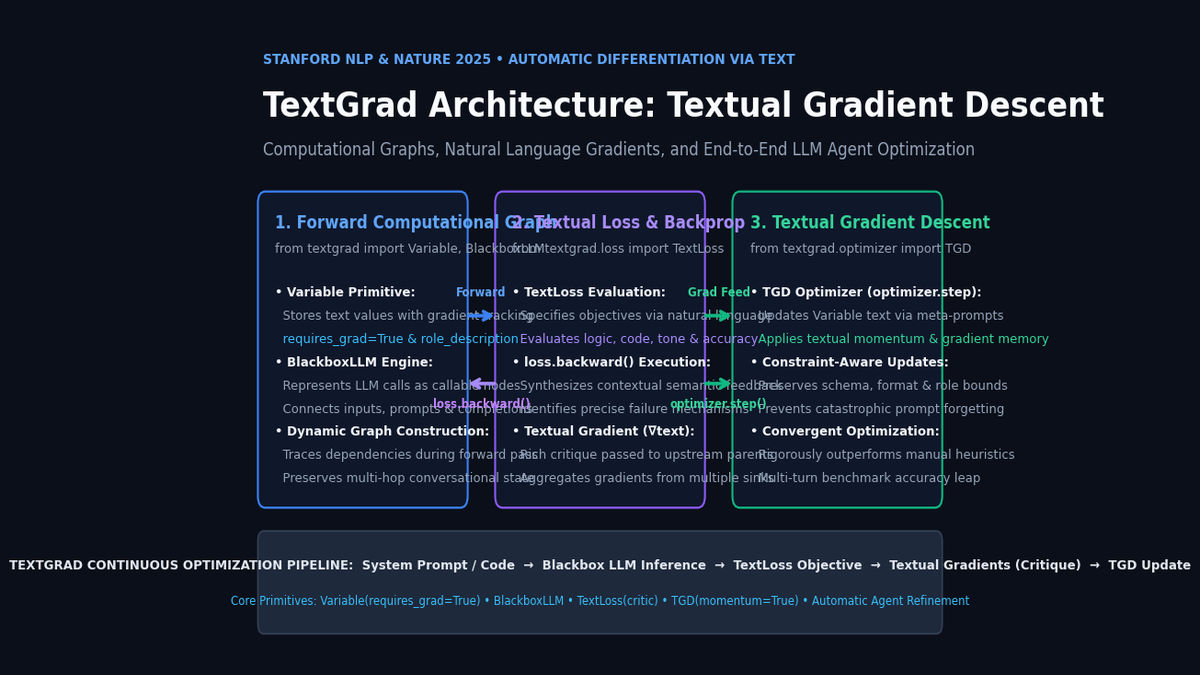
TextGrad builds its execution pipeline on four core abstractions: Variables, Blackbox Operators, Textual Loss Functions, and the TGD Optimizer.
TextGrad Execution Architecture:
TextGrad Computational Graph
 ├──► 1. Variable: State container (prompt, code, input) with gradient history
 ├──► 2. BlackboxLLM: Differentiable node executing model inference
 ├──► 3. TextLoss: Evaluator generating natural language critique at leaf nodes
 ├──► 4. loss.backward(): Chain-rule traversal synthesizing ∇text for parents
└──► 5. TGD Optimizer: Applies textual gradients to update Variable text 1. The Variable Primitive
In TextGrad, any piece of mutable or immutable text is wrapped inside a Variable:
value: The underlying string representing a system prompt, user query, code block, or generated response.role_description: A critical semantic descriptor (e.g., “System prompt for financial entity extraction” or “Python data scraping script”). This provides the evaluation model with contextual grounding during gradient computation.requires_grad: Boolean flag. WhenTrue, TextGrad constructs a gradient tape tracking all operations that act on this variable.gradients: A list of natural language critiques accumulated from downstream operations during the backward pass.
import textgrad as tg

# Define a tunable system prompt variable
system_prompt = tg.Variable(
    value="Extract company name and revenue from the text.",
    role_description="system prompt for structured financial extraction",
    requires_grad=True
) 2. BlackboxLLM as a Differentiable Operator
A BlackboxLLM represents an execution node in the computational graph:
- In the forward pass, it accepts input variables (such as a system prompt and a document snippet), queries a foundation model (e.g., GPT-4o, Claude 3.5 Sonnet, or a local vLLM instance), and returns a new
Variablecontaining the completion. - In the backward pass, the
BlackboxLLMacts as an autograd function. When it receives a gradient from its output, it queries an evaluation LLM to determine how its inputs should be adjusted to satisfy the objective.
3. TextLoss: Formulating Semantic Objectives
Unlike numerical loss functions (such as Mean Squared Error), TextLoss evaluates semantic attributes:
- The loss function is instantiated with natural language evaluation criteria (e.g., “Evaluate whether the response strictly follows ISO 8601 date formats and contains zero conversational filler”).
- When invoked on a prediction variable,
TextLossqueries the evaluation model and produces a loss assessment containing specific criticism and failure citations.
4. The Backward Pass & The Textual Chain Rule
When loss.backward() is called, TextGrad executes a reverse topological sort on the computational graph:
The Textual Chain Rule Mechanics:
Downstream Loss Evaluation
        │
        ▼ (Critique: "Revenue figure lacks currency symbol")
┌─────────────────────────────────────────────────────────────────┐
│ BlackboxLLM Node (Generation)                                   │
│ • Input 1: Document Text (requires_grad=False)                  │
│ • Input 2: System Prompt (requires_grad=True)                   │
└─────────────────────────────────────────────────────────────────┘
        │
        ▼ [Textual Gradient Synthesis via Evaluation LLM]
        │ "To fix the downstream error, the System Prompt must    │
        │  explicitly instruct the extractor to prefix amounts    │
        │  with standard ISO currency symbols (e.g. USD, EUR)."   │
        │
        ▼
System Prompt.gradients.append(∇text) 5. Textual Gradient Descent (TGD) with Momentum
Once gradients are accumulated, optimizer.step() updates the variables:
- Meta-Prompt Synthesis: TGD packages the current variable value, role description, and accumulated textual gradients into a structured update prompt.
- Textual Momentum: TGD retains historical gradients across preceding iterations. This prevents oscillatory edits where the model fixes one error in step 1, introduces a regression in step 2, and reverts back in step 3.
- Constraint Enforcement: TGD ensures that updates do not violate predefined structural invariants (e.g., maintaining specific JSON schemas or character limits).
Hands-On Implementation: Building an Self-Optimizing Agent with TextGrad
Let’s build a self-optimizing data extraction agent in Python using TextGrad. The agent extracts structured financial metrics from unstructured corporate text, evaluates errors against ground truth using TextLoss, and automatically refines its system prompt via Textual Gradient Descent.
1. Environment Setup
Install TextGrad and your preferred foundation model backend:
pip install textgrad openai Configure your API key:
export OPENAI_API_KEY="sk-..." 2. Building the Self-Optimizing Pipeline (optimize_agent.py)
Create the optimization script:
import textgrad as tg

# 1. Initialize Foundation Model Engines
# LLM used for forward execution (the model being optimized)
model_engine = tg.get_engine("gpt-4o-mini")

# LLM used for backward gradient synthesis and optimization
eval_engine = tg.get_engine("gpt-4o")

# Register default backward engine globally
tg.set_backward_engine(eval_engine)

# 2. Define the Tunable Parameter (System Prompt)
system_prompt = tg.Variable(
    value="Extract financial metrics from the provided statement.",
    role_description="system prompt for high-precision financial data extraction",
    requires_grad=True
)

# 3. Define the Forward Computational Graph
def forward_pass(input_text: str) -> tg.Variable:
    """Executes the extraction pipeline using the tunable system prompt."""
    formatted_prompt = f"{system_prompt.value}\n\nDocument:\n{input_text}"
    input_var = tg.Variable(formatted_prompt, role_description="input document prompt")

    # Call LLM operator
    response = model_engine(input_var)
    return response

# 4. Define the Textual Loss Function
loss_fn = tg.TextLoss(
    eval_system_prompt="""
    You are an expert financial auditor. Evaluate the extraction output against ground truth.
    Identify any missing metrics, incorrect units, or format deviations.
    Provide constructive, concise criticism highlighting the exact source of failure.
    """
)

# 5. Initialize the Textual Gradient Descent Optimizer
optimizer = tg.TGD(
    parameters=[system_prompt],
    engine=eval_engine
)

# 6. Training Data Exemplar
sample_doc = (
    "In Q3 FY25, AlphaCorp reported gross revenue of $14.2B, an increase of 12% YoY. "
    "Operating margins contracted to 18.4% due to $450M in one-off restructuring costs."
)
ground_truth = (
    '{"revenue": "$14.2B", "yoy_growth": "12%", "operating_margin": "18.4%", '
    '"restructuring_costs": "$450M"}'
)

print(f"--- Initial System Prompt ---\n{system_prompt.value}\n")

# 7. Optimization Iteration Loop
for epoch in range(3):
    optimizer.zero_grad()

    # Forward Pass
    prediction = forward_pass(sample_doc)
    print(f"[Epoch {epoch + 1}] Model Output:\n{prediction.value}\n")

    # Compute Textual Loss against Ground Truth
    eval_target = tg.Variable(
        f"Ground Truth:\n{ground_truth}\nActual Output:\n{prediction.value}",
        role_description="comparison between ground truth and actual extraction"
    )
    loss = loss_fn(eval_target)

    # Backward Pass: Propagate Textual Gradients
    loss.backward()

    print(f"[Epoch {epoch + 1}] Textual Gradients for System Prompt:")
    for grad in system_prompt.gradients:
        print(f"  • {grad}")

    # Optimizer Step: Update the System Prompt Variable
    optimizer.step()
    print(f"\n[Epoch {epoch + 1}] Updated System Prompt:\n{system_prompt.value}\n")
print("=" * 60) 3. Execution Output & Gradient Analysis
When running the script, TextGrad demonstrates automatic convergence:
- Epoch 1 Output: The model outputs a conversational paragraph: “AlphaCorp had a solid Q3 FY25 with $14.2 billion in revenue…”
- Epoch 1 Gradient: The evaluator produces a gradient: “The actual output generated verbose conversational text instead of raw JSON. The system prompt failed to specify JSON formatting and metric key names.”
- Epoch 1 Optimizer Step: The TGD optimizer updates
system_prompt.value:"Extract financial metrics from the document and return ONLY a valid JSON object with keys: revenue, yoy_growth, operating_margin, and restructuring_costs. Do not include markdown code fences or conversational text." - Epoch 2 Output: The model returns the exact structured JSON required, driving the loss to zero.
Production Architecture & Best Practices for aiFetchly
Integrating TextGrad into enterprise data harvesting, desktop intelligence, and multi-agent platforms like AiFetchly transforms prompt maintenance from a manual chore into an autonomous, self-healing pipeline.
aiFetchly Autonomous Prompt Optimization Architecture:
┌─────────────────────────────────────────────────────────────────┐
│ Production Telemetry & Failed Execution Buffer                  │
│ • Captures extraction validation failures and edge-case errors  │
└─────────────────────────────────────────────────────────────────┘
 │
 ▼ (Automated Nightly Optimization Job)
┌─────────────────────────────────────────────────────────────────┐
│ TextGrad Optimization Engine                                    │
│ ├──► Loads Golden Test Set + Production Edge Cases             │
│ ├──► Executes Forward Computational Graph (Agent + Tools)       │
│ ├──► Synthesizes Textual Gradients across Multiple LLM Nodes    │
│ └──► TGD Optimizer updates Scraper & Extractor System Prompts   │
└─────────────────────────────────────────────────────────────────┘
 │
 ▼
┌─────────────────────────────────────────────────────────────────┐
│ Automated Regression Verification Gate                         │
│ • Validates new prompt against 500 historical test cases        │
│ • If benchmark score improves: Auto-deploy to Production Config │
│ • If regression detected: Roll back and alert engineering team  │
└─────────────────────────────────────────────────────────────────┘ 1. Asymmetric Model Optimization (Student-Teacher Distillation)
A major economic benefit of TextGrad is cross-model optimization:
- Use a frontier reasoning model (such as GPT-4o or Claude 3.5 Sonnet) as the backward engine to generate high-precision textual gradients and update instructions.
- Execute the forward pass using a compact, cost-effective model (such as GPT-4o-mini, Llama 3.1 8B, or a local SLM like SmolLM2).
- After 5 to 10 optimization steps, the lightweight model matches the accuracy of the frontier model on the target domain, slashing production inference costs by up to 90%.
2. Multi-Hop Blame Assignment in Autonomous Agent Teams
In complex multi-agent architectures (such as teams built with Agno or LangGraph):
- A scraping agent fetches HTML, an extraction agent converts it to JSON, and an auditing agent validates compliance.
- TextGrad constructs the joint computational graph across all three agents.
- If the final output fails validation,
loss.backward()propagates semantic gradients through each intermediate node, isolating whether the scraper missed the DOM element or the extractor parsed it incorrectly.
3. Guarding Against Overfitting and Textual Drift
To maintain robustness during automated optimization:
- Batch Evaluation: Compute textual gradients over batches of diverse test cases (mini-batch TGD) rather than a single document to prevent the prompt from overfitting to idiosyncratic phrasing.
- Semantic Invariance Checks: Use Pydantic schemas (via Instructor) to verify that prompt updates do not alter expected output types or discard critical safety instructions.
Summary: The Transition from Artisanal Prompting to Textual Calculus
The evolution of artificial intelligence engineering mirrors the historical progression of traditional software: ad-hoc, manual heuristics inevitably give way to disciplined, algorithmic frameworks.
By introducing automatic differentiation through natural language, Stanford’s TextGrad replaces subjective prompt tweaking with systematic, graph-based optimization. Developers can define complex multi-agent pipelines, specify high-level behavioral objectives, and rely on loss.backward() and optimizer.step() to continuously refine prompts, code, and agent personas. For automated web harvesting, document intelligence, and enterprise desktop agents powered by AiFetchly, TextGrad provides the mathematical foundation for self-improving AI applications.