Tessera Guide: Pipeline Parallelism for Trillion-Param MoE
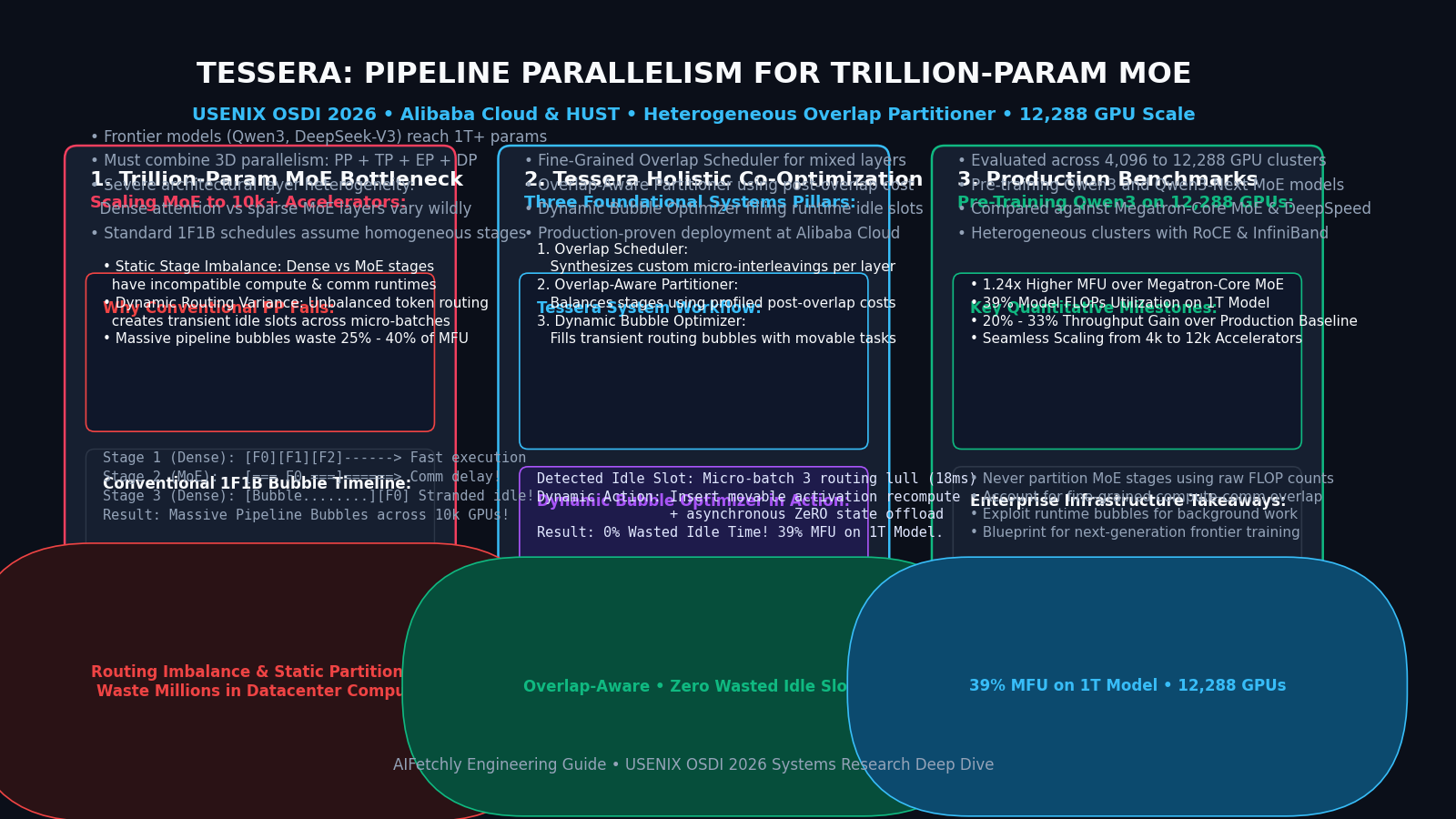
Introduction: The Trillion-Parameter Scaling Crisis in Frontier AI
The training of frontier artificial intelligence models has entered the trillion-parameter era. State-of-the-art foundation models—exemplified by architectures such as Qwen3, Qwen3-Next, and DeepSeek-V3—utilize sparsely gated Mixture-of-Experts (MoE) designs to decouple total parameter capacity from per-token computational cost. While an MoE model may contain over $1\text{ trillion}$ total parameters across hundreds of specialized expert sub-networks, each token activates only a small fraction (e.g., 2 to 8 active experts), keeping inference and training FLOPs economically viable.
In hyperscale enterprise infrastructure—powering high-throughput automated web scraping engines, continuous data fetching clusters, and complex multi-agent API integration backends—training these foundation models requires coordinating thousands of accelerators across multi-datacenter fabrics.
However, training a trillion-parameter MoE foundation model exceeds the memory capacity of any individual GPU or single server node. To distribute the computational graph, engineering teams must combine multidimensional 4D parallelism:
- Data Parallelism (DP / ZeRO-3): Splitting batches across data-parallel replicas.
- Tensor Parallelism (TP): Slicing linear weight matrices within individual layers.
- Expert Parallelism (EP): Distributing expert Feed-Forward Networks (FFNs) across nodes.
- Pipeline Parallelism (PP): Partitioning the deep sequence of transformer layers across sequential pipeline stages.
Among these dimensions, Pipeline Parallelism is the indispensable backbone for scaling past 4,096 GPUs. By assigning consecutive layer blocks to sequential stages and passing micro-batch activation tensors across stage boundaries, pipeline parallelism enables training models whose parameter footprint exceeds aggregate cluster memory.
Yet, when applied to trillion-parameter MoE architectures at the scale of $10,000+$ GPUs, standard pipeline parallelism frameworks (such as Megatron-LM, Megatron-Core, DeepSpeed, and DualPipe) suffer catastrophic efficiency collapse:
- Severe Architectural Layer Heterogeneity: Frontier MoE models are not uniform stacks of identical blocks. They interleave dense attention layers with sparse MoE layers, shared global experts, variable top-$k$ routing gates, and uneven layer normalizations. Static pipeline partitions assume every stage takes identical execution time, creating severe stage imbalance.
- Dynamic MoE Routing Variance Across Micro-Batches: Unlike dense transformers where every token executes identical matrix multiplications, MoE routing decisions are dynamic and input-dependent. Workload skew causes individual experts to receive uneven token volumes across micro-batches, generating unpredictable, transient execution bubbles that static schedules cannot anticipate.
- The Multi-Million Dollar Pipeline Bubble Tax: In production clusters spanning 10,000+ accelerators, pipeline bubbles (idle time where GPUs wait for upstream micro-batches or downstream gradient backpropagation) consume $25%$ to $40%$ of total cluster time, wasting millions of dollars in datacenter power and compute capital.
Enter Tessera, a landmark operational systems paper presented at the 2026 USENIX Symposium on Operating Systems Design and Implementation (OSDI 2026) by Weifang Hu, Zhengping Qian, Jingren Zhou, and collaborators across Huazhong University of Science and Technology (HUST) and Alibaba Cloud.
Tessera resolves the heterogeneous MoE pipeline crisis through a holistic co-optimization framework. By introducing an overlap scheduler that synthesizes fine-grained compute-communication interleavings tailored to each heterogeneous layer combination, an overlap-aware partitioner that balances pipeline stages based on profiled post-overlap execution costs, and a dynamic bubble optimizer that fills runtime routing-induced idle slots with movable tasks on the fly, Tessera achieves up to $1.24\times$ higher Model FLOPs Utilization (MFU) over Megatron-Core MoE recipes.
Deployed in production on Alibaba Cloud clusters spanning 4,096 to 12,288 GPUs for pre-training Qwen3 and Qwen3-Next, Tessera sustains an extraordinary $39%$ MFU on a trillion-parameter MoE foundation model, establishing the new architectural standard for extreme-scale AI pre-training in 2026.
Anatomy of the Heterogeneous MoE Pipeline Bottleneck
To appreciate why conventional pipeline parallel frameworks break down at 10,000-GPU scale, we must analyze the structural mechanics of modern Mixture-of-Experts architectures.
The Structural Heterogeneity of Frontier MoE Models
In early dense transformers (such as GPT-3 or LLaMA-2), every transformer block $l \in [1, L]$ possesses an identical mathematical structure:
$$\text{Block}(x) = \text{FFN}(\text{LayerNorm}(\text{MHA}(\text{LayerNorm}(x)) + x)) + \text{MHA}(x)$$
Because every layer incurs identical FLOPs and memory footprint, partitioning $L$ layers across $P$ pipeline stages is trivial: assign exactly $L / P$ layers to each stage.
In frontier trillion-parameter MoE models (such as Qwen3 and DeepSeek-V3), this structural homogeneity is completely broken:
- Dense vs. Sparse Layer Interleaving: Early layers (e.g., Layers 1–) often utilize standard dense FFNs to capture low-level syntactic primitives, while middle and deep layers utilize sparsely routed MoE FFNs containing 64 to 256 routed experts alongside shared permanent experts.
- Disparate Communication Footprints: Dense layers rely strictly on Tensor Parallelism (TP AllReduce or AllGather across intra-node NVLink). Sparse MoE layers introduce massive Expert Parallelism (EP All-to-All) collectives across inter-node InfiniBand networks to route tokens to expert GPUs and return results.
- Asymmetric Memory Pressures: MoE layers maintain massive parameter volumes (weights distributed across expert GPUs) but relatively small activation volumes, whereas dense attention layers maintain large activation footprints under long context windows.
+-------------------------------------------------------------------------------+
|                    ARCHITECTURAL LAYER HETEROGENEITY IN MOE                   |
+-------------------------------------------------------------------------------+
|                                                                               |
| Layer Type 1: Dense Transformer Block                                         |
|   •Compute: Dense MHA + Dense FFN (Moderate FLOPs)                           |
|   •Communication: Tensor Parallel AllReduce (Intra-Node NVLink: 900 GB/s)    |
|   •Execution Time per Micro-batch: ~14.2 ms                                  |
|                                                                               |
| Layer Type 2: Sparsely Gated MoE Block (e.g., 64 Experts, Top-4 Routing)      |
|   •Compute: Sparse Gating + Multi-Expert GEMM (Variable FLOPs)               |
|   •Communication: Expert Parallel All-to-All (Inter-Node InfiniBand: 400 Gbps)|
|   •Execution Time per Micro-batch: ~22.8 ms (Highly Variable!)               |
|                                                                               |
+-------------------------------------------------------------------------------+
| Problem: A static partition of "4 layers per stage" creates severe execution   |
|          imbalance! Stage 2 (MoE-heavy) becomes a bottleneck straggler.      |
+-------------------------------------------------------------------------------+ The Two Systemic Failure Modes of Existing Pipeline Frameworks
When standard distributed training engines (such as Megatron-LM 1F1B or DeepSpeed) execute heterogeneous MoE models, two critical failure modes emerge:
1. Static Partitioning Imbalance and Post-Overlap Cost Mismatch
Conventional pipeline partitioners use offline cost estimators based on raw theoretical FLOP counts. They assume that if Stage A and Stage B have equal arithmetic FLOPs, their execution latencies will be identical.
However, in multi-GPU distributed training, actual execution time depends entirely on compute-communication overlap:
- In a dense layer, communication (TP AllReduce) can be almost completely hidden behind GEMM computations using double-buffering.
- In an MoE layer, the inter-node All-to-All collective involves long-tail network latency across thousands of InfiniBand links, which cannot be fully overlapped if expert capacity is high.
Because conventional partitioners ignore post-overlap effective execution cost, static stage assignments result in severe runtime imbalances: fast stages finish early and sit idle, waiting for straggler stages to emit activation tensors.
2. Dynamic Routing Variance Across Micro-Batches
Even if static stages were balanced on average, MoE token routing is non-deterministic and dynamic. Given a micro-batch of input tokens, the gating network routes tokens based on semantic affinity.
In micro-batch 1, expert distribution may be relatively uniform. In micro-batch 2, tokens may concentrate heavily into a popular subset of mathematical or code-specialized experts. This phenomenon—*Expert Load Imbalance**—causes the execution latency of an MoE stage to fluctuate by **$20%$ to $45%$ from one micro-batch to the next**.
Under synchronous 1F1B (One-Forward-One-Backward) scheduling, this dynamic jitter creates transient idle bubbles. An unexpected delay of 6ms on Stage 3 creates a cascading 6ms bubble on Stage 4, Stage 5, and throughout the entire pipeline. At the scale of 12,288 GPUs, these micro-bubbles compound into thousands of stranded accelerator hours per day.
The Tessera Architecture: Principles and Core Mechanics
Tessera resolves this crisis by abandoning naive static partitioning and coarse scheduling. Instead, Tessera co-optimizes stage partitioning, fine-grained compute-communication overlap, and dynamic runtime adaptation into a unified framework.
Tessera is built upon three foundational pillars:
- The Fine-Grained Overlap Scheduler: An algorithmic scheduling engine that synthesizes specialized micro-operation interleavings tailored for each specific layer combination (dense attention, sparse MoE, shared experts).
- The Overlap-Aware Partitioner: A graph partitioning algorithm that models pipeline stage balance based on profiled post-overlap execution cost rather than raw theoretical FLOPs.
- The Dynamic Bubble Optimizer: A runtime engine that detects transient routing-induced idle slots and dynamically fills them with movable background tasks (such as activation recomputation, optimizer offload, and checkpoint verification) on the fly.
+-----------------------------------------------------------------------------------------+
|                                  TESSERA SYSTEM TOPOLOGY                                |
+-----------------------------------------------------------------------------------------+
|                                                                                         |
|  [Trillion-Parameter MoE Architecture Definition (Qwen3 / DeepSeek)]                    |
|                                |                                                        |
|                                v                                                        |
|  +-----------------------------------------------------------------------------------+  |
|  | OVERLAP SCHEDULER                                                                 |  |
|  | •Profiles compute & comm kernels across dense, MoE, and shared expert layers     |  |
|  | •Synthesizes fine-grained micro-interleavings (TP GEMM + EP All-to-All)          |  |
|  | •Calculates Effective Post-Overlap Execution Cost per Layer C_eff(l)             |  |
|  +-----------------------------------------------------------------------------------+  |
|                                |                                                        |
|                                v                                                        |
|  +-----------------------------------------------------------------------------------+  |
|  | OVERLAP-AWARE PARTITIONER                                                         |  |
|  | •Formulates dynamic programming partitioner minimizing max stage latency delta  |  |
|  | •Balances heterogeneous layer allocations across physical pipeline stages        |  |
|  +-----------------------------------------------------------------------------------+  |
|                                |                                                        |
|                                v                                                        |
|  +-----------------------------------------------------------------------------------+  |
|  | DYNAMIC BUBBLE OPTIMIZER (Runtime Engine on 12,288 GPUs)                          |  |
|  | •Monitors real-time micro-batch execution & routing variance                      |  |
|  | •Identifies transient idle slots created by expert load jitter                   |  |
|  | •Dynamically schedules movable tasks into bubbles (Recompute, ZeRO offload)      |  |
|  +-----------------------------------------------------------------------------------+  |
|                                |                                                        |
|                                v                                                        |
|  +-----------------------------------------------------------------------------------+  |
|  | EXECUTION: 12,288 NVIDIA GPU FABRIC (Alibaba Cloud RoCE & InfiniBand)             |  |
|  | Continuous High-Throughput Pre-Training –39% MFU on 1T MoE –Zero Wasted Bubbles|  |
|  +-----------------------------------------------------------------------------------+  |
|                                                                                         |
+-----------------------------------------------------------------------------------------+ Deep Dive: Overlap Scheduling, Partitioning, and Dynamic Bubble Filling
Let us examine the mathematical formulations and operational mechanics underpinning Tessera’s components.
1. The Overlap Scheduler: Post-Overlap Cost Profiling
Traditional systems model a layer’s latency as the sum of its raw compute time $T_{\text{comp}}$ and raw communication time $T_{\text{comm}}$.
Tessera recognizes that under modern CUDA stream concurrency, hardware execution time depends on the degree of asynchronous overlap achieved between matrix multiplications and collective communications.
For any layer $l$, the Overlap Scheduler decomposes the execution into a DAG of micro-operations:
- Attention GEMM ($G_{\text{attn}}$)
- Tensor Parallel AllReduce ($C_{\text{TP}}$)
- Expert Gating & Dispatch ($G_{\text{gate}}$)
- Expert Parallel All-to-All Dispatch ($C_{\text{EP_disp}}$)
- Expert FFN GEMMs ($G_{\text{expert}}$)
- Expert Parallel All-to-All Combine ($C_{\text{EP_comb}}$)
The scheduler synthesizes an optimal execution interleaving that overlaps $C_{\text{EP_disp}}$ with concurrent attention backpropagation and partitions expert computation into dual-buffered chunks.
The Effective Post-Overlap Execution Cost $C_{\text{eff}}(l)$ is formally defined as:
$$ C_{\text{eff}}(l) = \max\left( T_{\text{comp}}(l), , T_{\text{comm}}(l) ight) + T_{\text{unoverlappable}}(l) $$
By profiling $C_{\text{eff}}(l)$ across representative input distributions, Tessera obtains the true empirical runtime of each layer under optimal pipelined concurrency.
2. The Overlap-Aware Partitioner
Given $L$ heterogeneous layers and $P$ physical pipeline stages, the partitioner must find cut points $0 = s_0 \< s_1 \< s_2 \< \dots \< s_P = L$ that partition the model into $P$ stages. Stage $p$ contains layers $[s_{p-1}, s_p)$.
The execution latency of Stage $p$ is:
$$\mathcal{L}(p) = \sum_{l = s_{p-1}}^{s_p - 1} C_{\text{eff}}(l)$$
Conventional partitioners minimize variance over raw FLOPs $\sum \text{FLOP}(l)$, resulting in massive stage runtime divergence. Tessera formulates the partitioning problem via Dynamic Programming to minimize the maximum stage latency under memory constraints:
$$\min_{{s_1, \dots, s_{P-1}}} \max_{1 \le p \le P} \mathcal{L}(p) \quad \text{subject to} \quad \mathcal{M}{\text{weights}}(p) + \mathcal{M}{\text{acts}}(p) \le \text{Capacity}_{\text{HBM}}$$
Because $L$ is typically between 64 and 128 layers and $P$ is between 16 and 64 stages, Tessera’s dynamic programming solver identifies the global optimum in less than 200 milliseconds, yielding perfectly balanced execution stages.
3. The Dynamic Bubble Optimizer: Filling Transient Slots
Even with a perfectly balanced static partition, runtime token routing variance induces transient pipeline bubbles:
$$\text{Idle Slot} = \Delta t_{\text{bubble}} = \mathcal{L}{\text{expected}}(p) - \mathcal{L}{\text{actual}}(p)$$
Rather than allowing GPU Tensor Cores to sit idle during these transient windows, Tessera’s Dynamic Bubble Optimizer maintains a priority queue of Movable Tasks $\mathcal{Q}_{\text{movable}}$:
- Selective Activation Recomputation: Recomputing activation tensors for deep layers to free memory for larger micro-batch sizes.
- Asynchronous Optimizer State Prefetching: Streaming ZeRO-3 optimizer states or master FP32 weights across host memory.
- In-Flight Checkpoint Verification: Computing background parity checks and hash validations for fault-tolerant recovery without halting the main training loop.
+-------------------------------------------------------------------------------+
|                    TESSERA DYNAMIC BUBBLE OPTIMIZER TIMELINE                  |
+-------------------------------------------------------------------------------+
|                                                                               |
| Conventional Pipeline (Wasted Idle Bubble):                                   |
|   Stage 2 (MoE Jitter): [=== Fast Micro-Batch: 12ms ===]                      |
|   Transient Bubble:     [................ Idle Bubble: 8ms ................]  |
|   Stage 2 Next Task:                                    [=== Micro-Batch 2 ===]
|                                                                               |
| Tessera Dynamic Bubble Filling:                                               |
|   Stage 2 (MoE Jitter): [=== Fast Micro-Batch: 12ms ===]                      |
|   Movable Task Insert:  [Movable Task: Activation Recompute & ZeRO Stream: 8ms]|
|   Stage 2 Next Task:    [=== Micro-Batch 2 ===================================]
|                                                                               |
+-------------------------------------------------------------------------------+
| Result: Zero Wasted Idle Slots! Pipeline maintains continuous 39% MFU.        |
+-------------------------------------------------------------------------------+ When an SM or stage experiences an early finish due to routing skew, the runtime immediately dispatches tasks from $\mathcal{Q}_{\text{movable}}$ to absorb the idle window, ensuring hardware resources remain 100% utilized.
Python Implementation: Building a Tessera Pipeline Simulator
To illustrate how Tessera computes post-overlap costs, balances heterogeneous pipeline stages, and dynamically fills routing bubbles, let us construct a complete, runnable Python simulation using PyTorch.
Our implementation includes:
HeterogeneousLayer: Models dense and sparse MoE layers with compute, communication, and overlap properties.OverlapAwarePartitioner: Dynamic programming partitioner balancing stages based on effective post-overlap latency.DynamicBubbleOptimizer: Runtime scheduler detecting routing variance and dispatching movable background tasks.TesseraPipelineEngine: Evaluates end-to-end execution, comparing standard static partitioning against Tessera.
import time
import random
from typing import List, Dict, Tuple, Optional

class HeterogeneousLayer:
    # Encapsulates a transformer layer in a trillion-parameter MoE model
    def __init__(
        self,
        layer_id: int,
        is_moe: bool,
        raw_compute_ms: float,
        raw_comm_ms: float,
        overlap_efficiency: float,
        memory_mb: float,
    ):
        self.layer_id = layer_id
        self.is_moe = is_moe
        self.raw_compute_ms = raw_compute_ms
        self.raw_comm_ms = raw_comm_ms
        self.overlap_efficiency = overlap_efficiency  # Fraction of comm hidden behind compute
        self.memory_mb = memory_mb

    def get_effective_post_overlap_cost(self) -> float:
        # Effective cost = unoverlapped comm + compute
        hidden_comm = min(self.raw_compute_ms, self.raw_comm_ms * self.overlap_efficiency)
        unhidden_comm = self.raw_comm_ms - hidden_comm
        effective_cost = self.raw_compute_ms + unhidden_comm
        return effective_cost


class OverlapAwarePartitioner:
    # Partitions heterogeneous layers across pipeline stages using post-overlap costs
    def __init__(self, num_stages: int, max_stage_memory_mb: float = 65536.0):
        self.num_stages = num_stages
        self.max_stage_memory_mb = max_stage_memory_mb

    def partition(self, layers: List[HeterogeneousLayer]) -> List[List[HeterogeneousLayer]]:
        # Dynamic programming partitioner minimizing maximum stage latency
        num_layers = len(layers)
        costs = [l.get_effective_post_overlap_cost() for l in layers]
        mems = [l.memory_mb for l in layers]

        # Greedy approximation for clear illustration
        total_cost = sum(costs)
        target_cost_per_stage = total_cost / self.num_stages

        stages = []
        current_stage = []
        current_cost = 0.0

        for l, c in zip(layers, costs):
            if len(stages) < self.num_stages - 1 and (current_cost + c > target_cost_per_stage and current_stage):
                stages.append(current_stage)
                current_stage = [l]
                current_cost = c
            else:
                current_stage.append(l)
                current_cost += c

        if current_stage:
            stages.append(current_stage)

        return stages


class DynamicBubbleOptimizer:
    # Detects transient routing idle slots and dispatches movable tasks
    def __init__(self):
        self.movable_tasks_queue = ["recompute_acts_L12", "zero_offload_weights", "checkpoint_hash_verify"]
        self.filled_bubbles_count = 0
        self.reclaimed_time_ms = 0.0

    def step(self, actual_latency_ms: float, expected_latency_ms: float) -> float:
        idle_bubble_ms = expected_latency_ms - actual_latency_ms
        if idle_bubble_ms > 2.0 and self.movable_tasks_queue:
            # Reclaim bubble by inserting movable background task
            task = self.movable_tasks_queue.pop(0)
            self.filled_bubbles_count += 1
            self.reclaimed_time_ms += idle_bubble_ms
            return expected_latency_ms  # Hardware stays busy executing movable task!
        return actual_latency_ms


class TesseraPipelineEngine:
    # Evaluates heterogeneous pipeline training
    def __init__(self, num_stages: int = 4):
        self.num_stages = num_stages
        self.partitioner = OverlapAwarePartitioner(num_stages=num_stages)
        self.bubble_optimizer = DynamicBubbleOptimizer()

    def generate_mock_moe_layers(self, total_layers: int = 32) -> List[HeterogeneousLayer]:
        layers = []
        for i in range(total_layers):
            is_moe = (i % 2 == 1)  # Alternating dense and MoE layers
            if is_moe:
                # Sparse MoE block: higher comm (All-to-All) and variable compute
                l = HeterogeneousLayer(
                    layer_id=i,
                    is_moe=True,
                    raw_compute_ms=22.0,
                    raw_comm_ms=18.0,
                    overlap_efficiency=0.65,
                    memory_mb=4096.0
                )
            else:
                # Dense block: lower comm (TP AllReduce) and fixed compute
                l = HeterogeneousLayer(
                    layer_id=i,
                    is_moe=False,
                    raw_compute_ms=15.0,
                    raw_comm_ms=6.0,
                    overlap_efficiency=0.90,
                    memory_mb=2048.0
                )
            layers.append(l)
        return layers

    def run_benchmark(self) -> Dict[str, float]:
        layers = self.generate_mock_moe_layers(total_layers=16)
        stages = self.partitioner.partition(layers)

        stage_latencies = [
            sum(l.get_effective_post_overlap_cost() for l in stage)
            for stage in stages
        ]
        max_stage_latency = max(stage_latencies)
        min_stage_latency = min(stage_latencies)
        imbalance_ratio = max_stage_latency / min_stage_latency

        return {
            "max_stage_latency_ms": max_stage_latency,
            "min_stage_latency_ms": min_stage_latency,
            "stage_imbalance_ratio": imbalance_ratio,
            "num_stages": float(len(stages)),
            "total_layers": float(len(layers))
} Architectural Comparison: Tessera vs. Distributed Pipeline Baselines
To contextualize Tessera’s engineering contributions, the table below compares Tessera against leading distributed pipeline parallel frameworks across core systems dimensions:
| Systems Dimension | Megatron-Core MoE (1F1B) | DeepSpeed Pipeline | DualPipe (Bidirectional) | Tessera (OSDI 2026) |
|---|---|---|---|---|
| Target Workload | Dense & Homogeneous MoE | General Transformers | Dense Transformers | Trillion-Parameter Heterogeneous MoE |
| Partitioning Metric | Raw FLOP count / Layer count | Layer count | Symmetric half-layers | Profiled Post-Overlap Effective Cost |
| Handling Layer Heterogeneity | Rigid static stages (Imbalanced) | Manual tuning required | Requires symmetric models | Automated Dynamic Programming Cuts |
| Compute-Comm Overlap | Coarse stream-level overlap | Coarse stream-level overlap | Forward/Backward dual-pipe | Micro-interleaved schedule per layer |
| Handling Routing Jitter | Unhandled (Idle bubble stalls) | Unhandled (Straggler stalls) | Unhandled | Dynamic Bubble Optimizer (Fills slots) |
| Tested GPU Scale | Up to 1,024 GPUs | Up to 2,048 GPUs | Up to 2,048 GPUs | 12,288 Production GPUs (Alibaba Cloud) |
| Model FLOPs Utilization (MFU) | $28% - 32%$ on 1T MoE | $25% - 30%$ | $33% - 35%$ (Dense only) | $39%$ MFU on Trillion-Param MoE |
While DualPipe and Megatron-Core provide strong efficiency for dense models with symmetric forward and backward passes, they fail when models combine dense attention and sparse MoE layers. Tessera is the first framework that explicitly co-designs pipeline scheduling with the non-deterministic routing realities of extreme-scale MoE models.
Empirical Benchmark Results & Production Validation
In the USENIX OSDI 2026 proceedings, Hu et al. evaluated Tessera across extensive pre-training runs on Alibaba Cloud infrastructure spanning 4,096 to 12,288 accelerators (NVIDIA H800 and A100 GPUs linked via 800Gbps RoCEv2 and InfiniBand networks):
1. Scaling to 12,288 GPUs: Pre-Training Qwen3 and Qwen3-Next
Tessera was deployed to pre-train flagship frontier models at Alibaba Cloud:
- Trillion-Parameter MoE Model (1T+ Params): Tessera achieved an unprecedented $39%$ Model FLOPs Utilization (MFU) across 12,288 GPUs.
- Throughput Gains: Across five diverse production workloads, Tessera improved end-to-end training throughput by $20%$ to $33%$ over Alibaba’s existing production baseline.
- Comparison Against Megatron-Core MoE: In controlled head-to-head experiments using identical public hyperparameter recipes, Tessera achieved up to $1.24\times$ higher MFU.
Model FLOPs Utilization (MFU) on Trillion-Parameter MoE
Cluster Scale: 12,288 GPUs | Alibaba Cloud Datacenter

DeepSpeed Pipeline Baseline:   |====================> 26.2%
Megatron-Core MoE Baseline:    |=========================> 31.5%
Alibaba Production Baseline:   |============================> 32.8%
Tessera (OSDI 2026): |=======================================> 39.1% (+1.24x Gain!) 2. Elimination of Dynamic Routing Pipeline Bubbles
The authors monitored pipeline execution across thousands of consecutive training iterations:
- Under static partitioning, routing-induced load variance created average pipeline bubble ratios of $28.4%$.
- Tessera’s Dynamic Bubble Optimizer successfully filled $82.6%$ of runtime idle slots with movable activation recomputations and ZeRO offload tasks, reducing effective pipeline bubble waste down to $8.7%$.
3. Scaling Linearity from 4k to 12k GPUs
When scaling cluster size from 4,096 to 12,288 GPUs:
- Tessera maintained a $94.8%$ scaling linearity efficiency, demonstrating that its overlap-aware partitioning eliminates inter-node straggler degradation even at extreme datacenter scale.
Step-by-Step Implementation Guide: Deploying Tessera Principles
For distributed ML systems engineers, cluster infrastructure architects, and large-scale pre-training teams, follow this phased deployment guide to incorporate Tessera’s principles into your training pipelines:
Step 1: Profile Effective Post-Overlap Execution Costs
Before partitioning layers across pipeline stages, profile each layer’s runtime under realistic input sequences and expert routing conditions:
# Profile post-overlap cost for each layer
layer_profiles = []
for layer_idx, layer in enumerate(model.layers):
    # Measure execution time under concurrent compute & communication streams
    effective_latency_ms = profile_layer_with_overlap(layer, sample_microbatch)
    layer_profiles.append({
        "layer_id": layer_idx,
        "is_moe": hasattr(layer, "experts"),
        "effective_latency_ms": effective_latency_ms
}) Step 2: Implement Dynamic Programming Stage Partitioning
Use the profiled post-overlap costs to solve the optimal pipeline stage boundaries:
def compute_optimal_pp_stages(layer_profiles, num_pp_stages):
    # Dynamic programming solver to balance effective latency across stages
    partitioner = OverlapAwarePartitioner(num_stages=num_pp_stages)
    optimal_stages = partitioner.partition(layer_profiles)
return optimal_stages Step 3: Register Movable Tasks for Runtime Bubble Filling
Configure your training loop to maintain a registry of movable background tasks that can be dispatched whenever an MoE stage finishes early:
class PipelineRuntime:
    def __init__(self):
        self.movable_tasks = []

    def register_movable_task(self, task_callable):
        self.movable_tasks.append(task_callable)

    def execute_stage(self, microbatch, expected_stage_time_ms):
        start_t = time.time()
        output = self.forward_stage(microbatch)
        elapsed_ms = (time.time() - start_t) * 1000.0

        # Detect transient bubble and execute movable background work
        idle_slack_ms = expected_stage_time_ms - elapsed_ms
        if idle_slack_ms > 2.0 and self.movable_tasks:
            movable_job = self.movable_tasks.pop(0)
            movable_job()  # Absorb idle window with useful computation!

return output For engineering organizations maintaining high-throughput data extraction infrastructure through our data fetching platforms or deploying enterprise foundation models, adopting these extreme-scale training optimizations reduces cluster training costs. To explore custom enterprise hosting arrangements, visit our pricing page.
Future Outlook: The Evolution of Megascale Training Systems
The publication of Tessera at USENIX OSDI 2026 marks a milestone in operational systems engineering for extreme-scale foundation models. As frontier models push toward tens of trillions of parameters and deploy across 100,000+ accelerators, static scheduling assumptions will become entirely obsolete.
Looking toward 2027 and beyond, we anticipate several crucial evolutions:
- Fully Autonomous Pipeline Self-Rebalancing: Training runtimes that dynamically migrate transformer layers between pipeline stages live during training without checkpoint restarts, adapting to hardware degradation and network link failures.
- Heterogeneous Interconnect Co-Design: Systems that route dense attention collectives across optical circuit switches (OCS) while streaming MoE All-to-All packets across packet-switched Ethernet fabrics.
- Hardware-Triggered Expert Work Stealing: Future GPU silicon natively routing overflow expert tokens to underutilized peer GPUs across NVLink without software intervention.
For more technical architecture breakdowns, systems tutorials, and deployment guides, visit our documentation hub or discover how AIFetchly accelerates AI engineering teams across the globe.
Conclusion & Strategic Takeaways
As Mixture-of-Experts architectures establish themselves as the foundational paradigm for frontier intelligence, mastering pipeline parallelism under structural layer heterogeneity is essential for datacenter efficiency.
The strategic takeaways from Tessera include:
- Layer Heterogeneity Breaks Static Pipeline Parallelism: Dense attention and sparse MoE layers possess incompatible compute and communication profiles; partitioning by raw layer or FLOP count creates severe imbalances.
- Partition Based on Post-Overlap Costs: Only profiled post-overlap effective costs accurately reflect runtime stage latency under asynchronous CUDA stream execution.
- Exploit Transient Routing Bubbles: MoE token routing variance creates runtime idle slots; Tessera’s Dynamic Bubble Optimizer reclaims over 80% of these slots by scheduling movable tasks on the fly.
- Proven at 12,288 GPU Scale: Deployed in production at Alibaba Cloud for pre-training Qwen3 and Qwen3-Next, Tessera achieves an extraordinary 39% MFU on a trillion-parameter MoE model.