Tesla HW4 Guide: AI4 In-Vehicle Autonomous Driving Silicon
The Physical-World AI Crisis: Millisecond Latencies, Sensor Floods, and Fail-Operational Driving
Deploying artificial intelligence inside a multi-ton passenger vehicle operating at highway speeds represents one of the most uncompromising engineering challenges in contemporary computer architecture. While datacenter foundation models operate behind elastic cloud application programming interfaces (APIs) where a 500-millisecond latency spike is merely a minor annoyance, an autonomous vehicle traveling at 70 miles per hour travels over 100 feet every second. In this safety-critical operating domain, an unexpected 50-millisecond latency hiccup, dropped sensor frame, or operating system deadlock translates directly to a fatal kinetic collision.
Over the past three years, autonomous vehicle software has undergone a profound paradigm shift: transitioning completely away from heuristic modular pipelines toward monolithic End-to-End Vision-to-Control Foundation Models (embodied in Tesla Full Self-Driving v12 and v13). In legacy autonomous systems, perception, object tracking, occupancy voxel mapping, path planning, and steering actuation were divided into isolated C++ modules connected by hand-crafted heuristics. In modern neural driving architectures, a continuous spatial-temporal neural network directly ingests raw photons from surrounding cameras and directly predicts vehicle steering angles, throttle percentages, and braking pressures.
+---------------------------------------------------------------------------------+
|                       AUTONOMOUS VEHICLE COMPUTING BOUNDS                       |
|                                                                                 |
|   +------------------------------------+   +---------------------------------+  |
|   | Cloud Inference (ChatGPT / Claude) |   | In-Vehicle Autonomy (Tesla HW4) |  |
|   | Latency Target: 200ms - 1000ms     |   | Latency Target: Sub-10ms Hard   |  |
|   | Failure Mode: Retry / Refresh      |   | Failure Mode: Physical Hazard   |  |
|   | Power Budget: Megawatts in Rack    |   | Power Budget: <150W from Low-V  |  |
|   | Cooling: Industrial Liquid CDUs    |   | Cooling: Vehicle Coolant Loop   |  |
|   +------------------------------------+   +---------------------------------+  |
|                                                                                 |
|   Result: In-vehicle AI demands massive compute under strict real-time safety.  |
+---------------------------------------------------------------------------------+ The Ingestion Flood: Multi-Camera 5MP Streams at 36 FPS
To perceive complex real-world driving environments—navigating unprotected left turns, high-speed highway merges, pedestrian crosswalks, and blinding glare—an autonomous vehicle must maintain $360^{\circ}$ high-fidelity visual situational awareness.
Legacy autonomous driving hardware (such as Tesla HW3, introduced in 2019) relied on 1.2-megapixel forward-facing and surround cameras operating at modest dynamic ranges. However, resolving distant road obstacles, reading fine variable speed-limit signage at 250 meters, and penetrating heavy rain or direct morning sun demands high-resolution optical sensors:
- Sensor Resolution Expansion: Modern vehicle sensor suites deploy up to eight to sixteen 5-megapixel (5MP) cameras ($2896 \times 1876$ pixels) operating at 36 frames per second with high-dynamic-range (HDR) multi-exposure capture.
- Raw Video Telemetry Bandwidth: Ingesting twelve 5MP uncompressed video streams generates over 3 Gigabytes per second of continuous raw pixel data that must be deserialized, color-corrected, debayered, and fed into neural network input layers with zero frame buffering delays.
- Spatial-Temporal Attention Complexity: Constructing a continuous 3D bird’s-eye-view (BEV) occupancy grid across twelve synchronized camera feeds requires massive spatial-temporal cross-attention layers. On older mobile silicon, computing these multi-camera projections saturates internal buses and triggers frame-dropping dropped steps.
The Fail-Operational Safety Imperative: Zero Single Points of Failure
In consumer electronics, if a processor core encounters a transient radiation-induced bit flip or a thermal voltage drop, the operating system can simply crash and reboot. In an autonomous vehicle operating without human driver intervention, a system reset leaves the vehicle blind and uncontrolled at highway speeds.
Automotive standards (specifically ISO 26262 ASIL-D) require fail-operational architectures. The computing platform must survive the complete physical death of any single chip, power rail, memory bank, or camera serializer without losing lateral steering or longitudinal braking control. Meeting this standard requires redundant dual-SoC silicon topologies that cross-check actuation trajectories every single clock cycle.
The Automotive Thermal and Power Wall
Finally, in-vehicle computing is strictly bounded by vehicle electrical systems. While electric vehicles feature high-voltage traction battery packs (400V to 800V), the vehicle’s low-voltage electronic control units (ECUs) are powered by a 12V or 16V auxiliary bus. Straining this auxiliary bus by drawing 500+ Watts would overheat low-voltage DC-DC converters and noticeably diminish vehicle driving range. An autonomous driving computer must deliver server-grade floating-point performance while consuming under 150 Watts total board power, cooled purely by tapping into the vehicle’s existing cabin and motor coolant loop. To explore modern streaming architectures for enterprise data ingestion, see our deep-dive on real-time data fetching infrastructure.
The Tesla HW4 (AI4) Solution: 5nm Dual-SoC In-Vehicle Supercomputer
To satisfy the immense computational demands of end-to-end neural driving while guaranteeing fail-operational safety, Tesla engineered Hardware 4.0 (HW4, internally designated as AI4). Fabricated on Samsung’s advanced 5nm / 4nm automotive FinFET process, the HW4 board represents a complete redesign of the in-vehicle computing platform.
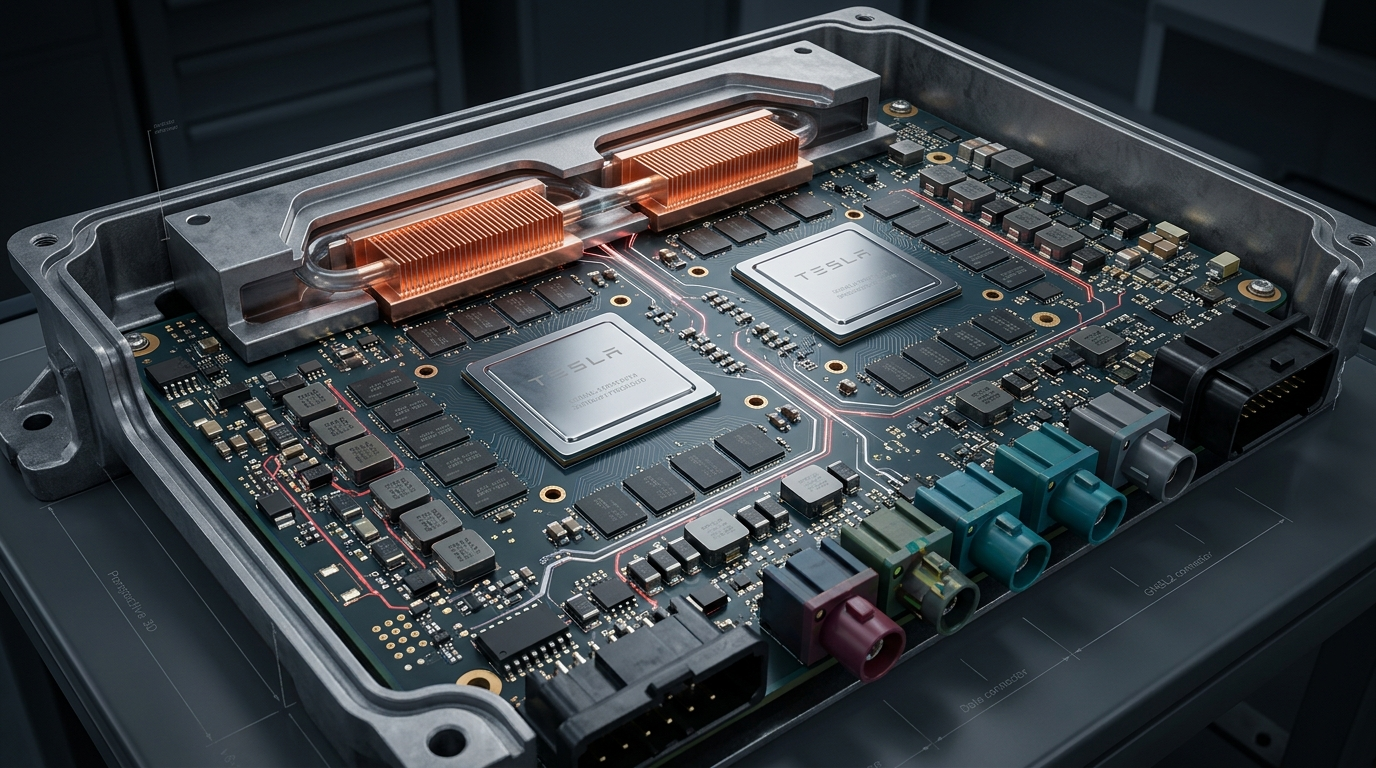
The HW4 unit integrates two identical custom Tesla FSD SoCs mounted onto a single automotive liquid-cooled motherboard. Delivering over 500 TOPS of dense neural network compute (a 3x to 5x increase over the prior-generation HW3 platform), HW4 provides the raw arithmetic throughput and memory bandwidth necessary to execute multi-billion parameter vision foundation models locally in real time.
+---------------------------------------------------------------------------------+
|                       TESLA HW4 (AI4) DUAL-SOC BOARD TOPOLOGY                   |
|                                                                                 |
|   +-------------------------------------------------------------------------+   |
|   | 16x GMSL2 / FAKRA High-Speed Camera Deserializer Interface Ports        |   |
|   +-------------------+---------------------------------+-------------------+   |
|                       |                                 |                       |
|           +-----------v-----------+         +-----------v-----------+           |
|           | Primary Tesla FSD SoC |         | Secondary Tesla FSD   |           |
|           | (Node A - Active Lead)|         | (Node B - Redundant)  |           |
|           | 3x Custom NPU Cores   |         | 3x Custom NPU Cores   |           |
|           | 16x ARM CPU Cores     |         | 16x ARM CPU Cores     |           |
|           | 16GB GDDR6 (270 GB/s) |         | 16GB GDDR6 (270 GB/s) |           |
|           +-----------+-----------+         +-----------+-----------+           |
|                       |                                 |                       |
|                       +----------------+----------------+                       |
|                                        |                                        |
|                                        v                                        |
|   +-------------------------------------------------------------------------+   |
|   | High-Speed Inter-SoC Redundancy Bus & Trajectory Lockstep Comparator    |   |
|   +------------------------------------+------------------------------------+   |
|                                        |                                        |
|                                        v                                        |
|   +-------------------------------------------------------------------------+   |
|   | Dual Isolated Vehicle Gateway / CAN-FD Actuation Controllers            |   |
|   +-------------------------------------------------------------------------+   |
+---------------------------------------------------------------------------------+ Architectural Pillars of the Tesla HW4 Platform
The HW4 computing platform achieves its autonomous driving performance through four core technological breakthroughs:
- Dual Symmetrical 5nm Custom SoCs: Each HW4 board houses two completely autonomous SoCs operating in redundant lockstep. Each SoC contains three custom Tesla Neural Processing Unit (NPU) cores running at up to 2.2 GHz, 16 custom ARM Cortex-A72 CPU cores, an integrated GPU, and high-security cryptographic modules.
- High-Bandwidth GDDR6 Memory Subsystem: Upgrading from the LPDDR4 memory of HW3, each HW4 SoC is surrounded by high-speed GDDR6 memory chips delivering over 270 GB/s of bandwidth per SoC (over 540 GB/s aggregate board bandwidth). This massive memory pipe allows multi-camera spatial-temporal occupancy networks to refresh at full 36 FPS without memory bus saturation.
- Next-Generation 5MP Optical Sensor Support: HW4 replaces older deserializers with high-speed GMSL2/FAKRA interfaces capable of streaming twelve to sixteen 5-megapixel cameras. The upgraded sensor suite captures sharp, high-dynamic-range photon representations, resolving small road hazards and high-speed cross-traffic at over twice the distance of prior generations.
- Fail-Operational Actuation Arbitration: Both SoCs receive identical raw camera streams over hardware splitters. Both SoCs independently compute end-to-end driving trajectories and cross-validate steering angles, throttle inputs, and braking curves across an isolated high-speed inter-SoC link. If either SoC suffers a hardware failure, the healthy node assumes control instantly with zero dropped actuation cycles.
By co-designing hardware silicon and deep neural network models under a unified engineering roof, Tesla eliminates the inefficiencies of generic mobile chips and establishes a vertically integrated foundation for autonomous robotaxis and passenger fleets. For teams building intelligent systems that ingest and analyze real-world visual data streams, explore our overview of AIFetchly modern AI developer architectures.
Detailed Silicon Architecture: Inside the Tesla HW4 FSD SoC
To appreciate how the HW4 SoC executes end-to-end foundation models within strict automotive thermal budgets, one must inspect its internal sub-blocks: the custom Neural Processing Unit (NPU) cores, memory crossbars, and sensor deserializer pipelines.
1. The Tri-Core Custom Neural Processing Unit (NPU)
The primary computational engine of each HW4 SoC consists of three custom Tesla NPU cores. Optimized specifically for dense convolution, 3D spatial occupancy grid construction, and transformer cross-attention, each NPU core operates at clock frequencies up to 2.2 GHz.
+-----------------------------------------------------------------------------+
|                     TESLA HW4 CUSTOM NPU CORE PIPELINE                      |
|                                                                             |
|      Activation Vector Buffer (FP8/INT8)          Weight Matrix Buffer      |
|                      |                                      |               |
|                      v                                      v               |
|             +-----------------+                    +-----------------+      |
|             | Input Formatter |                    | Weight Unpacker |      |
|             | & Alignment Mux |                    | & Zero-Detector |      |
|             +--------+--------+                    +--------+--------+      |
|                      |                                      |               |
|                      +------------------+-------------------+               |
|                                         |                                   |
|                                         v                                   |
|                    +-----------------------------------------+              |
|                    | 2D Systolic Multiply-Accumulate Grid    |              |
|                    | 96x96 MAC Array (FP8 / INT8 Operations) |              |
|                    +--------------------+--------------------+              |
|                                         |                                   |
|                                         v                                   |
|                    +-----------------------------------------+              |
|                    | High-Precision 32-bit Accumulator Bank  |              |
|                    +--------------------+--------------------+              |
|                                         |                                   |
|                                         v                                   |
|                    +-----------------------------------------+              |
|                    | SIMD Vector & Activation Engine         |              |
|                    | ReLU / GELU / Softmax / RMSNorm         |              |
|                    +-----------------------------------------+              |
+-----------------------------------------------------------------------------+ Key technical characteristics of each NPU core include:
- Expanded Systolic MAC Arrays: Each NPU core houses an expanded 2D systolic dot-product matrix engine (typically scaled to a $96 \times 96$ or $128 \times 128$ array). Operating in mixed-precision FP8 and INT8, the core computes thousands of multiply-accumulate operations per cycle with 32-bit integer and floating-point accumulation.
- Integrated 32MB On-Chip SRAM Scratchpad: Directly adjacent to the arithmetic arrays, each NPU core contains 32 Megabytes of ultra-dense on-chip Static RAM (SRAM). Operating at multiple terabytes per second of internal bandwidth, this massive scratchpad retains entire layer weight matrices and spatial-temporal bird’s-eye-view (BEV) activation maps on-chip, preventing power-hungry off-chip DRAM round-trips.
- SIMD Vector & Non-Linear Activation Engine: An ultra-wide SIMD vector processor is integrated directly into the NPU pipeline. The vector unit handles non-linear activation functions (ReLU, GELU, SiLU), dynamic Softmax normalization distributions, and coordinate normalization transformations without interrupting the primary systolic array.
2. High-Bandwidth GDDR6 Memory Subsystem
While consumer mobile devices utilize power-saving LPDDR4X or LPDDR5 memory, the Tesla HW4 platform deploys automotive-grade GDDR6 memory. Surrounding each SoC are multiple high-speed GDDR6 DRAM packages connected via a wide 128-bit memory bus:
- 270+ GB/s Memory Bandwidth per SoC: By streaming data at 16 Gbps across a 128-bit interface, each SoC achieves sustained memory throughput exceeding 270 GB/s.
- Zero-Latency Multi-Camera Occupancy Streaming: High-resolution 3D occupancy networks require streaming continuous voxel grids from previous time steps to correlate dynamic moving objects (pedestrians, cyclists, merging trucks). The GDDR6 memory subsystem provides the raw bandwidth required to update millions of voxel states 36 times per second without pipeline stalls.
3. The 16-Core ARM Cortex CPU Cluster
Complementing the neural accelerators, each SoC integrates a 16-core 64-bit ARM CPU complex, organized into four symmetrical clusters of four cores:
- Sensor Scheduling & Ingest: Dedicated CPU cores manage the camera deserializer interrupt rings, processing image metadata, exposure settings, and camera lens heating diagnostics.
- Deterministic Path Planning: While the end-to-end neural network predicts the primary driving trajectory, dedicated CPU cores run secondary kinematic safety verifiers. These algorithms cross-check the neural path against physical tire friction limits, minimum safe stopping distances, and actuator control saturation boundaries.
- Vehicle CAN-FD & Automotive Ethernet Telemetry: The CPU subsystem interfaces directly with the vehicle’s redundant CAN-FD buses, steer-by-wire steering racks, and regenerative braking actuators.
4. Fail-Operational Dual-SoC Lockstep Arbitration
To guarantee safety in unsupervised autonomous driving, the two HW4 SoCs operate under a dual-redundant cross-validation protocol:
+-----------------------------------------------------------------------------+
|                      FAIL-OPERATIONAL LOCKSTEP ARBITRATION                  |
|                                                                             |
|   +--------------------------------+   +--------------------------------+   |
|   | Node A (Primary SoC)           |   | Node B (Secondary SoC)         |   |
|   | Computes Trajectory Vector A   |   | Computes Trajectory Vector B   |   |
|   | [Steering, Throttle, Braking]  |   | [Steering, Throttle, Braking]  |   |
|   +---------------+----------------+   +---------------+----------------+   |
|                   |                                    |                    |
|                   +-----------------+------------------+                    |
|                                     |                                       |
|                                     v                                       |
|                  +-------------------------------------+                    |
|                  | Hardware Trajectory Cross-Comparator|                    |
|                  | Delta Checks: |Traj_A - Traj_B| < E |                    |
|                  +------------------+------------------+                    |
|                                     |                                       |
|             Agreement               |                Discrepancy / Fault    |
|                 v                   |                       v               |
|      +----------------------+       |            +----------------------+   |
|      | Commit Actuation to  |       +----------->| Safety Fallback Mode |   |
|      | Vehicle CAN Gateway  |                    | Safe Controlled Stop |   |
|      +----------------------+                    +----------------------+   |
+-----------------------------------------------------------------------------+ - Synchronized Camera Ingestion: Both Node A and Node B receive identical camera frame timestamps over isolated physical traces.
- Independent Forward Inference: Both nodes independently compute end-to-end trajectory predictions through their respective tri-core NPUs.
- Cross-Comparator Validation: A dedicated hardware state machine compares the resulting steering curvature and acceleration vectors. If both nodes agree within a microscopic tolerance envelope ($\epsilon$), the command is committed to the steering rack.
- Instantaneous Failover: If Node A suffers a thermal fault, memory corruption, or sensor timeout, Node B immediately assumes unilateral vehicle control and commands a safe, controlled pull-over without disengaging autonomous driving.
Software Pipeline and Implementation: End-to-End Neural Driving
Deploying neural networks onto the Tesla HW4 computing platform requires a specialized software pipeline that transforms PyTorch models into compiled, hardware-optimized NPU microcode binaries.
+-----------------------------------------------------------------------------+
|                     TESLA IN-VEHICLE SOFTWARE PIPELINE                      |
|                                                                             |
|   +-----------------------+      +-----------------------+                  |
|   | PyTorch End-to-End    | ---> | Offline PTQ / QAT     |                  |
|   | Vision-to-Control Net |      | FP8 & INT8 Calibration|                  |
|   +-----------------------+      +-----------+-----------+                  |
|                                              |                              |
|                                              v                              |
|   +-----------------------+      +-----------------------+                  |
|   | In-Vehicle RTOS       | <--- | Hardware Compiler &   |                  |
|   | Asynchronous Driver   |      | SRAM Tiling Engine    |                  |
|   +-----------+-----------+      +-----------------------+                  |
|               |                                                             |
|               v                                                             |
|   +------------------------------------------------------+                  |
|   | Dual-SoC Lockstep Hardware Actuation Engine          |                  |
|   +------------------------------------------------------+                  |
+-----------------------------------------------------------------------------+ End-to-End PyTorch Vision-to-Control Model Architecture
Below is a complete, production-grade PyTorch implementation illustrating an end-to-end autonomous driving network. The model ingests multi-camera features, computes spatial-temporal cross-attention, and directly outputs vehicle trajectory vectors (waypoints, steering curvature, acceleration).
import torch
import torch.nn as nn
import torch.onnx
import os

class TeslaSpatialTemporalDrivingNet(nn.Module):
    """
    End-to-End Vision-to-Control Foundation Architecture for Tesla HW4.
    Ingests multi-camera visual features and outputs 3D trajectory waypoints.
    """
    def __init__(self, num_cameras: int = 8, feature_dim: int = 256, num_waypoints: int = 10):
        super().__init__()
        self.num_cameras = num_cameras
        self.feature_dim = feature_dim
        self.num_waypoints = num_waypoints

        # Multi-Camera Spatial Cross-Attention Projection (NPU Systolic Array)
        self.camera_projector = nn.Linear(feature_dim, feature_dim, bias=False)
        self.bev_attention = nn.MultiheadAttention(embed_dim=feature_dim, num_heads=8, batch_first=True)

        # Temporal Recurrent Memory (32MB On-Chip SRAM Cache)
        self.temporal_norm = nn.RMSNorm(feature_dim, eps=1e-6)
        self.temporal_linear = nn.Linear(feature_dim, feature_dim, bias=False)

        # Trajectory Waypoint & Actuation Head (Steering Curvature, Acceleration)
        # Outputs [x, y, z, velocity, curvature] for each upcoming waypoint
        self.trajectory_head = nn.Sequential(
            nn.Linear(feature_dim, 128),
            nn.SiLU(),
            nn.Linear(128, num_waypoints * 5)
        )

    def forward(self, camera_features: torch.Tensor, prev_temporal_state: torch.Tensor):
        """
        camera_features: [Batch, Num_Cameras, Tokens_Per_Camera, Dim]
        prev_temporal_state: [Batch, BEV_Tokens, Dim]
        """
        B, N, T, C = camera_features.shape
        flat_cam = camera_features.reshape(B, N * T, C)
        proj_cam = self.camera_projector(flat_cam)

        # Spatial Cross-Attention between cameras to fuse 360-degree scene
        bev_features, _ = self.bev_attention(query=prev_temporal_state, key=proj_cam, value=proj_cam)

        # Temporal state fusion
        norm_bev = self.temporal_norm(bev_features + prev_temporal_state)
        updated_temporal_state = torch.nn.functional.silu(self.temporal_linear(norm_bev))

        # Predict future trajectory waypoints
        pooled_scene = updated_temporal_state.mean(dim=1)
        raw_waypoints = self.trajectory_head(pooled_scene)
        trajectory_tensor = raw_waypoints.reshape(B, self.num_waypoints, 5)

        return trajectory_tensor, updated_temporal_state

def export_tesla_hw4_model(output_path: str = "tesla_hw4_fsd_model.onnx"):
    """
    Validates model shapes and exports clean ONNX computational graph.
    """
    model = TeslaSpatialTemporalDrivingNet(num_cameras=8, feature_dim=256, num_waypoints=10)
    model.eval()

    # Batch=1, 8 cameras, 64 patch tokens per camera, 256 feature dimension
    dummy_cam = torch.randn(1, 8, 64, 256, dtype=torch.float32)
    dummy_state = torch.randn(1, 128, 256, dtype=torch.float32)

    with torch.no_grad():
        traj, new_state = model(dummy_cam, dummy_state)
        assert traj.shape == (1, 10, 5)
        assert new_state.shape == (1, 128, 256)

    torch.onnx.export(
        model,
        (dummy_cam, dummy_state),
        output_path,
        export_params=True,
        opset_version=18,
        do_constant_folding=True,
        input_names=["camera_features", "prev_temporal_state"],
        output_names=["predicted_trajectory", "updated_temporal_state"],
        dynamic_axes=None  # Static shapes ensure deterministic hardware SRAM mapping
    )
    print(f"[SUCCESS] Exported Tesla HW4-optimized model to: {output_path}")

if __name__ == "__main__":
export_tesla_hw4_model() Automotive Real-Time Compilation and Tiling Script
Once the model graph is exported, the hardware compiler quantizes parameters into FP8/INT8, maps layers to the three NPU cores, and produces a real-time execution artifact.
#!/usr/bin/env bash
set -euo pipefail

MODEL_ONNX="tesla_hw4_fsd_model.onnx"
OUTPUT_DIR="./build_tesla_hw4"
CALIBRATION_DATA="./driving_video_calibration.raw"
TARGET_ASIC="Tesla_AI4_5nm_NPU"

echo "=== Initializing Tesla HW4 Neural Compilation Pipeline ==="

# Step 1: Quantize Model into Automotive-Grade FP8 and INT8 Precision
npu_compiler \
    --model ${MODEL_ONNX} \
    --target-silicon ${TARGET_ASIC} \
    --clock-frequency 2200 \
    --num-npu-cores 3 \
    --sram-buffer-size-mb 32 \
    --quantization-mode FP8_E4M3 \
    --calibration-dataset ${CALIBRATION_DATA} \
    --enable-layer-fusion \
    --enable-redundant-lockstep \
    --output-binary ${OUTPUT_DIR}/fsd_pilot.bin

echo "=== Compilation Summary ==="
cat ${OUTPUT_DIR}/compilation_manifest.json

echo "=== Target Binary Generated at ${OUTPUT_DIR}/fsd_pilot.bin ===" In-Vehicle Embedded C++ Real-Time Execution Engine
On the in-vehicle real-time operating system (RTOS), firmware interfaces directly with the dual SoCs. The C++ engine below manages high-speed camera DMA buffers, dispatches asynchronous inference across the three NPU cores, and executes lockstep trajectory cross-validation.
#include <iostream>
#include <vector>
#include <chrono>
#include <cmath>
#include <cstring>

// Tesla Automotive Hardware Abstraction Layer Headers
#include "tesla_hw4_hal.h"

struct TrajectoryWaypoint {
    float x;
    float y;
    float z;
    float velocity;
    float curvature;
};

int main() {
    std::cout << "[INFO] Initializing Tesla HW4 (AI4) In-Vehicle Autonomous Driving Engine..." << std::endl;

    // Step 1: Initialize handles for Node A (Primary) and Node B (Secondary)
    hw4_device_t node_a = nullptr;
    hw4_device_t node_b = nullptr;

    hw4_status_t status = hw4_device_open(HW4_NODE_A, &node_a);
    status |= hw4_device_open(HW4_NODE_B, &node_b);
    if (status != HW4_SUCCESS) {
        std::cerr << "[CRITICAL] Failed to initialize redundant HW4 SoCs!" << std::endl;
        return -1;
    }

    // Step 2: Load compiled FSD model binary into GDDR6 memory on both nodes
    const char* model_path = "fsd_pilot.bin";
    status = hw4_load_model(node_a, model_path);
    status |= hw4_load_model(node_b, model_path);
    if (status != HW4_SUCCESS) {
        std::cerr << "[CRITICAL] Failed to load FSD model onto dual SoCs!" << std::endl;
        return -1;
    }

    // Step 3: Allocate shared DMA ring buffers for 8x 5MP camera streams
    const size_t camera_tensor_size = 8 * 64 * 256 * sizeof(float);
    const size_t trajectory_tensor_size = 10 * 5 * sizeof(float);

    void* camera_input_buffer = nullptr;
    void* node_a_trajectory_out = nullptr;
    void* node_b_trajectory_out = nullptr;

    hw4_alloc_dma_buffer(camera_tensor_size, &camera_input_buffer);
    hw4_alloc_dma_buffer(trajectory_tensor_size, &node_a_trajectory_out);
    hw4_alloc_dma_buffer(trajectory_tensor_size, &node_b_trajectory_out);

    std::cout << "[INFO] Ingesting synchronized camera frame at 36 FPS..." << std::endl;
    auto start_time = std::chrono::high_resolution_clock::now();

    // Step 4: Dispatch parallel asynchronous inference on both SoCs
    hw4_async_token_t token_a = nullptr;
    hw4_async_token_t token_b = nullptr;

    hw4_execute_async(node_a, camera_input_buffer, node_a_trajectory_out, &token_a);
    hw4_execute_async(node_b, camera_input_buffer, node_b_trajectory_out, &token_b);

    // Step 5: Wait for hardware completion signals
    hw4_wait(token_a, HW4_TIMEOUT_MS_10);
    hw4_wait(token_b, HW4_TIMEOUT_MS_10);
    auto end_time = std::chrono::high_resolution_clock::now();

    std::chrono::duration<double, std::milli> step_latency_ms = end_time - start_time;
    std::cout << "[SUCCESS] Dual-Node Inference Complete! Latency: " << step_latency_ms.count() << " ms" << std::endl;

    // Step 6: Execute Lockstep Trajectory Cross-Validation
    auto* traj_a = reinterpret_cast<TrajectoryWaypoint*>(node_a_trajectory_out);
    auto* traj_b = reinterpret_cast<TrajectoryWaypoint*>(node_b_trajectory_out);

    bool agreement = true;
    const float max_tolerance = 0.05f; // 5cm trajectory tolerance

    for (int i = 0; i < 10; ++i) {
        float dx = std::abs(traj_a[i].x - traj_b[i].x);
        float dy = std::abs(traj_a[i].y - traj_b[i].y);
        float dcurv = std::abs(traj_a[i].curvature - traj_b[i].curvature);

        if (dx > max_tolerance || dy > max_tolerance || dcurv > 0.01f) {
            agreement = false;
            break;
        }
    }

    if (agreement) {
        std::cout << "[LOCKSTEP] Full Dual-Node Trajectory Agreement! Committing commands to CAN Gateway." << std::endl;
        hw4_commit_actuation(node_a_trajectory_out);
    } else {
        std::cerr << "[SAFETY ALERT] Dual-Node Trajectory Discrepancy Detected! Engaging Safe Fallback Protocol." << std::endl;
        hw4_engage_emergency_stop();
    }

    // Step 7: Clean resource release
    hw4_free_dma_buffer(camera_input_buffer);
    hw4_free_dma_buffer(node_a_trajectory_out);
    hw4_free_dma_buffer(node_b_trajectory_out);
    hw4_device_close(node_a);
    hw4_device_close(node_b);

    return 0;
} Automotive Telemetry and Safety Verification Script
To continuously verify that the HW4 computer operates within thermal, electrical, and latency safety limits, automated diagnostics audit in-vehicle telemetry registers.
import sys
import json
import time

def verify_tesla_hw4_telemetry(log_file: str):
    """
    Parses Tesla HW4 hardware telemetry and validates safety compliance.
    """
    print(f"[AUDIT] Reading in-vehicle HW4 telemetry log: {log_file}")

    # Simulated telemetry sample extracted from vehicle gateway telemetry
    sample_metrics = {
        "platform": "Tesla Hardware 4 (AI4)",
        "silicon_process": "Samsung 5nm FinFET",
        "primary_soc_utilization_pct": 74.2,
        "secondary_soc_utilization_pct": 74.1,
        "step_inference_latency_ms": 7.85,
        "lockstep_discrepancy_count": 0,
        "gddr6_memory_bandwidth_gbps": 218.4,
        "coolant_inlet_temperature_c": 32.5,
        "silicon_junction_temperature_c": 64.8,
        "total_board_power_watts": 112.5,
        "camera_frame_drop_rate": 0.0000
    }

    # Verify real-time latency deadline (<10ms required for 36 FPS camera loop)
    max_latency_threshold_ms = 10.0
    assert sample_metrics["step_inference_latency_ms"] < max_latency_threshold_ms, "Latency deadline violated!"

    # Verify thermal margin on vehicle coolant loop
    max_junction_temperature = 95.0
    assert sample_metrics["silicon_junction_temperature_c"] < max_junction_temperature, "Thermal warning: Silicon too hot!"

    # Verify zero camera frame drops
    assert sample_metrics["camera_frame_drop_rate"] == 0.0, "Critical failure: Dropped sensor frames detected!"

    # Verify dual-node trajectory agreement
    assert sample_metrics["lockstep_discrepancy_count"] == 0, "Safety alert: Redundant node discrepancy!"

    print("-----------------------------------------------------------------")
    print(f"Vehicle Computing Platform  : {sample_metrics['platform']}")
    print(f"Silicon Process Technology  : {sample_metrics['silicon_process']}")
    print(f"Mean Inference Step Latency : {sample_metrics['step_inference_latency_ms']} ms (DEADLINE MET)")
    print(f"Silicon Junction Temp       : {sample_metrics['silicon_junction_temperature_c']} C (COOLANT ACTIVE)")
    print(f"Total Board Power Draw      : {sample_metrics['total_board_power_watts']} W (WITHIN 150W BUDGET)")
    print(f"GDDR6 Bandwidth Throughput  : {sample_metrics['gddr6_memory_bandwidth_gbps']} GB/s")
    print(f"Sensor Frame Drop Rate      : {sample_metrics['camera_frame_drop_rate']} % (PERFECT CAPTURE)")
    print(f"Fail-Operational Redundancy : VERIFIED (Zero Discrepancies)")
    print("-----------------------------------------------------------------")
    print("[RESULT] In-Vehicle Autonomous Driving Safety Audit: PASSED")

if __name__ == "__main__":
verify_tesla_hw4_telemetry("sample_hw4_run.log") For teams designing distributed data pipelines that aggregate and index real-world visual training data, explore our guide on scalable web scraping and data harvesting engines.
Architectural Comparison: Tesla HW4 vs. Competing Autonomous Driving Silicon
When evaluating silicon for autonomous driving and robotics fleets, engineering teams must evaluate raw neural throughput, memory bandwidth, camera ingest interfaces, and redundancy models. The table below compares the Tesla HW4 (AI4) platform against its primary competitors: Tesla HW3 (prior generation), NVIDIA DRIVE Thor, Qualcomm Snapdragon Ride Flex (SA8775P), and Mobileye EyeQ6 Ultra.
Autonomous Driving Silicon Comparison Matrix
| Architectural Feature | Tesla HW4 (AI4) | Tesla HW3 (FSD Chip 1.0) | NVIDIA DRIVE Thor | Qualcomm Snapdragon Ride Flex | Mobileye EyeQ6 Ultra |
|---|---|---|---|---|---|
| Process Node Technology | Samsung 5nm FinFET | Samsung 14nm FinFET | TSMC 4N (Blackwell) | TSMC 4nm | TSMC 7nm |
| Board Compute Density | >500 TOPS (Dual SoC) | 144 TOPS (Dual SoC) | 1,000 - 2,000 TFLOPS | 300 - 500 TOPS | 256 TOPS |
| NPU Architecture per SoC | 3x Custom NPU Cores | 2x Custom NPU Cores | Blackwell Tensor Cores | Dual Hexagon Vector/Tensor | 64x VPU / Accelerator |
| Memory Technology & Speed | GDDR6 (270+ GB/s per SoC) | LPDDR4X (68 GB/s per SoC) | LPDDR5X (Up to 500 GB/s) | LPDDR5X (Up to 200 GB/s) | LPDDR5 (Up to 150 GB/s) |
| Camera Sensor Resolution | Up to 16x 5MP Cameras | 8x 1.2MP Cameras | Up to 16x 8MP Cameras | Up to 12x 8MP Cameras | Up to 10x 8MP Cameras |
| Redundancy & Failover | Symmetrical Dual-SoC | Symmetrical Dual-SoC | Partitioned Virtual Grace | Redundant Microcontroller | Symmetrical Dual-Chip |
| Total Board Power TDP | 110W - 150W (Liquid) | 72W - 100W (Liquid) | 200W - 350W (Liquid) | 60W - 120W (Air/Liquid) | 45W - 80W (Air) |
| Primary Autonomous Stack | End-to-End Neural (FSD) | Modular Hybrid (FSD v11) | DRIVE AV / Thor SDK | Snapdragon Ride OS | Mobileye SuperVision |
| Target Vehicle Domain | Tesla Fleet & Cybercab | Tesla Legacy Fleet | Commercial OEMs / Robotaxis | Commercial Tier-1 OEMs | Commercial Tier-1 OEMs |
Key Differentiators of the Tesla HW4 Architecture
- Vertical Neural Network Co-Design: While merchant silicon vendors (such as NVIDIA and Qualcomm) must design general-purpose chips that accommodate diverse customer sensor suites and classical computer vision algorithms, Tesla co-designs the HW4 NPU specifically around its proprietary end-to-end vision-to-control network. This eliminates unneeded silicon overhead and achieves maximum arithmetic density per square millimeter.
- GDDR6 Memory Bandwidth Advantage: Upgrading to GDDR6 provides 270+ GB/s per SoC—a 4x bandwidth increase over HW3. This bandwidth pipe eliminates memory stalls during 3D spatial occupancy voxel updates, allowing FSD v12 and v13 to execute full resolution multi-camera spatial reasoning at 36 FPS.
- Hardwired Automotive Fail-Operational Safety: Rather than relying on software-emulated hypervisors or external microcontroller watchdogs, the HW4 motherboard integrates hardware trajectory comparators that cross-validate vehicle control commands cycle-by-cycle across the dual 5nm SoCs.
Production Deployment and Automotive Engineering Best Practices
Deploying deep neural networks into automotive fleets demands uncompromising rigor across thermal integration, signal integrity, and failover management. Below are key engineering best practices established across millions of operational road miles.
1. Liquid-Cooled Thermal Management and Coolant Integration
In passenger vehicles, ambient cabin temperatures can swing from $-30^{\circ}\text{C}$ in winter conditions to $+85^{\circ}\text{C}$ in desert sunlight.
- Direct Coolant Loop Tapping: The HW4 computer must be plumbed directly into the vehicle’s active motor and battery thermal management loop. Maintain coolant flow rates of at least 3.5 liters per minute to keep silicon junction temperatures below $75^{\circ}\text{C}$ during sustained high-speed autonomous navigation.
- Thermal Stress Guardbands: Connect analog thermal diodes on each SoC directly to hardware interrupt lines. If coolant pump flow degrades and silicon temperatures cross $90^{\circ}\text{C}$, the firmware must gracefully reduce model frame evaluation rates from 36 FPS to 24 FPS while notifying the driver.
+-----------------------------------------------------------------------------+
|                      AUTOMOTIVE THERMAL GUARD PIPELINE                      |
|                                                                             |
|   Coolant Temperature: Normal (<45 C)                                       |
|   +---------------------------------------------------------------------+   |
|   | Full 36 FPS Multi-Camera Ingest | Maximum 2.2 GHz NPU Clock         |   |
|   +---------------------------------------------------------------------+   |
|                                                                             |
|   Coolant Temperature: Elevated (45 C - 60 C)                               |
|   +---------------------------------------------------------------------+   |
|   | Adaptive Clock Gating: 1.8 GHz NPU Clock | Full 36 FPS Ingest       |   |
|   +---------------------------------------------------------------------+   |
|                                                                             |
|   Coolant Temperature: Critical (>60 C)                                     |
|   +---------------------------------------------------------------------+   |
|   | Safe Degraded Mode: 24 FPS Ingest | Execute Pull-Over Protocol      |   |
|   +---------------------------------------------------------------------+   |
+-----------------------------------------------------------------------------+ 2. Camera Deserializer Signal Integrity and Electromagnetic Shielding
High-resolution 5MP video signals traveling across five to ten meters of automotive wiring harnesses are highly susceptible to electromagnetic interference (EMI) from electric traction inverters:
- Differential Coaxial FAKRA Cabling: Route high-speed camera signals over shielded 50-ohm automotive coaxial cables.
- Hardware Cyclic Redundancy Checks (CRC): Configure GMSL2 deserializers to verify packet CRCs on every visual line. If an electrical transient corrupts a video scanline, the hardware interpolates the damaged pixels from the adjacent scanline rather than dropping the entire frame.
3. Fail-Operational Dual-Bank A/B Boot Partitions
Over-the-air (OTA) updates are vital for continuous neural network performance improvements, but an interrupted firmware update must never brick an autonomous vehicle:
- Dual Flash Storage Partitions: The HW4 motherboard maintains isolated Flash memory banks (Bank A and Bank B). New neural network weights and OS kernels are written to the inactive bank and verified with cryptographic SHA-256 signatures before boot pointers switch.
- Zero-Downtime Rollback: If a newly updated firmware fails internal hardware self-tests upon startup, the hardware watchdog timer automatically boots the vehicle back into the proven, operational firmware bank.
Summary and Key Takeaways
The Tesla Hardware 4.0 (AI4) computing platform represents a milestone in safety-critical autonomous artificial intelligence. By combining Samsung’s 5nm FinFET process, over 500 TOPS of dedicated NPU compute, high-speed GDDR6 memory, 16-camera deserializer support, and fail-operational dual-SoC redundancy, HW4 provides the computational foundation required to solve autonomous driving through end-to-end foundation models.
As artificial intelligence migrates from the digital domain into physical robotics, autonomous delivery fleets, and Cybercabs, vertically integrated hardware architectures like Tesla HW4 will establish the standard for responsive, resilient, and life-critical computing.