TensorRT-LLM Guide: High-Throughput GPU Inference Engine
The Problem: The Memory-Bandwidth Wall and Static Batching Inefficiencies
In enterprise artificial intelligence, automated web scraping platforms, and desktop copilots powered by AiFetchly, foundation models process millions of tokens continuously. Whether extracting unstructured data from complex web documents, generating structured database records, or powering interactive conversational agents, the economic viability of AI applications hinges directly on inference serving efficiency.
However, deploying state-of-the-art Large Language Models (LLMs) on modern GPU clusters reveals a brutal hardware reality: the memory-bandwidth wall and static batching inefficiencies.
The Static Batching & GPU Underutilization Dilemma:
┌─────────────────────────────────────────────────────────────────┐
│ Request 1: [Prompt: 128 tokens] ──► Target: 10 tokens output    │
│ Request 2: [Prompt: 512 tokens] ──► Target: 500 tokens output   │
│ Request 3: [Prompt: 64 tokens]  ──► Target: 20 tokens output    │
└─────────────────────────────────────────────────────────────────┘
 │
 ▼ [Standard Static Batching on PyTorch]
┌─────────────────────────────────────────────────────────────────┐
│ Padded Tensor Matrix [Batch Size = 3, Max Length = 1012 tokens] │
│ Request 1: [128 tokens] [10 tokens] [PAD PAD PAD PAD PAD ... ]  │
│ Request 2: [512 tokens] [500 tokens]                           │
│ Request 3: [64 tokens]  [20 tokens] [PAD PAD PAD PAD PAD ... ]  │
└─────────────────────────────────────────────────────────────────┘
 │
 ├── ❌ 70%+ of Computed Tokens Are Meaningless Padding Tokens!
 ├── ❌ Request 1 & 3 Finish in 100ms, but Block in GPU VRAM for 3 Seconds!
 ├── ❌ New Inbound Queries Wait in Queue While Cores Compute Padding!
└── ❌ Arithmetic Intensity: 1.0 FLOP/Byte (Tensor Cores Starved)! 1. The Arithmetic Intensity Mismatch
Transformer inference operates in two fundamentally distinct computational regimes:
- Prefill Phase (Prompt Processing): The model processes all input prompt tokens in parallel. This phase is compute-bound, saturating GPU Tensor Cores with high-arithmetic-intensity General Matrix Multiplies (GEMMs).
- Decode Phase (Token Generation): Tokens are generated autoregressively, one by one. For each token, the GPU must load every weight matrix parameter and historical Key-Value (KV) cache activation vector from High-Bandwidth Memory (HBM) into on-chip SRAM registers.
During the decode phase, the arithmetic intensity drops to approximately 1.0 FLOP/Byte:
- On an NVIDIA Hopper H100 GPU (capable of nearly 1,000 TFLOPS of FP16 compute fed by 3.35 TB/s of HBM3 bandwidth), the Tensor Cores sit idle for over 80% of the execution time, waiting on memory bus transfers.
- Without massive batch concurrency, GPU utilization remains below 20%.
2. The Failure of Static Batching
In traditional deep learning serving, requests are grouped into static batches:
- Because user queries and generated responses have variable lengths, shorter sequences must be zero-padded to match the longest sequence in the batch.
- Resource Lock-in: Shorter requests complete generation within tens of milliseconds, but their memory buffers cannot be released until the longest request finishes.
- Wasted FLOPs: The GPU performs full attention and feed-forward forward passes on thousands of padding tokens, consuming memory bandwidth and driving up cloud infrastructure bills.
3. The Python Runtime and Global Interpreter Lock (GIL) Overhead
Most open-source serving prototypes rely on Python runtimes (e.g., standard Hugging Face Transformers or PyTorch loops):
- Under high concurrency (hundreds of concurrent streaming connections), the Python Global Interpreter Lock (GIL) serializes request handling, tokenization, and scheduling.
- Host CPU thread contention introduces millisecond-level scheduling jitter, stalling CUDA command streams and preventing hardware from achieving its theoretical peak throughput.
The Solution: NVIDIA TensorRT-LLM’s Hardware-Accelerated Architecture
To bridge the gap between foundation model architectures and NVIDIA hardware silicon, NVIDIA developed TensorRT-LLM.
TensorRT-LLM is an open-source library built on top of NVIDIA TensorRT’s deep learning compiler. It optimizes LLM inference by providing custom, hand-tuned CUDA kernels, continuous in-flight batching, paged KV memory management, low-precision quantization (FP8 and INT4), and a high-performance, zero-overhead C++ execution runtime.
TensorRT-LLM System Architecture:
┌─────────────────────────────────────────────────────────────────┐
│ Client Applications (aiFetchly Desktop, Web APIs, Microservices)│
└─────────────────────────────────────────────────────────────────┘
 │
 ▼ (HTTP / gRPC via Triton Inference Server / C++ Executor API)
┌─────────────────────────────────────────────────────────────────┐
│ In-Flight Batch Manager (Iteration-Level Scheduler)             │
│ • Ingests prefill requests and active decode steps dynamically  │
│ • Evicts completed sequences step-by-step with 0% padding waste │
└─────────────────────────────────────────────────────────────────┘
 │
 ▼
┌─────────────────────────────────────────────────────────────────┐
│ TensorRT-LLM Compiled Execution Engine (.engine)                │
│                                                                 │
│ ┌─────────────────────────────────────────────────────────────┐ │
│ │ Paged KV Cache Manager: Virtual memory blocks in GPU VRAM   │ │
│ ├─────────────────────────────────────────────────────────────┤ │
│ │ Fused Multi-Head Attention (FMHA) & XQA CUDA Kernels        │ │
│ ├─────────────────────────────────────────────────────────────┤ │
│ │ FP8 / INT4 AWQ Tensor Core GEMMs (W8A8 / W4A16)             │ │
│ ├─────────────────────────────────────────────────────────────┤ │
│ │ Multi-GPU Tensor Parallelism (TP) via NVLink SHARP Comm     │ │
│ └─────────────────────────────────────────────────────────────┘ │
└─────────────────────────────────────────────────────────────────┘
 │
 ▼
┌─────────────────────────────────────────────────────────────────┐
│ NVIDIA Hardware Silicon (Hopper H100/H200, Blackwell B200, RTX) │
└─────────────────────────────────────────────────────────────────┘ The Core Architectural Pillars of TensorRT-LLM
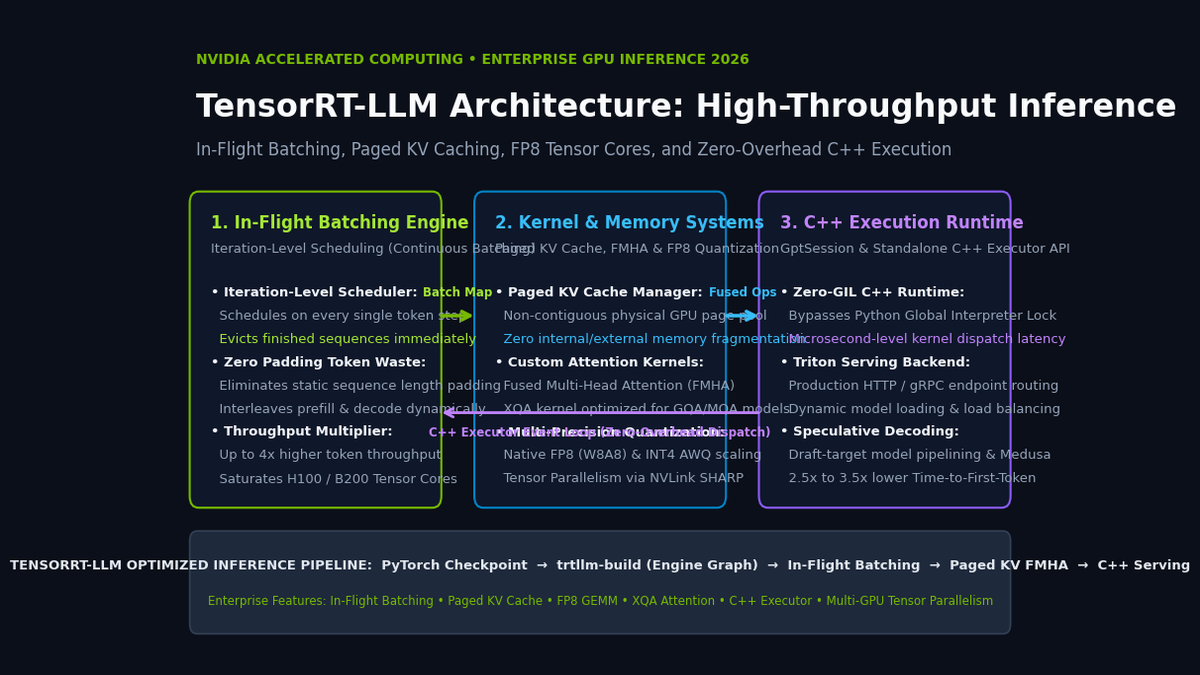
- In-Flight Batching (Iteration-Level Scheduling): Instead of waiting for an entire batch to complete, TensorRT-LLM schedules inference on a per-token-iteration boundary. When a request finishes, it is evicted immediately, and a new prefill request is injected into the vacant slot.
- Paged KV Cache Management: Breaks contiguous Key-Value allocations into discrete, non-contiguous physical memory pages. This eliminates internal and external VRAM fragmentation, allowing up to 3x larger batch sizes.
- Custom Fused Attention Kernels (FMHA & XQA): Implements state-of-the-art FlashAttention algorithms fused directly with positional encodings (RoPE). The XQA kernel provides specialized compute paths for Grouped-Query Attention (GQA) and Multi-Query Attention (MQA).
- Hardware-Native Quantization: Direct compilation for Hopper and Blackwell FP8 Tensor Cores (E4M3 and E5M2 formats) and INT4 AWQ/SmoothQuant, doubling throughput without model accuracy degradation.
- Standalone C++ Executor API: Completely decouples inference execution from the Python runtime, eliminating GIL contention and enabling sub-millisecond dispatch times inside Triton Inference Server.
Comparing High-Throughput Serving Engines
The table below contrasts TensorRT-LLM against other prominent serving frameworks:
Inference Engine Architectural Comparison:
┌───────────────────────────┬───────────────────────────────┬───────────────────────────────┬───────────────────────────────┐
│ Dimension                 │ Hugging Face TGI              │ vLLM                          │ NVIDIA TensorRT-LLM           │
├───────────────────────────┼───────────────────────────────┼───────────────────────────────┼───────────────────────────────┤
│ Core Engine Philosophy    │ Rust router + Python backend  │ Python-first async PagedAttn  │ C++ TensorRT graph compiler   │
│ Batching Mechanism        │ Continuous Batching           │ Dynamic Iteration Batching    │ In-Flight Batching (C++)      │
│ Peak Throughput on Hopper │ Baseline (1.0x)               │ 2.2x–2.8x                     │ 3.2x–4.2x (Native FP8 & FMHA) │
│ Attention Kernels         │ FlashAttention-2              │ PagedAttention + FlashAttn    │ Custom FMHA + XQA Kernels     │
│ Low-Precision Support     │ AWQ, GPTQ, BitsAndBytes       │ FP8, AWQ, GPTQ, Marlin        │ FP8 (W8A8), FP4, INT4 AWQ     │
│ Runtime Language          │ Rust & Python                 │ Python & C++ bindings         │ Pure C++ Executor API         │
│ Triton Server Integration │ Standalone container          │ Third-party backend           │ First-class native backend    │
│ Speculative Decoding      │ Basic draft model             │ Speculative, Medusa, EAGLE    │ Pipelined Draft, Medusa, Lookahead│
└───────────────────────────┴───────────────────────────────┴───────────────────────────────┴───────────────────────────────┘ Deep Dive into TensorRT-LLM Primitives & Kernels
TensorRT-LLM maximizes GPU hardware efficiency through four critical systems: the In-Flight Batch Scheduler, the Paged KV Cache, Custom Attention Kernels (XQA), and Multi-GPU Parallelism.
TensorRT-LLM Execution Subsystems:
TensorRT-LLM Engine
 ├──► 1. In-Flight Batching: Dynamic iteration scheduling evicting finished tokens
 ├──► 2. Paged KV Cache: Non-contiguous block allocation eliminating memory waste
 ├──► 3. XQA & FMHA Kernels: Fused attention optimized for GQA/MQA models
 ├──► 4. Low-Precision GEMM: FP8 Tensor Core scaling doubling arithmetic density
└──► 5. C++ Executor: Standalone multithreaded scheduler bypassing Python GIL 1. In-Flight Batching: Continuous Iteration Scheduling
Standard batching algorithms operate at the request level. TensorRT-LLM operates at the iteration level:
- At iteration $t$, the batch manager checks if any active sequence emitted an end-of-sequence (
<eos>) token. - If sequence $A$ completes, its KV cache pages are returned to the pool immediately.
- The scheduler checks the pending queue: if a new request $B$ is waiting, its prefill phase is scheduled into the next forward pass alongside active decode tokens from other requests.
- Result: Zero padding tokens are computed. Tensor Cores remain continuously saturated with active computation.
2. Paged KV Cache & Memory Virtualization
In traditional serving, GPU memory must be pre-allocated based on the maximum context length (e.g., 8,192 tokens per request):
- If an average request only uses 512 tokens, over 90% of allocated VRAM is wasted.
- TensorRT-LLM implements virtual memory paging for KV tensors:
- VRAM is divided into uniform blocks (e.g., 64 tokens per block).
- Physical pages are allocated on demand as tokens are generated.
- A block lookup table maps logical token positions to physical GPU memory addresses.
- Internal fragmentation is strictly bounded to the final unfilled block, enabling up to 3x higher batch concurrency on a single GPU.
3. Custom Fused Attention Kernels: FMHA and XQA
Modern architectures (such as LLaMA-3, Mistral, and Qwen) use Grouped-Query Attention (GQA), where multiple query heads share a single Key-Value head:
- Standard FlashAttention kernels are optimized for Multi-Head Attention (MHA) where the number of query and key heads are identical.
- TensorRT-LLM introduces XQA (eXtreme Query Attention):
- Specifically designed for GQA and MQA decode phases.
- Re-maps memory access patterns across GPU Streaming Multiprocessors (SMs) to ensure that shared KV blocks are read into on-chip cache once and reused across all associated query heads.
- Slashes memory bus traffic by up to 60%, accelerating decode speed on memory-bandwidth-bound workloads.
4. Native FP8 Quantization on NVIDIA Hopper & Blackwell
On NVIDIA Ada Lovelace, Hopper, and Blackwell GPUs, TensorRT-LLM provides native FP8 (8-bit floating point) compilation:
- Formats: Supports both
E4M3(4-bit exponent, 3-bit mantissa for activations and weights) andE5M2(for gradients). - Delayed Scaling Factors: Calculates per-tensor dynamic scale factors during compilation or calibration.
- Hardware Doubling: FP8 Tensor Cores compute matrix multiplications at twice the throughput of FP16, while cutting memory storage by 50%.
Hands-On Implementation: Compiling and Serving LLaMA with TensorRT-LLM
Let’s build a production-grade inference engine for a LLaMA model using TensorRT-LLM. We will convert the weights, compile an optimized engine with in-flight batching and FP8 quantization, and execute inference using the C++ Executor API.
1. Environment Setup
Launch the official NVIDIA TensorRT-LLM container with GPU access:
docker run --gpus all --ipc=host --ulimit memlock=-1 --ulimit stack=67108864 \
-it --rm -v $(pwd):/workspace nvcr.io/nvidia/tritonserver:24.08-trtllm-py3 Install TensorRT-LLM via pip (if building outside Docker):
pip install tensorrt_llm -U --extra-index-url https://pypi.nvidia.com 2. Converting Model Weights & Compiling the Engine
Use trtllm-build to compile a PyTorch Hugging Face checkpoint into an optimized TensorRT engine:
# Step 1: Convert Hugging Face weights to TensorRT-LLM intermediate checkpoint
python3 /app/tensorrt_llm/examples/llama/convert_checkpoint.py \
    --model_dir meta-llama/Llama-3.1-8B-Instruct \
    --output_dir ./tllm_checkpoint_1gpu_fp8 \
    --dtype float16 \
    --use_fp8 \
    --fp8_kv_cache

# Step 2: Compile the optimized TensorRT engine with in-flight batching
trtllm-build \
    --checkpoint_dir ./tllm_checkpoint_1gpu_fp8 \
    --output_dir ./trt_engines/llama3_8b_fp8 \
    --gemm_plugin float16 \
    --gpt_attention_plugin float16 \
    --paged_kv_cache enable \
    --remove_input_padding enable \
    --use_custom_all_reduce enable \
    --max_batch_size 128 \
    --max_input_len 4096 \
--max_seq_len 8192 3. Serving Inference via the Python Executor API
The Executor API connects directly to the underlying C++ runtime with zero-copy shared memory:
import tensorrt_llm
from tensorrt_llm.executor import Executor, GenerationConfig

# 1. Initialize the C++ Executor pointing to the compiled engine
engine_dir = "./trt_engines/llama3_8b_fp8"
executor = Executor(engine_dir)

# 2. Configure Generation Parameters
gen_config = GenerationConfig(
    max_new_tokens=256,
    temperature=0.7,
    top_p=0.9,
    eos_token_id=128001
)

# 3. Submit Asynchronous Inference Request
prompt_tokens = [128000, 2028, 374, 220, 2366, 18]  # "Hello, world!"
request_id = executor.enqueue_request(
    prompt_token_ids=prompt_tokens,
    sampling_config=gen_config
)

# 4. Stream Tokens Asynchronously as Generated
print("Streaming TensorRT-LLM Output:")
for response in executor.await_responses([request_id]):
    for res in response:
        if not res.has_error():
            new_tokens = res.result.output_token_ids[0]
            print(f"Token ID: {new_tokens[-1]}")
        else:
            print(f"Error: {res.error_msg}")

executor.shutdown() 4. Native C++ Production Dispatch (main.cpp)
For mission-critical production servers requiring microsecond dispatch without Python:
#include "tensorrt_llm/executor/executor.h"
#include <iostream>
#include <vector>

int main() {
    // 1. Create Executor Configuration
    std::string engine_path = "./trt_engines/llama3_8b_fp8";
    tensorrt_llm::executor::ExecutorConfig config;
    config.setMaxBeamWidth(1);

    // 2. Initialize Standalone C++ Executor
    tensorrt_llm::executor::Executor executor(engine_path, tensorrt_llm::executor::ModelType::kDECODER_ONLY, config);

    // 3. Construct Tokenized Request
    std::vector<int32_t> input_ids = {1, 15043, 29892, 1125};
    tensorrt_llm::executor::Request request(input_ids, 128); // 128 max new tokens

    // 4. Dispatch Request to In-Flight Batch Scheduler
    auto request_id = executor.enqueueRequest(request);

    // 5. Await Responses
    auto responses = executor.awaitResponses();
    std::cout << "Successfully executed in C++ runtime!" << std::endl;

    return 0;
} Production Architecture & Performance Tuning for aiFetchly
Integrating TensorRT-LLM into automated data extraction, document harvesting, and desktop intelligence systems like AiFetchly establishes a resilient, ultra-fast serving tier.
aiFetchly Enterprise GPU Serving Topology:
┌─────────────────────────────────────────────────────────────────┐
│ aiFetchly Web Scrapers & Document Ingestion Queues             │
└─────────────────────────────────────────────────────────────────┘
 │
 ▼ (Parallel Streaming Extraction Requests)
┌─────────────────────────────────────────────────────────────────┐
│ Triton Inference Server (with TensorRT-LLM C++ Backend)         │
│ • Load balances across multi-GPU nodes via gRPC / HTTP         │
│ • Dynamic In-Flight Batching handles unpredictable document sizes│
└─────────────────────────────────────────────────────────────────┘
 │
 ├──► GPU Node 1: NVIDIA H100 (TP=1, FP8 Quantized LLaMA-3.1 8B)
 └──► GPU Node 2: Dual NVIDIA H100 (TP=2, NVLink, LLaMA-3.3 70B)
 │
 ▼
┌─────────────────────────────────────────────────────────────────┐
│ Co-Located Unified Storage & Vector Database (PostgreSQL)       │
│ • Embeddings indexed via pgvector (HNSW + halfvec)              │
│ • Extracted JSON entities stored directly in ACID tables        │
└─────────────────────────────────────────────────────────────────┘ 1. Scaling Across NVLink with Tensor Parallelism (TP)
When hosting massive foundation models (such as LLaMA-3.3 70B or DeepSeek-V3):
- Compile with
--tp_size 2,--tp_size 4, or--tp_size 8. - TensorRT-LLM splits the attention query/key/value projection matrices across GPUs.
- It leverages NVLink SHARP (Scalable Hierarchical Aggregation and Reduction Protocol) to execute All-Reduce communications directly inside network switches, achieving near-linear multi-GPU throughput scaling.
2. Pipelined Speculative Decoding
To slash Time-to-First-Token (TTFT) and decode latency on high-complexity reasoning:
- Pair a small draft model (such as a 1B model) with a large target model (70B) inside TensorRT-LLM’s speculative decoding manager.
- The draft model speculates 4 tokens ahead; the target model verifies all 4 candidate tokens in a single parallel forward pass.
- In repetitive enterprise extraction tasks, this achieves 2.5x to 3.5x faster wall-clock generation speeds with zero degradation in accuracy.
3. Co-Locating Inference with Vector Storage
For end-to-end efficiency:
- Connect TensorRT-LLM directly to PostgreSQL with pgvector for unified hybrid retrieval.
- Route retrieved chunks directly into TensorRT-LLM’s in-flight batching queue.
- Monitor token costs, latency, and throughput metrics using distributed observability platforms like Langfuse or DeepEval to benchmark real-world inference ROI.
Summary: Unlocking Peak GPU Compute for Enterprise Generative AI
Moving from experimental LLM prototypes to mission-critical enterprise infrastructure requires eliminating un-optimized runtime overhead.
By integrating in-flight continuous batching, paged KV memory virtualization, specialized XQA and FMHA attention kernels, native FP8 Tensor Core quantization, and a standalone C++ runtime, NVIDIA TensorRT-LLM extracts maximum performance from modern GPU silicon. For automated web harvesting, intelligent document extraction, and desktop copilots engineered with AiFetchly, TensorRT-LLM provides the foundational serving architecture necessary to deliver sub-millisecond responsiveness and unprecedented token throughput.