Taming Complex Workflows: aiFetchly 4-Mode Subagents Guide
The Failure Modes of Monolithic AI Agents
When developers task a single conversational agent with executing multi-phase engineering projects—such as researching competitors, scraping dynamic web endpoints, verifying data claims, and formatting database exports—the architecture rapidly breaks down.
Monolithic single-prompt agents suffer from three systemic failure modes:
- Context Window Exhaustion: Passing discovery logs, intermediate scraping DOM trees, and verification steps into a single conversation saturates working memory, causing the model to forget earlier constraints (“Lost in the Middle” syndrome).
- Tool Over-Privilege: Granting a generalist prompt access to shell commands, scrapers, and database writes invites catastrophic errors or hallucinated parameters.
- Unchecked Confirmation Bias: When the agent performing data retrieval also verifies its own accuracy, it routinely overlooks hallucinated citations and declares premature victory.
AI Fetchly resolves these architectural bottlenecks through its 4-Mode Subagent Hierarchy.
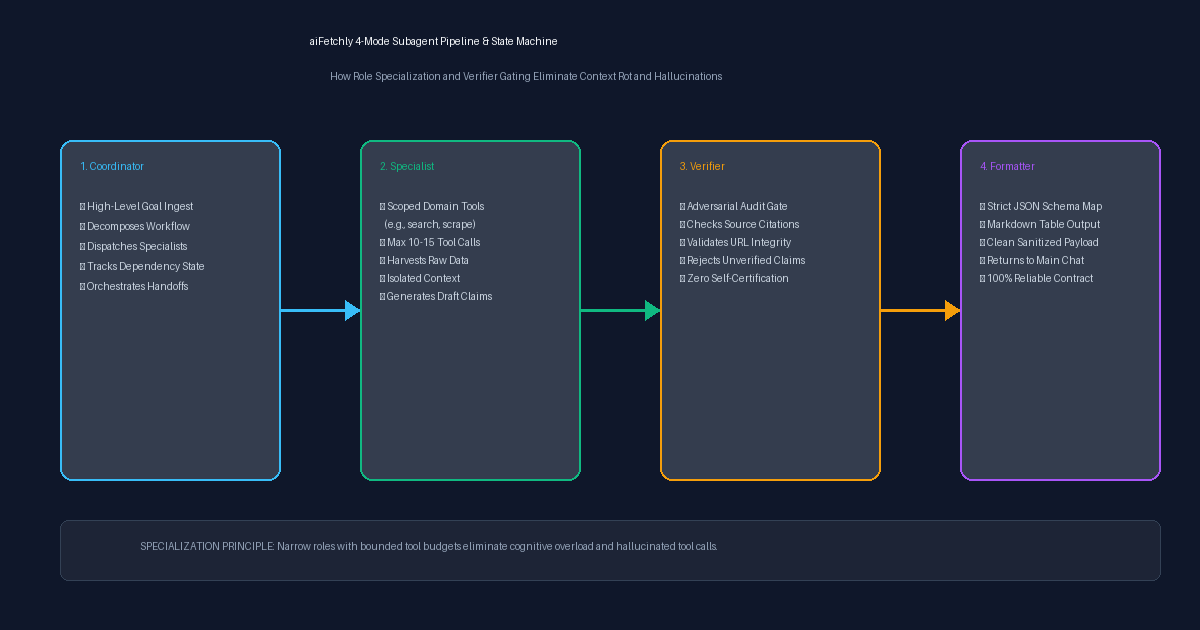
The 4-Mode Subagent Specialization Hierarchy
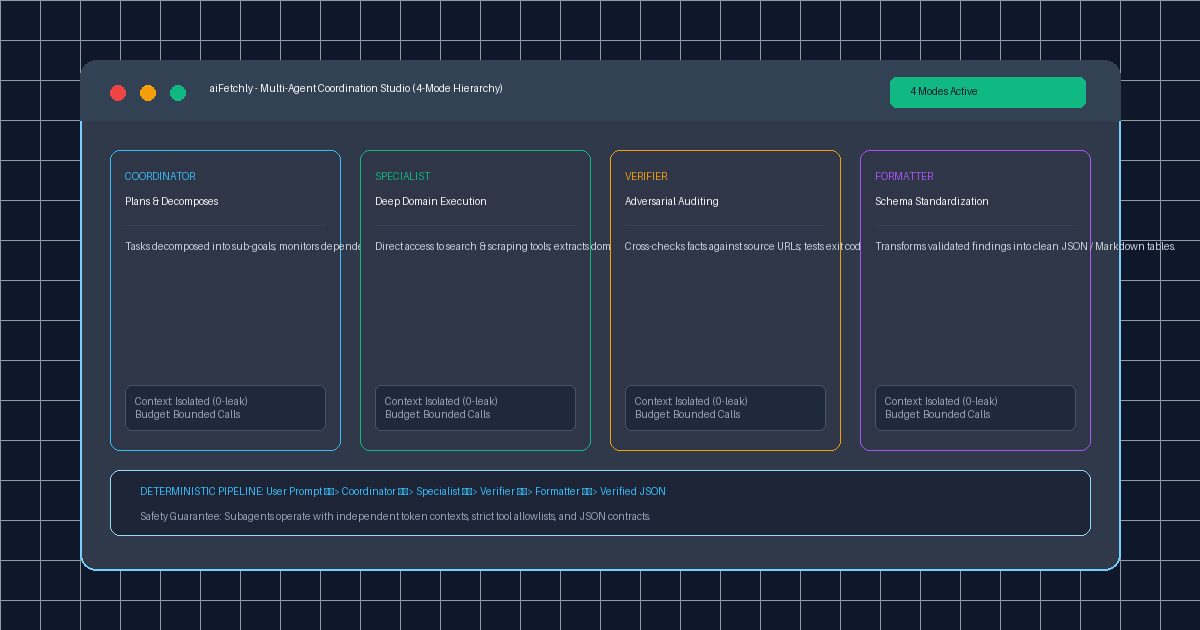
Rather than forcing one prompt to do everything, aiFetchly partitions agent responsibilities into four distinct operational modes governed by explicit contracts:
1. The Coordinator: Decompose and Orchestrate
The coordinator acts as the strategic project manager. Operating without invasive system tools, its sole responsibility is understanding the user’s objective, decomposing the workflow into linear milestones, and dispatching tasks to worker agents via the run_subagent interface. It maintains overall progress tracking without polluting its prompt with raw tool data.
2. The Specialist: Deep Domain Execution
Specialists are domain-bound execution units (e.g., agent-lead-researcher or agent-sql-query-builder). Equipped with a narrow tool allowlist (such as web scrapers or database connectors), the specialist focuses purely on deep retrieval within an isolated token context, protected by strict runtime limits (maxToolCalls: 10, maxRuntimeMs: 120000).
3. The Verifier: Adversarial Quality Gate
The verifier is an independent auditing agent. It receives the specialist’s draft findings and checks every assertion against source URLs and factual collateral:
- Employs read-only verification methods.
- Rejects ungrounded claims and identifies hallucinated statistics.
- The specialist cannot mark a task complete until the verifier passes the output.
4. The Formatter: Schema Standardization
The formatter ingests validated raw findings and normalizes them into strict target payloads—such as typed JSON schemas, Markdown comparative tables, or CRM-ready CSV rows. Because it possesses zero tool access, it cannot alter data or fabricate findings.
Enforcing Bounded Contracts via run_subagent
In aiFetchly, subagents communicate across clean JSON boundaries:
- Clean Contexts: When a subagent finishes, only its validated JSON return is passed upstream; raw scratchpad tokens are permanently purged.
- Circuit Breakers: Hard caps on execution time and continuation cycles prevent infinite recursion loops.
- Tamper-Proof Audit: Every subagent call and verification decision is permanently recorded in local SQLite ledgers.
Deterministic Multi-Agent Engineering
By separating orchestration, execution, verification, and formatting into sovereign, bounded roles, aiFetchly enables developers to automate intricate workflows with mathematical precision.
Explore custom subagent creation and schema definitions in the AI Fetchly Docs.
Visual Generation Prompts
Hero Image Prompt:Modern dark-mode developer UI of aiFetchly Multi-Agent Coordination Studio, displaying four distinct agent mode cards with glowing colored borders (‘Coordinator’ in cyan, ‘Specialist’ in emerald, ‘Verifier’ in amber, ‘Formatter’ in purple), highlighting isolated context budgets and a deterministic pipeline progress bar, sleek 3D perspective.Body Image Prompt:High-resolution technical architecture diagram illustrating the aiFetchly four-mode subagent state machine: user prompt decomposition by the Coordinator, isolated domain tool execution by the Specialist, adversarial citation verification by the Verifier, and strict JSON schema standardization by the Formatter, clean vector blueprint style on slate background.