Tabby Guide: Self-Hosted AI Coding Assistant Architecture
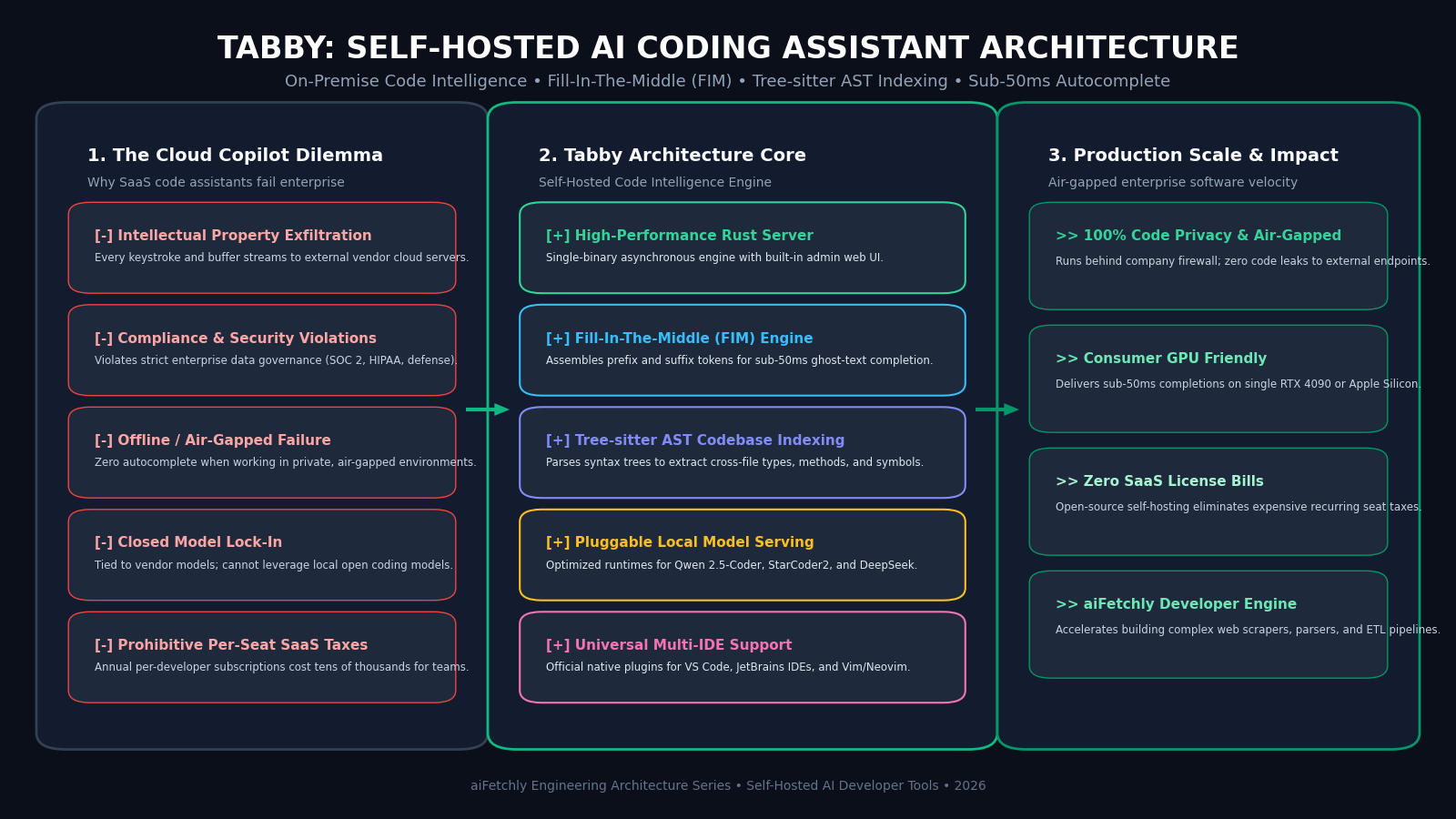
The Problem: The Enterprise Intellectual Property and Latency Crisis of Cloud Code Copilots
In modern software engineering, automated data collection systems, and desktop productivity applications powered by AiFetchly, AI code assistants have transitioned from experimental novelties into essential programming accelerators. Whether authoring asynchronous web scrapers, optimizing database query schemas, or refactoring frontend interfaces, developers rely heavily on real-time code autocomplete and inline conversational assistants to maintain developer flow state.
However, the widespread enterprise adoption of proprietary cloud code copilots (such as GitHub Copilot, Cursor, or commercial IDE plugins) has exposed severe operational, legal, and architectural vulnerabilities:
The Commercial Code Copilot Dilemma:
┌─────────────────────────────────────────────────────────────────┐
│ Risk 1: Intellectual Property Exfiltration & Data Privacy       │
│ • Every keystroke, comment, and private token streams to cloud  │
│ ❌ Violates strict enterprise SOC 2, HIPAA, and IP mandates     │
│ ❌ Risk of proprietary algorithms training external vendor models│
├─────────────────────────────────────────────────────────────────┤
│ Risk 2: The Network Latency Penalty (> 400ms Roundtrips)        │
│ • Autocomplete suggestions lag behind developer typing speed    │
│ ❌ High latency breaks cognitive flow state and typing rhythm   │
│ ❌ Complete failure during air-gapped or offline development    │
├─────────────────────────────────────────────────────────────────┤
│ Risk 3: Single-File Blindness & Hallucinated APIs               │
│ • Assistant only reads the currently open buffer                │
│ ❌ Blind to custom types, internal utils, and foreign schemas   │
│ ❌ Invents nonexistent function parameters and outdated imports │
├─────────────────────────────────────────────────────────────────┤
│ Risk 4: Compounding SaaS Per-Seat Licensing Taxes               │
│ • Commercial licenses cost $20 to $40+ per developer per month  │
│ ❌ Enterprise engineering departments spend $100k+ annually     │
│ ❌ Inflexible billing seats for contractor and offshore teams   │
└─────────────────────────────────────────────────────────────────┘
Result: Engineering leaders must compromise between developer velocity and code privacy! 1. Source Code Exfiltration and Regulatory Compliance Risks
In modern enterprise software development, source code is an organization’s crown-jewel intellectual property:
- When developers use closed cloud assistants, active file buffers, clipboard contents, and neighboring code snippets are transmitted across external public networks to vendor cloud data centers.
- For financial institutions, defense contractors, healthcare organizations, and proprietary algorithmic trading desks, streaming unencrypted code to third-party endpoints triggers immediate compliance violations.
- Furthermore, developers face persistent ambiguity regarding whether their proprietary code is retained to fine-tune commercial foundational models.
2. Cloud Latency and the Autocomplete Disruption Threshold
Inline code autocomplete operates under strict psychological and neurological latency bounds:
- Studies in human-computer interaction establish that for ghost-text autocomplete to feel seamless, suggestions must render within sub-100 milliseconds of a keystroke pause.
- When an IDE extension must serialize code buffers, dispatch HTTPS requests to distant cloud clusters, await remote inference, and parse JSON responses, roundtrip network latency routinely exceeds 300 to 500 milliseconds.
- This delay causes suggestions to pop up after the developer has already typed past the insertion point, creating visual flicker, cognitive distraction, and broken typing rhythm.
3. Single-File Blindness and Missing Codebase Context
Commercial inline models often operate with localized context:
- They focus narrowly on the immediate lines preceding and succeeding the cursor.
- When an engineer imports a custom internal data class or utility function defined elsewhere in a 100,000-line repository, the assistant has zero awareness of the class signature.
- The model resorts to hallucinating plausible-sounding methods, causing runtime
AttributeErroror type validation exceptions that require tedious manual correction.
4. Astronomical Recurring SaaS Per-Seat Licensing Taxes
Enterprise licensing for commercial copilots scales linearly with team headcount:
- At $20 to $40 per seat monthly, an engineering department with 200 developers pays between $48,000 and $96,000 every year in recurring software subscriptions.
- Organizations lack the ability to repurpose existing on-premise compute infrastructure or self-host cost-effective open-weights models.
To eliminate these structural constraints, the open-source community created Tabby: a self-hosted, open-source AI coding assistant that delivers sub-50ms local code completion, full-repository Tree-sitter context indexing, and complete data privacy behind your corporate firewall.
The Solution: Tabby Architecture, Rust Engine & Fill-In-The-Middle (FIM) Autocomplete
Tabby is engineered from the ground up as a high-throughput, standalone AI coding server. Built with a native Rust core, an embedded web administration console, and an integrated local inference engine, Tabby serves real-time autocomplete suggestions and multi-turn chat directly to client IDEs over local networks.
Tabby Comprehensive System Architecture:
┌─────────────────────────────────────────────────────────────────┐
│ Client IDEs: VS Code / JetBrains / Vim / Neovim Plugins        │
│ • Captures Keystrokes, Cursor Offsets, and Active Buffer Edits  │
└────────────────────────────────┬────────────────────────────────┘
                                 │ (Sub-50ms HTTP / SSE Stream)
                                 ▼
┌─────────────────────────────────────────────────────────────────┐
│ Tabby Server Core (Asynchronous Rust Runtime)                  │
│ • Embedded Axum Web Server & Multi-User RBAC Engine             │
│ • Tantivy Code Search & Git Repository Synchronization          │
│ • Keystroke Debouncer & Context Cache Management                │
└────────────────────────────────┬────────────────────────────────┘
                                 │
        ┌────────────────────────┼────────────────────────┐
        ▼                        ▼                        ▼
┌─────────────────┐      ┌─────────────────┐      ┌─────────────────┐
│ Fill-In-The-    │      │ Tree-sitter AST │      │ Local Hardware  │
│ Middle (FIM)    │      │ Code Indexer    │      │ Inference Engine│
│ • Prefix /      │      │ • Semantic Chunk│      │ • ctranslate2 / │
│   Suffix assembly      │ • Scope Parsing │      │   llama.cpp     │
│ • Prompt Format │      │ • Cross-File Ref│      │ • CUDA/ROCm/MPS │
└─────────────────┘ └─────────────────┘ └─────────────────┘ 1. High-Performance Asynchronous Rust Server
At the heart of Tabby is a compiled, asynchronous Rust server built on the Tokio and Axum web framework:
- Single-Binary Simplicity: Tabby packages the entire application—web server, model runners, indexing pipelines, and admin UI—into a single portable binary or lightweight Docker container.
- Zero Python Overhead: By eliminating Python runtime overhead and Global Interpreter Lock (GIL) contention, Tabby handles concurrent autocomplete requests from hundreds of developers on a single server without performance degradation.
- Embedded Web Administration: Administrators manage team user accounts, inspect API tokens, monitor per-developer completion metrics, and configure synchronized Git repositories through a clean web console.
2. Fill-In-The-Middle (FIM) Token Assembly
Code autocomplete differs fundamentally from open-ended natural language generation:
- When a developer writes code, the cursor is rarely at the very end of a file; it is usually nested inside an existing function or class body.
- Traditional causal language models only condition on preceding text (prefix), meaning they are blind to the closing brackets, return statements, and downstream methods (suffix) that follow the cursor.
- Tabby employs Fill-In-The-Middle (FIM) tokenization supported by models like StarCoder2, Qwen 2.5-Coder, and DeepSeek-Coder:
<PRE> Prefix Code Tokens <SUF> Suffix Code Tokens <MID> Model Generates Insertion Tokens - By conditioning generation on both the prefix and the suffix simultaneously, Tabby ensures that generated completions align with existing variable names, closing braces, and downstream control flow.
3. Tree-sitter AST Codebase Indexing and Context Retrieval
To solve single-file blindness, Tabby integrates Tree-sitter abstract syntax tree (AST) parsing with an embedded Tantivy search index:
- AST-Aware Chunking: When Tabby indexes a Git repository, Tree-sitter parses the code along structural semantic boundaries (function definitions, struct declarations, class methods) rather than arbitrary line counts.
- Cross-File Symbol Resolution: When a developer types in an active file, Tabby extracts referenced types and function identifiers, querying the local index to retrieve relevant type definitions from other files across the repository.
- Context Injection: Relevant signatures are automatically prepended as compact comment prompts before the FIM prefix, giving the model repository-wide awareness with zero hallucinated methods.
4. Pluggable Local Model Execution (Qwen 2.5-Coder & StarCoder2)
Tabby provides high-throughput inference backends tailored to developer hardware:
- Optimized C++ Engines: Tabby integrates high-performance inference backends (including
llama.cppandctranslate2), supporting INT8 and INT4 quantization. - Hardware Acceleration: Native support for NVIDIA CUDA, AMD ROCm, and Apple Silicon Metal (MPS).
- Supported Model Zoo: Tabby provides one-click support for cutting-edge open coding models:
StarCoder2-3B / 7B: Ultra-low latency for instant autocomplete.Qwen2.5-Coder-1.5B / 7B / 14B / 32B: State-of-the-art coding benchmark scores matching proprietary cloud models.DeepSeek-Coder-6.7B: Exceptional performance for complex refactoring and chat.
5. Enterprise Multi-Tenant Governance and Universal IDE Ecosystem
Tabby is built for enterprise engineering operations:
- Role-Based Access Control (RBAC): Manage developer permissions, configure custom access tokens, and enforce repository whitelists.
- Universal IDE Plugins: Tabby maintains official, high-quality extensions for Visual Studio Code, the entire JetBrains suite (IntelliJ IDEA, PyCharm, WebStorm, GoLand), and Vim / Neovim.
Architectural Comparison: Tabby vs. GitHub Copilot vs. Continue.dev vs. Cursor
The table below contrasts Tabby with competing AI code assistance architectures:
| Architectural Metric | GitHub Copilot | Cursor IDE | Continue.dev | Tabby |
|---|---|---|---|---|
| Self-Hosted / On-Premise | No (Cloud SaaS Only) | No (Cloud SaaS Only) | Client-Side Extension | Yes (Standalone Server & Docker) |
| Data Privacy & Air-Gap | Cloud Exfiltration | Cloud Exfiltration | Depends on Backend | 100% On-Premise Air-Gapped |
| Core Architecture | Proprietary Client-Cloud | Forked VS Code Cloud | IDE Extension Client | Compiled Rust Server + IDE Plugins |
| Centralized Team Server | Central Cloud Admin | Cloud Dashboard | No (Per-Client Config) | Yes (Web Admin + Central Index) |
| Fill-In-The-Middle (FIM) | Cloud Hosted | Cloud Hosted | Configured per Model | Native Sub-50ms FIM Engine |
| Repository AST Indexing | Remote Cloud Index | Cloud Shadow Workspace | Local SQLite/LanceDB | Tree-sitter + Embedded Tantivy |
| IDE Ecosystem | VS Code, JetBrains, Vim | Custom IDE Fork Only | VS Code, JetBrains | VS Code, JetBrains, Vim/Neovim |
| Licensing Cost | $19–$39 / user / mo | $20–$40 / user / mo | Free (Token API Costs) | 100% Free / Open Source (Apache 2) |
Hands-On Implementation: Deploying Tabby with Docker and Connecting to VS Code
Below is a complete, production-grade guide demonstrating how to launch a self-hosted Tabby server using Docker with NVIDIA GPU acceleration, index a local Git repository, and connect your VS Code editor.
Step 1: Deploy Tabby Server with GPU Acceleration via Docker
Create a docker-compose.yml file to launch Tabby on an on-premise server or local developer machine equipped with an NVIDIA GPU:
version: '3.8'

services:
  tabby:
    image: tabbyml/tabby:latest
    container_name: tabby-server
    restart: unless-stopped
    ports:
      - '8080:8080'
    volumes:
      - tabby_data:/data
    environment:
      - TABBY_LOG_LEVEL=info
    command: >
      serve
      --model TabbyML/StarCoder2-3B
      --chat-model TabbyML/Qwen2.5-Coder-7B
      --device cuda
    deploy:
      resources:
        reservations:
          devices:
            - driver: nvidia
              count: all
              capabilities: [gpu]

volumes:
tabby_data: Launch the server daemon:
docker compose up -d Navigate to http://localhost:8080 in your web browser. The initial setup wizard prompts you to create the administrator account and generate your primary team authentication token.
Step 2: Configure Repository Codebase Indexing in the Admin Web UI
To equip Tabby with cross-file repository context:
- In the Tabby Web Admin dashboard, navigate to Settings > Repositories.
- Click Add Repository and enter your Git repository URL (e.g.,
git@github.com:enterprise/data-pipeline.gitor a local file directory path mounted inside/data). - Tabby automatically clones the repository, executes Tree-sitter AST syntax analysis, extracts exported classes, interfaces, and function signatures, and builds an embedded Tantivy lexical and vector index.
- Subsequent Git commits are synchronized automatically on an hourly cron schedule.
Step 3: Connect VS Code to Your Self-Hosted Tabby Server
Equip your local development environment with private autocomplete:
- Open Visual Studio Code and install the official Tabby extension from the marketplace (
TabbyML.vscode-tabby). - Open your VS Code
settings.jsonand configure your self-hosted endpoint and API token:
{
  "tabby.serverUrl": "http://localhost:8080",
  "tabby.token": "your-generated-enterprise-tabby-token",
  "tabby.inlineCompletion.triggerMode": "automatic",
  "tabby.anonymousUsageTracking": false
} - Open any Python, TypeScript, or Rust project. As you type, Tabby’s status bar indicator turns active, delivering sub-50ms ghost-text completions directly conditioned on your internal repository context:
# Sample: Authoring an asynchronous data extractor in Python
import asyncio
from aiohttp import ClientSession

class WebExtractionPipeline:
    def __init__(self, target_domain: str, max_concurrency: int = 10):
        self.target_domain = target_domain
        self.semaphore = asyncio.Semaphore(max_concurrency)

    # Tabby suggests full method implementation via FIM suffix awareness:
    async def fetch_page(self, session: ClientSession, endpoint: str) -> str:
        async with self.semaphore:
            url = f"https://{self.target_domain}/{endpoint.lstrip('/')}"
            async with session.get(url, timeout=15) as response:
                response.raise_for_status()
return await response.text() Accept suggestions instantly by pressing Tab. All inference executes strictly on your local hardware with zero external cloud transmission.
Production Deployment with aiFetchly
In high-concurrency automated data harvesting, distributed web crawler development, and ETL pipeline engineering powered by AiFetchly, Tabby serves as the internal developer accelerator for engineering teams.
aiFetchly Enterprise Development Integration with Tabby:
┌─────────────────────────────────────────────────────────────────┐
│ 1. Proprietary Scraper & Parser Development                     │
│ • Engineers build custom DOM extractors, XPath rules, and parsers│
│ • Tabby provides instant inline autocomplete for internal SDKs  │
├─────────────────────────────────────────────────────────────────┤
│ 2. Air-Gapped Code Privacy                                      │
│ • Confidential anti-bot bypass logic and proxy rotation code    │
│ • Stays 100% on-premise; zero risk of leaking scraping heuristics│
├─────────────────────────────────────────────────────────────────┤
│ 3. Whole-Repository Cross-File Context                          │
│ • Tree-sitter indexing parses shared Pydantic extraction schemas│
│ • Developers receive suggestions matching exact database types  │
├─────────────────────────────────────────────────────────────────┤
│ 4. Zero Recurring Software Seat Taxes                           │
│ • Self-hosted on local RTX 4090 or shared internal GPU servers  │
│ • Unlimited developer access with zero per-seat SaaS invoices   │
└─────────────────────────────────────────────────────────────────┘ - Guaranteed Confidentiality for Scraper Heuristics: In automated web extraction, proprietary anti-detection algorithms, proxy rotation logic, and custom browser fingerprint modifications represent competitive advantages. Using Tabby ensures these trade secrets never leave the company network.
- Instant Developer Flow State: Because Tabby runs on local or on-premise high-bandwidth hardware, ghost-text completions appear in under 40 milliseconds, eliminating the frustrating visual stutter of cloud copilots.
- Seamless Schema Consistency: By continuously indexing aiFetchly’s central data schemas, Tabby automatically autocompletes typed fields, database models, and API responses with 100% structural fidelity.
To learn more about how aiFetchly combines automated data extraction with production-grade AI engineering architectures, explore our AiFetchly Documentation or review our AiFetchly Pricing.