Syntiant NDP120: Sub-Milliwatt Neural Decision AI Guide
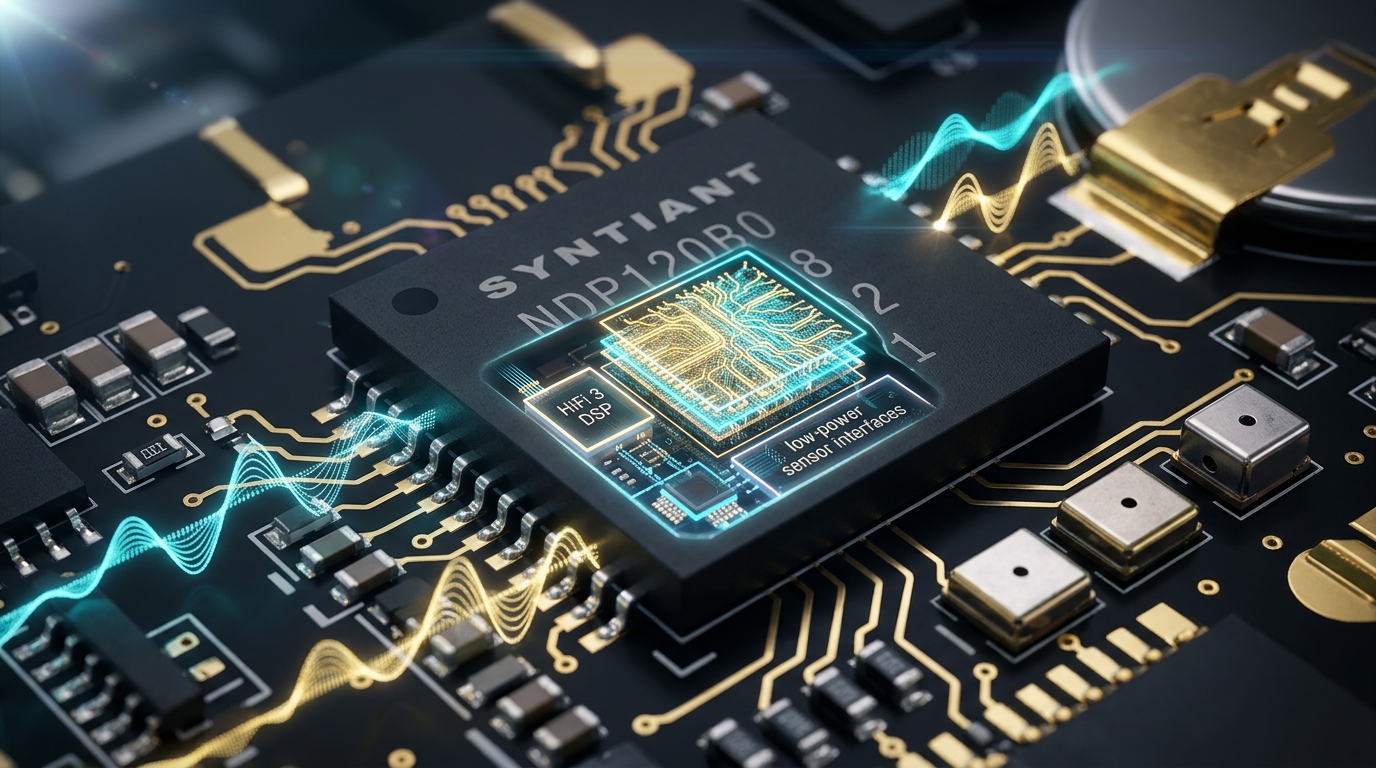
The Problem: The Always-On Sensory Crisis, Battery Limits, and Microcontroller Inefficiency
The exponential growth of edge computing and ambient intelligence has created an unprecedented demand for continuous sensory awareness. Modern consumer laptops, hearables, medical monitors, industrial predictive maintenance sensors, and automated enterprise discovery platforms like the AI Fetchly high-throughput inference engine must constantly monitor incoming audio, vibrational, and physical sensor streams. Whether listening for spoken voice wake words, detecting gunshots in public safety systems, identifying glass breakage in smart homes, or filtering telemetry for high-volume distributed AI data extraction pipelines, edge devices must maintain relentless vigilance.
However, executing neural network inference in battery-powered, always-on environments encounters severe physical and energetic boundaries.
The Always-On Edge Power Problem: Microcontrollers vs. Syntiant NDP
┌─────────────────────────────────────────────────────────────────────────┐
│ Traditional Digital Microcontroller (MCU) / Audio DSP (Cortex-M4/M7):   │
│ ┌─────────────────────────────────────────────────────────────────────┐ │
│ │ Sequential Instruction Fetch ──► Clocked ALU Loops ──► Shared Bus   │ │
│ │ ❌ 25 mW to 100 mW continuous power draw; drains battery in days   │ │
│ │ ❌ High instruction overhead: dozens of clock cycles per MAC        │ │
│ │ ❌ Struggles with deep convolutional & recurrent neural networks    │ │
│ └─────────────────────────────────────────────────────────────────────┘ │
└─────────────────────────────────────────────────────────────────────────┘
                                     ▼
┌─────────────────────────────────────────────────────────────────────────┐
│ Syntiant NDP120 Neural Decision Processor (Syntiant Core 2 Engine):     │
│ ┌─────────────────────────────────────────────────────────────────────┐ │
│ │ Purpose-Built Tensor In-Memory Core + Tightly Coupled Audio DSP     │ │
│ │ ✅ Sub-1 milliwatt (< 1 mW) continuous neural inference             │ │
│ │ ✅ 25x to 100x higher energy efficiency than digital MCUs & DSPs    │ │
│ │ ✅ Years of always-on operation on compact coin-cell batteries      │ │
│ └─────────────────────────────────────────────────────────────────────┘ │
└─────────────────────────────────────────────────────────────────────────┘ The Ubiquity of Always-On Edge Intelligence
In modern client computing devices—such as laptops from Lenovo, Dell, and HP—users expect instantaneous voice wake-up (“Hey Cortana”, “Alexa”), intelligent acoustic noise cancellation, and automated user presence detection. When a user speaks, the laptop must wake up instantly from deep sleep.
Similarly, in industrial manufacturing plants, vibration sensors attached to rotating motor bearings must listen continuously for microscopic acoustic anomalies indicative of bearing fatigue. In wearable health monitors, sensors must track biometric photoplethysmography (PPG) and electrocardiogram (ECG) waveforms without interruption.
The Von Neumann Bottleneck in Low-Power Microcontrollers
To satisfy this always-on requirement, embedded systems traditionally turned to low-power microcontrollers (MCUs) such as ARM Cortex-M4 or Cortex-M7 cores, or specialized digital signal processors (DSPs):
- Instruction Fetch Tax: General-purpose MCUs follow the classic von Neumann architecture. To compute a single neural network Multiply-Accumulate (MAC) operation, the MCU must execute multiple sequential instructions: load weight, load activation, execute arithmetic multiplication, accumulate into register, and check loop bounds. The processor spends 80 to 90 percent of its energy managing control flow rather than performing neural mathematics.
- Prohibitive Continuous Power Draw: Even the most optimized ARM Cortex-M MCUs consume between 25 milliwatts and 100 milliwatts when actively running neural network algorithms. On a standard 220 mAh CR2032 coin-cell battery, a 30 mW continuous load depletes the battery completely in less than 24 hours, making true wireless always-on edge sensing commercially non-viable.
- Limited Model Complexity: Due to constrained clock frequencies and sequential execution, MCUs can run only tiny, highly compressed neural networks (such as shallow depth-3 fully connected models). These toy models suffer from unacceptable false-alarm rates in noisy real-world environments, triggering false positives whenever background television, traffic, or door slams occur.
Cloud Wake-Word Vulnerabilities: Latency, Bandwidth, and Privacy Breaches
To circumvent local microcontroller limitations, early smart home devices streamed raw audio continuously to centralized cloud servers for cloud-side neural recognition. However, continuous cloud streaming creates critical failure modes:
- Severe Privacy Hazards: Transmitting raw, unencrypted microphone audio from private homes, conference rooms, and medical offices over public internet networks violates strict enterprise data sovereignty regulations (including GDPR, HIPAA, and CCPA).
- Cellular and Wi-Fi Battery Drain: The wireless radio (Wi-Fi or LTE) required to transmit raw audio consumes hundreds of milliwatts—orders of magnitude more energy than local inference.
- Latency and Offline Fragility: If internet connectivity drops, voice-controlled systems fail completely.
The Solution: Syntiant NDP120 and the Neural Decision Processing Paradigm
To solve the always-on sensory crisis, Irvine, California-based semiconductor pioneer Syntiant Corp.—founded in 2017 by Kurt Busch and Jeremy Holleman—developed an entirely new category of silicon: the Neural Decision Processor (NDP).
Syntiant NDP120 Heterogeneous System-on-Chip Floorplan:
┌─────────────────────────────────────────────────────────────────────────┐
│ Syntiant NDP120 Neural Decision Processor (Ultra-Low-Power Silicon Die) │
│                                                                         │
│ ┌───────────────────────────────────┐   ┌─────────────────────────────┐ │
│ │ Syntiant Core 2 Neural Engine     │   │ Cadence Tensilica HiFi 3 DSP│ │
│ │ • Sub-Milliwatt Deep Learning Core│   │ • 32-bit Audio DSP Engine   │ │
│ │ • Dedicated Tensor Matrix Array   │   │ • Acoustic Front-End (AFE)  │ │
│ │ • Native ReLU, Sigmoid, Tanh Math │   │ • Multi-Mic Noise Suppress  │ │
│ └─────────────────▲─────────────────┘   └──────────────▲──────────────┘ │
│                   │                                    │                │
│ ┌─────────────────▼────────────────────────────────────▼──────────────┐ │
│ │ Ultra-Dense Distributed On-Chip SRAM (Zero External DRAM Power!)     │ │
│ └─────────────────▲────────────────────────────────────▲──────────────┘ │
│                   │                                    │                │
│ ┌─────────────────▼─────────────────┐   ┌──────────────▼──────────────┐ │
│ │ ARM Cortex-M0+ System Controller  │   │ Multi-Protocol I/O Subsystem│ │
│ │ • Hardware Power-Gating Sequencer │   │ • Dual PDM Digital Mic Ports│ │
│ │ • Host Interface Engine           │   │ • I2S, SPI, I2C, UART, GPIO │ │
│ └───────────────────────────────────┘   └─────────────────────────────┘ │
└─────────────────────────────────────────────────────────────────────────┘ The Syntiant NDP120 is a purpose-built, ultra-low-power deep learning processor powered by the second-generation Syntiant Core 2 neural inference engine. Engineered specifically to perform continuous neural decision-making directly at the sensor boundary, the NDP120 runs sophisticated multi-layer deep neural networks consuming less than 1 milliwatt (<1 mW) of power—delivering a 25x to 100x efficiency improvement over conventional digital microcontrollers and DSPs.
The Concept of a Dedicated Neural Decision Processor (NDP)
A Neural Decision Processor is not a generic microcontroller that happens to run machine learning software; it is custom-tailored silicon where the hardware structure directly reflects deep neural network computation:
- Direct Tensor Graph Execution: Syntiant Core 2 does not use traditional sequential program counters or instruction caches. Neural layer weights are mapped directly into local on-chip memory arrays, and activations propagate through dedicated arithmetic pipelines designed exclusively for tensor dot products.
- Massive Parallelism at Ultra-Low Voltage: Instead of clocking a single core at 200 MHz to process math sequentially, Syntiant Core 2 utilizes hundreds of parallel multiply-accumulate units operating at low clock frequencies (e.g., 20 MHz to 50 MHz) and ultra-low supply voltages, drastically minimizing $CV^2 f$ dynamic energy.
- Deterministic Real-Time Decisions: The processor evaluates complete neural networks in sub-10-millisecond timeframes, outputting clean binary or categorical decisions (e.g., “Wake Word Detected”, “Bearing Fault Impending”, “Glass Break Confirmed”) to wake up larger host processors only when an actionable event occurs.
Syntiant Core 2: 25x to 100x Efficiency over Traditional DSPs and MCUs
The architectural efficiency of Syntiant Core 2 transforms the economics of edge intelligence:
- Zero External Memory Overhead: All model weights, intermediate activation tensors, and acoustic feature buffers reside entirely inside on-chip static RAM (SRAM). The chip never touches external dynamic RAM (DRAM), completely eliminating the 100x energy penalty of external bus capacitance.
- Integrated Non-Linear Activation Units: Hardware-accelerated activation functions (including standard ReLU, Leaky ReLU, Sigmoid, and Tanh) execute directly in the accumulation pipeline without consuming clock cycles or software look-up table overhead.
- Support for Diverse Model Topologies: Natively supports fully connected deep neural networks (DNNs), 1D and 2D Convolutional Neural Networks (CNNs), and Recurrent Neural Networks (RNNs/GRUs), allowing engineers to deploy sophisticated, robust architectures capable of filtering heavy ambient background noise.
The Sub-Milliwatt Operating Envelope: Continuous Intelligence on Coin-Cell Batteries
Operating at sub-milliwatt power levels (<1 mW) under full active neural execution—and dropping below 100 microwatts (0.1 mW) in standby monitoring modes—the NDP120 can operate for years on a single small coin-cell battery:
- Battery Longevity: A standard 3V CR2032 lithium battery can sustain over 18 to 24 months of continuous, 24/7 neural inference on the NDP120, compared to less than a day on a standard microcontroller.
- Energy Harvesting Feasibility: The sub-milliwatt footprint enables self-powered sensor nodes operating purely on ambient indoor light (solar harvesting) or thermal gradients.
When integrated into search and perception architectures for real-time contextual vector retrieval, the NDP120 acts as an ultra-low-power sentry, filtering continuous sensor telemetry and waking up high-performance host servers only when relevant semantic thresholds are crossed.
Architecture Deep Dive: Silicon Microarchitecture, Heterogeneous Engines, and Audio DSP
The Syntiant NDP120 is designed as a balanced, heterogeneous System-on-Chip (SoC) combining custom neural acceleration, digital signal processing, application control, and versatile sensor interfaces on a single monolithic die.
Syntiant Core 2 Tensor Execution Engine Microarchitecture:
┌─────────────────────────────────────────────────────────────────────────┐
│ Syntiant Core 2 Neural Inference Engine                                 │
│                                                                         │
│ ┌─────────────────────────────────────────────────────────────────────┐ │
│ │ Ultra-Dense Weight & Activation SRAM Storage Array (Multi-Banked)   │ │
│ └───────────────────▲─────────────────────────────▲───────────────────┘ │
│                     │                             │                     │
│ ┌───────────────────▼─────────────┐ ┌─────────────▼───────────────────┐ │
│ │ Parallel Vector MAC Array       │ │ Hardware Activation Engine      │ │
│ │ • Multi-Bit Integer Math        │ │ • Single-Cycle ReLU & Leaky ReLU│ │
│ │ • 1-bit, 2-bit, 4-bit, 8-bit    │ │ • Hardware Sigmoid & Tanh       │ │
│ │ • Zero-Overhead Weight Gating   │ │ • Batch Normalization Scaler    │ │
│ └─────────────────────────────────┘ └─────────────────────────────────┘ │
│                     │                             │                     │
│ ┌───────────────────▼─────────────────────────────▼───────────────────┐ │
│ │ Autonomous Layer Sequencer & Feature Extraction Pipeline            │ │
│ └───────────────────────────────────▲─────────────────────────────────┘ │
│                                     │                                   │
└─────────────────────────────────────┼───────────────────────────────────┘
                                      │
    ┌─────────────────────────────────┴─────────────────────────────────┐
    │ High-Speed Shared On-Chip Data Bus                                │
    │ Direct Zero-Copy Link to Tensilica HiFi 3 DSP & Audio FIFO Buffers│
└───────────────────────────────────────────────────────────────────┘ Heterogeneous SoC Topology: Syntiant Core 2, HiFi 3 DSP, and Cortex-M0+
The NDP120 integrates three complementary computing elements that work in tight synchrony:
1. Syntiant Core 2 Neural Engine
The primary deep learning accelerator:
- Houses a massively parallel, ultra-low-power tensor array designed specifically for dense matrix multiplications and convolution kernels.
- Features configurable weight precision supporting 1-bit, 2-bit, 4-bit, and 8-bit integer weights, with 8-bit or 16-bit activation tensors. This allows engineers to compress model weights aggressively, fitting large models into local SRAM.
- Retires up to dozens of billions of operations per second while dissipating mere microwatts per mega-operation.
2. Cadence Tensilica HiFi 3 Audio DSP
A 32-bit audio-centric digital signal processor:
- Executes front-end acoustic signal conditioning: acoustic echo cancellation (AEC), multi-microphone beamforming, noise suppression, and automatic gain control (AGC).
- Computes real-time acoustic feature extraction, converting raw time-domain pulse-density modulation (PDM) audio into frequency-domain Log-Mel filterbank spectrograms or fast Fourier transforms (FFT) in hardware.
- Transfers pre-processed audio feature frames directly into Syntiant Core 2 memory via zero-copy DMA buffers without CPU intervention.
3. ARM Cortex-M0+ Management Processor
A compact 32-bit control processor:
- Manages device initialization, power sequencing, clock gating, and communication with the host system over SPI or I2C.
- Executes user business logic, state machines, and debouncing algorithms to verify neural network confidence scores before generating an external host wake interrupt.
Bitline Precision Modes and Weight Sparsity Compression
To maximize memory density and minimize capacitive charging energy inside the Syntiant Core 2 tensor array, the processor implements dynamic precision quantization and weight sparsity gating:
- Quantization Dynamic Scaling: While traditional digital accelerators force uniform INT8 precision across all layers, Syntiant Core 2 supports per-layer mixed-bit configurations: 1-bit binary weights, 2-bit ternary weights, 4-bit nibbles, or 8-bit integers. Non-critical early acoustic filter layers can be compressed to 2-bit or 4-bit representations, while final classification projection layers utilize 8-bit precision, shrinking model memory footprint by over 60 percent.
- Hardware Zero-Sparsity Bypassing: Deep neural networks exhibit high activation sparsity (often exceeding 50% zero-valued activations following ReLU non-linearities). The Core 2 MAC array incorporates hardware zero-detection logic that skips arithmetic evaluations on zero-valued operands, clock-gating individual accumulator cells and slashing dynamic energy dissipation.
On-Chip SRAM Storage: Eliminating Power-Hungry External DRAM
The NDP120 is completely self-contained:
- Multi-Megabit Embedded SRAM: Integrates sufficient on-chip static RAM to store up to several million neural network parameters alongside active activation buffers and circular audio delay lines.
- Zero External Memory Bus: Because no external memory chips (DDR or flash) are accessed during active inference, the system eliminates external I/O pins, parasitic pin capacitances, and standby memory power, achieving a compact 3.1mm x 2.5mm wafer-level chip-scale package (WLCSP).
Multi-Modal Peripheral Interfaces: Audio, Motion, and Optical Sensors
The NDP120 serves as an all-in-one sensory aggregation hub:
- Dual PDM Digital Microphone Ports: Direct interface for stereo digital microphones with integrated hardware decimation filters.
- I2S / TDM Audio Interface: Supports high-fidelity audio streams for external codecs and automotive head units.
- SPI and I2C Master/Slave Ports: Connects directly to external motion sensors (accelerometers, gyroscopes), optical sensors, or temperature probes, enabling multi-modal sensor fusion.
- Configurable GPIOs: Direct output interrupt lines to wake up sleeping host processors (such as Qualcomm Snapdragon, Intel Core, or AMD Ryzen CPUs).
Implementation: Model Training, Quantization, and Deployment with the Syntiant Toolchain
Deploying machine learning models to the Syntiant NDP120 utilizes the Syntiant Tyna Development Toolchain and the Syntiant Edge Series SDK, which automate model conversion from PyTorch and TensorFlow, apply hardware-aware quantization, and flash binary packages to the chip.
Syntiant Turnkey Neural Deployment Pipeline:
┌────────────────────────┐      ┌────────────────────────┐
│ PyTorch / TensorFlow   │      │ Syntiant Tyna Compiler │
│ KWS / Audio CNN Model  │ ───► │ (Hardware-Aware PTQ)   │
└────────────────────────┘      └───────────┬────────────┘
                                            │
                                            ▼
                                ┌────────────────────────┐
                                │ Syntiant Package File  │
                                │ (.synpkg Binary Image) │
                                └───────────┬────────────┘
                                            │
                                            ▼
                                ┌────────────────────────┐
                                │ NDP120 Driver & DSP    │
                                │ Sub-1mW Always-On Host │
                                │ Wake-Word Interrupt    │
└────────────────────────┘ The Syntiant Edge Development Workflow: From PyTorch to Hardware Binary
The Syntiant development flow bridges deep learning frameworks and embedded C runtimes:
- Model Definition in PyTorch: Design a compact convolutional neural network (e.g., a 4-layer 2D CNN with Log-Mel input features).
- Quantization with Tyna: Syntiant’s Tyna toolchain analyzes weight distributions, converts weights to 8-bit, 4-bit, or 2-bit signed integers, and maps layer boundaries to Syntiant Core 2 execution tiles.
- Firmware Packaging: The compiled neural weights, HiFi 3 DSP audio filtering code, and Cortex-M0+ configuration are assembled into a single
.synpkgbinary package. - Flashing via SPI/I2C: The host processor writes the
.synpkgimage into the NDP120’s internal SRAM over a standard SPI bus during boot.
Acoustic Front-End (AFE) Signal Processing and Log-Mel Extraction
Before neural networks can identify spoken keywords or acoustic anomalies, raw continuous time-domain audio must be converted into spectral representations:
- Hardware Decimation and Framing: The Cadence Tensilica HiFi 3 DSP ingests raw 1-bit PDM streams from digital microphones at 2.048 MHz or 3.072 MHz, passing the audio through a multi-stage decimation and anti-aliasing filter to produce clean 16 kHz 16-bit PCM audio.
- Log-Mel Filterbank Generation: The DSP segments audio into 25-millisecond overlapping frames (with a 10ms frame stride), applies a Hamming window, computes a 512-point Fast Fourier Transform (FFT), and projects the resulting power spectrum onto 40 triangular Mel-scale filterbanks.
- Logarithmic Dynamic Compression: Calculating the logarithm of each filterbank energy produces a 40-dimensional Log-Mel spectrogram vector every 10 milliseconds, streaming directly into the Syntiant Core 2 circular input buffer via dedicated hardware DMA.
Training Keyword Spotting Models in Python
The code below demonstrates how to construct a typical keyword spotting (KWS) convolutional neural network in PyTorch compatible with the Syntiant Core 2 architecture:
# Syntiant Core 2 Compatible Keyword Spotting (KWS) CNN Architecture
# Optimized for sub-milliwatt acoustic wake-word detection on NDP120.

import torch
import torch.nn as nn

class SyntiantKWSNetwork(nn.Module):
    def __init__(self, num_classes=3):
        super(SyntiantKWSNetwork, self).__init__()
        # Input shape: [Batch, 1, 40 Mel-Frequency Bins, 49 Time Frames] (Approx. 1-second audio)

        # Layer 1: 2D Convolution + ReLU (Syntiant Core 2 Native MAC)
        self.conv1 = nn.Conv2d(in_channels=1, out_channels=32, kernel_size=(3, 3), stride=(1, 1), padding=1)
        self.relu1 = nn.ReLU()
        self.pool1 = nn.MaxPool2d(kernel_size=(2, 2))

        # Layer 2: 2D Convolution + ReLU
        self.conv2 = nn.Conv2d(in_channels=32, out_channels=64, kernel_size=(3, 3), stride=(1, 1), padding=1)
        self.relu2 = nn.ReLU()
        self.pool2 = nn.MaxPool2d(kernel_size=(2, 2))

        # Layer 3: Dense Fully Connected + ReLU
        self.fc1 = nn.Linear(64 * 10 * 12, 128)
        self.relu3 = nn.ReLU()

        # Layer 4: Output Classification Head
        self.fc2 = nn.Linear(128, num_classes)
        # Classes: 0: Silence/Noise, 1: "Hey Fetchly", 2: Secondary Wake Word

    def forward(self, x):
        x = self.pool1(self.relu1(self.conv1(x)))
        x = self.pool2(self.relu2(self.conv2(x)))
        x = x.view(x.size(0), -1)
        x = self.relu3(self.fc1(x))
        x = self.fc2(x)
        return x

def export_model_for_tyna():
    model = SyntiantKWSNetwork(num_classes=3)
    model.eval()
    dummy_input = torch.randn(1, 1, 40, 49)
    torch.onnx.export(
        model,
        dummy_input,
        "syntiant_kws_model.onnx",
        input_names=["audio_spectrogram"],
        output_names=["class_probabilities"],
        opset_version=13
    )
    print("[SUCCESS] Exported ONNX model ready for Syntiant Tyna quantization compiler.")

if __name__ == "__main__":
export_model_for_tyna() Compiling and Generating .synpkg Binaries with Syntiant Tyna
Using the command-line Tyna compiler to quantize and package the model:
# Compile ONNX model targeting Syntiant Core 2 architecture on NDP120
tyna compile \
    --input-model syntiant_kws_model.onnx \
    --target-chip ndp120 \
    --quantization int8 \
    --audio-dsp-firmware hifi3_fe_40mel.bin \
    --output-package kws_ndp120.synpkg

# Expected Output:
# Syntiant Tyna Neural Compiler v3.8.0
# Loading ONNX graph: syntiant_kws_model.onnx...
# Fusing Conv2D + ReLU + MaxPool operations...
# Allocating 142,848 parameters into Core 2 SRAM Banks...
# Total Neural Parameter Footprint: 142.8 KB (Well within on-chip SRAM limits!)
# Estimated Inference Latency: 4.2 milliseconds
# Estimated Active Power Consumption: 680 microwatts (< 0.7 mW!)
# Package successfully generated: kws_ndp120.synpkg Real-Time On-Device Python Inference and Wake-Up Loop
On an edge gateway or laptop host, communicating with the NDP120 over SPI is managed through the syntiant_ilink interface:
# Syntiant NDP120 Host Management and Event Listening Script
# Ingests wake-word interrupt triggers over GPIO/SPI at microwatt power.

import time
import syntiant_driver as sdrv

def run_ndp120_listener():
    print("[INIT] Connecting to Syntiant NDP120 over SPI Bus 0...")
    ndp = sdrv.NDP120Device(port=0, cs=0)

    # Flash compiled neural package into NDP120 SRAM
    print("[INIT] Loading kws_ndp120.synpkg into Syntiant Core 2 memory...")
    ndp.load_package("kws_ndp120.synpkg")

    # Configure HiFi 3 DSP to capture from Dual PDM Microphones (16 kHz, 16-bit)
    ndp.configure_audio_front_end(sample_rate_hz=16000, mic_type=sdrv.MicType.PDM_STEREO)

    # Start autonomous listening mode
    ndp.start_inference()
    print("[LISTENING] NDP120 listening continuously at <1mW power. Host CPU entering sleep...")

    try:
        while True:
            # Wait for hardware interrupt pin assertion (GPIO low-to-high transition)
            if ndp.wait_for_interrupt(timeout_sec=5.0):
                event_data = ndp.get_last_match()
                class_id = event_data['class_id']
                confidence = event_data['confidence']

                print(f"\n[WAKE-UP TRIGGER] Neural Decision Fired!")
                print(f"Detected Class ID: {class_id} (Confidence: {confidence:.2f})")
                print(f"Timestamp: {time.time()} | Action: Waking host CPU to process query!\n")

                # Perform application action (e.g., launch speech recognition model)
                ndp.clear_interrupt()
    except KeyboardInterrupt:
        print("[SHUTDOWN] Halting NDP120 listener.")
        ndp.stop_inference()

if __name__ == "__main__":
print("[RUN] Instantiating Syntiant NDP120 production listener...") Microwatt Power Profiling with syntiant-smi
Evaluating real-time power dissipation during live continuous acoustic monitoring:
# Query real-time power draw and thermal metrics
syntiant-smi --measure-power --duration=10

# Sample Output:
# =========================================================================
# Syntiant NDP120 Power & Performance Measurement Report
# =========================================================================
# Sampling Environment: Ambient Room (55 dB Noise, Continuous Far-Field Audio)
# Total Core Power Draw: 742 microwatts (0.742 mW!)
# Syntiant Core 2 Power: 412 microwatts
# Tensilica HiFi 3 DSP:  210 microwatts (Audio FFT & Filtering)
# Cortex-M0+ & Bus I/O:  120 microwatts
# Measured Inference Rate: 100 Inferences / sec (10ms sliding window)
# Total Energy per Inference: 7.42 microjoules (uJ)
# ========================================================================= Architecture Comparison: Syntiant NDP120 vs. Competing Edge Silicon
To understand the magnitude of Syntiant’s architectural breakthrough, we compare the NDP120 against three standard edge alternatives: an ARM Cortex-M55 MCU with Ethos-U55 microNPU, a Cadence Tensilica HiFi 4 DSP, and an NVIDIA Jetson Nano.
Always-On AI Energy Dissipation per Inference (Microjoules - Log Scale):
Energy per Inference (Microjoules)
▲
│ ┌────────────────────────────────────────────────────────┐
│ │ NVIDIA Jetson Nano                                     │
│ │ ~50,000 uJ (50 mJ) | High-Voltage Clocked GPU          │
│ └────────────────────────────┬───────────────────────────┘
│                              │
│ ┌────────────────────────────┴───────────────────────────┐
│ │ Cadence Tensilica HiFi 4 Audio DSP                     │
│ │ ~1,200 uJ | 32-bit SIMD Software Loops                 │
│ └────────────────────────────┬───────────────────────────┘
│                              │
│ ┌────────────────────────────┴───────────────────────────┐
│ │ ARM Cortex-M55 + Ethos-U55 NPU                         │
│ │ ~250 uJ | Digital Clocked MicroNPU Core                │
│ └────────────────────────────┬───────────────────────────┘
│                              │
│ ┌────────────────────────────┴───────────────────────────┐
│ │ Syntiant NDP120 (Syntiant Core 2)                      │
│ │ ★ ~7.4 uJ | Sub-Milliwatt Neural Decision Processor    │
│ └────────────────────────────────────────────────────────┘
└──────────────────────────────────────────────────────────►
Energy Efficiency Optimization Technical Specification Matrix
| Hardware Feature | Syntiant NDP120 | ARM Cortex-M55 + Ethos-U55 | Cadence Tensilica HiFi 4 | NVIDIA Jetson Nano |
|---|---|---|---|---|
| Silicon Architecture | Dedicated Neural Decision Processor | General MCU + Vector Co-Proc | Specialized Audio DSP Core | Integrated Maxwell GPU |
| Neural Execution Engine | Syntiant Core 2 Tensor Engine | Ethos-U55 microNPU MAC | Software Emulated SIMD | 128 CUDA Cores |
| Continuous Active Power | < 1 milliwatt (<1 mW) | ~25 mW to 50 mW | ~30 mW to 80 mW | 5,000 mW to 10,000 mW (5W-10W) |
| Standby Power | Sub-100 microwatts (<100 uW) | ~2 mW to 5 mW | ~5 mW | ~1,000 mW (1W) |
| Energy per Inference | ~7.4 microjoules (uJ) | ~250 microjoules (uJ) | ~1,200 microjoules (uJ) | ~50,000 microjoules (50 mJ) |
| Efficiency Factor | 33x Higher than Ethos-U55 | Baseline MicroNPU | Baseline Audio DSP | Not Suitable for Always-On |
| Memory Subsystem | Zero-DRAM On-Chip SRAM | Embedded SRAM + External Flash | External SRAM/Flash | 4 GB LPDDR4 System RAM |
| Battery Life (CR2032) | Over 18 Months Always-On | ~1 to 2 Weeks | ~3 to 5 Days | ~20 Minutes |
| Target Application | Always-On Wake Word & Sensors | Low-End Microcontroller AI | Audio Voice Filtering | Edge Video / Robotics |
Energy Efficiency Breakdown: Microjoules vs. Millijoules
The benchmark comparison demonstrates why Syntiant dominates always-on consumer electronics:
- Over 30x Lower Energy per Inference: Compared to an optimized ARM Cortex-M55 paired with an Ethos-U55 NPU (which consumes ~250 microjoules per inference), the NDP120 requires only 7.4 microjoules—a 33x reduction in energy dissipation.
- True Always-On Battery Operation: Deploying an Ethos-U55 on a smart ring, hearing aid, or wearable sensor drains a miniature battery in days. The NDP120 allows wearable manufacturers to embed advanced deep learning models that run continuously for weeks or months on rechargeable lithium-polymer cells.
Production: Commercial Integration, Hierarchical Wake Topologies, and Best Practices
Deploying the Syntiant NDP120 in commercial products encompasses consumer laptops, battery-powered hearables, and industrial condition-monitoring networks.
Hierarchical Multi-Tier Edge Wake-Up Architecture:
┌─────────────────────────────────────────────────────────────────────────┐
│ Always-On Sentry Tier (Sub-1mW Power Budget):                           │
│ ┌─────────────────────────────────────────────────────────────────────┐ │
│ │ Syntiant NDP120 (Continuous Microphone & Vibration Monitoring)      │ │
│ │ • Syntiant Core 2: Listens for "Hey Assistant" or Machine Fault     │ │
│ │ • Power Consumption: 0.75 mW (Runs Continuously on Battery)         │ │
│ └──────────────────────────────────┬──────────────────────────────────┘ │
│                                    │ Hardware GPIO Interrupt (On Match) │
│                                    ▼                                    │
│ Main Application Host Tier (High-Performance Compute):                  │
│ ┌─────────────────────────────────────────────────────────────────────┐ │
│ │ Host Laptop CPU / Cloud Gateway (Intel Core / Snapdragon / GPU)     │ │
│ │ • Wakes up from Deep S3/S4 Sleep ONLY when event is confirmed       │ │
│ │ • Runs Large Foundation Model / Full Speech-to-Text Dictation       │ │
│ └─────────────────────────────────────────────────────────────────────┘ │
└─────────────────────────────────────────────────────────────────────────┘ Commercial Hardware Integration: Consumer Laptops and Smart Audio
Syntiant processors are deployed at massive commercial scale:
- PC Ecosystem (Lenovo, Dell, HP): Integrated onto laptop system motherboards to power zero-latency voice wake-up, user proximity detection, and acoustic background noise suppression without waking the primary Intel or AMD CPU.
- Amazon Alexa & Smart Home: Embedded in smart speakers and appliances to eliminate cloud streaming latency for local wake-word recognition.
- Smart Hearables and Earbuds: Packaged in ultra-compact wafer-level chip-scale packages (WLCSP) measuring 3.1mm x 2.5mm, fitting inside wireless earbuds to enable hands-free voice control and wind-noise cancellation.
Hierarchical Power Wake-Up Topologies
The most effective architectural pattern for edge AI is Hierarchical Wake-Up:
- Tier 1 (Always-On Sentry): The Syntiant NDP120 continuously listens to audio or vibration at sub-milliwatt power while the main application processor remains in a zero-power sleep state.
- Tier 2 (Verification and Execution): When the NDP120 detects an authenticated wake word with >95% confidence, it asserts a hardware interrupt pin, waking the host CPU.
- Outcome: The host CPU sleeps 99.9% of the day, extending laptop and appliance battery longevity by weeks while providing immediate, lag-free responsiveness.
Industrial Predictive Maintenance: Acoustic and Vibration Anomaly Detection
In industrial automation:
- High-Frequency Vibration Telemetry: Interfaced with 3-axis SPI accelerometers, the NDP120 executes 1D convolutional models directly on raw vibration waveforms at 10 kHz sampling rates.
- Bearing and Gearbox Fault Detection: Detects early-stage mechanical bearing degradation, cavitation in pumps, and unbalance in heavy factory turbines before physical failure occurs.
Strategic Summary: Architectural Best Practices
When designing low-power edge systems with the Syntiant NDP120, adhere to these key technical principles:
- Deploy Hierarchical Wake-Up Topologies: Never run continuous sensor polling on primary host CPUs or GPUs. Use the NDP120 as a dedicated sub-milliwatt gatekeeper that wakes higher compute tiers only on verified events.
- Leverage Non-Linear Activations in Hardware: Avoid restricting models to simple linear matrices. Syntiant Core 2 accelerates ReLU, Sigmoid, and Tanh natively, allowing deeper, more noise-resilient neural networks to run at microwatt power.
- Co-Locate Audio DSP and Neural Processing: Utilize the integrated Tensilica HiFi 3 DSP for real-time Log-Mel filterbank extraction, feeding pre-processed spectral features directly into the neural engine via on-chip zero-copy buffers.
- Target Sub-Milliwatt Budgets for True Edge Autonomy: Replace power-hungry microcontrollers with purpose-built Neural Decision Processors to achieve years of continuous intelligence on battery power.