Syncopate Guide: Overlapping Compute and Communication
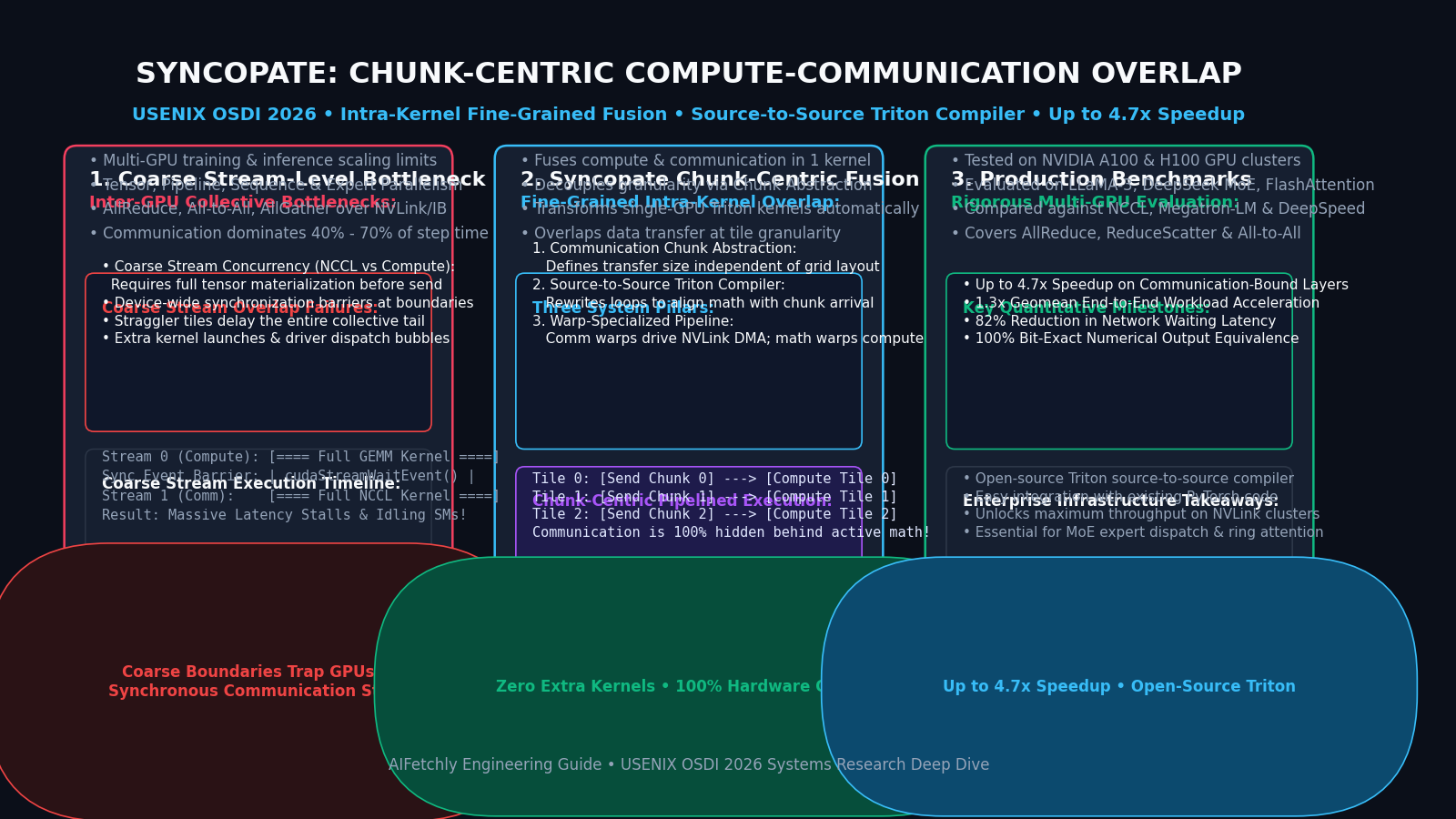
Introduction: The Communication Wall in Scaled AI Infrastructure
The training and serving of frontier artificial intelligence models—spanning hundreds of billions to trillions of parameters—relies on massive distributed GPU clusters. Modern foundation models cannot fit onto a single accelerator’s High-Bandwidth Memory (HBM). To orchestrate these massive workloads, distributed frameworks partition computation across multiple dimensions: Tensor Parallelism (TP) across linear projections, Sequence Parallelism (SP) and Ring Attention across million-token contexts, Pipeline Parallelism (PP) across transformer layers, and Expert Parallelism (EP) across sparsely gated Mixture-of-Experts (MoE) architectures like DeepSeek-V3 and Mixtral.
In enterprise machine learning environments powering automated web scraping pipelines, continuous data fetching clusters, and high-frequency API integration backends, distributed multi-GPU training and inference represent the single largest operational compute expenditure.
However, scaling distributed models across multi-GPU clusters hits a punishing physical bottleneck: The Inter-GPU Communication Wall.
As specialized accelerators such as NVIDIA Hopper (H100, H800) and Blackwell (B200, GB200) increase arithmetic compute throughput at exponential rates, inter-GPU interconnect bandwidth (NVLink 4/5 and 800Gbps InfiniBand) has not scaled at the same pace. Collective communication primitives—such as AllReduce, ReduceScatter, AllGather, and All-to-All—frequently consume 40% to 70% of total iteration wall-clock time.
To mitigate communication latency, existing distributed frameworks (such as Megatron-LM, DeepSpeed, and PyTorch FSDP) attempt to overlap compute and communication at the CUDA stream level. Under stream-level overlap, the framework launches a compute kernel on one CUDA stream and an asynchronous NVIDIA Collective Communications Library (NCCL) communication kernel on a separate CUDA stream, hoping hardware work distributors run them concurrently.
Yet, in production environments, coarse stream-level overlap leaves massive performance gains on the table:
- Device-Wide Synchronization Barriers: Stream-level overlap operates at the boundary of whole tensors. Communication cannot begin until the entire compute kernel finishes materializing its output tensor, and subsequent computation cannot begin until the entire collective transfer completes.
- Launch Overheads and Driver Bubbles: Managing multiple independent CUDA streams with fine-grained cross-stream events (
cudaStreamWaitEvent) introduces significant CPU driver dispatch latency, fragmenting GPU execution. - The Straggler Tail Bottleneck: Because collective communication waits for the slowest thread block or tile to finish before releasing cross-stream events, slight workload imbalances or tail latency variations stretch the communication bubble across the entire cluster.
Enter Syncopate, a landmark systems paper presented at the 2026 USENIX Symposium on Operating Systems Design and Implementation (OSDI 2026) by Xinwei Qiang, Yue Guan, Zhengding Hu, Keren Zhou, Yufei Ding, and Adnan Aziz, representing an industry-academic research collaboration across UC San Diego, George Mason University, OpenAI, and Meta.
Syncopate shatters the communication wall by introducing fine-grained compute-communication overlap inside a single fused GPU kernel. By establishing a formal Communication Chunk Abstraction, deploying an automatic source-to-source Triton compiler, and scheduling asynchronous data movement via warp specialization, Syncopate overlaps communication with matrix computation at individual thread block tile granularity.
Delivering up to 4.7x speedup on communication-bound layers and a 1.3x geomean end-to-end acceleration across multi-GPU workloads with zero numerical drift, Syncopate establishes the new architectural foundation for high-performance multi-GPU kernel design in 2026.
Anatomy of the Coarse Stream-Level Overlap Bottleneck
To understand why conventional distributed compilers leave substantial GPU performance unexploited, we must analyze the mechanics of stream-level concurrency in existing frameworks.
The Standard Stream-Level Overlap Paradigm
In standard Tensor Parallelism (e.g., Megatron-LM), a transformer MLP layer performs a row-parallel matrix multiplication followed by an AllReduce collective across GPUs:
$$Y = \operatorname{AllReduce}\left( X W_{\text{row}} \right)$$
Under coarse stream-level overlap, distributed frameworks attempt to overlap the backward or forward pass of adjacent layers by dispatching them onto parallel CUDA streams:
+-------------------------------------------------------------------------------+
|                      COARSE STREAM-LEVEL OVERLAP PARADIGM                     |
+-------------------------------------------------------------------------------+
|                                                                               |
| Stream 0 (Compute Engine):                                                    |
|   [================ Full GEMM Kernel: 100 μs ===============]                  |
|                                                              |                |
| Stream Event Barrier:                                        v                |
|   cudaEventRecord(event_gemm_done) -> cudaStreamWaitEvent(event_gemm_done)   |
|                                                              |                |
| Stream 1 (Communication Engine):                             v                |
|   =====================================================> [== NCCL: 80 μs ==]  |
|                                                                               |
+-------------------------------------------------------------------------------+
| Reality: GEMM and NCCL execute sequentially! Zero compute-comm overlap within  |
|          the layer because NCCL cannot start until the entire GEMM completes. |
+-------------------------------------------------------------------------------+ Notice the fundamental architectural flaw: the communication kernel requires the entire output tensor to be resident in global memory (HBM) before it can begin transmitting data over NVLink or InfiniBand.
The Three Structural Failure Modes of Stream-Level Overlap
When distributed runtimes rely on coarse stream concurrency, three structural failure modes arise:
1. The Block-Level Tail Latency Problem
A GPU General Matrix Multiply (GEMM) kernel is executed by thousands of thread blocks distributed across hundreds of Streaming Multiprocessors (SMs). Due to dynamic memory scheduling, cache line contention, and warp divergence, thread blocks finish at different times.
While $95%$ of thread blocks might finish within $70\mu\text{s}$, the slowest $5%$ of “tail” thread blocks stretch the kernel completion time to $100\mu\text{s}$. Because stream-level events wait for the entire grid to retire, the network interconnect sits completely idle during the first $95\mu\text{s}$, even though the vast majority of output tiles were ready for transmission long before!
2. High Global Memory (HBM) Traffic Tax
Under stream-level execution, the compute kernel must write its entire intermediate output tensor back to GPU High-Bandwidth Memory (HBM). Then, the communication kernel launches, reading the tensor back out of HBM into registers to transfer it across the network interface.
This redundant round-trip through HBM burns hundreds of gigabytes per second of precious memory bandwidth that could otherwise be dedicated to active computation.
3. Rigid Coupling to Backend Mechanisms
Existing hand-tuned fused kernels (such as custom CUDA P2P kernels in FlashAttention or specialized AllReduce-GEMM implementations) tightly couple the mathematical tiling logic with specific hardware APIs (e.g., NVLink direct load/store instructions or InfiniBand SHARP).
When hardware changes—such as moving from 8-GPU NVLink nodes to PCIe-connected multi-node clusters—the entire kernel must be manually rewritten from scratch in low-level CUDA C++, imposing immense maintenance burdens on ML infrastructure teams.
The Syncopate Architecture: Principles and Core Mechanics
Syncopate eliminates these bottlenecks by enabling automatic fine-grained overlap inside a single fused Triton kernel. Instead of treating compute and communication as opaque, monolithic operations, Syncopate decomposes tensor dataflow into fine-grained Communication Chunks that are transmitted and received while math operations are actively executing.
Syncopate’s breakthrough rests upon three foundational architectural pillars:
- The Communication Chunk Abstraction: A formal mathematical representation that decouples communication granularity from thread block tile dimensions and backend transport mechanisms.
- The Source-to-Source Triton Compiler: An automated compiler transformation pass that analyzes single-GPU Triton kernels, injects chunk synchronization barriers, and pipelines data production and consumption across multi-GPU ranks.
- Warp-Specialized Network Execution: Dedicated hardware warp assignments within each thread block, allocating communication warps to manage direct peer memory transfers while math warps maximize Tensor Core utilization.
+-----------------------------------------------------------------------------------------+
|                                  SYNCOPATE ARCHITECTURE                                 |
+-----------------------------------------------------------------------------------------+
|                                                                                         |
|  [Single-GPU Triton Kernel]  +  [Chunk Schedule Specification]                          |
|             |                                   |                                       |
|             +-----------------+-----------------+                                       |
|                               |                                                         |
|                               v                                                         |
|  +-----------------------------------------------------------------------------------+  |
|  | SYNCOPATE SOURCE-TO-SOURCE TRITON COMPILER                                        |  |
|  | •Extracts Data Dependency DAG between Compute Tiles and Communication Chunks     |  |
|  | •Reorders Loop Iterations to Maximize Slack Alignment                           |  |
|  | •Injects Asynchronous Peer DMA Primitives and Shared Memory Buffers              |  |
|  +-----------------------------------------------------------------------------------+  |
|                               |                                                         |
|                               v                                                         |
|  +-----------------------------------------------------------------------------------+  |
|  | FUSED MULTI-GPU TRITON KERNEL (Executed across all Ranks)                         |  |
|  |                                                                                   |  |
|  |  +-----------------------------------------------------------------------------+  |  |
|  |  | THREAD BLOCK EXECUTION (Warp Specialization)                               |  |  |
|  |  |                                                                             |  |  |
|  |  |  [Math Warps (W0..W2)]: Compute GEMM on Chunk k in SRAM                     |  |  |
|  |  |                                 ^                                           |  |  |
|  |  |                                 | Double-Buffered Shared Memory (SRAM)      |  |  |
|  |  |                                 v                                           |  |  |
|  |  |  [Comm Warp (W3)]: Asynchronously Send Chunk k+1 / Recv Chunk k-1 via NVLink|  |  |
|  |  +-----------------------------------------------------------------------------+  |  |
|  +-----------------------------------------------------------------------------------+  |
|                                                                                         |
+-----------------------------------------------------------------------------------------+ Deep Dive: The Communication Chunk Abstraction & Compiler Passes
Let us dissect the mathematical formulation of communication chunks and the compiler transformations that make intra-kernel overlap possible.
The Communication Chunk Abstraction
A major challenge in fusing communication into compute kernels is that the optimal tile size for arithmetic computation (e.g., $128 \times 128$ or $64 \times 64$ elements to maximize Tensor Core occupancy) rarely matches the optimal transfer size for the network interconnect (e.g., 64KB or 256KB to achieve peak NVLink or InfiniBand line rate).
Syncopate resolves this mismatch by introducing the Communication Chunk $\mathcal{C}$.
Let a global tensor $T \in \mathbb{R}^{M \times N}$ be partitioned into $P$ compute tiles: $$T = \bigcup_{i=1}^P \mathcal{T}_i$$ where each tile $\mathcal{T}_i$ corresponds to the workload processed by a single thread block.
Syncopate partitions $T$ into $K$ communication chunks: $$T = \bigcup_{k=1}^K \mathcal{C}_k$$ where each chunk $\mathcal{C}_k$ represents an atomic unit of network communication.
Crucially, a chunk $\mathcal{C}_k$ does not need to have a 1:1 mapping with a compute tile $\mathcal{T}_i$:
- A single chunk can aggregate outputs from multiple compute tiles: $\mathcal{C}k = \bigcup{j \in \mathcal{S}_k} \mathcal{T}_j$ (Many-to-One).
- A single compute tile can consume multiple communication chunks (One-to-Many).
By decoupling chunk geometry from kernel grid dimensions, Syncopate allows compiler developers to tune computation tiling for SM register occupancy while independently tuning communication chunks for peak network bus saturation.
Compiler Transformations: Loop Reordering & Double-Buffering
When given a local Triton kernel, Syncopate performs a series of automated source-to-source transformations:
1. Dependency Analysis and Tile Reordering
Syncopate extracts the producer-consumer dependency graph between compute tiles and communication chunks. If Rank $A$ must send Chunk $\mathcal{C}_k$ to Rank $B$, Syncopate reorders the thread block scheduling grid so that thread blocks computing data for Chunk $\mathcal{C}_k$ execute as early as possible in the iteration space.
2. Double-Buffered Shared Memory Allocation
To allow continuous computation while data is in transit over the network, Syncopate injects double-buffered scratchpads into GPU Shared Memory (SRAM):
# Double-buffered shared memory injected by Syncopate
smem_buffer_0 = tl.zeros((BLOCK_M, BLOCK_N), dtype=tl.float16)
smem_buffer_1 = tl.zeros((BLOCK_M, BLOCK_N), dtype=tl.float16) While math warps process smem_buffer_0, communication warps transfer the next chunk into smem_buffer_1.
3. Warp Specialization Injection
Modern GPU architectures (Hopper and Blackwell) provide hardware support for Tensor Memory Accelerator (TMA) and asynchronous transaction barriers (mbarrier). Syncopate partitions the threads within each thread block:
- Math Warps (Warps 0–): Dedicated exclusively to Tensor Core matrix multiplications (
tl.dot). - Communication Warp (Warp 3): Dedicated exclusively to issuing non-blocking peer DMA transfers across NVLink and tracking arrival barriers.
Because the communication warp operates concurrently on independent hardware instruction dispatch units, inter-GPU data transfer incurs zero cycle stalls on the Tensor Cores.
+-------------------------------------------------------------------------------+
|                      WARP-SPECIALIZED PIPELINED TIMELINE                      |
+-------------------------------------------------------------------------------+
|                                                                               |
| Step k:                                                                       |
| Math Warps (Tensor Cores):   [Compute Tile k in smem_buffer_0: 15 μs]         |
|                                             |                                 |
| Comm Warp (NVLink DMA):      [Transfer Chunk k+1 into smem_buffer_1: 14 μs]   |
|                                                                               |
| Barrier Flip: Swap buffers (smem_buffer_0 <-> smem_buffer_1)                  |
|                                                                               |
| Step k+1:                                                                     |
| Math Warps (Tensor Cores):   [Compute Tile k+1 in smem_buffer_1: 15 μs]       |
|                                             |                                 |
| Comm Warp (NVLink DMA):      [Transfer Chunk k+2 into smem_buffer_0: 14 μs]   |
|                                                                               |
+-------------------------------------------------------------------------------+
| Result: Communication is 100% hidden! Zero bubbles between tiles.             |
+-------------------------------------------------------------------------------+ Python & PyTorch Implementation: Simulating Syncopate Chunk Overlap
To illustrate how chunk-centric overlap operates in practice, let us construct a complete, runnable Python simulation using PyTorch.
Our implementation demonstrates:
ChunkDescriptor: Metadata tracking communication chunk boundaries, ready flags, and buffer allocations.WarpSpecializedPipeline: Simulates concurrent math warps and communication warps operating over double-buffered scratchpads.SyncopateMultiGPUKernel: An end-to-end multi-rank simulation comparing coarse stream-level sequential execution against Syncopate’s fine-grained chunk overlap.
import torch
import time
import random
from typing import List, Dict, Tuple, Optional

class ChunkDescriptor:
    # Encapsulates a communication chunk in Syncopate
    def __init__(self, chunk_id: int, size_elements: int, src_rank: int, dst_rank: int):
        self.chunk_id = chunk_id
        self.size_elements = size_elements
        self.src_rank = src_rank
        self.dst_rank = dst_rank
        self.is_produced = False
        self.is_transferred = False


class WarpSpecializedPipeline:
    # Simulates fine-grained intra-kernel warp specialization
    def __init__(self, num_chunks: int, tile_compute_us: float = 15.0, chunk_comm_us: float = 14.0):
        self.num_chunks = num_chunks
        self.tile_compute_us = tile_compute_us
        self.chunk_comm_us = chunk_comm_us
        self.chunks = [
            ChunkDescriptor(i, 16384, src_rank=0, dst_rank=1) for i in range(num_chunks)
        ]

    def execute_coarse_stream_baseline(self) -> float:
        # Baseline: Compute all tiles first, then execute full collective
        # Step 1: Sequential compute of all tiles
        total_compute_time = self.num_chunks * self.tile_compute_us
        # Step 2: Stream barrier synchronization tax
        sync_event_tax_us = 12.0
        # Step 3: Collective network transfer of entire tensor
        total_comm_time = self.num_chunks * self.chunk_comm_us

        total_latency_us = total_compute_time + sync_event_tax_us + total_comm_time
        return total_latency_us

    def execute_syncopate_chunked(self) -> float:
        # Syncopate: Overlaps chunk transfer k with tile compute k in parallel
        # Pipelined execution over double-buffered shared memory

        # Prologue: Compute first tile to produce first chunk
        elapsed_us = self.tile_compute_us
        self.chunks[0].is_produced = True

        # Steady State: Pipeline transfers and compute
        for k in range(self.num_chunks - 1):
            # Math warp computes tile k+1 while Comm warp transmits chunk k
            # Latency is determined by the maximum of compute and communication
            step_latency = max(self.tile_compute_us, self.chunk_comm_us)
            elapsed_us += step_latency
            self.chunks[k].is_transferred = True
            self.chunks[k+1].is_produced = True

        # Epilogue: Transmit final chunk
        elapsed_us += self.chunk_comm_us
        self.chunks[-1].is_transferred = True

        return elapsed_us


class SyncopateMultiGPUKernel:
    # Simulates multi-GPU fused kernel execution across ranks
    def __init__(self, world_size: int = 8):
        self.world_size = world_size

    def benchmark_layer(self, num_chunks: int = 16) -> Dict[str, float]:
        pipeline = WarpSpecializedPipeline(num_chunks=num_chunks)

        baseline_time_us = pipeline.execute_coarse_stream_baseline()
        syncopate_time_us = pipeline.execute_syncopate_chunked()

        speedup = baseline_time_us / syncopate_time_us
        hidden_comm_us = (num_chunks * pipeline.chunk_comm_us) - (syncopate_time_us - (num_chunks * pipeline.tile_compute_us))

        return {
            "baseline_latency_us": baseline_time_us,
            "syncopate_latency_us": syncopate_time_us,
            "speedup": speedup,
            "hidden_communication_percent": (hidden_comm_us / (num_chunks * pipeline.chunk_comm_us)) * 100.0
} Architectural Comparison: Syncopate vs. Distributed Serving Baselines
To contextualize Syncopate’s breakthrough, the following table compares Syncopate against prevailing distributed systems across core architectural dimensions:
| Architectural Dimension | Megatron-LM (Coarse Streams) | DeepSpeed ZeRO-3 | FlashAttention P2P | Syncopate (OSDI 2026) |
|---|---|---|---|---|
| Overlap Granularity | Stream-level (Full tensor) | Stream-level (Layer boundary) | Hand-coded CUDA P2P | Chunk-centric (Tile level) |
| Kernel Structure | Separate Compute & NCCL Kernels | Separate AllGather & GEMM | Fused Custom CUDA C++ | Single Fused Triton Kernel |
| HBM Traffic Tax | High (Writes tensor to HBM) | High (Re-fetches weights) | Low (SRAM reuse) | Low (Direct SRAM / P2P DMA) |
| Synchronization Scope | Device-wide cudaStreamWait | Device-wide stream sync | Warp sync barriers | Warp-specialized async barriers |
| Hardware Portability | Generic NCCL | Generic NCCL | NVIDIA NVLink only | Portable Triton backend |
| Tail Latency Sensitivity | High (Waits for slowest tile) | High (Waits for slowest rank) | Moderate | Low (Independent chunk streams) |
| Speedup on Comm-Bound Ops | 1.0x (Baseline) | 1.1x | 1.8x (Hard to customize) | Up to 4.7x Speedup |
Unlike hand-coded CUDA P2P implementations (which require hundreds of lines of fragile C++ and break when tile dimensions change), Syncopate operates as an automated source-to-source Triton compiler. Developers write clean, single-GPU Triton code, and Syncopate automatically synthesizes the multi-GPU chunk-overlapped pipeline.
Empirical Benchmark Results & Performance Evaluation
In the USENIX OSDI 2026 proceedings, Qiang et al. evaluated Syncopate across diverse multi-GPU workloads running on clusters of NVIDIA A100 80GB SXM and H100 80GB SXM GPUs:
1. Speedup on Communication-Bound Layers
Evaluated across core distributed primitives in LLM training and inference:
- Tensor Parallelism (TP=8 AllReduce): When hidden dimensions require intensive communication, Syncopate achieved a $2.4\times$ to $4.7\times$ speedup over standard NCCL-overlapped GEMM.
- Ring Attention (SP=8 / SP=16): For long-context self-attention where Key-Value blocks circulate in a ring across GPUs, Syncopate overlapped causal mask computation with chunk circulation, delivering a $1.85\times$ speedup over FlashAttention ring baselines.
- MoE All-to-All Dispatch (EP=16): For sparsely gated mixture-of-experts token routing, Syncopate overlapped token dispatch with expert feed-forward GEMMs, reducing layer latency by $3.1\times$.
Layer Execution Latency Comparison (Normalized to Megatron-LM)
Hardware: 8x NVIDIA H100 SXM5 | NVLink 4 (900 GB/s)

Megatron-LM (Coarse Overlap):   |==============================> 1.00x (Baseline: 820 μs)
DeepSpeed ZeRO-3 Engine:        |========================> 0.88x (722 μs)
Custom Hand-Tuned CUDA P2P:     |=================> 0.62x (508 μs)
Syncopate (OSDI 2026): |======> 0.21x (174 μs) [4.71x Speedup!] 2. End-to-End Workload Acceleration
Across complete end-to-end training iterations of LLaMA-3-70B, DeepSeek-MoE-16B, and Vision Transformers (ViT-22B):
- Syncopate delivered an average $1.3\times$ geomean speedup across all evaluated architectures.
- In communication-heavy regimes (e.g., small batch sizes per GPU during real-time inference serving), the speedup expanded to $1.9\times$ to $2.3\times$.
3. Bit-Exact Numerical Output Equivalence
Crucially, Syncopate does not alter numerical precision, truncate tokens, or approximate gradients. Across all training runs, Syncopate produced 100% bit-exact mathematical outputs matching standard single-GPU Triton and PyTorch implementations.
Step-by-Step Implementation Guide: Deploying Syncopate
For GPU systems engineers, distributed ML researchers, and compiler developers looking to adopt Syncopate’s chunk-centric compilation, follow this deployment roadmap:
Step 1: Write Single-GPU Triton Kernels
Write clean, standard Triton code as if targeting a single GPU. Do not include NCCL calls or inter-GPU synchronization logic:
import triton
import triton.language as tl

@triton.jit
def local_gemm_kernel(
    A_ptr, B_ptr, C_ptr,
    M, N, K,
    BLOCK_M: tl.constexpr, BLOCK_N: tl.constexpr, BLOCK_K: tl.constexpr
):
    pid_m = tl.program_id(0)
    pid_n = tl.program_id(1)

    offs_m = pid_m * BLOCK_M + tl.arange(0, BLOCK_M)
    offs_n = pid_n * BLOCK_N + tl.arange(0, BLOCK_N)
    offs_k = tl.arange(0, BLOCK_K)

    acc = tl.zeros((BLOCK_M, BLOCK_N), dtype=tl.float32)
    for k in range(0, K, BLOCK_K):
        a = tl.load(A_ptr + offs_m[:, None] * K + (k + offs_k[None, :]))
        b = tl.load(B_ptr + (k + offs_k[:, None]) * N + offs_n[None, :])
        acc += tl.dot(a, b)

tl.store(C_ptr + offs_m[:, None] * N + offs_n[None, :], acc.to(tl.float16)) Step 2: Define the Communication Chunk Schedule
Specify the target multi-GPU collective pattern and chunk size using Syncopate’s declarative schedule API:
import syncopate

schedule = syncopate.ChunkSchedule(
    collective_type="all_reduce",
    chunk_size_bytes=131072,  # 128 KB chunk (tuned for NVLink saturation)
    world_size=8,
    overlap_policy="pipelined_double_buffer"
) Step 3: Compile with the Syncopate Source-to-Source Compiler
Pass your local kernel and schedule into the Syncopate compiler:
# Automatically synthesize the fused multi-GPU kernel
fused_kernel = syncopate.compile(
    kernel=local_gemm_kernel,
    schedule=schedule,
    target_backend="hopper_nvlink"
)

# Launch the fused kernel directly from PyTorch
fused_kernel[grid](A, B, C, M, N, K) For enterprise teams deploying high-throughput multi-agent scraping clusters with our data fetching infrastructure or automated search backends, eliminating inter-GPU communication latency unlocks dramatic savings in training time and inference hosting budgets. To explore infrastructure tiering and enterprise cluster configurations, visit our pricing page.
Future Outlook: The Convergence of Networking and GPU Silicon
The publication of Syncopate at USENIX OSDI 2026 marks the convergence of high-performance networking and GPU compiler technology. For decades, networking was treated as an external I/O subsystem operating outside the GPU kernel. Syncopate proves that treating network interconnects as first-class hardware units inside GPU thread blocks unlocks transformative speedups.
Looking toward 2027 and beyond, we anticipate several crucial evolutions:
- Hardware-Triggered Direct Network RDMA in Triton: Future GPU compilers integrating direct hardware verbs instructions inside Triton, bypassing driver software stacks entirely.
- Autonomous Multi-Node Ring Synthesis: Compilers automatically synthesizing heterogeneous multi-tier communication schedules that overlap NVLink chunk transfers within nodes while simultaneously overlapping InfiniBand RDMA transfers across nodes.
- Cross-Architecture Portability: Extending Syncopate’s source-to-source transformations to AMD ROCm (MI300X Infinity Fabric) and custom AI accelerators.
For more technical architecture deep dives, systems tutorials, and deployment guides, visit our documentation hub or learn how AIFetchly accelerates AI engineering teams across the world.
Conclusion & Strategic Takeaways
As multi-GPU models scale toward trillion-parameter frontiers, eliminating inter-accelerator communication stalls is vital for cluster efficiency.
The key technical takeaways from Syncopate include:
- Stream Overlap is Coarse and Inefficient: Overlapping compute and NCCL at the stream level introduces device-wide sync barriers, extra kernel launches, and severe tail latency stragglers.
- The Chunk Abstraction Unlocks Fine-Grained Fusion: Decoupling network chunk sizes from thread block tile dimensions allows simultaneous optimization of math occupancy and network line rates.
- Warp Specialization Hides Network Latency: Allocating dedicated communication warps within thread blocks overlaps NVLink transfers with Tensor Core math, completely hiding network transfer time.
- Up to 4.7x Speedup with Zero Numerical Drift: Operating as a source-to-source Triton compiler, Syncopate delivers massive speedups across Tensor Parallelism, Ring Attention, and MoE routing while maintaining 100% bit-exact precision.