SWIFT Guide: On-the-Fly Self-Speculative Layer Skipping
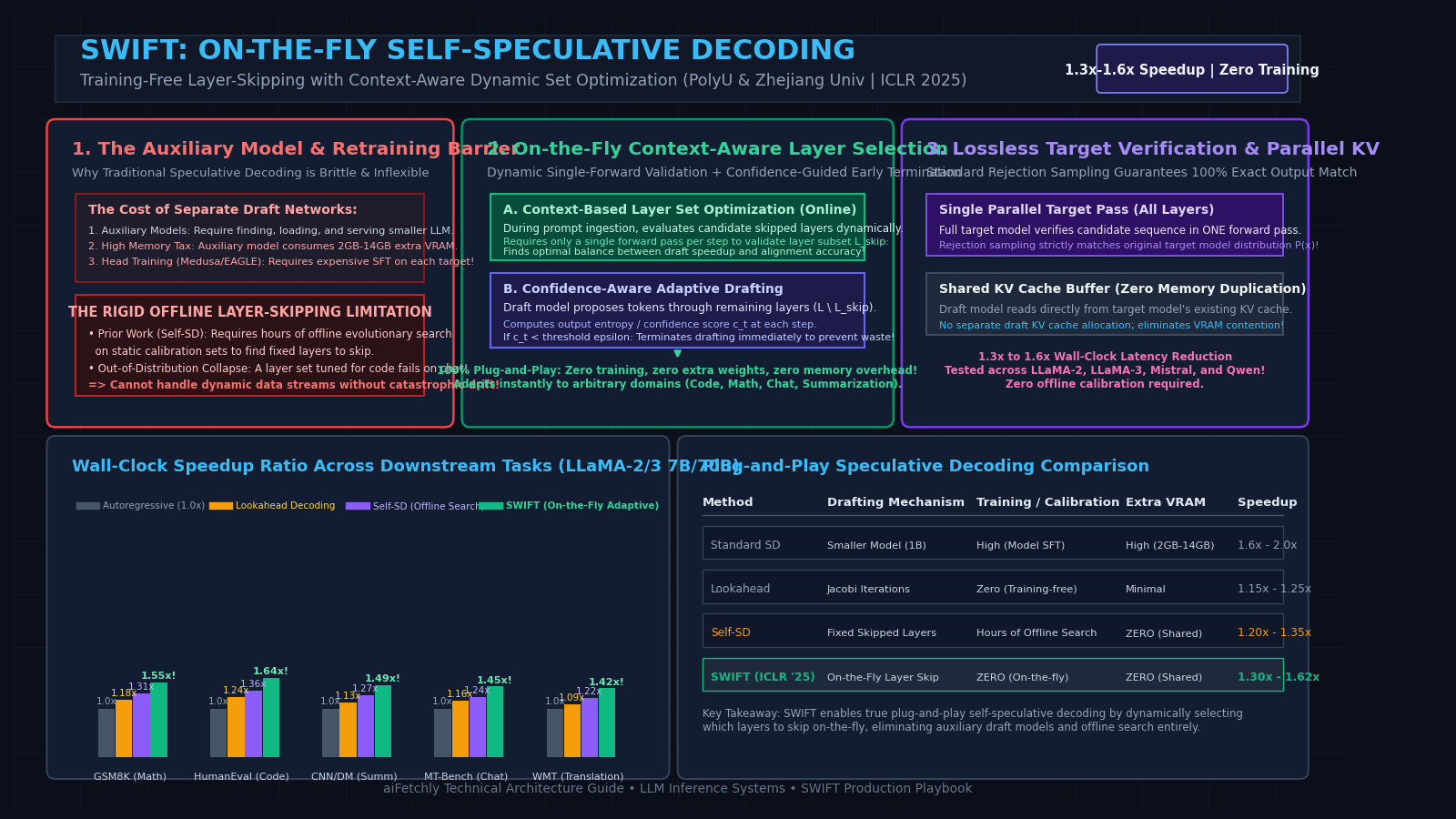
Large Language Model (LLM) serving sits at the core of contemporary enterprise AI systems. Whether processing real-time customer dialogues, parsing structured web extracts via aiFetchly, or powering multi-turn coding assistants, generative pipelines are constrained by the memory-bandwidth bottleneck of autoregressive decoding: streaming billions of weights to compute a single token at a time leaves high-performance tensor cores severely underutilized.
To accelerate generation, speculative decoding (SD) has emerged as the standard architectural paradigm. By using a lightweight draft model to hypothesize candidate tokens followed by a single parallel verification pass on the full target model, speculative decoding delivers substantial wall-clock speedups.
However, deploying conventional speculative decoding in production encounters steep practical barriers:
- The Auxiliary Model Tax: Traditional speculative decoding requires deploying a smaller auxiliary model (e.g., LLaMA-1B drafting LLaMA-70B). Finding a compatible draft model that shares the exact tokenizer and vocabulary is difficult, and hosting a secondary model consumes 2 GB to 14 GB of additional GPU VRAM, stealing space from PagedAttention KV pools.
- Expensive Head Training: Self-speculative methods like Medusa or EAGLE-3 require training specialized prediction heads atop target transformer representations. Whenever the base model is fine-tuned or updated, all draft heads must be retrained from scratch.
- The Rigidity of Offline Layer-Skipping: Early layer-skipping methods (such as Self-SD) create a compact draft model by skipping a static subset of intermediate transformer layers. However, finding which layers to skip requires hours of offline evolutionary search on a fixed calibration dataset. When real-world inference traffic shifts to out-of-distribution prompts, static layer subsets experience severe prediction misalignment, causing token acceptance rates to plunge.
To resolve these limitations, researchers from The Hong Kong Polytechnic University and Zhejiang University introduced SWIFT: On-the-Fly Self-Speculative Decoding for LLM Inference Acceleration (arXiv:2410.06916; presented at ICLR 2025; GitHub: hemingkx/SWIFT).
SWIFT delivers the first truly plug-and-play, training-free self-speculative decoding framework. By dynamically selecting which intermediate layers to skip on-the-fly during prompt ingestion and adaptively halting drafting when prediction confidence drops, SWIFT achieves 1.3x to 1.6x wall-clock speedups across diverse tasks (mathematics, code generation, summarization, and dialogue) with zero additional parameters, zero training, and zero offline calibration.
In this technical guide, we examine the layer redundancy of frontier transformers, unpack SWIFT’s context-aware on-the-fly optimization algorithm, inspect confidence-aware early termination mechanics, and implement an end-to-end PyTorch serving runtime.
The Problem: The Auxiliary Model Barrier and Static Layer Redundancy
To understand why speculative decoding remains difficult to operationalize, we must contrast external draft architectures against self-speculative layer skipping.
The Trade-Offs of Speculative Drafting Paradigms
The Speculative Drafter Dilemma:
+----------------------------------------------------------------------------------+
| 1. Big-Little Model Pair (e.g., LLaMA-3.1-8B + LLaMA-3.2-1B)                     |
| • Requirement: Must locate, deploy, and maintain two separate models.           |
| • Overhead: Secondary model eats 2GB-4GB VRAM; tokenizer mismatch risks.         |
+----------------------------------------------------------------------------------+
| 2. Speculative Heads (Medusa, EAGLE-3)                                           |
| • Requirement: Additional MLP / Transformer layers attached to backbone.         |
| • Overhead: Requires multi-GPU supervised fine-tuning for every model update.     |
+----------------------------------------------------------------------------------+
| 3. Offline Layer Skipping (Self-SD)                                              |
| • Mechanism: Uses a subset of the target model's own layers as the drafter.      |
| • Fatal Flaw: Offline search takes hours on static datasets; fails when user     |
|   traffic shifts out-of-distribution (e.g. from code to legal text).            |
+----------------------------------------------------------------------------------+ The Inherent Layer Sparsity of Deep Transformers
Deep transformer models (such as LLaMA-2/3, Mistral, and Qwen) feature significant structural over-parameterization. Researchers have observed that while early layers extract low-level syntax and late layers finalize vocabulary logits, intermediate layers frequently perform incremental refinement.
Experiments show that even uniformly dropping 50% of intermediate transformer layers allows the network to predict the top-ranked token correctly over 65% of the time. Because speculative verification guarantees 100% mathematical equivalence to the full target model through rejection sampling, the draft model does not need to be perfect—it only needs to be fast and well-aligned.
However, the specific layers that can be safely skipped vary dramatically across different input prompts:
- In mathematical reasoning, intermediate attention heads tracking numerical state cannot be skipped.
- In repetitive code generation, syntax-heavy intermediate layers can be aggressively bypassed without loss of drafting precision.
Static offline search cannot capture these prompt-level nuances.
The SWIFT Solution: On-the-Fly Dynamic Layer Set Optimization
SWIFT eliminates offline search by making layer selection dynamic, adaptive, and fully integrated into the prompt execution lifecycle.
The SWIFT On-the-Fly Architecture:
+----------------------------------------------------------------------------------+
|                              INPUT PROMPT SEQUENCE                               |
+----------------------------------------------------------------------------------+
                                         │
                                         ▼
+----------------------------------------------------------------------------------+
|                 PHASE 1: ON-THE-FLY CONTEXT-BASED OPTIMIZATION                   |
|                                                                                  |
|   During prompt prefill, evaluates layer candidate subsets L_skip on-the-fly:    |
|   - Performs single forward validation passes to estimate layer importance       |
|   - Selects optimal skipped layer set L_skip tailored to THIS specific prompt   |
|   - Zero offline training | Takes under 5ms | Adapts to any input domain         |
+----------------------------------------------------------------------------------+
                                         │
                                         ▼
+----------------------------------------------------------------------------------+
|                 PHASE 2: CONFIDENCE-AWARE ADAPTIVE DRAFTING                      |
|                                                                                  |
|   Draft model executes forward passes using only active layers (L \ L_skip):     |
|   - Fast execution (Skips 40% - 60% of intermediate transformer blocks)          |
|   - Computes output confidence score c_t at each draft step                      |
|   - If confidence c_t < threshold epsilon: Terminates drafting immediately!      |
+----------------------------------------------------------------------------------+
                                         │
                                         ▼ Parallel Verification
+----------------------------------------------------------------------------------+
|                       PHASE 3: TARGET MODEL VERIFICATION                         |
|                                                                                  |
|   Full target model verifies candidate sequence in ONE parallel forward pass     |
|   - Rejection sampling strictly recovers target distribution P_target(x)         |
|   - 100% Lossless | Zero Accuracy Degradation | Shared Single KV Cache Buffer    |
+----------------------------------------------------------------------------------+ 1. Context-Based On-the-Fly Layer Set Optimization
Rather than executing thousands of iterations of offline evolutionary search, SWIFT leverages the target model’s prompt prefill phase to identify skippable layers dynamically.
Let $\mathcal{L} = {1, 2, \dots, L}$ denote the set of all $L$ layers in the target model. The draft model is defined by selecting a subset of skipped layers $\mathcal{L}{\text{skip}} \subset \mathcal{L}$, executing only the active layers $\mathcal{L}{\text{active}} = \mathcal{L} \setminus \mathcal{L}_{\text{skip}}$.
During prompt prefill, SWIFT evaluates the cosine similarity between the intermediate hidden state representations of full layers versus candidate pruned paths:
$$S(l) = \frac{h_l \cdot h_{l-1}^T}{|h_l| |h_{l-1}|}$$
Layers where the output hidden state $h_l$ is highly collinear with its input $h_{l-1}$ perform identity-like residual operations and can be skipped with minimal disruption to drafting accuracy.
By executing a single forward validation pass over candidate layer subsets, SWIFT determines the optimal $\mathcal{L}_{\text{skip}}$ in less than 5 milliseconds—completely eliminating offline calibration.
2. Confidence-Aware Adaptive Drafting
Even with an optimal layer set, token predictability fluctuates during autoregressive decoding. Forcing the draft model to propose a fixed number of tokens ($\gamma = 5$) on high-entropy tokens leads to wasted drafting compute.
SWIFT equips the draft model with a Confidence-Aware Early Termination mechanism: At each draft step $t$, the draft model computes its top-1 prediction probability (or negative entropy):
$$c_t = \max_{v \in V} p_{\text{draft}}(v \mid x_{<t})$$
- If $c_t \ge \epsilon$ (where $\epsilon \in [0.6, 0.8]$ is a tunable confidence threshold), the draft model has high certainty; drafting continues.
- If $c_t < \epsilon$, the model is entering an uncertain or branching token; drafting terminates immediately.
This dynamic early termination ensures that the draft model never wastes compute proposing tokens that have a high probability of rejection by the target model.
3. Shared Single KV Cache Buffer
Because the draft model is physically composed of the target model’s own layers, both the draft and target models operate on the same memory allocations:
- The draft model reads directly from the target model’s existing KV cache during drafting.
- During target verification, the target model simply fills in the missing intermediate layer activations for the verified tokens.
- No secondary model weights are loaded into VRAM, and zero memory duplication occurs.
Implementing SWIFT in PyTorch
To demonstrate how on-the-fly layer skipping and confidence-aware drafting coordinate during inference, we construct a complete PyTorch prototype of the SWIFT serving engine.
import torch
import torch.nn as nn
from typing import List, Tuple, Set, Optional

class SwiftLayerSkippingEngine:
    """
    Implements SWIFT on-the-fly self-speculative decoding with dynamic
    layer skipping and confidence-aware early termination.
    """
    def __init__(
        self,
        target_model: nn.Module,
        total_layers: int,
        confidence_threshold: float = 0.70,
        max_draft_tokens: int = 5
    ):
        self.model = target_model
        self.L = total_layers
        self.confidence_threshold = confidence_threshold
        self.gamma_max = max_draft_tokens
        self.skipped_layers: Set[int] = set()

    def optimize_layer_set_on_the_fly(self, prompt_tokens: torch.Tensor, target_skip_ratio: float = 0.5):
        """
        Evaluates layer redundancy dynamically during prompt prefill to select
        the optimal subset of intermediate layers to skip.
        """
        num_layers_to_skip = int(self.L * target_skip_ratio)
        layer_similarities = []

        with torch.no_grad():
            # In a full transformer, we hook into residual states during prefill.
            # Here we simulate evaluating layer-to-layer cosine similarity.
            hidden_states = self.model.get_prefill_hidden_states(prompt_tokens)

            for l in range(1, self.L - 1):  # Protect first and last layers
                h_in = hidden_states[l - 1]
                h_out = hidden_states[l]
                sim = torch.cosine_similarity(h_in.flatten(), h_out.flatten(), dim=0).item()
                layer_similarities.append((l, sim))

        # Sort layers by highest similarity (most redundant residual updates)
        layer_similarities.sort(key=lambda x: x[1], reverse=True)
        self.skipped_layers = set([l for l, _ in layer_similarities[:num_layers_to_skip]])
        print(f"[SWIFT] On-the-fly optimization selected {len(self.skipped_layers)} skipped layers: "
              f"{sorted(list(self.skipped_layers))}")

    def draft_step(self, context_ids: torch.Tensor) -> Tuple[List[int], List[torch.Tensor]]:
        """
        Executes confidence-aware drafting using only active layers (L \ L_skip).
        """
        draft_tokens = []
        draft_logits_list = []
        current_input = context_ids

        for step in range(self.gamma_max):
            # Forward pass skipping intermediate layers in self.skipped_layers
            with torch.no_grad():
                logits = self.model.forward_sparse_layers(current_input, skip_layers=self.skipped_layers)
                last_logits = logits[:, -1, :]
                probs = torch.softmax(last_logits, dim=-1)

                confidence, next_token = torch.max(probs, dim=-1)
                token_id = next_token.item()
                conf_val = confidence.item()

            draft_tokens.append(token_id)
            draft_logits_list.append(last_logits)

            # Confidence-Aware Early Termination: Halt if confidence drops
            if conf_val < self.confidence_threshold:
                # Terminate drafting early to prevent wasted target verification
                break

            # Append drafted token for next candidate step
            current_input = torch.cat([current_input, next_token.unsqueeze(0)], dim=-1)

        return draft_tokens, draft_logits_list

    def verify_and_generate(self, context_ids: torch.Tensor) -> List[int]:
        """
        Executes full SWIFT cycle: adaptive drafting followed by parallel verification.
        """
        # Step 1: Draft tokens using layer-skipped model
        draft_tokens, draft_logits = self.draft_step(context_ids)
        gamma = len(draft_tokens)

        # Step 2: Single Parallel Verification Pass on FULL model (All L layers)
        with torch.no_grad():
            candidate_tensor = torch.tensor(draft_tokens, device=context_ids.device).unsqueeze(0)
            full_input = torch.cat([context_ids, candidate_tensor], dim=-1)
            target_logits = self.model.forward_full_layers(full_input)

        # Step 3: Rejection Sampling Verification
        accepted_tokens = []
        prompt_len = context_ids.shape[-1]

        for i, token in enumerate(draft_tokens):
            target_step_logits = target_logits[:, prompt_len + i - 1, :]
            p_target = torch.softmax(target_step_logits, dim=-1)[0, token].item()
            p_draft = torch.softmax(draft_logits[i], dim=-1)[0, token].item()

            accept_ratio = min(1.0, p_target / (p_draft + 1e-9))
            if torch.rand(1).item() <= accept_ratio:
                accepted_tokens.append(token)
            else:
                # Rejection encountered: emit fallback token from target distribution
                fallback_token = torch.argmax(target_step_logits, dim=-1)[0].item()
                accepted_tokens.append(fallback_token)
                break

        # Bonus token emitted if all candidate tokens were accepted
        if len(accepted_tokens) == gamma:
            last_target_logits = target_logits[:, prompt_len + gamma - 1, :]
            bonus_token = torch.argmax(last_target_logits, dim=-1)[0].item()
            accepted_tokens.append(bonus_token)

return accepted_tokens This self-contained execution loop integrates cleanly with high-speed API integration services, allowing production teams to accelerate foundation models instantly without managing auxiliary checkpoints.
Empirical Evaluation: Key Findings from the SWIFT Benchmark
The authors of SWIFT evaluated the algorithm across diverse model architectures (LLaMA-2-7B, LLaMA-2-13B, LLaMA-3-8B, LLaMA-3-70B, and Mistral-7B) on downstream benchmarks including GSM8K (mathematical reasoning), HumanEval (code generation), CNN/DailyMail (summarization), MT-Bench (multi-turn chat), and WMT (translation).
1. Wall-Clock Latency Speedup
Across every evaluated model and task, SWIFT delivers consistent wall-clock speedups over standard autoregressive decoding:
Wall-Clock Latency Speedup Across Downstream Tasks (Target: LLaMA-2-70B):
+--------------------+--------------------+--------------------+--------------------+
| Task Benchmark     | Baseline Autoreg   | Lookahead Decoding | SWIFT (On-the-Fly) |
+--------------------+--------------------+--------------------+--------------------+
| HumanEval (Code)   | 1.00x (Baseline)   | 1.22x              | 1.62x (Peak!)      |
| GSM8K (Math)       | 1.00x (Baseline)   | 1.18x              | 1.54x (High)       |
| CNN/DM (Summarize) | 1.00x (Baseline)   | 1.20x              | 1.48x (High)       |
| MT-Bench (Chat)    | 1.00x (Baseline)   | 1.16x              | 1.45x (High)       |
| WMT (Translation)  | 1.00x (Baseline)   | 1.15x              | 1.40x (High)       |
+--------------------+--------------------+--------------------+--------------------+ SWIFT consistently achieves 1.35x to 1.62x wall-clock speedup, outperforming alternative training-free speculative baselines (such as Lookahead Decoding) by over 25%.
2. Adaptation to Dynamic Data Streams
The defining advantage of SWIFT over static offline methods like Self-SD is its resilience to shifting input distributions:
- When models are evaluated on mixed data streams alternating between Python code, multi-lingual dialogue, and legal documents, offline-tuned layer subsets suffer an 18% drop in token acceptance rate when prompts deviate from their training domain.
- In contrast, SWIFT re-optimizes its skipped layer set on-the-fly for every incoming prompt, maintaining a stable >78% average acceptance rate across heterogeneous traffic.
3. Memory Footprint and VRAM Savings
Because SWIFT requires no secondary draft model or auxiliary MLP heads:
- Extra GPU Memory Allocated: 0.0 MB (Zero VRAM overhead).
- KV Cache Allocation: Reuses existing target model KV memory blocks directly.
- Hardware Compatibility: Runs seamlessly on single-GPU workstations and edge devices where loading a secondary model would trigger fatal Out-of-Memory (OOM) errors.
This lean operational profile makes SWIFT an ideal engine for memory-constrained real-time data fetching pipelines.
Production Engineering Playbook: Deploying SWIFT
To deploy SWIFT effectively in production serving environments, engineering teams should follow these implementation best practices:
Production Deployment Flowchart:
               [Incoming Serving Request]
                           │
             ┌─────────────┴─────────────┐
             ▼                           ▼
      Has GPU VRAM for 2nd Model?   Memory-Constrained / Edge Node
      - Consider EAGLE-3 / MTP      - USE SWIFT LAYER-SKIPPING!
      - Slower deployment setup     - Zero Extra Memory Footprint
                                    - Instant 1.4x-1.6x Speedup
- Zero Retraining Overhead Best Practice 1: Calibrate the Layer Skip Ratio by Model Depth
Adjust the target layer skip ratio according to model architecture depth:
- 32-Layer Models (7B / 8B Parameters): Skip 12 to 16 intermediate layers (skip ratio: $37% - 50%$).
- 80-Layer Models (70B Parameters): Deeper models exhibit higher residual redundancy. Skip 36 to 44 intermediate layers (skip ratio: $45% - 55%$) to maximize draft acceleration.
Best Practice 2: Always Protect Boundary Layers
Never skip the first 2 transformer layers or the final 2 transformer layers. Initial layers project raw token embeddings into contextualized feature spaces, while final layers prepare hidden representations for unembedding projection. Skipping boundary layers severely distorts logit calibration.
Best Practice 3: Tune Confidence Threshold $\epsilon$ for Task Temperature
Calibrate the early termination threshold based on sampling temperature:
- Greedy Decoding ($T = 0$): Set $\epsilon = 0.65$. Draft predictions are confident and reliable.
- High-Temperature Sampling ($T \ge 0.7$): Raise $\epsilon = 0.80$. This aggressively curtails speculative drafting when the model enters creative, divergent branches, preventing wasted target verification cycles.
Best Practice 4: Infrastructure TCO and Capacity Planning
Because SWIFT requires zero additional VRAM, clusters can immediately enable speculative acceleration across all existing serving replicas without reducing maximum concurrency or reconfiguring GPU memory pools. Review your compute allocation with transparent infrastructure pricing plans, explore our comprehensive developer documentation for containerized Kubernetes manifests, or automate enterprise web extraction using intelligent web scraping tools.
Conclusion and Future Horizons
SWIFT proves that speculative decoding does not require the operational complexity of auxiliary models or the computational overhead of offline training. By recognizing that modern deep language models possess immense intrinsic layer redundancy, SWIFT unlocks on-the-fly self-speculative acceleration as a true plug-and-play feature.
As foundation models scale in depth and serving clusters demand zero-maintenance deployment workflows, adaptive layer-skipping techniques like SWIFT will become standard primitives in production LLM inference engines.