Structured Web Processing: Raw DOM to Relational Tables
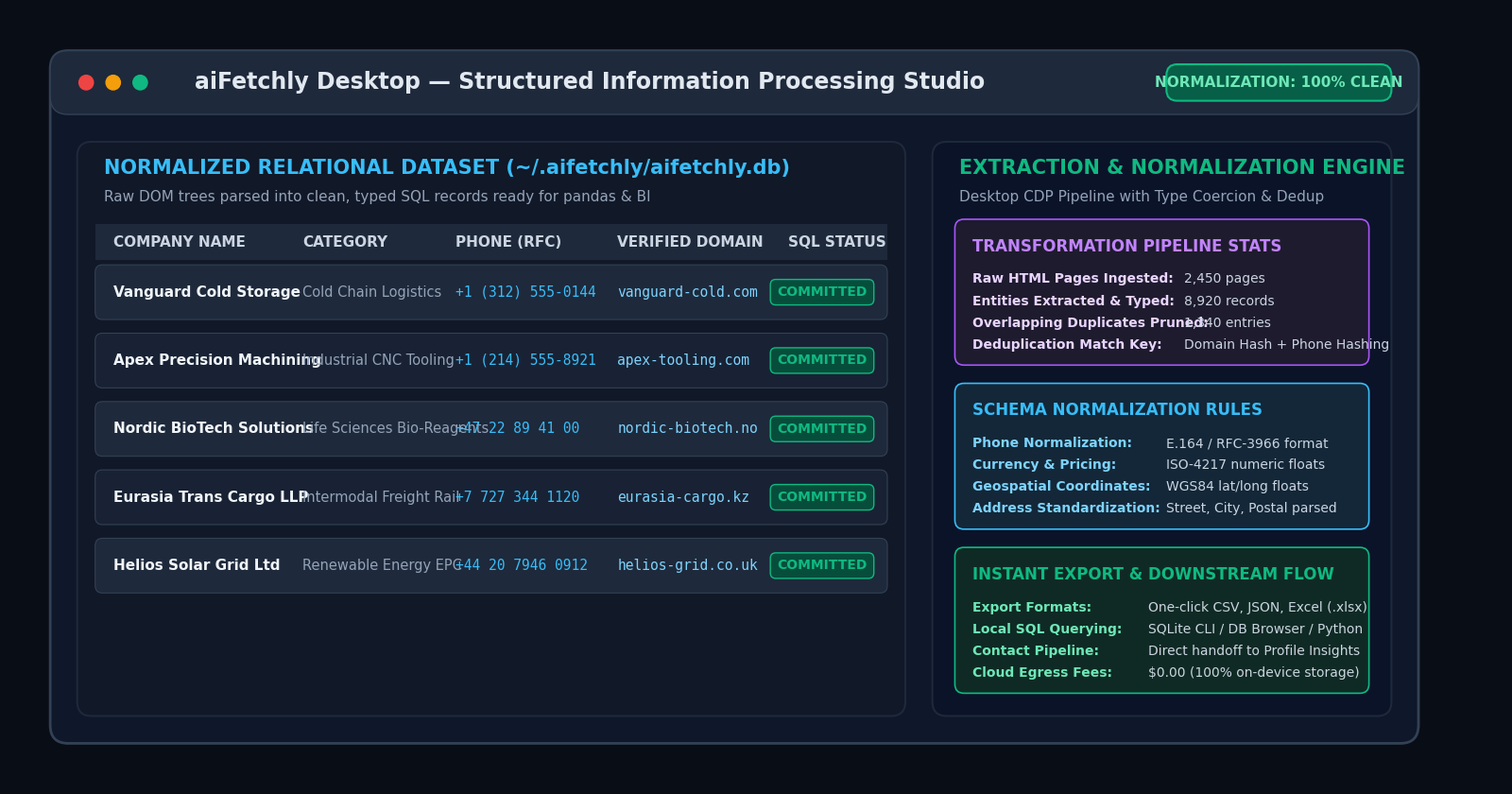
The Data Cleaning Tax in Web Intelligence
Data analysts and quantitative researchers extracting business intelligence from the modern web know that scraping raw HTML is only the beginning. Unstructured web pages are notoriously chaotic: commercial directories nest crucial firmographics inside arbitrary <div> containers, pricing matrices hide inside dynamic JavaScript shadow DOMs, and telephone numbers appear in dozens of incompatible regional formats.
Traditionally, turning raw web scrapes into usable analytical tables consumes 80% of project time:
- Brittle Regex Parsing: Hand-crafted regular expressions break whenever target websites modify class names or alter DOM nesting hierarchies.
- Inconsistent Type Casting: Scraped strings mix currencies, unformatted dates, and fragmented addresses that fail relational schema validation.
- Duplicate Data Bloat: Without canonical key resolution, multi-page crawls ingest hundreds of overlapping records, corrupting quantitative analysis.
AI Fetchly resolves this data cleaning bottleneck with native Structured Information Processing. By combining Chrome DevTools Protocol (CDP) traversal with automated schema normalization, aiFetchly transforms raw web documents directly into clean relational datasets on your local workstation.
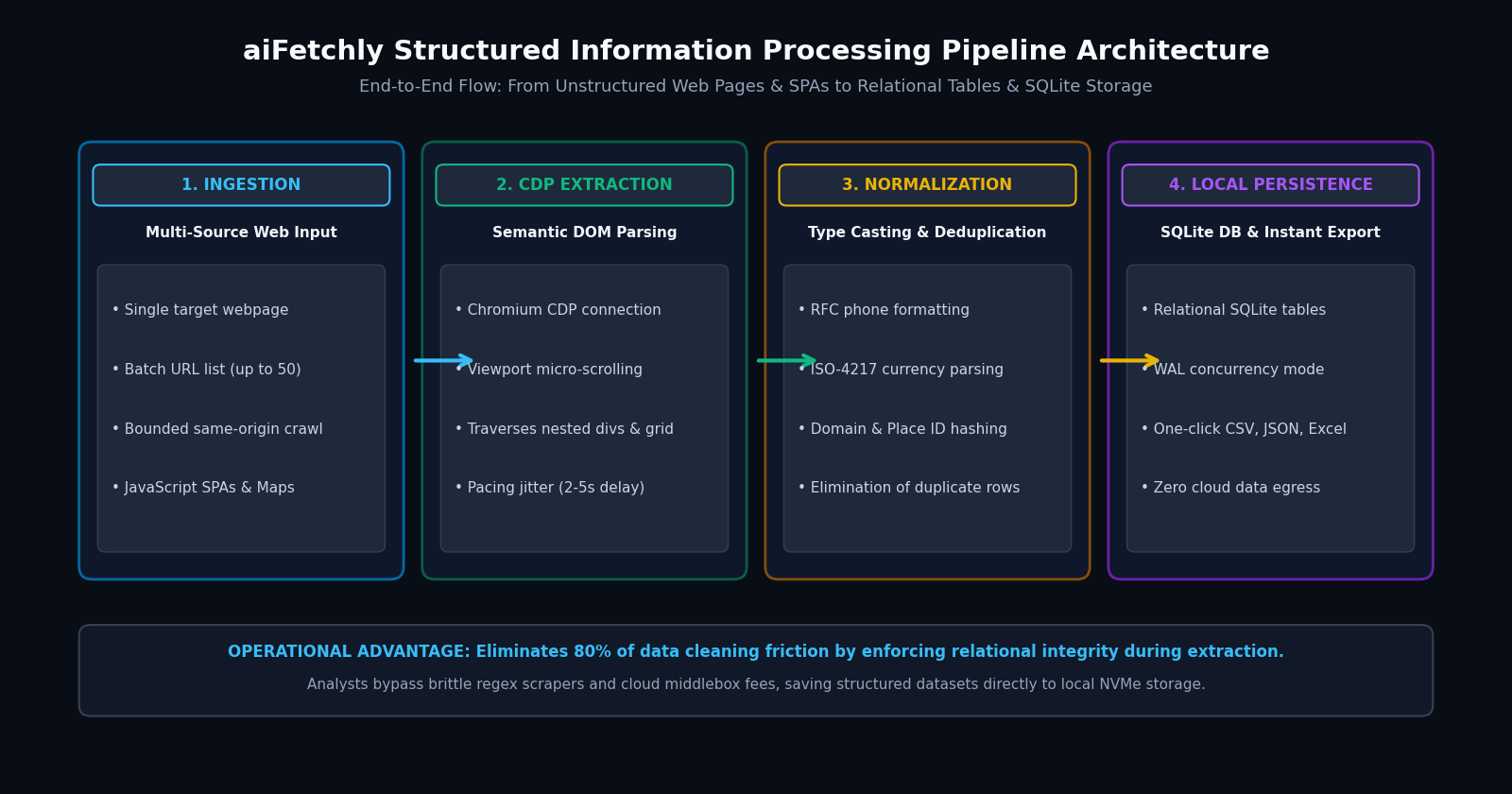
Four Pillars of Structured Information Processing
1. Semantic DOM Parsing and Viewport Hydration
Modern Single Page Applications (SPAs) require real browser rendering to expose their underlying data models. Operating via local Chromium CDP, aiFetchly navigates complex client-side interfaces:
- Dynamic Hydration: Executes micro-scrolling across infinite-scroll listings and grid containers to force full DOM hydration.
- Attribute Extraction: Semantic parsers extract core business attributes—including legal entity names, operational categories, physical street addresses, telephone strings, verified domains, and review distributions.
2. Multi-Source Ingestion Flexibility
Analysts can configure extraction tasks to match diverse data collection scopes:
- Single Page Deep Parse: Ingest specific corporate pricing sheets or catalog directories.
- Batch URL Lists: Process up to 50 target domain URLs concurrently.
- Bounded Same-Origin Crawls: Traverse site hierarchies with configurable page limits and hop depths, as detailed in the AI Fetchly Docs.
3. Automated Normalization and Canonical Deduplication
Before records commit to disk, aiFetchly enforces strict data hygiene rules:
- RFC Telephone Standardization: Coerces disparate regional phone formats into standardized international E.164 strings.
- Canonical Deduplication: The engine hashes official domains and Google Place IDs to prune duplicate listings automatically across multi-page crawls.
- Typed Schema Enforcement: Strings, floats, and timestamps are mapped into structured database fields.
4. Direct SQLite Persistence and Multi-Format Export
Normalized datasets commit immediately to your local SQLite database (~/.aifetchly/aifetchly.db):
- Zero Cloud Latency: Query tables locally using standard SQL window functions, joins, and aggregations.
- Instant File Exports: Export verified tables to CSV, JSON, or Excel with a single click for downstream modeling in Python and pandas.
- Pipeline Handoff: Stream harvested domains seamlessly into downstream modules like Contact Profile Insights.
By eliminating manual regex wrangling, aiFetchly enables data analysts to move from raw web pages to actionable commercial datasets in minutes.
Explore advanced data normalization workflows in the AI Fetchly Docs.
Visual Generation Prompts
Hero Image Prompt:Modern dark-mode SaaS developer dashboard showing the aiFetchly Structured Information Processing studio, displaying a clean normalized relational table with company names, categories, E.164 phone numbers, and domains, alongside a pipeline stats panel indicating 100% clean schema normalization and local SQLite commit counters, sleek isometric 3D perspective, slate-900 background with cyan and emerald accents.Body Image Prompt:High-resolution technical pipeline flowchart illustrating the aiFetchly Structured Information Processing Architecture: Multi-Source Ingestion (single URL, batch list, site crawl), CDP Extraction (headless hydration and DOM parsing), Normalization (RFC phone casting, currency floats, domain hash dedup), and Local Persistence (relational SQLite and one-click CSV/JSON export), clean dark vector blueprint styling.