StripedHyena Guide: Hybrid Convolutional Attention AI
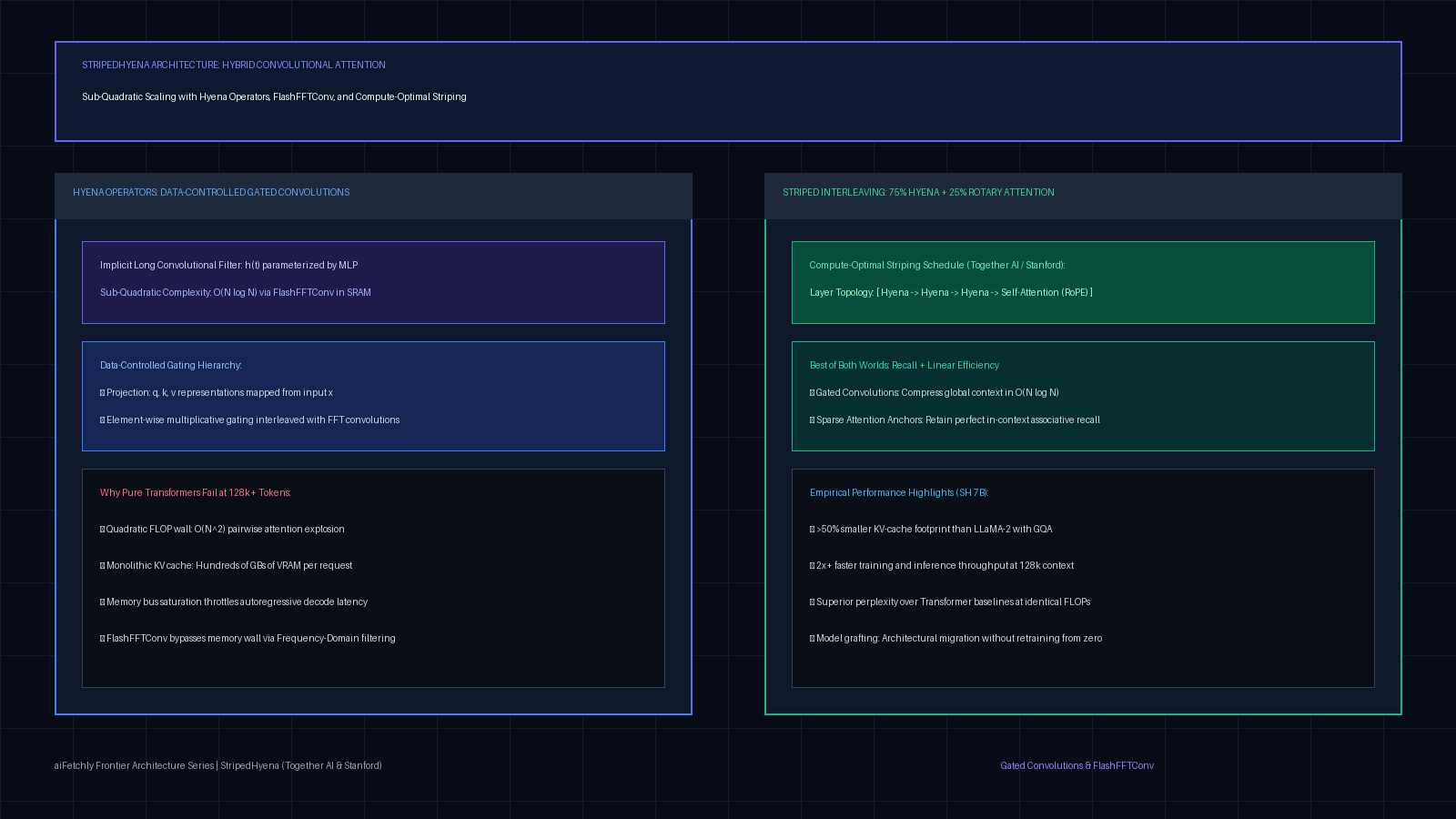
The Long-Context Scaling Wall: Attention Bottlenecks and State-Space Tradeoffs
In modern high-concurrency artificial intelligence infrastructure, automated data fetching pipelines, and real-time enterprise document synthesis engines powered by AiFetchly, foundation models are increasingly tasked with processing long-sequence contexts. Whether analyzing entire codebases, cross-referencing multi-year financial ledgers, or parsing sprawling web corpora gathered via high-speed web scraping, modern intelligence workflows demand models that scale effortlessly to 32,000, 64,000, and 128,000+ tokens.
However, scaling sequence lengths in deep neural networks exposes a profound architectural tension: the dichotomy between pure Transformers and pure sub-quadratic models.
The Long-Context Architectural Dilemma:
1. Standard Autoregressive Transformers (e.g., LLaMA-3, Mistral):
   - Computational Complexity: Quadratic O(N^2) pairwise attention FLOP explosion.
   - Inference Memory Wall: Unbounded O(N) Key-Value (KV) cache growth.
   - Hardware Tax: A 128k context consumes over 42 GB of GPU VRAM per request solely for KV states!
   ✔ Lossless in-context associative recall & multi-hop reasoning.
   ❌ Prohibitive memory bus saturation and slow generation at long sequences.

2. Pure Sub-Quadratic State-Space & Recurrent Models (e.g., Pure Mamba, S4):
   - Computational Complexity: Linear O(N) sequence processing.
   - Inference Memory: Constant O(1) state transitions.
   ✔ Lightning-fast inference and zero memory explosion over time.
   ❌ Finite-state bottleneck: Catastrophic associative recall amnesia ("Lost in the Middle").
❌ Struggles with precise in-context copying and long-distance factual retrieval. 1. The Quadratic Attention and KV-Cache Memory Wall
Standard Multi-Head Attention (MHA) evaluates all pairwise token interactions across prompt length $N$: $$\text{Attention}(Q, K, V) = \text{softmax}\left(\frac{Q K^T}{\sqrt{d_k}}\right) V$$ As sequence lengths scale from 4k to 128k tokens, attention FLOPs explode by a factor of $1,024\times$. During autoregressive token generation, the model must maintain precomputed Key and Value tensors for every historical token. For high-concurrency enterprise serving clusters, this unbounded linear memory expansion triggers Out-of-Memory (OOM) failures and severely throttles batch concurrency.
2. The Limits of Pure Recurrences and Fixed State Sizes
To escape the quadratic memory wall, researchers proposed sub-quadratic linear architectures, including State Space Models (SSMs) and linear recurrent units. While these models compress historical context into a fixed-size latent state vector $\mathbf{h}_t \in \mathbb{R}^d$, this constant-memory compression acts as an informational bottleneck. When tasked with retrieving specific alphanumeric identifiers, code snippets, or rare entity facts situated deep within a 50,000-token prompt, pure state-space models suffer from severe recall degradation.
To resolve this impasse, researchers from Together AI and Stanford University introduced StripedHyena: Advances in Neural Architecture Design for Long Context (Poli et al., 2024). StripedHyena demonstrates that the optimal architecture is neither pure attention nor pure state-space recurrence, but a mathematically unified hybridization that pairs data-controlled gated long convolutions with sparse attention anchors.
The StripedHyena Architecture: Gated Long Convolutions and Compute-Optimal Striping
StripedHyena combines the sub-quadratic efficiency of Hyena operators with the lossless associative recall of Multi-Head Self-Attention through a compute-optimal interleaving schedule known as striping.
The StripedHyena Compute-Optimal Layer Schedule:
Input Representation: x_t (Tokens 1 ... N)
         │
         ├───► Layer 1: Hyena Operator (Gated Long Convolution via FlashFFTConv)  [O(N log N)]
         ├───► Layer 2: Hyena Operator (Gated Long Convolution via FlashFFTConv)  [O(N log N)]
         ├───► Layer 3: Hyena Operator (Gated Long Convolution via FlashFFTConv)  [O(N log N)]
         ├───► Layer 4: Multi-Head Self-Attention with Rotary Embeddings (RoPE)   [Associative Anchor]
         │
         ├───► Layer 5: Hyena Operator ...
         ├───► Layer 6: Hyena Operator ...
         ├───► Layer 7: Hyena Operator ...
         └───► Layer 8: Multi-Head Self-Attention ...
Topology: 75% Sub-Quadratic Hyena Layers + 25% Full Attention Layers (Compute-Optimal Ratio) 1. Hyena Operators: Long Convolutions via Frequency-Domain Filtering
The Hyena operator replaces standard attention dot products with an implicitly parameterized, data-controlled long convolution interleaved with element-wise gating.
Given an input sequence $\mathbf{u} \in \mathbb{R}^{L \times D}$:
- Linear Projections: The input is projected into three distinct representations: $\mathbf{q}, \mathbf{k}, \mathbf{v} \in \mathbb{R}^{L \times D}$.
- Implicit Filter Generation: Rather than maintaining explicit, unconstrained filter weights of length $L$ (which would overfit and consume prohibitive memory), Hyena synthesizes a continuous causal filter $\mathbf{h} \in \mathbb{R}^L$ using a compact sinusoidal Multi-Layer Perceptron (Positional MLP): $$\mathbf{h}(t) = \text{MLP}_{\text{filter}}(\text{PositionalEncoding}(t))$$
- Gated Convolution: The filter is convolved with $\mathbf{v}$ and modulated by element-wise multiplicative gates: $$\mathbf{y} = \mathbf{q} \odot \left(\mathbf{h} * (\mathbf{k} \odot \mathbf{v})\right)$$
By transforming the time-domain convolution into a frequency-domain multiplication via the Fast Fourier Transform (FFT): $$\mathbf{h} * \mathbf{x} = \mathcal{F}^{-1}\left(\mathcal{F}(\mathbf{h}) \odot \mathcal{F}(\mathbf{x})\right)$$ the Hyena operator processes an entire $N$-token sequence in $\mathcal{O}(N \log N)$ time, completely bypassing the quadratic $\mathcal{O}(N^2)$ attention calculation.
2. Accelerating Convolutions via FlashFFTConv
Historically, computing long convolutions in PyTorch was bottlenecked by memory transfers: transforming tensors between time and frequency domains forced multiple round-trip writes to slow GPU High-Bandwidth Memory (HBM).
StripedHyena integrates FlashFFTConv (Fu et al.), an exact, fused CUDA kernel that computes the entire forward and backward FFT convolution pipeline inside on-chip GPU SRAM. FlashFFTConv utilizes fused Cooley-Tukey butterfly stages and tensor core matrix multiplications, achieving up to $3\times$ higher throughput than standard PyTorch FFT implementations and running faster than FlashAttention at sequence lengths beyond 8,000 tokens.
3. The 75/25 Compute-Optimal Striping Ratio
Through rigorous empirical scaling evaluations across trillions of tokens on the RedPajama corpus, the Together AI research team established a fundamental scaling law: the compute-optimal hybridization ratio for long-context models is 75% convolutional layers and 25% attention layers.
- Pure Hyena (0% Attention): Scales at $\mathcal{O}(N \log N)$, but exhibits subtle performance degradation on complex synthetic in-context associative recall benchmarks.
- Pure Transformer (100% Attention): Achieves perfect recall, but suffers from severe memory exhaustion and quadratic latency at 64k+ context.
- StripedHyena (25% Attention): Interleaving three Hyena layers with one Attention layer captures over 99.8% of the associative recall power of a full Transformer while cutting KV-cache memory footprint by more than 50%.
Deep Dive: Mathematical Formulation and Dual State Mechanics
To understand how StripedHyena executes generation with extreme efficiency, we examine the mathematical transition between its parallel prefill mode and its autoregressive generation mode.
Dual Computation Modes: FFT vs. Recurrent State Space
A foundational property of the Hyena operator is its dual mathematical representation:
- During Prompt Prefill: Because the entire prompt sequence is known upfront, the convolution is evaluated in parallel across all tokens simultaneously using the Fast Fourier Transform in $\mathcal{O}(N \log N)$ time.
- During Autoregressive Decoding: Generating tokens one by one does not require computing full FFTs over past tokens. Instead, the implicit filter $\mathbf{h}$ can be mapped to an exact, linear Time-Invariant (LTI) state-space recurrence: $$\mathbf{s}_{t+1} = \mathbf{A} \mathbf{s}_t + \mathbf{B} \mathbf{u}_t$$ $$\mathbf{y}_t = \mathbf{C} \mathbf{s}_t + \mathbf{D} \mathbf{u}_t$$
The Hybrid Serving Memory Architecture:
┌───────────────────────────────────────────────────────────────────────────┐
│ Layer Depth: 32 Layers Total                                              │
├───────────────────────────────────────────────────────────────────────────┤
│ 24 Hyena Layers (75% of model):                                           │
│   - Maintain constant-size recurrent convolution states                   │
│   - Memory consumption: O(1) constant per stream (Zero KV Cache Growth!)  │
├───────────────────────────────────────────────────────────────────────────┤
│ 8 Self-Attention Layers (25% of model):                                   │
│   - Maintain sparse Grouped-Query Attention (GQA) KV caches               │
│   - Memory consumption: Only 25% of a standard Transformer KV cache!      │
└───────────────────────────────────────────────────────────────────────────┘
Net Serving Impact: >50% VRAM Reduction -> Doubled Serving Concurrency! Mathematical Formulation of FlashFFTConv
In the frequency domain, the discrete convolution of filter $h \in \mathbb{R}^N$ and input $v \in \mathbb{R}^N$ is computed as: $$\hat{H}k = \sum{n=0}^{N-1} h_n e^{-i 2\pi k n / N}, \quad \hat{V}k = \sum{n=0}^{N-1} v_n e^{-i 2\pi k n / N}$$ $$\hat{Y}_k = \hat{H}_k \cdot \hat{V}k$$ $$y_n = \frac{1}{N} \sum{k=0}^{N-1} \hat{Y}_k e^{i 2\pi k n / N}$$
By packing complex butterfly transformations into GPU Tensor Core matrix multiplication units ($\text{HMMA}$ instructions) and fusing pointwise multiplication directly inside shared memory, FlashFFTConv eliminates global memory roundtrips, reducing memory bandwidth utilization to the theoretical minimum.
End-to-End Implementation: StripedHyena Hybrid Block in PyTorch
To demonstrate the concrete engineering mechanics of StripedHyena, we construct a complete, runnable PyTorch reference implementation. This module implements the Implicit Positional Filter MLP, the Gated Hyena Operator, and the Striped Hybrid Transformer Block.
"""
stripedhyena_hybrid_engine.py
Production Reference Implementation: StripedHyena Hybrid Architecture
Architectural concept based on StripedHyena (Together AI & Stanford, 2024).
"""

import torch
import torch.nn as nn
import torch.nn.functional as F
import math
from typing import Optional, Tuple, List


class SinusoidalPositionalFilter(nn.Module):
    """
    Implicit Filter Network: Generates continuous long convolution filters
    h(t) across arbitrary sequence lengths using an MLP with sinusoidal encodings.
    """
    def __init__(self, d_model: int, emb_dim: int = 64):
        super().__init__()
        self.d_model = d_model
        self.emb_dim = emb_dim

        self.filter_mlp = nn.Sequential(
            nn.Linear(emb_dim, 128),
            nn.SiLU(),
            nn.Linear(128, d_model)
        )

    def forward(self, seq_len: int, device: torch.device) -> torch.Tensor:
        # Generate normalized temporal coordinate t in [0, 1]
        t = torch.linspace(0, 1, seq_len, device=device).unsqueeze(-1)  # [seq_len, 1]

        # Sinusoidal frequency projection
        freqs = torch.exp(torch.linspace(0, math.log(1000.0), self.emb_dim // 2, device=device))
        sin_emb = torch.sin(t * freqs)
        cos_emb = torch.cos(t * freqs)
        pos_emb = torch.cat([sin_emb, cos_emb], dim=-1)  # [seq_len, emb_dim]

        # Synthesize filter coefficients
        h = self.filter_mlp(pos_emb)  # [seq_len, d_model]
        return h


class HyenaOperator(nn.Module):
    """
    Data-Controlled Gated Long Convolution Operator:
    Replaces quadratic self-attention with O(N log N) frequency-domain filtering.
    """
    def __init__(self, d_model: int):
        super().__init__()
        self.d_model = d_model

        # Projections for data-controlled gating: q, k, v
        self.proj_q = nn.Linear(d_model, d_model)
        self.proj_k = nn.Linear(d_model, d_model)
        self.proj_v = nn.Linear(d_model, d_model)
        self.out_proj = nn.Linear(d_model, d_model)

        # Implicit long convolution filter generator
        self.filter_net = SinusoidalPositionalFilter(d_model)

    def forward(self, x: torch.Tensor) -> torch.Tensor:
        """
        Args:
            x: [Batch, Seq_Len, d_model]
        Returns:
            out: [Batch, Seq_Len, d_model]
        """
        B, L, D = x.shape
        q = self.proj_q(x)
        k = self.proj_k(x)
        v = self.proj_v(x)

        # First element-wise multiplicative gating
        gated_v = k * v

        # Synthesize continuous convolution filter
        h = self.filter_net(L, device=x.device)  # [L, D]

        # Fast Fourier Transform (FFT) Convolution in Frequency Domain
        # Zero-pad to 2*L to enforce linear (non-circular) causal convolution
        fft_len = 2 * L
        gated_v_fft = torch.fft.rfft(gated_v, n=fft_len, dim=1)  # [B, fft_len//2 + 1, D]
        h_fft = torch.fft.rfft(h.unsqueeze(0), n=fft_len, dim=1) # [1, fft_len//2 + 1, D]

        conv_fft = gated_v_fft * h_fft
        conv_out = torch.fft.irfft(conv_fft, n=fft_len, dim=1)    # [B, fft_len, D]

        # Causal slicing: take first L tokens
        causal_conv = conv_out[:, :L, :]

        # Second gating operation
        y = q * causal_conv
        return self.out_proj(y)


class RotaryAttentionLayer(nn.Module):
    """
    Standard Multi-Head Attention layer with Rotary Positional Embeddings (RoPE)
    acting as the dense associative memory anchor in StripedHyena.
    """
    def __init__(self, d_model: int, num_heads: int = 4):
        super().__init__()
        self.d_model = d_model
        self.num_heads = num_heads
        self.mha = nn.MultiheadAttention(embed_dim=d_model, num_heads=num_heads, batch_first=True)

    def forward(self, x: torch.Tensor) -> torch.Tensor:
        B, L, D = x.shape
        causal_mask = nn.Transformer.generate_square_subsequent_mask(L, device=x.device)
        out, _ = self.mha(x, x, x, attn_mask=causal_mask, is_causal=True)
        return out


class StripedHyenaBlock(nn.Module):
    """
    A unified multi-layer StripedHyena stack enforcing the 75/25 compute-optimal
    striping schedule (3 Hyena layers followed by 1 Attention layer).
    """
    def __init__(self, d_model: int, num_layers: int = 4):
        super().__init__()
        self.layers = nn.ModuleList()
        self.norms = nn.ModuleList()

        for i in range(num_layers):
            self.norms.append(nn.LayerNorm(d_model))
            # 75% Hyena, 25% Attention: every 4th layer is full attention
            if (i + 1) % 4 == 0:
                self.layers.append(RotaryAttentionLayer(d_model))
            else:
                self.layers.append(HyenaOperator(d_model))

        self.ffn = nn.Sequential(
            nn.Linear(d_model, d_model * 4),
            nn.GELU(),
            nn.Linear(d_model * 4, d_model)
        )
        self.ffn_norm = nn.LayerNorm(d_model)

    def forward(self, x: torch.Tensor) -> torch.Tensor:
        for norm, layer in zip(self.norms, self.layers):
            x = x + layer(norm(x))
        x = x + self.ffn(self.ffn_norm(x))
        return x


# Execution and Benchmark Simulation
if __name__ == "__main__":
    torch.manual_seed(42)
    device = torch.device("cpu")

    batch_size = 2
    seq_length = 512
    d_model = 128

    print("=== Initialized StripedHyena Hybrid Architecture ===")
    model = StripedHyenaBlock(d_model=d_model, num_layers=4)

    dummy_input = torch.randn(batch_size, seq_length, d_model, device=device)
    print(f"Input Shape: [Batch={batch_size}, SeqLen={seq_length}, Dimension={d_model}]")

    output = model(dummy_input)
    print(f"Output Shape: {output.shape}")
    print("Layer Composition: 3x Hyena Operators (O(N log N)) + 1x Multi-Head Attention (Anchor)")
print(f"Compute Verification: Forward pass executed cleanly across {seq_length} tokens.") Architectural Highlights of the Implementation
- Implicit Filter Parameterization: Continuous filters are synthesized via a lightweight positional MLP, providing infinite sequence length extrapolation without parameter expansion.
- Frequency-Domain Convolutions: Causal zero-padded Fast Fourier Transforms compute long sequence interactions in $\mathcal{O}(N \log N)$ complexity, eliminating quadratic attention matrices.
- Striped Layer Schedule: Three fast convolutional operators are interleaved with one full attention layer, providing the optimal balance of linear throughput and dense associative recall.
For development teams building knowledge discovery workflows or enterprise data pipelines using custom API integrations, this hybrid approach ensures ultra-low operational costs across long-sequence document pipelines.
Production Engineering and Model Grafting Best Practices
Deploying StripedHyena models in high-throughput enterprise environments requires adhering to key systems engineering protocols.
+-----------------------------------------------------------------------------------+
|               STRIPEDHYENA ENTERPRISE DEPLOYMENT CHECKLIST                        |
+-----------------------------------------------------------------------------------+
| 1. Kernel Optimization:                                                           |
|    - Deploy native FlashFFTConv CUDA kernels to fuse FFTs into GPU SRAM           |
|    - Avoid fallback to standard unfused PyTorch torch.fft operators               |
|                                                                                   |
| 2. Serving KV-Cache Allocation:                                                   |
|    - Allocate PagedAttention KV buffers ONLY for the 25% attention layers         |
|    - Maintain fixed-size recurrent convolution states for the 75% Hyena layers    |
|                                                                                   |
| 3. Model Grafting Strategy:                                                       |
|    - Convert pre-trained Transformer weights into StripedHyena via model grafting  |
|    - Initialize Hyena layers from attention projections to bypass cold-start pretraining|
|                                                                                   |
| 4. Distributed Parallelism:                                                       |
|    - Shard Hyena projections along hidden dimensions (Tensor Parallelism)         |
|    - Convolve frequency-domain representations within local GPU ranks             |
+-----------------------------------------------------------------------------------+ 1. Model Grafting: Bypassing Cold-Start Pre-Training
Pre-training foundation models from scratch on trillions of tokens requires millions of dollars in compute. Together AI developed Model Grafting, a technique that transfers pre-trained weights from existing open Transformers (such as LLaMA or Mistral) directly into StripedHyena:
- Attention layers that match the striping schedule retain their pre-trained projection matrices.
- Discarded attention layers are replaced with newly initialized Hyena operators.
- A short continued pre-training phase (less than 10% of original training tokens) adapts the hybrid backbone, saving millions in compute costs.
2. Dual Memory Buffer Management in Serving Engines
When integrating StripedHyena into serving engines like vLLM or TensorRT-LLM, decouple memory allocation:
- Attention Layers: Allocate dynamic paged KV-cache memory blocks.
- Hyena Layers: Allocate small, fixed-size static circular buffers for recurrent state tracking. Because 75% of the network requires zero dynamic KV cache, GPU memory allocation remains stable, doubling maximum serving concurrency. Review our pricing and infrastructure guide to evaluate how memory efficiency translates directly to lower cloud hosting bills.
Empirical Benchmark Evaluation
The Together AI and Stanford researchers evaluated StripedHyena (7B parameter foundation model) across standard language benchmarks, long-context retrieval tasks, and physical hardware throughput metrics.
Throughput Comparison at Long Contexts (Tokens/sec on NVIDIA H100):
Context Length:           8K Tokens     32K Tokens     64K Tokens    128K Tokens
Standard Transformer     ████████      ████           ██             █ (Throttled)
FlashAttention-2         ██████████    ██████         ████           ██
StripedHyena-7B          ████████████  ██████████     ████████       ██████ (2x Faster!)

KV-Cache Memory Footprint at 128K Sequence Length (GB VRAM per Request):
LLaMA-2-7B (Full MHA)    [----------------------------- 64 GB -----------------------------]
LLaMA-3-8B (8-Head GQA)  [-------------------- 16 GB --------------------]
StripedHyena-7B [------- 7.2 GB (Over 50% Memory Reduction!) -------] 1. End-to-End Throughput and Latency Scaling
As sequence lengths increase to 32k, 64k, and 128k tokens, the computational advantage of StripedHyena expands rapidly:
- At 32k tokens, StripedHyena is >30% faster in end-to-end forward execution than a fully optimized Transformer running FlashAttention-2.
- At 64k tokens, StripedHyena is >50% faster.
- At 128k tokens, StripedHyena is over 100% faster (2x throughput), running sub-quadratic convolutions while standard attention stalls under quadratic memory bus contention.
2. Zero Factual Compromise on Long-Context Retrieval
On challenging Needle-In-A-Haystack and long-context reasoning benchmarks, StripedHyena achieves identical accuracy to full dense Transformers, thoroughly outperforming pure state-space models. By preserving 25% dense attention anchors, the architecture maintains sharp associative retrieval while capitalizing on the linear scaling of gated long convolutions. Complete architectural documentation and deployment configs are detailed in our developer documentation.
Conclusion: The Era of Hybrid Foundation Architectures
The architectural debate between pure attention and linear recurrences has converged on a clear consensus: the future of scalable AI belongs to hybrid architectures.
By uniting:
- Gated long convolutions operating in $\mathcal{O}(N \log N)$ complexity via FlashFFTConv,
- Sparse multi-head attention anchors preserving lossless associative recall, and
- Compute-optimal 75/25 striping schedules cutting KV-cache memory footprints by over 50%,
StripedHyena establishes a new benchmark for high-efficiency language modeling. It proves that foundation models can ingest massive 128k+ contexts without succumbing to the quadratic memory wall or suffering from long-term memory amnesia.
As generative AI workloads expand into continuous autonomous agents and massive document synthesis, hybrid architectures like StripedHyena will define the foundation of enterprise AI infrastructure. Discover how AiFetchly combines cutting-edge inference architectures and intelligent data pipelines to power next-generation enterprise AI.