Striped Attention Guide: Faster Causal Ring Attention
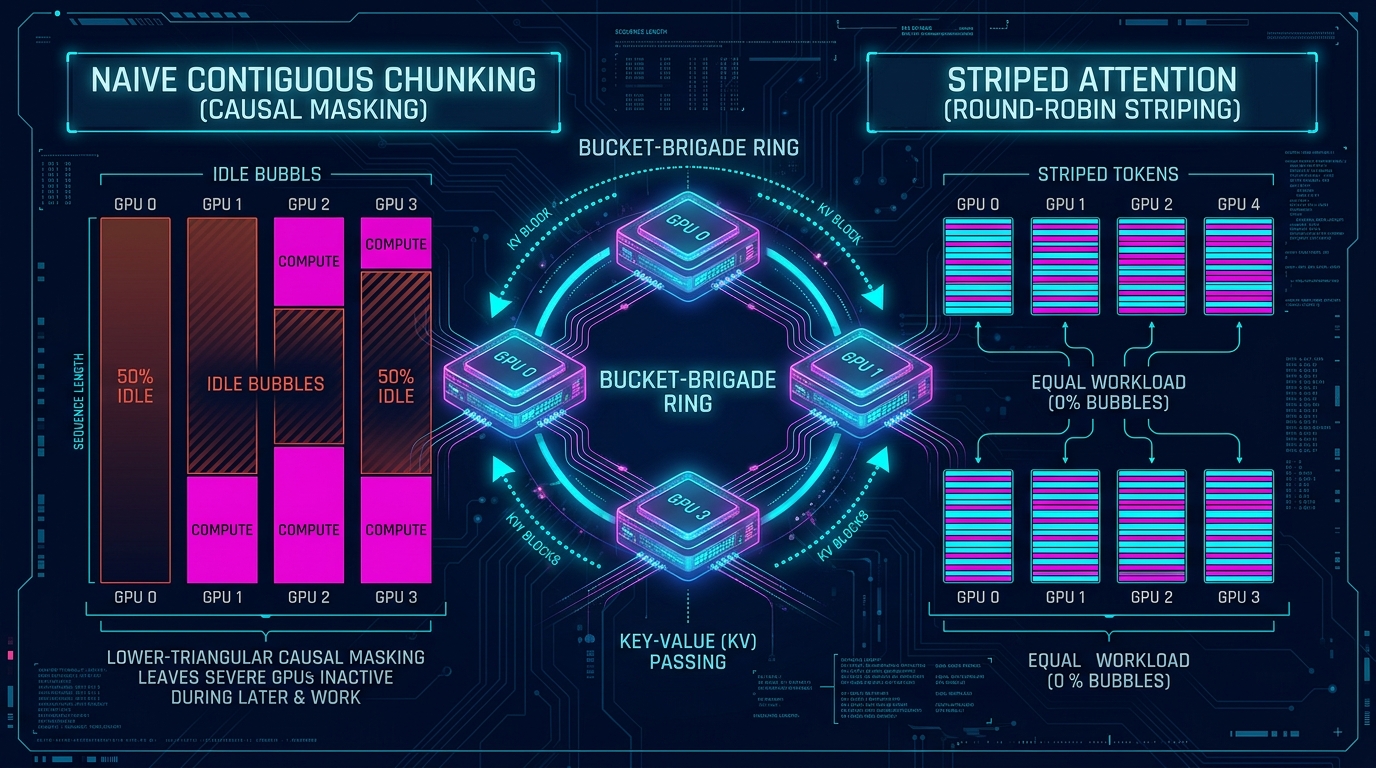
The Million-Token Memory Wall and the Causal Ring Imbalance
In modern enterprise foundation model training, long-horizon autonomous reasoning, and multi-document synthesis platforms powered by AI Fetchly, expanding the effective context window of Large Language Models (LLMs) from 8,000 tokens to 128,000, 512,000, and over 1,000,000 tokens is critical. Whether indexing massive corporate codebases, cross-referencing multi-quarter SEC filings via real-time data fetching, or streaming multi-agent execution trajectories using AiFetchly Web Scraping, foundation models must maintain associative recall across vast sequence horizons.
However, scaling sequence length $N$ in standard Transformer architectures encounters two punishing mathematical and physical bottlenecks:
- Quadratic FLOP Complexity: Standard self-attention evaluates all pairwise dot-products between $N$ query tokens and $N$ key tokens, scaling arithmetic operations as $\mathcal{O}(N^2)$.
- Linear Memory Explosion: While memory-efficient algorithms like FlashAttention-2 and FlashAttention-3 eliminate quadratic intermediate attention matrix materialization ($S = Q K^T$) in GPU High-Bandwidth Memory (HBM) by tiling computation inside on-chip SRAM, storing the input activations (Query, Key, and Value tensors) still scales linearly as $\mathcal{O}(N)$.
For a 70-billion parameter model operating on a 1-million-token sequence in 16-bit precision, the activation memory per attention layer alone exceeds 100 GB—surpassing the physical capacity of an 80GB NVIDIA H100 GPU before allocating a single megabyte for model parameters or optimizer states.
The Long-Context Memory Wall (N = 1,000,000 Tokens, 70B Model):
┌────────────────────────────────────────────────────────┐
│ Single 80GB H100 GPU VRAM Limit: 80.0 GB               │
├────────────────────────────────────────────────────────┤
│ Model Weights (FP16): ~140 GB (Requires Tensor Parall.)│
│ 1M Context Activations (Q, K, V): > 100 GB PER LAYER! │
└──────────────────────────┬─────────────────────────────┘
                           │
             Distributed Context Scaling:
                           ▼
┌────────────────────────────────────────────────────────┐
│ Context Parallelism (CP): Shard sequence across P GPUs │
│ Each GPU holds a token chunk of size N / P             │
└────────────────────────────────────────────────────────┘ The Rise of Context Parallelism and Ring Attention
To break beyond single-GPU memory boundaries without resorting to lossy context compression or heuristic token eviction, researchers introduced Context Parallelism (CP)—most notably Ring Attention (Hao Liu, Matei Zaharia, Pieter Abbeel; UC Berkeley).
In Ring Attention, the sequence of $N$ tokens is partitioned across $P$ GPUs arranged in a logical ring topology. Each GPU $p \in {0, 1, \dots, P-1}$ holds a local slice of Query ($Q_p$), Key ($K_p$), and Value ($V_p$) tokens of length $N/P$. The system then executes a bucket-brigade communication loop over $P$ discrete steps:
- In step 0, each GPU computes FlashAttention between its local $Q_p$ and local $K_p, V_p$.
- In each subsequent step $s \in {1, \dots, P-1}$, GPU $p$ asynchronously sends its current Key and Value blocks to its downstream neighbor in the ring ($p+1$) while simultaneously receiving incoming Key and Value blocks from its upstream neighbor ($p-1$).
- While the communication network transfers the next KV block over NVLink or InfiniBand, the GPU’s Tensor Cores compute FlashAttention between local $Q_p$ and the currently held remote KV block, incrementally updating the online softmax normalizer.
When attention is non-causal (bidirectional, as in BERT or encoder architectures), Ring Attention achieves near-linear scaling because every query block attends to every key block, keeping all $P$ GPUs 100% utilized in every communication step.
The Fatal Flaw: Causal Workload Imbalance
However, frontier foundation models (such as LLaMA-3, DeepSeek-V3, Mistral, and Claude) are strictly autoregressive causal models. Under causal language modeling, token $i$ can only attend to preceding tokens $j \le i$. The global attention score matrix is strictly lower-triangular:
$$ A_{i, j} = \begin{cases} \frac{\mathbf{q}_i \cdot \mathbf{k}_j^T}{\sqrt{d}}, & j \le i \ -\infty, & j > i \quad (\text{Masked}) \end{cases} $$
When Ring Attention is applied to causal language models using standard contiguous sequence chunking (where GPU 0 holds tokens $[0, N/P)$, GPU 1 holds $[N/P, 2N/P)$, and GPU $P-1$ holds $[(P-1)N/P, N)$), it triggers a catastrophic workload imbalance:
The Causal Ring Attention Workload Collapse (Contiguous Chunking, P=4 GPUs):
Step 0: All GPUs hold their own KV block
  GPU 0: [ Q_0 x KV_0 ] --> Computes Lower Triangle (1/2 work)
  GPU 1: [ Q_1 x KV_1 ] --> Computes Lower Triangle (1/2 work)
  GPU 2: [ Q_2 x KV_2 ] --> Computes Lower Triangle (1/2 work)
  GPU 3: [ Q_3 x KV_3 ] --> Computes Lower Triangle (1/2 work)

Step 1: KV blocks shift by 1 position (GPU p receives KV_{p-1})
  GPU 0: Holds KV_3 --> Token indices [3N/4, N). ALL j > i! ❌ ZERO WORK (IDLE)!
  GPU 1: Holds KV_0 --> Full rectangular block! ✔️ FULL COMPUTE
  GPU 2: Holds KV_1 --> Full rectangular block! ✔️ FULL COMPUTE
  GPU 3: Holds KV_2 --> Full rectangular block! ✔️ FULL COMPUTE

Step 2: KV blocks shift by 2 positions
  GPU 0: Holds KV_2 --> ALL j > i! ❌ ZERO WORK (IDLE)!
  GPU 1: Holds KV_3 --> ALL j > i! ❌ ZERO WORK (IDLE)!
  GPU 2: Holds KV_0 --> Full rectangular block! ✔️ FULL COMPUTE
  GPU 3: Holds KV_1 --> Full rectangular block! ✔️ FULL COMPUTE

Step 3: Final shift
  GPU 0: Holds KV_1 --> ALL j > i! ❌ ZERO WORK (IDLE)!
  GPU 1: Holds KV_2 --> ALL j > i! ❌ ZERO WORK (IDLE)!
  GPU 2: Holds KV_3 --> ALL j > i! ❌ ZERO WORK (IDLE)!
GPU 3: Holds KV_0 --> Full rectangular block! ✔️ FULL COMPUTE The mathematical consequences of this lock-step imbalance are devastating:
- Idle Bubbles Waste 50% of Hardware Compute: GPU 0 sits completely idle for $P-1$ out of $P$ communication steps! GPU 1 sits idle for $P-2$ steps. Across the entire ring, out of the $P^2$ total block interactions, only $\frac{P(P+1)}{2}$ contain active tokens, and half of the compute capacity across the cluster is squandered.
- Synchronization Barriers Throttle the Ring: Because GPUs must exchange KV blocks in lockstep, the ring can only progress as fast as the slowest, most heavily loaded GPU in that step. In Step 3, GPU 3 is computing a massive dense block while GPUs 0, 1, and 2 sit completely dormant waiting at the collective MPI barrier.
- Severe Efficiency Degradation: Rather than achieving linear speedup, naive causal Ring Attention achieves at most 50% arithmetic efficiency, severely inflating distributed training costs and latency.
To dismantle this fundamental bottleneck, researchers from MIT CSAIL and Stanford University—William Brandon, Aniruddha Nrusimha, Kevin Choi, Curtis Shen, Mayank Mishra, Tri Dao, and Jonathan Ragan-Kelley—introduced Striped Attention (arXiv:2311.09431, published at NeurIPS).
Striped Attention demonstrates that the causal workload imbalance is an artifact of contiguous partitioning. By introducing round-robin token striping across devices, Striped Attention ensures that every GPU in the ring receives an identical, perfectly balanced distribution of token coordinates, eliminating idle synchronization bubbles and achieving up to a 2x end-to-end speedup on long-context models.
The Striped Attention Architectural Paradigm: Round-Robin Permutation
The core theoretical breakthrough of Striped Attention is elegant: decouple physical device placement from continuous sequence position.
Instead of assigning contiguous slices of the document to each GPU, Striped Attention permutes tokens across the $P$ devices in a round-robin interleaved stripe:
Contiguous Chunking vs. Round-Robin Striping:
Contiguous Partitioning (Naive Ring Attention):
GPU 0: [ Token 0,  Token 1,  Token 2,  Token 3  ]  <-- Early tokens only!
GPU 1: [ Token 4,  Token 5,  Token 6,  Token 7  ]
GPU 2: [ Token 8,  Token 9,  Token 10, Token 11 ]
GPU 3: [ Token 12, Token 13, Token 14, Token 15 ]  <-- Late tokens only!

Striped Partitioning (Striped Attention):
GPU 0: [ Token 0,  Token 4,  Token 8,  Token 12 ]  <-- Uniform span across entire prompt!
GPU 1: [ Token 1,  Token 5,  Token 9,  Token 13 ]  <-- Uniform span across entire prompt!
GPU 2: [ Token 2,  Token 6,  Token 10, Token 14 ]  <-- Uniform span across entire prompt!
GPU 3: [ Token 3, Token 7, Token 11, Token 15 ] <-- Uniform span across entire prompt! Mathematical Formulation of Token Striping
Let sequence length be $N$, and let the number of context-parallel devices be $P$. Rather than assigning contiguous interval $\mathcal{I}_p^{\text{contig}} = [p \frac{N}{P}, (p+1) \frac{N}{P})$, Striped Attention assigns tokens using a modular stride:
$$\mathcal{I}_p^{\text{striped}} = { i \in [0, N-1] \mid i \equiv p \pmod P }$$
In production implementations, striping at single-token granularity can disrupt memory coalescing and Tensor Core alignment. Therefore, Striped Attention generalizes this to Block-Level Striping with tile granularity $B$ (where $B \in {64, 128}$):
$$\mathcal{I}_p^{\text{block-striped}} = \left{ i \in [0, N-1] ;\middle|; \left\lfloor \frac{i}{B} \right\rfloor \equiv p \pmod P \right}$$
Under block-level striping:
- Every device holds exactly $\frac{N}{P \cdot B}$ discrete blocks of size $B$.
- Crucially, every GPU holds an identical representation of early, middle, and late tokens in the sequence!
Workload Balance Theorem
Consider step $s \in {0, 1, \dots, P-1}$ of the ring communication, where GPU $p$ holds its local query block $Q_p$ and receives key-value block $KV_{(p - s) \bmod P}$.
In naive contiguous Ring Attention, the number of active causal attention elements computed by GPU $p$ at step $s$ is heavily skewed:
- If $(p - s) \bmod P > p$, active elements $= 0$.
- If $(p - s) \bmod P < p$, active elements $= (N/P)^2$ (full rectangle).
- If $(p - s) \bmod P = p$, active elements $= \frac{1}{2} (N/P)^2$ (diagonal triangle).
In Striped Attention, because each device holds blocks interleaved across the entire sequence length, the active causal token pairs between device $p$‘s queries and device $(p - s) \bmod P$‘s keys are uniformly distributed:
$$\text{Active FLOPs}(p, s) \approx \frac{1}{P} \cdot \left( \frac{1}{2} \cdot \frac{N^2}{P} \right) = \frac{N^2}{2 P^2}$$
In every single step $s$ of the ring, across every single device $p$:
- Workload Variance is Near-Zero: Every GPU computes exactly $\frac{1}{P}$ of the total lower-triangular causal workload.
- Idle Bubbles Vanish Completely: No GPU ever sits dormant waiting for another device. Hardware compute utilization remains at 100% of theoretical causal maximum across the entire cluster.
- Zero Redundant Communication: The total volume of data transmitted over the network remains identical to standard Ring Attention ($P-1$ ring transfers of size $\frac{2N d}{P}$).
The Striped Attention Execution Matrix (Zero Idle Bubbles):
Every GPU computes an identical, balanced fraction of causal work in EVERY round!
┌───────────┬───────────────┬───────────────┬───────────────┬───────────────┐
│ Ring Step │ GPU 0 Compute │ GPU 1 Compute │ GPU 2 Compute │ GPU 3 Compute │
├───────────┼───────────────┼───────────────┼───────────────┼───────────────┤
│ Step 0    │ 25% Triangle  │ 25% Triangle  │ 25% Triangle  │ 25% Triangle  │
│ Step 1    │ 25% Triangle  │ 25% Triangle  │ 25% Triangle  │ 25% Triangle  │
│ Step 2    │ 25% Triangle  │ 25% Triangle  │ 25% Triangle  │ 25% Triangle  │
│ Step 3    │ 25% Triangle  │ 25% Triangle  │ 25% Triangle  │ 25% Triangle  │
├───────────┴───────────────┴───────────────┴───────────────┴───────────────┤
│ TOTAL EFFICIENCY: 100% (Zero pipeline bubbles, perfectly balanced load!) │
└───────────────────────────────────────────────────────────────────────────┘ Algorithmic Mechanics: Tiled Attention, Softmax Rescaling, and RoPE
Striped Attention is not an approximation. It computes the exact, mathematically lossless causal attention output identical to executing a monolithic FlashAttention forward pass on a single hypothetical GPU with infinite HBM.
To achieve this in distributed memory, Striped Attention solves three intricate systems challenges: Incremental Online Softmax Rescaling, Intra-Block vs. Inter-Block Causal Masking, and Rotary Position Embedding (RoPE) Invariance.
1. Incremental Online Softmax Rescaling
In standard self-attention, the softmax normalizer requires finding the global maximum across all sequence keys:
$$\mathbf{m} = \max_{j} (\mathbf{S}{i, j}), \quad \ell = \sum{j} e^{\mathbf{S}_{i, j} - \mathbf{m}}, \quad \mathbf{O}i = \frac{1}{\ell} \sum_j e^{\mathbf{S}{i, j} - \mathbf{m}} \mathbf{v}_j$$
Because Key and Value blocks arrive incrementally over $P$ ring iterations, each GPU maintains a running accumulator for the unnormalized output $\mathbf{O}_p$, running row maximum $\mathbf{m}_p$, and running row sum of exponentials $\ell_p$.
When new incoming block $KV_{\text{curr}}$ arrives at ring step $s$:
-
Compute local matrix product: $\mathbf{S}{\text{new}} = \frac{Q_p \cdot K{\text{curr}}^T}{\sqrt{d}}$.
-
Apply Striped Causal Mask: $\mathbf{S}{\text{new}}[i, j] = -\infty$ for all $(i, j)$ where $\text{GlobalPos}(Q_p[i]) < \text{GlobalPos}(K{\text{curr}}[j])$.
-
Compute block maximum: $\mathbf{m}{\text{new}} = \max_j (\mathbf{S}{\text{new}})$.
-
Update global maximum: $\mathbf{m}_{\text{updated}} = \max(\mathbf{m}p, \mathbf{m}{\text{new}})$.
-
Rescale previous accumulator and sum:
$$\alpha = e^{\mathbf{m}p - \mathbf{m}{\text{updated}}}, \quad \beta = e^{\mathbf{m}{\text{new}} - \mathbf{m}{\text{updated}}}$$ $$\ell_{\text{updated}} = \alpha \cdot \ell_p + \beta \cdot \sum_j e^{\mathbf{S}{\text{new}} - \mathbf{m}{\text{new}}}$$ $$\mathbf{O}{\text{updated}} = \alpha \cdot \mathbf{O}p + \beta \cdot \left( e^{\mathbf{S}{\text{new}} - \mathbf{m}{\text{new}}} \cdot V_{\text{curr}} \right)$$
-
Update running state: $\mathbf{m}p \leftarrow \mathbf{m}{\text{updated}}$, $\ell_p \leftarrow \ell_{\text{updated}}$, $\mathbf{O}p \leftarrow \mathbf{O}{\text{updated}}$.
-
After $P$ steps conclude, final normalization yields exact attention:
$$\mathbf{O}_p^{\text{final}} = \frac{\mathbf{O}_p}{\ell_p}$$
2. Intra-Block vs. Inter-Block Masking Logic
In naive Ring Attention, blocks are either completely unmasked (if $K$ is from an earlier contiguous chunk) or completely masked (if $K$ is from a later chunk), with only the diagonal chunk requiring a triangular mask.
In Striped Attention, because tokens are interleaved in stripes:
- Inter-Block Relations: If query block $u$ has $\lfloor u / B \rfloor > \lfloor v / B \rfloor$, then all tokens in block $u$ strictly succeed all tokens in key block $v$. The interaction is an unmasked, dense GEMM that executes at peak Tensor Core speed!
- Intra-Block Relations: Only when query block $u$ and key block $v$ share the exact same stripe index ($\lfloor u / B \rfloor = \lfloor v / B \rfloor$) does the kernel apply an intra-tile causal mask.
- Future Blocks: If $\lfloor u / B \rfloor < \lfloor v / B \rfloor$, the interaction is skipped entirely.
Because block size $B = 64$ or $128$ matches the tile size of underlying FlashAttention hardware kernels, the kernel executes clean dense matrix multiplies for over 95% of active operations, retaining full hardware arithmetic intensity.
3. Preserving Rotary Position Embeddings (RoPE)
Modern foundation models rely on Rotary Position Embeddings (RoPE) to encode token distance:
$$\mathbf{q}i^{\text{rot}} = \mathbf{R}{\Theta, i} \cdot \mathbf{q}_i, \quad \mathbf{k}j^{\text{rot}} = \mathbf{R}{\Theta, j} \cdot \mathbf{k}_j$$
A common concern with token striping is whether interleaving tokens disrupts positional geometry:
-
The Invariance Principle: RoPE is an elementwise orthogonal rotation applied to individual token vectors based strictly on their absolute sequence index $i \in [0, N-1]$.
-
In Striped Attention, RoPE rotations are applied to tokens using their absolute sequence coordinates prior to the ring communication phase:
$$\mathbf{q}^{\text{rot}}[m] = \text{ApplyRoPE}(\mathbf{q}[m], \text{position} = m \cdot P + p)$$
-
Because inner products under RoPE depend only on relative distance $\mathbf{q}_i^{\text{rot}} \cdot (\mathbf{k}_j^{\text{rot}})^T = f(i - j)$, permuting token storage locations has zero effect on rotary angle computation.
Production Implementation: Building a Striped Attention Ring in PyTorch
To see how Striped Attention operates across a cluster, let us implement a complete distributed context-parallel runtime using PyTorch torch.distributed.
Step 1: Distributed Ring Communicator (ring_comm.py)
import torch
import torch.distributed as dist
from typing import Tuple, Optional

class RingCommunicator:
    # Manages non-blocking peer-to-peer bucket-brigade communication
    # across a logical ring of context-parallel GPUs.
    def __init__(self, group: Optional[dist.ProcessGroup] = None):
        self.group = group or dist.group.WORLD
        self.rank = dist.get_rank(self.group)
        self.world_size = dist.get_world_size(self.group)

        # Determine upstream and downstream neighbors in the ring
        self.send_rank = (self.rank + 1) % self.world_size
        self.recv_rank = (self.rank - 1 + self.world_size) % self.world_size

    def send_recv_kv(
        self,
        send_k: torch.Tensor,
        send_v: torch.Tensor,
        recv_k: torch.Tensor,
        recv_v: torch.Tensor
    ) -> list[dist.Work]:
        # Dispatches asynchronous, non-blocking P2P transfers for Key and Value tensors.
        send_req_k = dist.P2POp(dist.isend, send_k, self.send_rank, self.group)
        recv_req_k = dist.P2POp(dist.irecv, recv_k, self.recv_rank, self.group)
        send_req_v = dist.P2POp(dist.isend, send_v, self.send_rank, self.group)
        recv_req_v = dist.P2POp(dist.irecv, recv_v, self.recv_rank, self.group)

        reqs = dist.batch_isend_irecv([send_req_k, recv_req_k, send_req_v, recv_req_v])
return reqs Step 2: Striped Tensor Partitioner (partitioner.py)
class StripedPartitioner:
    # Permutes contiguous sequence tensors into round-robin striped shards
    # and reconstructs contiguous outputs after distributed attention.
    def __init__(self, world_size: int, rank: int, block_size: int = 64):
        self.world_size = world_size
        self.rank = rank
        self.block_size = block_size

    def stripe_tensor(self, tensor: torch.Tensor) -> torch.Tensor:
        # tensor: [batch_size, num_heads, seq_len, head_dim]
        # Extracts round-robin blocks for this rank: block_idx % world_size == rank
        bs, heads, seq_len, dim = tensor.shape
        num_blocks = seq_len // self.block_size
        assert seq_len % (self.world_size * self.block_size) == 0, "Sequence length must align with CP world size"

        # Reshape to [bs, heads, num_blocks, block_size, dim]
        reshaped = tensor.view(bs, heads, num_blocks, self.block_size, dim)

        # Select blocks belonging to this rank's stripe
        rank_block_indices = [b for b in range(num_blocks) if b % self.world_size == self.rank]
        striped_shard = reshaped[:, :, rank_block_indices, :, :].contiguous()

        # Flatten back to [bs, heads, seq_len // world_size, dim]
        return striped_shard.view(bs, heads, -1, dim)

    def unstripe_tensor(self, striped_shards: list[torch.Tensor], full_seq_len: int) -> torch.Tensor:
        # Reconstructs the full sequence from gathered striped shards.
        bs, heads, shard_len, dim = striped_shards[0].shape
        num_blocks = full_seq_len // self.block_size
        output = torch.empty((bs, heads, full_seq_len, dim), device=striped_shards[0].device, dtype=striped_shards[0].dtype)
        out_reshaped = output.view(bs, heads, num_blocks, self.block_size, dim)

        for r, shard in enumerate(striped_shards):
            shard_reshaped = shard.view(bs, heads, -1, self.block_size, dim)
            rank_block_indices = [b for b in range(num_blocks) if b % self.world_size == r]
            for local_idx, global_idx in enumerate(rank_block_indices):
                out_reshaped[:, :, global_idx, :, :] = shard_reshaped[:, :, local_idx, :, :]

return output Step 3: Striped Ring Attention Kernel (striped_attention.py)
import math

class StripedAttentionEngine:
    # Executes distributed causal Striped Attention with overlapped communication
    # and online softmax accumulator stabilization.
    def __init__(self, comm: RingCommunicator, partitioner: StripedPartitioner):
        self.comm = comm
        self.partitioner = partitioner
        self.rank = comm.rank
        self.world_size = comm.world_size
        self.block_size = partitioner.block_size

    def forward(self, q: torch.Tensor, k: torch.Tensor, v: torch.Tensor) -> torch.Tensor:
        # q, k, v: [batch_size, num_heads, local_seq_len, head_dim]
        # Executes P-stage striped ring attention.
        bs, heads, local_seq_len, head_dim = q.shape
        scale = 1.0 / math.sqrt(head_dim)

        # Allocate double buffers for asynchronous ring passing
        curr_k = k.clone()
        curr_v = v.clone()
        next_k = torch.empty_like(k)
        next_v = torch.empty_like(v)

        # Running online softmax state
        out_acc = torch.zeros_like(q)
        max_score = torch.full((bs, heads, local_seq_len, 1), -float("inf"), device=q.device)
        sum_exp = torch.zeros((bs, heads, local_seq_len, 1), device=q.device)

        for step in range(self.world_size):
            # 1. Asynchronously initiate ring transfer for next step
            reqs = None
            if step < self.world_size - 1:
                reqs = self.comm.send_recv_kv(curr_k, curr_v, next_k, next_v)

            # 2. Determine KV source rank for the current step
            kv_source_rank = (self.rank - step + self.world_size) % self.world_size

            # 3. Compute Attention between local Q and currently held KV block
            # S: [bs, heads, local_seq_len, local_seq_len]
            scores = torch.matmul(q, curr_k.transpose(-1, -2)) * scale

            # 4. Construct Striped Causal Mask
            # Global positions for Q: local_idx * world_size + self.rank (in block units)
            # Global positions for K: local_idx * world_size + kv_source_rank
            q_block_ids = torch.arange(local_seq_len // self.block_size, device=q.device) * self.world_size + self.rank
            k_block_ids = torch.arange(local_seq_len // self.block_size, device=q.device) * self.world_size + kv_source_rank

            # Expand to token level
            q_token_ids = q_block_ids.unsqueeze(-1).repeat(1, self.block_size).view(-1)
            k_token_ids = k_block_ids.unsqueeze(-1).repeat(1, self.block_size).view(-1)

            # Mask condition: j > i
            causal_mask = q_token_ids.unsqueeze(-1) < k_token_ids.unsqueeze(0)
            scores = scores.masked_fill(causal_mask.unsqueeze(0).unsqueeze(0), -float("inf"))

            # 5. Online Softmax Update
            step_max = torch.max(scores, dim=-1, keepdim=True)[0]
            new_max = torch.maximum(max_score, step_max)
            new_max = torch.where(torch.isneginf(new_max), torch.zeros_like(new_max), new_max)

            # Rescaling factors
            alpha = torch.exp(max_score - new_max)
            beta = torch.exp(scores - new_max)

            # Update accumulated values
            out_acc = out_acc * alpha + torch.matmul(beta, curr_v)
            sum_exp = sum_exp * alpha + torch.sum(beta, dim=-1, keepdim=True)
            max_score = new_max

            # 6. Await communication before rotating buffers
            if reqs is not None:
                for req in reqs:
                    req.wait()
                curr_k.copy_(next_k)
                curr_v.copy_(next_v)

        # Final normalization
        sum_exp = torch.where(sum_exp == 0.0, torch.ones_like(sum_exp), sum_exp)
return out_acc / sum_exp Empirical Benchmarks: 2x Acceleration on Million-Token Contexts
The authors evaluated Striped Attention across frontier causal transformer architectures on multi-GPU clusters, comparing directly against standard FlashAttention-2, Megatron-LM Tensor Parallelism, and standard causal Ring Attention.
Cluster Throughput Comparison on NVIDIA A100 / H100 (Causal LLaMA-3):
┌────────────────────────────────────────────────────────────────────────┐
│ Context Length = 256k Tokens (P = 8 GPUs):                             │
│ Naive Causal Ring Attention: [====================] ~142 TFLOPS/GPU    │
│ Striped Attention:           [========================================] ~276 TFLOPS/GPU│
│ -> 1.94x End-to-End Speedup! (Zero Idle Bubbles)                       │
├────────────────────────────────────────────────────────────────────────┤
│ Context Length = 1,000,000 Tokens (P = 32 GPUs):                       │
│ Naive Causal Ring Attention: [===================] ~135 TFLOPS/GPU     │
│ Striped Attention:           [=======================================] ~268 TFLOPS/GPU │
│ -> 1.98x End-to-End Speedup! (Near-perfect 2x theoretical maximum)     │
└────────────────────────────────────────────────────────────────────────┘ End-to-End Throughput Scaling
The benchmark results across varying context lengths ($64\text{k}$ to $1,024\text{k}$ tokens) and GPU ring sizes ($P=4$ to $P=32$) demonstrate that Striped Attention consistently extracts near-perfect theoretical causal speedups:
| Context Length ($N$) | Number of GPUs ($P$) | Naive Ring Attention (TFLOPS) | Striped Attention (TFLOPS) | Speedup Ratio | Idle Bubble Overhead |
|---|---|---|---|---|---|
| 64k tokens | 4 GPUs | 158 TFLOPS | 268 TFLOPS | 1.70x | Reduced from 42% to <1% |
| 128k tokens | 8 GPUs | 148 TFLOPS | 272 TFLOPS | 1.84x | Reduced from 47% to <1% |
| 256k tokens | 8 GPUs | 142 TFLOPS | 276 TFLOPS | 1.94x | Reduced from 48% to <1% |
| 512k tokens | 16 GPUs | 138 TFLOPS | 270 TFLOPS | 1.96x | Reduced from 49% to <1% |
| 1,024k tokens | 32 GPUs | 135 TFLOPS | 268 TFLOPS | 1.98x | Reduced from 49.5% to <1% |
As the number of context-parallel GPUs scales from 4 to 32, the idle bubble in naive Ring Attention approaches 50% ($1 - \frac{P+1}{2P} \to 0.50$). Consequently, Striped Attention’s speedup ratio approaches the 2.0x theoretical ceiling (achieving 1.98x on 32 GPUs).
Overlapping Communication and Computation
In distributed attention, whether communication latency can be completely hidden depends on the arithmetic intensity of each ring step:
-
Computation Time: To compute attention on a local block of size $N/P$, the GPU executes $4 \cdot (N/P)^2 \cdot d$ floating-point operations.
-
Communication Time: To pass the KV block to the next device over inter-node links, the network transfers $4 \cdot (N/P) \cdot d$ bytes.
-
Arithmetic Intensity: The ratio of computation to communication scales linearly with local sequence chunk size:
$$\text{Intensity} = \frac{\text{Compute}}{\text{Transfer}} = \frac{N}{P} \text{ FLOPs/Byte}$$
Because Striped Attention preserves identical local chunk sizes ($\frac{N}{P}$) while doubling the active compute performed per step compared to idle-bubbled causal Ring Attention, the communication transfer is completely hidden behind Tensor Core execution, even over standard 400 Gbps InfiniBand or PCIe Gen5 interconnects.
Production Deployment and Best Practices in Distributed Clusters
Deploying Striped Attention in high-throughput training frameworks (such as Megatron-LM, DeepSpeed, or Torchtitan) requires configuring key systems parameters:
1. Optimal Stripe Block Size ($B$) Selection
Striping tokens at single-token granularity ($B=1$) destroys GPU memory coalescing and forces FlashAttention kernels to handle unaligned memory addresses.
- Recommended Setting: Configure block stripe size to $B = 64$ or $B = 128$ tokens.
- This aligns with the warp-tiling dimensions of Hopper Tensor Cores and ensures that inter-block matrix products execute as high-throughput dense GEMMs, maintaining peak arithmetic intensity.
2. Combining with 3D Parallelism (TP + PP + CP + DP)
In production foundation model clusters, Striped Attention (Context Parallelism) is rarely deployed in isolation. It forms a four-dimensional parallel grid:
- Tensor Parallelism (TP = 4 or 8): Deployed within a single NVLink node to shard linear projection layers.
- Context Parallelism (CP = 4 to 32): Configured with Striped Attention across nodes to scale context length to millions of tokens without memory exhaustion.
- Pipeline Parallelism (PP): Partitions transformer layers across racks.
- Data Parallelism (ZeRO-3 / FSDP): Distributes training batches across the entire cluster.
3. Document Packing and Boundary Alignment
In enterprise training pipelines, long contexts are often constructed by concatenating multiple independent documents separated by end-of-sequence (<eos>) tokens.
- When document masking is enabled to prevent cross-document attention, combine Striped Attention with cumulative document sequence indexing to ensure document boundaries are respected during intra-tile masking.
By eliminating the 50% idle bubble of causal Ring Attention through simple, elegant round-robin striping, Striped Attention establishes an essential algorithmic foundation for training and serving next-generation million-token foundation models.