StarCoder2 Guide: The Stack v2 & Open Code LLM Architecture
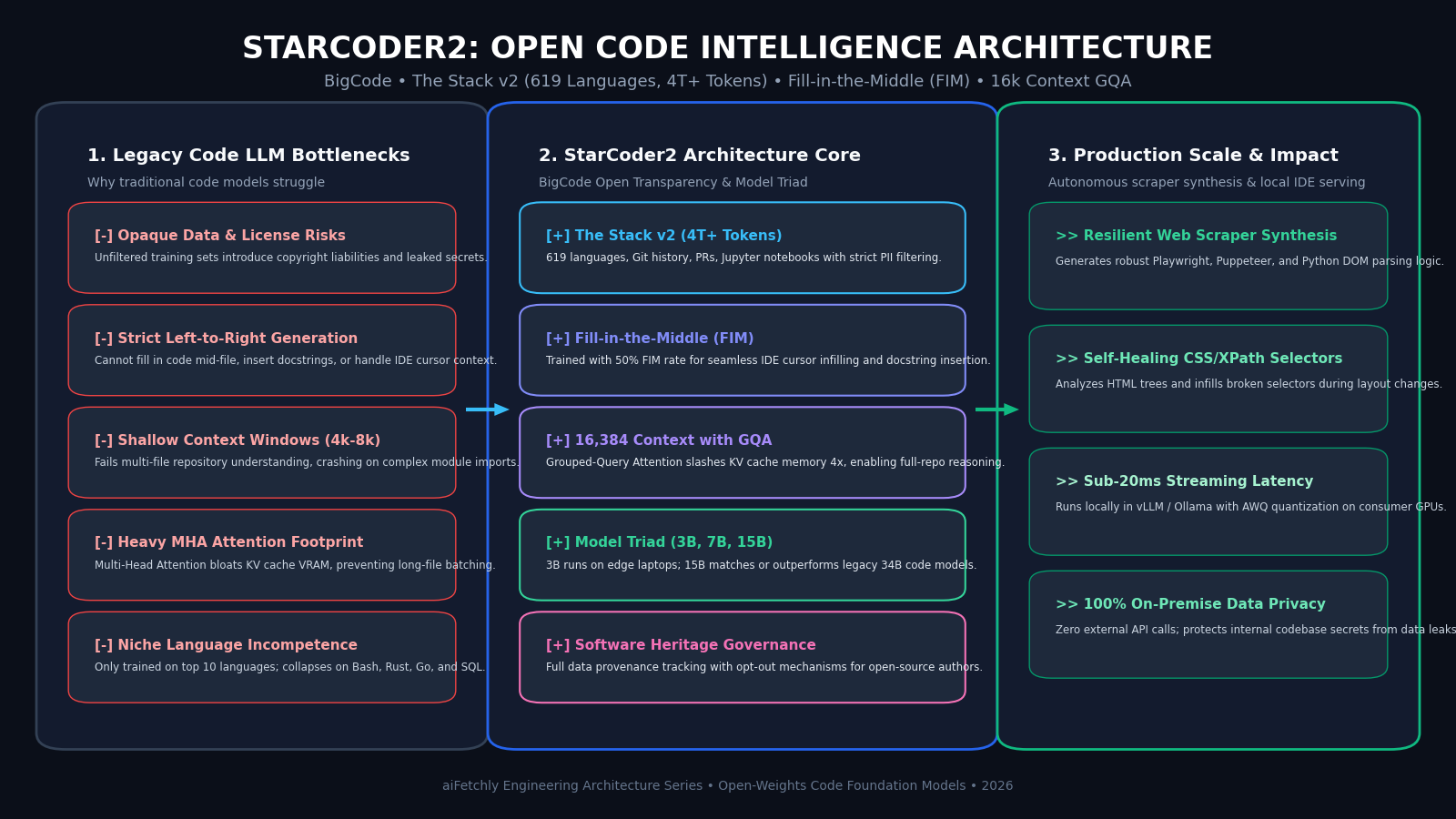
The Problem: The Licensing, Infilling, and Context Bottlenecks of Legacy Code Models
In modern enterprise automation, automated web data extraction, resilient scraper generation, and autonomous developer copilots powered by AiFetchly, software engineering relies on code-specialized Large Language Models (Code LLMs). Engineering teams use code models to synthesize robust web scrapers (such as Playwright and BeautifulSoup scripts), write data transformation functions, repair broken CSS selectors, and generate integration test suites.
However, for years, the deployment of code intelligence models in enterprise production environments was impeded by four severe architectural and operational hurdles: opaque training data governance, rigid left-to-right generation, shallow context limits, and prohibitive memory overhead.
The Enterprise Code LLM Dilemma:
┌────────────────────────────────────────────────────────┐
│ Bottleneck 1: Opaque Data Governance & Legal Risks     │
│ • Unfiltered web corpora ingest proprietary code,      │
│   GPL copyleft violations, and unscrubbed API secrets  │
├────────────────────────────────────────────────────────┤
│ Bottleneck 2: Strict Left-to-Right Generation Inability│
│ • Standard autoregressive LLMs cannot infill code      │
│   between existing functions or insert docstrings      │
├────────────────────────────────────────────────────────┤
│ Bottleneck 3: Shallow Context Windows (4k to 8k)       │
│ • Slicing complex multi-file modules drops imports,    │
│   type definitions, and cross-file dependencies        │
├────────────────────────────────────────────────────────┤
│ Bottleneck 4: Heavy Multi-Head Attention (MHA) Bloat   │
│ • Standard attention bloats Key-Value (KV) cache VRAM, │
│   preventing concurrent long-sequence IDE batching     │
└────────────────────────────────────────────────────────┘
Result: Enterprises faced legal compliance risks and slow, brittle code completion! 1. The Opaque Training Data and Intellectual Property Hazard
Most commercial and early open code models were pre-trained on indiscriminately scraped GitHub repositories:
- Pre-training pipelines frequently ingested proprietary repositories, code protected by restrictive copyleft licenses (like AGPL), and hardcoded production API tokens, private SSH keys, and personal credentials.
- When enterprise developers use models trained on unvetted code, corporate legal and compliance teams face severe copyright infringement risks and licensing ambiguities.
- Furthermore, original open-source authors had zero visibility into whether their code was scraped and zero mechanism to opt out.
2. The Strict Left-to-Right Generation Failure in IDEs
Standard causal autoregressive models only generate code strictly from left to right:
- In real-world software development, engineers rarely write code strictly from top to bottom. Instead, developers place their cursor inside an existing function, add parameters to a signature, or insert logic between existing try-catch blocks.
- A standard model evaluated with code before and after the cursor only sees the prefix, remaining completely blind to the surrounding suffix. This causes redundant duplicate function definitions and invalid variable re-declarations.
3. Shallow Context Windows and Multi-File Repository Starvation
Modern software projects are modular:
- A single Python web scraping script might depend on custom DOM helper classes, authentication middlewares, and configuration schemas spread across four separate files.
- Older code models constrained to 2,048 or 4,096 tokens cannot ingest these dependencies simultaneously, forcing developers to truncate critical context and resulting in hallucinated method signatures.
To resolve these foundational bottlenecks, the BigCode project—an open scientific collaboration led by ServiceNow, Hugging Face, and Software Heritage—engineered StarCoder2: a family of open-weights code models (3B, 7B, and 15B) built on The Stack v2, Fill-in-the-Middle (FIM) training, and 16,384-token context windows with Grouped-Query Attention (GQA).
The Solution: StarCoder2 Architecture, The Stack v2 & Fill-in-the-Middle
StarCoder2 delivers a transparent, legally compliant, and computationally efficient code foundation model family designed specifically for local workstation serving, IDE completion, and autonomous repository-level reasoning.
StarCoder2 Comprehensive System Architecture:
┌─────────────────────────────────────────────────────────────────┐
│ Input Source: Multi-File Code Repo + IDE Cursor (Prefix & Suffix)│
└─────────────────────────────────────────────────────────────────┘
                               │
                               ▼
┌─────────────────────────────────────────────────────────────────┐
│ 1. The Stack v2 Pre-Training Foundation                         │
│ • 4+ Trillion tokens across 619 programming languages           │
│ • Sourced from Software Heritage archive (permissive licenses)  │
│ • MinHash LSH deduplication & automated PII/secret redaction    │
├─────────────────────────────────────────────────────────────────┤
│ 2. Fill-in-the-Middle (FIM) Objective (50% Rate)                │
│ • Document transformed: <fim_prefix> P <fim_suffix> S <fim_middle> M
│ • Enables bi-directional context infilling inside IDE editors   │
├─────────────────────────────────────────────────────────────────┤
│ 3. 16,384 Context Engine with Grouped-Query Attention (GQA)    │
│ • Sliding Window Attention + RoPE positional frequency scaling  │
│ • 4x reduction in KV cache memory footprint vs. Multi-Head MHA  │
├─────────────────────────────────────────────────────────────────┤
│ 4. Model Triad Scaling (3B, 7B, 15B Parameters)                 │
│ • 3B: Ultra-fast local laptop completion (fits in 4GB VRAM)     │
│ • 7B: Balanced enterprise workstation assistant                 │
│ • 15B: Frontier coding performance matching legacy 34B models   │
└─────────────────────────────────────────────────────────────────┘
                               │
                               ▼
┌─────────────────────────────────────────────────────────────────┐
│ Output: Verified Syntax / Infilled Logic / Resilient Scrapers   │
└─────────────────────────────────────────────────────────────────┘ 1. The Stack v2: 619 Languages and Rigorous Provenance
The foundation of StarCoder2 is The Stack v2, the largest and most thoroughly curated open dataset of source code ever assembled:
- Software Heritage Provenance: All training data is mirrored directly from the Software Heritage universal archive, establishing permanent cryptographic content identifiers (SWHIDs) for every file.
- 619 Programming Languages: Expands beyond mainstream languages (Python, JavaScript, Java, C++) to provide robust support for systems languages (Rust, Go), shell scripts (Bash, PowerShell), hardware description languages (Verilog), and configuration languages (YAML, SQL, Dockerfile).
- High-Quality Contextual Code: Ingests not only raw source files, but also GitHub pull requests, commit messages, issue discussions, and Jupyter notebooks, teaching the model the conceptual intent behind code modifications.
- Ethical Developer Opt-Out: BigCode provides an automated opt-out tool where any open-source developer can verify if their repositories are indexed and remove them from future training runs.
2. Fill-in-the-Middle (FIM) Architecture for Real-Time Infilling
To support native code completion where the cursor is placed in the middle of a document, StarCoder2 is trained using the Fill-in-the-Middle (FIM) objective on 50% of all pre-training documents:
- Token Transformation: A source document $D$ is split into three chunks: Prefix ($P$), Middle ($M$), and Suffix ($S$).
- The chunks are rearranged using special control tokens: $$\text{FIM-PSM Sequence} = \langle \text{fim_prefix} \rangle P \langle \text{fim_suffix} \rangle S \langle \text{fim_middle} \rangle M \langle \text{fim_end} \rangle$$
- During inference inside an IDE, the editor passes the code above the cursor as $P$ and the code below the cursor as $S$. StarCoder2 autoregressively predicts the missing middle $M$ conditioned simultaneously on both past and future code context.
3. 16,384 Context Window with Grouped-Query Attention (GQA)
Handling real-world repositories requires both deep context and low memory latency:
- 16K Sequence Length: StarCoder2 natively supports up to 16,384 tokens, allowing developers to pass multiple related source files, unit tests, and database schemas in a single prompt.
- Grouped-Query Attention (GQA): Instead of allocating separate Key and Value heads for every Query head (Multi-Head Attention), StarCoder2 groups multiple query heads to share key-value projections (e.g., 4:1 ratio).
- KV Cache Compression: GQA slashes KV cache memory consumption by 75%, enabling developers to run long-context inference locally on consumer GPUs (such as an NVIDIA RTX 4090 or Apple Silicon M-series chips) without memory exhaustion.
4. The Model Triad: 3B, 7B, and 15B Parameter Scaling
BigCode released three purpose-built model tiers:
- StarCoder2-3B: Built by ServiceNow, trained on 3.3 trillion tokens. Operates with sub-15ms token latency on developer laptops and edge devices, outperforming the original 15B StarCoder v1 model.
- StarCoder2-7B: Built by Hugging Face, trained on 3.5 trillion tokens. Serves as a versatile copilot for workstation and CI/CD environments.
- StarCoder2-15B: Trained on over 4 trillion tokens across 619 languages. Matches or exceeds the coding capabilities of models more than twice its size (such as CodeLlama-34B) while fitting comfortably on a single 24GB GPU.
Architectural Comparison: StarCoder2 vs. CodeLlama vs. DeepSeek-Coder vs. Qwen2.5-Coder
To benchmark where StarCoder2 stands across modern open code intelligence models, consider the following technical comparison:
| Metric / Capability | CodeLlama-13B | DeepSeek-Coder-V2 | Qwen2.5-Coder-7B | StarCoder2-15B |
|---|---|---|---|---|
| Active Parameters | 13.0 Billion | 16.0B (MoE 236B total) | 7.6 Billion | 15.0 Billion |
| Pre-Training Tokens | 500 Billion | 6.0 Trillion | 5.5 Trillion | 4.0+ Trillion |
| Languages Supported | ~80 Languages | ~338 Languages | ~92 Languages | 619 Languages (The Stack v2) |
| Native Context Length | 16,384 Tokens | 128,000 Tokens | 128,000 Tokens | 16,384 Tokens |
| Attention Architecture | Multi-Head (MHA) | Multi-Head Latent (MLA) | Grouped-Query (GQA) | Grouped-Query Attention (GQA) |
| Fill-in-the-Middle | Supported (FIM) | Partial | Supported | Native 50% FIM Training |
| Data Transparency | Opaque Scraping | Opaque Scraping | Opaque Scraping | 100% Software Heritage Provenance |
| Developer Opt-Out | Not Available | Not Available | Not Available | Automated BigCode Opt-Out Tool |
| HumanEval Score | ~50.6% | ~81.1% | ~85.4% | ~72.6% (Top Dense 15B) |
Hands-On Implementation: Serving StarCoder2 with vLLM & FIM Completion
Below is a complete, production-grade guide demonstrating how to deploy bigcode/starcoder2-15b using vLLM for high-throughput local serving and execute Fill-in-the-Middle (FIM) code infilling.
Step 1: Install Dependencies
Set up an isolated environment with vLLM, PyTorch, and Transformers:
# Create and activate virtual environment
conda create -n starcoder2 python=3.10 -y
conda activate starcoder2

# Install PyTorch with CUDA 12.4
pip install torch torchvision torchaudio --index-url https://download.pytorch.org/whl/cu124

# Install vLLM and Hugging Face client tools
pip install "vllm>=0.6.3" "transformers>=4.44.0" openai Step 2: High-Throughput Serving with vLLM
Launch the OpenAI-compatible vLLM server with Grouped-Query Attention optimization:
# Serve StarCoder2-15B on a single 24GB GPU (RTX 4090 / A10G / L4)
vllm serve bigcode/starcoder2-15b \
    --dtype bfloat16 \
    --max-model-len 16384 \
    --gpu-memory-utilization 0.92 \
--trust-remote-code For developer laptops or consumer edge devices with limited VRAM (e.g., 8GB to 16GB), deploy bigcode/starcoder2-3b or use 4-bit AWQ quantization (--quantization awq).
Step 3: Python Client for Fill-in-the-Middle (FIM) Infilling
The following script connects to your local vLLM instance and infills missing Python web scraping logic between an existing function signature and its return statement:
from openai import OpenAI

# Connect to local vLLM endpoint
client = OpenAI(
    base_url="http://localhost:8000/v1",
    api_key="EMPTY"
)

# Define code context surrounding the developer's cursor
prefix_code = '''import httpx
from bs4 import BeautifulSoup

def extract_product_pricing(html_content: str) -> dict:
    soup = BeautifulSoup(html_content, "html.parser")
'''

suffix_code = '''
    return {
        "title": title,
        "price_usd": float(price_clean),
        "in_stock": is_available
    }
'''

# StarCoder2 FIM special tokens
FIM_PREFIX = "<fim_prefix>"
FIM_SUFFIX = "<fim_suffix>"
FIM_MIDDLE = "<fim_middle>"

# Format the prompt using StarCoder2's PSM (Prefix-Suffix-Middle) syntax
fim_prompt = f"{FIM_PREFIX}{prefix_code}{FIM_SUFFIX}{suffix_code}{FIM_MIDDLE}"

print("Generating Fill-in-the-Middle code completion...")
response = client.completions.create(
    model="bigcode/starcoder2-15b",
    prompt=fim_prompt,
    max_tokens=256,
    temperature=0.2,
    stop=["<fim_end>", "<|endoftext|>"]
)

infilled_code = response.choices[0].text
print("\n=== Infilled Code Snippet ===")
print(infilled_code)

print("\n=== Complete Assembled Python Function ===")
print(prefix_code + infilled_code + suffix_code) Production Deployment with aiFetchly
In autonomous data collection, real-time web scraping, and self-healing scraper architectures engineered by AiFetchly, code foundation models are active runtime components rather than static development aids.
Here is how StarCoder2 elevates enterprise web data harvesting:
aiFetchly Autonomous Extraction Pipeline with StarCoder2:
┌─────────────────────────────────────────────────────────────────┐
│ 1. HTML DOM Mutation Detection                                  │
│ • Target e-commerce site updates layout; scrapers fail          │
│ • aiFetchly captures raw updated HTML tree and broken selector  │
├─────────────────────────────────────────────────────────────────┤
│ 2. StarCoder2 Infilling & Selector Repair                       │
│ • Uses Fill-in-the-Middle to inject updated BeautifulSoup/CSS   │
│ • Synthesizes resilient fallback selectors in under 50ms        │
├─────────────────────────────────────────────────────────────────┤
│ 3. Automated Playwright Script Generation                       │
│ • Generates async headless browser routines with retry policies │
│ • Handles pagination clicks, scroll triggers, and cookie auth   │
├─────────────────────────────────────────────────────────────────┤
│ 4. 100% Legally Compliant On-Premise Execution                  │
│ • Powered by The Stack v2 with full license attribution         │
│ • Zero corporate data leaks: runs strictly inside your VPC      │
└─────────────────────────────────────────────────────────────────┘ - Self-Healing Web Scrapers: When target websites modify their DOM class names or nest pricing elements inside dynamic shadow DOMs, aiFetchly utilizes StarCoder2’s FIM capabilities to automatically generate resilient, self-healing CSS selectors without human intervention.
- Transparent Enterprise IP Security: StarCoder2’s strict Software Heritage data provenance guarantees that generated scraping scripts do not inadvertently copy proprietary or license-encumbered code.
- High-Throughput Local Execution: Operating locally in vLLM with Grouped-Query Attention, StarCoder2 generates real-time parser code with sub-20ms streaming latency, bypassing third-party cloud API rate limits.
To explore how aiFetchly combines open-weights code intelligence with automated web harvesting, consult our AiFetchly Documentation or review our AiFetchly Pricing.