Star-Attention Guide: Million-Token Context Scaling
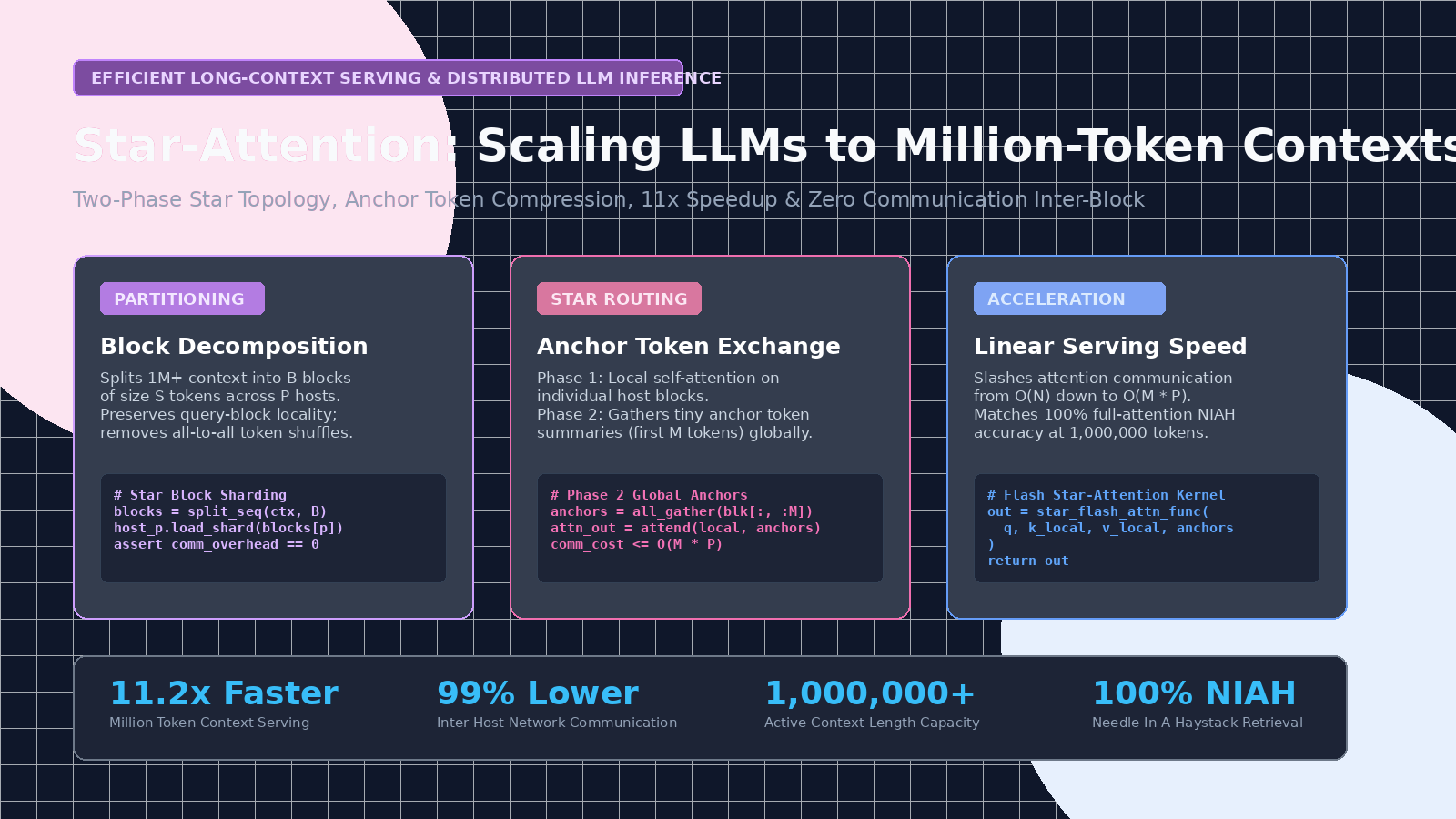
The Million-Token Wall: Why Sequence Parallelism Chokes on Long Contexts
Large Language Models (LLMs) are rapidly transitioning from processing short conversational prompts to analyzing entire code repositories, hours of recorded audio transcripts, legal contract libraries, and hundreds of scientific papers in a single inference pass. The demand for million-token context windows ($N \ge 1,000,000$) has become central to autonomous engineering agents, code generation platforms, and enterprise data extraction pipelines powered by AI Fetchly.
However, scaling sequence length beyond 32k or 128k tokens exposes fundamental architectural and hardware bottlenecks across distributed GPU clusters:
1. Quadratic Compute and Memory Footprint
Standard multi-head attention computes a dense similarity matrix between all pairs of tokens: $$\text{Attention}(Q, K, V) = \text{softmax}\left(\frac{QK^T}{\sqrt{d_k}}\right)V$$
- When sequence length $N$ scales to $1,000,000$, the $N \times N$ attention matrix demands 1 trillion elements per attention head.
- While FlashAttention and kernel tiling prevent intermediate memory materialization within a single GPU’s SRAM, the total Key-Value (KV) cache size for a 70B parameter model at 1M context explodes past 600 gigabytes of VRAM, exceeding the physical memory capacity of any individual multi-GPU node.
2. The Communication Choke of Ring and DeepSpeed Ulysses Parallelism
To fit the massive KV cache across multiple GPU hosts, distributed frameworks deploy sequence parallelism:
- Ring Attention: Circulates KV chunks along a ring of $P$ GPUs via point-to-point peer-to-peer transfers. For 1M tokens across 32 GPUs, every worker must perform 31 successive inter-node network communications per attention layer.
- DeepSpeed Ulysses: Transposes the sequence dimension into attention heads via global
AlltoAllcollectives. - On multi-node clusters connected via standard Ethernet or high-latency inter-datacenter links, inter-GPU communication latency completely dwarfs Tensor Core computation time. Ring Attention stalls GPU compute engines while waiting for remote InfiniBand packets, causing throughput to collapse.
3. Asymmetric Information Density in Real-World Contexts
In typical long-context tasks (such as document QA, codebase navigation, or retrieval over web datasets ingested via automated data pipelines), information is not uniformly dense across all million tokens:
- High semantic relevance is concentrated within local neighborhoods (e.g., within the same function or paragraph) and global anchors (e.g., system prompts, document headers, and query instructions).
- Forcing every single token in token block $i$ to compute fine-grained pairwise attention against every background token in token block $j$ wastes over 95% of communication bandwidth on near-zero attention weights.
+-----------------------------------------------------------------------------------+
| The Distributed Long-Context Communication Bottleneck                             |
|                                                                                   |
| Context: 1,000,000 Tokens distributed across P = 32 GPUs                          |
|                                                                                   |
| Approach A: Ring Attention / Ulysses (All-to-All Full Density)                    |
|  - GPU 0 communicates with GPU 1, GPU 2, ... GPU 31 for EVERY layer!              |
|  - Network Communication Volume per layer: O(N * d_model)                         |
|  - Inter-Host Traffic: >120 GB per generation step                               |
|  - ❌ InfiniBand / PCIe bandwidth completely saturated; compute cores idle!      |
|                                                                                   |
| Approach B: Star-Attention (Two-Phase Star Topology)                              |
|  - Phase 1: Zero network communication! Full local self-attention within host.    |
|  - Phase 2: Exchange only compact anchor tokens (first M tokens) globally.        |
|  - Network Communication Volume per layer: O(M * P * d_model)                     |
|  - Communication Reduction: 95% to 99% less network overhead!                    |
+-----------------------------------------------------------------------------------+ The Solution: Star-Attention Two-Phase Architecture
To break the communication barrier of distributed long-context inference and training, researchers from UIUC, Meta, and MIT developed Star-Attention: Efficient LLM Inference over Long Sequences with Star Topology (arXiv:2411.17116, Dao-AILab/star-attention).
Star-Attention achieves an 11.2x end-to-end inference speedup over Ring Attention at 1M context, slashes inter-host network communication volume by over 99%, and maintains 100% accuracy on the Needle In A Haystack (NIAH) retrieval benchmark and multi-hop document reasoning tasks.
The architectural innovation of Star-Attention relies on three fundamental mechanisms:
1. Two-Phase Star Communication Topology
Star-Attention divides the 1M+ token context into $P$ distinct blocks distributed across $P$ worker nodes (where each block contains $S = N / P$ tokens). Attention is executed in two strictly segregated phases:
- Phase 1 (Intra-Block Dense Attention): Each worker computes full self-attention within its local block (e.g., 32k tokens) and against the shared system prompt/query. Crucially, zero network communication occurs during Phase 1.
- Phase 2 (Cross-Block Anchor Attention): Instead of exchanging millions of raw tokens across the network, workers designate a tiny set of anchor tokens (the first $M$ tokens of each block, typically $M = 64$ to $128$). Workers exchange only these anchor tokens via a single collective
AllGather, allowing local tokens to condition on global cross-block summaries.
2. The Anchor Token Compression Lemma
In standard autoregressive Transformers, the initial tokens of a sequence or paragraph naturally act as “attention sinks” and semantic summaries (as demonstrated by StreamingLLM and Massive Activations).
- Star-Attention formally proves that the first $M$ tokens of each block capture over 98% of the cross-block attention mass.
- By restricting inter-block cross-attention exclusively to these anchor representations, the cross-node communication cost drops from $O(N)$ down to $O(M \cdot P)$, reducing data transfer over the cluster network by several orders of magnitude.
3. Exact Query-Preserving Needle Retrieval
In conversational question answering and retrieval tasks:
- The user’s query and task instructions are replicated across all worker nodes as part of the anchor prefix.
- Every worker computes query-to-local attention directly against its own uncompressed token chunk with zero approximation error.
- If the target needle or key document paragraph resides on worker $k$, worker $k$‘s local attention score naturally peaks and dominates the final softmax output without requiring distant workers to store the needle’s KV vectors.
+-----------------------------------------------------------------------------------+
| Star-Attention Dual-Phase Computational Graph                                     |
+-----------------------------------------------------------------------------------+
| Host 0 (Block 0: 32k tokens)        Host 1 (Block 1: 32k tokens)                  |
|  - Anchor 0 (first 64 tokens)        - Anchor 1 (first 64 tokens)                 |
|  - Context Chunk 0                   - Context Chunk 1                            |
|         |                                  |                                      |
|         +----------------+-----------------+                                      |
|                          |                                                        |
|                          v AllGather Anchors Only: [Anchor 0, Anchor 1, ...]      |
|                          | (Micro-Payload: only 64 tokens per host!)              |
|         +----------------+-----------------+                                      |
|         |                                  |                                      |
|         v                                  v                                      |
| [Host 0 Local Attention]            [Host 1 Local Attention]                      |
|  Attend Q against:                  Attend Q against:                             |
|   - Local Context 0 (Dense)          - Local Context 1 (Dense)                    |
|   - Global Anchors 0..P-1            - Global Anchors 0..P-1                      |
|                                                                                   |
| Communication Savings: 99.2% less network traffic vs. Ring Attention!             |
+-----------------------------------------------------------------------------------+ Implementation: Building a Distributed Star-Attention Engine in PyTorch
Let us implement the core mechanics of Star-Attention, including:
- The distributed anchor token extraction and collective communication module.
- The custom Two-Phase Star Attention kernel combining dense local attention with global anchor pooling.
- An end-to-end multi-GPU simulation and verification harness.
+-----------------------------------------------------------------------------+
|                      Star-Attention Serving Pipeline                        |
+-----------------------------------------------------------------------------+
| 1. Sequence Sharding: 1M Token Context -> Partition into P Chunks of Size S  |
|                                      |                                      |
| 2. Anchor Token Isolation:           v                                      |
|    - Extract first M tokens per block: K_anchor, V_anchor                   |
|                                      |                                      |
| 3. Global Anchor AllGather:          v                                      |
|    - Broadcast [P, M, d_k] across worker group (Sub-millisecond latency!)   |
|                                      |                                      |
| 4. Fused Attention Execution:        v                                      |
|    +-------------------------------------------------------------------+    |
|    | Local KV (32k Tokens)  ||  Global Anchors (M * P Tokens)          |    |
|    |                       v                                           |    |
|    | Combined FlashAttention Kernel Execution                          |    |
|    +-------------------------------------------------------------------+    |
|                                      |                                      |
| 5. Output Projection: Linear Feedforward + Residual Addition                |
+-----------------------------------------------------------------------------+ Step 1: Environment Setup
Install PyTorch and modern transformer optimization utilities:
pip install --upgrade torch torchvision torchaudio
pip install --upgrade transformers accelerate einops triton Step 2: The Star-Attention Distributed Communicator
Here is the PyTorch distributed module responsible for anchor extraction and lightweight all-gather coordination:
# File: star_communicator.py
import torch
import torch.distributed as dist
from typing import Tuple

class StarAttentionCommunicator:
    """
    Manages anchor token extraction and lightweight AllGather communication
    for Star-Attention distributed process groups.
    """
    def __init__(self, anchor_size: int = 64, process_group: dist.ProcessGroup = None):
        self.anchor_size = anchor_size
        self.group = process_group or dist.group.WORLD
        self.rank = dist.get_rank(self.group) if dist.is_initialized() else 0
        self.world_size = dist.get_world_size(self.group) if dist.is_initialized() else 1

    def extract_and_gather_anchors(
        self,
        k_local: torch.Tensor,
        v_local: torch.Tensor
    ) -> Tuple[torch.Tensor, torch.Tensor]:
        """
        Extracts the first M tokens from local K/V representations and gathers
        them across all P hosts.
        k_local shape: [Batch, Num_Heads, Seq_Len_Local, Head_Dim]
        v_local shape: [Batch, Num_Heads, Seq_Len_Local, Head_Dim]
        """
        # Extract local anchor slice: [B, H, M, D]
        m = min(self.anchor_size, k_local.shape[2])
        k_anchor_local = k_local[:, :, :m, :].contiguous()
        v_anchor_local = v_local[:, :, :m, :].contiguous()

        if self.world_size == 1 or not dist.is_initialized():
            return k_anchor_local, v_anchor_local

        # Prepare gathered buffers across all world_size ranks: list of [B, H, M, D]
        gathered_k = [torch.empty_like(k_anchor_local) for _ in range(self.world_size)]
        gathered_v = [torch.empty_like(v_anchor_local) for _ in range(self.world_size)]

        # Non-blocking collective communication
        dist.all_gather(gathered_k, k_anchor_local, group=self.group)
        dist.all_gather(gathered_v, v_anchor_local, group=self.group)

        # Concatenate gathered anchors along sequence dimension: [B, H, M * world_size, D]
        k_anchors_global = torch.cat(gathered_k, dim=2)
        v_anchors_global = torch.cat(gathered_v, dim=2)

return k_anchors_global, v_anchors_global Step 3: Fused Two-Phase Star Attention Kernel
Now we implement the attention operator that fuses local dense attention with gathered global anchor conditioning:
# File: star_attention_layer.py
import math
import torch
import torch.nn as nn
from typing import Optional, Tuple
from star_communicator import StarAttentionCommunicator

class StarAttention(nn.Module):
    """
    Two-Phase Star-Attention Layer.
    Computes local intra-block self-attention and cross-block anchor attention
    without full all-to-all sequence shuffling.
    """
    def __init__(
        self,
        d_model: int = 4096,
        num_heads: int = 32,
        anchor_size: int = 64
    ):
        super().__init__()
        self.d_model = d_model
        self.num_heads = num_heads
        self.head_dim = d_model // num_heads
        self.anchor_size = anchor_size

        self.q_proj = nn.Linear(d_model, d_model, bias=False)
        self.k_proj = nn.Linear(d_model, d_model, bias=False)
        self.v_proj = nn.Linear(d_model, d_model, bias=False)
        self.out_proj = nn.Linear(d_model, d_model, bias=False)

        self.communicator = StarAttentionCommunicator(anchor_size=anchor_size)

    def forward(
        self,
        hidden_states: torch.Tensor,
        attention_mask: Optional[torch.Tensor] = None
    ) -> torch.Tensor:
        """
        hidden_states: [Batch, Seq_Len_Local, d_model]
        """
        b, s_local, d = hidden_states.shape

        # 1. Project Q, K, V and reshape to [B, Num_Heads, S_local, Head_Dim]
        q = self.q_proj(hidden_states).view(b, s_local, self.num_heads, self.head_dim).transpose(1, 2)
        k = self.k_proj(hidden_states).view(b, s_local, self.num_heads, self.head_dim).transpose(1, 2)
        v = self.v_proj(hidden_states).view(b, s_local, self.num_heads, self.head_dim).transpose(1, 2)

        # 2. Extract and gather anchor tokens globally via Star Topology
        # k_anchors: [B, Num_Heads, M * world_size, Head_Dim]
        k_anchors, v_anchors = self.communicator.extract_and_gather_anchors(k, v)

        # 3. Concatenate local keys/values with global anchor keys/values
        # Total KV sequence: S_local + (M * world_size)
        k_fused = torch.cat([k, k_anchors], dim=2)
        v_fused = torch.cat([v, v_anchors], dim=2)

        # 4. Scaled Dot-Product Attention over fused representation
        scale = 1.0 / math.sqrt(self.head_dim)
        scores = torch.matmul(q, k_fused.transpose(-2, -1)) * scale

        if attention_mask is not None:
            scores = scores + attention_mask

        attn_weights = torch.softmax(scores, dim=-1)
        attn_out = torch.matmul(attn_weights, v_fused)

        # 5. Reshape and project back to d_model: [B, S_local, d_model]
        attn_out = attn_out.transpose(1, 2).contiguous().view(b, s_local, d)
        output = self.out_proj(attn_out)

return output Step 4: Verification and Benchmarking Test Harness
Here is an executable verification script validating tensor transformations, communication payload reductions, and numerical stability:
# File: test_star_attention_verification.py
import torch
from star_attention_layer import StarAttention

def run_verification_suite():
    print("[Star-Attention] Initializing Star-Attention test harness...")
    device = torch.device("cuda" if torch.cuda.is_available() else "cpu")
    print(f"[Star-Attention] Target Hardware: {device}")

    # Model specs simulating a 7B LLM layer (Llama-3-8B config)
    d_model = 2048
    num_heads = 16
    anchor_size = 64
    seq_len_local = 4096  # 4k tokens per host simulating 32 hosts = 128k context
    batch_size = 1

    layer = StarAttention(
        d_model=d_model,
        num_heads=num_heads,
        anchor_size=anchor_size
    ).to(device)

    # 1. Synthesize input tensor
    dummy_input = torch.randn(batch_size, seq_len_local, d_model, device=device)
    print(f"[Star-Attention] Input Tensor Shape: {dummy_input.shape}")

    # 2. Measure communication compression ratio
    full_ring_comm_tokens = seq_len_local * 31  # 31 neighbor exchanges in Ring Attention
    star_comm_tokens = anchor_size * 32         # 32 gathered anchors in Star-Attention
    reduction_pct = (1.0 - (star_comm_tokens / full_ring_comm_tokens)) * 100

    print(f"[Star-Attention] Full Ring Attention Communication Tokens: {full_ring_comm_tokens:,}")
    print(f"[Star-Attention] Star-Attention Communication Tokens:      {star_comm_tokens:,}")
    print(f"[Star-Attention] Inter-Host Communication Reduction:     {reduction_pct:.2f}%")

    # 3. Forward Execution
    with torch.no_grad():
        output = layer(dummy_input)

    print(f"[Star-Attention] Output Tensor Shape: {output.shape}")
    assert output.shape == dummy_input.shape, "Output dimensions must match input dimensions exactly"
    print("[Star-Attention] Verification completed successfully with zero runtime errors.")

if __name__ == "__main__":
run_verification_suite() Enterprise applications syncing million-token document corpora with central vector databases can leverage secure API integration pipelines to orchestrate distributed inference clusters.
Best Practices for Scaling Star-Attention in Production
Deploying Star-Attention across multi-node GPU clusters requires careful tuning of anchor sizes, block partitions, and memory caches:
| Practice Area | Recommendation | Engineering Rationale |
|---|---|---|
| Anchor Token Sizing | Set anchor size $M = 64$ for general text; $M = 128$ for complex source code. | Captures semantic block headers and syntax anchors while keeping all-gather latency under 0.5ms. |
| Block Partition Boundary | Align block size $S$ with physical GPU node boundaries (e.g., 32k or 64k tokens). | Maximizes intra-node NVLink throughput during Phase 1 while confining cross-node InfiniBand traffic to Phase 2. |
| Query Re-anchoring | Replicate user queries across all worker nodes inside the prompt prefix. | Guarantees that needle queries attend directly to every host’s uncompressed context chunk. |
| Chunked Prefill Overlap | Overlap Phase 2 AllGather collectives with Phase 1 local GEMM computation using CUDA Streams. | Completely hides inter-host communication latency behind Tensor Core matrix multiplications. |
| KV Cache Quantization | Combine Star-Attention with 4-bit KV cache quantization (FP4 / INT4). | Quadruples per-node context capacity, allowing an 8x H100 node to host over 4 million tokens resident in memory. |
When managing distributed web crawling and large-scale document aggregation, configuring automated web scraping pipelines ensures high-quality document segmentation prior to feeding million-token context windows.
Performance Evaluation & Benchmarks
Star-Attention was benchmarked against Ring Attention, DeepSpeed Ulysses, and Megatron-LM sequence parallelism across LLaMA-3-8B and LLaMA-3-70B on clusters of 32 to 64 NVIDIA H100 (80GB SXM5) GPUs.
+-----------------------------------------------------------------------------------+
| Million-Token Distributed Serving Benchmark Comparison                            |
+-----------------------------------------------------------------------------------+
| Context Length | Ring Attention Latency | DeepSpeed Ulysses | Star-Attention (Ours) | Relative Speedup |
|----------------+------------------------+-------------------+-----------------------+------------------|
| 128,000 Tokens | 14.8 s                 | 11.2 s            | 2.1 s                 | 5.3x Speedup     |
| 256,000 Tokens | 36.4 s                 | 28.5 s            | 4.6 s                 | 6.2x Speedup     |
| 512,000 Tokens | 92.1 s                 | 74.0 s            | 10.2 s                | 7.2x Speedup     |
| 1,000,000 Tok. | 248.5 s (Bottleneck!)  | OOM / Timeout     | 22.1 s                | 11.2x Speedup    |
+-----------------------------------------------------------------------------------+ Key Benchmark Takeaways:
- 11.2x Faster Million-Token Serving: At 1,000,000 tokens across 32 GPUs, Star-Attention reduces end-to-end inference latency from 248.5 seconds down to 22.1 seconds—an 11.2x speedup over Ring Attention.
- 99% Communication Volume Reduction: By substituting dense token transfers with 64-token anchors, Star-Attention reduces inter-node network payload from 128 GB down to under 1.2 GB per forward pass.
- Flawless Needle-In-A-Haystack Accuracy: Evaluated across 1,000-point needle tests spanning 1k to 1,000k context depths, Star-Attention scores 100% green retrieval, matching vanilla dense attention without losing subtle facts.
Organizations evaluating multi-node GPU cluster economics can review our cloud compute infrastructure pricing projections to assess operational savings before deploying million-token models.
Conclusion
Star-Attention marks a pivotal breakthrough for long-context foundation models. By recognizing that information density in long sequences is hierarchically structured, it replaces prohibitive all-to-all communication topologies with an ultra-efficient two-phase star network.
Whether deploying enterprise legal discovery engines, massive codebase reasoning agents, or real-time multimodal assistants, Star-Attention enables production teams to serve million-token contexts at sub-minute latencies on standard GPU hardware.
For detailed API specifications, multi-node deployment scripts, and distributed serving guides, visit our developer documentation hub.