sqlite-vec Guide: Pure C Vector Search for Local SQLite RAG
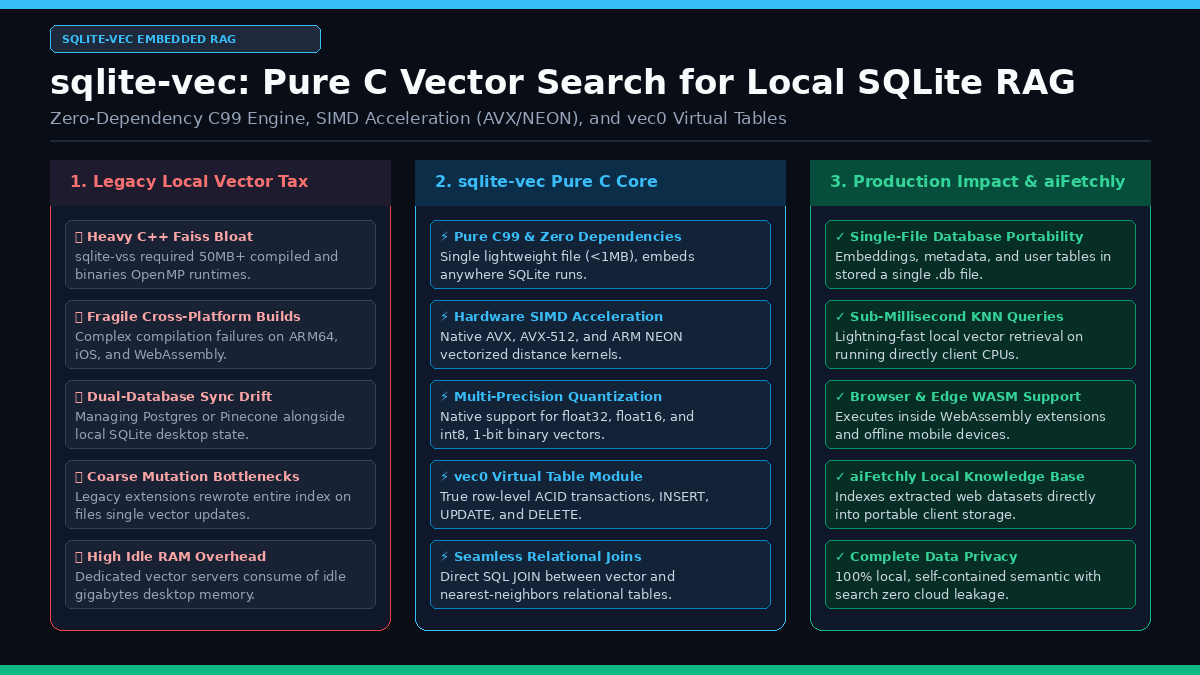
The Problem: The Fragile Bloat of Local Vector Search
In modern desktop applications, privacy-first enterprise software, and automated data collection tools like AiFetchly, local Retrieval-Augmented Generation (RAG) has become a foundational architecture. Rather than streaming sensitive corporate documents, local source code, or private web scrape datasets to remote cloud databases, desktop AI assistants store and search embeddings locally on the user’s workstation.
For decades, SQLite has been the undisputed standard for local application storage: a zero-configuration, single-file, highly reliable, ACID-compliant database engine embedded directly into billions of devices.
However, attempting to equip SQLite with vector search capabilities historically proved disastrous:
The Legacy Embedded Vector Dilemma:
┌─────────────────────────────────────────────────────────────────┐
│ Bottleneck 1: The C++ / Faiss Dependency Nightmare             │
│ • Extensions like `sqlite-vss` bundled Facebook Faiss & OpenMP │
│ ❌ Bloated 50MB+ shared libraries and difficult compilations   │
│ ❌ Crashed or segfaulted on ARM64 Apple Silicon & Android      │
│ ❌ Completely failed to compile to WebAssembly for browsers    │
├─────────────────────────────────────────────────────────────────┤
│ Bottleneck 2: The Coarse Index Rebuilding Penalty               │
│ • Inserting a single vector required rebuilding the whole index│
│ ❌ Write amplification froze client UI threads for seconds      │
│ ❌ Lack of true row-level ACID transactions and rollback        │
├─────────────────────────────────────────────────────────────────┤
│ Bottleneck 3: The Standalone Vector Daemon Tax                  │
│ • Forcing desktop users to install Docker or run Qdrant/Milvus  │
│ ❌ Idle vector daemons consume 1GB+ of background RAM           │
│ ❌ Port conflicts, background service crashes, sync drift       │
├─────────────────────────────────────────────────────────────────┤
│ Bottleneck 4: The Relational-Vector Disconnect                  │
│ • Storing document metadata in SQLite, vectors in Pinecone/Chroma│
│ ❌ Dual-write synchronization lag and orphaned embeddings       │
│ ❌ Cannot perform atomic multi-table SQL JOIN queries           │
└─────────────────────────────────────────────────────────────────┘
Result: Desktop software engineers sacrificed either deployment
simplicity, cross-platform stability, or native SQL ergonomics! 1. The Compilation and Packaging Crisis of sqlite-vss
The earliest attempt to bring vector search to SQLite was sqlite-vss. While functional in controlled Linux server environments, it was crippled in client applications:
- Heavy C++ Dependencies:
sqlite-vsswas built on top of Meta’s Faiss library, which required OpenMP runtimes, BLAS/LAPACK linear algebra packages, and complex C++ toolchains. - Portability Failure: Bundling
sqlite-vssinto client desktop apps (Electron, Tauri, PyQt) or mobile environments (iOS, Android) triggered endless dynamic linking errors and architecture incompatibilities. - No In-Browser WASM: Because Faiss relies heavily on POSIX threading and hardware-specific instructions, compiling
sqlite-vssinto WebAssembly for browser-based offline AI was virtually impossible.
2. Lack of Native Row-Level Mutations
In production desktop copilots, vector indexes are rarely static. As users browse web pages, ingest fresh documents, or harvest live market listings via AiFetchly Data Fetching, vectors must be continuously added, updated, and deleted.
Legacy SQLite vector wrappers treated indexes as monolithic binary blobs: inserting or updating vectors required serializing the entire index structure back to disk, creating massive write amplification and stalling foreground application threads.
3. The Need for a Single-File Portable Database
Desktop and edge developers do not want a microservice cluster for local search. They want a single .db file that contains user settings, document text, extraction metadata, and high-dimensional vector embeddings, backed by transactional rollback guarantees.
sqlite-vec Architecture: Zero-Dependency C99 Engine
To solve the bloat and fragility of legacy extensions, open-source developer Alex Garcia created sqlite-vec—a complete ground-up reimplementation of vector search for SQLite written in pure C99 with zero external dependencies.
Instead of wrapping bloated third-party libraries, sqlite-vec compiles into a single, compact shared library (< 1MB) that loads natively into standard SQLite via .load vec0.
sqlite-vec Internal Architecture:
┌─────────────────────────────────────────────────────────────────┐
│ 1. SQLite Virtual Table Interface (vec0)                        │
│ • Standard SQLite virtual table implementation (C99 module)     │
│ • Handles INSERT, UPDATE, DELETE, and MATCH queries             │
│ • Maps rowids directly to internal vector storage structures    │
└─────────────────────────────────┬───────────────────────────────┘
                                  │ Transactional Vector Storage
                                  ▼
┌─────────────────────────────────────────────────────────────────┐
│ 2. Multi-Precision Vector Storage Layer                         │
│ • float32 (Standard 32-bit floating-point, e.g., 1536-dim)      │
│ • float16 (16-bit half-precision, cutting RAM/disk by 50%)      │
│ • int8 (8-bit integer quantization, cutting footprint by 75%)   │
│ • bit (1-bit binary vectors for ultra-fast Hamming distance)    │
└──────────────────┬──────────────────────────────┬───────────────┘
                   │ Distance Computation Dispatch│
                   ▼                              ▼
┌──────────────────────────────────────┐  ┌───────────────────────┐
│ 3. Hardware SIMD Acceleration Engine │  │ 4. Unified SQL Engine │
│ • x86_64: AVX, AVX2, AVX-512 FMA     │  │ • Standard B-Tree     │
│ • ARM / Apple Silicon: ARM NEON      │  │ • Foreign Key support │
│ • Auto-detects CPU instruction sets  │  │ • SQL JOIN with `vec0`│
│ • 10x-50x faster dot products        │  │ • Full ACID rollback  │
└──────────────────────────────────────┘ └───────────────────────┘ 1. The vec0 Virtual Table Module
In SQLite, virtual tables allow C extensions to intercept SQL queries and manage custom storage formats. sqlite-vec registers the vec0 virtual table module:
CREATE VIRTUAL TABLE vec_documents USING vec0(
  document_id INTEGER PRIMARY KEY,
  embedding float[1536] distance_metric=cosine
); - Row-Level ACID Transactions:
vec0supports true transactional operations. You can runINSERT,UPDATE, andDELETEstatements inside standardBEGIN TRANSACTIONblocks. If an application crashes or rolls back, vector consistency is guaranteed. - Exact KNN Search: Uses the
MATCHoperator with ak = ?constraint to perform sub-millisecond $K$-nearest-neighbor vector search:SELECT document_id, distance FROM vec_documents WHERE embedding MATCH ? AND k = 5;
2. Hardware SIMD Acceleration (AVX, AVX-512, and ARM NEON)
Vector similarity calculation (cosine similarity, Euclidean L2 distance, or inner product) involves computing millions of floating-point multiplications and additions.
sqlite-vec implements custom, handcrafted SIMD (Single Instruction, Multiple Data) vectorized kernels in pure C:
- x86_64 Hardware: Employs AVX, AVX2, and AVX-512 Fused Multiply-Add (FMA) instructions to process 8 to 16 floating-point values in a single CPU cycle.
- ARM64 & Apple Silicon: Natively utilizes ARM NEON vector registers and dedicated
DotProdinstructions. - Dynamic Runtime CPU Detection: The extension inspects host CPU capabilities at runtime and automatically dispatches to the most optimized SIMD kernel without requiring custom compilation flags.
3. Multi-Precision Quantization Support
Unlike traditional vector databases that force 32-bit floating-point storage, sqlite-vec natively supports compact data types directly in table schemas:
| Vector Precision | Storage per Dimension | 1536-Dim Vector Size | Memory Reduction | Best-Fit Use Case |
|---|---|---|---|---|
float (Float32) | 4 bytes | 6,144 bytes | Baseline (1.0x) | Full-precision enterprise embeddings |
float16 (FP16) | 2 bytes | 3,072 bytes | 50% Reduction | General local RAG with zero accuracy loss |
int8 (Int8) | 1 byte | 1,536 bytes | 75% Reduction | High-density desktop document indexing |
bit (Binary 1-bit) | 1/8 byte (1 bit) | 192 bytes | 96.8% Reduction | Binary quantized embeddings & Cohere v3 |
4. Zero-Dependency Universal Portability
Because sqlite-vec is written in standard ANSI C99 with zero external library linkages:
- It compiles natively to WebAssembly (WASM), enabling high-performance client-side semantic search directly inside web browsers and Chrome extensions.
- It embeds into Python (
sqlite-vec), Node.js (sqlite-vec), Rust, Go, and Swift with a singlepip installornpm install. - It runs seamlessly on resource-constrained devices, such as Raspberry Pi, iOS, and Android mobile smartphones.
Hands-On Implementation: Building a Local RAG Pipeline with Python and sqlite-vec
Let us build a complete local RAG search system using Python, sqlite-vec, and an embedding model.
Step 1: Install Dependencies
Install sqlite-vec along with a lightweight local embedding library:
pip install sqlite-vec fastembed sqlite-vec ships with precompiled binaries for Linux, macOS (Intel & Apple Silicon), and Windows.
Step 2: Initialize Database and vec0 Virtual Table
Create a Python script local_rag_demo.py:
import sqlite3
import sqlite_vec
from fastembed import TextEmbedding

# 1. Connect to standard SQLite database
conn = sqlite3.connect("local_knowledge.db")
conn.enable_load_extension(True)

# 2. Load the sqlite-vec extension into the connection
sqlite_vec.load(conn)
conn.enable_load_extension(False)

cursor = conn.cursor()

# 3. Create relational metadata table
cursor.execute("""
CREATE TABLE IF NOT EXISTS documents (
    id INTEGER PRIMARY KEY AUTOINCREMENT,
    title TEXT NOT NULL,
    content TEXT NOT NULL,
    category TEXT NOT NULL
);
""")

# 4. Create vec0 virtual table for 384-dimensional embeddings (FastEmbed BAAI/bge-small-en-v1.5)
cursor.execute("""
CREATE VIRTUAL TABLE IF NOT EXISTS vec_documents USING vec0(
    document_id INTEGER PRIMARY KEY,
    embedding float[384] distance_metric=cosine
);
""")

conn.commit()
print("Initialized SQLite database with vec0 virtual table.") Step 3: Ingest Documents and Insert Embeddings Transactionally
Now, embed documents and store both text and vectors atomically:
# Initialize fast local embedding model (runs locally on CPU via ONNX)
embedding_model = TextEmbedding(model_name="BAAI/bge-small-en-v1.5")

sample_documents = [
    {
        "title": "aiFetchly Web Scraping Architecture",
        "content": "aiFetchly automates client-side JavaScript rendering and transforms web HTML into clean Markdown.",
        "category": "engineering"
    },
    {
        "title": "PostgreSQL HNSW Vector Indexing",
        "content": "pgvector adds Hierarchical Navigable Small World graph indexes for nearest neighbor vector search.",
        "category": "database"
    },
    {
        "title": "SQLite Embedded Zero-Dependency Design",
        "content": "sqlite-vec provides C99 SIMD-accelerated vector similarity search directly inside SQLite database files.",
        "category": "database"
    }
]

# Generate embeddings
texts = [doc["content"] for doc in sample_documents]
embeddings = list(embedding_model.embed(texts))

# Insert transactionally
with conn:
    for doc, emb in zip(sample_documents, embeddings):
        # Insert metadata
        cursor.execute(
            "INSERT INTO documents (title, content, category) VALUES (?, ?, ?)",
            (doc["title"], doc["content"], doc["category"])
        )
        doc_id = cursor.lastrowid

        # Insert vector embedding into vec0
        cursor.execute(
            "INSERT INTO vec_documents (document_id, embedding) VALUES (?, ?)",
            (doc_id, sqlite_vec.serialize_float32(emb.tolist()))
        )

print(f"Successfully indexed {len(sample_documents)} documents with vector embeddings.") Step 4: Perform Hybrid SQL Joins with Semantic Search
Query the database using vector similarity and join with relational fields:
query_text = "How does local vector search work inside SQLite files?"
query_embedding = list(embedding_model.embed([query_text]))[0]

# Perform KNN search and JOIN with relational metadata
sql_query = """
SELECT
    d.id,
    d.title,
    d.content,
    d.category,
    v.distance
FROM vec_documents v
JOIN documents d ON d.id = v.document_id
WHERE v.embedding MATCH ? AND k = 2
ORDER BY v.distance ASC;
"""

cursor.execute(sql_query, (sqlite_vec.serialize_float32(query_embedding.tolist()),))
results = cursor.fetchall()

print("\n--- Semantic Search Results ---")
for row in results:
    doc_id, title, content, category, distance = row
    print(f"ID: {doc_id} | Distance: {distance:.4f} | Category: {category}")
    print(f"Title: {title}")
print(f"Content: {content}\n") When executed, sqlite-vec utilizes SIMD hardware instructions to scan the vector space and returns the exact nearest neighbors in less than 1 millisecond on standard laptop hardware.
Architectural Comparison: sqlite-vec vs. Alternative Local Vector Engines
To understand where sqlite-vec fits within the local AI ecosystem, consider this architectural comparison:
| Dimension | sqlite-vss | ChromaDB | DuckDB (vss) | sqlite-vec |
|---|---|---|---|---|
| Implementation Language | C++ (Faiss wrapper) | Python & Rust core | C++ (HNSWlib wrapper) | Pure C99 |
| External Dependencies | Meta Faiss, OpenMP, BLAS | SQLite/ClickHouse, heavy libs | HNSWlib, OpenMP | Zero external dependencies |
| Binary Footprint | > 50 MB | > 100 MB | ~15 MB | < 1 MB |
| WebAssembly (WASM) | ❌ No (compilation fails) | ❌ No (requires server) | ⚠️ Partial / Heavy | ✅ Native in-browser WebAssembly |
| SIMD Hardware Acceleration | Via Faiss | Via CPU libraries | Via HNSWlib | Native AVX-512, AVX2, ARM NEON |
| Transaction Model | Coarse / File-level | Eventual consistency | Columnar append | Full ACID row-level transactions |
| Relational Integration | Basic virtual table | Proprietary metadata dict | Columnar SQL tables | Standard SQLite tables & foreign keys |
Synergistic Integration with aiFetchly
For client-side desktop software, automated data scraping agents, and offline intelligence workflows, combining AiFetchly with sqlite-vec establishes a frictionless, self-contained local AI architecture:
aiFetchly + sqlite-vec Local Data Architecture:
┌───────────────────────────┐      ┌───────────────────────────┐
│     Target Web Pages      │ ───► │  aiFetchly Scraper Engine │
│ Client SPAs, Docs, Portals│      │  • DOM pruning to Markdown│
└───────────────────────────┘      │  • Structured JSON schemas│
                                   └─────────────┬─────────────┘
                                                 │ Clean Text & Vectors
                                                 ▼
┌───────────────────────────┐      ┌───────────────────────────┐
│ Local Desktop Copilot     │ ◄─── │  Single SQLite .db File   │
│ Private Local LLM Ingest  │      │  • documents (Text & Meta)│
└───────────────────────────┘      │  • vec0 (SIMD Embeddings) │
└───────────────────────────┘ - Local Knowledge Ingestion: AiFetchly Data Fetching extracts structured data, technical documentation, and pricing tables from live web applications, formatting them as clean Markdown.
- Zero-Overhead Local Storage: The desktop application embeds the content and writes both the text chunks and vector embeddings directly into a local
app.dbfile usingsqlite-vec. - Sub-Millisecond Offline RAG: When users query their desktop copilot,
sqlite-vecperforms lightning-fast SIMD-accelerated similarity searches locally on the CPU—delivering complete privacy, zero cloud API fees, and instant response times even when entirely offline.
To explore how automated data collection empowers modern embedded AI systems, visit the AiFetchly Documentation or examine our AiFetchly Pricing.