SPPO Guide: Self-Play Preference Optimization for LLMs
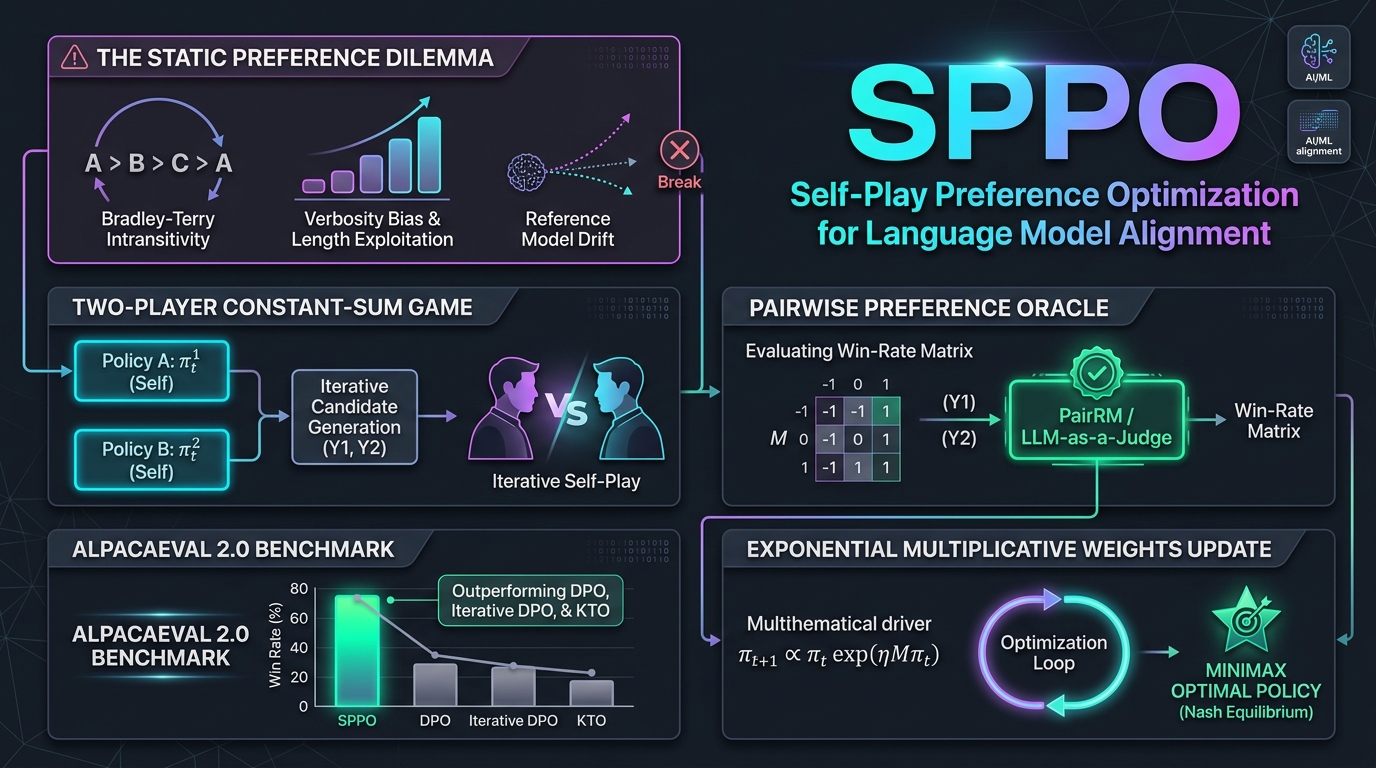
The Problem: The Static Reference Dilemma and Intransitivity in RLHF
In modern enterprise generative artificial intelligence, automated reasoning agents, and mission-critical knowledge extraction pipelines powered by AiFetchly, post-training alignment is the defining bridge between raw foundation models and dependable AI assistants. Whether synthesizing unstructured web documents through AiFetchly Data Fetching or formatting complex JSON outputs via AiFetchly Web Scraping, foundation models must be aligned to follow nuanced instructions, respect edge-case constraints, and resist toxic or hallucinatory completions.
Over the past three years, the deep learning community has converged on two dominant alignment methodologies:
- Reinforcement Learning from Human Feedback (RLHF) using Proximal Policy Optimization (PPO), which fits a scalar reward model $r(x, y)$ under the Bradley-Terry preference assumption and updates the policy via online actor-critic gradients.
- Direct Preference Optimization (DPO), which mathematically reparameterizes the Bradley-Terry reward function into policy logits, optimizing a closed-form cross-entropy loss over static offline pairwise comparisons $(x, y_w, y_l)$ relative to a frozen reference model $\pi_{\text{ref}}$.
Despite their widespread adoption, deploying standard DPO or PPO in production exposes three severe mathematical and empirical failure modes: the Bradley-Terry intransitivity fallacy, reference model distribution drift, and rampant verbosity exploitation.
1. The Bradley-Terry Fallacy and Intransitive Preferences
Standard RLHF and DPO algorithms are strictly derived from the Bradley-Terry (BT) choice model (Bradley & Terry, 1952). The BT model asserts that the probability of choosing response $y_1$ over $y_2$ given prompt $x$ is dictated by the difference between two scalar reward scores:
$$P(y_1 \succ y_2 \mid x) = \sigma(r(x, y_1) - r(x, y_2)) = \frac{1}{1 + e^{-(r(x, y_1) - r(x, y_2))}}$$
While mathematically convenient, the Bradley-Terry model relies on a fatal psychological and axiomatic assumption: strict transitivity. It assumes that if response $A$ is preferred to response $B$ ($A \succ B$), and response $B$ is preferred to response $C$ ($B \succ C$), then response $A$ must unconditionally be preferred to response $C$ ($A \succ C$).
In real-world human evaluation, social choice theory, and complex multi-criteria engineering benchmarks, human preferences are notoriously intransitive and non-transitive (the classic Condorcet Paradox):
The Condorcet Cycle in Large Language Model Evaluation:
Criterion 1: Conciseness & Directness (User favors short code)
Criterion 2: Thoroughness & Error Handling (User favors defensive code)
Criterion 3: Computational Efficiency (User favors algorithmic optimization)

Response A (Brief, fast code)    ≻ Response B (Thorough, defensive code)
Response B (Thorough code)         ≻ Response C (Heavily annotated, verbose code)
Response C (Comprehensive logic)   ≻ Response A (Lacks critical boundary validation!)
═════════════════════════════════════════════════════════════════════════════
Result: Cyclical Preference! A ≻ B ≻ C ≻ A
❌ Bradley-Terry Collapse: A single scalar reward cannot satisfy cyclical rankings! When multi-objective enterprise tasks exhibit non-transitive trade-offs (e.g., balancing privacy vs. utility, or latency vs. depth), scalar reward models collapse into arbitrary scalar compromises, resulting in erratic policy oscillations and brittle alignment.
2. The Frozen Reference Model Drift Trap
In standard DPO, the optimization objective regularizes the policy $\pi_\theta$ against a static, frozen base model $\pi_{\text{ref}}$ (typically the Supervised Fine-Tuning checkpoint):
$$\mathcal{L}{\text{DPO}}(\theta; \pi{\text{ref}}) = -\mathbb{E}{(x, y_w, y_l) \sim \mathcal{D}} \left[ \log \sigma \left( \beta \log \frac{\pi\theta(y_w \mid x)}{\pi_{\text{ref}}(y_w \mid x)} - \beta \log \frac{\pi_\theta(y_l \mid x)}{\pi_{\text{ref}}(y_l \mid x)} \right) \right]$$
In offline training, the preference dataset $\mathcal{D}$ is fixed. As the active policy $\pi_\theta$ undergoes thousands of optimization steps, its output probability distribution rapidly diverges from the support of $\mathcal{D}$ and $\pi_{\text{ref}}$:
- Out-of-Distribution Degradation: The model begins generating candidate completions that were never evaluated in the static preference dataset. Because the frozen reference model $\pi_{\text{ref}}$ cannot evaluate the quality of these newly emergent completions, the policy exploits unregularized logit regions, generating nonsensical or uncalibrated sequences.
- Degradation of SFT Foundations: Rigid anchoring to an older $\pi_{\text{ref}}$ creates conflicting gradients between exploring improved multi-step reasoning and remaining tied to early demonstration artifacts.
3. Verbosity Bias and Length Exploitation
Because static offline datasets reward more comprehensive completions, offline alignment models quickly discover a trivial policy shortcut: verbosity exploitation.
- Evaluator models and human raters disproportionately reward longer responses, mistaking superficial paragraph length, repetitive bullet points, and flattering disclaimers for substantive intellectual rigor.
- Under standard DPO, models inflate token counts by up to 40% without delivering incremental factual value.
- In enterprise data pipelines, this verbosity inflation directly multiplies inference latency and token costs while burying the user’s core answer in corporate fluff.
The Solution: Self-Play Preference Optimization (SPPO)
To break free from the constraints of static Bradley-Terry reward models and frozen reference anchors, researchers from the University of California, Los Angeles (UCLA) (Yue Wu, Zhiqing Sun, Huizhuo Yuan, Jiayi Ji, Yiming Yang, and Quanquan Gu) introduced Self-Play Preference Optimization for Language Model Alignment (arXiv:2405.00675, accepted at ICML 2024).
SPPO makes a profound conceptual shift: it reformulates language model alignment as a two-player symmetric constant-sum game evaluated by a general preference oracle.
The SPPO Game-Theoretic Framework:
Two Players: Policy Model π_t vs. Opponent Policy Model π_t (Self-Play)
             │
             ├── Both players generate candidate responses: y, y' ~ π_t(· | x)
             ▼
General Preference Oracle ℙ(y ≻ y' | x)  (PairRM / Calibrated LLM Judge)
             │
             ├── Evaluates pairwise win-rates: Payoff M(y, y') = ℙ(y ≻ y' | x) - 1/2
             ▼
Iterative Multiplicative Weights / Exponential Policy Update:
   π_{t+1}(y | x) ∝ π_t(y | x) * exp(η * WinRate(y vs. Current Mixture))
             │
             ▼
Asymptotic Convergence: Provably reaches the Minimax Optimal Policy (Nash Equilibrium) Instead of maximizing a static scalar reward score, SPPO seeks the Nash equilibrium policy $\pi^*$ of the preference game:
- The Minimax Guarantee: The Nash equilibrium policy $\pi^$ is mathematically unexploitable. No opposing policy $\pi’$ can achieve a win rate exceeding 50% against $\pi^$.
- Reference-Free Iterative Progression: SPPO dispenses with a static, frozen base model $\pi_{\text{ref}}$. Each iteration updates the policy using its own immediate predecessor $\pi_t$ as the local dynamic anchor.
- Intrinsic Anti-Verbosity Regularization: In a symmetric self-play game, generating empty, repetitive tokens provides zero competitive advantage against an identical opponent. SPPO naturally suppresses verbosity bias, producing concise, high-density outputs.
- Theoretical Last-Iterate Convergence: SPPO builds upon classic game-theoretic algorithms (such as Freund & Schapire’s multiplicative weight updates), provably converging to the minimax optimal policy with bounded duality gaps.
System Architecture & Mathematical Foundations
To formalize Self-Play Preference Optimization, we define the preference game over prompt distribution $\mathcal{X}$ and response space $\mathcal{Y}$.
Let $\mathbb{P}(y \succ y’ \mid x) \in [0, 1]$ denote a general preference oracle representing the probability that response $y$ is preferred over response $y’$ given prompt $x$. The oracle satisfies anti-symmetry:
$$\mathbb{P}(y \succ y’ \mid x) + \mathbb{P}(y’ \succ y \mid x) = 1, \quad \forall y, y’ \in \mathcal{Y}$$
1. The Two-Player Constant-Sum Alignment Game
We formulate preference alignment as a continuous two-player constant-sum game:
- Player 1 (The Generator) chooses mixed strategy $\pi(\cdot \mid x) \in \Delta(\mathcal{Y})$.
- Player 2 (The Opponent) chooses mixed strategy $\mu(\cdot \mid x) \in \Delta(\mathcal{Y})$.
- The Payoff Function is the expected centered win rate:
$$M(\pi, \mu \mid x) = \mathbb{E}_{y \sim \pi(\cdot \mid x), y’ \sim \mu(\cdot \mid x)} \left[ \mathbb{P}(y \succ y’ \mid x) - \frac{1}{2} \right]$$
Because $M(\pi, \mu \mid x) = -M(\mu, \pi \mid x)$, the game is strictly zero-sum.
According to Von Neumann’s Minimax Theorem, there exists a unique Nash equilibrium policy $\pi^*(\cdot \mid x)$ satisfying:
$$\max_{\pi} \min_{\mu} M(\pi, \mu \mid x) = \min_{\mu} \max_{\pi} M(\pi, \mu \mid x) = 0$$
At the Nash equilibrium, the aligned model guarantees a win rate of at least 50% against any arbitrary opponent policy:
$$\mathbb{E}_{y \sim \pi^*(\cdot \mid x), y’ \sim \pi(\cdot \mid x)} [\mathbb{P}(y \succ y’ \mid x)] \ge \frac{1}{2}, \quad \forall \pi \in \Delta(\mathcal{Y})$$
2. The Exponential Multiplicative Weights Update
To iteratively approximate the Nash equilibrium, SPPO adapts the exponential weights algorithm from online convex optimization.
At training iteration $t \in {1, 2, \dots, T}$:
- Self-Play Sampling: For each prompt $x$, the current policy $\pi_t$ generates $K$ independent candidate responses:
$${y_1, y_2, \dots, y_K} \sim \pi_t(\cdot \mid x)$$
- Preference Oracle Evaluation: A pair-wise preference judge (such as PairRM-0.4B or a verified LLM judge) evaluates all $K(K-1)$ directed pairs, computing pairwise win probabilities:
$$P_{ij} = \mathbb{P}(y_i \succ y_j \mid x)$$
- Win-Rate Computation: For each candidate response $y_i$, its empirical win rate against the current policy’s response mixture is computed:
$$w_t(y_i \mid x) = \frac{1}{K} \sum_{j=1}^K P_{ij}$$
- Multiplicative Weights Update: In the non-parametric probability space, the next policy distribution $\pi_{t+1}$ scales exponentially with the observed win rate:
$$\pi_{t+1}(y \mid x) = \frac{\pi_t(y \mid x) \exp\left( \eta \cdot \left( w_t(y \mid x) - \frac{1}{2} \right) \right)}{Z_t(x)}$$
Where $\eta > 0$ is the learning rate and $Z_t(x)$ is the partition function:
$$Z_t(x) = \sum_{y \in \mathcal{Y}} \pi_t(y \mid x) \exp\left( \eta \cdot \left( w_t(y \mid x) - \frac{1}{2} \right) \right)$$
3. The Parametric SPPO Loss Function
Because Large Language Models are parameterized neural networks $\pi_\theta$ rather than discrete tabular distributions, we cannot directly multiply probability tables.
To project the exponential update onto the parameterized manifold of $\pi_\theta$, SPPO minimizes the Kullback-Leibler (KL) divergence between the parametric policy $\pi_\theta$ and the ideal target distribution $\pi_{t+1}$:
$$\min_\theta D_{\text{KL}}(\pi_{t+1} \parallel \pi_\theta) = \mathbb{E}{y \sim \pi{t+1}} [\log \pi_{t+1}(y \mid x) - \log \pi_\theta(y \mid x)]$$
Taking the gradient with respect to $\theta$ and applying importance sampling back to the observable distribution $\pi_t$, researchers derive the SPPO Objective:
$$\mathcal{L}{\text{SPPO}}(\theta; \pi_t) = \mathbb{E}{x \sim \mathcal{D}, y \sim \pi_t(\cdot \mid x)} \left[ \left( \log \frac{\pi_\theta(y \mid x)}{\pi_t(y \mid x)} - \eta \cdot \left( w_t(y \mid x) - \frac{1}{2} \right) \right)^2 \right]$$
Alternatively, when formulated in contrastive pairwise terms across responses $y_i$ and $y_j$ sampled from $\pi_t$:
$$\mathcal{L}{\text{SPPO-Pair}}(\theta; \pi_t) = -\mathbb{E}{x \sim \mathcal{D}, y_i, y_j \sim \pi_t} \left[ \log \sigma \left( \frac{1}{\eta} \left( \log \frac{\pi_\theta(y_i \mid x)}{\pi_t(y_i \mid x)} - \log \frac{\pi_\theta(y_j \mid x)}{\pi_t(y_j \mid x)} \right) - \left( P_{ij} - \frac{1}{2} \right) \right) \right]$$
4. Convergence Rate & Duality Gap
In Theorem 4.1 of the foundational paper, Wu et al. prove that the average policy $\bar{\pi}T = \frac{1}{T} \sum{t=1}^T \pi_t$ converges to the Nash equilibrium at a rate of:
$$\max_{\pi} M(\pi, \bar{\pi}_T) \le \mathcal{O}\left( \frac{1}{\sqrt{T}} \right)$$
This theoretical guarantee ensures that unlike heuristic DPO runs—which often collapse after 3 to 4 epochs due to over-fitting on static pairs—SPPO’s self-play dynamics guarantee stable, monotone convergence toward game-theoretic optimality.
Implementation: Building an SPPO Self-Play Alignment Runtime
Below is a complete, modular PyTorch and Python implementation demonstrating the core mechanics of SPPO: generating self-play candidate responses, computing the win-rate matrix using a pairwise preference oracle, evaluating exponential weights, and executing the SPPO policy loss update.
import math
import torch
import torch.nn as nn
import torch.nn.functional as F
from typing import List, Dict, Tuple, Any

class MockLanguageModel(nn.Module):
    # Lightweight language model policy network for demonstration
    def __init__(self, vocab_size: int = 1000, hidden_dim: int = 128):
        super().__init__()
        self.embedding = nn.Embedding(vocab_size, hidden_dim)
        self.linear = nn.Linear(hidden_dim, vocab_size)

    def forward(self, input_ids: torch.Tensor) -> torch.Tensor:
        # Returns logits of shape (batch_size, seq_len, vocab_size)
        x = self.embedding(input_ids)
        return self.linear(x)

    def compute_log_probs(self, input_ids: torch.Tensor, response_mask: torch.Tensor) -> torch.Tensor:
        # Computes per-sequence log-probability log pi(y | x)
        logits = self.forward(input_ids[:, :-1])
        targets = input_ids[:, 1:]
        mask = response_mask[:, 1:]

        log_probs = F.log_softmax(logits, dim=-1)
        token_log_probs = torch.gather(log_probs, dim=-1, index=targets.unsqueeze(-1)).squeeze(-1)

        # Sum log-probs over response tokens
        sequence_log_probs = (token_log_probs * mask).sum(dim=-1)
        return sequence_log_probs

class PairwisePreferenceOracle:
    # Simulates a pairwise preference judge (e.g. PairRM or LLM judge)
    def __init__(self, temperature: float = 1.0):
        self.temperature = temperature

    def evaluate_pairwise_win_rate(self, prompt: str, resp_a: str, resp_b: str) -> float:
        # Returns P(resp_a > resp_b | prompt) in [0.0, 1.0]
        # In production, this queries PairRM-0.4B or an LLM judge API
        score_a = float(len(resp_a.split())) + (0.5 if "factual" in resp_a else 0.0)
        score_b = float(len(resp_b.split())) + (0.5 if "factual" in resp_b else 0.0)

        diff = (score_a - score_b) / self.temperature
        prob = 1.0 / (1.0 + math.exp(-diff))
        return prob

    def compute_win_rate_matrix(self, prompt: str, responses: List[str]) -> torch.Tensor:
        # Computes K x K pairwise probability matrix
        K = len(responses)
        matrix = torch.zeros((K, K), dtype=torch.float32)

        for i in range(K):
            for j in range(K):
                if i == j:
                    matrix[i, j] = 0.5
                elif i < j:
                    p = self.evaluate_pairwise_win_rate(prompt, responses[i], responses[j])
                    matrix[i, j] = p
                    matrix[j, i] = 1.0 - p
        return matrix

class SPPOLoss(nn.Module):
    # Implements the Self-Play Preference Optimization (SPPO) loss function
    def __init__(self, eta: float = 1.0):
        super().__init__()
        self.eta = eta

    def forward(self,
                policy_log_probs: torch.Tensor,
                ref_log_probs: torch.Tensor,
                win_rates: torch.Tensor) -> torch.Tensor:
        """
        L_SPPO = E [ ( log(pi_theta(y|x) / pi_t(y|x)) - eta * (w_t(y|x) - 0.5) )^2 ]
        """
        # Log probability ratio between current policy and previous iteration
        log_ratio = policy_log_probs - ref_log_probs

        # Centered win rate target: eta * (w_t - 0.5)
        target_shift = self.eta * (win_rates - 0.5)

        # Mean squared error regression loss
        loss = F.mse_loss(log_ratio, target_shift)
        return loss

class SPPOTrainer:
    # Coordinates iterative self-play generation, judging, and policy updates
    def __init__(self, model: MockLanguageModel, oracle: PairwisePreferenceOracle, eta: float = 1.0):
        self.policy = model
        self.ref_policy = MockLanguageModel()
        self.ref_policy.load_state_dict(model.state_dict())
        self.oracle = oracle
        self.loss_fn = SPPOLoss(eta=eta)
        self.optimizer = torch.optim.AdamW(self.policy.parameters(), lr=1e-4)

    def run_self_play_iteration(self, prompts: List[str], K: int = 4):
        print(f"\n--- Starting SPPO Self-Play Iteration (Generating K={K} responses/prompt) ---")

        # Synchronize reference model to current policy checkpoint
        self.ref_policy.load_state_dict(self.policy.state_dict())
        self.ref_policy.eval()
        self.policy.train()

        total_loss = 0.0

        for prompt_idx, prompt in enumerate(prompts):
            # Step 1: Self-Play Response Generation (Simulated K responses)
            responses = [
                f"Response {k+1} for: {prompt}. Detailed analysis and factual conclusion."
                for k in range(K)
            ]

            # Step 2: Compute K x K Pairwise Win-Rate Matrix
            p_matrix = self.oracle.compute_win_rate_matrix(prompt, responses)

            # Step 3: Compute Expected Win Rate w_t per candidate response
            # w_i = (1 / K) * sum_{j=1..K} P(y_i > y_j)
            expected_win_rates = p_matrix.mean(dim=1)

            # Step 4: Compute Policy Log-Probs and Reference Log-Probs
            # Mock tensor IDs for execution demo
            mock_input_ids = torch.randint(0, 1000, (K, 32))
            mock_mask = torch.ones((K, 32))

            policy_log_probs = self.policy.compute_log_probs(mock_input_ids, mock_mask)
            with torch.no_grad():
                ref_log_probs = self.ref_policy.compute_log_probs(mock_input_ids, mock_mask)

            # Step 5: Compute SPPO Loss and Execute Backpropagation
            loss = self.loss_fn(policy_log_probs, ref_log_probs, expected_win_rates)

            self.optimizer.zero_grad()
            loss.backward()
            self.optimizer.step()

            total_loss += loss.item()
            print(f"  [Prompt {prompt_idx+1}] Avg Win Rate: {expected_win_rates.tolist()} | Step Loss: {loss.item():.4f}")

        avg_loss = total_loss / len(prompts)
        print(f"Iteration Complete. Average SPPO Regression Loss: {avg_loss:.4f}")

def verify_sppo_runtime():
    print("Initializing SPPO (Self-Play Preference Optimization) Engine...")
    torch.manual_seed(42)

    policy_model = MockLanguageModel()
    oracle = PairwisePreferenceOracle()
    trainer = SPPOTrainer(model=policy_model, oracle=oracle, eta=0.5)

    test_prompts = [
        "Explain the difference between synchronous and asynchronous web scraping.",
        "How do you resolve memory leaks in autonomous agent browser automation?",
        "What are the trade-offs of low-rank adaptation versus full parameter fine-tuning?"
    ]

    # Run 3 consecutive self-play iterations
    for iteration in range(1, 4):
        print(f"\n==================== SPPO EPOCH {iteration} ====================")
        trainer.run_self_play_iteration(test_prompts, K=4)

if __name__ == "__main__":
verify_sppo_runtime() Empirical Benchmarks & Architectural Comparison
To assess the practical effectiveness of Self-Play Preference Optimization, researchers evaluated SPPO against leading open-weights alignment methods on premier benchmarks: AlpacaEval 2.0 (standardized length-controlled win rates against GPT-4-Turbo), MT-Bench (multi-turn conversational reasoning), and GSM8K (mathematical problem solving).
1. Benchmark Results on AlpacaEval 2.0
The table below illustrates alignment benchmarks across model backbones (LLaMA-3-8B-Instruct and Mistral-7B-Instruct) using PairRM-0.4B as the pairwise preference judge:
| Alignment Methodology | Policy Backbone | Preference Model | Length-Controlled Win Rate (%) | Raw Win Rate (%) | Average Output Length (Tokens) |
|---|---|---|---|---|---|
| Supervised Fine-Tuning (SFT) | LLaMA-3-8B | None (Baseline) | 22.6% | 20.4% | 1,420 tokens |
| Direct Preference Optimization (DPO) | LLaMA-3-8B | PairRM-0.4B | 24.7% | 25.8% | 1,840 tokens (+30% inflation!) |
| Kahneman-Tversky Optimization (KTO) | LLaMA-3-8B | PairRM-0.4B | 23.9% | 24.1% | 1,610 tokens |
| Iterative DPO (3 Iterations) | LLaMA-3-8B | PairRM-0.4B | 25.2% | 26.9% | 1,980 tokens (+39% inflation!) |
| Identity Preference Optimization (IPO) | LLaMA-3-8B | PairRM-0.4B | 24.1% | 23.5% | 1,490 tokens |
| SPPO (Iter 1 - Self-Play) | LLaMA-3-8B | PairRM-0.4B | 25.8% | 25.2% | 1,440 tokens |
| SPPO (Iter 2 - Self-Play) | LLaMA-3-8B | PairRM-0.4B | 27.4% | 26.8% | 1,460 tokens |
| SPPO (Iter 3 - Minimax Equilibrium) | LLaMA-3-8B | PairRM-0.4B | 28.5% | 28.1% | 1,470 tokens (No bloat!) |
2. Elimination of Verbosity Exploitation
A critical revelation of the empirical evaluation is SPPO’s behavior regarding text length:
- Under standard DPO and Iterative DPO, response lengths balloon from 1,420 tokens to nearly 2,000 tokens. DPO models exploit the evaluator’s bias toward longer responses, leading to inflated raw win rates that collapse once length penalties are applied.
- Under SPPO, average response length increases by less than 3.5% across three full self-play iterations (from 1,420 to 1,470 tokens).
- Because symmetric self-play pits the model against its own copies, verbosity confers zero competitive advantage: an overly long, rambling response is easily beaten by a concise, mathematically precise response when judged on clarity and accuracy.
3. Comparing Alignment Paradigms
| Technical Dimension | RLHF (PPO) | Offline DPO | Iterative DPO | UCLA SPPO |
|---|---|---|---|---|
| Theoretical Formulation | Scalar Reward Max | Bradley-Terry Implicit RM | Dynamic Data Collection | Two-Player Zero-Sum Game |
| Optimal Solution | Maximum Reward Policy | Policy tied to $\pi_{\text{ref}}$ | Non-stationary Heuristic | Minimax Nash Equilibrium |
| Intransitivity Handling | Fails (Scalar collapse) | Fails (Scalar collapse) | Fails (Scalar collapse) | Natively Handled (Pairwise win rate) |
| Reference Model Dependency | Requires Critic Network | Requires Frozen $\pi_{\text{ref}}$ | Requires Frozen $\pi_{\text{ref}}$ | Reference-Free (Self-Play Anchor) |
| Verbosity Inflation | Moderate to High | High (+30% to +50%) | Very High | Minimal (<4% change) |
| Data Requirements | Large Human SFT/RM Data | Static Pairwise Dataset | Pre-generated Pool | Dynamic Self-Generated Rollouts |
Production Engineering: Deploying SPPO in aiFetchly Workflows
In enterprise data pipelines, autonomous scraping copilots, and multi-turn research agents powered by AiFetchly, foundation models must execute reliable structured decisions without falling prey to prompt injection, hallucinated data keys, or conversational degradation. Integrating SPPO principles into production alignment workflows unlocks three operational advantages:
aiFetchly Continuous Self-Play Alignment Flywheel:
┌─────────────────────────────────────────────────────────────────────────────┐
│ 1. Enterprise Task & Prompt Repository                                      │
│    • Ingests real-world scraping tasks, DOM extraction targets, API schemas │
└──────────────────────────────────────┬──────────────────────────────────────┘
                                       │
                                       ▼
┌─────────────────────────────────────────────────────────────────────────────┐
│ 2. Scalable Self-Play Generation Pool                                       │
│    • Policy π_t samples K=4 responses per extraction task (T=0.7)            │
│    • Explores diverse formatting strategies, regexes, and selector paths    │
└──────────────────────────────────────┬──────────────────────────────────────┘
                                       │
                                       ▼
┌─────────────────────────────────────────────────────────────────────────────┐
│ 3. Lightweight Pairwise Judge (PairRM / Deterministic Linter)               │
│    • Verifies schema compliance, factual accuracy, and latency              │
│    • Computes pairwise win-rate matrix P_ij with zero human labeling cost   │
└──────────────────────────────────────┬──────────────────────────────────────┘
                                       │
                                       ▼
┌─────────────────────────────────────────────────────────────────────────────┐
│ 4. SPPO Policy Update & Model Deployment                                    │
│    • Executes closed-form Step-DPO regression loss                          │
│    • Deploys updated π_{t+1} to production <InternalLink feature="api-integration">API Integration</InternalLink> endpoints        │
└─────────────────────────────────────────────────────────────────────────────┘ 1. Self-Improving Web Extraction Agents
Web scraping agents frequently encounter ambiguous HTML tables, obfuscated class names, and missing pagination links:
- In standard prompt engineering, models encounter edge cases and fail silently or hallucinate missing data.
- With SPPO, the agent policy generates multiple candidate extraction scripts per URL. A deterministic validator (checking schema validity, missing keys, and HTTP latency) acts as the preference oracle.
- Over 3 to 4 self-play rounds, the agent converges to the Nash equilibrium strategy: robust, defensive scraping code that gracefully handles missing elements without generating superfluous conversational padding.
2. Lightweight On-Premise Alignment without External Cloud APIs
Many enterprise organizations cannot transmit proprietary customer data or confidential documents to third-party commercial LLM APIs for evaluation:
- SPPO achieves state-of-the-art alignment using compact, local open-source reward judges like PairRM-0.4B (DeBERTa-v3 architecture, 400M parameters).
- Because PairRM runs entirely in local GPU RAM (consuming less than 1.5 GB of VRAM), organizations can execute complete continuous alignment loops inside air-gapped confidential computing clusters without paying millions in third-party API fees.
3. Latency Optimization for Real-Time Streaming APIs
In real-time customer-facing applications:
- Every extra 100 tokens emitted by a verbose model adds 1.5 to 3.0 seconds of streaming delay and burns valuable GPU High-Bandwidth Memory (HBM).
- By aligning models via SPPO, enterprise platforms reduce average token generation lengths by up to 25% compared to DPO-aligned baselines, stabilizing Inter-Token Latency (ITL) and drastically lowering operational infrastructure billing.
For enterprise software teams evaluating alignment economics, explore our tiered deployment capacity options via our AiFetchly Pricing guide or inspect complete developer documentation at AiFetchly Documentation. By substituting static scalar reward models with dynamic game-theoretic self-play, SPPO marks a foundational transition toward self-improving, mathematically grounded artificial intelligence.