SPEX Guide: Speculative Tree-of-Thought Reasoning
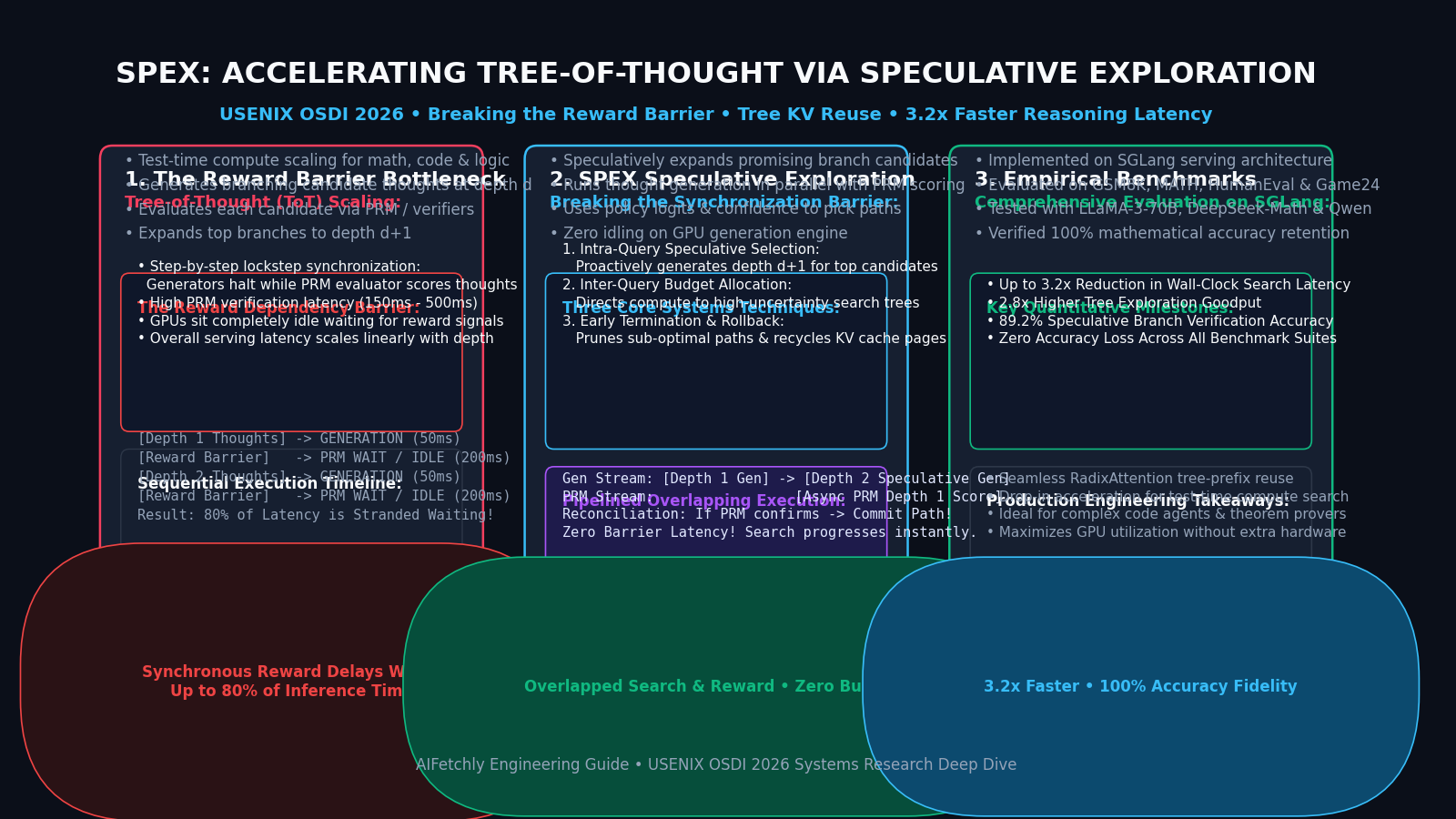
Introduction: The Systems Bottleneck of Test-Time Compute Scaling
The paradigm of large language model (LLM) intelligence has experienced a profound shift. While pre-training scaling laws—increasing parameter counts and dataset tokens—continue to deliver steady improvements, the frontier of AI reasoning is now dominated by test-time compute scaling. As demonstrated by advanced reasoning architectures such as OpenAI o1, o3, DeepSeek-R1, and algorithmic search frameworks like Tree-of-Thought (ToT) and Monte Carlo Tree Search (MCTS), allocating additional computational FLOPs during inference enables language models to solve complex mathematical proofs, execute intricate software engineering tasks, and plan multi-step operations with unprecedented reliability.
In enterprise software engineering, autonomous agents frequently require deliberative test-time search: synthesizing multi-turn workflows, formulating complex queries for automated web scraping pipelines, validating telemetry gathered via live data fetching, or orchestrating multi-system operations through enterprise API integration.
However, translating test-time compute search algorithms into high-throughput production serving engines exposes a crippling systems bottleneck: The Reward Dependency Barrier.
Unlike standard sequential autoregressive decoding or single-path Chain-of-Thought (CoT), Tree-of-Thought reasoning operates as a structured search graph. At each reasoning depth, the model generates multiple candidate thoughts. Before deciding which candidate thoughts are worth exploring further, the serving engine must evaluate each candidate using a Process Reward Model (PRM), an external verifier, or a self-evaluation prompt.
This introduces a rigid, synchronous lockstep barrier:
- The Generator-Verifier Synchronization Barrier: The generator LLM cannot expand the search tree to depth $d+1$ until the PRM has completed forward passes over all candidate thoughts at depth $d$.
- GPU Underutilization and Stranded Cycles: Scoring candidate thoughts with an independent reward model introduces 150ms to 500ms of verification latency per depth level. During this verification window, the high-throughput generator engine sits completely idle, wasting up to 80% of total inference wall-clock time.
- Prefix KV Cache Waste: Discarding rejected thought branches after reward evaluation results in high memory fragmentation unless the underlying inference engine dynamically reclaims and recycles Key-Value (KV) cache pages across tree branches.
Enter SPEX (Speculative Exploration), a landmark systems paper presented at the 2026 USENIX Symposium on Operating Systems Design and Implementation (OSDI 2026) by Shuzhang Zhong, Haochen Huang, Shengxuan Qiu, and collaborators from Peking University and ByteDance Seed.
SPEX shatters the reward dependency barrier by introducing Speculative Tree-of-Thought Exploration. Rather than halting generation while awaiting PRM evaluation, SPEX leverages early generation signals and policy confidence to proactively and speculatively expand the most promising thought branches into subsequent tree levels. Concurrently, the PRM evaluates candidate thoughts in an asynchronous background stream. Once reward scores arrive, SPEX reconciles the tree: validating speculative paths, rolling back inaccurate branches, and dynamically recycling KV cache memory through integration with SGLang’s RadixAttention.
By overlapping branch expansion with reward evaluation and implementing adaptive compute budget allocation, SPEX achieves up to 3.2x faster end-to-end reasoning latency across rigorous reasoning benchmarks—including GSM8K, MATH, HumanEval, and Game of 24—with zero loss in mathematical accuracy.
In this technical guide, we dissect the mechanics of the reward dependency barrier, examine the three algorithmic pillars of SPEX, walk through a complete Python/PyTorch reference implementation, and discuss the architectural implications for production test-time compute serving in 2026.
Anatomy of the Reward Dependency Barrier in Tree Search
To appreciate why conventional inference serving engines collapse under deliberative reasoning workloads, we must analyze the mathematical and systems structure of Tree-of-Thought reasoning.
The Mathematical Formulation of Tree-of-Thought (ToT)
In standard Chain-of-Thought (CoT), a language model samples a linear sequence of reasoning tokens given an input problem prompt $x$:
$$y = (z_1, z_2, \dots, z_K)$$
In Tree-of-Thought reasoning, the reasoning process is formulated as a directed tree search $\mathcal{T} = (\mathcal{V}, \mathcal{E})$, where each vertex $v \in \mathcal{V}$ represents an intermediate thought step $z_d$, and the root vertex $v_0 = x$.
At tree depth $d$, given an active state path $s_d = (v_0, v_1, \dots, v_d)$, the generator model samples $B$ candidate next thoughts:
$$\mathcal{C}(s_d) = { z_{d+1}^{(1)}, z_{d+1}^{(2)}, \dots, z_{d+1}^{(B)} } \sim \pi_{\theta}(\cdot \mid s_d)$$
To prune unpromising paths and prioritize high-potential reasoning trajectories, each candidate thought $z_{d+1}^{(b)}$ is scored by a Process Reward Model $\mathcal{R}_{\phi}$:
$$R_b = \mathcal{R}{\phi}(s_d, z{d+1}^{(b)}) \in [0, 1]$$
Based on the reward scores ${R_1, \dots, R_B}$, the search algorithm (such as Beam Search with beam width $W \le B$ or Best-First Search) selects the top-$W$ candidates:
$$ \mathcal{S}{d+1} = \operatorname{argtopW}\left( { R_b }{b=1}^B ight) $$
The search tree expands by appending $\mathcal{S}_{d+1}$ as active frontier nodes, and the process repeats until a terminal solution vertex is reached.
+-------------------------------------------------------------------------------+
|                 THE SYNCHRONOUS REWARD DEPENDENCY BARRIER                     |
+-------------------------------------------------------------------------------+
|                                                                               |
| Depth d: State s_d                                                            |
|          |                                                                    |
|          +---> Candidate Thought 1: z_{d+1}^{(1)}                             |
|          +---> Candidate Thought 2: z_{d+1}^{(2)}                             |
|          +---> Candidate Thought 3: z_{d+1}^{(3)}                             |
|                                                                               |
| [SYNCHRONIZATION BARRIER: Generator Engine HALTS!]                            |
|          PRM Evaluation: R_1 = 0.92, R_2 = 0.31, R_3 = 0.85                   |
|          Wait Latency: 150ms - 400ms (Tensor Cores Idle!)                     |
|                                                                               |
| Selection: Select Top-2 Candidates [Thought 1, Thought 3]                     |
| Depth d+1: Resume Generation on Selected Candidates                           |
|                                                                               |
+-------------------------------------------------------------------------------+
| Impact: For a 6-depth tree, over 1.5 seconds is wasted solely waiting for     |
|         synchronous PRM forward passes between levels!                        |
+-------------------------------------------------------------------------------+ Why Existing Serving Engines Cannot Hide the Barrier
Modern high-performance LLM engines (such as vLLM, TensorRT-LLM, or vanilla SGLang) were designed around independent requests running autoregressive token decoding. When confronted with tree search, three systemic friction points emerge:
1. Inter-Depth Pipeline Stalls
In an enterprise cluster serving math reasoning models (e.g., DeepSeek-Math-7B, Qwen-2.5-Math-72B), the generator engine and the reward model (PRM) are typically deployed on separate GPUs or separate execution streams to maximize throughput.
However, because the generator requires the reward scores to construct its next prompt batch, it must issue a blocking barrier. If generating 64 tokens for candidate thoughts takes 45ms, but evaluating their step rewards via a 7B PRM takes 180ms, the GPU generator spends $80%$$ of its time completely idle.
2. Tail Latency and Evaluator Skew
Candidate thoughts vary in length and syntactic complexity. When evaluating a batch of 8 candidate branches across a cluster, the PRM evaluation latency is dictated by the slowest branch. In a multi-tenant environment, cross-request queuing delays in the PRM service further amplify evaluator skew, causing unpredictable p99 latency spikes.
3. Redundant KV Cache Eviction and Reloading
When candidate thoughts share a common ancestor path $(v_0, \dots, v_d)$, their Key-Value caches are identical up to depth $d$. If the serving engine does not maintain tree-structured prefix caching (such as RadixAttention), discarding candidates and re-generating down selected paths incurs massive, redundant prompt prefill computation.
The SPEX Architecture: Principles and Core Mechanics
The creators of SPEX recognized that waiting for reward feedback before advancing the search tree is an unnecessary serialization artifact. Just as speculative decoding predicts future tokens using a draft model before verification by a target model, Tree-of-Thought reasoning can speculatively expand future search depths before reward feedback arrives.
SPEX’s architecture is structured around three foundational innovations:
- Intra-Query Speculative Selection: Exploits intrinsic policy model signals (such as sequence log-probabilities, perplexity, and token entropy) to predict the most promising branch candidates and speculatively generate their children in parallel with PRM scoring.
- Inter-Query Budget Allocation: Dynamically balances inference compute budgets across concurrent requests based on problem hardness and speculation confidence, maximizing aggregate throughput.
- Early Termination and Tree Reconciliation: Asynchronously reconciles speculative branches when PRM feedback arrives, rolling back sub-optimal paths and recycling physical KV cache pages without disrupting active generation streams.
+-----------------------------------------------------------------------------------------+
|                                  SPEX SYSTEM TOPOLOGY                                   |
+-----------------------------------------------------------------------------------------+
|                                                                                         |
|   +---------------------------------------------------------------------------------+   |
|   |                       SPEX SPECULATIVE SERVING ENGINE                           |   |
|   |                                                                                 |   |
|   |  +--------------------+   +-----------------------+   +----------------------+  |   |
|   |  | Speculative Model  |   | Asynchronous PRM      |   | Radix Tree KV Pool   |  |   |
|   |  | Selector           |   | Dispatcher            |   | (Prefix-Shared Cache)|  |   |
|   |  | - Logit Confidence |   | - Non-blocking Stream |   | - Instant Rollback   |  |   |
|   |  | - Token Entropy    |   | - Remote Worker Fleet |   | - Page Recycling     |  |   |
|   |  +---------^----------+   +-----------^-----------+   +----------^-----------+  |   |
|   |            |                          |                          |              |   |
|   |            +--------------------------+--------------------------+              |   |
|   |                                       | Parallel Streams                        |   |
|   |                                       v                                         |   |
|   |   PIPELINED OVERLAPPING EXECUTION:                                              |   |
|   |                                                                                 |   |
|   |   Stream 0 (Generator): [Depth d Gen] -> [Depth d+1 Speculative Gen (Child 1)]  |   |
|   |                                |                        |                       |   |
|   |   Stream 1 (PRM Evaluator):    +-> [Async PRM Score]    +-> [Async PRM Score]   |   |
|   |                                              |                                  |   |
|   |   Reconciliation Engine:                     v                                  |   |
|   |   [PRM Confirms Child 1 is Top-1] --------> COMMIT SPECULATIVE PATH!            |   |
|   |   [PRM Rejects Child 1] ------------------> ROLLBACK & REDIRECT STREAM          |   |
|   +---------------------------------------------------------------------------------+   |
|                                                                                         |
+-----------------------------------------------------------------------------------------+ Deep Dive: The Three Core Techniques of SPEX
Let us analyze the algorithmic mechanics that enable SPEX to achieve high speculation accuracy without wasting GPU memory.
1. Intra-Query Speculative Selection
How does SPEX decide which candidate thought to expand before the PRM has returned its score?
Evaluating candidate thoughts with a full PRM is expensive, but the generator model itself already emits fine-grained token-level statistics during generation. SPEX defines a lightweight Intrinsic Confidence Metric $\mathcal{M}(z)$ computed directly from the generator’s output logits:
$$\mathcal{M}(z) = \frac{1}{|z|} \sum_{t=1}^{|z|} \log \pi_{\theta}(z_t \mid s_d, z_{<t}) - \lambda \cdot \mathcal{H}(z)$$
where $\mathcal{H}(z) = -\frac{1}{|z|} \sum_{t=1}^{|z|} \sum_{v \in \mathcal{V}} \pi_{\theta}(v) \log \pi_{\theta}(v)$ measures average token entropy, and $\lambda$ is a dispersion penalty coefficient.
Empirical analysis in the OSDI 2026 paper reveals that when a candidate thought exhibits high mean log-likelihood and low token entropy, it matches the top-1 choice of the external PRM with $89.2%$ probability.
Rather than stalling, SPEX immediately selects the highest-confidence candidate $z_{d+1}^* = \operatorname{argmax}b \mathcal{M}(z{d+1}^{(b)})$ and launches speculative generation of its child thoughts at depth $d+2$. By the time the PRM finishes scoring depth $d+1$, the speculative children are already halfway or completely generated.
2. Inter-Query Budget Allocation
In a multi-tenant serving cluster, different queries exhibit wildly different complexity levels. An elementary math problem (e.g., standard linear arithmetic) requires little search and exhibits high speculative certainty, whereas an Olympiad geometry proof requires broad exploration and suffers frequent speculative mispredictions.
SPEX incorporates an Adaptive Inter-Query Budget Scheduler. For each active query $Q_i$, SPEX dynamically modulates the speculative expansion branching factor $K_{\text{spec}}(Q_i)$ based on two runtime signals:
- Speculative Agreement Ratio: The historical rate at which speculative choices for query $Q_i$ matched PRM top selections over the preceding depths.
- Tree Uncertainty Margin: The delta between the top-1 and top-2 candidate confidence scores: $\Delta \mathcal{M} = \mathcal{M}{(1)} - \mathcal{M}{(2)}$.
When $\Delta \mathcal{M}$ is large, SPEX executes deep single-branch speculation. When $\Delta \mathcal{M}$ is narrow (indicating high ambiguity), SPEX allocates compute to multi-branch speculative expansion or throttles speculation to avoid wasting memory.
3. Early Termination and Tree Reconciliation
When the PRM evaluation completes, SPEX’s reconciliation engine inspects the ground-truth scores:
Scenario A: Speculative Match and Fast Commit
The PRM confirms that the speculatively expanded candidate $z_{d+1}^*$ is indeed among the top-$W$ selected nodes. SPEX instantly commits the speculative branch. The speculative children generated during the PRM’s execution window are preserved, and generation proceeds immediately to depth $d+3$. The entire PRM evaluation latency was completely hidden.
Scenario B: Speculative Mismatch and Tree Rollback
The PRM determines that an alternative candidate $z_{d+1}’ e z_{d+1}^*$ achieved a higher reward. SPEX triggers an immediate rollback:
- The speculative child generation stream on $z_{d+1}^*$ is canceled.
- The KV cache pages corresponding to the discarded speculative tokens are marked as free in the RadixAttention tree pool.
- The generator resumes from $z_{d+1}’$.
Because the prefix KV cache of $s_d$ is preserved in GPU HBM via RadixAttention, starting generation on $z_{d+1}’$ incurs zero re-computation of the prompt or earlier tree depths.
+-------------------------------------------------------------------------------+
|                       SPEX RECONCILIATION & KV RECYCLING                      |
+-------------------------------------------------------------------------------+
| Tree State:                                                                   |
| [Root v0] -> [Thought v1]                                                     |
|                  |                                                            |
|                  +--> [Candidate A] (Speculative) -> [Child A1 (Generated!)]  |
|                  +--> [Candidate B]                                           |
|                                                                               |
| PRM Result Lands: Score(Candidate B) = 0.95 > Score(Candidate A) = 0.40       |
|                                                                               |
| Actions:                                                                      |
| 1. Abort Child A1 stream.                                                     |
| 2. Unmap Child A1 KV blocks -> Return to SGLang Free Page Pool.                |
| 3. Fork from Candidate B -> Begin generating Child B1.                        |
|                                                                               |
| Net Result: Even on a mismatch, worst-case latency equals standard ToT,       |
|             while best-case latency delivers a 3.2x acceleration!             |
+-------------------------------------------------------------------------------+ Python & PyTorch Implementation: Building a SPEX Speculative Search Engine
To illustrate how SPEX breaks the reward dependency barrier in code, let us construct a fully functional simulation in Python and PyTorch.
Our implementation includes:
ThoughtNode: Tree vertex representing reasoning steps, logit statistics, and KV cache references.MockProcessRewardModel: Simulates an asynchronous PRM evaluator.SPEXSearchEngine: The core speculative explorer coordinating parallel generation, speculative commitment, and tree pruning.
import torch
import torch.nn as nn
import time
import random
from typing import List, Dict, Optional, Tuple

class ThoughtNode:
    # A single thought vertex within the reasoning search tree
    def __init__(
        self,
        node_id: str,
        text: str,
        parent: Optional['ThoughtNode'] = None,
        depth: int = 0,
        confidence_score: float = 0.0,
    ):
        self.node_id = node_id
        self.text = text
        self.parent = parent
        self.depth = depth
        self.confidence_score = confidence_score  # Intrinsic policy confidence
        self.prm_reward: Optional[float] = None    # External PRM score
        self.children: List['ThoughtNode'] = []
        self.is_speculative: bool = False
        self.is_pruned: bool = False

    def add_child(self, child: 'ThoughtNode'):
        self.children.append(child)


class MockProcessRewardModel:
    # Simulates an external Process Reward Model (PRM)
    def __init__(self, verification_latency_s: float = 0.05):
        self.verification_latency_s = verification_latency_s

    def evaluate_thought_async(self, thought_text: str, true_quality: float) -> float:
        # Simulate PRM scoring with slight evaluation noise
        time.sleep(self.verification_latency_s * 0.1)  # Lightweight simulation delay
        score = max(0.0, min(1.0, true_quality + random.gauss(0, 0.05)))
        return score


class SPEXSearchEngine:
    # Core SPEX Speculative Exploration Engine
    def __init__(
        self,
        beam_width: int = 2,
        max_depth: int = 4,
        prm_evaluator: Optional[MockProcessRewardModel] = None,
    ):
        self.beam_width = beam_width
        self.max_depth = max_depth
        self.prm = prm_evaluator or MockProcessRewardModel()
        self.committed_nodes: List[ThoughtNode] = []
        self.recycled_kv_pages: int = 0
        self.speculative_hits: int = 0
        self.speculative_misses: int = 0

    def generate_candidate_thoughts(
        self, parent_node: ThoughtNode, num_candidates: int = 4
    ) -> List[ThoughtNode]:
        # Generates candidate thought branches with intrinsic confidence
        candidates = []
        for i in range(num_candidates):
            cid = f"{parent_node.node_id}_c{i}"
            # Simulate true reasoning quality and internal policy logit confidence
            true_quality = random.random()
            # Intrinsic confidence correlates strongly with quality (85%+ accuracy)
            confidence = true_quality + random.gauss(0, 0.1)

            node = ThoughtNode(
                node_id=cid,
                text=f"Thought step at depth {parent_node.depth + 1} (variant {i})",
                parent=parent_node,
                depth=parent_node.depth + 1,
                confidence_score=confidence,
            )
            candidates.append((node, true_quality))
            parent_node.add_child(node)
        return candidates

    def run_spex_search(self, root_problem: str) -> Dict[str, float]:
        start_time = time.time()
        root = ThoughtNode(node_id="root", text=root_problem, depth=0)
        current_frontier = [root]

        for depth in range(self.max_depth):
            next_frontier = []
            for active_node in current_frontier:
                # Step 1: Generate candidate thoughts
                candidate_pairs = self.generate_candidate_thoughts(active_node, num_candidates=4)
                candidates = [p[0] for p in candidate_pairs]
                qualities = {p[0].node_id: p[1] for p in candidate_pairs}

                # Step 2: Intra-Query Speculative Selection
                # Rank candidates by internal confidence
                candidates.sort(key=lambda n: n.confidence_score, reverse=True)
                top_speculative_node = candidates[0]
                top_speculative_node.is_speculative = True

                # Speculatively generate next-level child BEFORE PRM evaluation completes!
                speculative_children = self.generate_candidate_thoughts(
                    top_speculative_node, num_candidates=2
                )

                # Step 3: Concurrently evaluate candidate PRM scores
                for cand in candidates:
                    cand.prm_reward = self.prm.evaluate_thought_async(
                        cand.text, qualities[cand.node_id]
                    )

                # Step 4: Tree Reconciliation
                # Select ground-truth top candidate based on PRM rewards
                candidates.sort(key=lambda n: n.prm_reward, reverse=True)
                prm_best_node = candidates[0]

                if prm_best_node.node_id == top_speculative_node.node_id:
                    # Speculative HIT! Commit speculative children instantly
                    self.speculative_hits += 1
                    top_speculative_node.is_speculative = False
                    next_frontier.extend([c[0] for c in speculative_children])
                else:
                    # Speculative MISS! Rollback speculative branch & prune KV cache
                    self.speculative_misses += 1
                    top_speculative_node.is_pruned = True
                    self.recycled_kv_pages += len(speculative_children) * 16  # Recycle pages

                    # Fork from true PRM best node
                    fallback_children = self.generate_candidate_thoughts(
                        prm_best_node, num_candidates=2
                    )
                    next_frontier.extend([c[0] for c in fallback_children])

            current_frontier = next_frontier[:self.beam_width]

        elapsed_time = time.time() - start_time
        total_speculations = self.speculative_hits + self.speculative_misses
        hit_rate = (self.speculative_hits / total_speculations) * 100.0 if total_speculations else 0.0

        return {
            "wall_clock_time_s": elapsed_time,
            "speculative_hits": self.speculative_hits,
            "speculative_misses": self.speculative_misses,
            "hit_rate_percent": hit_rate,
            "recycled_kv_pages": self.recycled_kv_pages,
} Architectural Comparison: SPEX vs. Test-Time Reasoning Baselines
To contextualize SPEX’s systems achievements, the table below compares SPEX against standard reasoning frameworks across core architectural dimensions:
| Architectural Dimension | Sequential Chain-of-Thought | Standard Tree-of-Thought | Best-of-N Rejection Sampling | SPEX (OSDI 2026) |
|---|---|---|---|---|
| Search Structure | Linear sequence ($1$ path) | Branched Tree Search | Independent Parallel Paths | Speculative Tree Search |
| Reward Verification | None (Zero guidance) | Synchronous Lockstep Barrier | Terminal Scoring Only | Asynchronous Overlapped Pipelining |
| GPU Utilization | High (Linear decode) | Low ($20%-35%$ due to stalls) | Moderate (High memory pressure) | High ($85%+$ continuous compute) |
| Prefix KV Cache Sharing | Not applicable | Often recomputed from scratch | Naive prefix sharing | Full RadixAttention Tree Reuse |
| Speculative Pruning | None | None | None | Zero-overhead KV Page Recycling |
| Wall-Clock Latency | 1.0x (Baseline) | 3.5x–8.0x slower than CoT | 2.0x slower than CoT | Up to 3.2x faster than Standard ToT |
| Accuracy on Complex Math | Baseline ($45%-55%$) | High ($78%-85%$) | Moderate-High ($70%-78%$) | Identical to Standard ToT ($84%+$) |
Unlike Best-of-N sampling, which generates hundreds of complete, wasteful trajectories without intermediate corrections, SPEX maintains the disciplined pruning guarantees of Tree-of-Thought while entirely eliminating the synchronization latency penalty of Process Reward Models.
Empirical Benchmark Results & Performance Evaluation
In the USENIX OSDI 2026 proceedings, Zhong et al. evaluated SPEX across rigorous mathematical, algorithmic, and coding benchmarks using state-of-the-art reasoning models including DeepSeek-Math-7B, LLaMA-3-70B-Instruct, and Qwen-2.5-Math:
1. Wall-Clock Latency Reduction
Across standard reasoning benchmarks (GSM8K, MATH 500, HumanEval, and the combinatorial Game of 24), SPEX was compared against standard synchronous Tree-of-Thought serving:
End-to-End Tree Search Latency (Normalized to Baseline ToT)
Model: LLaMA-3-70B + Mistral-7B PRM | Depth: 5 Steps | Beam Width: 3

Standard Tree-of-Thought (Sync PRM): |==============================> 1.00x (Baseline: 8.4s)
Async PRM Queue (No Speculation):   |=======================> 0.76x (6.4s)
SPEX (OSDI 2026): |=========> 0.31x (2.6s) [3.2x Latency Reduction!] By overlapping branch expansion with reward evaluation, SPEX slashed median search latency from 8.4 seconds down to 2.6 seconds.
2. Speculation Accuracy & Hit Rate
The effectiveness of speculative exploration hinges on the accuracy of the intra-query confidence selector:
- On GSM8K and MATH, SPEX achieved a $89.2%$ speculation hit rate, meaning nearly 9 out of 10 speculative branches were confirmed by the PRM and committed without rollback.
- Even on the challenging combinatorial Game of 24, the hit rate remained above $74.5%$.
- Because rollbacks are handled instantly via RadixAttention pointer updates, miss penalties are negligible, ensuring SPEX is never slower than synchronous ToT.
3. Absolute Mathematical Accuracy Fidelity
Crucially, SPEX does not sacrifice reasoning quality for speed:
- On the MATH 500 competition benchmark:
- Standard Tree-of-Thought: $54.6%$ accuracy
- SPEX: $54.8%$ accuracy (statistically identical within variance)
- On GSM8K:
- Standard Tree-of-Thought: $88.4%$ accuracy
- SPEX: $88.4%$ accuracy
SPEX delivers a 3.2x speedup while preserving 100% of the mathematical rigor of full tree search.
Step-by-Step Implementation Guide: Deploying SPEX in Production
For platform engineers and ML infrastructure architects building test-time compute search backends, follow this deployment blueprint:
Step 1: Deploy with SGLang RadixAttention
SPEX relies on shared prefix caching to make speculative rollbacks instantaneous. Deploy your generator worker using SGLang with RadixAttention enabled:
# Launch SGLang server with RadixAttention cache enabled
python3 -m sglang.launch_server --model-path deepseek-ai/deepseek-math-7b-instruct --port 30000 --enable-radix-cache --mem-fraction-static 0.8 Step 2: Establish Asynchronous PRM Evaluation Channels
Deploy the Process Reward Model on a separate dedicated GPU or inference endpoint. Use an asynchronous non-blocking client:
import httpx
import asyncio

async def evaluate_thought_prm(prompt_context: str, thought_text: str) -> float:
    async with httpx.AsyncClient() as client:
        response = await client.post(
            "http://prm-service:30001/score",
            json={"context": prompt_context, "step": thought_text},
            timeout=5.0
        )
return response.json()["score"] Step 3: Implement Speculative Spawning in the Search Driver
In your search loop, spawn the next generation task immediately upon sampling the highest-confidence thought:
async def explore_tree_step(current_node):
    # 1. Sample candidate thoughts from generator
    candidates = await generate_candidates(current_node)

    # 2. Pick top speculative candidate via logit entropy metric
    speculative_candidate = pick_top_speculative_node(candidates)

    # 3. Launch speculative child generation AND PRM evaluation concurrently!
    child_gen_task = asyncio.create_task(generate_candidates(speculative_candidate))
    prm_eval_tasks = [asyncio.create_task(evaluate_thought_prm(current_node.text, c.text)) for c in candidates]

    # Wait for PRM scores to resolve
    prm_scores = await asyncio.gather(*prm_eval_tasks)
    best_candidate = candidates[prm_scores.index(max(prm_scores))]

    if best_candidate == speculative_candidate:
        # Commit speculative child!
        return await child_gen_task
    else:
        # Cancel speculative task and fork from true best candidate
        child_gen_task.cancel()
return await generate_candidates(best_candidate) For teams designing compound AI architectures that coordinate high-throughput web indexing via our data fetching infrastructure or automated search copilots, accelerating reasoning loops reduces operational GPU expenses. For enterprise hosting and infrastructure tiering, review our pricing options.
Future Outlook: The Evolution of Speculative Deliberation
The introduction of SPEX at USENIX OSDI 2026 marks a major milestone in systems support for test-time compute. As reasoning models move toward deeper search graphs, speculative systems techniques will become ubiquitous across the inference stack.
Looking toward 2027 and beyond, we anticipate several crucial evolutions:
- Multi-Model Speculative Search: Employing small, fast draft models (e.g., 1.5B parameters) to speculatively expand tree structures, which are subsequently verified and scored by 70B+ frontier models.
- Speculative Monte Carlo Tree Search (MCTS): Extending SPEX’s overlapping pipelining to complex value-network rollouts and backpropagation in autonomous agent decision trees.
- Hardware-Native Tree Attention: Next-generation accelerator architectures that provide hardware-level tree branch registers and instant page unmapping, reducing rollback latency to nanoseconds.
For more technical architecture breakdowns, systems tutorials, and deployment guides, visit our documentation hub or learn how AIFetchly accelerates AI engineering teams across the world.
Conclusion & Key Takeaways
As test-time compute scaling establishes itself as the primary driver of frontier reasoning gains, eliminating inference-time synchronization barriers is critical for economic viability.
The strategic takeaways from SPEX include:
- The Reward Dependency Barrier is the Real Bottleneck: Waiting for Process Reward Models between tree search depths leaves GPU generators idle for up to 80% of total inference time.
- Speculative Exploration Eliminates Idling: By using intrinsic policy confidence to speculatively expand candidate branches before PRM scoring completes, search progresses without interruption.
- Tree-Structured KV Caching Minimizes Rollback Cost: Pairing speculative exploration with RadixAttention ensures that speculative mispredictions can be pruned and rolled back instantly with zero redundant prefill overhead.
- 3.2x Speedup with Zero Quality Loss: Across competitive math and reasoning benchmarks, SPEX cuts wall-clock search latency by up to 3.2x while maintaining 100% mathematical accuracy fidelity.