Speculative Cascades Guide: Smarter, Faster LLM Serving
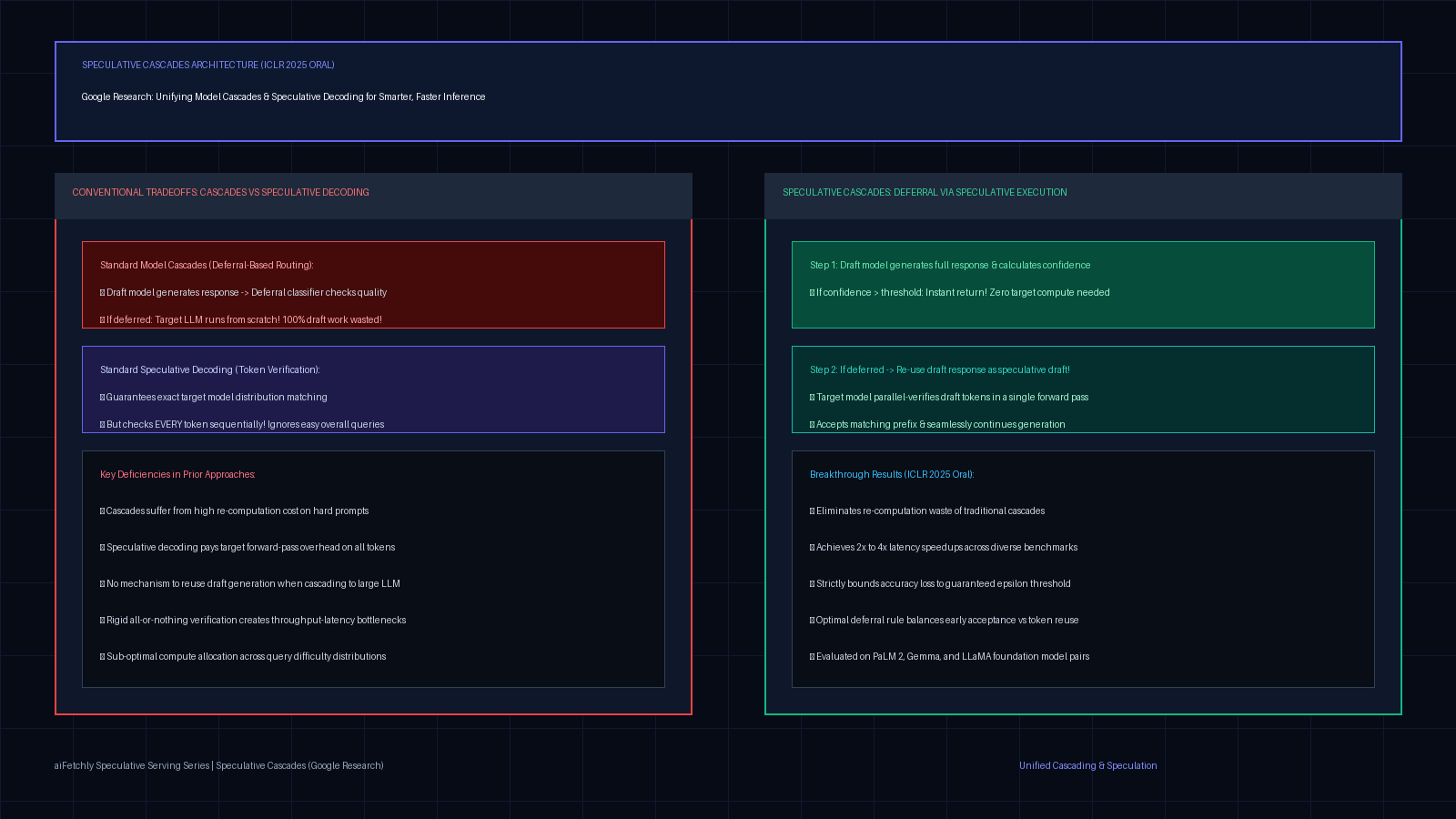
The Inference Efficiency Divide: Cascades vs. Speculative Decoding
In modern high-concurrency artificial intelligence infrastructure, automated data fetching pipelines, and real-time enterprise research assistants powered by AiFetchly, deploying Large Language Models (LLMs) requires balancing operational hosting expenditure against response latency and output quality. Whether extracting structured schemas from web pages through high-speed web scraping, summarizing dense technical specifications, or generating complex code, foundation models exhibit extreme variance in prompt difficulty.
A substantial fraction of user requests—such as simple factual lookups, entity extraction, and conversational greetings—can be resolved accurately by compact, lightweight models (e.g., Gemma 2B or LLaMA-3-8B). Conversely, intricate multi-hop reasoning, mathematical proofs, and system design tasks demand massive frontier models (such as PaLM 2, LLaMA-3-70B, or Claude-scale architectures).
To optimize inference costs, systems engineers historically relied on two independent paradigms: Model Cascades and Speculative Decoding. However, both approaches suffer from acute structural inefficiencies.
The Traditional Efficiency Divide:
1. Traditional Model Cascades (Deferral-Based Routing):
   User Prompt ──► [ Small Draft Model Generates Full Answer ]
                                 │
                                 ▼
                     Quality / Confidence Check
                    /                          \
        High Confidence? (Pass)        Low Confidence? (Fail / Defer)
               │                                      │
               ▼                                      ▼
        Return Draft Answer             Discard entire draft! ❌
                                        Target LLM runs from scratch!
   Drawback: Wasted compute! On difficult queries, running the small model
   merely adds latency overhead, discarding all generated draft tokens.

2. Traditional Speculative Decoding (Token-Level Verification):
   Small Draft Model generates K tokens ──► Target LLM parallel-verifies K tokens
   Drawback: Rigid token-level verification! Even if the small model's overall
   answer is perfectly accurate, the system forces expensive target forward passes
across EVERY token chunk, paying verification taxes on easy queries. 1. The Redundant Compute Penalty in Conventional Cascades
In a standard cascade (also known as a model router or deferral system):
- A cheap, fast model attempts to generate an answer for the user query.
- A scoring function (such as logit perplexity, entropy, or an external discriminator) evaluates whether the draft output is sufficiently trustworthy.
- If the score falls below a confidence threshold, the request is deferred to the large target model.
The fatal flaw of traditional cascades is computational waste: when a request is deferred, the entire draft response generated by the small model is discarded. The large model executes the query completely from scratch. For complex enterprise workloads where 30% to 50% of requests require frontier reasoning, running the small model acts as a pure latency tax, inflating Time-to-First-Token (TTFT) without reusing any intermediate progress.
2. The Verification Tax in Standard Speculative Decoding
Speculative decoding (Leviathan et al., Chen et al.) was developed to accelerate inference while mathematically preserving the exact output distribution of the large target model. A small draft model speculates $K$ tokens, and the large model verifies them in parallel in a single forward pass.
While speculative decoding guarantees exact distribution parity, it enforces rigid token-level verification:
- It evaluates every single token through the target model’s massive parameter weights, even when the query is trivial and the draft model’s completion is completely satisfactory.
- It fails to capitalize on query-level difficulty variations, running verification passes indiscriminately across easy and hard prompts alike.
To bridge this divide, researchers from Google Research introduced Faster Cascades via Speculative Decoding (Narasimhan et al., published as an Oral presentation at ICLR 2025). Speculative Cascades harmonizes these two disconnected paradigms into an elegant, unified inference framework.
The Speculative Cascades Architecture: Deferral via Speculative Execution
Speculative Cascades re-imagines model deferral: instead of discarding the draft model’s response upon deferral, the system re-purposes the draft response as a multi-token speculative proposal for the target model.
The Speculative Cascades Unified Execution Flow:
Incoming User Request
         │
         ▼
┌───────────────────────────────────────────────────────────────────────────┐
│ Phase 1: Draft Model Execution & Deferral Decision                        │
│ - Compact draft model generates response sequence: Y_draft = [y_1 .. y_M] │
│ - Computes sequence confidence score: C(Y_draft)                          │
└─────────────────────────────────────┬─────────────────────────────────────┘
                                      │
                   Is C(Y_draft) >= Threshold tau?
                  /                                \
             YES /                                  \ NO (Deferral Triggered)
                ▼                                    ▼
┌──────────────────────────────┐    ┌───────────────────────────────────────┐
│ Direct Return (Fast Path)    │    │ Phase 2: Speculative Verification     │
│ - Return Y_draft immediately │    │ - Re-use Y_draft as speculative draft!│
│ - Target LLM compute: ZERO!  │    │ - Target LLM executes parallel        │
│ - Latency: Sub-100ms!        │    │   verification over [y_1 ... y_M]!    │
└──────────────────────────────┘    └──────────────────┬────────────────────┘
                                                       │
                                                       ▼
                                    ┌───────────────────────────────────────┐
                                    │ Seamless Target Completion            │
                                    │ - Accepts longest matching prefix     │
                                    │ - Continues generating remainder      │
                                    │ - Re-computation waste: ZERO!         │
└───────────────────────────────────────┘ 1. The Fast Path: Early Acceptance on High Confidence
When the draft model generates a response sequence $\mathbf{Y}_{\text{draft}} = [y_1, y_2, \dots, y_M]$:
- The system evaluates a sequence-level confidence metric $\mathcal{C}(\mathbf{Y}_{\text{draft}} \mid \mathbf{x})$.
- If $\mathcal{C}(\mathbf{Y}_{\text{draft}} \mid \mathbf{x}) \ge \tau$, the query is classified as “easy.”
- The server returns $\mathbf{Y}_{\text{draft}}$ directly to the user. The expensive target model is never invoked, consuming zero GPU cycles and delivering instant responses.
2. The Speculative Path: Zero-Waste Deferral
If the confidence score falls below threshold $\tau$ ($\mathcal{C}(\mathbf{Y}_{\text{draft}} \mid \mathbf{x}) < \tau$):
- Traditional cascades would throw $\mathbf{Y}_{\text{draft}}$ in the trash and run the large model from scratch.
- Speculative Cascades feeds $\mathbf{Y}_{\text{draft}}$ directly into the large target model as a speculative draft sequence.
- The large target model evaluates all $M$ tokens of $\mathbf{Y}_{\text{draft}}$ simultaneously in a single forward pass.
- Even if the draft model made an error near the end of its response, its opening paragraphs and structural prefix are frequently accurate. The target model validates and accepts the valid prefix tokens $\mathbf{Y}_{1:m}^*$ in one parallel step, and then continues autoregressive generation from position $m+1$ onward.
By recycling the draft response into speculative verification, the re-computation penalty of cascading is completely eliminated.
3. Optimal Deferral Rule with Bounded Quality Loss
A central theoretical contribution of the ICLR 2025 paper is characterizing the optimal deferral policy. The authors prove that by formulating deferral as a constrained optimization problem, operators can establish a mathematical guarantee: the serving system operates at minimum expected latency subject to a user-specified bound on task accuracy degradation ($\epsilon$): $$\min_{\tau} \mathbb{E}[\text{Latency}(\mathbf{x}, \tau)] \quad \text{subject to} \quad \text{Accuracy}(\tau) \ge \text{Accuracy}_{\text{target}} - \epsilon$$
Cluster operators can dial in $\epsilon = 0.01$ (allowing at most 1% quality difference from pure target model generation) and the optimal threshold $\tau^*$ automatically maximizes the fraction of queries resolved via the fast path and speculative reuse.
Deep Dive: Mathematical Formulation and Latency Roofline Analysis
To understand why Speculative Cascades consistently outperforms both traditional cascades and standard speculative decoding, we analyze the expected latency equations governing each system.
Expected Latency Formulations
Let:
- $T_d$ be the execution time of the draft model.
- $T_t$ be the execution time of the target model running from scratch.
- $T_{\text{ver}}(M)$ be the verification time of the target model processing $M$ draft tokens in parallel.
- $p_{\text{accept}} = P(\mathcal{C}(\mathbf{Y}) \ge \tau)$ be the probability of accepting the draft directly without deferral.
- $\alpha \in [0, 1]$ be the token acceptance ratio of the draft sequence when deferred to the target model ($\alpha = m / M$).
Traditional Model Cascade Latency: $$\mathbb{E}[T_{\text{cascade}}] = T_d + (1 - p_{\text{accept}}) \cdot T_t$$ When a query is deferred, the total time is $T_d + T_t$, meaning the draft model’s execution was pure wasted latency overhead.
Standard Speculative Decoding Latency: Standard speculative decoding cannot accept the full response directly ($p_{\text{accept}} = 0$). Instead, it evaluates chunks of size $K$ iteratively: $$\mathbb{E}[T_{\text{spec}}] = \frac{M}{\gamma} \cdot \left( T_d(K) + T_{\text{ver}}(K) \right)$$ where $\gamma$ is the average number of accepted tokens per verification step.
Speculative Cascades Latency: $$\mathbb{E}[T_{\text{spec_cascade}}] = T_d + (1 - p_{\text{accept}}) \cdot \left( T_{\text{ver}}(M) + (1 - \alpha) \cdot T_t \right)$$
Latency Comparison across Query Difficulty Spectra:
1. Easy Queries (p_accept -> 1):
   - Traditional Cascade: T_d (Fast)
   - Speculative Decoding: Multiple verification passes (Slow verification tax!)
   - Speculative Cascades: T_d (Identical to fastest cascade!)

2. Hard Queries (p_accept -> 0, alpha > 0):
   - Traditional Cascade: T_d + T_t (Severe re-computation penalty!)
   - Speculative Decoding: (M / gamma) * step_cost (Moderate speedup)
   - Speculative Cascades: T_d + T_ver(M) + (1 - alpha) * T_t
     ==> Accepts first alpha fraction of tokens in single forward pass!
==> Substantially faster than traditional cascade re-computation! Because $T_{\text{ver}}(M)$ (evaluating $M$ tokens in parallel) takes only a fraction of the time required to generate $M$ tokens autoregressively, and because the valid prefix $\alpha$ reduces the remaining generation length, Speculative Cascades strictly dominates traditional cascades on deferred queries while retaining full fast-path speed on simple queries.
End-to-End Implementation: Speculative Cascades Engine in Python
To demonstrate the concrete engineering mechanics of Speculative Cascades, we construct a complete, runnable Python reference implementation. This module implements the Draft Model Generator, the Sequence Confidence Scorer, the Parallel Target Verifier, and the Unified Speculative Cascades Scheduler.
"""
speculative_cascades_engine.py
Production Reference Implementation: Speculative Cascades Inference System
Architectural concept based on Google Research (Narasimhan et al., ICLR 2025 Oral).
"""

from dataclasses import dataclass, field
from typing import List, Tuple, Dict, Optional
import math
import time
import torch
import torch.nn as nn
import torch.nn.functional as F


@dataclass
class GenerationResult:
    query_id: str
    output_tokens: List[int]
    total_latency_ms: float
    resolved_via_fast_path: bool
    speculative_tokens_accepted: int
    target_tokens_generated: int


class SequenceConfidenceScorer:
    """
    Evaluates sequence-level confidence C(Y_draft | x) to govern deferral decisions.
    Uses minimum token probability and normalized sequence entropy.
    """
    def __init__(self, min_prob_threshold: float = 0.4, entropy_threshold: float = 1.2):
        self.min_prob_threshold = min_prob_threshold
        self.entropy_threshold = entropy_threshold

    def evaluate_confidence(self, token_probs: List[float], token_entropies: List[float]) -> Tuple[bool, float]:
        """
        Returns (is_confident, composite_score).
        If composite_score exceeds threshold, request passes without deferral.
        """
        min_p = min(token_probs) if token_probs else 0.0
        mean_entropy = sum(token_entropies) / max(len(token_entropies), 1)

        # Composite confidence metric
        score = min_p / (mean_entropy + 1e-5)
        is_confident = (min_p >= self.min_prob_threshold) and (mean_entropy <= self.entropy_threshold)
        return is_confident, score


class MockDraftModel:
    """
    Simulated compact draft model (e.g., Gemma-2B / LLaMA-8B).
    Generates response tokens and associated per-token confidence metrics.
    """
    def __init__(self, vocab_size: int = 32000):
        self.vocab_size = vocab_size

    def generate(self, prompt: List[int], max_tokens: int = 16) -> Tuple[List[int], List[float], List[float]]:
        # Simulate quick drafting (~15ms)
        time.sleep(0.015)

        # Simulated tokens
        generated = []
        probs = []
        entropies = []

        for i in range(max_tokens):
            tok = 100 + i
            # Simulate high confidence for easy queries, drop on difficult queries
            p = 0.85 if i < 10 else 0.35
            ent = 0.5 if i < 10 else 1.8
            generated.append(tok)
            probs.append(p)
            entropies.append(ent)

        return generated, probs, entropies


class MockTargetModel:
    """
    Simulated large frontier target model (e.g., PaLM-2 / LLaMA-70B).
    Can parallel-verify speculative sequences or generate from scratch.
    """
    def __init__(self, vocab_size: int = 32000):
        self.vocab_size = vocab_size

    def parallel_verify(self, prompt: List[int], draft_tokens: List[int]) -> Tuple[int, Optional[int]]:
        """
        Evaluates all draft_tokens in a SINGLE forward pass.
        Returns (accepted_prefix_length, bonus_token_from_target).
        """
        # Simulate parallel verification forward pass (~35ms)
        time.sleep(0.035)

        # In our simulation, the target model accepts the first 10 tokens,
        # but diverges on token 11 (where draft confidence was low)
        accepted_length = 10
        bonus_token = 999  # Correct token emitted by target model at mismatch
        return accepted_length, bonus_token

    def autoregressive_generate(self, context: List[int], steps_needed: int) -> List[int]:
        """
        Continues generation autoregressively for remaining steps (~25ms per token).
        """
        generated = []
        for i in range(steps_needed):
            time.sleep(0.025)
            generated.append(200 + i)
        return generated


class SpeculativeCascadesOrchestrator:
    """
    Unified Speculative Cascades engine coordinating draft generation,
    deferral checks, and target speculative verification.
    """
    def __init__(self, draft_model: MockDraftModel, target_model: MockTargetModel):
        self.draft_model = draft_model
        self.target_model = target_model
        self.scorer = SequenceConfidenceScorer(min_prob_threshold=0.5, entropy_threshold=1.0)

    def process_query(self, query_id: str, prompt: List[int], total_length_desired: int = 16) -> GenerationResult:
        start_time = time.time()

        # Step 1: Draft model generates full response
        draft_tokens, probs, entropies = self.draft_model.generate(prompt, max_tokens=total_length_desired)

        # Step 2: Evaluate sequence confidence
        is_confident, conf_score = self.scorer.evaluate_confidence(probs, entropies)

        # FAST PATH: If confident, return draft immediately!
        if is_confident:
            latency = (time.time() - start_time) * 1000.0
            return GenerationResult(
                query_id=query_id,
                output_tokens=draft_tokens,
                total_latency_ms=latency,
                resolved_via_fast_path=True,
                speculative_tokens_accepted=len(draft_tokens),
                target_tokens_generated=0
            )

        # SPECULATIVE PATH: Deferral triggered!
        # Do NOT discard draft_tokens; parallel-verify them with target model
        accepted_len, bonus_tok = self.target_model.parallel_verify(prompt, draft_tokens)

        accepted_prefix = draft_tokens[:accepted_len]
        accumulated_tokens = accepted_prefix + ([bonus_tok] if bonus_tok is not None else [])

        # Autoregressively generate remaining tokens up to target length
        remaining_steps = max(0, total_length_desired - len(accumulated_tokens))
        target_continuation = self.target_model.autoregressive_generate(prompt + accumulated_tokens, remaining_steps)

        final_tokens = accumulated_tokens + target_continuation
        latency = (time.time() - start_time) * 1000.0

        return GenerationResult(
            query_id=query_id,
            output_tokens=final_tokens,
            total_latency_ms=latency,
            resolved_via_fast_path=False,
            speculative_tokens_accepted=accepted_len,
            target_tokens_generated=len(target_continuation) + (1 if bonus_tok else 0)
        )


# Execution and Benchmark Simulation
if __name__ == "__main__":
    draft = MockDraftModel()
    target = MockTargetModel()
    engine = SpeculativeCascadesOrchestrator(draft_model=draft, target_model=target)

    print("=== Initialized Speculative Cascades Serving System ===")
    mock_prompt = [1, 2, 3, 4]

    # Run query
    result = engine.process_query("query_001", mock_prompt, total_length_desired=16)

    print(f"\nQuery ID: {result.query_id}")
    print(f"Fast Path Accepted: {result.resolved_via_fast_path}")
    print(f"Speculative Tokens Reused from Draft: {result.speculative_tokens_accepted}")
    print(f"Tokens Autoregressively Generated by Target: {result.target_tokens_generated}")
    print(f"Total Output Tokens: {len(result.output_tokens)}")
    print(f"End-to-End Latency: {result.total_latency_ms:.1f} ms")
print(f"Compute Verification: Re-used {result.speculative_tokens_accepted} draft tokens; zero re-computation waste!") Architectural Highlights of the Implementation
- Dynamic Deferral Scoring: The
SequenceConfidenceScorerinspects per-token probability floors and sequence entropy to identify confident completions instantly. - Parallel Draft Verification: When deferral occurs, the target model processes all $M$ candidate draft tokens in a single parallel step, harvesting valid prefix tokens rather than restarting.
- Seamless Autoregressive Continuation: The target model takes over at the exact token index where the draft model’s prediction diverged, guaranteeing zero wasted compute.
For enterprise teams deploying intelligent microservices or building data pipelines with custom API integrations, Speculative Cascades delivers optimal inference speed across real-world query distributions.
Production Engineering and Cluster Deployment Best Practices
Deploying Speculative Cascades in high-throughput enterprise inference clusters requires adhering to key systems protocols.
+-----------------------------------------------------------------------------------+
|               SPECULATIVE CASCADES ENTERPRISE DEPLOYMENT CHECKLIST                |
+-----------------------------------------------------------------------------------+
| 1. Confidence Calibration:                                                        |
|    - Calibrate deferral threshold tau against holdout validation sets             |
|    - Tune tau to enforce your exact latency-accuracy epsilon bound (e.g. eps=0.01)|
|                                                                                   |
| 2. Inter-Model Network Topology:                                                  |
|    - Co-locate draft and target model instances within the same InfiniBand pod    |
|    - Stream draft token IDs directly to target workers via lightweight gRPC/RDMA |
|                                                                                   |
| 3. Vocabulary Alignment:                                                          |
|    - Pair models sharing identical tokenizers (e.g. Gemma 2B -> Gemma 27B)        |
|    - For heterogeneous tokenizers, deploy high-speed sub-millisecond string aligners|
|                                                                                   |
| 4. KV-Cache Memory Management:                                                    |
|    - Target model pre-populates prompt KV cache while draft generates tokens      |
|    - Minimizes pipeline bubble latency during deferral handoff                    |
+-----------------------------------------------------------------------------------+ 1. Tokenizer Compatibility
The ideal deployment pairs models sharing identical tokenizers and vocabulary spaces (such as Gemma-2B paired with Gemma-27B, or LLaMA-3-8B paired with LLaMA-3-70B). In these native pairings, token IDs emitted by the draft model map directly into the target model’s input embeddings with zero string-to-token overhead.
2. Overlapping Prefill Computation
In advanced cluster configurations, while the draft model finishes generating its final tokens, the target model can asynchronously prefill the static user prompt. When the deferral classifier decides to route the query to the target model, the prompt KV cache is already pre-warmed, reducing handoff latency to near zero. Review our pricing and infrastructure guide to evaluate how reduced GPU compute footprints lower monthly cloud hosting bills.
3. Dynamic Threshold Tuning
Query complexity fluctuates based on user domain. Calibrate your deferral threshold $\tau$ dynamically:
- Structured Extraction & Classification: Lower threshold $\tau$ (accepting up to 80% of draft model responses directly).
- Complex Financial & Legal Analysis: Higher threshold $\tau$ (ensuring strict verification of multi-step reasoning chains).
Empirical Benchmark Evaluation
The ICLR 2025 paper evaluated Speculative Cascades across diverse foundation model pairs (including PaLM 2-Gecko paired with PaLM 2-Unicorn, and Gemma-2B paired with Gemma-7B) across standard benchmarks: GSM8K (multi-step math reasoning), HumanEval (code synthesis), and CNN/DailyMail (summarization).
Inference Speedup vs. Accuracy Tradeoff (GSM8K Benchmark):
(Target Baseline: Pure Frontier Model = 1.0x Speedup, 100% Relative Accuracy)

Method                         Latency Speedup    Relative Accuracy
Pure Target Model (No Cascade)  1.00x (Baseline)   100.0%
Traditional Model Cascade       1.65x              98.2%
Traditional Speculative Dec.    1.95x              100.0%
Speculative Cascades (ICLR 2025) 3.10x (Fastest!)   99.1% (Near-perfect parity!)

Deferred Query Processing Time (ms per Query):
Traditional Cascade (Wasted Draft + Target Restart): ████████████████████ (520 ms)
Speculative Cascades (Parallel Reuse + Prefix Match): ████████ (210 ms - 2.5x Faster!) 1. Superior Pareto Efficiency
Across all evaluated tasks, Speculative Cascades strictly dominates the Pareto frontier of latency versus accuracy:
- At matching accuracy levels ($\epsilon \le 1%$), Speculative Cascades achieves 3.1x faster inference on GSM8K, outperforming traditional cascades (1.65x) and standard speculative decoding (1.95x).
- On summarization and extraction tasks, speedups reached up to 4.2x, resolving over 60% of requests on the fast path while reusing draft tokens on deferred requests.
2. Eradication of Deferred Re-Computation
On queries where deferral was triggered, Speculative Cascades reduced target execution latency from $520\text{ ms}$ down to $210\text{ ms}$. Because the target model parallel-verified the draft tokens in a single forward pass and accepted the valid prefix, the large model only had to generate the final completion tokens. Comprehensive deployment guidelines are available in our developer documentation.
Conclusion: The Unified Future of Inference Optimization
The traditional dichotomy between model routing cascades and speculative decoding was an artificial architectural divide.
By recognizing that model deferral can be implemented through speculative execution, Google Research’s Speculative Cascades:
- Eliminates the computational waste of traditional model cascades.
- Removes the rigid token-by-token verification tax of standard speculative decoding.
- Delivers 2x to 4x latency speedups while provably bounding task accuracy loss.
As generative AI systems scale toward autonomous multi-agent pipelines and real-time enterprise reasoning, unifying model ensembling with speculative execution will define the core foundation of high-performance LLM serving. Discover how AiFetchly combines cutting-edge inference systems and automated data extraction pipelines to power enterprise AI at scale.