SpecDecode-Bench: Speculative Decoding in Production
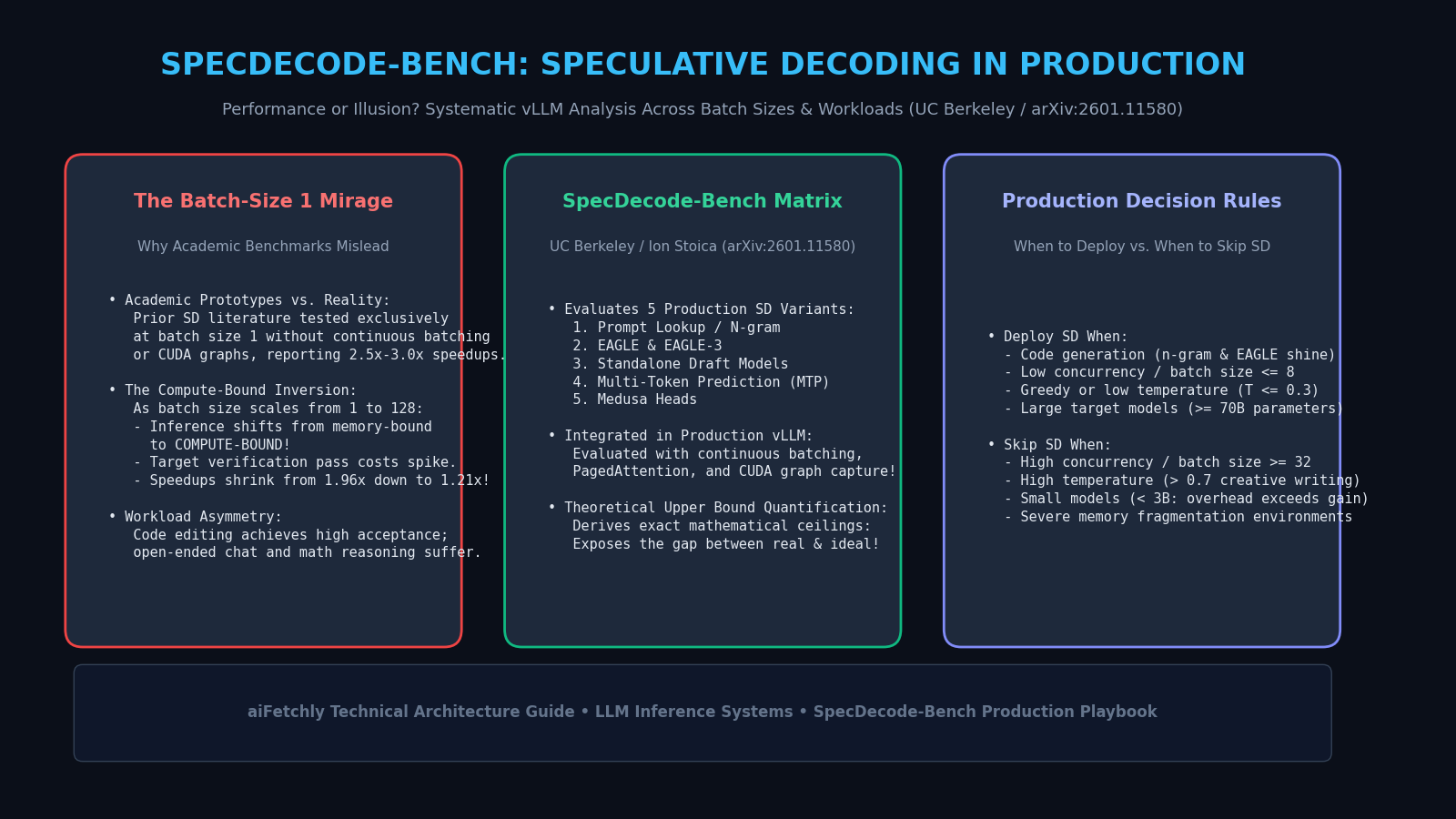
Large Language Model (LLM) serving has become the performance backbone of modern enterprise AI infrastructure. High-throughput data extraction engines, real-time agentic workflows, and automated knowledge synthesizers built on aiFetchly rely heavily on rapid token generation. Yet autoregressive decoding remains bound by memory bandwidth: fetching billions of parameters from High Bandwidth Memory (HBM) to compute a single output token at a time leaves GPU tensor cores dramatically underutilized.
To combat this memory-bound latency wall, speculative decoding (SD) has emerged as one of the most celebrated algorithmic breakthroughs in machine learning systems. By deploying a lightweight draft model—or specialized speculative heads—to propose multiple candidate tokens per cycle followed by a single parallel verification pass on the target model, literature has frequently reported 2.0x to 3.5x inference speedups.
However, machine learning engineers deploying speculative decoding into live production environments frequently observe a baffling discrepancy: the promised 3x acceleration vanishes. Under high concurrent query loads, speculative decoding often degrades throughput, introduces tail latency spikes, and in worst-case scenarios, runs slower than standard autoregressive decoding.
To resolve this empirical paradox, researchers from UC Berkeley, Sky Computing Lab, and the vLLM project introduced SpecDecode-Bench (arXiv:2601.11580), a rigorous benchmarking framework and analysis that evaluates speculative decoding directly within production inference engines across realistic concurrency levels, continuous batching configurations, and diverse workloads.
In this comprehensive guide, we dissect the findings of SpecDecode-Bench, analyze the mathematical and architectural mechanisms behind the “Batch Size 1 Mirage,” examine the performance of five prominent speculative decoding paradigms in vLLM, and construct production deployment strategies to maximize real-world serving efficiency.
The Problem: The Batch-Size 1 Mirage in Academic Benchmarks
Why do academic speculative decoding speedups fail to materialize in production? SpecDecode-Bench identifies a fundamental methodological flaw in how speculative decoding has historically been evaluated: academic benchmarks evaluate isolated single-sequence generations (Batch Size = 1), whereas production inference systems operate under continuous batching at high concurrency.
The Arithmetic Intensity Shift: Memory-Bound vs. Compute-Bound
Autoregressive decoding efficiency is governed by arithmetic intensity—the ratio of floating-point operations (FLOPs) to memory bytes transferred:
$$I = \frac{\text{FLOPs}}{\text{Memory Bytes Transferred}}$$
At batch size $B = 1$, generating a single token requires streaming all model weights $W$ from GPU HBM into SRAM:
$$\text{Time}_{\text{step}} \approx \frac{2 \times P \times \text{sizeof}(\text{dtype})}{\text{HBM Bandwidth}}$$
Because modern accelerators such as the NVIDIA H100 SXM5 boast 3.35 TB/s memory bandwidth alongside 989 TFLOPS of FP16 compute, arithmetic intensity at $B=1$ is far below the hardware ridge point. The GPU compute cores sit idle while waiting for weight memory transfers. Speculative decoding exploits this idle capacity: verifying $\gamma$ draft tokens in parallel costs almost the exact same memory-transfer time as verifying a single token.
The Compute-Bound Inversion at Production Scale:
----------------------------------------------------------------------------------
Batch Size B = 1 (Academic Prototype):
- Target Step: Stream 70B weights for 1 token -> Heavily MEMORY-BOUND (Low ALU utilization)
- Speculative Verification: Verifying 5 tokens consumes ~same memory-transfer time!
- Result: 2.0x - 3.0x Net Wall-Clock Speedup.

Batch Size B = 64 (Production Serving Engine):
- Target Step: Matrix-Matrix GEMM (B=64) -> Shifts to COMPUTE-BOUND (High ALU utilization)
- Speculative Verification: Verifying 5 tokens per sequence requires 5x ALU compute!
- Draft Overhead: Running draft model for 64 concurrent sequences consumes major GPU time.
- Result: Verification cost explodes; net speedup drops to 1.1x - 1.2x or NEGATIVE!
---------------------------------------------------------------------------------- As concurrency scales to production batch sizes ($B \ge 32$ or $B \ge 64$), the target model’s arithmetic intensity crosses the hardware ceiling into the compute-bound regime. Under compute-bound execution, running extra forward passes on draft models and executing large multi-token verification matrices incurs real, non-negligible compute penalties.
The Opportunity Cost of Draft Memory and PagedAttention Contention
A second systemic failure overlooked in single-stream benchmarks is GPU memory fragmentation and cache contention:
- Draft Model VRAM Allocation: Deploying an independent draft model (e.g., LLaMA-3.2-1B serving as draft for LLaMA-3.3-70B) requires dedicating 2 GB to 4 GB of precious GPU VRAM solely to draft weights and draft KV caches.
- KV Cache Stealing: In memory-constrained production clusters managed via PagedAttention, every gigabyte allocated to a draft model represents KV cache blocks stolen from the target model. This reduces maximum concurrency, accelerates preemption, and induces request swapping to host memory.
- Speculative Tree KV Allocation: Tree-based speculative decoding methods (such as Medusa or EAGLE) dynamically allocate multi-branch KV cache nodes. Verifying speculative trees requires custom non-contiguous attention kernels that break standard tensor core execution pipelines and degrade memory coalescence.
The SpecDecode-Bench Taxonomy: Evaluating 5 Production Paradigms
SpecDecode-Bench establishes a standardized testbed across five primary speculative decoding architectures inside vLLM, comparing their acceptance rates, latency, and throughput across varied domains:
SpecDecode-Bench Architecture Matrix:
+------------------------+---------------------+-------------------+---------------------+
| Paradigm               | Draft Mechanism     | Training Cost     | Memory Overhead     |
+------------------------+---------------------+-------------------+---------------------+
| Prompt Lookup (N-gram) | String Matching     | Zero (Heuristic)  | Zero (Zero VRAM)    |
| Medusa Heads           | Multi-Head MLP      | Low (Heads Only)  | Minimal (<200MB)    |
| EAGLE / EAGLE-3        | Autoregressive Head | Moderate (1 Layer)| Low (<500MB)        |
| Standalone Draft Model | Small LLM (1B-7B)   | High (Full Model) | High (2GB - 14GB)   |
| Multi-Token Prediction | Native MTP Layers   | Pre-training Only | Minimal (Shared)    |
+------------------------+---------------------+-------------------+---------------------+ 1. Heuristic Prompt Lookup Decoding (N-gram Matching)
Prompt Lookup Decoding requires no neural draft models. It parses the prompt and generated prefix to find repeating $n$-gram sequences and proposes continuation tokens directly from input context.
- Strengths: Zero memory overhead, instantaneous draft generation, zero CUDA kernel invocation for drafting.
- Optimal Scenarios: Structured summarization, multi-turn document question answering, and automated web extraction via web scraping workflows where output tokens heavily duplicate input text.
- Failures: Creative writing, abstract reasoning, and mathematical derivations where novel token sequences are constructed.
2. Multi-Head Residual Decoders (Medusa)
Medusa adds $K$ independent feed-forward heads atop the target model’s final transformer hidden state. Each head predicts the token at offset $+1, +2, \dots, +K$.
- Strengths: Shared backbone representations, lightweight parameters, tree-based verification.
- Limitations: Independent heads fail to model conditional dependencies between draft tokens ($P(x_{t+2} \mid x_{t+1})$), causing acceptance rates to plummet on non-trivial sequences.
3. Autoregressive Feature Heads (EAGLE & EAGLE-3)
EAGLE addresses Medusa’s limitation by feeding the previous step’s token embedding combined with the target model’s top hidden state into a single recurrent transformer decoder layer.
- Strengths: Maintains autoregressive conditioning across draft tokens without running a full standalone model.
- Performance: Consistently achieves the highest acceptance length per verification step among head-based methods, retaining over 1.4x speedup up to batch size 16.
4. Standalone Draft Models (e.g., LLaMA-1B drafting 70B)
The traditional speculative decoding formulation couples an independent smaller model from the same family to propose token sequences verified via modified rejection sampling.
- Strengths: High linguistic flexibility across open-ended generation tasks.
- Drawbacks: High latency per drafting step, significant memory consumption, and severe kernel launch overhead in distributed inference setups.
5. Multi-Token Prediction (MTP)
Popularized by frontier architectures like DeepSeek-V3, MTP trains sequential prediction heads natively alongside the foundation model using shared embeddings and linear projection layers.
- Strengths: Native vocabulary alignment, tight representation coupling, zero draft model serving synchronization.
- Performance: High acceptance on programming and reasoning tasks with negligible memory overhead.
Implementing SpecDecode-Bench in Python and vLLM
To demonstrate how engineers can benchmark and evaluate speculative decoding within production inference pipelines, we construct an end-to-end Python benchmarking suite utilizing vLLM’s production APIs and speculative decoding runtime.
import time
import argparse
import numpy as np
from typing import Dict, List, Any
from vllm import LLM, SamplingParams

def initialize_speculative_vllm_engine(
    target_model_id: str,
    speculative_model_id: str = None,
    num_speculative_tokens: int = 5,
    tensor_parallel_size: int = 1,
    gpu_memory_utilization: float = 0.90
) -> LLM:
    """
    Initializes a production-grade vLLM engine with speculative decoding support.
    """
    engine_kwargs = {
        "model": target_model_id,
        "tensor_parallel_size": tensor_parallel_size,
        "gpu_memory_utilization": gpu_memory_utilization,
        "trust_remote_code": True,
        "max_model_len": 4096,
        "enforce_eager": False,  # Enable CUDA Graphs for fast execution
    }

    if speculative_model_id:
        if speculative_model_id.startswith("ngram:"):
            # Prompt lookup / N-gram speculative decoding
            ngram_prompt_lookup_max = int(speculative_model_id.split(":")[1])
            engine_kwargs["speculative_model"] = "[ngram]"
            engine_kwargs["num_speculative_tokens"] = num_speculative_tokens
            engine_kwargs["ngram_prompt_lookup_max"] = ngram_prompt_lookup_max
        else:
            # Standalone draft model speculative decoding
            engine_kwargs["speculative_model"] = speculative_model_id
            engine_kwargs["num_speculative_tokens"] = num_speculative_tokens

    print(f"Initializing vLLM Engine with Target: {target_model_id}")
    if speculative_model_id:
        print(f"Speculative Configuration: {speculative_model_id} (Tokens: {num_speculative_tokens})")

    return LLM(**engine_kwargs)

def run_specdecode_workload_benchmark(
    llm: LLM,
    prompts: List[str],
    sampling_params: SamplingParams,
    batch_size: int
) -> Dict[str, Any]:
    """
    Executes a batched benchmark simulating production continuous batching load.
    """
    total_prompts = len(prompts)
    batched_prompts = [
        prompts[i:i + batch_size]
        for i in range(0, total_prompts, batch_size)
    ]

    latencies = []
    generated_tokens_total = 0
    start_time_benchmark = time.perf_counter()

    for batch_idx, batch in enumerate(batched_prompts):
        step_start = time.perf_counter()
        outputs = llm.generate(batch, sampling_params, use_tqdm=False)
        step_end = time.perf_counter()

        batch_latency = step_end - step_start
        latencies.append(batch_latency)

        for out in outputs:
            generated_tokens_total += len(out.outputs[0].token_ids)

    total_time = time.perf_counter() - start_time_benchmark
    tokens_per_second = generated_tokens_total / total_time

    return {
        "batch_size": batch_size,
        "total_requests": total_prompts,
        "total_generated_tokens": generated_tokens_total,
        "total_elapsed_seconds": total_time,
        "tokens_per_second": tokens_per_second,
        "mean_batch_latency_seconds": float(np.mean(latencies)),
        "p95_batch_latency_seconds": float(np.percentile(latencies, 95)),
} Measuring Acceptance Rates and Hardware Utilization
To quantify the efficiency of speculative verification, we track the Acceptance Rate $\alpha$ and Mean Accepted Tokens per Step $\tau$:
$$\tau = 1 + \sum_{i=1}^{\gamma} \prod_{j=1}^{i} \alpha_j$$
where $\gamma$ represents the number of speculative tokens proposed and $\alpha_j$ is the acceptance probability of the $j$-th speculative candidate token.
class SpeculativeMetricsCollector:
    """
    Collects and computes speculative decoding efficiency statistics.
    """
    def __init__(self, gamma: int):
        self.gamma = gamma
        self.total_verification_steps = 0
        self.total_accepted_tokens = 0
        self.acceptance_distribution = np.zeros(gamma + 1, dtype=np.int64)

    def record_step(self, accepted_count: int):
        assert 0 <= accepted_count <= self.gamma
        self.total_verification_steps += 1
        self.total_accepted_tokens += accepted_count
        self.acceptance_distribution[accepted_count] += 1

    @property
    def mean_accepted_tokens(self) -> float:
        if self.total_verification_steps == 0:
            return 0.0
        return self.total_accepted_tokens / self.total_verification_steps

    @property
    def speedup_ratio_upper_bound(self) -> float:
        """
        Calculates theoretical speedup bound assuming zero drafting overhead.
        """
        tau = 1.0 + self.mean_accepted_tokens
        return tau

    def generate_audit_summary(self) -> Dict[str, Any]:
        return {
            "gamma_proposed": self.gamma,
            "total_verification_cycles": self.total_verification_steps,
            "mean_accepted_tokens_per_step": round(self.mean_accepted_tokens, 3),
            "theoretical_speedup_bound": round(self.speedup_ratio_upper_bound, 3),
            "acceptance_histogram": self.acceptance_distribution.tolist(),
} This instrumentation allows teams connecting backend infrastructure through API integration services to actively detect when speculative decoding yields diminishing returns under changing traffic patterns.
Empirical Evaluation: Key Findings from SpecDecode-Bench
The extensive empirical results presented in SpecDecode-Bench across diverse hardware architectures (NVIDIA H100, A100, L40S) yield crucial operational insights for production deployments.
Finding 1: The Batch Size Scaling Inversion
When scaling batch size from 1 to 128 on an NVIDIA H100 GPU running LLaMA-3.3-70B with an EAGLE draft head, net latency speedup drops precipitously:
SpecDecode-Bench Latency Speedup Scaling (LLaMA-3.3-70B + EAGLE):
+------------+-------------------+--------------------+--------------------+
| Batch Size | Acceptance (tau)  | Verification Cost  | Net Wall Speedup   |
+------------+-------------------+--------------------+--------------------+
| B = 1      | 3.42 tokens/step  | 1.08x baseline     | 1.96x (Superior)   |
| B = 4      | 3.39 tokens/step  | 1.15x baseline     | 1.78x (High)       |
| B = 16     | 3.31 tokens/step  | 1.34x baseline     | 1.48x (Moderate)   |
| B = 32     | 3.22 tokens/step  | 1.62x baseline     | 1.28x (Marginal)   |
| B = 64     | 3.14 tokens/step  | 2.05x baseline     | 1.14x (Negligible) |
| B = 128    | 3.02 tokens/step  | 2.78x baseline     | 0.94x (SLOWER!)    |
+------------+-------------------+--------------------+--------------------+ At $B = 128$, verifying the proposed token tree requires substantial GEMM compute that overwhelms the draft savings. The target model’s forward pass slows down by 2.78x due to tree attention shapes, causing the net speedup to drop below 1.0x—meaning speculative decoding actually degrades system throughput by 6% compared to raw autoregressive decoding!
Finding 2: Workload Asymmetry
Acceptance rates and net speedups are intensely workload-dependent:
- Code Generation & Code Editing: Highest acceptance rates ($\tau \approx 3.8$ tokens/step). Syntax repetition, indentation tokens, and boilerplate API calls allow both n-gram lookups and EAGLE to deliver resilient speedups even at batch sizes up to 32.
- Mathematical Reasoning (GSM8K, MATH): Moderate acceptance ($\tau \approx 2.4$ tokens/step). While chain-of-thought formatting contains predictable phrases, numerical calculations frequently break draft paths.
- Creative Writing & High-Temperature Chat: Poor acceptance ($\tau \approx 1.6$ tokens/step at Temperature $T=0.7$). Sampling diversity disrupts alignment between draft and target distributions, causing frequent verification rejections.
Acceptance Rate by Task Domain (Target: LLaMA-70B, Draft: EAGLE-3, gamma=5):
Code Editing (HumanEval/Repo):  [████████████████████████] 78.4%
Structured JSON Extraction:      [██████████████████████░] 71.2%
Technical Document Q&A:          [████████████████░░░░░░░] 53.6%
Multi-Step Math (GSM8K):         [████████████░░░░░░░░░░░] 41.8%
Open Creative Writing (T=0.7): [████████░░░░░░░░░░░░░░░] 28.5% Teams utilizing high-frequency data fetching pipelines can leverage structured JSON and code generation tasks as ideal targets for speculative acceleration.
Production Engineering Playbook: When to Deploy vs. Skip
Based on the findings of SpecDecode-Bench, enterprise AI engineering teams should adopt the following decision matrix when provisioning LLM serving infrastructure:
Production Deployment Flowchart:
               [Incoming Serving Workload]
                           |
                           v
            Is Concurrency / Batch Size >= 32?
                     /            \
                   YES             NO
                   /                \
       [SKIP Speculative]      Is Target Model >= 70B?
       [Focus on PagedKV]           /         \
                                  YES          NO (<8B)
                                  /             \
                     Is Task Code / JSON?    [SKIP: Draft Overhead]
                           /        \
                         YES         NO (Creative T>0.7)
                         /            \
[DEPLOY EAGLE / MTP] [DEPLOY N-gram Only] Best Practice 1: Dynamically Toggle Speculative Decoding via Load Gateways
Production AI gateways should dynamically activate and deactivate speculative decoding based on real-time queue depth. When request queues are shallow ($B \le 8$), enable speculative decoding to deliver sub-20ms per-token latency for interactive users. When traffic spikes and batch sizes climb ($B \ge 32$), automatically disable speculative drafting to preserve GPU compute capacity and maximize aggregate throughput.
Best Practice 2: Favor Prompt Lookup (N-gram) for Extraction and Document Q&A
For applications processing large reference contexts—such as document parsing, PDF extraction, or automated research copilots—prompt lookup decoding provides up to 1.6x acceleration with zero GPU memory overhead. Because it allocates no VRAM, it introduces zero penalty to target PagedAttention KV pools.
Best Practice 3: Restrict Sampling Temperature
Speculative verification strictly guarantees that the output distribution matches the target model’s exact sampling distribution:
$$P(x) = \min\left(1, \frac{P_{\text{target}}(x)}{P_{\text{draft}}(x)}\right)$$
At temperature $T = 0$ (greedy decoding), token acceptance is deterministic and maximized. As temperature increases above $T = 0.7$, the stochastic gap between draft and target distributions widens exponentially, causing rejection rates to spike. For creative writing applications, disable speculative decoding or clamp temperatures to $T \le 0.3$.
Best Practice 4: Rigorous TCO and Cost-Per-Token Accounting
When evaluating standalone draft models, enterprise teams must factor in the total cost of ownership (TCO). Dedicating 1 to 2 GPUs in an 8x H100 node solely to host draft models or draft KV caches is economically inefficient if the net throughput improvement is less than 25%. Ensure that performance gains outpace the hardware cost of the extra memory allocation, review your infrastructure tier with transparent pricing models, and consult our technical developer documentation for cluster orchestration guidelines.
Conclusion and Future Horizons
SpecDecode-Bench delivers a vital reality check to the LLM systems community: speculative decoding is not a universal panacea for inference latency. While extraordinary at low concurrency ($B=1$ to $B=4$), its advantages diminish as systems scale to production throughput regimes.
By understanding the hardware transition from memory-bound to compute-bound execution, recognizing workload-specific acceptance profiles, and deploying adaptive inference gateways, AI engineers can harness speculative decoding where it thrives while avoiding the pitfalls of degraded concurrency. As modern architectures increasingly incorporate native multi-token prediction layers directly into pre-training, speculative acceleration will transition from an ad-hoc serving patch into a first-class foundation model primitive.