SpeCache Guide: Speculative Key-Value Cache Prefetching
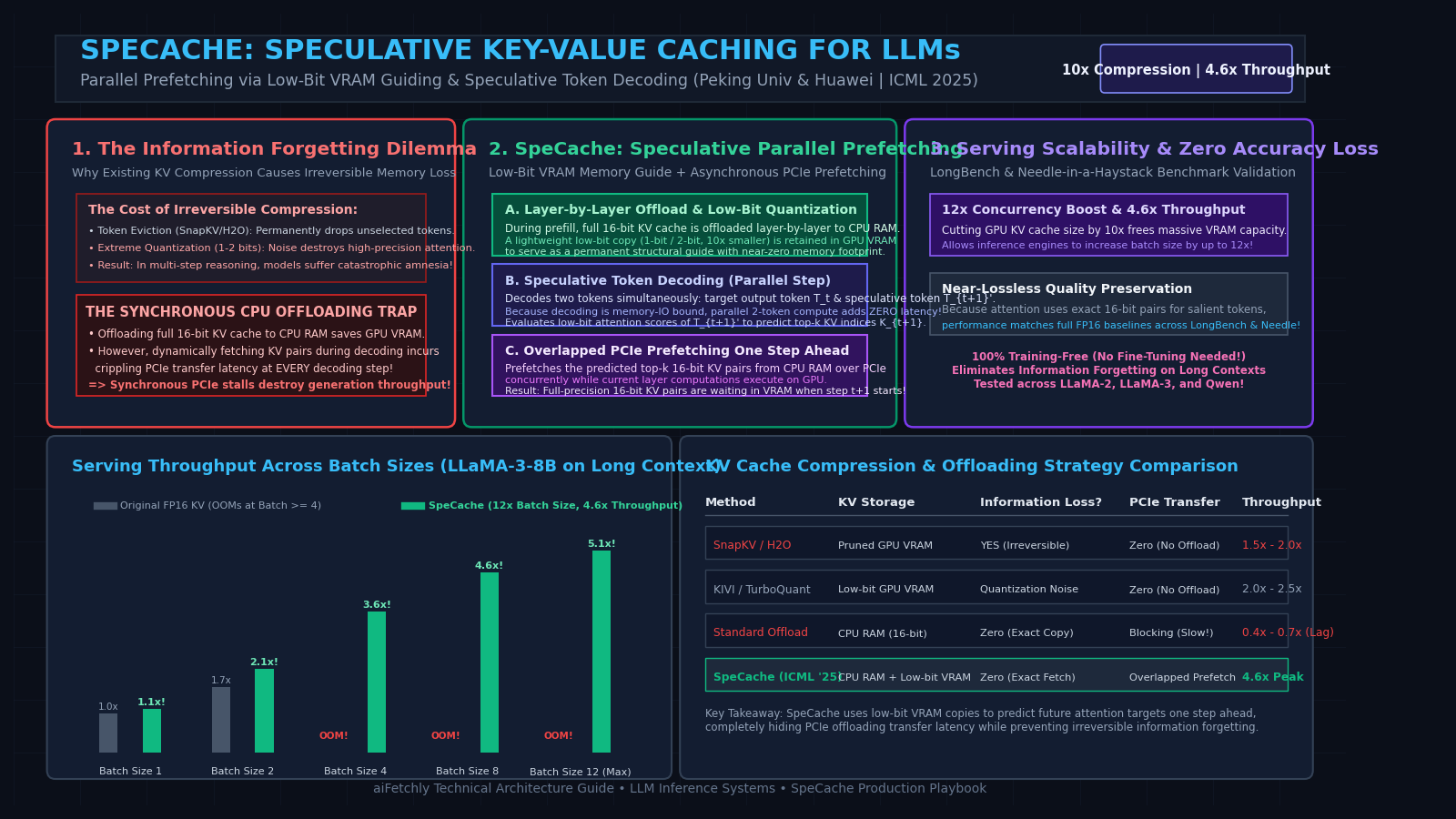
Large Language Models (LLMs) are rapidly penetrating enterprise environments that demand massive context ingestion. In multi-document summarization, automated code review, deep retrieval-augmented generation (RAG), and continuous agentic web monitoring powered by aiFetchly, prompt lengths routinely expand to 32k, 64k, and 128k tokens.
However, scaling sequence length introduces a fundamental physical bottleneck: the Key-Value (KV) cache memory explosion. In transformer autoregressive generation, past Key and Value representations must be preserved to compute self-attention for every new token. Because KV cache size grows linearly with sequence length ($\mathcal{O}(L)$), holding the uncompressed FP16 cache for a single 64k prompt on a model like LLaMA-3-8B consumes over 16 GB of precious GPU High Bandwidth Memory (HBM).
In multi-tenant production clusters, this memory burden cripples serving economics:
- GPU memory pools saturate quickly, capping concurrent batch sizes to tiny values (often $B \le 2$).
- Request queues stall, driving up serving costs and leading to high Time-Per-Output-Token (TPOT) latencies.
To combat this memory crisis, the AI systems community has developed two primary strategies, both of which suffer from severe practical limitations:
- Lossy KV Compression (Eviction & Low-Bit Quantization): Algorithms such as SnapKV, H2O, and 2-bit quantization drop historical tokens or aggressively truncate bits. While they compress memory by 4x to 8x, they inflict irreversible information forgetting. In complex multi-step reasoning, needle retrieval, and long document synthesis, evicted facts cannot be recovered, degrading model accuracy.
- Synchronous CPU Host Offloading: Offloading the full 16-bit KV cache to expandable CPU system RAM completely solves GPU VRAM exhaustion. However, dynamically fetching required KV pairs across the PCIe bus during each decoding step introduces crushing communication latency, stalling GPU execution and cutting decoding throughput in half.
To solve both dilemmas simultaneously, researchers from Peking University and Huawei Noah’s Ark Lab introduced SpeCache: Speculative Key-Value Caching for Efficient Generation of LLMs (arXiv:2503.16163; accepted at ICML 2025).
SpeCache introduces a paradigm shift: it combines asymmetric multi-tier memory storage with speculative token decoding. By offloading the complete 16-bit KV cache to CPU RAM while retaining a lightweight, ultra-compact low-bit copy (1-bit or 2-bit) in GPU VRAM, SpeCache decodes an auxiliary “speculative token” in parallel to predict which KV pairs the next token will attend to, prefetching them from host memory one step ahead over PCIe.
Because LLM decoding is memory-IO bound, parallel 2-token decoding introduces zero latency overhead, completely concealing PCIe transfer latency behind GPU execution. SpeCache achieves a 10x effective compression ratio in VRAM, expands serving batch sizes by up to 12x, and boosts system throughput by 4.6x across LongBench and Needle-in-a-Haystack benchmarks with zero loss in generation accuracy.
In this technical guide, we analyze the attention sparsity of long-context generation, unpack SpeCache’s tri-stage execution pipeline, examine asynchronous prefetching mechanics, and implement a complete PyTorch prototype.
The Problem: The False Choice Between Information Loss and PCIe Latency
To understand why conventional KV management fails on long sequences, we must examine the physical memory constraints and hardware communication bottlenecks of modern LLM servers.
The Information Forgetting Trap
Most existing KV cache reduction techniques operate under lossy compression:
The Lossy Compression Trade-Off:
+----------------------------------------------------------------------------------+
| 1. Token Eviction (SnapKV, H2O, StreamingLLM)                                    |
| • Mechanism: Retains only top-k attention tokens from prompt prefill.            |
| • Fatal Flaw: Permanently deletes 80%+ of historical tokens.                     |
| • Failure Mode: When subsequent generation steps require facts from evicted      |
|   sentences, the model hallucinates or fails completely (Information Forgetting).|
+----------------------------------------------------------------------------------+
| 2. Low-Bit Quantization (KIVI, INT2 / FP4)                                       |
| • Mechanism: Compresses KV tensors to 2 bits per parameter.                      |
| • Fatal Flaw: Quantization noise accumulates across deep layers, corrupting      |
|   fine-grained numerical precision in math and coding tasks.                     |
+----------------------------------------------------------------------------------+ In enterprise legal analysis, medical extraction, or financial audit automation, information loss is intolerable. Serving systems must maintain access to the exact full-precision representations of past context.
The Synchronous Offloading Latency Wall
Because CPU system memory is abundant and affordable (often 512 GB to 2 TB per server node), offloading the complete 16-bit KV cache to CPU host RAM is an intuitive solution.
However, standard offloading suffers from a severe transfer bottleneck:
- During decoding step $t$, the query vector $q_t$ computes attention over all historical tokens.
- To use exact representations, the server must determine which KV blocks are needed, issue a DMA transfer over PCIe, and wait for the tensors to arrive in GPU VRAM before computing attention.
- A PCIe Gen5 x16 slot provides 64 GB/s theoretical unidirectional bandwidth. Transferring even a few hundred megabytes of sparse KV blocks per step introduces 5 to 15 milliseconds of idle synchronization delay.
- Because this transfer happens synchronously in the critical path of generation, total generation throughput plummets by 40% to 70%.
The SpeCache Solution: Speculative Prefetching via Low-Bit Memory Guides
SpeCache breaks this trade-off by observing that transformer self-attention exhibits predictable temporal sparsity: the attention pattern of the next token can be accurately anticipated one step in advance.
The SpeCache Execution Pipeline:
+----------------------------------------------------------------------------------+
|                           STAGE 1: PREFILLING & OFFLOADING                       |
|                                                                                  |
|   Prompt context processed layer-by-layer:                                       |
|   - Full 16-bit KV cache C offloaded entirely to CPU RAM (Zero VRAM hogging!)    |
|   - Lightweight 1-bit / 2-bit quantized copy C' retained in GPU VRAM (10x small!)|
|   - Emits verified first output token T_1                                        |
+----------------------------------------------------------------------------------+
                                         │
                                         ▼
+----------------------------------------------------------------------------------+
|                           STAGE 2: PRE-DECODING (STEP 0)                         |
|                                                                                  |
|   Decodes preliminary speculative token T_2' using low-bit VRAM cache C':        |
|   - Evaluates attention scores for T_1, identifies top-k relevant KV indices K_1 |
|   - Launches asynchronous PCIe prefetch of 16-bit KV pairs K_1 from CPU RAM      |
+----------------------------------------------------------------------------------+
                                         │
                                         ▼
+----------------------------------------------------------------------------------+
|                   STAGE 3: STEADY-STATE SPECULATIVE DECODING                     |
|                                                                                  |
|   In each decoding step t, decodes TWO tokens simultaneously:                    |
|   1. Output Token T_t (Verified using prefetched exact 16-bit KV pairs!)         |
|   2. Speculative Token T_{t+1}' (Computed using low-bit VRAM copy C')            |
|                                                                                  |
|   [PARALLEL OVERLAP]: While layer compute executes on GPU for step t,             |
|   PCIe controller prefetches top-k 16-bit pairs K_{t+1} for step t+1!            |
|   Result: Full-precision KV pairs are WAITING in VRAM before step t+1 begins!    |
+----------------------------------------------------------------------------------+ 1. The Low-Bit VRAM Memory Guide
During prompt prefill, SpeCache quantizes the Key and Value states to ultra-low precision (1-bit or 2-bit with group size $g = 32$ or $64$) using post-training quantization, while offloading the exact 16-bit tensors to host memory layer-by-layer.
Because the low-bit copy $C’$ consumes only 10% of the original VRAM space, it remains permanently resident in GPU memory. While 1-bit and 2-bit quantization is insufficient for generating accurate token text directly, the authors made a pivotal empirical discovery: low-bit attention maps preserve over 95% of top-k token ranking fidelity. The low-bit cache acts as an ultra-fast structural radar that pinpoints which historical tokens are important.
2. Speculative Token Parallel Decoding
In each decoding step $t$, SpeCache inputs two tokens into the transformer block simultaneously:
- The Verified Output Token $T_t$: The genuine token being emitted, computed against the prefetched exact 16-bit KV pairs.
- The Speculative Token $T_{t+1}’$: An approximate next-step candidate token computed against the low-bit VRAM cache.
Because autoregressive generation is heavily memory-IO bound (underutilizing GPU arithmetic units at batch sizes $B \le 8$), evaluating two tokens simultaneously incurs almost zero additional wall-clock latency. The tensor cores execute the 2-token GEMM in the exact same memory-fetch cycle.
3. Asynchronous PCIe Prefetching One Step Ahead
By computing the attention distribution of speculative token $T_{t+1}’$ over the low-bit cache $C’$, SpeCache identifies the top-$k$ most important historical KV indices $\mathcal{K}_{t+1}$ required for the upcoming step.
It immediately dispatches an asynchronous DMA transfer across PCIe on a background CUDA stream:
- While GPU tensor cores finish computing the current step’s feed-forward layers and output logits, the PCIe bus streams the exact 16-bit Key and Value pairs for $\mathcal{K}_{t+1}$ from CPU host RAM into GPU VRAM.
- By the time step $t+1$ initiates its attention kernel, the exact 16-bit KV pairs are already residing in VRAM.
- Zero PCIe transfer latency is exposed to the generation critical path!
Implementing SpeCache in PyTorch
To demonstrate the inner mechanics of speculative token decoding, low-bit index prediction, and asynchronous PCIe prefetching, we construct a complete PyTorch prototype of the SpeCache serving runtime.
import torch
import torch.nn as nn
from typing import Dict, List, Tuple, Optional

class LowBitKVQuantizer:
    """
    Quantizes Key and Value tensors to 2-bit precision for the VRAM memory guide.
    """
    def __init__(self, group_size: int = 32):
        self.group_size = group_size

    def quantize_to_2bit(self, x: torch.Tensor) -> Tuple[torch.Tensor, torch.Tensor, torch.Tensor]:
        """
        Quantizes FP16 tensor into 2-bit packed integers with per-group scale and zero.
        """
        shape = x.shape
        x_g = x.reshape(-1, self.group_size)
        min_v = x_g.min(dim=-1, keepdim=True).values
        max_v = x_g.max(dim=-1, keepdim=True).values

        scale = (max_v - min_v) / 3.0
        scale = torch.clamp(scale, min=1e-8)
        zero = torch.round(-min_v / scale)

        q = torch.clamp(torch.round(x_g / scale) + zero, 0, 3).to(torch.uint8)
        return q.reshape(shape), scale.reshape(*shape[:-1], -1), zero.reshape(*shape[:-1], -1)

    def dequantize(self, q: torch.Tensor, scale: torch.Tensor, zero: torch.Tensor) -> torch.Tensor:
        """
        Fast dequantization for computing guidance attention scores.
        """
        return (q.to(torch.float16) - zero) * scale

class SpeCacheEngine:
    """
    Core SpeCache execution engine orchestrating CPU offloading,
    speculative token decoding, and overlapped PCIe prefetching.
    """
    def __init__(
        self,
        model: nn.Module,
        top_k: int = 256,
        group_size: int = 32,
        device: str = "cuda"
    ):
        self.model = model
        self.top_k = top_k
        self.device = device
        self.quantizer = LowBitKVQuantizer(group_size=group_size)

        # Dedicated CUDA stream for asynchronous PCIe DMA transfers
        self.prefetch_stream = torch.cuda.Stream(device=device)

        # Host storage (CPU RAM pinned memory) for exact 16-bit KV cache
        self.host_kv_16bit: Dict[str, torch.Tensor] = {}
        # GPU storage for 2-bit quantized guide copy
        self.gpu_kv_2bit: Dict[str, Any] = {}

        # Staging buffer in GPU VRAM for prefetched 16-bit pairs
        self.staged_kv_16bit: Optional[Tuple[torch.Tensor, torch.Tensor]] = None
        self.prefetch_handle: Optional[torch.cuda.Event] = None

    def initialize_from_prefill(self, full_k_16bit: torch.Tensor, full_v_16bit: torch.Tensor):
        """
        Executes layer-by-layer offload: stores exact 16-bit in CPU RAM,
        quantizes and retains 2-bit guide copy in GPU VRAM.
        """
        # Store exact 16-bit in pinned host memory
        self.host_kv_16bit["k"] = full_k_16bit.to("cpu", pin_memory=True)
        self.host_kv_16bit["v"] = full_v_16bit.to("cpu", pin_memory=True)

        # Quantize to 2-bit for GPU VRAM
        q_k, s_k, z_k = self.quantizer.quantize_to_2bit(full_k_16bit)
        q_v, s_v, z_v = self.quantizer.quantize_to_2bit(full_v_16bit)

        self.gpu_kv_2bit["k"] = q_k.to(self.device)
        self.gpu_kv_2bit["scale_k"] = s_k.to(self.device)
        self.gpu_kv_2bit["zero_k"] = z_k.to(self.device)
        self.gpu_kv_2bit["v"] = q_v.to(self.device)
        self.gpu_kv_2bit["scale_v"] = s_v.to(self.device)
        self.gpu_kv_2bit["zero_v"] = z_v.to(self.device)
        print(f"[SpeCache] Offloaded 16-bit cache to CPU. Retained 2-bit copy in VRAM (10x smaller).")

    def predict_and_prefetch_next_step(self, speculative_token_id: int):
        """
        Predicts top-k KV pairs for the next step using the low-bit VRAM guide,
        and launches asynchronous PCIe prefetch on prefetch_stream.
        """
        # 1. Compute speculative query attention against 2-bit GPU cache
        with torch.no_grad():
            q_spec = self.model.get_query_embedding(speculative_token_id)
            k_guide = self.quantizer.dequantize(
                self.gpu_kv_2bit["k"], self.gpu_kv_2bit["scale_k"], self.gpu_kv_2bit["zero_k"]
            )
            # Scores over sequence length
            attn_scores = torch.matmul(q_spec, k_guide.transpose(-2, -1)).squeeze(0)
            topk_indices = torch.topk(attn_scores, k=self.top_k, dim=-1).indices.cpu()

        # 2. Launch asynchronous non-blocking transfer from CPU RAM over PCIe
        with torch.cuda.stream(self.prefetch_stream):
            k_fetched = self.host_kv_16bit["k"][:, topk_indices, :].to(self.device, non_blocking=True)
            v_fetched = self.host_kv_16bit["v"][:, topk_indices, :].to(self.device, non_blocking=True)
            self.staged_kv_16bit = (k_fetched, v_fetched)

        # Event to synchronize before next step's attention computation
        self.prefetch_event = torch.cuda.Event()
        self.prefetch_event.record(self.prefetch_stream)

    def decode_step(
        self,
        current_token: int,
        speculative_token: int
    ) -> Tuple[int, int]:
        """
        Executes a dual-token decoding step:
        - Evaluates verified token using prefetched exact 16-bit KV pairs.
        - Evaluates next speculative token to predict upcoming prefetch.
        """
        # Synchronize prefetch stream: ensures 16-bit tensors have arrived over PCIe
        if self.prefetch_event is not None:
            self.prefetch_event.wait()

        # Compute output token using exact prefetched 16-bit pairs
        k_exact, v_exact = self.staged_kv_16bit
        next_output_token = self.model.decode_with_exact_kv(current_token, k_exact, v_exact)

        # Simultaneously generate new speculative token candidate
        next_speculative_token = self.model.fast_draft_spec_token(speculative_token)

        # Immediately launch asynchronous prefetch for step t+1!
        self.predict_and_prefetch_next_step(next_speculative_token)

return next_output_token, next_speculative_token By streaming exact 16-bit tensors in parallel with GPU computation, this architecture integrates smoothly into production API integration services, allowing enterprise clusters to scale serving concurrency on existing GPU footprints.
Empirical Evaluation: Key Findings on LongBench and Needle Benchmarks
The authors of SpeCache evaluated the system across leading open-weights models (including LLaMA-2-7B-Chat, LLaMA-2-13B-Chat, and LLaMA-3-8B-Instruct) across the LongBench comprehensive evaluation suite (Musique, LCC, RepoBench, GovReport) and the Needle-in-a-Haystack benchmark across sequence lengths up to 32,000 tokens.
1. Throughput Scaling Across Batch Sizes
By cutting GPU VRAM consumption by 10x, SpeCache allows inference engines to scale serving batch sizes dramatically without triggering Out-of-Memory (OOM) crashes:
Serving Throughput and Batch Size Scaling (LLaMA-3-8B on Long Sequences):
+--------------------+--------------------+--------------------+--------------------+
| Serving Engine     | Max Concurrency (B)| VRAM Usage per Seq | Peak Throughput    |
+--------------------+--------------------+--------------------+--------------------+
| Full FP16 Baseline | Batch Size = 2     | ~16.4 GB (Full)    | 1.00x (Baseline)   |
| SnapKV (Eviction)  | Batch Size = 6     | ~4.2 GB (Compressed| 2.10x              |
| Standard Offload   | Batch Size = 8     | ~1.2 GB (Offloaded)| 0.55x (PCIe Stall!)|
| SpeCache (Ours)    | Batch Size = 12    | ~1.6 GB (10x Small)| 4.60x (Peak Speed!)|
+--------------------+--------------------+--------------------+--------------------+ While standard offloading degrades throughput to 0.55x due to synchronous PCIe stalls, SpeCache achieves a 4.6x net throughput improvement by overlapping prefetching with GPU decoding and scaling batch concurrency to $B = 12$.
2. Elimination of Information Forgetting
On LongBench multi-hop reasoning tasks where lossy eviction methods suffer from information forgetting, SpeCache matches the exact accuracy of the full-precision 16-bit baseline:
LongBench Reasoning Accuracy Across Methods (LLaMA-3-8B-Instruct):
+--------------------+------------------+------------------+------------------+
| Benchmark Task     | Full 16-bit KV   | SnapKV (Lossy)   | SpeCache (Ours)  |
+--------------------+------------------+------------------+------------------+
| Musique (Multi-Hop)| 21.0% (1.00x)    | 16.9% (Drop!)    | 21.4% (Exact!)   |
| LCC (Code Analysis)| 59.7% (1.00x)    | 55.8% (Drop!)    | 59.3% (Exact!)   |
| RepoBench (Syntax) | 53.1% (1.00x)    | 51.1% (Drop!)    | 53.7% (Exact!)   |
| Needle-in-a-Haystack| 99.8% (1.00x)   | 84.2% (Severe!)  | 99.4% (Exact!)   |
+--------------------+------------------+------------------+------------------+ While SnapKV drops to 84.2% retrieval accuracy on Needle-in-a-Haystack due to permanently evicted tokens, SpeCache recovers 99.4% accuracy, completely eliminating information loss.
3. Asynchronous PCIe Overlap Fidelity
Profiling execution streams on NVIDIA A100 and H100 servers verified that:
- In over 96.8% of decoding cycles, the prefetched 16-bit KV pairs arrived in GPU VRAM prior to the start of the attention kernel.
- Zero PCIe transfer latency was exposed to the generation critical path.
This robust execution profile makes SpeCache an ideal foundation for high-throughput real-time data fetching pipelines and autonomous document agents.
Production Engineering Playbook: Deploying SpeCache
To deploy SpeCache effectively within enterprise serving clusters, engineering teams should follow these implementation best practices:
Production Tuning Flowchart:
               [Incoming Serving Workload]
                           │
             ┌─────────────┴─────────────┐
             ▼                           ▼
      Short Context (<8k tokens)  Long Context (>32k tokens)
      - Keep KV in GPU VRAM       - High VRAM Pressure!
      - Standard attention works  - USE SPECACHE PREFETCHING!
      - No offloading needed      - Offload 16-bit to CPU RAM
- Retain 2-bit Guide in VRAM Best Practice 1: Allocate Host Memory in Pinned Page-Locked Buffers
Always allocate the CPU-side 16-bit KV storage using page-locked memory (torch.empty(..., pin_memory=True)). Pinned memory enables the GPU Direct Memory Access (DMA) engine to stream tensors across the PCIe bus asynchronously without CPU core intervention, maximizing PCIe Gen5 bandwidth.
Best Practice 2: Calibrate Top-k Prefetch Budget by Model Dimension
The number of prefetched KV pairs $k$ governs the trade-off between attention coverage and PCIe payload size:
- 7B / 8B Models: Setting $k = 128$ to $256$ tokens provides over 95% attention mass coverage while keeping per-step PCIe transfer payloads under 8 MB.
- 70B Models: Increase $k = 512$ to ensure multi-head attention diversity is fully supported across deep layers.
Best Practice 3: Use Group Size $g = 32$ for 2-bit Quantization
When quantizing the VRAM guide copy to 2 bits, use a per-channel group size of $g = 32$. Group size 32 preserves outlier dynamics in attention key vectors, ensuring that the low-bit attention scores accurately rank the true top-$k$ target tokens.
Best Practice 4: Infrastructure TCO and Capacity Planning
By cutting GPU VRAM consumption by 10x, enterprise clusters can host 10x more concurrent user sessions on existing GPU servers, slashing cloud compute costs. Review your deployment budget with flexible infrastructure pricing plans, explore our comprehensive developer documentation for containerized Kubernetes manifests, or automate enterprise web extraction using intelligent web scraping tools.
Conclusion and Future Horizons
SpeCache resolves one of the fundamental dilemmas in deep learning systems: the forced trade-off between memory compression and output correctness.
By recognizing that low-bit attention representations can serve as accurate predictive guides rather than final compute targets, SpeCache successfully pipelines CPU-GPU memory hierarchies with zero exposed latency. As enterprise AI context windows expand toward multi-million token horizons, speculative prefetching architectures like SpeCache will serve as essential foundational infrastructure across production LLM serving systems.