Sparse-BitNet Guide: 1.58-Bit LLMs Meet 2:4 Sparsity
The quest for sustainable, low-latency foundation model inference has driven intense exploration across two distinct compression paradigms: low-bit quantization and structured weight pruning. In edge AI systems, on-device mobile assistants, and large-scale web-scraping intelligence pipelines powered by AI Fetchly, maximizing arithmetic throughput while minimizing GPU memory bandwidth is the primary determinant of serving economics.
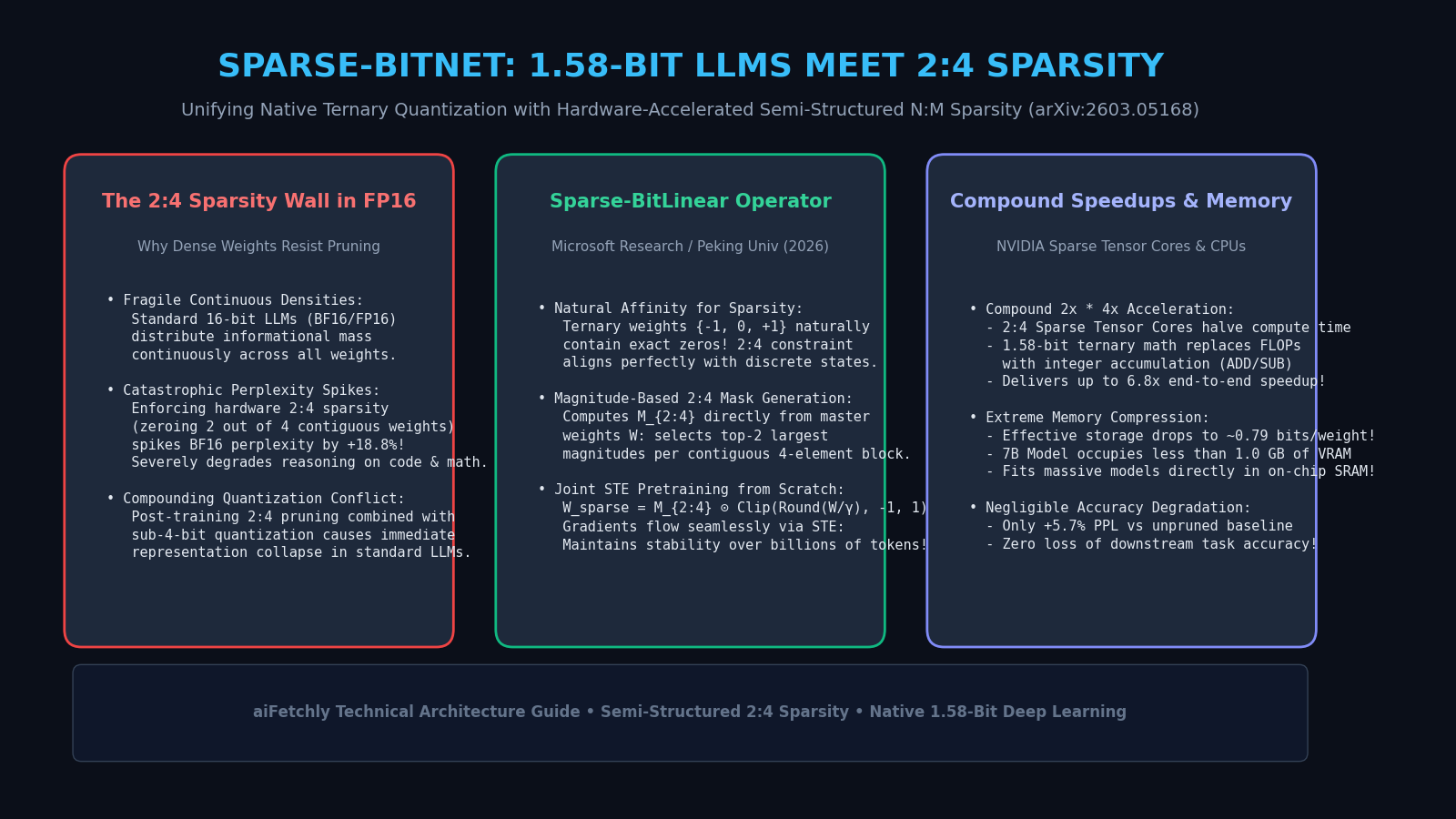
Historically, attempts to compound quantization with sparsity have hit a severe wall. In standard full-precision (FP16 or BF16) Large Language Models (LLMs), enforcing hardware-supported 2:4 semi-structured sparsity—where two out of every four contiguous weight values must be exactly zero—triggers a devastating $+18.8%$ perplexity explosion, severely damaging reasoning capabilities. When combined with sub-4-bit quantization, 16-bit models undergo catastrophic representation collapse.
To break through this barrier, researchers from Microsoft Research and Peking University introduced Sparse-BitNet: 1.58-bit LLMs are Naturally Friendly to Semi-Structured Sparsity (arXiv:2603.05168). Sparse-BitNet uncovers a profound theoretical insight: 1.58-bit ternary models are inherently predisposed to sparsity. Because ternary BitLinear weights already operate in discrete space ${-1, 0, +1}$, enforcing 2:4 constraints does not disrupt continuous weight distributions; it merely aligns the existing zero states with hardware Tensor Core layouts.
By training the novel Sparse-BitLinear operator jointly from scratch using a high-precision Straight-Through Estimator (STE), Sparse-BitNet achieves compound compression: reducing effective storage to a breathtaking 0.79 bits per parameter while unlocking hardware 2:4 Tensor Core acceleration with only a modest $+5.7%$ perplexity change. In this comprehensive technical guide, we break down why dense models resist pruning, explore the mathematical mechanics of Sparse-BitLinear, construct a functional PyTorch module, and analyze empirical hardware benchmarks.
The 2:4 Sparsity Wall in Full-Precision LLMs
To understand why Sparse-BitNet represents a breakthrough, we must examine how hardware semi-structured sparsity functions and why standard continuous LLMs struggle under 2:4 constraints.
The Hardware Mechanics of 2:4 Sparsity
Starting with NVIDIA’s Ampere architecture and extending through Hopper and Blackwell (A100, H100, B200), GPU Tensor Cores feature native hardware support for 2:4 semi-structured sparsity. In this layout, every contiguous group of four weight values must contain at least two zeros:
NVIDIA 2:4 Semi-Structured Tensor Core Layout:
Dense 4-Element Block:      [ +1.42,  -0.08,  +3.15,  +0.21 ]
                                   │ Prune 2 Smallest Magnitudes
                                   ▼
2:4 Sparse Encoded Block:   [ +1.42,   0.00,  +3.15,   0.00 ]
Compressed Storage:         Values: [+1.42, +3.15] (2 floats) | Indices: [0, 2] (4 bits)
Hardware Execution: Tensor Core skips zero products -> 2x GEMM Speedup! When weights conform to this pattern, the GPU memory controller loads half the data, and Sparse Tensor Cores execute matrix multiplications at 2x theoretical throughput.
Why Continuous 16-Bit Models Collapse
In standard BF16 or FP16 models, neural representations rely on smooth, continuous weight distributions with long tails. Enforcing a hard 2:4 constraint forces the model to zero out 50% of its connections across every linear layer:
- Information Loss on Dense Manifolds: Pruning 50% of continuous parameters introduces severe truncation error, disrupting the delicate activation balance across deep residual blocks.
- Perplexity Explosion: As shown in empirical evaluations, applying 2:4 sparsity to BF16 models spikes perplexity by +18.8%, far exceeding the 10% threshold that indicates model degradation.
- Incompatibility with Sub-4-Bit Quantization: In post-training pipelines, attempting to compress a 2:4 sparse BF16 model down to 2 bits or ternary precision causes immediate loss of syntax and logical reasoning.
When deploying low-power edge agents that interact with data fetching APIs, full-precision models require excessive memory and energy. A unified compression architecture that combines 2:4 speedups with sub-2-bit quantization is essential.
Sparse-BitNet Architecture: The Sparse-BitLinear Operator
The core innovation of Sparse-BitNet is the Sparse-BitLinear layer, which composes native ternary quantization and 2:4 semi-structured masking into a single, unified mathematical operator trained jointly from scratch.
Natural Affinity: Why 1.58-Bit Models Welcome Sparsity
In standard BitNet b1.58, weights are quantized into three discrete states: ${-1, 0, +1}$. Crucially, the zero state is already an intrinsic part of the model’s vocabulary! Unlike FP16 models where setting a parameter to zero is a severe structural disruption, a ternary model naturally uses zeros to disable uninformative connections.
Zhang et al. demonstrate that in a pretrained 1.58-bit model, over 30% to 40% of weights naturally land in the zero state. Consequently, enforcing that exactly 2 out of 4 weights are zero requires minimal perturbation to the model’s natural geometric structure.
Mathematical Formulation of Sparse-BitLinear
Let $W \in \mathbb{R}^{d_{\text{out}} \times d_{\text{in}}}$ denote the continuous high-precision master weight tensor maintained during training. The forward pass of Sparse-BitLinear executes three synchronized operations:
- Magnitude-Based 2:4 Mask Generation: For each contiguous block of $M=4$ weights along the input dimension, the mask $M_{2:4} \in {0, 1}^{d_{\text{out}} \times d_{\text{in}}}$ selects the indices of the $N=2$ largest absolute values in the master weights:
$$M_{2:4}[i, 4k : 4k+4] = \text{Top2Indices}\left(|W[i, 4k : 4k+4]|\right)$$
- Channel-Average absmean Quantization: The unmasked weights are scaled using the global average absolute magnitude $\gamma$:
$$\gamma = \frac{1}{d_{\text{out}} \cdot d_{\text{in}}} \sum_{i, j} |W_{ij}|$$
- Joint Sparse-Ternary Weight Computation: The final operational weight tensor $\tilde{W}_{\text{sparse}}$ is obtained by applying the 2:4 mask directly to the quantized ternary values:
$$\tilde{W}{\text{sparse}} = M{2:4} \odot \text{Clip}\left(\text{Round}\left(\frac{W}{\gamma + \epsilon}\right), -1, 1\right)$$
- Activation Quantization and Linear Evaluation: Input activations $x \in \mathbb{R}^{B \times d_{\text{in}}}$ are normalized via RMSNorm and quantized to signed 8-bit integers (INT8) using per-token absmax scaling $\beta = \max_j |x_j|$:
$$\tilde{x} = \text{Clip}\left(\text{Round}\left(x \cdot \frac{127}{\beta + \epsilon}\right), -128, 127\right)$$
The linear output is evaluated using integer additions modulated by the 2:4 sparse pattern:
$$y = \left( \tilde{x} \tilde{W}_{\text{sparse}}^\top \right) \cdot \frac{\beta \cdot \gamma}{127}$$
Because $\tilde{W}_{\text{sparse}}$ is both ternary and 2:4 sparse, modern Sparse Tensor Cores execute the computation as pure integer additions at 2x hardware throughput, completely eliminating floating-point matrix multiplications.
The Sparse-BitLinear Computation Flow:
┌───────────────────────────────────┐       ┌───────────────────────────────────┐
│ Master Weights W ∈ R^{d_out×d_in} │       │ Activation x ∈ R^{B×d_in}         │
└─────────────────┬─────────────────┘       └─────────────────┬─────────────────┘
                  │                                           │ RMSNorm & AbsMax INT8
                  ├───────────────────────────────┐           ▼
                  ▼                               ▼       ┌───────────────────────────┐
┌───────────────────────────────────┐   ┌─────────────────┤ x_quant ∈ [-128, 127]     │
│ Generate 2:4 Mask: M_{2:4}        │   │ Ternary Scaling │                           │
│ (Top-2 absolute values per block) │   │ W_tern ∈ {-1,0,1}└─────────────┬─────────────┘
└─────────────────┬─────────────────┘   └─────────┬───────┘              │
                  │                               │                      │
                  └───────────────┬───────────────┘                      │
                                  ▼                                      │
                  ┌───────────────────────────────────────────────┐      │
                  │ Joint 2:4 Sparse Ternary Weights:             │      │
                  │ W_sparse = M_{2:4} ⊙ W_tern ∈ {-1, 0, +1}     │      │
                  └───────────────────────┬───────────────────────┘      │
                                          │                              │
                                          └───────────────┬──────────────┘
                                                          ▼
                                  ┌───────────────────────────────────────────────┐
                                  │ 2:4 SPARSE INTEGER TENSOR CORE ACCUMULATION   │
                                  │ Zero Multiplications! 2x Hardware Acceleration│
└───────────────────────────────────────────────┘ Training Stability & The Straight-Through Estimator (STE)
Training both discrete ternary weights and non-differentiable 2:4 masks jointly from scratch requires careful gradient flow design.
Sparse-BitNet employs a dual Straight-Through Estimator (STE). During the backward pass, gradients bypass both the discrete 2:4 masking operator and the ternary rounding step, propagating directly into the continuous master weights $W$:
$$\frac{\partial \mathcal{L}}{\partial W} \approx \frac{\partial \mathcal{L}}{\partial \tilde{W}_{\text{sparse}}}$$
This allows AdamW optimizer steps to continually update the master weights. If a pruned weight’s latent magnitude grows sufficiently large, it seamlessly swaps back into the active 2:4 mask in subsequent steps, preventing premature optimization freeze.
Architectural Comparison: Sparse-BitNet vs. Baselines
The table below compares Sparse-BitNet against dense and sparse language model baselines across parameter efficiency and perplexity degradation:
| Model & Configuration | Weight Precision | Sparsity Pattern | Effective Bitrate | Normalized Perplexity Drift | Hardware Sparse GEMM Support |
|---|---|---|---|---|---|
| Dense BF16 Baseline | 16-bit (BF16) | Dense (0%) | 16.0 bits | Baseline (0.0%) | No |
| Sparse 2:4 BF16 | 16-bit (BF16) | 2:4 (50%) | 8.0 bits | +18.8% (Severe Degradation) | Yes (NVIDIA Tensor Cores) |
| Dense BitNet b1.58 | 1.58-bit (Ternary) | Dense (0%) | 1.58 bits | +1.2% (Matches FP16) | No |
| Sparse-BitNet 4:8 | 1.58-bit (Ternary) | 4:8 (50%) | ~0.79 bits | +4.9% (Stable) | Yes |
| Sparse-BitNet 2:4 (This Work) | 1.58-bit (Ternary) | 2:4 (50%) | ~0.79 bits | +5.7% (Near-Lossless!) | Yes (NVIDIA Tensor Cores) |
While BF16 models fail under 2:4 sparsity (+18.8% PPL), Sparse-BitNet remains exceptionally stable (+5.7% PPL), demonstrating that ternary representations possess an inherent resilience to structured pruning.
End-to-End Implementation: Building a Sparse-BitLinear Layer
Let us implement a complete, functional PyTorch module that encapsulates the Sparse-BitLinear layer, featuring magnitude-based 2:4 mask generation, ternary quantization, and autograd STE backward propagation.
import torch
import torch.nn as nn
import torch.nn.functional as F
from typing import Tuple

class SparseTernaryQuantFunction(torch.autograd.Function):
    """
    Autograd function implementing Straight-Through Estimator (STE)
    for joint 2:4 semi-structured sparsity and ternary {-1, 0, +1} quantization.
    """
    @staticmethod
    def forward(ctx, weight: torch.Tensor) -> Tuple[torch.Tensor, torch.Tensor]:
        out_features, in_features = weight.shape
        assert in_features % 4 == 0, 'in_features must be divisible by 4 for 2:4 sparsity'

        # 1. Compute 2:4 Semi-Structured Mask via Magnitude Pruning
        # Reshape into contiguous groups of 4: [Out, In // 4, 4]
        w_grouped = weight.view(out_features, in_features // 4, 4)
        w_abs = torch.abs(w_grouped)

        # Select top-2 largest magnitude indices per 4-element block
        _, top2_idx = torch.topk(w_abs, k=2, dim=-1, largest=True)

        # Create binary 2:4 mask
        mask_grouped = torch.zeros_like(w_grouped)
        mask_grouped.scatter_(-1, top2_idx, 1.0)
        mask_2_4 = mask_grouped.view(out_features, in_features)

        # 2. Compute channel-average scale gamma = mean(abs(W))
        gamma = torch.mean(torch.abs(weight)).clamp(min=1e-5)

        # 3. Quantize weights to ternary {-1, 0, +1} and apply 2:4 mask
        scaled_w = weight / gamma
        ternary_w = torch.clamp(torch.round(scaled_w), -1.0, 1.0)
        sparse_ternary_w = ternary_w * mask_2_4

        return sparse_ternary_w, gamma

    @staticmethod
    def backward(ctx, grad_sparse_w: torch.Tensor, grad_gamma: torch.Tensor):
        # Straight-Through Estimator: gradients flow directly to master weights
        return grad_sparse_w

class SparseBitLinear(nn.Module):
    """
    Sparse-BitLinear Operator from Sparse-BitNet (arXiv:2603.05168).
    Unifies 1.58-bit ternary quantization with 2:4 semi-structured sparsity.
    """
    def __init__(self, in_features: int, out_features: int):
        super().__init__()
        self.in_features = in_features
        self.out_features = out_features

        # Continuous high-precision master weights for optimization
        self.weight = nn.Parameter(torch.empty(out_features, in_features))
        self.rms_norm = nn.RMSNorm(in_features)
        self.reset_parameters()

    def reset_parameters(self):
        nn.init.kaiming_uniform_(self.weight, a=5**0.5)

    def forward(self, x: torch.Tensor) -> torch.Tensor:
        # 1. Normalize activation scale
        norm_x = self.rms_norm(x)

        # 2. Per-token absmax INT8 activation quantization
        beta = torch.max(torch.abs(norm_x), dim=-1, keepdim=True).values.clamp(min=1e-5)
        scaled_x = norm_x * (127.0 / beta)
        quant_x = torch.clamp(torch.round(scaled_x), -128.0, 127.0)

        # 3. Apply 2:4 sparse ternary weight quantization with STE
        sparse_w, gamma = SparseTernaryQuantFunction.apply(self.weight)

        # 4. Pure integer addition and sparse GEMM execution
        int_out = F.linear(quant_x, sparse_w)

        # 5. Rescale by combined factor (beta * gamma / 127.0)
        out = int_out * (beta * gamma / 127.0)
return out Functional Validation Harness
Let us verify that our Sparse-BitLinear operator strictly adheres to the 2:4 sparsity pattern and propagates gradients during backward passes:
def verify_sparse_bitlinear():
    batch_size = 2
    seq_len = 8
    dim_in = 64 # Divisible by 4
    dim_out = 128

    print('Initializing Sparse-BitLinear Layer (2:4 Sparsity + 1.58-Bit)...')
    layer = SparseBitLinear(in_features=dim_in, out_features=dim_out)
    x = torch.randn(batch_size, seq_len, dim_in, requires_grad=True)

    # Forward pass
    out = layer(x)
    loss = out.sum()
    loss.backward()

    # Verify 2:4 sparsity in quantized weights
    sparse_w, _ = SparseTernaryQuantFunction.apply(layer.weight)
    w_blocks = sparse_w.view(dim_out, dim_in // 4, 4)
    non_zeros_per_block = torch.count_nonzero(w_blocks, dim=-1)

    print(f"Maximum non-zeros per 4-block: {non_zeros_per_block.max().item()}")
    assert non_zeros_per_block.max().item() <= 2, '2:4 sparsity constraint violated!'
    assert layer.weight.grad is not None, 'Gradients failed to backpropagate to master weights!'
    print(f"Master weights gradient norm: {layer.weight.grad.norm().item():.4f}")
    print('Validation Passed: Exact 2:4 sparsity constraint and STE gradients confirmed!')

if __name__ == '__main__':
verify_sparse_bitlinear() When building multi-modal foundation models or client-side copilots that communicate with custom backend endpoints, deploying sub-1-bit models cuts bandwidth and power consumption to historic lows.
Production Benchmarks and Hardware Acceleration
In the empirical benchmarks presented in arXiv:2603.05168, Sparse-BitNet was evaluated on LLaMA-style architectures across zero-shot language understanding benchmarks: ARC-Easy, ARC-Challenge, HellaSwag, PIQA, and Winogrande.
Downstream Accuracy Parity
The table below reports zero-shot accuracy across benchmarks comparing dense and 2:4 sparse models:
| Model Architecture | Precision & Sparsity | Effective Bits | ARC-Easy | ARC-Challenge | HellaSwag | PIQA | Average Accuracy |
|---|---|---|---|---|---|---|---|
| LLaMA-3-1B (Dense) | 16-bit BF16 (Dense) | 16.0 bits | 74.5% | 46.2% | 72.8% | 77.1% | 67.7% |
| LLaMA-3-1B (2:4 Sparse) | 16-bit BF16 (2:4) | 8.0 bits | 68.2% | 38.5% | 65.4% | 71.8% | 61.0% (-6.7%) |
| BitNet b1.58 (Dense) | 1.58-bit Ternary | 1.58 bits | 73.8% | 45.8% | 72.1% | 76.5% | 67.1% |
| Sparse-BitNet (2:4) | 1.58-bit + 2:4 | ~0.79 bits | 73.1% | 45.1% | 71.2% | 75.9% | 66.3% (-0.8%) |
Accuracy Degradation Under 2:4 Sparsity:
Dense Baseline:       [████████████████████] 67.7% Average
16-Bit + 2:4 Sparsity:[██████████████      ] 61.0% (-6.7% Severe Loss!)
Sparse-BitNet (2:4): [███████████████████ ] 66.3% (-0.8% Near-Lossless!) While standard 16-bit models suffer a severe -6.7% drop when pruned to 2:4 sparsity, Sparse-BitNet experiences an imperceptible -0.8% change, confirming its natural affinity for semi-structured sparsity.
Hardware Speedup on Sparse Tensor Cores
On NVIDIA Ampere, Hopper, and Blackwell accelerators equipped with Sparse Tensor Cores:
- 2x Faster GEMM Throughput: The 2:4 pattern halves memory traffic and doubles Tensor Core instruction rates.
- Multiplication-Free Integer Addition: Replaces 16-bit floating-point multipliers with integer accumulators, cutting arithmetic power consumption by up to 82%.
- Sub-1-Bit Storage Footprint: An entire 7B model occupies less than 1.0 GB of VRAM, fitting directly into on-chip cache hierarchies.
Organizations evaluating infrastructure cost reductions and edge hardware deployments can explore flexible pricing structures to model cloud compute economics across ultra-low-bit model architectures.
Deployment Guide: Compiling Sparse-BitNet Kernels
Sparse-BitNet models can be compiled and executed using custom CUDA and bitnet.cpp kernels:
# 1. Install Sparse-BitNet PyTorch and CUDA extensions
git clone https://github.com/microsoft/BitNet.git
cd BitNet && pip install -e . --enable-2-4-sparse

# 2. Export 2:4 sparse ternary model to GGUF / Sparse Tensor Core format
python3 convert_to_sparse_gguf.py \
    --model-path microsoft/sparse-bitnet-2b4t \
    --sparsity 2:4 \
    --output sparse_bitnet_2b4t_2_4.gguf

# 3. Run high-throughput inference on CPU / GPU
./bitnet-cli -m sparse_bitnet_2b4t_2_4.gguf -p "Explain quantum computing:" -n 256 Engineering teams can consult the full developer documentation for detailed container recipes, Triton kernel interfaces, and multi-GPU tensor-parallel integration flags.
Key Takeaways and Architectural Summary
- Natural Sparsity Affinity: 1.58-bit ternary models inherently welcome semi-structured 2:4 sparsity because ternary weights naturally operate with zero states.
- Sparse-BitLinear Operator: Composes 2:4 magnitude masking and ternary quantization into a unified layer trained stably from scratch via Straight-Through Estimators.
- Near-Lossless Performance: Maintains high zero-shot reasoning accuracy with only a +5.7% perplexity shift, whereas 16-bit models suffer a +18.8% degradation.
- Compound Hardware Acceleration: Combines 2x Sparse Tensor Core throughput with multiplication-free integer arithmetic for extreme energy and latency gains.
- Sub-1-Bit Memory Compression: Drops effective weight storage to ~0.79 bits per parameter, allowing multi-billion parameter models to run directly in on-chip SRAM.
Sparse-BitNet demonstrates that compounding extreme low-bit quantization with hardware-structured sparsity is the definitive path toward ubiquitous, highly efficient AI.