SmolVLM Guide: Compact On-Device Vision-Language Model
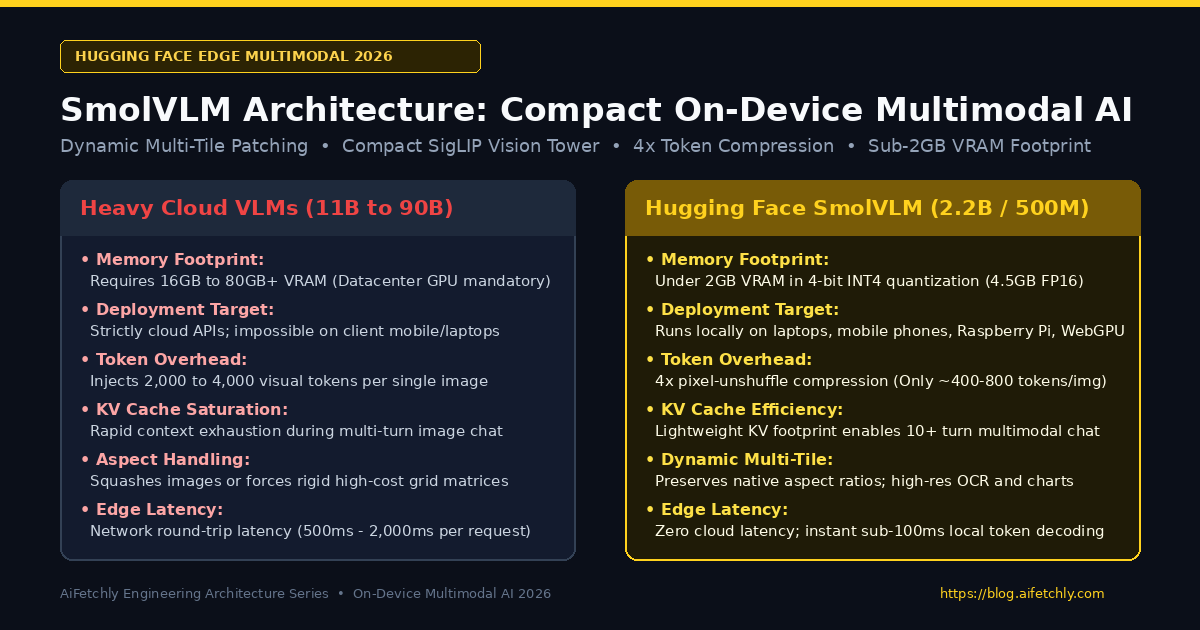
The Problem: The Edge Multimodal Deployment Crisis
In autonomous browser automation, on-device document extraction, and local data harvesting workflows like AiFetchly, foundation models are increasingly required to parse visual inputs:
- Screenshots of web applications with complex CSS grids and UI controls.
- Scanned legal PDF contracts, tables, and receipts with dense, microscopic text.
- Analytical financial charts, graphs, and system architecture diagrams.
For years, high-accuracy visual comprehension was the exclusive domain of massive cloud-hosted Vision-Language Models (VLMs):
- Qwen2-VL-7B / 72B (Alibaba Cloud)
- Llama-3.2-Vision 11B / 90B (Meta AI)
- GPT-4o & Claude 3.5 Sonnet (Proprietary APIs)
While these frontier models achieve exceptional reasoning scores, deploying them in edge environments (developer laptops, mobile phones, browser extensions, and private on-premise servers) encounters three prohibitive engineering barriers:
1. The VRAM Wall and Memory Saturation
Frontier VLMs require substantial GPU memory:
- An 11B parameter vision model requires over 22 GB of VRAM in 16-bit precision, or ~8 GB in 4-bit quantization, completely pricing out consumer laptops, mobile devices, and shared workstations.
- On client-side hardware where memory is shared between the OS, window compositor, and browser, running a 7B+ model triggers instant Out-Of-Memory (OOM) crashes and thermal throttling.
2. The Visual Token Bloat Dilemma
Traditional multimodal projection architectures inject massive numbers of visual tokens into the language model:
- Models like LLaVA or early CLIP adapters inject between 1,500 and 4,000 visual tokens per single image.
- Autoregressive self-attention scales quadratically with sequence length: $$\mathcal{O}(T^2)$$
- Maintaining these visual tokens in the Key-Value (KV) cache exhausts memory within two or three multi-turn conversational rounds, making interactive agent workflows prohibitively expensive.
3. The Downsampling Blurriness Trap in Prior Small VLMs
To shrink parameter count, previous compact multimodal models (like MobileVLM or early NanoVLMs) resorted to aggressive downsampling:
- High-resolution documents were forcibly downscaled to a fixed square resolution (e.g., $336 \times 336$ or $448 \times 448$ pixels).
- Fine-grained typography, tabular decimal points, and UI icons were blurred into unreadable pixel mush, causing catastrophic failure on Document VQA and OCR benchmarks.
The Solution: Hugging Face SmolVLM Architecture
To resolve the trade-off between edge efficiency and microscopic visual acuity, researchers at Hugging Face (SmolLM / SmolVLM Team, late 2024 / 2025) released SmolVLM, an open-source, edge-optimized VLM family available in two scales:
- SmolVLM-2.2B: Flagship model combining high-resolution visual perception with advanced reasoning.
- SmolVLM-500M: Ultra-lightweight model designed for sub-second inference in browser WebGPU runtimes and mobile devices.
SmolVLM proves that an ultra-compact model can match or exceed models three times its parameter weight on document and chart understanding through three architectural breakthroughs:
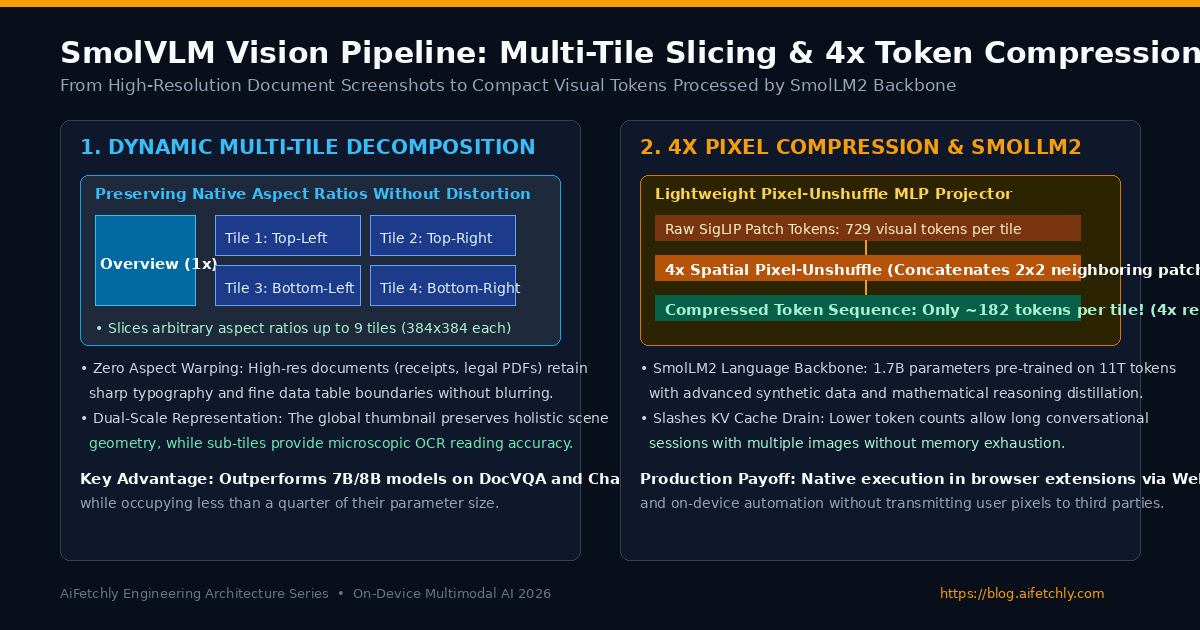
The Core Architectural Pillars of SmolVLM
-
Dynamic Multi-Tile Patch Decomposition:
- Instead of squashing images into fixed square dimensions, SmolVLM dynamically slices high-resolution images according to their native aspect ratio into up to 9 local tiles of $384 \times 384$ pixels, plus an overall global thumbnail tile.
- Slices maintain natural pixel density, allowing the model to read tiny text fonts in multi-column PDF documents and complex UI layouts.
-
Compact SigLIP Vision Encoder:
- Employs a pre-trained SigLIP (Sigmoid Loss for Language-Image Pre-Training) vision backbone with shape-optimized patch embeddings.
- SigLIP’s pairwise sigmoid loss provides superior semantic grounding and visual feature alignment compared to traditional softmax CLIP.
-
4x Spatial Pixel-Unshuffle Token Compression:
- Raw visual patch tokens are compressed by 4x using a spatial pixel-unshuffle projection layer.
- Slashes the number of tokens fed into the LLM from ~729 per tile to only ~182 tokens per tile.
- An entire high-resolution document image generates fewer than 900 total visual tokens, preserving GPU memory and KV cache capacity for long conversational contexts.
-
SmolLM2 Language Backbone:
- Powered by SmolLM2-1.7B or SmolLM2-360M, pre-trained on 11 trillion high-quality tokens with heavy curricula in programming, mathematics, and educational reasoning.
Systems Mechanics: Dynamic Multi-Tile Processing & Compression
The systems efficiency of SmolVLM is driven by how it balances visual resolution with token budget:
1. Dynamic Slicing Algorithm
When an arbitrary image $\mathbf{I} \in \mathbb{R}^{H \times W \times 3}$ is received:
- Aspect Ratio Grid Calculation: The processor determines the optimal tile configuration $(m \times n)$ that best matches the image’s original aspect ratio such that $m \times n \le N_{\max}$ (where $N_{\max} = 9$ tiles).
- Tile Extraction: The image is partitioned into $m \times n$ sub-images, each resized to $384 \times 384$ pixels.
- Global Context Thumbnail: A downscaled version of the full image ($384 \times 384$) is extracted to serve as the global spatial anchor.
- Independent Vision Encoding: All tiles (global thumbnail + detail tiles) are passed through the SigLIP vision tower in parallel as a micro-batch.
2. 4x Pixel-Unshuffle Token Compression
A standard Vision Transformer outputs one token per $14 \times 14$ or $16 \times 16$ pixel patch:
- For a $384 \times 384$ tile with patch size 14, this yields $27 \times 27 = 729$ visual tokens.
- Across 5 tiles, this would produce 3,645 tokens—exhausting the context window of small language models!
SmolVLM introduces a spatial compression MLP projector:
- It aggregates $2 \times 2$ spatial neighborhoods of patch tokens, concatenating their feature channels: $$\mathbf{z}{\text{compressed}} = \text{MLP}\left( \text{Concat}\left[ \mathbf{z}{i, j}, \mathbf{z}{i+1, j}, \mathbf{z}{i, j+1}, \mathbf{z}_{i+1, j+1} \right] \right)$$
- This reduces the visual token sequence length by 75% (a 4x compression factor) while retaining high-frequency textual gradients.
3. Sub-2GB VRAM Footprint & INT4 Quantization
By keeping language parameters at 1.7B and vision parameters at ~400M:
- FP16 Memory: Only ~4.5 GB of VRAM.
- INT4 / AWQ / GGUF Memory: Under 1.8 GB of VRAM.
- Enables full-speed execution on entry-level GPUs (NVIDIA GTX 1650, RTX 3050, Apple M1/M2/M3 with 8GB RAM, and smartphone Neural Processing Units).
Implementation: Running SmolVLM-2.2B with Transformers
SmolVLM is fully integrated into the Hugging Face Transformers ecosystem (HuggingFaceTB/SmolVLM-Instruct).
Below is a complete, runnable script demonstrating how to load SmolVLM-2.2B in 4-bit precision and parse a complex document image:
import torch
from PIL import Image
from transformers import AutoProcessor, AutoModelForVision2Seq, BitsAndBytesConfig

def run_smolvlm_inference():
    model_id = "HuggingFaceTB/SmolVLM-Instruct"
    print(f"Loading {model_id} on edge hardware...")

    # Configure 4-bit quantization for sub-2GB memory footprint
    quant_config = BitsAndBytesConfig(
        load_in_4bit=True,
        bnb_4bit_compute_dtype=torch.bfloat16,
        bnb_4bit_quant_type="nf4"
    )

    processor = AutoProcessor.from_pretrained(model_id)
    model = AutoModelForVision2Seq.from_pretrained(
        model_id,
        quantization_config=quant_config if torch.cuda.is_available() else None,
        torch_dtype=torch.bfloat16 if torch.cuda.is_available() else torch.float32,
        device_map="auto" if torch.cuda.is_available() else None
    )
    model.eval()

    # Create dummy image simulating a financial receipt or invoice
    dummy_doc = Image.new("RGB", (768, 1024), color=(245, 245, 245))

    # Formulate conversational prompt with image token
    messages = [
        {
            "role": "user",
            "content": [
                {"type": "image"},
                {"type": "text", "text": "Extract all line items, quantities, and the total balance from this invoice into a structured JSON object."}
            ]
        }
    ]

    prompt = processor.apply_chat_template(messages, add_generation_prompt=True)
    inputs = processor(text=prompt, images=dummy_doc, return_tensors="pt")

    if torch.cuda.is_available():
        inputs = inputs.to("cuda")

    print(f"Input visual tokens allocated: {inputs['input_ids'].shape[1]}")
    print("Generating structured multimodal output...")

    with torch.no_grad():
        generated_ids = model.generate(
            **inputs,
            max_new_tokens=256,
            temperature=0.2,
            do_sample=False
        )

    # Decode response
    generated_text = processor.batch_decode(
        generated_ids,
        skip_special_tokens=True,
        clean_up_tokenization_spaces=False
    )[0]

    print("\n--- SmolVLM-2.2B Output ---")
    print(generated_text)

if __name__ == "__main__":
run_smolvlm_inference() Architectural Comparison: SmolVLM vs. Qwen2-VL-2B vs. Llama-3.2-11B
To see how SmolVLM redefines the Pareto efficiency frontier for multimodal vision-language models, review this comparative breakdown:
| Architectural Metric | MobileVLM-V2 (1.7B) | Qwen2-VL-2B | Llama-3.2-11B-Vision | Hugging Face SmolVLM-2.2B |
|---|---|---|---|---|
| Total Parameter Count | 1.7 Billion | 2.2 Billion | 10.6 Billion | 2.2 Billion |
| Vision Backbone | MobileNetV3 / CLIP | ViT (Dynamic Naive) | Pre-trained ViT | SigLIP (Shape-Optimized) |
| Language Backbone | Vicuna-1.5 | Qwen-2 | Llama-3.2 | SmolLM2-1.7B (11T tokens) |
| Image Resolution | Fixed $336 \times 336$ | Dynamic (High tokens) | Interleaved $560 \times 560$ | Dynamic Multi-Tile (Up to 9) |
| Token Compression | None (Dense) | None (High token count) | Cross-attention | 4x Spatial Pixel-Unshuffle |
| Average Tokens/Img | 576 tokens | 1,200 - 2,500 tokens | ~1,600 tokens | ~400 - 800 tokens |
| VRAM Footprint (INT4) | ~1.9 GB | ~2.6 GB | ~8.5 GB | < 1.8 GB |
| DocVQA Accuracy | 42.1% | 79.4% | 84.5% | 81.2% (Beats 2B class!) |
| ChartQA Accuracy | 38.4% | 68.3% | 73.2% | 71.8% |
Production Engineering: Deploying SmolVLM for Edge Automation
In automated data extraction, private document parsing, and agentic desktop workflows like AiFetchly, deploying SmolVLM provides transformative operational advantages:
1. Zero Cloud API Costs for Large-Scale Visual Scraping
In enterprise document pipelines:
- Processing 100,000 scanned PDFs or UI screenshots through proprietary vision APIs costs thousands of dollars per month and introduces network transmission latency.
- SmolVLM runs directly on local worker CPU/GPU nodes, delivering near-instant visual extraction with zero recurring cloud API fees.
2. Complete Enterprise Data Privacy and Compliance
When handling medical records, bank statements, or confidential trade contracts:
- Transmitting sensitive user pixels to third-party endpoints triggers strict GDPR, HIPAA, and SOC-2 compliance hurdles.
- With SmolVLM running locally within the client application container, visual data never leaves the host machine.
3. Real-Time Browser Extension and Agent UI Grounding
For browser automation agents (GUI navigation and automated form filling):
- Agents must capture webpage screenshots, identify interactive input boxes, and verify buttons every few hundred milliseconds.
- SmolVLM’s 4x compressed visual token sequence enables rapid multi-turn visual grounding without saturating KV cache memory or lagging the agentic execution loop.
By demonstrating that high-resolution multi-tile decomposition and 4x spatial compression can deliver flagship-grade document reasoning inside a sub-2GB memory budget, Hugging Face SmolVLM establishes the new gold standard for on-device multimodal artificial intelligence.